Report from Santa Fe; Louis Caldera
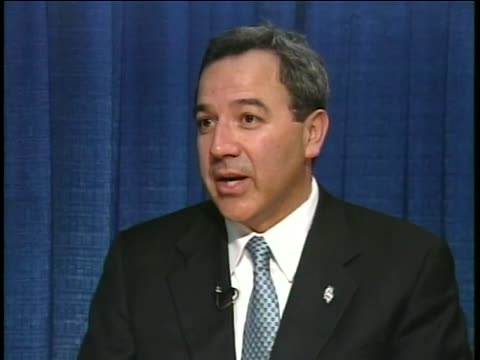
- Transcript
NU Microsoft MetRA Report from Santa Fe is made possible in part by grants from New Mexico Tech, on the frontier of science and engineering education. For bachelor's, master's and PhD degrees, New Mexico Tech is the college you've been looking for, 1-800-428-TECH. Our guest today is Lewis Caldera, the president of the University of New Mexico. Welcome. Thank you, Lorraine. Well, I'm delighted to have you here. And as I was researching, your background is extraordinary. Let's just take a little minute to talk about the three things that leaped out for me was that you were Secretary of the Army under Clinton, West Point, that you had worked with a California State University system that's a huge system. And in between that, you were doing volunteer service programs like AmeriCare's and the Senior Service Corps.
And you've taken all this vast experience and brought it to UNM to be the president of UNM. Talk a little about your background. Thanks. Well, you know, my parents were immigrants from Mexico, I was born in El Paso. I really grew up with a family that really stretched patriotism, education, family, community, and to give something back. So I always wanted to be in public service, and that's why I went to West Point, served in the Army, got law degree MBA from Harvard, and then went to the legislature in California from there to the Clinton administration, and after the Clinton administration wanted to go into higher education. And even when I was Secretary of the Army, I worked a lot on creating educational programs for soldiers and their families. So we created an online education program. That featured a kind of distance learning for the soldiers. Absolutely, because I wanted the soldiers to leave the Army with more than the pride of having served, but with marketable skills, with degrees, ready to go back and integrate themselves into society.
And that led to work with Dick Riley, then Secretary of Education, and to working at the California State University System, and then here to New Mexico. Now I read an address that you gave to an incoming class of freshmen, and you quoted the German philosopher Gute, who said, dream no small dreams, for they have no power to move the hearts of men. What is your vision for UNM? What is your big dream? Well, I want the University of New Mexico to make a very positive difference in the life of every New Mexican, whether it's through education that we provide to the students, the young people of New Mexico, whether it's through the research that we do that is trying to improve health care outcomes for people throughout the state, or the part of our scientific research that is helping to create a, what it's called, the Knowledge Based Economy in New Mexico, helping to create that new economy that's based on advances in material science and in physics, and in information technology and nanotechnology, nanotechnology, biomech, engineering, all of those kinds of disciplines, I think could
revolutionize the kind of economy that we have in New Mexico, and it's part of US global economic competitiveness that we invest and be very good in our research universities. We also, we touch people through our public service mission, which includes things like patient care at University Hospital, but other ways in which we reach out throughout the state, our work with K-12 schools is very important to improving educational outcomes for New Mexico students, and one of my passions, public policy is, can we use the power of the university to help address the most pressing questions that we have, whether it's in air quality, water quality, and availability, economic development, whatever those issues are, does the university, its faculty, its students have something to add to make our public policy choices the best that they can be? Well, that was one part that really, that has really fascinated me, that you would like
to see the role of UNM as helping facilitate and convene public policy discussions. Yes. So, and you do that through your media outlets, like the television and K-U-N-M and K-N-E, and the whole statewide PBS, but you also bring in speakers, don't you, you bring in us, and we want to do it through the work of institutes like our public law institute, health care public policy, a group that we have, our School of Public Administration, the Bureau of Business and Economic Research. These are, you know, we have a lot of faculty and expertise in areas that are of great importance to the state. And so, we want to use the work of our faculty, not just to write books for faculty members at other universities and around the world, but in ways that are really going to make a difference for New Mexico. So, it's not just public, it's your parish, but it might be pronounced. Yes.
Well, it's a funificate and proclaim. I think the university is the most relevant to the state if the work that our faculty is doing makes a difference to the people of the state of New Mexico. So, how do we use the power of all of those faculty members and graduate students in the work that they're doing to make a difference right here at home? That's really what I'm talking about, so that the work isn't divorced from the challenges that we have here. So that you would have symposia, you'd have workshops and invite the public and... Absolutely, and things like our School of Architecture and Planning actually works with communities as they think about local planning issues and about economic development, even about preserving their heritage in some of the older parts of our cities and towns. So there's lots of ways in which the work of the faculty can be used to make outreach to local communities throughout the state to make a difference there.
Well, certainly one of the most outstanding ways that the University of New Mexico affects the citizens of the state is through your hospital and through your research, let's talk about what's going on there because it's pretty amazing. Well, University Hospital is just phenomenal in the amount of care that it provides throughout the state. It's the state's only trauma-1 emergency center, and so we do the most airlift medevac of any hospital in the country because people from throughout the state are coming there every single day to have unique life-threatening challenges addressed. We're working on constructing a new wing to the hospital because one of our biggest challenges is capacity. As patient loads have increased, it's just having the space for both inpatient and outpatient and specialty care visits. So we're working on the Bill and Barbara Richardson Pavilion, which will be the wing that expands
the hospital, adds to our emergency room, to our neonated intensive care, and to certain other specialties where we just don't have enough beds right now for all the demand. But the hospital, the School of Medicine, of course, is the state's only School of Medicine and School of Pharmacy, and we also have a School of Nursing. Not only help to prepare pharmacists, nurses, and doctors for New Mexico, but support things such as a rural telehealth program and a local attendance program, which allows doctors who need to be able to leave their local offices throughout the year, either for vacations or for to attend medical conferences or for additional training. We'll send a doctor there to cover for their patients and cover for them for whatever period of time that requires. And you also get to take care of everyone with the kind of disease to sure, be it hunt
a virus or a West Nile, you have to be right on the cutting edge of public health. Yes, you know, in fact, hunt a virus was identified and isolated in the carriers in mice at through researchers at UNM, and that area actually has led to a specialty in infectious diseases that the University has recognized for. So we've also now done work on anthrax, done work on West Nile virus, some of the really leading cutting edge work in the country. The expertise in both infectious diseases and in genetics and in other areas are some of the strengths of the researchers at the University of Hospital and at the School of Medicine. And some of it is very, very much related to things that are very specific to populations in New Mexico. As we've had very stable populations and this tremendous diversity in our state, it's possible to go back and do work on specific kinds of cancers that are unique in terms of their incidences in New Mexico and to really gain insights and understandings that help
to fight cancer wherever occurs worldwide. So our cancer research treatment center we're very proud of, we're currently pursuing a designation as a cancer-1 comprehensive cancer center, which would be one of only 40 in the United States, which means that you can get the treatment for the most rare and forms of cancer. Today, New Mexico patients have to go to either Stanford or MD Anderson in Texas or Phoenix or the Mayo Clinic or somewhere else to be treated for those cancers. We'll be able to deliver that kind of care right here in New Mexico. Some of the other innovative things that you've been doing, I think quality undergraduate education is one of your missions and you've set up a freshman community system telling us about that. Well, we have a very large group of undergraduate students, of our 33,000 students, 25,000 are undergraduates, including on main campus and at our four branch campuses in Los
Salamos and in Gallup, Valencia, County, and Tauce, and so undergraduate education is very important and it's how I think we're known to most New Mexicans. How are you doing at undergraduate education? Are you equipping these students with the knowledge and skills that they're going to need to be able to compete in this fast-changing world? So to me, excellence in undergraduate education is something that a great university should always be pursuing. Because we have to educate a wide range of students in terms of their preparation and skills when they come to the university, we've really focused on not just how do we serve the best students through things like terrific honors programs and programs to involve them in research, but also how do we serve the students who are not as well prepared, how do we improve their educational outcomes, and things like freshman learning communities, which is a program of small seminar sections for students, have really helped to increase retention rates and graduation rates.
Another plan because your platform might be bolstering the research portfolio that the university has. You spoke about that earlier in terms of medicine, and how about some of the, your famous for nanotechnology, tell people what that is and what you're doing. Absolutely. Our research, we are a research university, today we're one of the top 50 in terms of the amount of external support for research, which is great company to be able to keep, but our research portfolio, our external funding for education and research has grown from less than 100 million to about 300 million in over the last five years. It's just tremendously good news. A lot of those are in cutting edge areas in science, technology, health, and other kinds of application in the physical and life sciences. So nanotechnology, which is really to understand and be able to build instruments and processes and separate proteins and fluids at the nano level, which is 100 molecule level.
So these are microscopic, almost infinitesimally small level to be working at, is an area that the university has a core strength in, including that we were asked to become part of the National Nanotechnology Infrastructure Network, and that was a grand competition of the best universities in the country, it includes MIT and Stanford and others. And we were selected as one of the places that is receiving investment to help develop these programs further. So that is usually independently funded from outside the university, and then of course the state provides money, and then the students provide money. But I understand you've been embarking on a new sort of self-funding initiative. Did that pass? I mean, this is very recent, and is anyone else doing it, and whose idea was this? Well, we are trying to do as much to help ourselves, because part of our challenge is to develop the resources that the university needs to be able to achieve the vision that we have.
And that means trying to maximize the resources from the state, from the federal government, from private donors, from corporations, foundations, alumni, and also be as efficient and good as stewards as the resources that we get from students and parents through tuition or how we do our own business processes. So we're looking at everything, because you have to invest to be able to reach the kind of level of excellence that we're trying to be able to pursue. And that includes that, for example, we've been getting about $10 million a year from the state on average for new construction for capital outlay, and sometimes for renovation of buildings that are very old and in need of renovation. But we looked at the challenges we have in outdated facilities and the need for new facilities because of the tremendous growth we've had in our enrollment in recent years.
And concluded that we really had to do more to help ourselves. So we are proposing $135 million bond, so we're going to be able to do in one year what would otherwise might take us 10, 12, 15 years to do to build a new Centennial Engineering Center that will have civil engineering and biomedical engineering and a number of the other engineering fields. We're going to renovate our biology space. Right now a lot of students are having trouble, and these are, you can imagine some of our best students who want to be doctors, who want to be scientists, trying to take biology courses. And the limitation on lab space, the antiquated facilities means they have a tremendous backlog and they can't get the classes that they need to graduate on time. So we're going to renovate and are proposing to completely modernize our biology buildings. We need a new education, buildings for our College of Education.
There's just a host of different projects around the campus that will improve the quality of education, research facilities, administrative and support space, all of the things that go into running a major university. I'd like to expand our horizons a little bit because the structure of higher ed is going to change since we now have authorized a new Cabinet Secretary level post of Cabinet Secretary for Higher Education. How do you think that we don't have the person yet, they're still in the search process? Do you think that will help integrate the higher education overall in the state with all this issues of so many universities with so many branches, and will it also get a more regular stream of, like you say, funding for the actual structures of the campuses that are so old? Well, we certainly hope and expect that the new Secretary will be a true, passionate advocate for higher education.
The part of the Governor's goal, we supported this legislation, is to have better coordination and integration of the different segments of higher education. Higher education has to work better with K-12 education, both because we prepare the teachers, but also so that students graduated from high school are prepared to do college level work. We also, we have our three segments, our community colleges, our comprehensive colleges that offer bachelor's and master's degree education, and our research universities that offer not just undergraduate education, but also professional law, business, medicine, architecture, and PhD level graduate education and research. All three have, are very important. They have different missions, different areas that they focus on, but it's very important that they work well together, so that a student who starts at a community college or at a comprehensive university can pursue graduate and professional education at a research university.
So, and so part of it is to eliminate the kind of duplication that is too expensive for a state like New Mexico, but have good, healthy competition in the sense that we all want to deliver excellent education to students and cooperation in the sense that students can move between the different systems, the different schools, as they work to achieve their educational goals. So, you have some branches in Dallas, Valencia, County, Gallup, and Los Alamos. So, a student could do maybe the first four years there, say they were pre-matter engineering, and then they would come where they would maybe do the first two years there, they might do one year, two years, they might get an associate there. In some cases, we are pushing out the undergraduate degrees through distance education and through some instruction in the branch campuses, and also at community colleges that are not branch campuses, so that they can earn degrees, not necessarily having to travel to main campus, but students certainly can start there, and we want them to, if their goal is to
earn a bachelor's degree, or a law degree, MD, or a graduate degree, that they would be able to transfer and finish their education at main campus. Now, some issues that have been in the news lately, besides the branch campus thing, bonuses for vice presidents, you got some plaque about that. Well, you know, there is, I think, a trend in higher education to have things like more performance-oriented compensation systems, so the real point is that it is performance-oriented, that we are a large complex organization, we are a one and a half billion dollar organization. So our senior administrative team, you want people who have the kinds of skills, experience, and vision dedication to be able to help the university achieve its goals. So in that senior administrative team, in order to really focus, what are the things
we are trying to achieve? So if we are trying to, for example, get more external research funding, our goals are going to be tied to the level of funding that we are able to attract. If we are trying to raise more money from fund raising from individuals and foundations and others, the goals are going to be tied to raising more money. So these are all individuals whose work makes a huge difference in terms of the success of the university. On the academic side, the goals are going to be tied to graduation rates and to retention rates, and what you are trying to do is reward people for performance. Now what it allows us to do is, because the goal is always attract and retain the best people, and higher education is very competitive. So these people are in demand all over the country. My other universities who also want to be the very best and to improve their performance. And I think it both helps us attract and retain the best people, but also most importantly
focus us on performance, not just wanting to be the best, but doing the things it takes to be the best. So it's bringing some of the better elements of the business model in to keep your good people, to have performance appraisals and then reward them the people who have done the job. And that's why I think happening at universities throughout the country is, as they adopt business models, the do come from the private sector, and your bottom line isn't a private sector bottom line in terms of profit ability or return to shareholders. You have a much more complex bottom line because it's also about quality of patient care, quality of education, but part of it is gaining the resources we need to invest in the university to be able to do even more to improve education, research, and public service. I read over some of your, speaking of retention, because you've got to retain the individual
student, and some of your welcoming speeches to the new students, you actually have them say out loud, I'm going to finish this to me. So that's such an obvious step toward retention. Put it in their mind that they can do this and that you're going to help. Yes, and to really stay focused, that this is a very special time of your life. A lot of our students work, but I urge them to the extent that they can protect this time in your life, avoid work to the extent it is possible to do so. So you can really get the most out of it. Really put a lot of effort into your school work, into doing the readings, writing the papers, rewriting, it's only through that hard work that you're going to get the most out of this education. And for a lot of our students, we'll take six, seven, eight years to graduate. I would like them to think of it more as try to make it the traditional four-year, five-year college experience, immerse yourself in your studies, protect this time, work hard, get
that degree, and then go out and have you realize your educational dreams, be able to realize your professional dreams to work and serve in your community in the things that you want to accomplish with your life. And you have a large percentage of students that are the first member of their family to go to college. So they're going to be working in their family pressures to do it. We have unique challenges, including the students who are coming from rural communities and very small communities, now culture shock of being on a campus with 25,000 others students and sometimes 50,000 people come on a campus every single day. But and that's how we help them make the transition through things like our orientations and our freshmen learning communities. To let them know they can be successful in this environment, we'll provide the advising and support for them to be able to succeed. But they all come to us with great aspirations for getting a degree, for doing work,
that is important and meaningful to them. And our job is to help them reach those dreams. So as you embrace these new coming freshmen, and what is your, the rest of your message to them, to dream big, to know, to conceptualize that this can be done in a certain, discreet amount of time. And then... Well, and to take advantage of all the things that we have to offer, including the faculty who really are here because they are committed to these students. And we have faculty who have been in many different universities, but I hear from a lot of them a similar kind of thing, which is that the students here appreciate the opportunity they have to get this education more than students at, for more privileged backgrounds at some of the so-called elite institutions. And those students often take for granted the educational opportunity they have.
Our students don't, and they work very hard, but to get them to make office hours, to take advantage of the faculty members, of the advisors, of people there who are there to help, sometimes they are a little intimidated. So you got to urge them to take that step and to get the most out of being on campus from other students, from the people who are here to support them. We talked earlier about your vast experience that you brought to this military and educational and how has, we only have a few minutes left, how has being president of UNM changed you? Well, it very much has. I mean, my wife, Eva and our daughters love living in New Mexico. We've learned a lot from the people here, for a lot from the people at the university, but this is a place that really values family and community and relationships that treasures the outdoors and the arts, and so it's been a wonderful experience for us.
Well, it's been wonderful experience interviewing you, thank you for coming again today, is Lewis Caldera, the president of the University of New Mexico. Thank you very much for joining us. Thank you, Lorraine. And I'm Lorraine Mills. I'd like to thank you for spending some time with us today on report from Santa Fe. We'll see you next week. Report from Santa Fe is made possible in part by grants from New Mexico Tech on the frontier of science and engineering education. For bachelor's, master's and PhD degrees, New Mexico Tech is the college you've been looking for, 1-800-428-T-E-C-H.
- Series
- Report from Santa Fe
- Episode
- Louis Caldera
- Producing Organization
- KENW-TV, Eastern New Mexico University, Portales, New Mexico
- Contributing Organization
- KENW-TV (Portales, New Mexico)
- AAPB ID
- cpb-aacip-615319a3349
If you have more information about this item than what is given here, or if you have concerns about this record, we want to know! Contact us, indicating the AAPB ID (cpb-aacip-615319a3349).
- Description
- Episode Description
- Louis Caldera, president of the University of New Mexico, talks about his background, his vision for the university, the University of New Mexico Hospital, some of the projects he’s working on, increasing retention, and how they’re trying to help students.
- Series Description
- Hosted by veteran journalist and interviewer, Lorene Mills, Report from Santa Fe brings the very best of the esteemed, beloved, controversial, famous, and emergent minds and voices of the day to a weekly audience that spans the state of New Mexico. During nearly 40 years on the air, Lorene Mills and Report from Santa Fe have given viewers a unique opportunity to become part of a series of remarkable conversations – always thoughtful and engaging, often surprising – held in a warm and civil atmosphere. Gifted with a quiet intelligence and genuine grace, Lorene Mills draws guests as diverse as Valerie Plame, Alan Arkin, and Stewart Udall into easy and open exchange, with plenty of room and welcome for wit, authenticity, and candor.
- Broadcast Date
- 2005-07-09
- Asset type
- Episode
- Genres
- Interview
- Media type
- Moving Image
- Duration
- 00:29:12.339
- Credits
-
-
Guest:
Caldera, Louis
Host: Mills, Lorene
Producer: Ryan, Duane W.
Producing Organization: KENW-TV, Eastern New Mexico University, Portales, New Mexico
- AAPB Contributor Holdings
-
KENW-TV
Identifier: cpb-aacip-84990943f61 (Filename)
Format: Betacam: SP
Generation: Master
Duration: 00:27:20
If you have a copy of this asset and would like us to add it to our catalog, please contact us.
- Citations
- Chicago: “Report from Santa Fe; Louis Caldera,” 2005-07-09, KENW-TV, American Archive of Public Broadcasting (GBH and the Library of Congress), Boston, MA and Washington, DC, accessed June 24, 2026, http://americanarchive.org/catalog/cpb-aacip-615319a3349.
- MLA: “Report from Santa Fe; Louis Caldera.” 2005-07-09. KENW-TV, American Archive of Public Broadcasting (GBH and the Library of Congress), Boston, MA and Washington, DC. Web. June 24, 2026. <http://americanarchive.org/catalog/cpb-aacip-615319a3349>.
- APA: Report from Santa Fe; Louis Caldera. Boston, MA: KENW-TV, American Archive of Public Broadcasting (GBH and the Library of Congress), Boston, MA and Washington, DC. Retrieved from http://americanarchive.org/catalog/cpb-aacip-615319a3349