Moments in Time: Stories of New Mexico’s History; The Drinan Diary
- Transcript
We were hit today by a suicide plane, a lot of mess, a lot of guys I know were killed. I sure wish I was out of this. You don't expect a man with a second hand forward to polish the windshield. But the man with a new Packard, you expect to strive in every minute detail of cleanliness and upkeep. We believe our ship is a Packard. You can stand by and watch your ship steadily decline, or you can get in there and strive to make the ship you be proud of. Untightiness and negligence are contagious, but so are cleanliness and pride. The Salvo, 1926.
Nicknamed the Queen and Wondership, the USS New Mexico was one of the most technologically advanced ships of her time. Because there was hardly a device on boarder which did not operate electrically, she was often called the 100% electric ship and was the marvel of her day. Launched on April 23rd, 1917, for more than a quarter century, the battleship and its crew garnered numerous accolades for gunnery, engineering and battle efficiency. It was also the flagship for two different US Navy battleship fleets. On board the Queen, excellence was a way of life. Last night, the New Mexico TSL members won the enormous four-decker chocolate cake, given as a prize for the largest attendance from any ship at the Fleet Triangle Service League banquet in the Salvo, 1929. The loose use of obscenity throughout the service is well known.
There are a lot of men in the Navy, at least 90% who do not care to listen to filth. The next time you hear a man indulging in rotten language, size him up, the Salvo, 1926. It was often said that good men with poor ships are better than poor men with good ships, the Salvo, 1926. The Queen's stateliness was one of the reasons why it was promoted away from the Pacific Fleet at Pearl Harbor. Only months before the December 7th, 1941 attack, the New Mexico was reassigned to the Atlantic Fleet to guard the convoy routes to Britain. The Queen dodged the Pearl Harbor bullet. However, another was headed directly for her. On the morning of January 6th, 1945, the New Mexico arrived in the Philippines for the invasion of Luzon, the biggest and most prized of the Philippine Islands. While fighting off Japanese suicide planes, one kamikaze struck the Queen and exploded.
30 men were killed and 87 wounded. Among the dead was Time Magazine War correspondent William Henry Chickering. In his last dispatch from the New Mexico, Chickering ironically wrote, it is my hunch that the Japanese at Lungayan won't react very favorably, may even retreat to the hills and make our initial success easy. Despite the damage, the Queen bravely defended herself and continued to battle. Among the targets were two bridges believed almost impossible to hit. They were only 16 feet wide and seven and a half miles away, yet both bridges were struck repeatedly. The damage the USS New Mexico sustained was severe. The Queen would soon seem much worse. One month later, she was ready for battle and life on the ship resume. It was the ship's very own publications, the salvo of the USS New Mexico, and later the Queen's Daily News.
It brought the crew their daily dose of news, sports, and humor. Feeding the Queen's men required huge amounts of work. The man he got to 1,600 pounds a day, and for a single meal, the crew eats 1,400 pounds of turkey. During the Battle of Okinawa, wave after wave of Kamikaze's attack, the Japanese lost 1900 aircraft, 30 US ships were sunk, and 368 were damaged, including the USS New Mexico. Car attacks all night, what a night. Sometimes I think I'm nuts, or at least going.
Shortly before sunset, a drove of Japanese Kamikaze descended from the clouds. The New Mexico shot one suicide plane into the sea, but could not fend away another. With a tremendous roar, the plane's bombs exploded on impact. Aviation gasoline sent flames swishing skyward 200 feet. One report said the top of the stack looked like a gigantic blowtorch. It worked hard to put out fires and take care of men. I was never so scared in all of my life. There were 177 casualties, including 55 dead and three missing. I wish we would get out of this hellhole.
When the atomic bomb brought the war to a close, the Queen was in late-day undergoing repairs. They were completed in time for the New Mexico to participate in the ceremonies, marking Japan's surrender. The New Mexico was decommissioned on June 19, 1946. For nearly 30 years, the Queen was the pride of the Navy and her crew was the embodiment of that.
- Episode
- The Drinan Diary
- Producing Organization
- KNME-TV (Television station : Albuquerque, N.M.)
- Contributing Organization
- New Mexico PBS (Albuquerque, New Mexico)
- AAPB ID
- cpb-aacip-6120bd724b1
If you have more information about this item than what is given here, or if you have concerns about this record, we want to know! Contact us, indicating the AAPB ID (cpb-aacip-6120bd724b1).
- Description
- Episode Description
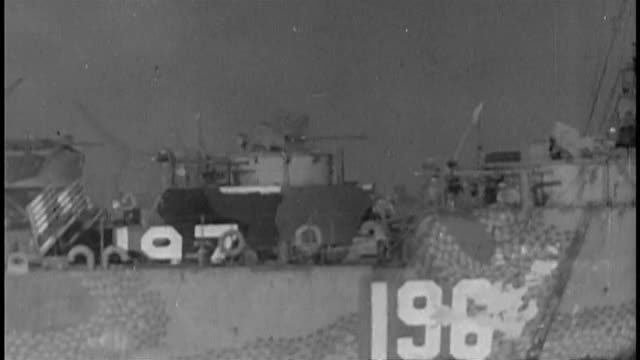
- The Drinan Diary explores the history of the men who served on the USS New Mexico BB40. This ship was the marvel of its day and was part of many pivotal moments in the United States’ history. This ship’s thirty-year history was tumultuous and impressive.
- Asset type
- Episode
- Genres
- Miniseries
- Media type
- Moving Image
- Duration
- 00:07:27.239
- Credits
-
-
Producer: Kamins, Michael
Producing Organization: KNME-TV (Television station : Albuquerque, N.M.)
- AAPB Contributor Holdings
-
KNME
Identifier: cpb-aacip-beca016514a (Filename)
Format: XDCAM
Generation: Master: caption
If you have a copy of this asset and would like us to add it to our catalog, please contact us.
- Citations
- Chicago: “Moments in Time: Stories of New Mexico’s History; The Drinan Diary,” New Mexico PBS, American Archive of Public Broadcasting (GBH and the Library of Congress), Boston, MA and Washington, DC, accessed March 15, 2026, http://americanarchive.org/catalog/cpb-aacip-6120bd724b1.
- MLA: “Moments in Time: Stories of New Mexico’s History; The Drinan Diary.” New Mexico PBS, American Archive of Public Broadcasting (GBH and the Library of Congress), Boston, MA and Washington, DC. Web. March 15, 2026. <http://americanarchive.org/catalog/cpb-aacip-6120bd724b1>.
- APA: Moments in Time: Stories of New Mexico’s History; The Drinan Diary. Boston, MA: New Mexico PBS, American Archive of Public Broadcasting (GBH and the Library of Congress), Boston, MA and Washington, DC. Retrieved from http://americanarchive.org/catalog/cpb-aacip-6120bd724b1