Report from Santa Fe; Mark Winter
- Transcript
You . . Report from Santa Fe is made possible in part by grants from the members of the National Education Association of New Mexico, an organization of professionals who believe that investing in public education is an investment in our state's economic future.
And by a grant from the Healey Foundation, Taos, New Mexico. Hello, I'm Lorraine Mills and welcome to report from Santa Fe. It's Indian Market in Santa Fe and we have a very special guest today. We have Mark Winter who has been collecting and trading for 40 years. And he's the author of two extraordinary books, one I'm less than meant I love this title, dances with wool, and he's just finished truly a great work, a lifetime work, the master weavers celebrating 100 years of Navajo textile artists. And now we think about Navajo textiles and I think the most common ones are the chiefs blankets that were most popular in the 19th century. And what does Spanish say about the chiefs blankets? Well, the Spanish referred to the Navajo chiefs blanket is the most valuable trade item in the provenance of New Mexico. Well, let's have a look at one of the chiefs blankets,
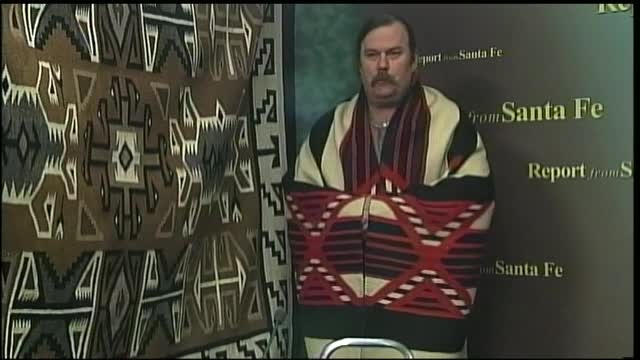
because you see them flat or you see a picture of them in the book, but you can't really understand the intricacy and the magnificence of their design until you see them worn the way that they're supposed to be worn. And one other thing about a chiefs blanket was because the distances were so far, you could identify the blanket before you could identify the face. But let's, Mark is going to show us what an extraordinary chiefs blanket tells us about it. Well, this was an example from about the Civil War period. It really represents a Navajo woman's love for her husband and wanted him to look good when he went out and was out in the world. And they were very beautiful items, but also very practical. You know, this was before they put heaters and pick-up trucks, so you needed to have a good Navajo blanket to keep you warm when you traveled around, especially with the temperature shifts, you know, of 60, 70 degrees between day and night. Wow. But, you know, to see it worn like that, to see it folded like
that, it is truly magnificent. Yeah, and although they're conceived flat on the loom, they're really designed to be worn and accent the body as they're worn. Yeah. Yeah. Well, thank you for showing us that. Well, that's the 19th century, but we also have as part of our background a rug from the 20th century. So tell us a little about the one that we're using as a background now. Well, the one we have from back here is a totally into two gray hills rug from about 1950 to 1960, and it was woven by Master Weaver Ramona Curly. And Ramona was from the totalena area, and she, unfortunately, passed away about five years ago. She was about 90 years old, and she had a very long weaving career and made numerous, very, very beautiful textiles. Well, you recently had a show, or you worked with the Wheeler Museum to put on a show that was up for 11 months, and it was called Master Weaver's of the totalena two gray hills region, and then it had a subtitle, two words in Navajo.
Yeah. It was called Nijoni Shemaah, and that means my mother, it is beautiful. And so when the weavers bring me in rugs, and they lay the rug down, that is usually my comment to them, Nijoni Shemaah. And you do speak Navajo. Well, a little bit. Yeah, it's a very intricate language, but it really is. But what you've done, imagine that 100 years ago, Hubble, a man who, the famous Hubble Trading Post, predicted that Navajo weaving would be gone, would die out. Well, I think he was a little premature in his assessment of Navajo weaving, and we often say the main reason the Renzo Hubble said that is he never came to visit totalena. And we have a very thriving weaving community there, and we have, we've been on the post for 14 years now, and in that 14 years, we bought over 5,000 rugs out of the community. Well, I want to show a picture here this book is weighs seven
pounds, but this is, and we'll do a close-up of it. This is totalena. You went to totalena in 1997. Tell us about it. Well, I first started going out there in 1990. I was an antique Navajo blanket trader for years, and was very fairly successful in the business. And I reached a point where I had a big enough house and a fast enough car, and it was not a satisfying. And so it seemed to shame to me that most Navajo weavers were anonymous, and especially when we see these old, these early jeeps blankets, the, you know, we know what culture they came from, that's all we'll ever know. But for a nice early, totalena, two gray hills rug, to be anonymous and only be 50 years old seemed to shame. So my soapbox was to go on, take some of the old rugs, and see if we could really identify the weavers of those things. And it took a long time for the weavers to be used to seeing their old rugs and for us to get used to knowing how to,
you know, kind of talk to them about getting information out of them. And so we've been very successful with re-attributing the rugs to their makers. Well, you tell the story of, was it Clara Sherman, where you went back with one of her early rugs, maybe 40 years before a long time early? She'd made it in the 40s, and this was in the mid-90s. 50 years. Yeah. And, you know, the weavers are far more familiar with the process than the product. And the minute a rug is finished, you know, their, their money needs are great, so they take them to the trading post. And although the intricate design is in their mind, they never really see the finished product. And so it took the ladies a long time to see their old work again. You would think if they sat at something for a year, they'd recognize it instantly. But instead, it takes them a long time. And so I took this rug back to Clara. I didn't know who woven. I was showing it to a lot of weavers.
And when she looked at it, she said that it was definitely one sheet woven. And by that time, I'd learned about the Navajo sense of humor. And so I told her, no, it was, I had actually woven that one. And so in teasing her, she got me over the corner of her hogan. She took down a couple steamer trunks, pulled out an old wooden box, and pulled out a photograph of her with the rug. And that was a huge breakthrough for us identifying, you know, the makers of rugs. I didn't expect there to be photographs of the early weavers with rugs like that. So this was a huge breakthrough in our research that we were doing. Well, your book is really a magnus opus because you have pictures of the grandmothers with their early weavings, with their current weavings, with the families. You do the genealogies of these families. It is just quite extraordinary. It is 608 pages. And weighs seven pounds. And it is a masterpiece. Yeah, we didn't know when to stop.
Yeah. I want to back up just a little bit about some of the mythology with the Navajo and with spider women. Why is weaving important to the Navajo? Well, it appears that, you know, that the Spanish brought the sheep. We consider Navajo weaving really a blending of early Anasazi loom, which was an upright frame loom, so the Anasazi was caught in prior to the arrival of the Spanish. The Spanish bring the sheep. The Navajos initially acquire the sheep for food. And it is mobile food. So it is food that can travel with them. So because they were semi-nomadic. And slowly the women started picking up the art of weaving. And for some reason something very magical happened. And the Navajo weavers excelled at the weaving. And just, you know, it was spectacular. Now, Navajo legends say that they learned from spider woman who was a mythological character.
But historians say that it was really the contact with the pueblos and the Spanish that created, you know, the technology and the ability for them to do these things. And so you had familiarized yourself with all the Navajo tech sales. But I've heard, I know that Arizona Highways had a special issue in 1974. And they say that the two gray heels are totalina. It's the Navajo rugs as paris is the old couture. Yes, that was a great quote. It is a great quote. So what drew you to the two gray heels rugs in totalina? Well, in my years of dealing in them, they were just my favorite. And in looking at the weavers of today, it was really the holdout for traditional weavers. Our trading post is at the end of a dirt road. It's a very isolated area. Traditional weavers, a lot of weavers that don't speak English. And they were still willing to do things what we call the real way. They raised their own sheep.
They take them up on the mountains behind the post in the summer. And they share the wool once a year. And they take that wool and they just wash it. And then they hand card it and clean it. And when we have beautiful rugs. And the early traders actually credit the weavers with developing the totalina to gray heels style. And there seemed to be an affinity in that area against using red. And so we had sheep in the area that were a lot of beautiful colors. And so we've restarted blending the natural wool colors using very intricate patterns. And you know, the rest is sort of history. They've been the most popular style of the 20th century. Well, you had an exhibit at, you have a museum at totalina that's not just a trading post. And you published this wonderful dances with wool. But tell us a little about the design, the motifs. Why this is a special rug here that's on the cover. Well, this was a catalog of an exhibit we did in the museum. I think it opened in 2002. And the imagery on the rug is drawn from rock art drawing. And the weaver of that rug, Estherette City,
lives a little north of the trading post up against the mountain. And the canyons right above her house have the rock art drawings. And so she utilizes those for her design inspiration for these rugs. And here's another one. This is a sort of early version of the master weavers talking about Clara Sherman. But this, this rug again. So we are looking for native natural dyes and geometric designs. No, actually no dyes. It's just the natural wool. Oh, that's why it's a natural wool. Yeah. And they are sheep coming a wide variety of colors, tans, browns, grays. But they can also take colors and blend them with their carding combs, mixing a lighter and darker color to get subtones of different shades. And so one of the rugs pictured in my new book has 15 different natural wool colors. But typically they'll have six or eight natural wool shades in them. Now, I'm going to try this again.
You have, this is a very famous photograph by Laura Gilpin of one of the best known, how do you say her name, Daisy? Daisy Togglechi. Okay. We'll do a close-up of this too. This was taken in January of 1955. And she had already at that point one gallop ceremonials about 15 years in a row. And so Laura knew of her reputation. And so when she went to the reservation, she took that nice picture of Daisy. But she's the one who had the most dense, was it? Talk about warp and weft and then how, and machine. The density that needed to be considered machine made, and how dense Daisy was able to weave. Yeah. It started off as kind of a joke amongst the traders. To make a kind of brief story out of it, they sold a rug to the Fred Harvey company in Albuquerque. And it was done by Daisy and it was about 65 wefts to the inch. And so that, the wool has to be spun very fine to do that.
And so they told the trader at Totally and the Charlie Herring that if it was 80 wefts to the inch, it could be considered machine made. And this was about 1940. So it became sort of a challenge to see if Daisy could spin her wool that fine and get 80 wefts to the inch. We have to remember that machine made was not, hasn't looked at it. And it wasn't bad in those days. So Daisy completed her first piece at that fine scale in about, in the early 1940s and achieved up to 130 wefts per inch in her very finest pieces. Wow. And I just want to show these three women, are you say, represent in a way some of the best weavers of the area. Yeah, this is, this is three wonderful old grandmothers. The lady in the middle is named Mrs. Police Boy. And she was Daisy's cousin. And Daisy lost her mother when she was young. So she was raised by Mrs. Police Boy's mother. And then those, those are two of Mrs. Police Boy's daughters.
And the one on the left was born in 1877 and passed away in 1977. And the one on the right lived to be up, was born in 1888 and lived to be 107. So great longevity in this family. And there's, although it is the grandmothers, the daughters and everything, there was a very famous figure, Huston Claw. Yeah. Yeah, Huston Claw. And here's a picture of him and one of his sand painting. But tell us what he did that was so different. Well, because he was a medicine man. And he felt that the Navajo medicine ways were being lost as the older medicine men passed away. So he went and studied with other medicine men and gained incredible knowledge. And the images that are used for the Navajo healing ceremonies that are called sand paintings were never to be reproduced in permanent form. And Claw really broke tradition. And to reproduce these forms, since his grandfather was a hope he had been taught
to weave as a young man, because in the hope he cultured men weave. And so he decided to weave the images. And as the story goes, he appealed to the holy people and they told him it was okay to do. But the people around him weren't quite sure of his actions. It had never been done before. So he wolves sand painting textiles, Mary Cabot, Wheelwright, the benefactor, the Wheelwright Museum, saw one of his textiles at the Gallup ceremonials and bought it. And that started her quest, she gathered numerous of the textiles and a lot of recorded chance from Claw. And like I said, he was highly criticized. But nowadays modern medicine men go and listen to those. They look at the images Claw did and listen to the chance. And so it seems like ultimately Claw was right about what he did, because he preserved part of Navajo culture that would be gone now. Well, and that he preserved the sand paintings by their nature. You know, they're gone.
Once they're gone, they're gone. And so to preserve those images is an incredible gift. Yeah. So it was quite a thing that he did. Like I said, he was controversial in his day, but time has proven him correct to save those wonderful images. And there's one more I'd like you to speak about Clara. Okay. And here's a picture of her actually getting an award from the governor, from Governor Richardson. Yeah. We nominated her for the Governor's Excellence in the Arts Award. And from what they told us, she was the first artist that ever received the unanimous first round vote. She was about 90 years old when she received the award. She passed away last year at 96. And so she got the award. We brought her to Santa Fe, and she spoke to the crowd. And she was one of the first recipients to speak, and all the rest of the recipients that spoke just referred to Grandma Clarica. She was so enlightening. Yeah.
She spoke pretty good English. And so she was really, she was very wise lady, and was a fabulous weaver. She has rugs and museums around the country, a nine by 12 in the museum, a museum in Northern Arizona, and there's things in the museums in Santa Fe here by her. So... Well, you have such a close relationship with these grandmothers. It's just lovely, and some of your stories, I was reading the one about Virginia Deal, selling, you asked her how much for this rug, and tell us what she said. Well, she... Really, I'll go back to that and say, but all of the grandmothers are really wonderful to deal with. You know, they're just so delightful. They have fabulous sense of humours. And, you know, just, you know, just an amazing to deal with all of them. So, Virginia is really one of our delightfuls. She lives about a mile or so from the post, and we have her up all the time. And Virginia kind of tricked me into buying her rug. When I first went out there, I wasn't really interested in the contemporary rugs,
and she kind of tricked me into buying it. And as soon as I did a couple days later, another weaver came in and said, I want to say a rug. I said, I don't buy contemporary rugs. I'm interested in old rugs, and she said, well, you bought my cousin's rug. So, then that started it, and now we've bought over 5,000 rugs out of the community. But did not they refer to it as old bones? Sometimes you'd come back with... Oh, now that was Julia Jumbo. And when I brought her up... When I brought one of her mother's old rugs back, and I got into the point where I was starting to identify weavers. And Julia's mom had died when she was young. Also, she had an adopted mother named Esther Silentman. And I found one of Esther's rugs, and so Julia didn't speak English, but I took the rug down to her with her daughter to interpret for me. And when we opened up the rug, as soon as Julia looked at it, she started crying. So, I figured I was pretty right about the maker of that rug. And so, Julia told her daughter,
that after I left, she said, you know, that guy's kind of like an old dog. He goes out, and he brings these rugs back in there. It's kind of like he's digging up old bones and bringing them home again. So, that got to be the joke around totalina. When I found an old rug by weaver, it was an old bone we brought back home again. They are delighted to see their early pieces and to see that they survived, and how nice they look, and you know, that they're still beautiful. They go, I made that. How lovely. Yeah. And then you have the pictures in here. So, you could see them some from the 20s with the rug, and then they're now with their contemporary work. Another one thing about the Virginia Deal story was, did she not once ask you for a truck? Oh, no. No, what happened there? How is that? What happened there is, in 1973, Virginia traded one of her rugs for a brand new pickup truck.
There was another collector who went out there to see her. He happened to be a car dealer. And when he asked how much she wanted for a rug, she said, well, I'd like a new pickup truck. And she said it as a joke, but not knowing he was a car dealer. So, a couple days later, we were a brand new truck showed up for her. And there's a famous picture in Arizona Highways of Virginia with her brand new pickup truck. And she's been a really best living weaver in my time, at Totaleen and Saw. Now, teasing the retailer that she just gets hummers and Mercedes is no further rugs, yeah. Right. So, you have how many families in here with the whole genealogy? It's just... Well, we have 23 genealogy charts in the book, and we selected a little over 80 of the best of the best of the weavers in our region. And in the selection process, they had to have a unique style, a identifiable style. We wanted to see their work represented in public and private collections. We had to find examples of their work, obviously,
rather than just photographs. And so, we selected those ladies, and we did in-depth research in them and studying them. And they come from 20 different families. And so, some families only have one master weaver. Claire's family has about eight or nine master weavers in it. And that's what the book is focused on. And the Navajo's in that area were gathered up by the US troops in the 1860s and taken to Bosque, Redondo on what's called the Long Walk. Well, when they were allowed to come home again, our families went right back to where they were. It was such a beautiful area, a lot of water, and trees, and mountains there. And so, they all came back. So, their antiquity in that area is even much, much longer before Bosque, Redondo. And so, we chased, we were managed to track a lot of the families back to Bosque, Redondo. And in some cases, even into the late 18th century. One of the things I love about this is that it's not a closed circuit.
It's a chapter on unknown weavers. Well, yeah, that was kind of the last thing I ended up doing. Because, you know, I worked on this for years, but I was still always frustrated by what I didn't know. You know, we gathered a lot of information, but it's what you don't know that bothers you more than anything else. And so, to include a lot of other information, and to show the readers more examples of work, we came up with a chapter called the Unknown Master Weavers. So, in one, there's two pages there. I'll show eight rugs by the same weaver. It has her fingerprint of design and in coloration, but I never was able to figure out who the weaver was. And so, all of that sort of research that we couldn't resolve, I tell stories about weavers that were told to me to be good weavers, but I never found an example of their work. So, you know, some of this information will come later by readers and go, well, I have a rug by that weaver or something. You know, our area seemed to be the first one
where the traders cared enough about the weavers that the tags, and this started in the 1940s. The tags started having a place for the makers. And so, that was the first in our area that I know of anywhere on the reservation before that they were all just anonymous. And so, we start getting a smattering of information about these early-day weavers, and it becomes more and more through the 50s and 60s. Another thing that you've done that to me is so moving. And I wish that every indigenous art could be as well catalogued and the whole history put together as you have done here. But you have helped set up classes at Newcomme High, weaving classes, and you work with the young weavers to show them there's a bridging between the new weavers and the traditionalists and you bridge that gap for them. Yeah, well, you know, unfortunately, most of our weaving base is over 55 years old. And so, for the tradition to really survive, it's very important that we do encourage, you know,
the young people in the area to weave. And we do that by providing, you know, weaving teachers, weaving classes at both at the Newcomme School, at the High School there, at the Totally the Boarding School, that still does operate as a BIA boarding school. And we'll buy the rugs from them and we'll try to pay them really good prices to try to encourage them to weave. And so, it's been very successful. We've bought over 150 first rugs, which is a first effort by a young weaver. And our young weavers have ranged in age from four years old to 60 years old, and that have done us, brought us their first rugs. And so, it really is very satisfying. And we really like to see them continue. Some of our first rug weavers are now prize-winning master weavers. And so, that's kind of exciting to have seen them, you know, to take the effort in really, and really produce really beautiful things. Well, I just want to hold this up again.
But the master weavers, this is really a Magnus Opus. And you have really saved so much from oblivion by spending the years and years that it took to put this together. Well, we hope so. You know, I really like to look at it as a gift to those young weavers. It is a gift. Because they can show who their families are, where they came from, that they come from great weaving families. And hopefully, it'll give them an inspirational boost, and maybe an economic boost, too, to come from some of these great early-day weaving families. And you do end the book with a famous Navajo. I guess it's a chant, poetry about walking and beauty. Can you tell us part of that? Well, it comes from one of the chant ways. And it's with beauty above me, and beauty below me, and beauty in front of me, and beauty beneath me. And so, and so we say, you know, to walk and beauty, and to weave and beauty. Uh-huh. And literally, by the time you have blankets, rugs,
blankets, you are surrounded by this form of beauty, as well as the beauty of the natural world that they so beautifully capture. Yeah, and it's a really pretty area, and I think the rugs are, in a sense, abstract impression, and isms of the beauty they see around them. And even in really sometimes really poor conditions, they can really create such beautiful things. It's really is impressive. Well, it's impressive to me what you've done by bringing us this. Our guest today is Mark Winter. I want to easily show this other one, dances with wool. And of course, the master weavers, you've done great. Thank you so much, it's Indian market. I know that many people will be coming and talking to you about the book, but this way, we get our audience to see. Thank you, Mark. Okay, thanks a lot for having me. Um, thank you, Mark. And I'm Lorraine Mills. This is report from Santa Fe. I want to thank you, our audience, for being with us today, and may you also walk in beauty. Past archival programs of report from Santa Fe
are available at the website, report from Santa Fe dot com. If you have questions or comments, please email info at report from Santa Fe dot com. Report from Santa Fe is made possible in part by Grant Strong, the members of the National Education Association of New Mexico, an organization of professionals who believe that investing in public education is an investment in our state's economic future. And by a grant from the Healey Foundation, Taos, New Mexico. Thank you.
Thank you.
- Series
- Report from Santa Fe
- Episode
- Mark Winter
- Producing Organization
- KENW-TV, Eastern New Mexico University, Portales, New Mexico
- Contributing Organization
- KENW-TV (Portales, New Mexico)
- AAPB ID
- cpb-aacip-5fe8d4a264e
If you have more information about this item than what is given here, or if you have concerns about this record, we want to know! Contact us, indicating the AAPB ID (cpb-aacip-5fe8d4a264e).
- Description
- Episode Description
- On this episode of Report from Santa Fe, we interview Mark Winter, author of “Dances with Wool,” and “The Master Weavers: Celebrating 100 Years of Navajo Textile Artists,” who has been collecting and trading Navajo textiles for 20 years. His book is a magnum opus which includes pictures of the grandmothers weaving the textiles and their genealogy. Navajo weaving originated from early upright looms used primarily for weaving cotton. When the Spanish brought sheep, the Navajo women slowly picked up the art of weaving. Guest: Mark Winter (Author “Dances with Wool”). Hostess: Lorene Mills.
- Broadcast Date
- 2011-08-20
- Created Date
- 2011-08-20
- Asset type
- Episode
- Genres
- Interview
- Media type
- Moving Image
- Duration
- 00:29:14.138
- Credits
-
-
Producer:
Ryan, Duane W.
Producing Organization: KENW-TV, Eastern New Mexico University, Portales, New Mexico
- AAPB Contributor Holdings
-
KENW-TV
Identifier: cpb-aacip-1bbcc258988 (Filename)
Format: DVD
If you have a copy of this asset and would like us to add it to our catalog, please contact us.
- Citations
- Chicago: “Report from Santa Fe; Mark Winter,” 2011-08-20, KENW-TV, American Archive of Public Broadcasting (GBH and the Library of Congress), Boston, MA and Washington, DC, accessed June 19, 2026, http://americanarchive.org/catalog/cpb-aacip-5fe8d4a264e.
- MLA: “Report from Santa Fe; Mark Winter.” 2011-08-20. KENW-TV, American Archive of Public Broadcasting (GBH and the Library of Congress), Boston, MA and Washington, DC. Web. June 19, 2026. <http://americanarchive.org/catalog/cpb-aacip-5fe8d4a264e>.
- APA: Report from Santa Fe; Mark Winter. Boston, MA: KENW-TV, American Archive of Public Broadcasting (GBH and the Library of Congress), Boston, MA and Washington, DC. Retrieved from http://americanarchive.org/catalog/cpb-aacip-5fe8d4a264e