Bill Moyers Journal; 203; Kent State: Struggle for Justice
- Transcript
BILL MOYERS' JOURNAL
"KENT STATE: STRUGGLE FOR JUSTICE
FEMALE VOICE: From the poem, "The Quarry," by W.H. Auden: What is that sound which so thrills the air, down in the valley - drumming, drumming?
MALE VOICE: Only the soldiers, dear, the soldiers coming.
FEMALE VOICE: What is that light I see flashing so clear over the distance, brightly, brightly?
MALE VOICE: Only the sun on their weapons, dear, as they step lightly.
FEMALE VOICE:What are they doing with all that gear? What are they doing this morning, this morning?
MALE VOICE: Only their usual maneuvers, my dear, or, perhaps, a warning,
FEMALE VOICE: Why have they left the road down there? Why are they suddenly wheeling, wheeling?
MALE VOICE: Perhaps a change in their orders, dear. Why are you kneeling?
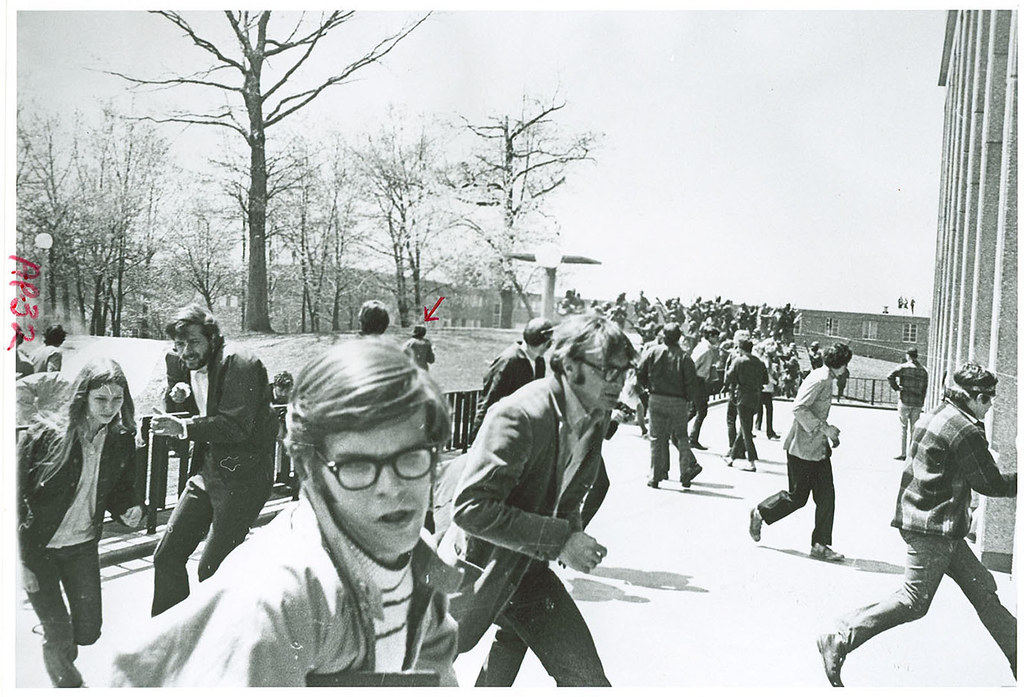
MR. MOYERS: Thirteen seconds of gun fire, on a spring day, four years ago, at a place called Kent State, in Ohio Thirteen seconds contained violence enough to kill four young people, to injure nine others, and severely scar this nation's belief in due process. For these young people, those thirteen seconds were the end of time, itself. For the rest of us, they were an ugly reminder, în an unpleasant year, of how we were warring with each other. For a handful of Americans in particular, for a student paralyzed by that gun fire, for the parents of his classmates who fell here beside him, for an insurance broker on Staten Island, a Methodist Minister in Washington, and a lawyer in Cleveland, for some journalists who kept asking questions, and for the students who knew the victims, those thirteen seconds were the beginning of a struggle for justice. Now, in the fourth winter since the Kent State tragedy, that struggle may finally be nearing an end.
MOYERS: This is the place in the center of the Kent State campus where events reached a swift and bloody conclusion on May 4, 1970. The Guard had come up the hill. Here, it turned, retraced a few of its steps, and then fired down the slopes into the students. It all happened four years ago. But those events still seem uncomfortably familiar this much later. Student protests against the U.S. invasion of Cambodia had led to violence and disorder in downtown Kent, and to the burning of the R.O.T.C. building on campus. Governor Rhodes ordered the National Guard to the scene on May 2, and, two days later, as rocks, tear gas canisters, and angry insults filled the air, several Guardsmen turned in unison, and opened fire on the students. Few events of the last decade have been investigated as extensively as Kent State. The President's Commission on Campus
Unrest, headed by former Pennsylvania Governor William Scranton, concluded that the shooting was, quote: "Unnecessary, unwarranted, and inexcusable." The F.B.I. conducted its own investigation, and concluded that there were grounds for criminal charges against at least six of the Guardsmen. According to the F.B.I., the assembly of students which the Guard attempted to disperse was peaceful and quiet, until the Guard advanced. And, the F.B.I. continued, there was reason to believe that the claim by the Guard that their lives were endangered by the students was fabricated subsequent to the event. But, in Ohio, sentiment ran in favor of the soldiers. Some people even suggested that the students got what they deserved. The State convened a Grand Jury, but it heard little of the incriminating evidence. Instead, it exonerated the Guard, and indicted several students. The whole exercise was such a farce, that a Federal Judge ordered the Grand Jury's report expunged. The hope for justice now lay in Washington.
But there would be no Federal Grand Jury - not under Attorney General John Mitchell, or his deputy and successor, Richard Kleindienst. They would ignore the F.B.I. report. They would ignore their own Department's summary of that report. They would agree that the rifle fire was unnecessary, unwarranted and inexcusable. But they would not call a Grand Jury. That was in 1971. Two years later, in August, 1973 with Mitchell and Kleindienst gone, and the Nixon administration reeling under revelation after revelation of how justice had, in fact, been served, the new Attorney General, Elliot Richardson, reversed his predecessors, and ordered the Kent State case reopened. This report is about the people who wouldn't let the Justice Department forget Kent State, and who kept stirring the conscience of the whole nation.
MR. DAVIES: If I had kids that age, and they happened to be on that campus that day, they could have been killed just like the four who were killed; and I felt I had to do something. I mean, I can't just say you know the way most of us tend to do: "That's terrible," and forget about it. I couldn't forget about it.
MOYERS: Peter Davies, a Staten Island, New York, insurance broker, not only refused to forget Kent State, but also made sure that America would not forget. He wrote The Truth About Kent State - one citizen's report on the refusal of the Justice Department to fully investigate the shootings. That this could happen in America was disturbing to Davies, a naturalized citizen who came here from Britain.
DAVIES: For a long time, ever since my early teens, I felt the United States was the citadel of individual rights- which, I feel, are so important
MOYERS:
Was that really a factor in your coming?
DAVIES: One, that's one factor. The trend was socialism in England, which I didn't go along with. And also financial. When I became a citizen in 1966, and it took me nine years to do it, I had to renounce the Queen, which was a difficult decision to reach. And then, in becoming a citizen - you know, you go into Federal Court, and you stand there and raise your arm, and you take this oath to defend the Constitution and uphold it which a natural born citizen does not do and I took it seriously, that oath. And Kent State, to me, was a blatant violation of the Constitution.
MOYERS: What was the first thing you did?
DAVIES: I was just sort of in a state of shock at what had happened. And then, on that Friday, mid-day, downtown by that time, I had my office in Manhattan I've since had to move it here into the house to save money the construction workers went and waded into the students who were observing Mayor Lindsay's Day of Mourning for the Kent Four - just the idea of these storm- trooper-type tactics moved me, at that point, to write this long two page letter that I wrote to President Nixon. And then, I thought I'll send a copy to the Krauses. Now why the Krauses I think I was - I was deeply affected by Allison's death for some reason. And so I mailed the letter just with a note, saying that you know: "I hope that these words that I have said to Nixon will be of some Of course, I didn't know the Krauses, or Allison. And three days later, on the Wednesday, I got this phone call, and I couldn't believe it. It was Arthur Krause. And he'd received my letter, and was very moved by it, and that was sort of the start. comfort to you.
MOYERS: Have these three years really consumed you?
DAVIES: Well daily constant the phone you know, daily working calls, the letters - there were at least twelve hundred letters I must have written and then the research, and working on the book working on the first report that went into the Justice Department and then being sued, and legal problems-time consuming.
MOYERS: Did you spend your own money?
DAVIES: Yeah.
MOYERS: How much?
DAVIES: Too much way too much. I mean it's getting close to six thousand on phone bills alone.
MOYERS: Are you going to spend the rest of your life driven by what happened on May 4, 1970.
DAVIES: No, I'm very satisfied now that we have the Federal Grand Jury. But, I can't turn around and walk away from it now. I can't just say: "Well, I'm finished now. I've done my bit." This isn't a bit thing. I mean it's become a part of my life. I feel that, from the testimony of witnesses, and from the photographs, that this didn't just happen. There was a - it's either a decision to do this on a signal, or there was, as some witnesses say, an order. Now here's the interesting thing in terms of the Guard's claim that they fired in self-defense. They turned, and this dirt, here is you can see that with the sergeant here with the forty-five - his foot is in the dirt, and these Guardsmen here are sort of standing in the dirt. That is at the point where they turned. Now, there is the shooting is in full swing. And the dirt is back here from the grass. They've moved forward, up the slope, to get a better line of fire and elevation down into the parking lot. I can't guess the distance here, but they must have moved about eight or ten feet forward. In other words, for a self-defense action, this movement forward toward the students, for a better line of fire, in my opinion, contradicts this claim on the part of the Guard. When you have the actual shooting you have 77 Guardsmen, but only 29 fired. Why didn't the others fire? Why didn't they all fire? And, why, out of the 29 who fired, yet only a few fired at the students, and the majority fired in the air.
MOYERS: Well then, why do you think John Mitchell didn't proceed?
DAVIES: Politics I'm convinced it's politics. And I think that you know since Watergate, and since his testimony before the Ervin Committee where he testified that he would do anything for the re-election of President Nixon.
MOYERS: Well, where does politics enter into it?
DAVIES: Well Ohio this President was, in my opinion, almost paranoiac about re-election. And Ohio is a key State. And in Ohio, public sentiment was in favor of the Guard. And it just would not be politically wise for Mitchell to convene a Grand Jury which, out there, would give the impression that the Justice Department - the Federal Government was out to get Guardsmen.
MOYERS: When you think of the victims of Kent State, do you think they were seen as radicals as revolutionaries so that they became stereotypes of a public consciousness?
DAVIES: Very much so. And I'm trying to break through that false image, because they were just like your kids and mine - you know - they weren't the Abbie Hoffmans and Jerry Rubins, the SDS and the Weathermen. And yet, these four have, in a sense, to a great many Americans, become the sacrificial lambs to atone for that violence against society.
MOYERS: The newspaper of record on Kent State has been the Knight newspaper Akron Beacon Journal. The paper won a Pulitzer Prize in 1970 for its reporting on Kent State, and has continued to follow the story, pursuing the unanswered questions. The Beacon Journal's Washington correspondent is Davis Hess. He's written more than a hundred articles on Kent State.
MR. HESS: As you know, at the time, Attorney General Mitchell said that one of the reasons that he refused to convene the Grand Jury was because of the probability of getting any convictions against Guardsmen was so slight that it would hardly have been worth the effort. And, of course, that is, in my opinion, one of the lamest reasons of all, because, what, in effect, that says is that the Attorney General himself is acting not only as prosecutor - the potential prosecutor in the case but as the judge and jury. One question that, I think, hasn't been addressed by any of the investigative bodies, as far as I know, is whether the inflammatory remarks by former Governor James Rhodes of Ohio - who called out the National Guard - whether those remarks, in some way, created the mood that gave the National Guardsmen the idea that whatever they did on that campus that day would be condoned, and appreciated even by their leaders.
VOICE OF GOVERNOR RHODES: We're going to use every part of the law enforcement agencies of Ohio to drive them out of Kent. These people just move from one campus to the other, and terrorize the community. They're worse than the Brown Shirt and the Communist element, and also the night-riders and the vigilantes. They're the worst type of people that we harbor in America. And I want to say this: They're not going to take over a campus.
HESS: There were also rampant rumors that the Government had planted agent provocateurs. on the Kent State campus, and that, perhaps, some of these agents had, in effect, been responsible, at least in part, for the four days of protest and demonstrations on the campus. And if so, if this were true, then might not the Government, itself, have been, at least, partially responsible for what happened?
MOYERS: The new Attorney General, William Saxbe, when he testified before
the Senate Judiciary Committee during his confirmation hearings, promised to remove himself from any active participation in any decisions bearing on the Kent State Grand Jury investigation.
MR. SAXBE: Having gone to the Grand Jury, now, I certainly intend to remove myself from any further consideration. If they seek indictments, why, that will be the next step. If they find no evidence for indictments, I would hope that that would be the end of it.
HESS: However, he did not say that he would remove his own hand-picked deputy Attorney General from providing, quote: "Advice and direction," unquote to the lower ranking members of the Justice Department who are actually conducting the investigation.
MOYERS: In Akron, the Beacon Journal's State editor, Pat Englehart, is the authority on Kent State. He's trained several reporters to become investigative specialists on this story, the latest: John Dunphy. Together, they kept digging for evidence. Englehart feels he could solve the Kent State case, if he could get more cooperation from Government officials, and if he could gain access to the F.B.I.'s 8000-page report that's been locked up for the next 75 years.
MR. ENGLEHART: I think that the duty of every newspaper, and television, too, is to keep whenever there's a question that needs answers regardless of whether it's about Kent State, or about Watergate, or just a small happening and you ask a question, and you don't get an answer to it - then you've you know got to pursue it further.
MOYERS: Do you think you've kept Kent State alive when it, otherwise, would have been forgotten?
ENGLEHART: I don't believe we're keeping the Kent State story alive. I've been accused of that, but I don't think we are. I think we're just trying to get the answer to the question, which, after all, they're still questions that or the motivation behind the 50,000 student petitions that went to the White House, on at least two different occasions. At least 50,000 people would still like to have the answers.
MOYERS: The carton of petitions that twice went to the White House is once again back in Kent, Ohio. The organizers of the petition campaign - Paul Keane and Greg Rambo - are no longer students. But they continue to persist in the drive for a Federal Grand Jury. In the off-campus apartment of Dean Kahler, the most severely injured of the nine wounded students, Greg Rambo evaluated the petition effort.
MR. RAMBO: The petition was something that we could always refer back to, and say
you know 10,000 people, and then 40,000 people from across the country, were concerned enough that they signed their name to a piece of paper asking President Nixon to reverse John Mitchell's decision.
MR. KEANE: It held a mirror up to the Government, and forced them to confirm or deny our suspicions about their hypocrisy. We tried to work through the system - you know. Instead of getting 10,000 or 40,000 people in the streets, we put their names on paper, petitioning the Government for a redress of grievances; and they totally ignored it.
RAMBO: I would not say that the petition effort got us the Federal Grand Jury, but I think it helped. The Federal Grand Jury would not have been convened if it were not for the Watergate situation, because the atmosphere changed in Washington you know. They started looking at things that the Justice Department had swept under the rug like the Kent State case.
·
ROOMATE: Living with Dean, I can't help but remember May 4th. Just watching him wheel around makes me wonder how the Government could send troops out to a campus to shoot its students to kill them, or to paralyze them for the rest of their life. You know you don't just forget that every time you watch Dean. He's my roommate. I see him all the time. It just boggles my mind as to how he got shot, and why he is in a wheelchair today. There seems to be no reason for it, as there seems to be no reason for the four graves that've come about on account of this.
MOYERS: Since the shooting, Dean Kahler has been in and out of college and the hospital. The six-foot-four athletic Kahler worked in a steel mill to earn the money to go to Kent State. And then, as he puts it, "everything got ripped off from me. Two years went by before Kahler concluded the Justice Department was not going to act. Then he decided to join the fight, himself. His family's been impressed with his own growing self-confidence, and his ability to function despite his handicap.
Do you often think back to the events of that day?
MR. KAHLER: Oh, I have to, because, every time I'm lying in bed, and I have to get up, and I have to use the wheelchair, and I can't roll over easy because I have to pick up my legs, and move it, I think about it every day of the week. I use up so much energy every day, when I sleep I sleep. Nobody can wake me up during the night when I'm zapped out.
MOYERS: Do you ever dream about Kent State?
KAHLER: Luckily, I haven't. I never have. But every time I dream, I dream I'm walking. My subconscious hasn't submitted to the fact that I'm handicapped yet. So, maybe there is a hope that I can walk, subconsciously.
MOYERS: Let's go back to May 4th. What were you doing in the parking lot?
KAHLER: Well, I was walking in the direction of the National Guard. I had a class at one o'clock, which was about a half-hour from then. And I was walking in the general direction towards the National Guard, and when they wheeled and fired, I saw - I think I saw Lewis who got shot. And then after that, I hit the ground immediately, and then I got hit later, after hitting the ground.
MOYERS: Had you been taking any part in the demonstrations?
KAHLER: When I was there, I was in the original nucleus of a group that had started the whole thing.
MOYERS: Had there been any rocks thrown?
KAHLER: Yes all the people were throwing rocks. I, myself, I remember picking up some rocks and heaving them, but they landed on top of other students, because I was so far back into the crowd. You know it's just sheer frustration, sheer tension, and it's against my nature to do that, but you know - it was just so you're frightened, you're being chased, and you're just up tight you know
MOYERS: Could it have been against the nature of the Guard to fire under those circumstances, but that they did so out of the same kind of frustration you felt?
KAHLER: Yeah, there's a good possibility I think so. But frustration and tension, I think, was planned, or it was sort of set into peoples! minds. Governor Rhodes came to the campus the day before the shootings - called us Brown Shirts and Communists and, maybe, set a mood for the whole thing.
MOYERS:
Isn't there a danger that you may become a professional symbol of Kent State?
KAHLER: Oh, there is a danger of that, but I don't know I'm sure I'll get out of it somehow or another, because you know I want to live my life as normally as possible. Everywhere I go now, people will say: "Where did you get hurt?" or "How did you get hurt?" I have to say: "Kent State." But, if the thing is righted, and the American people are shown what happened there - at least from what I see, and from what other people see that whenever I say "Kent State," they won't get uptight and they won't look at me you know they'll just accept me as a person, and you know maybe pat me on the back, you know: "You did a good job by pursuing this." I hope that's what'll and say happen.
MOYERS: On several occasions, Dean Kahler has flown to Washington to lend his presence to lobbying the Government. When the petitions were taken to the White House for the second time, Kahler was there. When lawyers for the victims' families argued before the Supreme Court for the right to bring damage suits against the Ohio Guardsmen and officials, Kahler was there. And when the Senate Judiciary Committee held its confirmation hearings of Senator William Saxbe as Attorney General, Kahler was there. Kahler's appearances have been coordinated by the Reverend John Adams, of the Board of Church in Society of the United Methodist Church, located directly across the street from the U.S. Supreme Court. The Methodist Agency has been a liaison between the petitioners and the Government.
REVEREND ADAMS: The United Methodist Church has played various roles, and I've been asked on their behalf to play those roles. At points, I think, we call ourselves Pastors to the families. They needed, at points, our support, our encouragement. They needed someone that they felt was really understanding what they were experiencing as they confronted the whole United States Government. And I, today, pulled a letter out of the file that is typical of many that we got at the time, that said: "Why doesn't the United Methodist Church spend its funds trying to correct the evil that rests in the hearts of persons, rather than trying to brow-beat the only government in the world that has given as much freedom as the American people have?" We believe that we were being supportive of our system of government. And I am convinced that the families and the students really believed in this system of government more than many of their officials who were responsible for making that government function. They really believed that justice could be done.
MOYERS: J. Stanley Pottinger was appointed Assistant Attorney General for Civil Rights in February, 1973. Prodded by his own doubts, he began to review the Kent State case. By August, the new Attorney General, Elliot Richardson, announced the investigation was to be formally re-opened. In December, Pottinger and his staff began presenting evidence to a Federal Grand Jury in Cleveland. Pottinger admits that part of the reason for re-opening Kent State was the persistence of private citizens.
What impressed you about the people who were coming in, saying: "Re-open the case"?
MR. POTTINGER: I think, most of all, it was a degree of intense concern - not to punish anyone. It didn't seem to be a vindictive kind of petition it was: "Can we find the truth? Can we discover the truth? There are so many questions unanswered." I think that's got to impress anybody who works on an incident of this magnitude.
MOYERS:
Whatever the reason, should it take three years for citizens to get justice?
POTTINGER: Well, clearly not, if you assume what we believe to be that, namely, that there have been, for a long time, important questions to go into. But, if I may, in defense of the period of time - let me point out that we re-opened the case on the basis of a record that developed over that period of time, not on the basis of a record that was known in 1970.
MOYERS: Have you felt any political pressure not to pursue this case?
POTTINGER: I have not felt, in terms of any superior at all, in the Government, or, for that matter, in the Congress, any pressure not to pursue the truth in this case, and I'm happy to say that.
MOYERS: Of all the parents, none have been more vocal than Arthur Krause. When someone showed an interest in Kent State, Krause forged that interest into a commitment to action.
MR. KRAUSE: The thing that hurts the worst is to have your dead child called every name in the book. Why? Because she was out there, under the Constitution, stating to get off that campus, let us go back to school. But you're not allowed to use words, because if you use words against somebody, you're non-patriotic. My God that isn't what our forefathers fought for. That isn't why most of the people came over to this country. I blame Nixon for his sinking to the negative thinking that he does, trying to bring out the worst in human beings rather than the best. I blame Rhodes for the same thing. But I blame the people for not listening to what the men are really saying. And the people - and I'm the people just as well - I'm afraid lots of times I just sit back people are sitting back on Watergate right now morality and ethics are what are involved. No man is above the law, and no student is below the law. I wanted justice. I want justice. We had it under Richardson for a brief period. God bless him every moment of the day. He tried to put even-handed justice back in the Department of Justice.
MOYERS: This report doesn't have a conclusion, because the story of Kent State isn't over yet. John Mitchell and Richard Kleindienst tried to end it a long time ago. In those days, they were running the Justice Department as if it were a branch of Tammany Hall, and justice was something you dispensed to your friends and withheld from your foes - like turkeys on Christmas Day. To investigate political dissenters, they would convene grand juries at the drop of an informer's hat. But Kent State - Kent State represented official lawlessness, and this they dared not prosecute. So, for political expediency, a notorious violation of the deepest traditions of due process was permitted to go without redress without even an opportunity for hearing. But Mitchell and Kleindienst went the way of Watergate, to be succeeded by men like Richardson and Pottinger: men who can hear when the victim cries. Whatever happens at the grand jury hearings in Cleveland, anyone who cares about law and justice in this country owes something to the people who wanted the truth about Kent State, and, in the face of official cynicism,refused to remain silent.
I'm Bill Moyers.
- Series
- Bill Moyers Journal
- Episode Number
- 203
- Episode
- Kent State: Struggle for Justice
- Contributing Organization
- Public Affairs Television & Doctoroff Media Group (New York, New York)
- AAPB ID
- cpb-aacip-5ebfeeca74c
If you have more information about this item than what is given here, or if you have concerns about this record, we want to know! Contact us, indicating the AAPB ID (cpb-aacip-5ebfeeca74c).
- Description
- Episode Description
- A report revealing the new legal developments surrounding the May 4, 1970 slayings of four Kent State University students by the Ohio National Guard. Bill Moyers talks with those who helped to keep the issue in front of the public: Peter Davies, author of THE TRUTH ABOUT KENT STATE: A CHALLENGE TO THE AMERICAN CONSCIENCE, and Assistant Attorney General J. Stanley Pottinger, the Justice Department official in direct charge of the government’s new investigation.
- Series Description
- BILL MOYERS JOURNAL, a weekly current affairs program that covers a diverse range of topic including economics, history, literature, religion, philosophy, science, and politics.
- Broadcast Date
- 1974-01-16
- Asset type
- Episode
- Genres
- Talk Show
- Rights
- Copyright Holder: WNET
- Media type
- Moving Image
- Duration
- 00:28:53;27
- Credits
-
-
Campbell, Marrie
McCarthy, Betsy
Varas, Larry
Karnes, Beth
Associate Producer: Rubin, Ron
Editor: Deitch, Edward
Editor: Moyers, Bill
Executive Producer: Toobin, Jerome
Production Manager: Hill, Randall
- AAPB Contributor Holdings
-
Public Affairs Television & Doctoroff Media Group
Identifier: cpb-aacip-4c14081f08b (Filename)
Format: LTO-5
-
Public Affairs Television
Identifier: cpb-aacip-7f5fa05f368 (Filename)
Format: U-matic
If you have a copy of this asset and would like us to add it to our catalog, please contact us.
- Citations
- Chicago: “Bill Moyers Journal; 203; Kent State: Struggle for Justice,” 1974-01-16, Public Affairs Television & Doctoroff Media Group, American Archive of Public Broadcasting (GBH and the Library of Congress), Boston, MA and Washington, DC, accessed September 5, 2026, http://americanarchive.org/catalog/cpb-aacip-5ebfeeca74c.
- MLA: “Bill Moyers Journal; 203; Kent State: Struggle for Justice.” 1974-01-16. Public Affairs Television & Doctoroff Media Group, American Archive of Public Broadcasting (GBH and the Library of Congress), Boston, MA and Washington, DC. Web. September 5, 2026. <http://americanarchive.org/catalog/cpb-aacip-5ebfeeca74c>.
- APA: Bill Moyers Journal; 203; Kent State: Struggle for Justice. Boston, MA: Public Affairs Television & Doctoroff Media Group, American Archive of Public Broadcasting (GBH and the Library of Congress), Boston, MA and Washington, DC. Retrieved from http://americanarchive.org/catalog/cpb-aacip-5ebfeeca74c
- Supplemental Materials