Report from Santa Fe; Max Evans
- Transcript
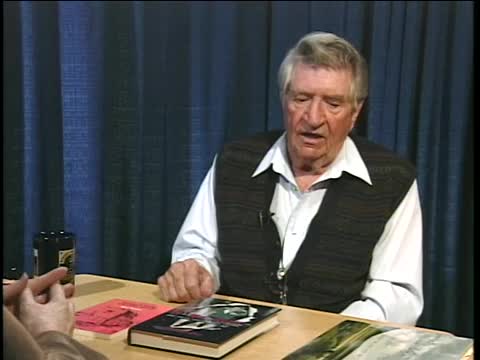
Report from Santa Fe is made possible in part by a grant from the members of the National Education Association of New Mexico, an organization of professionals who believe that investing in public education is an investment in our state's economic future. I'm Lorraine Mills. I'd like to welcome you to report from Santa Fe. Our guest today is Max Evans, cowboy extraordinaire, author, wonderful person, thank you for joining us. Thank you for having me, and look forward to being with you all later. Yes, well, you were with us a year ago when we celebrated the fact that you were given a huge award by the Santa Fe Film Festival, the Luminaria Award, for your contributions to film in New Mexico. And so in a year you've come up with so many more wonderful books, I'd like you to tell us about them. So shall we start with your new autobiography? Sure. It's Baselam Randalls.
It's my biography, took him three and a half, excruciating years to get this down, I'm very, very proud of it. He did a good job, I think, with a complex subject. And it's called Old Max Evans, a biography, the first thousand years, and it has you bursting through the cosmos. Absolutely. Wonderful. As you name it. Yes, yes. So it was three and a half years in the making, it's full of pictures of your life and wonderful stories. It is such a good read, I love this book. Thank you so much. And yet you have another book, too, and tell us about your another book called The High Low Country, and you will be doing a signing of these books in November, right? Yes. November the 14th, it's on Saturday from two to four, at the Albuquerque Museum of Art and History. And it's a grand opening, they've enlarged and done a lot of renovations to the museum. And it's a fine museum to start with, it's going to be even greater now.
And I feel very honored that we're going to open with them, and that we'll have the photographs. It'll be a dozen of the photographs out of the High Low Country book here, showing it will be blown up about 20 by 30, and we'll be signing books there, and I'm looking forward to it. Well, show us a little of the book, The High Low Country, because it's an extraordinary book. That is the High Lonely, I call it The Great Vacant, because it is, and that's the wonder of it. There's so few people, and so much grass, so many animals, and here's, here's one that I love very much, is the grass in the snow, sparseness, and there's so many that I care and make me feel. Well, would you tell us where is The High Low Country? Well, it should also be. Well, also people have to know that you wrote the book on which the wonderful movie The High Low Country was made, and that was filmed in that area.
Yes, it was. Yes. So show us a couple more pictures, if you would. Okay. And the book is called The High Low Country. Not Seven's High Low Country under the one-eyed sky, and I hope people don't get it mixed up with the original book, oh yeah, here's a shop, it's a one-half cow ranch. But that shows the space, and the loneliness, and the wonder of the country to me, I just love it. And in the text you say that no one can get to know The High Low Country in a hurry, that only the wind really knows, tell us a little about the feeling of this land. Well, it's so vast, and it's so well cared for really, and it's full of a wonderful life, it seems so vacant, but it isn't, you know, the air cattle, and there's antelope in the deer, and the grass is richer than most anywhere in the world because of the great volcanic upheels in the early history and ancestry of that land, the land ancestry of the land
not the people, and it enriched the land, all this volcanic dust, and the cattle, and the deer, and all the animals, the bones are about 20% heavier than anywhere else that I know of, in the entirety of the West, just there almost as it was in the very beginning. The loneliness of it that people call the lonely, to me it just soothes the soul, and it's peaceful, even when the wind's blowing, and even when the blizzards come, it's a music to it, and if you look at it and open up to it, really open up to that grand space, it opens your soul, it opens everything about you, and you'll see things that you didn't know you were seeing all the time, you were just looking what you weren't seeing.
Now geographically, it would be pretty much considered the Northwest, the Northeast quadrant of... The Northeast Quadrant, and this book is, first of all, what we call, would be the heart of that country, but it is basically the Northeast Quadrant. It has a little slash of a Southern Colorado in it, and a little bit of West Texas, a little bit of Oklahoma Panhandle, and that's what I've always called a high-low country. And it's called high-low because... Because the emotions are high and low because of the difference in the wind and the beautiful weather, the contrast, you're either up or you're down and you're feeling that way, if it rains or if it doesn't rain, and so is the landscape. The dominant mountain is Sierra Grande, it's a little town of the Moens where I actually located high-low, although I called it village of high-low, but I incorporated Springer and the Simmerone into that little town, the three of them, but that's the location of it.
Also when I first was there, I was a very young man, had a little ranch out there. They had a poker game that they told me had been going on for 25 years, and the main... The favorite game was high-low split, so there's several reasons of high-low. It all seems to fit that country. Now the people that I've met from that country are extraordinary people, extraordinary people. Tell us a little about your experience when you had a ranch there and were a young man ranching, and now when you travel back to photograph their ranches, what are the people like? Well, I didn't do the photography. The last time I went across it was looking for locations for this film, and we drove to 2,000 miles of dirt roads, I call them corrugated roads. So it all became familiar to me again, and every where I went, the people were open and welcome as long as they found out that you had to get intentions, and they were blessing. But this lady, Jan Haley...
She's the photographer. Yes, she's a photographer, and she was born Eric Clayton and went to school there, and we got acquainted in Towson, the writer's symposium, Frank Waters, what it was holding it, and that's where we got acquainted. We found out we were from a high-low country, and she had a similar feeling for that great vacancy. Great vacant, I call it, and I call that a great compliment, as well. It said wonderful space to have to know with all this is around you, and there's so much of life there, and it's a giving country, but it'll make you tough if you stay there. It's not an easy country, but you grow with it, and I've loved it so long, and I would say that almost half of my life's work has been located there one way or the other. Sometimes I'll write a story that will be somewhere else in this great Southwest, and darn it, the people won't wind up somewhere in a high-low country, a little visit or some reason
or other, maybe you get a job, whatever. Well, and you have written so many other books set in the Southwest, I'd just like to mention a few of them. Your book, Madame Milley, by nonfiction book, a wonderful biography of one of the greatest madams in Southwest has now. Oh, yes, she was a jewel of all the earth, and she probably had invented McDonald's in a strange sense, because she had houses from large bird to silver city, where she had a quarter, all the way to catch kind of life's good. But she was highly respected in this state, and she's idealized in silver city right now. She did so much good that she wouldn't actually wouldn't let me tell in the book. She felt like it was bragging over her, and I mean, a lot of things are good things. The good things are left out mostly, just the fun things, but it's a grand adventure with her. And it was grand in terms of the length of time, because I know you started interviewing her in 1978, and the book finally came out in the year 2000.
So these books have only three and a half years each. Yes. Seen a piece of art. Yeah, easy, easy go. Yes, and then you have one more project you've been working on. I'd like you to show us Xavier's or Xavier's falling. Yes, it's a heavy air or Xavier, whichever you choose. Finally, I did this almost 30 years ago, and it was inspired by a true incident in Tows of a plumber, Hispanic plumber, who we'd hired. We had no water in our house, my wife and I, at that time, we were young, young artists. I kept a few horses and a broken horses and a cow there, but we had no plumbing, and he was recommended to us. And one day he told me that he was going to put on a ballet in Tows, that they needed some culture. Now, here's a place full of artists who was founded and famous on artists in the later days, and by God, as he did it, he brought her there and put it on.
But I was already out in the world, and I wasn't there when I was out in California, so I'd come back and look, and he put that thing on. And I did not know it, but I wrote this story, and now Karen Cook from Santa Fe, a second generation Santa Fe in her associate, Lula Johnson III, also from here, they're going to do this next May and June. As a film? Yes. And she's done films all over the world, and she loves independent films, good independent films. And I do believe Lorraine was Paris, Texas, which became a cult film. She was a production manager on that, and in various forms she did attraction in other films. She produced, co-produced, and I have total faith in her bringing off an immortal film out of this.
We've had 30 years of struggle, it's been optioned all over the world, millions spent on it, and they can never get a script, but we really have a good script now, and I am darn proud to say I wrote it. Excellent. Well, you... I'll probably never do another one or not. Never did do a good one in front of it, but this one is a dandy. Well, I look forward to seeing it when it's ready. Really, really proud of it. Now, you do have a very interesting and long career with film. Of course, you've worn so many hats because you were a wonderful painter, and you gave it up for writing, and now you were also Governor Dave Cargo had appointed you, you were one of the first members in the New Mexico film commission, and you have fought all these years to help the film industry in New Mexico. Your own movie, The Rounders, is famous, and of course, the beautiful, recent, high-low country, and now this. But how do you feel about the state's exposure in the world of movies, and because you were there at the inception when you and Governor Cargo said, you know, we should bring movies
here. Talk about that. Well, Arena, I'm glad you mentioned that, because I think it's one of the things it can be, and is becoming the most important industry this state could ever conceive of. We've been very lucky with governors, aren't they enough? They've just about all of them supported the film industry, and it did drop down because of Western. But now, people are becoming aware that we can make any kind of film here in New Mexico. And it's just one of the greatest drills to me to see this expanding and the potential of it is so vast, the contributions to the beauty of our state, the wonder of our people having the courage and dignity and love to back this and support it. I think Governor Richardson has an opportunity to make this an international film center. I believe that with all my heart. And I believe that the most of New Mexico feels the same way.
I couldn't be more excited. And the rounders was made in what year? 1965. And was that your first time you worked with the famous Sam Pick and Pie? Oh, no. We became great friends over the hollow country. He was the first one to option it in 1961. And he called my agent, he'd read it in a slush pile in a studio, which were just manuscripts they'd sold there for people, directors, producers, to peruse, to see if they would not be interested. He discovered it there, an associate of his did, it worked for him, and it said, you better read this. So he called my agent and said, I want to meet the SO, what you call it, that wrote this. And my agent called me in Tows, and he was a young, excitable, and ambitious. And he said, you know, the hottest young director in the world.
He just done a ride to high country, which had failed in this country, and oddly enough, in France they discovered it, and they were around the block for seven or eight blocks. Then they brought it back here, and it became a great cult film. And so he was worshiped, he was being written up everywhere in the world, and I didn't know who he was. I said, who's that guy? He said, well, he wants to meet you, and I said, okay, and talk over the hollow country. So we met in Tahitian, a famous old place in next to Warner Brothers Studio, not far from it in the studio city, at noon, and at two o'clock that night, and there's the, we did, I went to my motel, and he went to Malibu to his home, but we had started a lifelong friendship. And he never got it made. He never did. No, he obviously did over and over, and by the way, I'd like to, he's fixing to have his biggest year among the Immortals, this coming year, they're giving him the biggest prize,
the only one they've ever given at the Cannes Film Festival this year, they're even gave it to Fellini, or Bergman, or Houston, or anybody like that. He's got two great documentaries coming out on him this year, and I'm doing a book on it, my memoirs, not a biography, my personal, very personal memoirs, I'm about half through it. Okay. Now if I can hold it together, it's about like a ride in Madame Millie, right in about this guy. Yeah, you got to wait and see who's out there who can get you in trouble for what? You tell the truth. Yeah, it's fun. He was just as wild as she were, they really reminded me of one another, and he had the same wonderful spirit of adventure both of them. But you have been so blessed to have known so many people like that. Who are some of the influences on you in your life? Who are some of your favorite people? Well, I suppose one of my favorite people that I never met is Federico Fellini, and I named a book after him, I don't know how you can, my biggest, what I think is my best
book, Federico Fellini. I named that after him just to honor him, but I love his films. They open my eyes as this land of the high low country will open your soul the same way. It opened my eyes and my soul with the wonderful adventures he took. The personal part of himself that he was willing to expose in his work. And then, of course, Woody Crumbo was a great powder-waterment Indian artist who is neglected in this sense. He was the first one to successfully paint in oil as an Indian artist, and he opened the doors for everybody, all the Indians of the world to paint American Indians to paint in any form they wanted. And I think he's been neglected about twenty-five years. Yeah, when I met him, he had in Tows, he had over 500 paintings already in museums. And I was really greatly honored that he took me on as his protégé. He took you on as his protégé as a painter, but did he not contribute to your becoming
a writer? Yeah, and I was about three years becoming a really good painter, and I knew it. And we just got into her really pretty good, Pat and I, and I walked in and told her, I said, you know, you may, I may never see you again because I'm going to start writing. She looked at me and said, well, we just now got to where we can feed ourselves, and that's been kind of tough, and you're going to go with her writing. And I said, yes, ma'am, I am. She said, well, when did we start? And so, but he guided me in a strange way into writing, and I didn't even know it. But he recognized something that I didn't recognize. I'd always written a little bit, and I'd published in magazines and short stories, few short stories, a lot of articles. But I just, I had to go do it, and I spent my life doing it. And I think one of the wonderful things about your writing, I can see from your skills
as a painter because you do such, such immediate word paintings. I mean, your locales in all your books are so vibrant and so real, you can practically, you know, hear the wind and smell the dust and smell coming rain. It's just quite extraordinary that painterly way of writing that you have. So, what was the first book you wrote? It was a collection of short stories called Southwest Wind. And my first review that I ever read about myself was done by a book reviewer here at the Santa Fe, New Mexico. And it said, if you read this book at all, start it to end, read to the middle and throw the cock-eyed thing away. Oh, no. So that was the first words I ever read about myself as a writer. So, after that, you only wrote the second half of books. So, I did paint your mouth a little. And I didn't even get mad about that.
I thought that was pretty close to the truth. And anyway, a lot of people would have been defeated right there. And I thought, well, here's where I find out if I'm tough enough to be a writer, Omo Long Terms, not anybody else's terms in this old world, just mine. It's a very selfish thing, but it's the way you have to be if you're going to write and get out of your soul what you've absorbed in truth, real truth. Now, somebody else's truth, and he's sparse truth, visionary truth. And by God, as I was, I'm still here doing it, in the thousand, eighteen years old, and I'm still going after it. The first thousand years. Well, you write the most passionate love stories. High-low country is an extraordinary love story, now and forever, a blue feather felini. They're just great love stories, and yet you're such a cowboy. Well, cowboy and merges the early part of my life, and I was obsessed with Roman Caz for a while, but I knew I wasn't going to ever be any champion, and make a living
at it, or anything. But I liked it, it was a beautiful, it was like music to me, like a symphony calf rope, and a horse, and a rope, and a calf, and yourself, and the rhythm, and it has to be, like music. You know, I'm a musical idiot, so this kind of made up for music to me. And I have no concept of why I went into all these other things, but I suppose that in the end, it had to be. I had to have these adventures to know these truths that I've been trying to write in my whole long life. And they're very spiritual books, too. Yes, I have a lot of deep spiritual experiences scattered throughout that book, there, a lot of them. And I can't help it, they happened. I saw them and observed them. They were very lucky. They were very lucky. I feel very blessed to have that little privilege. And that's what I feel, this lonely land, like this picture book here, when I'm there
in that land, I feel blessed to actually be able to absorb that great space, and visualize what's been there before me, long, long, long before me, and I feel privileged to be there. And this book helps preserve that. And you've also been a participant in preserving another part of the way of life, because you were on the board for the Farm and Ranch Museum, weren't you? Yes, ma'am, in Los Cruz's farm, Ranch Heritage. Which was aptly and wonderfully named in honor of former Governor Bruce King. Oh, yes. And that's great, because he really did help us get that together, and I'm so happy he got that honor. He really deserved it, and a lot of his family had their heart in that. I was stupid enough to spend 16 years, straight years on that, longer than anyone else. I just drove ahead of him enough, and I wanted to see that thing through.
And now I feel fantastic when I go down there and look at that indoor outdoor museum, and the kids out there seeing, you know, how high it is on farms and ranches. And you know, they have art shows, and all kinds of wonderful photography shows. And it's a great thing for the southern half of the state, and eventually the world. And the facility, the museum itself, is so beautiful, set against the organ mountains like that, with the old windmills, and I just think it's an extraordinary accomplishment. So thank you for helping preserve this way of life. Well, thank you for saying it like you did, that was beautiful. Now what else can be done to preserve this vanishing way of life? We only have a few minutes left, there's always so much to talk with you about. Well, I don't know, I have halfway through the memoirs of Sam Paganfall, and I'm going to be there, but I just finished a little bit at a time. I finished a true horse story from the time, and my first horse I was four years old.
We lived in the South Eastern New Mexico at that time, and I was dreaming about, always dreaming about coming to the mountains. I wanted to be around the Hispanics, the Indians, and I had only these ranches, and I had a chance to go glory at a mason, to go to work when I, just four or 12 years old, just 11 years old, got a job on a ranch. And that was my first dream, it came true, you see. And so I thought, well, that horse, that little horse, I had there when I was four years old, I was raised up there on that horse, and it was lonely plains, and it made me think about mountains, I kept looking for a mountain, I loved that country, believe me, I did. But I kept looking for a mountain, and I couldn't sleep when I was around, I've got to go. But I start with the adventures of horses throughout my life, how they, in different ways, not just cow horses, just regular horses riding horses, and how they influence your life and become part of it.
And I figured the same way about dogs and coyotes and all kinds of creatures. I finished that book, I still have to edit it, now I'm going to get a guy, I've got a person in mind to illustrate it, and then I have a book that I dreamed of finishing at Tows, when I was there, a young man, I dreamed I started making notes, it's like blue feathers flinging, almost that long, and it's half finished. I don't know, that's the third neck, it's in line third, it'd be a sure enough great blessing from the massive mystery in the sky, if I could do it with three. I would feel like I completed something. And do they have titles, The Horse Book and The House Book? Yeah, it's for the love of a horse, and it's my best horse story, it was five brand news, and in the Peck and Paul memoirs, it will be called Something Like This, I see if I can remember it, going crazy with Sam Peck and Paul, a director Sam Peck and Paul
and his friends, so that gives me a range of taking lead Marvin and all those kind of crazy wonderful people. And then the one at Tows, Irene, I think you'll understand this, it's called The King of Tows, I think that'll create quite a bit of curiosity because there's been many kings in Tows. That's right. Well, I'm looking forward, and I'd like, I love how you say the great mystery in the sky, and I'm sure that you have the help of that great mystery in finishing these wonderful works. I want to thank our guest today, Max Evans, author, extraordinaire, thank you for being with us. Oh, it's my great pleasure always. And I'd like to thank you, our viewers, for being with us today, on report from Santa Fe. Report from Santa Fe is made possible in part by a grant from the members of the National Education Association of New Mexico, an organization of professionals who believe that investing in public education is an investment in our state's economic future.
Thank you.
- Series
- Report from Santa Fe
- Episode
- Max Evans
- Producing Organization
- KENW-TV, Eastern New Mexico University, Portales, New Mexico
- Contributing Organization
- KENW-TV (Portales, New Mexico)
- AAPB ID
- cpb-aacip-542b7619a3c
If you have more information about this item than what is given here, or if you have concerns about this record, we want to know! Contact us, indicating the AAPB ID (cpb-aacip-542b7619a3c).
- Description
- Episode Description
- Max Evans, cowboy and author, sits down with Lorene once again to talk about some of his new books, including his biography, “O’l Max Evans: The First Thousand Years” by Slim Randles, and “Hi Lo Country: Under the One-Eyed Sky.” He also talks about his experiences in “Hi Lo Country,” his book “Xavier’s Folly and Other Stories,” his work with the New Mexico Film Commission, and his involvement with the Farm and Ranch Museum board.
- Series Description
- Hosted by veteran journalist and interviewer, Lorene Mills, Report from Santa Fe brings the very best of the esteemed, beloved, controversial, famous, and emergent minds and voices of the day to a weekly audience that spans the state of New Mexico. During nearly 40 years on the air, Lorene Mills and Report from Santa Fe have given viewers a unique opportunity to become part of a series of remarkable conversations – always thoughtful and engaging, often surprising – held in a warm and civil atmosphere. Gifted with a quiet intelligence and genuine grace, Lorene Mills draws guests as diverse as Valerie Plame, Alan Arkin, and Stewart Udall into easy and open exchange, with plenty of room and welcome for wit, authenticity, and candor.
- Broadcast Date
- 2004-11-06
- Asset type
- Episode
- Genres
- Interview
- Media type
- Moving Image
- Duration
- 00:28:37.950
- Credits
-
-
Guest: Evans, Max, 1924-2020
Host: Mills, Lorene
Producer: Ryan, Duane W.
Producing Organization: KENW-TV, Eastern New Mexico University, Portales, New Mexico
- AAPB Contributor Holdings
-
KENW-TV
Identifier: cpb-aacip-dcf820d49b5 (Filename)
Format: Betacam: SP
Generation: Master
Duration: 00:27:45
If you have a copy of this asset and would like us to add it to our catalog, please contact us.
- Citations
- Chicago: “Report from Santa Fe; Max Evans,” 2004-11-06, KENW-TV, American Archive of Public Broadcasting (GBH and the Library of Congress), Boston, MA and Washington, DC, accessed April 2, 2026, http://americanarchive.org/catalog/cpb-aacip-542b7619a3c.
- MLA: “Report from Santa Fe; Max Evans.” 2004-11-06. KENW-TV, American Archive of Public Broadcasting (GBH and the Library of Congress), Boston, MA and Washington, DC. Web. April 2, 2026. <http://americanarchive.org/catalog/cpb-aacip-542b7619a3c>.
- APA: Report from Santa Fe; Max Evans. Boston, MA: KENW-TV, American Archive of Public Broadcasting (GBH and the Library of Congress), Boston, MA and Washington, DC. Retrieved from http://americanarchive.org/catalog/cpb-aacip-542b7619a3c