NAACP convention 1980; Part 1
- Transcript
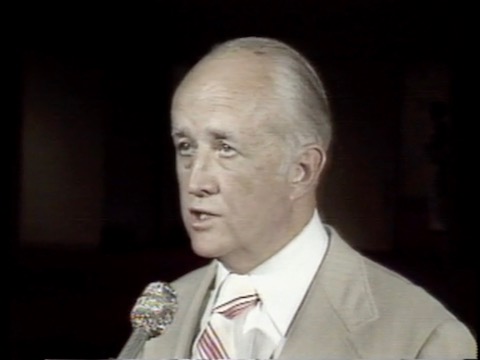
<v Narrator>Major funding for this program was provided by this station and other public <v Narrator>television stations. Additional funding was provided by the Quaker <v Narrator>Oats company. [Intro music] Now <v Narrator>here is host and commentator Carl Rowan. <v Carl Rowan>Good evening. Independent presidential candidate John Anderson came <v Carl Rowan>before the NAACP National Convention tonight with a confession <v Carl Rowan>that most white politicians could make. <v Carl Rowan>But few ever do. <v John Anderson>Let me be very direct.
<v John Anderson>I come from an essentially white community in Rockford, Illinois. <v John Anderson>I have grown up in white America. <v John Anderson>I have not had that many really close black <v John Anderson>friends and that has not been entirely my own choice. <v John Anderson>Indeed, I believe it has been my loss and it may well <v John Anderson>be a measure of our common situation. <v John Anderson>I cannot pretend to know how it feels. <v John Anderson>Day in and day out to be black in America. <v John Anderson>I do not know how it feels to be black and poor. <v John Anderson>And I do not even know how it means to be black and successful. <v Carl Rowan>But Anderson insisted that he knows enough to chart a national course to create <v Carl Rowan>jobs and justice, which he called a great and overriding needs <v Carl Rowan>of this country. He spoke of the recent riots in the Liberty City section <v Carl Rowan>of Miami as a lesson for America. <v John Anderson>It is appropriate that we meet here this evening just a
<v John Anderson>short distance, as we have heard over and over again during this convention, <v John Anderson>a short distance from Liberty City. <v John Anderson>It is a tragic but gripping reminder, as the governor has told <v John Anderson>us and others this evening of the unfinished work which the next <v John Anderson>president of the United States must carry on. <v John Anderson>And it is he the only one who is elected by all <v John Anderson>Americans who must seek to translate America's age <v John Anderson>old promise of equality for all of our citizens into a new <v John Anderson>and meaningful reality. <v John Anderson>[Clapping] And it ought to be clear for all of us to say that if we are going to deal <v John Anderson>with problems like Liberty City, if we are to prevent <v John Anderson>other cities like that from occurring, then we have <v John Anderson>to address ourselves to the basic issues of jobs and justice.
<v John Anderson>But, you know, it isn't enough simply to create jobs. <v John Anderson>We must also create opportunities for human fulfillment <v John Anderson>and career advancement. <v Carl Rowan>Still, there are some important questions about John Anderson's quest for the presidency <v Carl Rowan>that he did not address in his speech. <v Carl Rowan>So in a private interview this evening, I asked the Illinois congressman some <v Carl Rowan>of those questions. For example, does Anderson think that he can convince <v Carl Rowan>these delegates and other Americans that they are not wasting their votes? <v Carl Rowan>If they cast ballots for him? <v John Anderson>And uh I would answer, I think, this way that recent surveys indicate <v John Anderson>that I would take almost equally from President Carter and from Ronald <v John Anderson>Reagan. And I am firmly determined that during the 4 months that remain in <v John Anderson>this election campaign, that I will set forth the kind of positive program <v John Anderson>for this country that will convince people that uh I would be the best of the three
<v John Anderson>candidates. I think without my presence in the race, there's simply by November <v John Anderson>would not be any credible opposition standing in the way <v John Anderson>of the election of Ronald Reagan. <v John Anderson>Jimmy Carter today has an approval rating of 30 percent. <v John Anderson>He's down way back where he was in October before the taking of the hostages. <v John Anderson>He has continued to slide in the polls. <v John Anderson>Reagan has a 10 point lead over him at the present time. <v John Anderson>I repeat, unless John Anderson continues this race and I fully <v John Anderson>intend to do so, I don't think there's any question but what Ronald Reagan would be the <v John Anderson>president come January 1981. <v Carl Rowan>Well now, tell me this. What are you going to offer these <v Carl Rowan>delegates? What are you going to offer black America that the other candidates are not <v Carl Rowan>offering? <v John Anderson>Well, I think Senator Kennedy has offered some programs that would appeal <v John Anderson>to the black community. I haven't seen any evidence to date that either Ronald Reagan <v John Anderson>has done so or that President Carter, who's had three and a half years
<v John Anderson>to prove that he was going to do something. <v John Anderson>Uh he hasn't certainly accomplished the goal of reducing the rate of black unemployment <v John Anderson>from being double that of white unemployment in this country or of teenage jobless <v John Anderson>rates among minority youth ranging as high as 50 or 55 percent. <v John Anderson>I have specifically called for the kind of urban programs that would divert <v John Anderson>8 billion dollars in excise revenues to cities to set up <v John Anderson>first an urban reinvestment fund, a mass transit fund that would <v John Anderson>begin to deal with some of the basic problems of our cities, provide new tax <v John Anderson>incentives to industry to locate and relocate plants in those <v John Anderson>areas where the jobless are actually living. <v John Anderson>I've said over and over again they can't all move out to suburbia, to the nice, neat, <v John Anderson>green, manicured lawns of suburbia. <v John Anderson>Many people are in the city. They're going to stay there. <v John Anderson>And we ought to give the kind of tax incentives to industry to create jobs <v John Anderson>in those areas where the jobless live.
<v Carl Rowan>Now, I'm sure you've heard that Ronald Reagan, who's going to get that <v Carl Rowan>Republican nomination that you wanted, is the only contender who will not speak to this <v Carl Rowan>NAACP convention. <v Carl Rowan>Are you surprised that he's not coming here? <v John Anderson>No, because I don't think he has a program in the first place to appeal to the people <v John Anderson>who are attending this convention. He's called for a tax cut that would give the family <v John Anderson>with an income of 12,500 dollars a 102 dollar <v John Anderson>tax cut a year or 20,000 dollars a year. <v John Anderson>We have some two families with two wage earners where maybe they make $20,000 <v John Anderson>a year. They would get $224, about four bucks a week. <v John Anderson>What is that going to do? <v John Anderson>Really address the problems of the American economy that have led to an unemployment <v John Anderson>rate today of almost 8 percent that have led to the decline of the automobile industry uh <v John Anderson>to the point where one third of the auto workers of this country are out of jobs. <v John Anderson>How many people with two bucks or four bucks in their pockets are going to be able to <v John Anderson>bail Detroit out of the kind of problems that they have today in selling their products?
<v John Anderson>I think his program is simplistic. <v John Anderson>I don't think it really addresses some of the basic underlying needs of the country. <v John Anderson>And frankly, I'm not surprised that he's not here to talk to these delegates. <v Carl Rowan>Congressman Anderson, I thank you very much. <v John Anderson>Thank you. <v Carl Rowan>In the convention hall, Anderson got a firsthand view of the fervor of <v Carl Rowan>black America's demand for jobs. <v Carl Rowan>But he and other Americans surely now know that the anger and the anguish <v Carl Rowan>are much greater in America's ghettos as Rodney Ward of Miami's WPBT <v Carl Rowan>indicates in this report on black despair. <v Carl Rowan>[Song: Ain't Gonna Let Nobody Turn Me Around] <v Carl Rowan>[Song: Lift Every Voice and Sing]
<v Speaker 1>I'd like to see America go a long ways with black folks, but now we are <v Speaker 1>seeing they're going to be very hard, very difficult. <v Speaker 2>I feel like the problem is, you know, that <v Speaker 2>they just don't understand us, you know. Like we all created equal and like, <v Speaker 2>hey, if we can get some justice, man, you know, some equal rights then we can get <v Speaker 2>it. <v Speaker 3>You're white, you're right. You're black, you're out, you know? <v Speaker 3>That's how it go down here in Miami now in the justice system. <v Marzell Smith>The masses of black people who have not been cut in to <v Marzell Smith>the system of rewards have suggested very strongly to our leadership in <v Marzell Smith>this county and in the city and in this nation. <v Marzell Smith>But they are not satisfied. <v Marzell Smith>And they will not just sit back and rest at ease <v Marzell Smith>when they have nothing to rest at ease on and rest at ease about [Song: Lift Every Voice <v Marzell Smith>and Sing] <v Protestor 1>We are going to demand equal
<v Protestor 1>justice under the law. [Cheers] <v Protestor 1>We are going to declare poor people's independence in this country. Thank you, Jesus. <v Protestor 1>[Song: Lift Every Voice and Sing] <v Eula Bell McDuffie>That's alright, let them walk free. But they'll be sorry. <v Rodney Ward>Do you find that you're taking advantage of this situation? <v Rodney Ward>Just why are you selling this T-shirt? <v Speaker 4>I think that this is why we why we're doing this is because we want to make <v Speaker 4>sure that this stays in the people's face. <v Speaker 4>Not all people who already know what I'm talking about, the people that did it. <v Speaker 4>We want them to know. We want to keep seeing it. <v Speaker 4>If we keep seeing that, they might do some about it so it don't happen again. <v Rodney Ward>You're putting a five dollar price tag on an incident that happened... <v Speaker 4>No, we're not putting a $5 price tag, All we're doing is selling a piece of black <v Speaker 4>history. [Song: Lift Every Voice and Sing] <v Rodney Ward>What do you think about your future?
<v Speaker 5>Well, if I stay around here, it won't be too much <v Speaker 5>of it. Because, you know, <v Speaker 5>ain't too much out here, you know, to have a good future about it, so that's what I think. You know, I might have a better chance, you know, if the community lived more decently <v Speaker 5>and everything [Song: Lift Every Voice and Sing] <v Marvin Dunn>America has always been a very racist country and it still is.
<v Marvin Dunn>But I also suggest uh that um <v Marvin Dunn>black people have to confront that reality, have also <v Marvin Dunn>the responsibility for owning some charge to <v Marvin Dunn>ourselves to move ahead in spite of that racism and not to have all of our <v Marvin Dunn>defeats attributed to the fact that the white race is out there who give a darn about <v Marvin Dunn>black people. <v Carl Rowan>One issue that everyone here is discussing is hostility between the police <v Carl Rowan>and black communities. One of the problems is that police forces no longer <v Carl Rowan>reflect the growing minority populations of urban areas. <v Carl Rowan>For example, in Tampa, Florida, there are only 19 black officers on a force of over <v Carl Rowan>500. A few cities have tried to do something about this problem, <v Carl Rowan>and Detroit is a premier example. <v Carl Rowan>For decades, the Detroit Police Department practiced racial discrimination. <v Carl Rowan>In 1974, when Coleman Young became mayor, Detroit's police
<v Carl Rowan>force as a whole was 15 percent black. <v Carl Rowan>And the lieutenant corps? Only 2 percent black. <v Carl Rowan>Detroit's population at that time was 50 percent black. <v Carl Rowan>This disparity and the hostility it created between police and <v Carl Rowan>the black community was a major factor in the Detroit riots <v Carl Rowan>of 1943 and 1967. <v Carl Rowan>Mayor Young and a white police chief started an affirmative action program. <v Carl Rowan>Today, blacks make up more than half the Detroit force and more than 20 <v Carl Rowan>percent of its lieutenants. <v Carl Rowan>A federal judge who upheld the minority hiring program said <v Carl Rowan>that in that program's wake, and I quote, police community <v Carl Rowan>relations improved substantially. <v Carl Rowan>Crime went down. Complaints against the department went down <v Carl Rowan>and no police officers were killed in the line of duty, <v Carl Rowan>unquote. Well, you should know that the Law Enforcement Assistance
<v Carl Rowan>Administration today announced that the NAACP will get a grant <v Carl Rowan>of 381 thousand dollars. <v Carl Rowan>The organization will use the money to conduct an intensive 15 month <v Carl Rowan>survey of police brutality. <v Carl Rowan>The police foundation will assist the NAACP in its analysis. <v Carl Rowan>Earlier today, reporter Rodney Ward talked to Police Foundation <v Carl Rowan>President Patrick Murphy about the purpose of the police brutality <v Carl Rowan>study. <v Patrick Murphy>The National Office and the Police Foundation uh will be <v Patrick Murphy>uh providing materials for NAACP members in cities <v Patrick Murphy>across the country, especially on the West Coast and in the southeastern <v Patrick Murphy>region of the country. Uh and that will um <v Patrick Murphy>enumerate the questions they should take to their police departments and their police <v Patrick Murphy>chiefs about the use of deadly force by the police in order <v Patrick Murphy>to get the information that will then permit them to compare
<v Patrick Murphy>how good or bad their department is with other departments. <v Patrick Murphy>There are some police parts of the country that have done a great deal of work on the <v Patrick Murphy>problem of deadly force and have a very low rate of shootings <v Patrick Murphy>by police officers. There are other cities and have much, much higher rates <v Patrick Murphy>of shooting by police officers. We hope this project will bring bring the departments <v Patrick Murphy>with the bad records closer to the level and the standards of <v Patrick Murphy>the departments with the good records. <v Interviewer>So in other words, you're going to be devolving questions so that local groups can go to <v Interviewer>their police officers, to their police department and ask them questions that <v Interviewer>would elicit the kind of response that would let them know just how responsive these <v Interviewer>departments are in terms of the use of deadly force. <v Patrick Murphy>That's uh precisely what this project will do. <v Patrick Murphy>And uh there is a great deal of mystery about this <v Patrick Murphy>subject of useful force by the police as well as deadly <v Patrick Murphy>force as well as there is a great deal of mystery about too much
<v Patrick Murphy>of police work, as some of this mystery is quite unnecessary <v Patrick Murphy>and we'll be reducing that level of a mystery. <v Patrick Murphy>We hope so that people will have a better understanding of the problem and <v Patrick Murphy>be able to propose solutions that will reduce the problem. <v Interviewer>Once we've learned out where a police department stands where and then comes the <v Interviewer>accountability as to make changes? <v Patrick Murphy>And there's no simple answer to that because <v Patrick Murphy>there are police departments in the country, I'm sorry to say, that are not very <v Patrick Murphy>accountable either to the citizens or the elected officials <v Patrick Murphy>or the elected council or to the news media. <v Patrick Murphy>But there will be a new opportunity now for the news media, for citizens, <v Patrick Murphy>for elected officials. <v Patrick Murphy>To evaluate their departments on the basis of <v Patrick Murphy>this information, which has not been available up until now. <v Carl Rowan>In workshops today, delegates grappled with some other important issues <v Carl Rowan>like affirmative action. These delegates, stunned by yesterday's abortion
<v Carl Rowan>ruling by the Supreme Court, are wondering if another bad shoe is about <v Carl Rowan>to be dropped in the wake of the Barki case, dealing with affirmative action <v Carl Rowan>in education and the Webber case dealing with job training and promotion <v Carl Rowan>programs. Delegates wait for the court to rule in the full alert case. <v Carl Rowan>The simple issue is whether Congress may decree that 10 percent <v Carl Rowan>of funds appropriated for public works programs be set aside <v Carl Rowan>for minority contractors. <v Carl Rowan>Here are Rodney Ward and Sharon Stevens with summaries of today's workshop <v Carl Rowan>activities. <v Rodney Ward>America has moved toward two societies one white, one black, separate <v Rodney Ward>and unequal. That, according to NAACP, director of research policy <v Rodney Ward>and plans, Michael Meyers. <v Rodney Ward>Meyers told delegates gathered to discuss crises in urban America that there exists <v Rodney Ward>two separate classes, particularly in America's large cities. <v Dr. Michael Meyers>As a result of years and years of racial discrimination and economic exploitation,
<v Dr. Michael Meyers>we have an underdeveloped black community and an overdeveloped <v Dr. Michael Meyers>white community, an underclass and <v Dr. Michael Meyers>an upper class. This is a fact. <v Dr. Michael Meyers>And despite all the talk about a new south and rhetoric <v Dr. Michael Meyers>about human rights and more rhetoric about the progress made for blacks <v Dr. Michael Meyers>as a result of 40 years of civil rights activism on the part of the courts <v Dr. Michael Meyers>and the Congress, it seems clear that America, <v Dr. Michael Meyers>as a Kerner Report warned, has moved toward two separate societies <v Dr. Michael Meyers>one black, one white, separate and unequal. <v Dr. Michael Meyers>Life in the Harlem's to the South Bronxs <v Dr. Michael Meyers>in the Newarks in the Watts in the Liberty Cities <v Dr. Michael Meyers>remain for the masses of blacks just as drab <v Dr. Michael Meyers>as 12 years ago, if not more so.
<v Rodney Ward>Florida International University sociologist Marvin Dunn, speaking about the recent <v Rodney Ward>racial violence in Miami, said that what happened here was not unique, but a part of <v Rodney Ward>America's tragic treatment of blacks. <v Marvin Dunn>Miami's tragedy is America's tragedy. <v Marvin Dunn>What happened here could have happened any place in this country in 1980, given the <v Marvin Dunn>existence of perhaps even a more serious degree <v Marvin Dunn>in other places, the same problems that were outlined in the so-called kind <v Marvin Dunn>of report. It was not the refugee problem. <v Marvin Dunn>It was not the failure of the local black leadership, was not competition between <v Marvin Dunn>blacks and Hispanics as you've read in the press. <v Marvin Dunn>It was not the press coverage of the case. <v Marvin Dunn>It was not the weather. It was not the tooth fairy. <v Marvin Dunn>It was the utter collapse of our system of justice <v Marvin Dunn>and the widespread belief in the black community that
<v Marvin Dunn>a vicious crime against an innocent black person had gone unpunished. <v Marvin Dunn>And that is why people went to the streets. <v Marvin Dunn>McDuffy killer, you must understand it, was a thing <v Marvin Dunn>taken quite personally by a great many black people in this town, including myself, <v Marvin Dunn>because the killing of McDuffy merely reaffirmed our individual and <v Marvin Dunn>collective vulnerability. It said to us, this could have happened to you. <v Marvin Dunn>And I think that that in part explains the particular viciousness <v Marvin Dunn>of this riot. It was an act of revenge. <v Rodney Ward>Dunn, who delivered much the same message to a congressional subcommittee last week said <v Rodney Ward>the message fell on deaf ears. <v Marvin Dunn>When I made the statement before the Congress made it without any illusions <v Marvin Dunn>about what they would do. That Congress will not hear these <v Marvin Dunn>screams from Miami. Why should they when they did not hear the screams
<v Marvin Dunn>from Watts and from Detroit and from Newark? <v Marvin Dunn>Congress doesn't care because really, when you look at it, the American people don't care <v Marvin Dunn>what people will tell you when you talk to them about the plight of black people, what <v Marvin Dunn>plight of black people, Indians are the only ones supposed to have a plight. <v Marvin Dunn>We solve the people's problems back in the 60s. <v Marvin Dunn>Don't y'all remember? <v Marvin Dunn>The War on Poverty? <v Marvin Dunn>Civil rights bill? Don't y'all remember that? We took care of you. <v Marvin Dunn>Black people ought to be doing pretty well, they say. <v Rodney Ward>Dunn says that white Americans belief that black America is doing fine is totally <v Rodney Ward>incorrect. He said he has faced the reality that throughout the remainder of <v Rodney Ward>his lifetime, life in this country will continue to be contaminated by <v Rodney Ward>racism. But Michael Meyers of the NAACP held out hope for black America, <v Rodney Ward>saying a deepening racial split in this country can be avoided if we as a nation
<v Rodney Ward>pursue a course of full equality of races. <v Rodney Ward>I'm Rodney Ward. <v Sharon Stevens>More than 100 people, many lining the walls, attended the workshop on affirmative action. <v Sharon Stevens>And what they heard is that the fast train to equality in the marketplace is in the <v Sharon Stevens>process of derailing. Affirmative action is America's way of redressing <v Sharon Stevens>historic inequities in the hiring and promotion of non-whites. <v Sharon Stevens>It provides preferential treatment for blacks and other minorities. <v Sharon Stevens>But that process is increasingly threatened by whites who claim affirmative action is <v Sharon Stevens>reverse discrimination. The Adam Barky decision is a major case in point. <v Sharon Stevens>Dr. Bernard Anderson, a vice president with the Rockefeller Foundation and a workshop <v Sharon Stevens>panelist, outlined the progress of affirmative action programs in the preceding decade, <v Sharon Stevens>charging that the occupational upgrading of blacks came to a screeching halt <v Sharon Stevens>despite a variety of new programs aimed at equalizing minority employment. <v Bernard Anderson>We are spending now somewhere in the neighborhood of 15 to 20 billion dollars a year
<v Bernard Anderson>on manpower and related programs. <v Bernard Anderson>And yet there has been no significant change in the occupational position <v Bernard Anderson>of blacks with respect to the occupational status or the unemployment rate. <v Bernard Anderson>And so there is something wrong in the way our public policies are operating. <v Bernard Anderson>That uh demonstrates that no matter how much money seems to be spent in these <v Bernard Anderson>areas, there is no improvement in the relative position. <v Bernard Anderson>I don't have the answer to that. But it seems to me that that's one thing that we can <v Bernard Anderson>point to very clearly. That did not happen during the 1970s <v Bernard Anderson>that we are going to have to look at very carefully to be sure that that does not happen <v Bernard Anderson>during the 1980s. <v Sharon Stevens>Anderson added other factors worked against blacks, primarily <v Sharon Stevens>the increased hiring of white women who often view themselves as a minority. <v Sharon Stevens>Anderson added other factors worked against blacks, primarily the increased hiring of <v Sharon Stevens>white women who often view themselves as a minority. <v Sharon Stevens>The other panelists expressed similar views, as did audience participants.
<v Sharon Stevens>Much of corporate America and many government agencies are participating in the <v Sharon Stevens>convention's commercial exhibition and they are highlighting their equal opportunity <v Sharon Stevens>programs. It's a visible step in the affirmative action process. <v Sharon Stevens>The next step, accountability, is more difficult, though, because it requires <v Sharon Stevens>more commitment. And judging by the continuing complaints of job discrimination <v Sharon Stevens>and the high black unemployment rate of corporate America and the government still <v Sharon Stevens>have a long way to go from the convention center this is Sharon Stevens reporting. <v Carl Rowan>Senator Edward M. Kennedy, who's still fighting for the Democratic nomination, <v Carl Rowan>will plead his case to this convention tomorrow. <v Carl Rowan>We'll be here tomorrow afternoon and tomorrow evening to report on his speech <v Carl Rowan>and his reception. We hope you will be watching. <v Carl Rowan>Good evening. [Song] <v Narrator>Major funding for this program was provided by this station and other public
<v Narrator>television stations. Additional funding was provided by the Quaker <v Narrator>Oats company. <v Narrator>This program is made possible by grants from the Bureau of Education
<v Narrator>for the Handicapped and from International Business Machines <v Narrator>Corp. [Intro music]
- Program
- NAACP convention 1980
- Segment
- Part 1
- Producing Organization
- Public Broadcasting Service (U.S.)
- WPBT-TV (Television station : Miami, Fla.)
- Contributing Organization
- The Walter J. Brown Media Archives & Peabody Awards Collection at the University of Georgia (Athens, Georgia)
- AAPB ID
- cpb-aacip-526-br8mc8sh7k
If you have more information about this item than what is given here, or if you have concerns about this record, we want to know! Contact us, indicating the AAPB ID (cpb-aacip-526-br8mc8sh7k).
- Description
- Program Description
- "Live and videotape coverage for PBS of the 1980 Convention of the National Association for the Advancement of Colored People, held in Miami Beach, Florida, June 30th to July 4th, 1980. The coverage included live broadcasts from the convention floor as well as videotape reports from locations throughout Miami. Analysis and interpretation of the convention was provided by award-winning nationally syndicated Chicago Sun-Times correspondent, Carl Rowan. The series included a live hour each afternoon, a half-hour of highlights each evening, and a one-hour summary of the week's events. "The 1980 NAACP Convention occurred shortly after the devastating racially oriented riots in the Liberty City area of Miami and during the developing Presidential campaign. Issues ranging from inflation and unemployment to equal opportunity in education and employment predominated on the national scene. It was the intent of the broadcasts to report and interpret the convention events within a broad context to give viewers perspective on how the issues dealt with by the delegates affected the concerns, not only of black Americans but all Americans. In short, convention coverage was designed to reach as diverse an audience as possible, relating the events to their own interests and concerns, with an emphasis on interpretation and analysis. The specific audience was a wide group who might not ordinarily have been interested in the specific activities of the NAACP but who would watch if those activities were related to important national issues and the developing presidential campaign. Measured in terms of letters and phone calls, the response to the broadcast, especially the one-hour final report and overview, was exceptionally positive and definitely seemed to reach beyond those who had a special interest in the NAACP to those who found the programs enlightening for their general content."--1980 Peabody Awards entry form. The coverage of this convention, reported by Carl Rowan, includes exclusive interviews with Congressman John Anderson, educator Marzell Smith, sociologist Marvin Dunn, Police Foundation President Patrick Murphy, and US Department of Labor secretary Ernest Green. Reports from Sharon Stevens and Rodney Ward give audiences an inside look at the convention including interviews with NAACP executive directors Gloster Current and Benjamin Hooks as well as with some of the protestors in the 1980 Miami riots. At the studio, Rowan himself hosts a few guests such as activist Ruth Bates Harris, NAACP council member Thomas Atkins, and Reverend Charles Smith. The program also includes footage of speeches from NAACP board members such as Dr. Michael Meyers, attorney Althea Semmons, Margaret Bush Wilson, Rayford Logan as well as other leaders in other important organizations such as the director of the Defense Communications Agency Samuel Gravely, Donald Shelton of the National Black Veterans Organization, Colonel D. R. Butler of the Army Discharge Review Board, and Ernest Green of the US Department of Labor. Because it is an election year, the convention importantly hosts speeches from presidential candidates including former President Jimmy Carter, Ted Kennedy, and John Anderson that concern their policies and ideas on black issues in America.
- Broadcast Date
- 1980
- Asset type
- Program
- Media type
- Moving Image
- Duration
- 00:35:35.900
- Credits
-
-
Stevens, Sharon
Ward, Rodney
Rowan, Carl
Director: Carpenter, Richard
Executive Producer: Morgan, Shep
Producer: McIntosh, Clarence
Producing Organization: Public Broadcasting Service (U.S.)
Producing Organization: WPBT-TV (Television station : Miami, Fla.)
Writer: Rowan, Carl
- AAPB Contributor Holdings
-
The Walter J. Brown Media Archives & Peabody Awards Collection at the
University of Georgia
Identifier: cpb-aacip-272cbc5b651 (Filename)
Format: U-matic
Duration: 4:00:00
If you have a copy of this asset and would like us to add it to our catalog, please contact us.
- Citations
- Chicago: “NAACP convention 1980; Part 1,” 1980, The Walter J. Brown Media Archives & Peabody Awards Collection at the University of Georgia, American Archive of Public Broadcasting (GBH and the Library of Congress), Boston, MA and Washington, DC, accessed May 30, 2026, http://americanarchive.org/catalog/cpb-aacip-526-br8mc8sh7k.
- MLA: “NAACP convention 1980; Part 1.” 1980. The Walter J. Brown Media Archives & Peabody Awards Collection at the University of Georgia, American Archive of Public Broadcasting (GBH and the Library of Congress), Boston, MA and Washington, DC. Web. May 30, 2026. <http://americanarchive.org/catalog/cpb-aacip-526-br8mc8sh7k>.
- APA: NAACP convention 1980; Part 1. Boston, MA: The Walter J. Brown Media Archives & Peabody Awards Collection at the University of Georgia, American Archive of Public Broadcasting (GBH and the Library of Congress), Boston, MA and Washington, DC. Retrieved from http://americanarchive.org/catalog/cpb-aacip-526-br8mc8sh7k