Oklahoma Passage Telecourse #106 Native Americans - Unit 2, Lesson 1
- Transcript
. . . . . . . .
. . . . . . . .
. . . . . . . . . . . . .
. . . . . . . . . . . . . . . . . . . . . . . . . . . . . . . . . . . . . . . . . . .
. . in there, and they soon met. What do you think, Jesse? They know we're here. Hey, Otto. We made enough noise coming down from Baxter Springs. I don't matter. When that's some way, do we got 3,000 men? Looks like they're going to send out a patrol. Give me those, man. Yeah, they're coming all right. Give the order, Cole. Well, why do I get the trees and find out how much I know? Benton, you stay with me. Take the squad.
It's got north, down to the river. You report back to me. Do you understand? Yes. OK, man, you heard the lieutenant. We're going to head down to the ravine, take the back way. Stay five or six yards apart. Follow me, I'll lead the way. Don't move, too, as he says. We're going to die. Don't make a move, soldier boy.
So help me out, Santa Bullock, through your skull. Well, well, well. Looks like your boys were a little hard to hear him. Yeah, it's your face, my heart. That's kill all you boo-bellies like this. You ain't got a heart. Shut up. You know who I am. I suppose you tell me how much strength that colonel's got in that fort. Glass just killing him.
Wait. No sense in you fellas having all the fun. Let me do it. And do it, Ben. He's already been shot. Can't keep blood. What do we got? Wait, he's wore your thirsting for a little blood? I'm going to hang him. Yeah. I reckon every man oughta have the chance to be hung at least once in his life. God wouldn't want a men hung. He wouldn't have made neck. Hurry up, Chief. I want to enjoy this. Ben, you're fine.
The only way to let him go, the way he finds him, is to have a scout for sure. Yeah, that's all right. I don't think I got him anyway. Joseph, you're his. What? Why don't you say something? No. No. No. You saved my life. I won't forget it. Eventually, the war came to an end.
Stand wait, he was the last Confederate general to surrender. So many people had died, it had been like one long funeral. John? John? John? John? John?
Well, John came home, but the war had changed him. In his mind's eye, he still carried the images of the men who had killed his brother, and he vowed revenge. It wasn't long before the little world of Park Hill began to close in on him. John, I take this. John, we're a family.
We need to stay together. Jess? Jess, our family will never be together again. John, please don't go. Stay with us. It's nothing for me here, Jess. You know that. You be sharing right now.
You can count on it. John rode into Texas in search of the faces that haunted his dreams. Why Texas? John took a job on the Johnson Ranch to herd cattle north up the Chisholm Trail. A hundred years later, one of those Johnson's would be the President of the United States of America. Lyndon Johnson? LBJ. The Johnson's had the biggest cattle driving operation in the Texas Hill country. This was all once a great highway. If you had stood here a few years after the Civil War, you would have seen a river of cows stretching as far as the eye could see. You know, John Benton once said that he saw 27 herds of cattle.
And in each of those herds, there were sometimes as many as 6,000 head of cattle. From down in Texas, through Indian territory, to railheads in Aveline, Dodge City in Wichita, Kansas, in five years, more than a million head cattle came by here. It was known as the Chisholm Trail, named after an old Scotch Cherokee trader. You could hear the thundering of lawn horns miles away, like a freight train. Never heard a cow that sounded like a train. Huspo. There's a lot of good men head up to Chisholm Trail.
Most of them fought for the south during the war. Charlie Good Night, Shanghai Pierce, Sam Averick. The war's left a scar for us all, but for some reason folks forget when they're heard in cattle and branded calves all day. The work is hard and long. Water scares and dust plentiful. We settle into a routine. Everybody has a job and knows just what to do. I guess the best man in the mall though is Jake Henry Jefferson. Never met a man who could work better, play harder, or fill the days with more life. He was born in a slave cabin in Tennessee. He rode to Dodge City when he was 15, and he's been working the trails ever since. What's this? A few days ago we crossed the Red River in the Indian Territory and came upon a small band of Indians. I hear the Cherokees in the east charge ten cents ahead for cattle crossing their land.
And further west the Comanche had been known to take the whole herd. Why hey, we come in peace to cross your land. What do you want? Too much. E sati. Three. Woo ha. To cross. Ha ho hanana he. And then we moved on toward Abilene. Cute.
But you would think that they would drive those cattle around town instead of driving them right down Main Street. But people around here are getting sick and tired of the smell. Well, last season it drove almost a hundred and twenty thousand ahead. Right down Main Street. Business is doing it. Oh, I'm not complaining, man. Well, I'm not complaining. Why, they're taking one down to the railroad down there and they haul them off the market. Just, well, it's the smell. Ha ho hanana. Oh, stinking cowboys come in here wanting to shave before they ever take a bath. Now, who said it was right? For a man to have a shave before he took a bath. Now, why couldn't they take a bath? And then come in here for a shave. At least then I wouldn't have to smell you. Go ahead, Curly.
Tell John here what you did before you were a barber. It's not our house. Yeah, sir. Well, I can skin a side of beef faster than any man west of the Mississippi. Uh, I think I'll wait a while. Maybe I will take a good bath first. You're next. I guess every man has to settle down sometime. Maybe my time is now. I'd hate to lose you, John. Got a big drive coming up. You're one of the best men we got. Got to deal with Charles Colcord, one of the biggest cattle bosses in the new territory. Up the good night, loving trail to shine.
I don't know, Jake. Been thinking about going home. It was posthick and Jessica could use some help. Even though I fought the white man's war and I drive the white man's cattle. I'm still a Cherokee. My heart belongs with my people. If it's Indian territory you crave and you better hurry up. It won't last forever. It's just a matter of time. When the land is gone, what becomes of you? What then? I don't know, Jake. I don't know. I guess I can always come back here. Spiders.
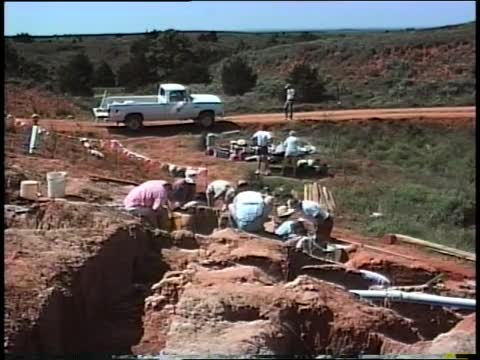
I hate them. Oklahoma, straddling the line that separates the great plains from the wooded lowlands, has always been a crossroads for people, whether it was cowboys pushing long horns up the cattle trails or osage warriors following buffalo across the plains. It's a story that began more than 11,000 years ago when neolithic men and women first crossed this land in search of game. In many ways, the traditions, technologies, and social systems of today's tribal groups can be traced to those early nomads. To provide a portrait of these prehistoric Native Americans, we go now to Dr. Don Wyckoff, director of the Oklahoma Archaeological Survey. As an archaeologist, I find Oklahoma extremely fascinating to work in, because we have good indications that we've had people here going back at least 11,200 years ago, out of these finds of places where people have hunted and killed ancient,
now extinct kinds of bison, as well as elephants. These folks were extremely adept at hunting animals. They brought with them when they came to the New World. They brought with them a technology right out of the Paleolithic of Asia and Europe. And we're quite excited about the possibilities of tracing man's or human Native American heritage back here in Oklahoma. One of the things that's been very, very exciting to us is the fact that we have a location in Northwestern Oklahoma, up in Woods County, that may prove that people were here at least 25,000 years ago. We haven't proven it yet, but we have found artifacts in a situation where we never should have found any sign of people. And it's one of the sites that we'll be devoting a lot of attention to in the forthcoming years. I think one of the things that makes Oklahoma truly fascinating in terms of looking at the Native American heritage is the fact that there is a long heritage here.
There's evidence that lots of people have lived here over at least 600 generations. They develop societies that were in tune with nature and were able to sustain themselves much longer than we our society has been here. And the fact that they could do this is largely, I think, based on the fact that Oklahoma is lies in an ecological transition zone between the woodlands and the plains. And even though the climate has changed dramatically over the last 10,000 years, those zones fluctuate back and forth, east and west. So there's always been a mixture of plants and animals that one would find in the plains and in the woodlands, and these folks could find something that would be dependable on which they could live. The earliest folks that we have here, one of the things that strikes we archaeologist as remarkable is their ability to work, flint, and chert and make it into the kinds of tools they need to hunt these large game animals. They literally could take blocks of flint the size of a man's head and slice it, actually working it with hammer stones and antler billets that slice it into bacon-like slices from which they could make knives and spear points and scrapers and all kinds of implements that they would need in order to survive and in order to successfully hunt.
And they were very good at hunting. They could take on a large elephant, they could take on several large elephants at one time and kill them. And we actually have a site just barely into the Texas Panhandle where about 10,500 years ago a small band of these hunters killed 55 bison in one setting. And how you could do that with spears and without horses being on feet, it's truly a remarkable success and it's something that just boggles our minds in terms of understanding how they could do it, but they did it. Very, very good hunters, very well adapted to a hunting gathering way of life. The cultural developments that we see in Oklahoma around AD 1200 are the culmination of a series of developments. We believe that pertain to Cado and speaking people.
We believe that these folks settled in the Washtetaw Mountains of Southeast Oklahoma and adjacent parts of Arkansas and Texas and Louisiana as much as 5 or 6,000 years ago. At that time they were principally hunters and gathers and they eventually spread out from there. So we tend to think of at least I think of Oklahoma and Texas and Louisiana and Arkansas as kind of a staging ground for the spread of these Cado and speaking trucks. And I'm referring to groups such as the Cado Adacho, the Nananseho, the Anadarko, who were members of the Hassanai who were part of what we now call the Cado tribe. But we also had groups like the Kichai and the Waco and the Washtetaw and the Tiavias and the Skani who were parts of the Washtetaw tribe as we now recognize them today. And likewise at some point groups even as far away as the Pawnee who were residing in Nebraska and the Erickera who were in Southeast South Dakota speak Cado and must have come out of this area of Oklahoma and Arkansas and Texas and Louisiana.
These folks in contrast to many people's understanding the prehistoric people who resided in Oklahoma did live sedentary lives, they weren't all buffalo hunters, they weren't all nomadic hunters of game. Those that I've talked about, the four major groups in Eastern Oklahoma and along the Washtetaw River and Central Oklahoma and the Beaver River and the Oklahoma Panhandle lived in small villages, sometimes as many as 15 houses. They were permanent dwellings, those in the Eastern part of the state typically being made from upright poles where brush was woven, brush and cane would be woven in and around that and then they would have the very tall post that supported a steeply pitched grass that's rough such as we see here. These are very effective types of dwellings, they're very cool in the summertime, the steeply pitched roofs quickly shed rain, the roof would have been covered with cane or grass, they're very cool in the summer as I mentioned and with a very small fire in the winter time they're very warm.
We rebuilt one of these at Spiro Mound State Park which is Oklahoma's only archaeological park and several of the archaeologists stayed in the dwelling in November of a very cold winter and kept quite warm. These were folks who, as I say, were very complexly developed, they were participating in religious practices, ceremonies that were also participated in by groups clear to the east coast of Florida. These folks were carrying on trade with Native Americans who lived on the west coast of Florida, the people at Spiro Mound's for instance were obtaining large conkshells from which they made ceremonial drinking cups and ornaments.
They were getting copper from the Lake Superior Region, also copper from Northern Alabama and Northern Georgia, raw materials for Flint and other things like that from as far away as Northwest Kansas. We're carrying on long distance trade with other complexly complex societies throughout the southeast United States and the southern plains. The achievements of the Spiro people and the material remains they left behind provide a unique window to describe the most accomplished prehistoric indians of Oklahoma. From approximately 800 to 1200 AD, the Catoan-speaking people of the Southern Mississippi Valley developed a remarkable civilization that rivaled anything found in medieval Europe.
Freed from subsistence farming by plentiful rains and rich harvest, the Spiro people found time to perfect crafts, produce prized artwork and develop new technologies, trade flourished and religion became more complex. At the epicenter of these new activities was a community located on the Arkansas River near the present day town of Spiro. By a thousand AD that one city, its name lost to time, had more than ten thousand inhabitants larger than Paris or Berlin at that time. Like the Anasazi, their cultural and technological equals to the west, the Spiro people began a slow decline in the 1200s as the climate changed. A drought cycle, coupled with overuse of local resources, may have been the reasons for the decline. We do know that the large cities were abandoned and the Catoan peoples scattered to smaller villages along the rivers and creeks of the region.
Forced by hard times to resume subsistence farming and hunting, skills in artwork and crafts suffered while surpluses for trade disappeared. By 1541 and the journey of Coronado, the widely dispersed bands of Indians in the region were known as the Wichita. For a description of these people, we turn to historian Dr. Howard Meredith. My name is Howard Meredith. I teach at the University of Science and Arts of Oklahoma in Chickachay. My interest is with the Southern Plains Indians in Oklahoma of all of the tribes, the 36 federally recognized tribes that still exist in the state, the one tribe that has lived here for thousands of years before any other, the Wichita. This is a Wichita-fatched house, a miniature of a fatched house behind me. They were an agrarian people who ventured onto the plains so long ago.
It was before the horse. Before the horse culture was introduced, they were very successful in their intensive farming methods. They raised corn and squash. They grew surpluses in fact that they stored in caches. They also used it in trade ultimately when the other tribes emerged onto the plains. The Wichita were fierce protectors of their homeland when threatened from the outside. They were in time threatened by the Apache, by the Spanish and others, and they successively defeated them. But disease took its toll with the Wichita. Smallpox, measles, there was no built up immunity, and so literally thousands of people were carried away in these plagues. By the beginning of the modern period, the Wichita began to feel the pressure from other tribes as they emerged onto the plains, and as the horses from the Spanish expeditions began to be bred by the Indian tribes themselves, other tribes began to come out of the Rocky Mountains.
First, the Comanche. They were accomplished horsemen, probably the finest horsemen in the world. They came onto the plains, made alliance, a lasting alliance with the Wichita, and there was a symbiotic relationship that was important. The Comanche traded with the Wichita for foodstuffs, tobacco, other items, and in turn the Wichita received buffalo hide and other materials that the Comanches could provide. In time, the Comanches were followed by the Kayawa and the plains Apache that came from further north in the Rocky Mountains down to Rainy Mountain. Scott Mamade has recorded a way to Rainy Mountain as one of the finest traditional tales of migration history. The Apache were always in close alliance with the Kayawa, but they never took on their language. They have a distinctive culture, and so they remain separate themselves. They are known today as the Apache of Oklahoma.
These tribes that came to the plains of their own volition lived here throughout the modern period, and what is essentially a golden age. There were 10 million buffalo that migrated up and down the Great Plains. It took maybe one or two buffalo to feed a family for a year and provide for them, so the economy was extraordinary. When the European trade goods came in, the Wichita centers became centers of trade and exchanged places of exchange of information. So it was a wonderful life, and people still look back on the tales are welcomed from that period. The other tribes that emerged onto the southern plains were forced here by the United States and really appeared in the 19th century.
The US Army moved the Kato tribe and the Delaware, which became the Delaware Western Oklahoma, north from a reservation in what is now Texas. The Cheyenne and Rapahole were forced after the battles of San Creek and other places into their reserve in what is now on Northwest Oklahoma. From approximately 1600 to 1850, the southern plains tribes flourished during what has come to be called their golden age. It was a time when Spaniards and Frenchmen were welcomed for their trade goods. It was the age of the horse acquired from Spanish conquistadores and quickly adapted for more efficient hunting and rating. It was the age of the buffalo, spreading an indescribably large herds north and south across an ocean of grass.
The cumulative effect was prosperity for the Cheyenne, Rapahole, Comanche, Caiwa, and other tribes of the open plains. Ironically, the forces that created that era of prosperity, European contact, the richness of the plains were also the agents of change that ended their nomadic way of life. At the 1850s, American settlers were pushing out onto the plains of Kansas and Texas, challenging the tribes' claims to the lands. Railroads pierced the frontier, opening new markets for cattlemen, buffalo hunters, and merchants. When the inevitable clash of cultures flared in bloodshed, the military was sent in to defeat the tribes and push them onto reservations. By 1874, the bloody task was complete. Once on the reservations, with the buffalo gone, the former nomads were targets of cultural genocide, agents ignored leadership customs, attacked religious ceremonies, and tried to turn their wards into farmers. This revolutionary conversion was followed quickly by allotment in the 1890s and the attempted assimilation of Indians into mainstream America.
By 1907, the old ways nomadic hunting were gone, and the momentary protection of the reservation was gone with it. Although the reservations had vanished, the Indians had not. On their individual allotments, typically munched together along the river courses, they held on to many of the old ways and adapted to new. Dr. Howard Meredith talks about this new age of adaptation. I think it's important to note, although much of our focus is on the past, that these very same tribes, the eight tribes that I mentioned, are in existence today. And they're vitally important to the economic development, the political development of Oklahoma and the surrounding region. Oklahoma is in a privileged place in that it has these governmental entities that can help them come out of economic doldrums. They have access to money. They're the only legal entity in the United States left that can still issue double tax exempt bonds.
They bring in money for educational impact aid in lieu of taxes. Besides the money that can be brought in in terms of loans and additional federal aid, they have their own money that has been invested for them in the trust relationship with the United States. All of this is vitally important as it turned over in the economy again and again and again in Oklahoma. We'd be in desperate sprites if we did not have that. Military spending, spending in terms of the tribes, are vitally important to Oklahoma's economy and will become increasingly so as we see tribal industries grow. They're clothing manufacturing. The Comanches have clothing manufacturing concerns in the Lawton area today. The Delaware are working to do space age technology in terms of new types of refrigeration units. So there are a variety of businesses that are being built up. They employ all kinds of people that are in the region, Anglo, Indian, African Americans.
So the tribes are in a period of real growth and an increasing responsibility. As we noted, the Indian policy of the United States is flip-flopped over the years. We've gone through reservation policy, allotment policy, the efforts to revitalize the government in the New Deal period, termination after that. Finally, we're to a government-to-government relationship that is founded in the basis of international law in the way the United States found these tribes. The United States is a nation of law. I think that's important that we continue to recognize that. I would hate to end up with any other alternative. The tribes have the responsibility for their own being. These tribes are negotiating now with the federal government so that they can take over their aid. That is an obligation one way or another, whether it's treaty or whether it's legislation or whatever. From the United States government, and they will be accountable for that. They will expend it. They will account for it just as Israel accounts for the money that goes into their aid.
And it's approximately about the same amount of money. In other words, $3.3 billion are given to the various tribes throughout the United States. Our least exchanged with these tribes just as $3.3 billion goes to Israel each year. These monies are extremely important to the local economies. And the tribes, I think, for the most part are becoming more and more responsible as they implement their democratic ideals and they build a sense of community that has not been there before. Any living culture will be changing. We see that in Anglo-American culture. The same thing is true of each tribal culture. The central focus of culture is language. And they have revitalization efforts in teaching the language, especially to the younger people in the schools. It's a different logic, a different grammar, and makes them truly intellectual. They can look at things, problems from a variety of viewpoints. So to say that certainly if you thought of any culture as a static being or entity in the past, certainly they're not living that kind of life.
But they wouldn't have been even if the United States was not in existence. The culture changes. And really there are three levels of culture that most tribes in the Southern Plains are concerned with. They're their own tribal culture and their traditions. But also an emerging Pan Indian type culture that's found in the literature as well as dances, powwows, a variety of meeting efforts, economic development efforts, and then finally the Anglo-American culture. They're working on three levels at all time. And it's difficult sometimes to reconcile all of that. And so there are problems, but at the same time I would think a lot of energy develops from that. Well, at one time US policy made it so that there was corporal punishment if an Indian child spoke his own his or her own language in the schools. This would be from the 1880s through the 1930s. Children were punished. So there's a whole generation or two generations probably that suffered under that.
Today there has been encouragement since the 60s, particularly since the 70s. There's been a lot of encouragement to retain their culture. They see the value of it. If you break up a community, you have a dysfunctional community. You don't replace it with something else. The story of Native Americans and their impact on the history of Oklahoma is not and never will be completed. It's a story that can be traced to a time predating the pharaohs of ancient Egypt. It's a story that includes tribal corporations and cultural retention. Today the Native Americans of Oklahoma have much to be proud of, much to look forward to. Until next time, I'm your host Dean Lewis with Oklahoma Passage. Thank you very much.
Thank you. Thank you. Thank you very much.
Thank you. Thank you.
- Contributing Organization
- OETA (Oklahoma City, Oklahoma)
- AAPB ID
- cpb-aacip/521-wh2d796j0q
If you have more information about this item than what is given here, or if you have concerns about this record, we want to know! Contact us, indicating the AAPB ID (cpb-aacip/521-wh2d796j0q).
- Description
- Episode Description
- This episode of the Oklahoma Passage Telecourse #106 is hosted by Dean Lewis, Dr. Don Wyckoff, and Dr. Howard Meredith. This episode addresses present day Oklahoma, then called the Indian Territory's Native American population outside the Five Civilized Tribes. It begins with a scene from the Oklahoma Docudrama Oklahoma Passage. Within this docudrama which dramatizes 150 years of Oklahoma history, we see the Oklahoma passage of the Benton family which focuses on six generations beginning with Abraham Benton, a mixed-blood Cherokee printer who immigrates to Indian Territory in the mid-1830s. The location is Park Hill near Tahlequah, Oklahoma that was founded in 1838 as the home of many important Cherokee leaders, including John Ross. During this lesson, the two Benton brothers, each fighting for different sides during the Civil War, meet each other on the field. It depicts the end of the war and the issues that the Native American populations had to deal with upon its conclusion. The post-Civil War depiction of the Chisholm Trail is covered. It depicts Oklahoma as a crossroads going back to Neolithic period. It looks at the prehistoric Native Americans from this Neolithic era. This lesson looks back at the Native American heritage going back at least six generations. It looks at the heritage of the Caddoan bands (Kadohadacho, Natchitoches, and Hasinai) lived near the Red River. It depicts the religious, trade, ceremonial, and cultural practices of these Caddoan speaking people including the long distance trade with other complex societies. It looks at the Spiro people between 800-1200 A.D., the Wichita people contacted by Coronado's expectation during the 1500s, the Comanche people who were allies with the Wichita, the Kiowa and Apache people and others who came of their own volition during 1600's to the 1860's or the "Golden Age" which is also seen as the age of the Buffalo on the open plains. Others were forced such as the Cheyenne and Arapaho people. By the 1850's American settlers challenged the Native people for their lands. This covers the forced assimilation, genocidal practices, and allotment policies leading into the tribal accountability of its people during the present time. It speaks of revitalization efforts and the movement to rekindle their heritage looking at the emerging Pan-Indian cultural revitalization and the undeniable Anglo-American culture influences. Native American impact on Oklahoma is looked at.
- Date
- 1991-08-10
- Asset type
- Episode
- Rights
- Copyright Oklahoma Educational Television Authority (OETA). Licensed under a Creative Commons Attribution 4.0 International License (https://creativecommons.org/licenses/by/4.0/).
- Media type
- Moving Image
- Duration
- 00:47:14
- Credits
-
- AAPB Contributor Holdings
-
OETA - Oklahoma Educational Television Authority
Identifier: AR-1223/1 (OETA (Oklahoma Educational Television Authority))
Duration: 00:46:58
If you have a copy of this asset and would like us to add it to our catalog, please contact us.
- Citations
- Chicago: “Oklahoma Passage Telecourse #106 Native Americans - Unit 2, Lesson 1,” 1991-08-10, OETA, American Archive of Public Broadcasting (GBH and the Library of Congress), Boston, MA and Washington, DC, accessed June 9, 2026, http://americanarchive.org/catalog/cpb-aacip-521-wh2d796j0q.
- MLA: “Oklahoma Passage Telecourse #106 Native Americans - Unit 2, Lesson 1.” 1991-08-10. OETA, American Archive of Public Broadcasting (GBH and the Library of Congress), Boston, MA and Washington, DC. Web. June 9, 2026. <http://americanarchive.org/catalog/cpb-aacip-521-wh2d796j0q>.
- APA: Oklahoma Passage Telecourse #106 Native Americans - Unit 2, Lesson 1. Boston, MA: OETA, American Archive of Public Broadcasting (GBH and the Library of Congress), Boston, MA and Washington, DC. Retrieved from http://americanarchive.org/catalog/cpb-aacip-521-wh2d796j0q