The MacNeil/Lehrer NewsHour
- Transcript
Intro ROBERT MacNEIL: Good evening. President Reagan eased sanctions against Japan as the economic summit opened in Geneva. The President said the U. S. is not bluffing about warning Iran on Persian Gulf shipping. The Iran contra committees heard testimony from Col. North's secretary Fawn Hall. We'll have details in our news summary in a moment. Jim? JIM LEHRER: After the news summary, we preview the economic summit with our regular economic man Paul Solman and with Wall Street Journal reporters Walter Mossberg and Ellen Hume in Venice. Then Judy Woodruff presents the day's Iran contra hearings, and we close with an essay about those famous Helga paintings. News Summary MacNEIL: The 13th Economic Summit opened in Venice with President Reagan making a gesture of harmony to a key participant, Japan. Mr. Reagan partially lifted the restrictions placed on Japanese electronic goods in retaliation for Japan's alleged dumping of computer chips. We have a report from Venice by Jim Angle of National Public Radio.
JIM ANGLE: Officials, said the President, made the decision to lift part of the sanctions after meeting with Prime Minister Nakasone. The President said he will remove $51 million -- or 17% -- of the $300 million in tariffs ordered in April against Japanese computers, televisions and power tools. The President also met with acting Italian Prime Minister Amintore Fanfani, and West German Chancellor Helmut Kohl. White House officials said the President did not make any specific requests of these three leaders for assistance in the Persian Gulf. National Security Advisor Frank Carlucci said that was a major topic of discussion at tonight's dinner. And that the U. S. is hoping each of these countries will do what it can. FRANK CARLUCCI, National Security Advisor: The major contribution all these countries can make is to help us working in the U. N. Security Council to bring about a resolution with teeth in it for a cease fire in the area and put an end to the fighting.
ANGLE: Some of the allies are reportedly concerned about what they consider saber rattling by the White House. As the President moved (unintelligible) Venetian countryside to his hotel in Venice, he was asked if U. S. statements are a bluff. Pres. RONALD REAGAN: I haven't bluffed once since I've been here.
ANGLE: Under heavy security, Mr. Reagan made his way by boat along the Venetian Canals, accompanied by a flotilla of naval vessels and frogmen. The first economic issue raised here in Venice came before the summit began -- not from the Italian government, but from 212 gondoliers. They were closed down for security reasons, and weren't compensated. LEHRER: Fawn Hall came to Congress today. The former secretary of White House aide Oliver North testified before the Iran contra hearings. She was questioned about altering and shredding documents, particularly a large scale shredding session last November 21. That was shortly after the Iran contra affair became public.
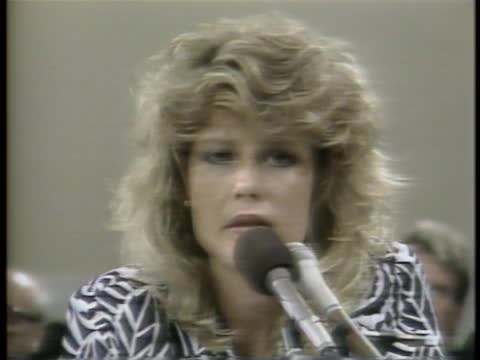
FAWN HALL, Former North Secretary: To the best of my recollection, it was early evening. I don't have a clear recollection of how it started. I believe that I probably -- Col. North probably opened the five drawer safe and began to pull items from it, and I joined him in an effort so that he would not have to -- wasting his time shredding. And as he pulled documents from each drawer, and placed them on top of the shredder, I inserted them into the shredder. MARK BELNICK, Senate Assistant to Chief Counsel: How would you describe the quantity of the documents that were shredded? In feet. Ms. HALL: Maybe a foot and a half. Mr. BELNICK: How long did the shredding go on? Ms. HALL: Possibly a half hour. LEHRER: The other witness today was Bretton Sciaroni, counsel for President Reagan's Intelligence Oversight Board. It was his legal opinion that Col. North used to justify his activities in generating support for the contras during the time of Congressional ban on such activities by government agencies. Sciaroni told the committees today he still stood by his opinion. MacNEIL: The Justice Department said it will begin immediate AIDS testing of all federal prisoners who have just been sentenced or are about to be released. That was the first of four action on AIDS announced by Attorney General Edwin Meese. He said he would ask the Immigration Service to develop ways to test applicants for permanent residence. He also said the department would take steps to protect law enforcement personnel and victims of crime from AIDS. Mr. Meese said protection of civil liberties would be a consideration.
EDWIN MEESE, Attorney General: Together, the steps that I have announced today constitute a reasonable and compassionate approach on the part of the Department of Justice to this serious public health problem. You can never divorce civil liberties from any issue, and the protection of civil liberties is a number one priority of government. Now, when you have a health and safety issue, it is occasionally necessary to balance civil liberties vs. the handling of the public health and safety issue, as we have in the case of tuberculosis in the past and other things. But I think that an extreme sensitivity to civil liberty issues is absolutely critical in handling this public health issue. MacNEIL: The Supreme Court today made it easier for the government to deny Social Security Disability benefits to people who can still do basic work. The 6 3 ruling said disability can be denied to people who are not severely disabled, even if they're incapable of doing their past jobs. The ruling is regarded as a victory for the Reagan Administration, which has been tightening up on eligibility requirements for the two million people who claim social security disability benefits each year. LEHRER: The U. S. Embassy in Moscow is in worse security shape than originally believed. That was the word today from former Defense Secretary James Schlesinger. Schlesinger is in Moscow on special presidential assignment to assess the embassy situation. He told reporters it will cost millions of dollars over several years to make the embassy building completely free of Soviet bugging devices. The Senate Intelligence Committee, among others, has recommended the embassy be torn down. MacNEIL: Pope John Paul II returned home to Poland for a third visit today. The pontiff called Poland ''a land so sorely tried,'' and at a mass paid tribute to the Rev. Jerzy Populewsko, the Catholic priest who was abducted and killed by security police in 1984. During his week long visit, the Pope is expected to meet the solidarity leader Lech Walesa. LEHRER: And that's it for the news summary tonight. Now, a preview of the economic summit, our special Iran contra hearings coverage, and the Helga paintings. Venice View MacNEIL: First tonight, the opening day of the Economic Summit in Venice, where the leaders of the world's seven major industrial nations met today. Besides the U. S. , the countries are Japan, Germany, England, France, Canada and Italy. President Reagan made the biggest news today by agreeing to easetrade sanctions against Japan. But important differences remain between the U. S. and Japan, and another key ally, West Germany. We'll be hearing from two correspondents in Venice. First, special business correspondent Paul Solman sets out the issues.
PAUL SOLMAN [voice over]: For the past few summits, the main concern, besides keeping on schedule, has been how to avoid a worldwide recession -- how to keep the industrial economies going strong. This is a meeting of politicians -- remember. Economics can get short shrift. But economics is playing a larger role in the lives of most politicians these days. And so the annual summit has become an important event. In the recent past, the big issue looming behind the scenes at the summit has been worldwide recession. The economic downturn that everyone at the table fears. In 1987, as before, the summit partners are split on how to prevent it. On one side is the world's big spender -- America. On the other side are both Japan, a country that's been saving its money, and Germany, Japan's thrifty European counterpart. But since both sides are diplomats at events like these, I'm going to speak bluntly for the United States and Germany and Japan. (American POV) In the U. S. , we think Japan is the problem. We fork over our money for their stuff, and they don't spend a dime. Instead, the Japanese save. Then they turn around and lend the savings to their Japanese companies, which produce more goods to sell to Western countries like ours. It's time for a change. What we want from our so called trading partner is true partnership. The Japanese should take some of that money they made from us and spend it right back here in America. (Japanese POV) In Japan we find this argument unfair. We are spending. We're building factories in the United States, in Europe, all over the world. We buy at all the Western art auctions. In fact, we spent $40 million on one painting alone a few months ago. The Americans simply want us to buy what they produce. But our people don't want what their people make. SOLMAN [voice over]: Japan's Prime Minister has been on a personal campaign to get people to buy imports, especially from America. American goods have been actively promoted, heavily publicized. But when you ask the man on the street in Tokyo, and we asked many, the usually shy Japanese are unusually outspoken on the subject of American goods. (to woman) Aren't American products very good? WOMAN English Translation : Well, they're not so good. There aren't any parts for electric goods. It's just difficult to get things repaired. Japanese goods are better.
SOLMAN (American POV): C'mon, the Japanese people won't buy from anybody. Just ask our European colleagues at the summit. The Japanese government rigs the system against consumption, imposing all sorts of taxes and import restrictions to drive consumer prices through the roof. Where's the beef? It's available in Tokyo all right, but at $15 a pound, who's going to buy it? Rice, the country's staple, costs six times the world price. So the Japanese should simply encourage their people to spend more money. And the Japanese government itself should start spending more. (Japanese POV) Don't you read the newspapers? Our government just announced a huge federal spending program. $42 billion on public works. (American POV) You do that every year. Nothing ever comes of it. We're looking for real spending. Buy weapons from us. Give the Japanese people social security so they won't have to save so much for their old age. And what's truefor the Japanese is also true for the Germans. Anybody here from Germany? (German POV) Right here. And yes, we're also running a trade surplus with the Americans, but it's nowhere near the size of the Japanese surplus. And as you know, our market is as open as America's. (American POV) Yeah, but like the Japanese, you're making more than you're spending. So what we'd really like to say at this summit to both the Germans and the Japanese is simply this: Loosen up, guys. Get your economies growing. Run budget deficits. You can afford it, and the rest of the world needs it. (German POV) Ah, the ''Big Spender'' solution. For the past few years, the Americans have been telling us Germans and the Japanese that this is what we should do. But we believe it's irresponsible to spend more than you've got. The problem isn't that we spend too little. It's that the Americans spend too much. and we Germans -- and the Japanese -- believe that the most important thing is for the Americans to drastically reduce their budget deficit. (American POV) If by that, you mean no spending, then the world is headed for a recession. We had one in the 1980s, and it was American spending that got us out of it. In fact, the main beneficiaries were the Japanese and the Germans. All we're saying is that now it's their turn to help the rest of us. (German POV) That may play in Peoria, but you try selling it to the German people. (Japanese POV) Or the Japanese people, for that matter. Now that the yen has risen, and is killing our exports, we're in trouble already. In Japan, big spending is politically unpopular. (American POV) And how do you suggest we get rid of our deficit? Just try selling higher taxes to the American electorate these days. (to audience) Look, somebody's got to take an unpopular stand. Or we'll all wind up leaving Venice empty handed. MacNEIL: While economics will play a role in this year's summit, it may well be dominated by political and defense issues. Early reports indicate the final communique to be issued on Wednesday will deal with issues ranging from AIDS to arms control. For what happened in Venice today, and what's likely to occur over the next two days, we talk to two reporters from the Wall Street Journal. Walter Mossberg covers international economics for the paper. Ellen Hume covers politics and the White House. Both join us tonight from Venice. Welcome to both of you. Mr. Mossberg -- Walter Mossberg -- having just heard Paul Solman, is anybody going to get brave? Or make unpopular decisions? WALTER MOSSBERG. Wall Street Journal: I don't think so, Robin. Not at this summit. You have a tough situation because you do have this urgent problem of a potential worldwide recession, which is more of a danger this year than I think in the past couple of years. And yet you have a mood that is anything but urgent here at the summit. With the expectation of just reaffirming old agreements. MacNEIL: Mr. Reagan met with both Prime Minister Nakasone and Chancellor Kohl today on the ''loosen up, guys'' theme. Any progress? Mr. MOSSBERG: No, I don't think so. Chancellor Kohl listened politely, we're told, when the President made the appeal for stimulating the German economy, but had very little to say. His aides and others in his government who talked to reporters laid out an elaborate case about their inability to really do any more. So no change today on that score. MacNEIL: Is Mr. Reagan getting heat in return? I saw one aide to Chancellor Kohl quoted as saying, ''We want something solid on the economy. Not just a summit about terrorism and AIDS. '' Mr. MOSSBERG: Well, what they want, as we've heard, is for the U. S. to cut the budget deficit, and the Germans in particular would really like to see it done with a substantial tax increase in the United States in addition to spending cuts. But just as the Germans are holding firm, there is absolutely no indication that the President's going to come over here to Europe and agree to a tax increase that he has resisted so long back home. MacNEIL: Walter, if the purpose of this summit in part is to get tough and put some pressure on Japan, what is the significance of Mr. Reagan's concession today to the Japanese? Mr. MOSSBERG: Well, it's interesting. It's a little bit of a give. And I think that it mostly reflects gratitude on the part of the United States for the $42 billion domestic stimulus package which was described earlier. That package was a little bit bigger than we had expected, and as compared to the sort of annual ritual of Japanese motions, it appears to be more solid. And the President, who is very fond of Prime Minister Nakasone, and believes him to be pulling for the right things, wanted to give him a little political bonus. And so he did this partial lifting of the sanctions. MacNEIL: Is Mr. Reagan actually negotiating things with these leaders, or have the details of whatever they're going to achieve been worked out by officials in advance? Mr. MOSSBERG: They don't like to say that the communique, which will be the final document, has been totally worked out in advance, Robin. But the main outlines of it certainly have been by staff members from each of the governments. And in any case, we have been told for weeks at least on the economic side, we are not going to have new agreements of the sort that would have to be negotiated. They are likely to reaffirm some previous agreements -- which would in fact get the surplus countries to loosen up and get up in the United States to tighten our situation, and maybe head off that recession. But what we really need is to get something that will indicate greater political will in these countries to do it. And there's no evidence that that's going to happen here. MacNEIL: All this talk of recession, to us laymen it sounds rather frightening. How -- what is the pitch of anxiety among these leaders? You say they don't seem to be very concerned about it. Mr. MOSSBERG: No, they don't let on that they think it's likely. And they may not think it's likely. But private economists, and those in the U. S. government and the other governments, including -- before he was nominated -- the incoming Fed Chairman Alan Greenspan, all talked about the danger of recession, because the United States has been the engine of growth for the industrial world. And if we are to trim our trade deficit, we're going to have to be contracting the extent to which we are buying things from overseas. If Japan and Germany don't begin to grow faster, that's where the danger of recession does lie. You're quite right. They're just very relaxed about it. MacNEIL: I was going to ask Ellen Hume this question. But let me ask you first. Is it pessimism over what they can achieve on the economic front that is leading the American side to putting so many political issues on the agenda? Is that the purpose of that, Walter? Mr. MOSSBERG: Well, I think that may be part of it. The other part of it is that if you're looking for a country which has failed to live up -- at least in a major way -- to some of its promises, you do have Germany, but you also have the United States. And so it may be that the administration would just as soon talk about some other things other than the economic promises that have been made, for fear that the United States would look bad in that economic context. MacNEIL: Why would it look bad? Mr. MOSSBERG: Because we haven't cut the deficit -- budget deficit very dramatically. And the expectations, as you have been reporting all year, are that they're not going to make the Gramm Rudman targets. The other countries are expecting that budget deficit to be cut dramatically, but it doesn't seem to be in the cards. MacNEIL: Ellen Hume -- Sorry, go ahead. Finish, Walter. Mr. MOSSBERG: I was just going to say, the other thing is we've promised to hold down protectionism, and we now have a very strong head of protectionism working in the Congress. MacNEIL: Ellen Hume, from the perspective of a political and White House reporter, why was the Administration piling so many other things last week onto this summit agenda -- AIDS, the Persian Gulf, the East/West Arms Control negotiations? ELLEN HUME, Wall Street Journal: Well, there are a lot of reasons for that, and one of the main ones is that President Reagan has a great opportunity now to come out and look presidential. He wants to show that he's a world leader. And before we all left Washington some days ago, we were all given background briefings and told that the President has an ace up his sleeve, he's going to come out and talk about arms control, because, as you know, Robin, we're on the verge of having a pretty hammered down INF agreement with the Soviets. And Europe is falling in line, the German Government has now indicated it's willing to come along, even though it's painful. So President Reagan had intended to be able to change the subjects away from the painful economic questions, at least at the dinners and lunches -- which are meant to be devoted to non economic subjects. He had expected to come here and talk about arms control -- and in fact what's happened instead is they've been diverted and are talking now about the Persian Gulf. MacNEIL: Yes, well, that's what's making the headlines back here today. The President's statement when asked by reporters that the United States is not bluffing. Can you elaborate a little bit on the circumstances of that statement and what's intended by it? Ms. HUME: Well, I think what's clear from all these well coordinated television interviews by all these senior White House officials on Sunday and again Monday -- indicate that they have a message they wanted delivered to the Iranians. And that is, ''Don't deploy these missiles that they've bought from China. '' And that if they fail to deploy them, if they somehow stall or don't move forward in that way, then we won't consider that a hostile act. But I think a lot of this is a message meant to be delivered to Iran, and tonight, as you may know, the leaders of these countries have just had their private dinner. They took the note takers away, they took their foreign ministers away, and just these heads of state sat down. And the subject was the Persian Gulf. We haven't been briefed yet on what exactly they came up with. But my understanding was as they went into the dinner that there was so much dissension about exactly what they might agree to, that they're just expected now to come out with a very bland, sort of supportive statement saying, ''Yes, we think there should be freedom of seas in the Persian Gulf. '' And we don't really expect many specifics out of them. MacNEIL: Something Amintore Fanfani was quoted as saying. We quoted him in the news summary earlier, suggested that he didn't think it should even be raised here. Ms. HUME: Well, I think that most people do expect these issues to be raised. President Reagan sent telegrams to the heads of states saying he was going to raise it. It may be that it's an uncomfortable issue for Mr. Fanfani. But I'll tell you, one of the interesting things about this summit -- as we all know -- is that each leader has come here -- pretty much each leader -- in a weakened state politically. And I think it's a gamble for President Reagan to be raising the Persian Gulf as one of his big issues, because it is difficult for a lot of these countries to go long with this sort of thing. The French, for example, have been selling arms apparently to both sides of the Iran Iraq conflict. And of course they weren't very happy about our asking them for air overflying rights for our bombing of Libya. So, in fact, I think no one really expected that this subject would become a big subject, and it sort of has happened. Because arms control turned out to be already established before they got here. There were no surprises on arms control. MacNEIL: With the Iran contra hearings going on back here in Washington, is it in any way evident that that whole issue has affected Mr. Reagan's effectiveness with the other leaders? Ms. HUME: I think what's fascinating is it is quite a backdrop. I will be surprised if we hear that any of these leaders has actually raised this in a serious fashion and said to President Reagan directly, ''We think you're weakened by this. '' Because each of these leaders has had embarrassing moments in his own political career, and doesn't like to bring it up. But I'll tell you, the Europeans in particular have been watching these hearings closely. And one of the things that they're feeling about it is the question is -- can President Reagan make an agreement stick? Is he weakened back home? And especially when it comes to the trade issue. We talked about -- Walter talked about the semiconductor finding today. I think one of the things the European leaders are looking for is some movement on agricultural trade barriers being reduced. This is one of the top themes that President Reagan wants to reach. But at the same time, people are wondering whether the Iran contra affair, tied in with the Democrats' control of the U. S. Congress, has left Reagan really in a weakened condition to follow through on any kind of movement they may establish here in that regard. MacNEIL: Well, Ellen Hume and Walter Mossberg, thank you both very much for joining us from Venice. Jim? Ms. HUME: Thank you. Mr. MOSSBERG: Thank you. LEHRER: Still to come on the NewsHour tonight, today's session of the Iran contra hearings, and an essay on those Helga paintings. Iran-contra Hearings LEHRER: It was a busy day for the congressmen and senators of the Iran contra committees. They heard testimony from two witnesses, a government lawyer named Bretton Sciaroni, and a government secretary named Fawn Hall. Judy Woodruff has our report. Judy?
JUDY WOODRUFF: Fawn Hall is, of course, they young woman who has attracted so much attention throughout the Iran contra affair. She provided dramatic testimony this afternoon about her role in altering and shredding sensitive documents, and in hiding documents in her clothes in order to keep them from being found by government investigators. [voice over] The 27 year old Hall became North's secretary at the National Security Council in 1983. She has been described as loyal, hardworking, the ideal secretary. Hall's mother had already been a secretary to a succession of National Security Advisors, beginning with Henry Kissinger. Last February, Hall became an instant celebrity when it was disclosed that she helped Col. North destroy NSC documents. The attention brought a flurry of modeling offers -- all of which she turned down through her attorney, who stated she was determined not to trade on the situation. Before answering any questions from the committee members or council, Hall addressed those skeptics who may have questioned her professional abilities. DAWN HALL, former North Secretary: As a secretary, it was my job to facilitate the smooth operation of the office. I was a dedicated and a loyal secretary and performed my duties in an exemplary manner. I can type.
WOODRUFF: Assistant Counsel, Mark Belnick, took Hall through a series of classified memos sent by Col. North to then National Security Advisor Robert McFarlane. The 1985 memos pertained to covert support of the Nicaraguan rebels. On November 21, 1986, just a day before the Attorney General's office was to come in and review NSC files, Col. North had Hall make changes to the original documents -- deleting mention of possible illegal activities. To do this, Hall had to use new stationery not available in 1985. Hall never completed the job. MARK BELNICK, Senate Assistant to Chief Counsel: Once you made the changes and you destroyed the marked up originals, what were you going to do with the altered originals? Ms. HALL: The altered originals I planned to xerox and replace the chron copy and a subject file copy, and then return the original altered document to the (unintelligible) keeper. Mr. BELNICK: At that time, you recognized that you had your own copies in your subject and chron files in the office of the same documents that Col. North was asking you to change? Ms. HALL: Yes, sir. Mr. BELNICK: So to complete the alteration process, and to make it effective, you knew you had to substitute the new altered original for the copies that were in your files, and get rid of those copies. Right? Ms. HALL: Yes, sir. Mr. BELNICK: And to complete the process, finally, you understood that you had to then get the altered original back to Mr. Merchant Shop to be refiled. Right? Ms. HALL: Yes, sir. Mr. BELNICK: Did you ever get past the step of destroying the original originals that Col. North had marked up? Ms. HALL: I destroyed the originals, made the changes, assembled the packages, began to xerox them, and I was stopped in the process by what I now think is probably the shredding incident. Mr. BELNICK: Which we'll get to. In any event, you were interrupted while you were making copies or endeavoring to make copies of the documents -- the altered originals -- correct? Ms. HALL: Yes. Mr. BELNICK: So you never had the opportunity to get out of your file the copies of the unaltered documents. Ms. HALL: Yes, sir. Mr. BELNICK: Or to get the altered originals back to the security office. Ms. HALL: Yes. Mr. BELNICK: Which accounts for why two copies of each document were found ultimately in the files. Ms. HALL: Yes. Mr. BELNICK: You were uneasy while you were making these changes, weren't you? Ms. HALL: I felt a little bit of uneasiness when he asked me to do it. But again, as I stated, I believe in Col. North, and I know thatthere must have been a good reason why he asked me to do this. And I did as I was told. Mr. BELNICK: Did you know at the time that Col. North asked you to do this that the President of the United States had asked the Attorney General to make an inquiry into the facts concerning delivery and sale of American weapons to Iran? Ms. HALL: I do not recall that, no. Mr. BELNICK: Did Col. North mention to you he knew the Attorney General had been asked to undertake that assignment and would be coming to the office to review documents or that his representatives would be coming the very next morning? Ms. HALL: No, sir. Mr. BELNICK: You did not know any of those things when you made the changes that Col. North requested. Right? Ms. HALL: No, sir. Mr. BELNICK: You weren't totally comfortable with what you were doing, were you, Ms. Hall? Ms. HALL: I would say that I wasn't totally comfortable, yes. But as I said before, there was -- I believed that Col. North had a good reason for doing what he was doing. And I'm not going to question that. Mr. BELNICK: He didn't tell you what that reason was? Ms. HALL: No, he didn't. Mr. BELNICK: You said before that your work on those documents probably was interrupted by the shredding. Correct? Ms. HALL: Yes, sir. Mr. BELNICK: And you do recall that shredding of documents occurred in Suite 302 on that day? Ms. HALL: Yes, sir. Mr. BELNICK: Tell us how it began and when it began. Ms. HALL: To the best of my recollection, it was early evening. I don't have a clear recollection of how it started. I believe that I probably -- Col. North probably opened the five drawer safe and began to pull items from it, and I joined him in an effort so that he would not have to -- wasting his time shredding. And as he pulled documents from each drawer, and placed them on top of the shredder, I inserted them into the shredder. At the same time, I asked him if I could go ahead and shred the profs notes and phone logs, and he acknowledged that I should go ahead and do that. Mr. BELNICK: Now, you said that Col. North was pulling the documents from the five drawer safe. That's the safe that had previously been in his private office in 392? Ms. HALL: That's correct. Mr. BELNICK: A safe that you had not seen open during the entire time that you were in 302? Ms. HALL: That's correct. Mr. BELNICK: Did you look at the documents that Col. North was pulling to be shredded? Ms. HALL: No, I didn't. Mr. BELNICK: Well, did you glance to see what kinds of documents they were? Ms. HALL: I really didn't take notice, sir. I was just purely doing my job. I was shredding the documents as they went in. Mr. BELNICK: Did Col. North give you the documents in file folders? Ms. HALL: No, he didn't. Mr. BELNICK: He was just pulling documents and handing to you to shred? Ms. HALL: Yes. Mr. BELNICK: Did you notice whether any of those documents were prof messages? Ms. HALL: I said before, sir, that I shredded an entire file of prof messages. Mr. BELNICK: Those were prof messages that you pulled out from your files? Ms. HALL: Yes. Mr. BELNICK: Did there come a time while Col. North was pulling documents that he came across a letter from Felix Rodriguez? Ms. HALL: Yes, sir. Mr. BELNICK: And did he make a comment about that letter? Ms. HALL: Yes, he did. Mr. BELNICK: What did he say? Ms. HALL: My recollection is that he said something to the effect of, youknow, ''They'll all have fun with this,'' and he tossed it back in the safe. Mr. BELNICK: He said, ''They'll have fun with this. ''? Ms. HALL: Yes, sir. Mr. BELNICK: And he threw the document back into the safe? Ms. HALL: Yes, sir. Mr. BELNICK: Did you know who Col. North was referring to when he said, ''They'll have fun with this. ''? Ms. HALL: No. And I'd like to say that I don''t know exactly that those were his words. Mr. BELNICK: That's what you recall? Ms. HALL: Yes. Mr. BELNICK: Did there come a point during the shredding that the quantity became so great that the machine jammed? Ms. HALL: I believe it did. The bag had become full, and as I was shredding it, it comes into a tunnel, and it jammed, yes. Mr. BELNICK: And what did you do? Ms. HALL: I placed a call to the Crisis Management Center and a gentleman by the name of J. R. came over and -- (laughter) Mr. BELNICK: No relation? Ms. HALL: No. He shook the bag and the shredding material fell, and he reversed the switch and also touched a button much the same as you might on a garbage disposal, and the machine unjammed, and he removed the bag. And I believe a new bag was placed in. Mr. BELNICK: In the afternoon of November 25, the same day as the Attorney General's press conference, do you recall that Col. North's office was sealed by the NSC staff? Ms. HALL: Yes, sir. Mr. BELNICK: And that was under the direction of Brenda Rieger, who is the NSC officer in charge of Freedom of Information Act Requests. Ms. HALL: Yes, sir. Mr. BELNICK: Now, Ms. Rieger and her assistants, in addition to sealing the office, were boxing up documents. Correct, Ms. Hall? Ms. HALL: Yes, sir. Mr. BELNICK: And you overheard Commander Coy and Lt. Col. Oral discussing how they were going to be able to work without their files? Ms. HALL: Yes, sir. Mr. BELNICK: What did you do at that point? Ms. HALL: I realized that I had not had a chance to complete a lot of current filing. I in fact had a stack probably 6'' high, or more. And I pulled the filing from the lefthand corner of my desk and began to separate it into categories to be filed so that they would be able to pull the files and see the material. In doing so, I came across the original altered documents that I had not completed the process at -- and in fact, before that had forgotten. I'd like to say that at the time I did not know what was going to be happening to Col. North. I had no idea that he would be fired. I had no idea the real extent of the urgency of that process. And in fact, it occurred on a Friday when I was interrupted, and I came in -- had a weekend -- and came into the office on Monday and was very busy and I forgot. Mr. BELNICK: All right. So you put the documents in your desk file, and as you say, you forgot about them. Ms. HALL: Yes. Mr. BELNICK: Now, in looking through the desk file on November 25 in the afternoon, you found the documents. Ms. HALL: Yes, sir. Mr. BELNICK: The altered documents, and that concerned you. Ms. HALL: Yes, sir. Mr. BELNICK: Did you find other things that concerned you in your desk file? Ms. HALL: I found some profs notes that I knew had been shredded. All the profs had been shredded prior to that. Mr. BELNICK: The profs notes you found were the same type that had been shredded on that Friday. Ms. HALL: They were profs notes, yes. Mr. BELNICK: Did you find anything else? Ms. HALL: Minutes of the Teheran meeting in May of 1986. Mr. BELNICK: How did you happen to have those minutes? Ms. HALL: I had seen a copy and pulled it so that I might have hopefully an opportunity to sit down and read, and maybe understand the process a little more. Mr. BELNICK: Did you call Col. North? Ms. HALL: Yes, I did. Mr. BELNICK: What did you say to him? Ms. HALL: I called Col. North because Brenda Rieger and her assistant Bill Vaneheart at the time indicated they were going to be closing up, and I became panicked at the fact that I had discovered these. And that they were going to be closing up, and I didn't know what to do. And so I called him and said that Brenda Rieger was in fact there closing the office and would he please come back. And he said, no, there's really no need. And I said, ''No. '' and I whispered very low so that Brenda Rieger and others would not be able to hear me, that I was concerned and that he needed to come back. And I tried to convey to him that I had found documents. And I don't know whether that was conveyed or not. I was -- as I said -- my voice was very low, and I don't know if he quite understood. But he understood in my voice the urgency of coming back to the office. And I insisted that he come back, and he did so. The profs sets were folded and he was going to take them and put them in his jacket. And I -- he crossed the room to put them in his jacket, and I turned to him and said, ''No, you shouldn't have to do this. I'll do it. '' And he returned the profs notes and I put them in my back, and turned to him -- I mean, the door was left opened, and I asked him to watch the door as I did this. And when I had completed putting the documents in my back, I turned to him and asked him if he could see, and he said, ''No. '' At that point, I believe we walked downstairs, and just about that time, I think, Col. North and Tom Green entered the office. The phone rang. Mr. BELNICK: Did Col. (unintelligible) go downstairs with you? Ms. HALL: I believe so. Mr. BELNICK: And you were now carrying all of the documents on your person? Ms. HALL: Yes, sir. Mr. BELNICK: You saw Col. North and Tom Green downstairs? Ms. HALL: Yes, sir. Mr. BELNICK: Col. North went in to take a telephone call in his private office? Ms. HALL: Yes, sir. Mr. BELNICK: Did you follow him in? Ms. HALL: Yes, sir. Mr. BELNICK: Did you speak to him? Ms. HALL: Yes, sir. Mr. BELNICK: What did you say? Ms. HALL: I asked him if he could see anything in my back, and he said, ''No. '' Mr. BELNICK: And did you indicate that you wanted to give him something at that time? Ms. HALL: No. Mr. BELNICK: You then came out and prepared with Col. North and Mr. Green to leave the office. Correct? Ms. HALL: Yes, sir. Mr. BELNICK: And was Brenda Rieger inspecting all briefcases that people were carrying as they left the office? Ms. HALL: Yes, sir. Mr. BELNICK: And was Col. North carrying a briefcase? Ms. HALL: Yes, sir. Mr. BELNICK: Did she inspect it? Ms. HALL: Yes, sir. Mr. BELNICK: Was Mr. Green carrying a briefcase? Ms. HALL: I don't recall. Mr. BELNICK: But whoever had a briefcase, she looked at it before it got out of 302, right? Ms. HALL: Yes, sir. Mr. BELNICK: Now, when you reached the corridor outside of 302, did you indicate to Col. North something concerning the documents that you had with you. Ms. HALL: Yes, I indicated with a gesture or words that I wanted to give him the documents. And he turned to me and just said, ''No, just wait until we get outside. '' And we went down the elevator, exited the Old Executive Office Building on 17th Street, and again I indicated with a word or gesture that I wanted to pass the documents. And Tom Green said, ''No, wait until we get inside the car. '' We cross 17th Street, and got in Tom Green's car on G Street and took off. And I started pulling the documents from my boots and then pulled them from my back, indicated to Col. North, I believe at this time, that I had not completed the process of replacing the altered documents in the files and that I had started the xeroxing and these were copies of the xeroxes that I had in fact left the originals in the office. As we turned the corner, Tom Green was dropping us both off at the parking lot where our cars were parked, Tom Green turned to me and asked me if I was asked about shredding, what would I say. And I said we shred every day. And he said, ''Good. '' We said good night. Got out of the car and went home.
WOODRUFF: The profs notes Hall referred to are confidential computer messages used by the NSC staff. Before Hall came to the witness table, the committees heard from the author of a 1985 legal opinion, telling Col. North that it was okay for the National Security Council to go ahead with its activities on behalf of the Nicaraguan contras, this despite Congressional ban on such aid. The ban is contained in the language of the Boland Amendment. In effect, from the fall of 1984 to the fall of 1986. The Amendment says in part, ''No funds available to the Central Intelligence Agency, the Department of Defense, or any other agency or entity of the United States involved in intelligence activities may be obligated or expended for the purpose of which would have the effect of supporting, directly or indirectly, military or paramilitary operations in Nicaragua by any nation, group, organization, movement, or individual. Thirty five year old Bretton Sciaroni is the legal counsel for the President's Intelligence Oversight Board. A little known body, located in the Old Executive Office Building, and charged with overseeing the activities of various intelligence gathering agencies of the government. When he was asked in 1985 to assess whether Oliver North was engaged in any illegal activities, he concluded after a minimal investigation that North was not. And also that the NSC was not covered by the Boland Amendment. Because in his view it was not an intelligence agency. Much of this morning's questioning focused on that interpretation. Rep. HENRY HYDE, (R) Illinois: The Act says ''the C. I. A, it says the Department of Defense, or any other agency or entity involved in intelligence activities. '' Now, we are in a morass of ambiguity as to what agents -- what it means about an agency involved in intelligence activity. You interpret that to mean ''operational,'' is that correct? BRETTON SCIARONI, Counsel, Intelligence Oversight Board: That's true. but there are some elements in the intelligence community that don't have an operational role. That's also true. Rep. HYDE: The President is not involved in intelligence activities -- he's the ultimate consumer of what has been produced by those agencies involved in intelligence activities. Correct? Mr. SCIARONI: That's true. Rep. HYDE: And the NSC doesn't go out and collect, analyze and disseminate, which are the traditional functions of an intelligence operational agency -- isn't that correct? Mr. SCIARONI: Right. Rep. HYDE: Now, if the Boland Amendment wanted to foreclose all government funds, why didn't it simply say so? Mr. SCIARONI: Well, that's the first point. And the second point is that in the late summer of '85, there was widespread recognition that there was a controversy here. And that would have been another appropriate time to rectify this situation, if there was a situation that needed to be rectified. Sen. GEORGE MITCHELL: Mr. Sciaroni, as I understand your opinion, the National Security Council staff is not covered by the Boland Amendment because the National Security Council is not specifically identified either in the Boland Amendment itself or in Section 101 of the Intelligence Authorization Act of 1985. Is that correct? Mr. SCIARONI: That's correct. Sen. MITCHELL: So if an agency is listed, it is covered. And if an agency isn't listed, it's not covered. That's your opinion? Mr. SCIARONI: That's correct. Sen. MITCHELL: And in your opinion, it didn't make any difference what the employees of any agency were actually doing if the agency is listed, they're covered by Boland. If the agency isn't listed, they're not covered by Boland. That's your opinion. Mr. SCIARONI: Well, it would stretch credulity to think that somebody in AG would do those kinds of things that the Boland Amendment tried to prohibit. Sen. MITCHELL: Well, supposing they did just that, Mr. Sciaroni, supposing employees of the Department of Agriculture -- which is not listed in either of those pieces of legislation -- engaged directly in the prohibited type of activity -- that is, intelligence activities -- would they be covered by the Boland Amendment? Mr. SCIARONI: They wouldn't, but it's a highly unlikely situation, operationally, agriculturally -- Sen. MITCHELL: Have you been following these hearings, Mr. Sciaroni? Mr. SCIARONI: Yes, I have. Sen. MITCHELL: Then there is very little that you can say that would qualify as highly unlikely. So your opinion, however, is -- apart from the conclusion about ''highly unlikely'' -- is that if the Director of the Central Agency did not agree with the Boland Amendment and wanted to avoid the Boland Amendment, he could have done so simply by transferring from the CIA to the offices and payroll of the Department of Agriculture those persons who were engaged in intelligence activities. Since they were then employed by an agency not specifically listed in the law, in your opinion, they're not covered by the Boland Amendment. Is that correct. Mr. SCIARONI: That would be -- very quickly become known there was some operational entity in the Agriculture Department, and I'm sure the Congress would move to cut that off. Sen. MITCHELL: But until Congress moved to cut it off, in your legal opinion, they would not be covered by the Boland Amendment. That's what you're saying? Mr. SCIARONI: That's true. WOODRUFF: Sciaroni's opinion was not widely circulated. Robert McFarlane, National Security Advisor at the time, has said he never saw it. Col. North apparently did his best to keep it quiet. JOHN NIELDS, Chief Counsel, House Select Committee: I'd like you to turn to what has been marked ''Exhibit No. 28'' in your book. And this is in August 19, 1985. And it says, ''Prior to your transfer of this action, I discussed the Barnes letter with Jim Michael. And he urges that we not jump too fast on this issue. '' And then it says, ''He shares my concern that our legal fellow is going to create unhealthful speculation, re our intentions on this matter as he proceeds around town, asking questions about the Boland Amendment and its legal legislative intent. Jim recommends, and I agree, that our response to the Barnes letter should be very quietly drafted by Jim, Paul Thompson and a rep from Fielding's office. Regards, North'' Now, ''our legal fellow'' -- that's you, isn't it? Mr. SCIARONI: I have no idea. Mr. NIELDS: But apparently whoever writes this -- who was Oliver North -- doesn't want -- he's afraid that if people find out that somebody's going to write a legal opinion saying that the NSC can do all these things that Congress is going to find out they are doing them. Isn't that what that prof message shows? Mr. SCIARONI: I don't know who this profs message is referring to. Let me just add, too, that if this is referring to any work that I was doing -- which I'm not sure it does -- it would be a misrepresentation, because the memo merely stated the Boland amendment didn't apply to the NSC. I was not discussing whether you could positively do anything. It was a very narrow opinion that said that that particular piece of legislation didn't apply to the NSC. Mr. NIELDS: In any event, they seem to be pretty nervous about the idea that somebody may be announcing that as legal to support the contras. Mr. SCIARONI: Also, I'm not sure this would be me -- going around town would not seem to be me. I wasn't going around town. I was going around the building, I suppose. Mr. NIELDS: Whoever it is, it apparently made them nervous. Right? Because they were afraid that somebody would find out what they were doing. Mr. SCIARONI: It would seem to be the implication of that statement.
WOODRUFF: Sciaroni admitted that during his investigation of possible NSC involvement with the Nicaraguan resistance, he failed to push NSC counsel, Paul Thompson, for documents in the hands of Col. North. This led some members to question Sciaroni's methods of investigation. And his qualifications. Rep. THOMAS FOLEY, (D) Washington: Did you in fact not take the bar exam for five years after your graduation from law school? Mr. SCIARONI: No, I did take the bar exam. Rep. FOLEY: You graduated in 1979? Mr. SCIARONI: Right. Rep. FOLEY: And you took the bar examination in 1984? Mr. SCIARONI: No, I didn't pass the bar in California? Rep. FOLEY: You failed the California bar exam? Mr. SCIARONI: Right. Rep. FOLEY: Did you take any other bar examinations? Mr. SCIARONI: D. C. And I failed D. C. as well. Rep. FOLEY: You failed the D. C. bar exam. What bar exam did you pass? Mr. SCIARONI: Pennsylvania. Rep. FOLEY: You were a resident of Pennsylvania at that time? Mr. SCIARONI: No, I wasn't. Rep. FOLEY: Did you subsequently work in Pennsylvania, or at that time were you working in Pennsylvania? Mr. SCIARONI: No, it's a common trait among people in Washington to go to Pennsylvania to take the bar exam, because if you score very well on it, you can immediately waive into D. C. Rep. FOLEY: So you took the bar exam in Pennsylvania as an easy way to get admitted to the D. C. bar? Mr. SCIARONI: Right. Rep. FOLEY: I congratulate you on your candor. Mr. SCIARONI: Thank you. Rep. FOLEY: Wouldn't you fairly say that you didn't conduct any kind of an adequate or serious investigation of this matter? Mr. SCIARONI: No, that's not true at all. I discussed with the individuals the constraints imposed by law. They gave me every reason to believe that they understood what those constraints were and that they were acting within their bounds. Rep. FOLEY: But your testimony is that except for asking them if they had violated the constraints of law, you spoke to no other person, in or outside the government, made no effort to check their assertions or to discover any additional facts that might relate to this matter. Is that fair? Mr. SCIARONI: That's a fair statement. Rep. FOLEY: And you are insisting to us in your testimony today that as counsel and chief investigator of the Oversight Board for Intelligence, appointed by the President, that you thought you conducted a thorough and serious investigation of this matter, when you spoke to Commander Thompson for half an hour, and Col. North for five minutes, and didn't go beyond the assertions made by either one that they were innocent of any wrongdoing, didn't talk to anybody else -- even people you knew were associated with them in the allegations -- and didn't look at any files except the files that were given to you, and didn't inquire where there were any other relevant files. Is that your testimony? Mr. SCIARONI: Well, at that point and time, I thought that I was going to an objective colleague, Commander Thompson, a legal colleague of mine at the NSC. Rep. FOLEY: Let me ask you, then, in view of what you testified to, in your experience, do you think the Intelligence Oversight Board is in a good position to discover illegalities committed by intelligence agencies? Unless those are previously admitted by the agencies themselves? Mr. SCIARONI: I think that we're an integral and essential part of the whole system of intelligence oversight and we rely heavily on the people down below -- Rep. FOLEY: Integral and effective? Or integral and ineffective part of that overall -- that's what I'm trying to reach --
WOODRUFF: Tomorrow morning the hearings will resume with more testimony from Fawn Hall. Secret Obsession? MacNEIL: Finally tonight, we have an essay on the Helga paintings by Andrew Wyeth. Our essayist is Newsday art critic Amei Wallach.
AMEI WALLACH: After nearly a year of hyperbole and innuendo, Helga has arrived at the National Gallery of Art in Washington. The Helga pictures, as they are called, are everything millions of Andrew Wyeth admirers around the country could love, and everything those who believe passionately in modernist art would hate. But the one thing they are not -- and that is sexy. It was sex that sold the news magazines last summer when the portraits of Helga appeared on their covers. Andrew Wyeth's secret obsession, his stunning secret was Helga Testor, his Chadsford, Pennsylvania, neighbor. For 15 years, he'd drawn and painted her and nobody knew it. Not even his wife Betsy. Betsy is also Wyeth's business manager and a very good business manager indeed. It was she who set the delicious scandal abrewing, with one well timed pause, and one word -- Love -- when she was asked what the Helga pictures were all about. Betsy undoubtedly didn't know the breadth of Wyeth's Helga period. But she'd sold a Helga picture or two herself over the years. What Betsy, along with any [TEXT OMITTED FROM SOURCE]. or the next two years, the Helga pictures are not going to change anyone' mind about Andrew Wyeth. LEHRER: Again, the major stories. President Reagan relaxed the microchip trade sanctions against Japan, and the Iran contra hearings heard the testimony of former Oliver North secretary Fawn Hall. Good night, Robin. MacNEIL: Good night, Jim. That's the NewsHour tonight. We'll be back tomorrow. I'm Robert MacNeil. Good night. c
- Series
- The MacNeil/Lehrer NewsHour
- Producing Organization
- NewsHour Productions
- Contributing Organization
- NewsHour Productions (Washington, District of Columbia)
- AAPB ID
- cpb-aacip/507-zs2k64bq9z
If you have more information about this item than what is given here, or if you have concerns about this record, we want to know! Contact us, indicating the AAPB ID (cpb-aacip/507-zs2k64bq9z).
- Description
- Episode Description
- This episode's headline: Venice View; Iran-contra HearingsSecret Obsession?. The guests include In Venice: WALTER MOSSBERG, Wall Street Journal; ELLEN HUME, Wall Street Journal; REPORTS FROM NEWSHOUR CORRESPONDENTS: JUDY WOODRUFF, JIM ANGLE, NPR,PAUL SOLMAN, AMEI WALLACH. Byline: In New York: ROBERT MacNEIL, Executive Editor; In Washington: JIM LEHRER, Associate Editor
- Date
- 1986-06-08
- Asset type
- Episode
- Topics
- Global Affairs
- Technology
- War and Conflict
- Transportation
- Military Forces and Armaments
- Politics and Government
- Rights
- Copyright NewsHour Productions, LLC. Licensed under a Creative Commons Attribution-NonCommercial-NoDerivatives 4.0 International Public License (https://creativecommons.org/licenses/by-nc-nd/4.0/legalcode)
- Media type
- Moving Image
- Duration
- 01:00:22
- Credits
-
-
Producing Organization: NewsHour Productions
- AAPB Contributor Holdings
-
NewsHour Productions
Identifier: NH-19860608 (NH Air Date)
Format: 1 inch videotape
Generation: Master
Duration: 01:00:00;00
If you have a copy of this asset and would like us to add it to our catalog, please contact us.
- Citations
- Chicago: “The MacNeil/Lehrer NewsHour,” 1986-06-08, NewsHour Productions, American Archive of Public Broadcasting (GBH and the Library of Congress), Boston, MA and Washington, DC, accessed January 9, 2026, http://americanarchive.org/catalog/cpb-aacip-507-zs2k64bq9z.
- MLA: “The MacNeil/Lehrer NewsHour.” 1986-06-08. NewsHour Productions, American Archive of Public Broadcasting (GBH and the Library of Congress), Boston, MA and Washington, DC. Web. January 9, 2026. <http://americanarchive.org/catalog/cpb-aacip-507-zs2k64bq9z>.
- APA: The MacNeil/Lehrer NewsHour. Boston, MA: NewsHour Productions, American Archive of Public Broadcasting (GBH and the Library of Congress), Boston, MA and Washington, DC. Retrieved from http://americanarchive.org/catalog/cpb-aacip-507-zs2k64bq9z