The MacNeil/Lehrer NewsHour
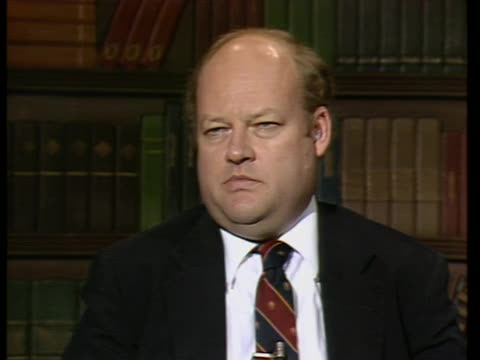
- Transcript
Intro
JIM LEHRER: Good evening. Leading the news today, the government triggered the first round of Gramm-Rudman budget cuts. Secretary Shultz urged allies to not just sit around in the fight against terrorism. And Soviet leader Gorbachev offered a 15-year plan to rid the earth of nuclear weapons. We'll have the details in our news summary. Robin?
ROBERT MacNEIL: After the news summary we talk to the President's budget director, James Miller, then get some differing editorial opinions on Gramm-Rudman. Next, the dispute between El Paso, Texas, and Washington over who pays hospital bills for illegal immigrants. A city official takes on the head of the Immigration Service. Finally, from Los Angeles, a documentary report on a bilingual education system that works. News Summary
LEHRER: The first big shoe fell from Gramm-Rudman today. The Office of Management and Budget and the Congressional Budget Office both certified the 1986 federal budget deficit at $220 billion. That triggers nearly $12 billion in automatic spending cuts March 1st -- a 4.3 across-the-board cut in domestic programs, 4.9 in military spending. The administration and congressional budget officials disagreed over the impact the cuts will have.
JAMES MILLER, OMB Director: The administration's firm position is that we are going to meet these changes and these cuts in a way that minimizes disruption.
RUDOLPH PENNER, Congressional Budget Office: I don't know the definition of minimial disruption, but, sure, it'll cause a problem like any cut will. And it's a little more of a problem than is indicated by a 4.3 cut. There's a big variance from office to office and agency to agency.
LEHRER: A Defense Department spokesman said the budget cuts will mean less ammo, spare parts and days of readiness for the military, but he said the President has exempted the Strategic Defense Initiative research program, some long-term contracts and almost all military pay from the automatic cuts. Robin?
MacNEIL: The U.S. Navy is moving a second carrier task force into the Mediterranean. The carrier Saratoga, accompanied by a cruiser, a destroyer and an ammunition ship, was ordered to move to the Med from routine patrols in the Indian Ocean. U.S. officials, reporting the orders, said the Navy had no orders to attack Libya. In an interview, Secretary of State Shultz said, "As conditions become a little more tense we want to be sure we have adequate force on hand." In that satellite interview with European journalists, Shultz made a strong pitch to allied countries to join U.S. sanctions against Libya and not just sit around. He brushed aside the idea that European countries depend on Libya for oil, saying, "The world is awash in oil." In a speech today at a conference on warfare, Shultz talked about the use of force against terrorism.
GEORGE SHULTZ, Secretary of State: Some have suggested that even to contemplate using force against terrorism is to lower ourselves to the barbaric level of the terrorists. I want to take this issue head on. It is absurd to argue that international law prohibits us from capturing terrorists in international waters or airspace, from attacking them on the soil of other nations even for the purpose of rescuing hostages, or from using force against states that support, train and harbor terrorists or guerrillas. International law requires no such result. A nation attacked by terrorists is permitted to use force to prevent or pre-empt future attacks, to seize terrorists, or to rescue its citizens when no other means is available.
MacNEIL: In South Yemen, at the tip of the Arabian Peninsula, government troops continue to battle rebels in the streets of the capital, Aden. Diplomatic reports said the pro-Soviet president, Ali Nassar Mohammed, appeared to be beating down a revolt by hardline Marxists.
LEHRER: The nuclear arms talks resume in Geneva tomorrow, and there were words about it today from both sides. Soviet leader Mikhail Gorbachev said he has a plan to rid the earth of all nuclear weapons in 15 years. He said in a statement read by an announcer on Moscow television that it was contingent on both sides renouncing the development of weapons in space. That was an obvious reference to the U.S. Strategic Defense Initiative. Gorbachev also said he was extending a unilateral Soviet moratorium on nuclear testing for another three months. In Washington, White House spokesman Larry Speakes said the United States hopes the negotiations in Geneva will go faster now.
LARRY SPEAKES, White House spokesman: U.S. negotiators are ready for tough but honest bargaining. The challenge is formidable, but they have the flexibility to explore any promising avenues for agreement. As we said before, we're more interested in results than in the methods of reaching them. If the Soviet approach to this round -- if the Soviets approach this round in a similar spirit, the prospects for progress will be greatly increased.
LEHRER: Senator Edward Kennedy had a rough time of it today in the South American nation of Chile. Anti-Kennedy demonstrators blocked his motorcade's way out of the Santiago airport and later threw rocks and eggs at a car he was riding in. The protestors were supporters of Chile's military government who claim Kennedy is an enemy of Chile.
MacNEIL: Attorney General Edwin Meese denied today that the Reagan administration had improper contacts with organized crime. Yesterday a presidential commission said that organized crime was increasingly working through labor unions and said administration contacts with some union officials linked to organized crime risked the appearance of impropriety. At a news conference Attorney General Meese rejected that.
EDWIN MEESE, Attorney General: And I can only say that at no time have I, nor, to my knowledge, any members of the administration done anything which was designed to assist or aid anyone who might be involved with organized crime. The fact that people did meet with others in their position as labor leaders was certainly not designed, nor was it intended to in any way preclude -- or any way interfere with proper investigation of organized crime or give any status to those people involved.
MacNEIL: A national scientific panel warned today that snuff and chewing tobacco are not a safe alternative to cigarette smoking. The panel ended a three-day conference at the National Institutes of Health in Washington by expressing concern over the growing use of smokeless tobacco, particularly by teenaged boys. The scientists said there is convincing evidence linking such products to cancer.
In Geneva, the executive board of the World Health Organization expressed its deep concern over the current pandemic of smoking and other forms of tobacco use. The board said smoking kills one million people a year.
LEHRER: There is a report drugs may have played a part in the New Year's Eve plane crash in Texas that killed singer Rick Nelson and six others. The Washington Post said in a front-page story today the fire that led to the crash may be related to the use of cocaine aboard the plane. Nelson's manager termed the report "pure nonsense."
MacNEIL: President Reagan will go back to Bethesda Naval hospital on Friday for his first follow-up examination after the removal of a cancerous tumor from his colon seven months ago. The White House said the President feels great and called the procedure, a colonoscopy, routine. The President marked the birthday of Martin Luther King today by talking about the civil rights leader to students in a Washington, D.C., elementary school named after him. After tracing King's campaign to end racial discrimination, Mr. Reagan said there was something he'd been thinking a lot about lately.
Pres. RONALD REAGAN: The civil rights workers of the 1950s and '60s, long before you were born, they won their great battle because America had a conscience that they could appeal to. It wouldn't let us hide from the truth, and it wouldn't let us sleep until we all together, as a whole country, admitted that all people are equal and that in America there should be no second-class citizens. Our national conscience told us to change and start to be fair, and we listened and changed and we started to be fair. Ultimately the great lesson of Martin Luther King, Jr.'s life was this: he was a great man who wrested justice from the heart of a great country, and he succeeded because that great country had a heart to be seized. Martin Luther King, Jr., really helped make our nation freer. It's not a perfect place; we still have a long way to go. There's unfinished business, and we can't rest until all prejudice is gone forever.
MacNEIL: That's our news summary. Coming up, a newsmaker interview with Budget Director James Miller and some editorial opinions about Gramm-Rudman. Then a Texas town versus the Immigration Service on who pays hospital bills for illegal immigrants, and bilingual education in Los Angeles. Budget Cutter
LEHRER: That noise you heard from the direction of Washington today was that of Gramm-Rudman making its presence felt. Congressional and administration officials signed off on $220 billion as the amount of the 1986 federal budget deficit. That sets in motion some automatic $12 billion in spending cuts to take effect March 1st under the new Gramm-Rudman budget law. Those cuts amount to 4.3 across the domestic board, 4.9 , or $6 billion, from defense. There were stories today of job freezes and layoffs in the federal workforce, among other immediate impacts. We will now get the full scoop on all of it from one of the key figures in today's certification and the March 1st cuts, the head of the Office of Management and Budget, James Miller.
Mr. Miller, welcome.
JAMES MILLER: Good to be here.
LEHRER: First, in general terms, what will be the impact of these cuts on March 1st?
Mr. MILLER: Well, what we've got to do is to reduce that budget deficit. As you said, it's $220 billion; that's even greater than the record set in 1985 of $212 billion. The President says we've got to get that budget deficit down.
LEHRER: Yes, but what will be the effect of these cuts on March 1st on the operations of the federal government?
Mr. MILLER: We don't really think that there will be noticeable effects on the goods and services that people see daily delivered by the government. We're going to tighten our belts. Overall the cut is only 2 in the domestic area and only -- excuse me, 2 in the military area and 3 in the domestic area, and that doesn't count Social Security and all of those things that are off --
LEHRER: Now, why is that? That's because there are so many things exempted?
Mr. MILLER: So many things exempted. Of the things that are not exempted, the cut is 4.3 in the domestic area and 4.9 in the defense area.
LEHRER: Will there be workers laid off?
Mr. MILLER: I don't think that we should anticipate any layoffs. There will be a reduction in the personnel accounts, but in the personnel accounts, for example, there would be travel and there would be other kinds of expenses that we can economize on. I think we can tighten our belts and meet this reduction without, again, any noticeable reduction in the goods and services delivered --
LEHRER: What about jobs --
Mr. MILLER: -- to taxpayers.
LEHRER: What about freezes on jobs, on new hires and that sort of thing?
Mr. MILLER: Well, some agencies may not be hiring nearly as much as they might have hired otherwise. The situation is not really different from an agency that finds itself -- Congress cuts it back a little bit or maybe it doesn't get as much of an appropriation as it thought it might. We do not anticipate at this point any substantial problems.
LEHRER: Who's going to make the decision in each individual agency's case?
Mr. MILLER: Well, each individual, agency head will have to make the decisions about how they go about living within these slightly tighter budgets.
LEHRER: Well, let's go through some specifics. The head of the Customs Department sent you a letter and he said that his department's war on drugs will be severely hampered by this. In fact it'll have to stop during the duration of these cuts.
Mr. MILLER: Well, I think that's not an accurate representation of what would happen.
LEHRER: Why would he make that up?
Mr. MILLER: I don't know. Again, what we're looking at is a 4.3 reduction in these areas, and it seems difficult for me to believe that a 4.3 reduction would entail our cutting off all drug surveillance or something like that. Let's keep in mind -- I don't want to talk about this particular individual, but I think over the next few days we will hear loud protests from people who say this will not -- we won't be able to provide this service or we won't be able to provide that service -- the old Washington Monument game; that is --
LEHRER: That's all it is?
Mr. MILLER: Well, I suspect we'll hear a lot of Washington Monument-game stories over the next several days. But when we think about it very hard how we can meet those budget reductions, I think we will find ways.
LEHRER: Well, let me bring up another specific. As you know, the Internal Revenue Service had computer problems, a lot of delay problems, a lot of angry taxpayers as a result of it. The head of the Internal Revenue Service says that these cuts that are mandated on March 1st go into effect against his agency. All of the gains that he has made on the budget last year will go down the tubes.
Mr. MILLER: Well, I haven't discussed this with him. Again, I do not believe that a 4.3 cut in the overall personnel account would give the dire result that you imply. Again, you could cut back on travel and you could cut back on other things. Besides that, there has been an escalation, an increase, in the number of tax examiners and personnel to handle these forms. We don't want to have the same problem this year that happened last year. I don't really believe that we will have the problem under the kind of better management that Mr. Eggar and others are bringing to the Internal Revenue Service.
LEHRER: On defense, Congressman Aspin, who is chairman of the House Defense Committee, Armed Services Committee, says that these cuts mean a reversal of the military buildup that President Reagan and Congress have put into effect these last five years.
Mr. MILLER: Well, the President obviously wants the buildup of America's defense posture to continue, and he will produce a budget or send a budget to Congress in the next several weeks that will call for a 3 real increase in defense spending.
LEHRER: In other words, just ignore Gramm-Rudman as far as defense is concerned?
Mr. MILLER: No, not at all. The Gramm-Rudman bill, the Gramm-Rudman-Hollings bill, calls for a reduction of that deficit that's out there now at $220 billion down to a level of $144 [billion] for next year. And the President will propose a budget that gets the deficit down to that level and he won't raise your taxes. He will not knock the props out from under our defense posture, and he won't savage the elderly and the poor. He is going to meet that budget deficit target. And only if Congress does not respond to his budget will we have the kind of problem of sequestering that you're talking about.
LEHRER: I know it's a long, involved and complicated subject, but if he's not going to hurt defense and Social Security is exempt, and he's not going to raise taxes, I mean even a simple mathematic mind like mine tells me you've got a lot of work to do.
Mr. MILLER: Well, let me just say this. Of course, what you see for next year is that because we expect revenues with gross to the economy -- and that's one of the big problems about a deficit, is it poses a threat to our continued expansion. But with this continued expansion we see that revenues will increase by more than the increase in expenditures, and therefore the deficit will drop some on its own. But we do need another $50 billion or so, and we're going to find those in areas that are not serving the public needs quite as well.
LEHRER: Like what?
Mr. MILLER: Well, we -- if you look at -- if you take the Social Security and those other things that the President has told me he does not want to touch, you've got over $400 billion out of which we need to find $50 billion in savings, and there is a lot of things that we can do better in the federal government, that we can save money, we can also sell some assets in the federal government. We need the money. Those assets, I think, are put to better use in the private sector. We may suggest transferring certain activities to the state and local governments where they can target those services better.
LEHRER: As a general rule, then, when you woke up this morning and had to come up with a $220-billion figure and you knew that that was going to trigger these cuts on March the 1st, it already pretty well was in motion, then you didn't say, oh, my goodness, this wasn't what we had in mind when we supported Gramm-Rudman? You don't have any second thoughts?
Mr. MILLER: Oh, not at all. Gramm-Rudman is a compact that's going to force the Congress to respond to the President's budget, and it means that we're going to get that deficit -- nally we're going to get that deficit taken care of, put it on a declining plane over the next four or five years. I think that this is good for the American people.
LEHRER: And you don't think that the reaction, negative reaction, to these March 1st cuts could cut into the support for Gramm-Rudman?
Mr. MILLER: Well, there'll be some people that oppose them, but I believe that we will see, the American people will see, that we're quite serious about doing something about the deficit and we will have widespread support for that reason.
LEHRER: Mr. Miller, thank you. Robin? Editor's View
MacNEIL: We have some reaction to the Gramm-Rudman process now from outside Washington. In Atlanta we have Tom Teepen, editor of the Atlanta Constitution. From Manchester, New Hampshire, Joe McQuaid, editor-in-chief of The Union-Leader. Hejoins us from public station WENH in Durham.
Mr. Teepen, in Atlanta, is this a good way to deal with the deficit?
TOM Mr. TEEPEN: It's a terrible way to deal with the deficit. It tries to eliminate politics in a system that is inherently and properly political. That is, when it triggers in these automatic kinds of cuts, it eliminates choice, it eliminates a sense of proportion and priority. Not the way to go about it at all. You remember how this thing came about in the first place. It's got terrible bloodlines. This is legislation that was enacted by panic out of improvisation last year. and in a desperate effort to appear to be doing something about the budget. I can't imagine that the stresses, the political stresses -- human stresses, for that matter -- that it's going to make will survive more than a couple of years before Congress figures it has to redo this process.
MacNEIL: Joe McQuaid in Durham, New Hampshire. Will it die in two years, or is this a good way to look after the deficit?
JOE McQUAID: I think it's the only way. I don't disagree that it's terrible. One of the sponsors, from New Hampshire, Senator Rudman, says it's a bad idea whose time has come. I think -- Mr. Teepen says it's not politics. Politics is what got us into this mess; politics is what has given us Gramm-Rudman and politics is what we're seeing now in response to it. It's forcing the issue, and if it's addressed and brought to the attention of the American public I think it will do the best yet to resolve the deficit problem.
MacNEIL: What about that, Mr. Teepen? It forces the issue?
Mr. TEEPEN: It does have some of the effect of forcing the issue, but when it forces it over into a mindless kind of proportional budget-cutting regardless of what the program intent or priority ought to be, then I don't think that's a very healthy solution at all. It also, of course, sets up a goal of a perfectly balanced budget in five years. I'm not even sure that's a very good idea -- economically that it's a very good idea. Are the deficits too large? By a ton. I don't think there's any question about that. As Mr. Miller says, they do threaten the recovery in the out-years. But this is not an appropriate approach for it. It's a really pretty silly piece of legislation, I think.
MacNEIL: Mr. McQuaid, have your readers cottoned onto this, are they interested in it? Are you getting some reaction from them on Gramm-Rudman?
Mr. McQUAID: Yes, we are. I think especially so in New Hampshire, as I said, Rudman being a co-sponsor of it. We're getting a lot of flak in the letters to the editor from veterans who have already been affected by this. I think January 1st they lost a cost-of-living increase. I knew I was coming on today and I asked a state legislator who was down from Concord what was happening up there. They had been briefed by one of Rudman's staff on it, and they asked a question that Rudman couldn't answer, and that was, what all these federally mandated programs, what will now become of them if the federal revenue sharing is going to go by the boards, will the mandate still stand, or will small states like New Hampshire be able to be more resourceful in how they meet the federal government requirements in various programs? I think your program and the news, and our newspaper tomorrow, as Mr. Miller's figures become widespread and these things become apparent, you're going to see a lot more interest in it. I want to say one thing, Robert. These cuts, as Mr. Teepen said, that are going to happen March 1, that is practically so, but let's not let the Congressoff the hook. These cuts only take effect if Congress doesn't do something about the problem itself.
MacNEIL: Mr. Teepen, how are your readers reacting to it so far?
Mr. TEEPEN: Not really a great deal. I don't think a sense of its impact has come through, and as merely legislation it's a very technical piece, and I don't think it's had a great deal of reaction so far. But over the long haul, even over the near term, Georgia calculates it's going to lose at least $100 million just in the first 18 months. The biggest --
MacNEIL: That would be $100 million out of how much federal money?
Mr. TEEPEN: The figure is not at the top of my head, I'm sorry. But the big losers, the three biggest losers, as it appears here right now, daycare for the poor, a program that helps young women hold jobs who would otherwise be on welfare in many cases; heating-bill assistance for the poor; and higher education, the university system, Board of Regents. You're going to hear a lot of pain out of this, and people are going to ask, are these the right things to be hitting and hitting hardest? And I think it's very difficult to answer yes to that, and when it's not answered yes Congress is going to hear about it, the administration is going to hear about it. The administration is trying to use this, as it has tried from the beginning, to carry out a program that says let the military spend away, deny ourselves our own tax resources, and then come down and crunch the domestic program in this country as hard as you can because of the pinch you've put it in. It hasn't worked in Congress to date, and I don't think when the public begins to feel it it's going to work with the public either.
MacNEIL: Budget Director Miller in Washington, how do you react to that?
Mr. MILLER: Well, let me say --
MacNEIL: That the real purpose is simply to cut the size of domestic government?
Mr. MILLER: No, that's not really true. Let me say that the important thing to keep in mind here is that if Congress reacts favorably to the President's budget, then we are going to avoid these kinds of across-the-board reductions in the future. And the second thing I'd like to say is, for those who have some criticisms of the Gramm-Rudman-Hollings approach, let me ask what the alternatives are. The alternative that we've had for the last several years has gotten us higher and higher deficits. We have, as one was saying, some threat to our expansion. We need to get those deficits down. This again is a compact. We are going to see some success in reducing those deficits. And, again, let's talk -- even in those unencumbered areas you're seeing a domestic reduction of only 4.3 , so when you hear the squeals and the screams about things coming to a halt, just keep in mind that that's only 4.3 reduction that's causing the pain that you're allegedly seeing.
MacNEIL: Are you saying that 4.3 isn't going to make much difference in daycare for the poor, in heating assistance and higher education in the state of Georgia, for example?
Mr. MILLER: Well, many of these programs, as you know, are not touched at all under Gramm-Rudman-Hollings, and again I'm not hear to defend the sequester that essentially was legislated for this year, but what I am saying is, if the Congress responds appropriately, as they should, to the President's budget, then we will not have this across-the-board kind of phenomenon in the future.
MacNEIL: Mr. Teepen, what's your reaction to that?
Mr. TEEPEN: Well, that's perfectly true, but the administration has so far not, in over five years, been willing to be part of thesolution. It has set up certain very rigid ground rules, as I say. No increase in revenue; in fact, it gave away 25 of our revenue resources. You know, spend away on the military. And then it says, ah, there's this solution, but it's only the administration's solution and it's all taken out of the hide of the domestic program. I think it's an imbalanced, even a perverse way to look at our national function as expressed through our federal government, and I don't think it's going to play. Not in the long run.
MacNEIL: Mr. Miller? He doesn't think it's going to play.
Mr. MILLER: Well, I would say again, what are the alternatives? Do people really want their taxes raised? Do they really want to knock the props out from under our defense posture when we finally have the Soviet Union talking about real reductions in arms? Do we want to hit the poor and the elderly? The choices are there. I think the President's budget takes a rational, prudent approach to eliminating those kinds of expenditures that are of low priority so that we won't have to have a tax increase, so that we won't have to knock the props out from under our defense posture, so that we won't have to hit the poor and the elderly.
MacNEIL: Mr. Miller, how do you react to the point that Joseph McQuaid in New Hampshire raised about what's going to happen to these federally mandated programs in the states?
Mr. MILLER: Well, to the extent -- of course, revenue sharing is on a separate track, has nothing to do with the announcements for today. But to the extent that there are less funds for states and there are federally mandated programs, we would certainly give a great deal of credence to any appeals for changing the ground rules in order to give the states greater flexibility. That's part of the President's federalism goal.
MacNEIL: Does that answer you, Joe McQuaid?
Mr. McQUAID: Yeah. I think that's a great plus for New Hampshire, Robert. The more that the controls are at the local level the better. We hear 4.3 cuts and they're going to affect daycare, and I read in the Times that they're going to affect the Library of Congress' ability for books for the blind, but let's hear how it's going to affect the Congress. I think it's going to cut $62 million out of congressmen's expenses so it ain't all bad.
MacNEIL: Well, Joe McQuaid in New Hampshire and Tom Teepen in Atlanta, thank you for joining us, and Mr. Miller, thank you for staying.
Mr. MILLER: Thank you.
MacNEIL: Jim?
LEHRER: Still to come tonight on the NewsHour, a fight between El Paso, Texas, and the federal government over a $10-million hospital bill, and a report from Los Angeles about a bilingual education program that works. Who Foots the Bill?
MacNEIL: Last week President Reagan was sent a very unusual and hefty bill. The county of El Paso, Texas, says Mr. Reagan owes them $10 million. Judy Woodruff explains why. Judy?
JUDY WOODRUFF: The bill is for hospital care for illegal aliens in El Paso County, care that county officials say should be paid by the federal government, not by the citizens who happen to live in the county, which sits right on the border with Mexico. In a letter accompanying the bill the President was told that $7.5 million was actually the cost of treating undocumented aliens in 1985 while the other $2.5 million was for overdue reimbursements for Medicare and Medicaid. We sent correspondent Tom Bearden to El Paso to find out what exactly is behind the bill.
TOM BEARDEN [voice-over]: They cross the shallows of the Rio Grande, a daily migration of thousands of Mexican citizens leaving Juarez and entering El Paso, Texas. A border patrolman says this is the slow season; they're only catching about 650 a day. He estimates for each one they catch two get away. Some of the illegals that make it into the United States eventually come here, to the emergency room at R.E. Thomason General Hospital. Like county hospitals everywhere, Thomason is legally bound to care for the indigent. The problem is that it's going broke doing it, despite a 50 increase in hospital taxes in the last three years. The hospital can't collect from the patients, and it can't turn them away, either. So last week El Paso County sent President Reagan a bill for $10 million. Pat O'Rourke heads the county commission that sent the bill.
PAT O'ROURKE, county judge: We're the poorest major community in the United States. It's a very, very poor country and it's been a survival kind of country. We don't have the resources, the tax base to support that much longer.
BEARDEN [voice-over]: The biggest money-loser at Thomason is the emergency room. Aliens come here even when hospital facilities in Juarez are half-empty. The other major service provided to illegal aliens is maternity care. Hundreds of pregnant women who are Juarez residents come to Thomason General to have their babies, because those children are granted American citizenship by virtue of being born in U.S. territory. Many mothers carefully time their arrival at the hospital to the last minute because they won't be admitted unless it's an emergency. If they arrive too early they're turned away. Most simply go to the parking lot until it becomes an emergency. This day a child was born on the sidewalk outside the hospital. The hospital used to collect 41 on the dollar for the charges incurred in emergency and maternity cases, but the enormous devaluation of the peso in the last decade has reduced even that amount. Now the hospital can expect to collect only 25 on every dollar it spends. Judge O'Rourke says this is just the beginning of an economic crisis of staggering proportions.
Judge O'ROURKE: It's a most pressing problem and one that I think if an answer is not arrived at shortly will be one that will crush this economy on the border to a point where it will not be able to revive itself, both on the Mexican side and the American side.
BEARDEN: How long is shortly?
Judge O'ROURKE: I would say 18 months, 24 months, is shortly. If there is not a major fix created in that time period I think you're going to see this part of the world just begin to really fall apart.
BEARDEN: The city of Juarez has three times as many people as El Paso and many of them are desperately poor. Local leaders believe as long as they remain poor the hospital's financial plight will never improve. They say the disparity between the two cities is simply too great, the lure of jobs and a better life just too powerful. They say this is part of an international problem that must eventually be addressed by the federal government.
BILL KENNEDY, hospital administrator: We're going to have to realize that the economic plight of Mexico tends to draw those people towards the border communities. Immigration enforcement isn't the answer. I understand the INS is recruiting immigration officials, or hiring immigration officials as quickly as they can, but enforcement is not going to solve it until there is a major policy issue that does something to stem the flow of those Mexican nationals towards the border communities.
BEARDEN [voice-over]: El Paso's leaders realize sending the White House a bill isn't going to solve their problems, but they believe it's an important gesture to call attention to their growing desperation.
Judge O'ROURKE: It would be awful nice if the eastern part of the United States would realize that we're going to absolutely bankrupt the southern border of the United States and that that eventually will impact the Denvers and the Chicagos and the Philadelphias and the New Yorks. And it's not an isolated problem, and it's not one that's going to go away by the rest of the country turning its back on this part of the world.
WOODRUFF: Judge Pat O'Rourke, the top administrator in El Paso County, is with us tonight to expand on this story, but first we want to get a reaction from Alan Nelson, the commissioner of the U.S. Immigration and Naturalization Service, the agency charged with watching the border. Commissioner Nelson, we contacted the White House today. They said they didn't have any response to this letter. Is the federal government going to pay that bill?
ALAN NELSON: I have not seen the bill, Judy, and probably the federal government won't pay it. But I think the more important issue that Judge O'Rourke and Mr. Kennedy raise is the issue not only for El Paso but for the state of Texas and for the United States as a whole is that we have a major problem with illegal immigration, it is costing this country billions of dollars, we must deal with the issue. I might say, somewhat facetiously, maybe the bill should go to Congress because the issue is right now before Congress that is considering new legislation that would help us to deal with the problems that El Paso states they have, and clearly in fact do have.
WOODRUFF: But specifically what do you recommend that the people who run this county, who have to turn to the taxpayers for money, what should they do about this kind of enormous bill that has built up over the last year and will continue to build up?
Comm. NELSON: One thing they should do, and the same would be true with people all over the country, hospital administrators or others, they should put pressure on their local congressmen in the House of Representatives right now to be sure that this immigration bill is brought up for hearing in the next month or so and moves on to passage. Because if we can pass a bill this will give us the best step we can take to avoid running up these huge health costs, education costs, crime costs, employment displacement costs and many other things.
WOODRUFF: But how would that immigration bill take care of the health care costs that have already built up?
Comm. NELSON: Well, it might not deal so much with the past costs. I think we need to look at the future because this is an on-going problem. And the point is if illegal aliens cannot come into the country they won't access the health services, they won't access the education and the other facilities or the welfare programs. So it's very important that we deal with this problem from a broad basis. We all are federal taxpayers in addition to local taxpayers, and in addition to the costs that El Paso is talking about, there are huge costs to each of us as federal taxpayers.
WOODRUFF: All right, specifically then, what would the legislation do to stop -- what would you like to see done to stop the --
Comm. NELSON: The major part of the legislation, Judy, is what is known as employer sanctions. It would tell employers you cannot hire illegal aliens. Right now there is no legal bar for employers to do so. Illegal aliens, as shown in the clip here, are coming largely for jobs, and so if we can deny them access to jobs that's one way of deterring them. Also, another major program underway administratively and also part of the legislation would prevent the illegal aliens from accessing the various welfare-type programs, and that ties into many of the health issues also.
WOODRUFF: But how would that prevent these people from coming across the border and going to the emergency room at that hospital in El Paso County the next day?
Comm. NELSON: Well, most of them come in for employment. A few might come across in a place like El Paso and just come in for the care, but most illegal aliens are coming into the United States for jobs. So you would try to deny them access to jobs, you'd deny them access to the welfare-type programs; that's very important. And also the border enforcement that was alluded there, this administration has in the last year increased dramatically the number of border patrol, and that is helping also. So it's a three-pronged attack to deal with the issues of illegal immigration. The main point is that the American public really, like tax reform, we want it. We want to reform our immigration laws, at the same insuring that people come here legally. And I think it's important that the Congress address the issue and pass the law so we can deal with it and avoid these kind of bills being raised that the county is talking about.
WOODRUFF: All right, Judge O'Rourke, let me bring you into this. The commissioner is saying you should have sent the bill to the Congress. You sent it to the wrong place.
Judge O'ROURKE: Well, I would have to disagree with the commissioner that the Congress can establish legislation that can speak to immigration, and until such time as the federal government creates a foreign policy that stimulates the Mexican national to stay in his or her country, the economic magnet is still too great for any legislation to address and to try to dampen the appeal of the United States.
WOODRUFF: What exactly are you saying the administration should do?
Judge O'ROURKE: Well, if we've got an economy in Mexico where the peso is 500 to one, an economy that is slipping by the day or by the week, well then, there has got to be some way to revitalize the northern Mexican economy in such a way that you keep those people home. I think that's a job between the President of the United States and the president of Mexico, if not also including other leaders in Central and South America.
WOODRUFF: All right. Mr. Nelson, what about that?
Comm. NELSON: Yes, I think Judge O'Rourke makes a good point. I think the main issue here is that there is no single easy answer to illegal immigration problem.
WOODRUFF: But what specifically about his recommendation?
Comm. NELSON: We need several things. We need the legislation. We need to do the things I addressed. We also need to work with Mexico. Well, let me talk about a few things. There are some things going on. Of course you're aware of the recent presidential visit. I accompanied the attorney general and others to San Antonio last month to meet with the Mexican officials. We have had a lot of cooperation from Mexico recently in alien-smuggling cases, and also third-country nationals coming into southern Mexico as well as the U.S. We also need more cooperation on border violence problems, and no question we need to do more in the economic area. It's a many-faceted approach. We need -- one issue is that the immigration issue in the past has not been addressed well between the two countries. We must do that. The President's raised it; we must continue to talk about it.
WOODRUFF: JudgeO'Rourke, the commissioner is saying they're already doing a number of things.
Judge O'ROURKE: Well, I'm sure they are, and we read from time to time that new initiatives have been developed. But the statement by the commissioner that we haven't really had a policy is most correct. We have never addressed in meaningful terms our relationship with our fine neighbor, Mexico, to the south, and until such time as we do address our neighbor and that relationship, we're going to have to come with two elements of a fix. We're going to have to support these local economies which are being devastated by the impact of the Mexican national, and we're going to have to find a way to have Mexico's economy develop more rapidly than it is now.
WOODRUFF: Can we do those things, Mr. Nelson?
Comm. NELSON: To a degree. There are many issues. Mexico has over 70 million population; they're growing dramatically. They have an unemployment problem, they have some economic problems. They are our friends, as I think we all agree. We must have a good relationship. I think there has been a growing recognition of late that we must address immigration. We must ask for help from Mexico not to allow the large-scale illegal immigration, and we must work with them in economic and political and other areas.
WOODRUFF: Judge O'Rourke, what about the point that the commissioner made earlier, that once this immigration legislation is passed, if it were passed, there would be sanctions on employers who hire illegal aliens? There would be steps taken to prevent aliens from getting on the welfare rolls and so forth?
Judge O'ROURKE: Well, I've lived on the border all my life, and it's a 2,000-mile-long border, and the Rio Grande's not but about 18 inches deep and maybe twice that wide. Those people in Mexico receive benefits either in health care or employment, and I think regardless of the legislation that is passed, they're going to continue in the millions to come across and go north.
WOODRUFF: What about that?
Comm. NELSON: Well, again, I've got to repeat, we must deal with this from all aspects. We are the only country in the world that does not have a law preventing employment of illegal aliens. Mexico has such a law --
WOODRUFF: But he's saying -- excuse me. He's saying even if that law were passed it wouldn't do any good.
Comm. NELSON: Well, I would disagree, and we have to try new things. What we have now isn't working. You can't do it all at the border. You can't stop all illegal immigration at the border. You must deny the illegal alien access to jobs and to benefit programs. You do that, together with better border enforcement, you've done a lot. And that's important, along with the other issues we're talking about here.
WOODRUFF: Judge O'Rourke, are you hearing what you would like to hear from Washington here tonight?
Judge O'ROURKE: No. Quite honestly, Judy, I'm not hearing what I would like to hear because, again, we have a near-term problem of overburdening our tax base to provide services for illegal aliens, and that's something we've got to address today and tomorrow. But more importantly, unless the executive branch, in conjunction with the Congress, deals cooperatively with Mexico, we just aren't going to get there from here. It's an area that's never been directly solved, or we've never tried to have a solution directly before, and we've really got to concentrate on one that speaks to the long-term growth of the Mexican economy.
WOODRUFF: Mr. Nelson, in the meantime, what about the $10 million?
Comm. NELSON: Well, I think we'll have to pursuethat. I think what the county of El Paso has done has been a good catalyst here because it does draw attention to the fact we have health costs, education costs, crime costs, job costs, lack of tax payments -- many issues that are impacting all citizens. So it's not an El Paso issue; it's a United States issue, and I think we need to deal with that in that broad context.
WOODRUFF: Commissioner Nelson, Judge O'Rourke, thank you both for being with us.
Comm. NELSON: Thank you.
Judge O'ROURKE: Thank you. Learning the Language
MacNEIL: Finally we look at the needs of hispanic immigrants in another light. Recently, Education Secretary William Bennett has reopened the long debate about how best to educate children who don't speak English. Bennett advocates more flexibility in the way school districts handle such programs. The Los Angeles school district has embarked on an experiment in bilingual education that has broad support and appears to work. Our report is by Jeffrey Kaye of public station KCET.
JEFFREY KAYE, KCET [voice-over]: In the predominantly Mexican-American barrio of East Los Angeles, the operative language is Spanish. Here, without knowing English, you can function but not easily prosper. This is the poorest area of Los Angeles. The school dropout rate is the highest, a fact sometimes blamed on failings in bilingual education. Angelina Vera speaks only Spanish to her four children. Her oldest, Sandra, aged 11, speaks English fluently. She learned it in school.
[interviewing] Did you speak any English when you went to school?
SANDRA VERA: No, I didn't know -- barely, not a lot.
KAYE: How do you talk to your mother and how do you talk to your father?
Ms. VERA: Well, I just talk in Spanish.
KAYE [voice-over]: Five-year-old Alma Vera is just starting school. She speaks little English, but she's learning.
ALMA VERA: Hello, everybody, yes indeed, yes indeed, yes indeed.
STUDENTS [singing]: "Hello, everybody, yes indeed, yes indeed, yes indeed, my darling."
KAYE [voice-over]: Alma attends kindergarten at the Eastman Avenue elementary school in East Los Angeles. It's the same school her sisters attend, one of many that cater to L.A.'s 134,000 non-English-speaking students. This school is trying an unusual experiment in bilingual education, one that appears to be working. Most schools with bilingual education programs require their teachers to teach in two languages, to translate as they go along. Not at Eastman. Here, Principal Mirta Gonzalez Feinberg oversees a program where classes are conducted in either Spanish or English. Unlike other schools, Eastman doesn't turn subjects like math and science into simultaneous English lessons. English is taught separately. Then, grade by grade, English replaces Spanish in all subjects.
MIRTA GONZALEZ FEINBERG, Eastman Principal: We feel that if we use the child's language to give him the greatest amount of opportunity to learn, while at the same assuring that that child learns English and learns it as best as possible, that we should end up with a child in the sixth grade who not only knows English well but also has developmental skills, has all the academic subject matter that is required.
KAYE [voice-over]: This is how Eastman does it. When children first enter the school in kindergarten or first grade, their language skills are tested. They are separated according to their proficiency in English. Those who speak only Spanish are placed in classes where most of the instruction is in that language. Here Alma Vera is taught important concepts -- square, circle, triangle -- in Spanish. She will eventually also learn such basic subjects as reading, writing, math and science in Spanish. Alma is starting to learn English in her non-academic lessons such as music, art and physical education. The idea is an old one. Children learn a language by being forced to speak it.
Ms. FEINBERG: But it's also to be sure that the children have, early on, a lot of opportunities to hear English in non-threatening situations where it isn't a matter that they have a test to pass tomorrow, for example, as you would have in science or math.
KAYE [voice-over]: Here bilingual teacher Pauline Griffith teaches second-graders English. The method is not to teach grammar but to teach the language in an informal, conversational way. She sees an advantage to teaching a class of children whose language abilities are the same.
Ms. PAULINE GRIFFITH, teacher: If I have English-speaking children and Spanish-speaking children in my class, then I would have to do my lessons in both languages in order to reach the children. And so then there are days when I go -- you know, I used to go home and I used to say, well, I didn't reach my children today or I didn't have time to work with a group of children because I didn't have time for my lessons. And I used -- it releases me of a lot of anxiety that way, and stress.
KAYE [voice-over]: Eastman school officials are mindful that segregating children by language ability has its disadvantages. One class can see another as inferior. Eastman tries to prevent problems by combining some non-academic classes for part of the day. These mixed classes are taught in English. In this fourth-grade class Eileen Swete teaches students who are both fluent and not so fluent in English. Maria Vera, who takes most of her classes in English, is here with children from a Spanish-speaking class.
EILEEN SWETE, teacher: The object is for them to speak and converse also with their neighbor in English. If I hear them speaking in Spanish, I'll say, "Why are you here for this period of time? We need to speak in English."
KAYE [voice-over]: And this is where the Spanish and English come together, though not at the same time. This is Grace Rose's fifth-grade social studies class. On this day Mrs. Rose teaches her class about the American colonies. The lesson is all in Spanish, no English. The very next day Grace Rose is back at the same map, teaching the same lesson in English. This class is where students start to make the transition to all-English lessons.
GRACE ROSE, teacher: Yesterday we talked about impuestos, all right? What is impuestos?
STUDENT: Taxes.
Ms. ROSE: Taxes. Absolutely.
KAYE [voice-over]: From what we could see, most of the class seemed ready to absorb the material in English. They could understand the teacher, although some students couldn't always express themselves.
Ms. ROSE: What were they trying to tell the English? [Arturo answers in Spanish] Okay, who can tell me what Arturo is trying to say? Adrian?
ADRIAN: He's trying to say they couldn't get the money.
Ms. ROSE: We do social studies in Spanish three times a week and then two days we expand in English. Most of our day, all the directions and any conversation that I have with the children is in English unless it's a matter of life and death or something that the child definitely wants to use Spanish. Then we use Spanish. But most of the time they use English.
KAYE [voice-over]: By the sixth grade children who were once separated in Spanish-speaking classes aremixed in with those who speak only English.
TEACHER: And why on earth was this boy named Patch? How did he get the name?
KAYE [voice-over]: All Sandra Vera's classes are conducted in English. Like her youngest sister, she once spoke only Spanish. Now she is encouraged to participate in Spanish-language activities because the school doesn't want her to lose her Spanish skills, but none of her instruction is in Spanish. The Los Angeles school district as well as state officials are in the process of evaluating Eastman's experiment, now two years old. Preliminary results indicate that Eastman students do better on standardized tests than children at neighboring bilingual schools. L.A. school officials are impressed enough with Eastman that members of the school board, liberals and conservatives alike, recently voted unanimously to try the Eastman approach in seven other elementary schools in the area. Board member Larry Gonzalez led the effort to expand the Eastman experiment.
LARRY GONZALEZ, school board member: The self-esteem is very high amongst the student body in this school because many children are now becoming that much more successful in learning. Children are not failing in the areas of academics and in other areas of their educational life. Children are being successful, and success breeds success.
KAYE [voice-over]: Even with the limited success Eastman has shown, for children like Sandra, Maria and Alma Vera the future is uncertain. Given their neighborhood and background, the chances are 50fi50 that they will drop out before they finish high school, according to the statistics. Their mother, Angelina, believes her children will beat those odds, in part because of Eastman.
ANGELINA VERA [through interpreter]: They are doing well. I have compared them with some of the children, my sister's children, and my children are doing better.
KAYE [voice-over]: While L.A. officials seem ready to accept limited success at Eastman, there is no intention to modify the entire school district. Eastman's experiment is designed for its homogeneous Spanish-speaking student body. But every day Los Angeles schools must accommodate students who speak neither Spanish nor English but 87 other languages and dialects. Nonetheless, for the 115,000 Spanish-speaking students in Los Angeles, the Eastman model is promising, and officials here and throughout the country are watching it closely.
LEHRER: Our cartoonist, Ranon Lurie, looks now at the continuing bloodletting in Lebanon.
[Lurie cartoon -- Lebanese Moslems, Druzes and Christians paint themselves into three separate corners in the same room while blood flows and bullets fly.]
Again, the major stories of this Wednesday. Congressional and administration budget officers triggered $12 billion in automatic spending cuts on March 1st. White House Budget Director James Miller said on the NewsHour the cuts will be made without serious damage to federal programs. Secretary of State Shultz urged U.S. allies to to quit just sitting around in the fight against terrorism, and Soviet leader Gorbachev said he had a plan to rid the earth of nuclear weapons in 15 years, but it was contingent on renouncing weapons in space, otherwise known as the U.S. Strategic Defense Initiative. Good night, Robin.
MacNEIL: Good night, Jim. That's our NewsHour tonight. We will be back tomorrow night. I'm Robert MacNeil. Good night.
- Series
- The MacNeil/Lehrer NewsHour
- Producing Organization
- NewsHour Productions
- Contributing Organization
- NewsHour Productions (Washington, District of Columbia)
- AAPB ID
- cpb-aacip/507-zs2k64bq2s
If you have more information about this item than what is given here, or if you have concerns about this record, we want to know! Contact us, indicating the AAPB ID (cpb-aacip/507-zs2k64bq2s).
- Description
- Episode Description
- This episode's headline: Budget Cutter; Editor's View; Who Foots the Bill?; Learning the Language. The guests include In Washington: JAMES MILLER, Budget Director; ALAN NELSON, INS Commissioner; In Atlanta: TOM TEEPEN, Editor, Atlanta Constitution; In New Hampshire: JOE McQUAID, Editor, Manchester Union-Leader; In Denver: PAT O'ROURKE, El Paso County Judge; Reports from NewsHour Correspondents: TOM BEARDEN, in El Paso; JEFFREY KAYE (KCET), in East Los Angeles. Byline: In New York: ROBERT MacNEIL, Executive Editor; In Washington: JIM LEHRER, Associate Editor; JUDY WOODRUFF, Correspondent
- Date
- 1986-01-15
- Asset type
- Episode
- Topics
- Economics
- Education
- Social Issues
- Literature
- Global Affairs
- Film and Television
- War and Conflict
- Journalism
- Military Forces and Armaments
- Politics and Government
- Rights
- Copyright NewsHour Productions, LLC. Licensed under a Creative Commons Attribution-NonCommercial-NoDerivatives 4.0 International Public License (https://creativecommons.org/licenses/by-nc-nd/4.0/legalcode)
- Media type
- Moving Image
- Duration
- 00:59:57
- Credits
-
-
Producing Organization: NewsHour Productions
- AAPB Contributor Holdings
-
NewsHour Productions
Identifier: NH-19860115 (NH Air Date)
Format: 1 inch videotape
Generation: Master
Duration: 01:00:00;00
If you have a copy of this asset and would like us to add it to our catalog, please contact us.
- Citations
- Chicago: “The MacNeil/Lehrer NewsHour,” 1986-01-15, NewsHour Productions, American Archive of Public Broadcasting (GBH and the Library of Congress), Boston, MA and Washington, DC, accessed April 2, 2026, http://americanarchive.org/catalog/cpb-aacip-507-zs2k64bq2s.
- MLA: “The MacNeil/Lehrer NewsHour.” 1986-01-15. NewsHour Productions, American Archive of Public Broadcasting (GBH and the Library of Congress), Boston, MA and Washington, DC. Web. April 2, 2026. <http://americanarchive.org/catalog/cpb-aacip-507-zs2k64bq2s>.
- APA: The MacNeil/Lehrer NewsHour. Boston, MA: NewsHour Productions, American Archive of Public Broadcasting (GBH and the Library of Congress), Boston, MA and Washington, DC. Retrieved from http://americanarchive.org/catalog/cpb-aacip-507-zs2k64bq2s