The NewsHour with Jim Lehrer
- Transcript
MR. LEHRER: Good evening. I'm Jim Lehrer. On the NewsHour tonight, the Montana standoff, we get three perspectives on how to resolve it; the need for a missile defense system, Kwame Holman reports, Senators Levin and Kyl debate; "Where They Stand," President Clinton speaks at Princeton; and the Russian elections as seen by U.S. Ambassador Tom Pickering. It all follows our summary of the news this Tuesday. NEWS SUMMARY
MR. LEHRER: A U.S. fighter plane was accidentally shot down this morning by a Japanese destroyer. It happened near Hawaii during a joint U.S.-Japanese military exercise. Japan's defense ministry apologized for the accident. The Navy A-6 Intruder was touring a gunnery target when it was hit by the destroyer firing at the target. The two-man crew of the plane ejected and were rescued by helicopter uninjured. A Pentagon spokesman in Washington explained.
CAPT. MICHAEL DOUBLEDAY, Pentagon Spokesman: The Japanese have, have apologized, and we certainly, uh, accept their apology. This, I think, could best be characterized as a very unfortunate training accident. At this point, I am not aware of any explanation. I know that both the Japanese self-defense force and the 7th Fleet are looking into the matter. And I think we'll just have to wait until we see what the results of their investigation reveal.
MR. LEHRER: The month-long military exercises are conducted annually. In Israel today, Prime Minister-elect Benjamin Netanyahu met privately with his predecessor Shimon Peres for the first time since last week's elections. Afterward, Peres said they had discussed security issues. Netanyahu said they had agreed on several important matters. Netanyahu defeated Peres by less than 1 percent of the vote. He has until mid July to form a government. In Northern Burundi today, three Red Cross workers were ambushed and shot to death. A Red Cross spokesman said the three men were delivering water and medical supplies to hospitals. There has been bitter ethnic violence in the African nation between the Hutu and Tutsi tribes, but the Red Cross spokesman said this was the first attack on relief workers in Northern Burundi. Back in this country today, President Clinton said American students should get at least two years of college education, and he proposed giving a tax credit of $1500 for each of those two years. He said it in a commencement address at Princeton University in New Jersey. We'll have excerpts as part of our "Where They Stand" series later in the program. Republican Presidential candidate Bob Dole immediately attacked the President's proposal. He said it would be financed by higher taxes on international air travel, among other things. Dole visited a new home site near Richmond, Virginia. He told an audience there he would bring up the balanced budget amendment for a vote next week and he hoped the Senate would pass it.
SEN. ROBERT DOLE, Republican Presidential Candidate: What would happen if we did? Three fourths the states would ratify it. It would be part of the Constitution. It would give Congress and the Executive Branch more back bone to balance the budget every year and drive down interest rates and make housing more affordable for more and more and more people all across America. That's the American dream. We want to make America better.
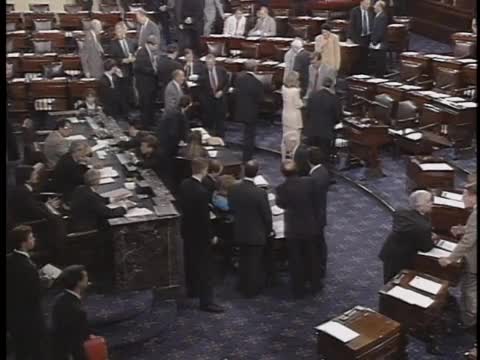
MR. LEHRER: Sen. Dole also said he would leave the Senate a week from today to campaign for President full time. A federal judge in Little Rock today ordered President Clinton to testify on video tape in another Whitewater-related trial. Two owners of a rural bank face charges of conspiracy and bank fraud. The charges allege the two bankers illegally reimbursed themselves for money they contributed to Clinton campaigns for governor. The trial is set to begin June 17th. In the Senate today, Democrats blocked a vote on creating a national missile defense system. Sixty votes were needed to end a Democratic filibuster. There were only 53. Senate Majority Leader Dole had made the missile system a legislative priority. President Clinton does not support the plan. We'll have more on the story later in the program. In Montana today, two FBI vehicles drove up to the gate of the Freemen compound and were seen leaving what appeared to be a note, according to one wire service. It was the first visible communication between the two sides in a week. The FBI cut off power to the ranch yesterday. Late last night a light was seen at the Freemen compound. Some neighbors say the anti-government group had its own generators. We'll have more on this story right after the News Summary. The Federal Aviation Administration announced a ban today on child booster seats on airplanes. FAA tests show the restraints do not provide adequate protection for infants and toddlers. An agency statement said they should instead be placed in approved front or rear-facing child seats. Parents are also legally permitted to hold children under the age of two on their laps. And that's it for the News Summary tonight. Now it's on to what next in the Montana standoff, the missile defense debate, "Where They Stand," and the U.S. Ambassador to Russia. UPDATE - MONTANA STANDOFF
MR. LEHRER: We do go first tonight to the standoff in Montana. After more than 10 weeks, federal officers have turned up the pressure on the armed group known as the Freemen. Charlayne Hunter- Gault begins our coverage.
CHARLAYNE HUNTER-GAULT: The conflict began in March when FBI agents arrested two Montana men, LeRoy Sweitzer and Daniel Petersen, on charges of mail fraud and passing millions of dollars worth of phony money orders and checks. They were also accused of threatening federal officials and making a death threat against one judge. The two were the leaders of a group known as the Freemen, tax protesters who deny the legitimacy of the American government and want to set up their own. The Freemen's neighbors in Montana report that they are heavily armed. After the arrests, other members of the Freemen group named in the fraud indictment holed up in a remote farm house on a wheat and sheep farm located 130 miles from Billings. Local state and federal police moved in and surrounded the compound. And that was the beginning of the 72-day standoff. Since it started, federal authorities have gone out of their way to avoid a violent confrontation with the Freemen, saying they didn't want a repeat of earlier clashes like Waco, Texas, and Ruby Ridge, Idaho. Attorney General Janet Reno emphasized her desire for a peaceful ending no matter how long it takes.
JANET RENO, Attorney General: The FBI has gone to great pains to ensure that there is no armed confrontation, no siege, no armed perimeter, and no use of military assault type tactics or equipment. The FBI is trying to negotiate a peaceful solution.
MS. HUNTER-GAULT: In the last two months, there have been a number of attempts to negotiate with the Freemen at their compound by friends and family of the Freemen, the FBI, and different sympathizers to the militia movement, including former Green Beret Bo Gritz. The negotiations that seemed the most promising were led by one of those sympathizers, State Sen. Charles Duke of Colorado. But those talks collapsed on May 21st, and Duke returned to Colorado, saying he thought the Freemen were not militia men but criminals. In the last few weeks, federal authorities have stepped up pressure on the Freemen. Last week, the FBI brought in a helicopter and three armored trucks. They told journalists who have been staking out the standoff to move back more than two miles away. Over Memorial Day Weekend, the FBI set up generators to provide electricity to the farm's neighbors and yesterday cut off the power to the compound, itself. But last night, it appeared there were a few lights on in the farm house, indicating that the group has generators of their own. The Freemen are reportedly out of toilet paper and cigarettes but have meat in a freezer, fish in a pond, and deer to shoot, all suggesting they are capable of holding out a long time.
MR. LEHRER: Three perspectives now on this Montana standoff. Joe Conley is a former FBI agent whose specialty is negotiations and crisis intervention. Lawrence Myers is a freelance writer on domestic terrorism issues and is on the editorial board of Security & Intelligence Report. Charles Duke is a Colorado state senator who, as we just saw, volunteered to negotiate between federal agents and the Freemen. Joe Conley, what effect do you think turning off the electricity is going to have on this?
JOE CONLEY, Retired FBI Special Agent: Well, Jim, I think that it's basically going to send a signal. In and of itself, turning off the electricity isn't going to prompt these people to come directly to the negotiating table, but it is telling them that the FBI is there, law enforcement is there, and law enforcement is not going to go away. One of the things that we want to do in situations like this is to isolate the people that we're negotiating with. And up until now really we've contained these folks but we have not isolated them. And I think this is probably one of the first steps in tightening the perimeter and starting the isolation process.
MR. LEHRER: Mr. Myers, do you agree, it's a first step that sends a signal, and that's all it does?
LAWRENCE MYERS, Freelance Writer: [Evansville, IN] Well, obviously, I don't know that's somewhat problematic to send any signals to these folks. They, first of all, don't recognize the jurisdictional authority of the people who have them surrounded. Second of all, as I recall looking into this, I flew up there last year to talk with these people and look into it, and the fact is that in the late 1980's, the electricity was shut off on the Clark Ranch for three years. Nobody came out. Nobody moved away.
MR. LEHRER: So what are you saying? Are you saying you don't think--what--so--what signal do you think is being sent by this, nothing?
MR. MYERS: Well, obviously the escalating militarization up there with the armored vehicles and the helicopters certainly shows an intent that they are about ready to use or at least display force. I do think it's instructive, however, that the notion of isolating people who live in this neck of the woods is kind of unrealistic. These people have--they could stay up there approximately forever. Jim, they've got silos full of grain, plenty of chow, like Charlayne had pointed out, and not only that, but they're used to living in an isolated situation. They are used to being isolated. And there's five generations of Clark families that have lived on that ranch. To not have electricity is not unusual and to fend for themselves and live off the land is something they've been doing for almost most of this century.
MR. LEHRER: Senator Duke, how do you see the cutting off of the electricity?
CHARLES DUKE, Colorado State Senator [R]: [Colorado Springs] Well, I think it will be helpful long-term. Uh, we have to be careful not to consider the occupants of the Clark Ranch as one unified body. They are not. Had it just been up to the Clarks, this would have been over sometime ago, I believe. But what you've got there are some destabilizing factors, such as Russ Landers, Dale Jacobi, and Rod Skirdall, and--
MR. LEHRER: Who are--
SEN. DUKE: --we have to begin--
MR. LEHRER: --these folks?
SEN. DUKE: These are--
MR. LEHRER: Excuse me. Tell me who these people are. Yeah. Tell us who they are.
SEN. DUKE: Well, Russ Landers is a gentleman that's been around the country teaching lectures on the war powers, and, uh, the deviation of our government from the Constitution, and he has warrants outstanding in Colorado, in New York, and a couple of other states, I believe. Dale Jacobi is actually a Canadian citizen. He doesn't really have anything to say, in my opinion, about what our United States Government does. And Rod Skirdall is, is an ex--he's a veteran and had an industrial accident, and so he sometimes has trouble connecting two sentences with each other. But those are the three main destabilizing factors, and my recommendation to the FBI when I left is that those three somehow be isolated from the remainder of the farm, if necessary by force. And I think the rest of the farm would capitulate. I have seen people who are prepared to die for their beliefs, and these people don't strike me as that type of person.
MR. LEHRER: Joe Conley, as a practical matter, how do you do that? How do you isolate? What have you got there, 20 people in there, right, Sen. Duke, roughly?
SEN. DUKE: There are 21.
MR. LEHRER: You have 21 people. Okay. Joe Conley, you've got 21 people in there. You say you got--you heard what the Senator said- -you got three bad apples and you want to isolate them from the others. How do you do that through force?
MR. CONLEY: Well, the Senator has a good point, that the, umm, there are people in there that are really driving this thing, and that the majority of the people inside the compound probably would be very happy to leave if they were given their choice to do so. And certainly on a ranch that's almost a thousands acres large, you're not going to be able to isolate just as simply as you would in an urban center but you are really cutting back on their ability to deal with the outside world, except through you. Now in this cellular world, of course, we can't isolate today the way we used to be able to, but we've got to be able to get to the point where they will talk to the outside world only through the people that are outside that perimeter, and again, the message is being sent the ultimate authority out there is law enforcement and if this thing is going to be settled, they're going to have to cooperate with law enforcement. Law enforcement certainly is going to be in a position to try and accommodate these people to the extent that the law will allow them to, but they are going to have to make a move at some point in order to bring this thing to a peaceful resolution.
MR. LEHRER: Mr. Myers. Yeah, go ahead, Senator.
SEN. DUKE: I think it's important to point out that they have been offered alternatives for law enforcement for civil authority, and they choose to ignore all of them, including the county sheriff, the Montana state legislature, and the Montana state police. So it's not just the federal government. They are using this Freemen facade as a means of holding off all civil authority, not just the FBI.
MR. LEHRER: Mr. Myers, do you believe it's going to have to come down to force, some kind of force?
MR. MYERS: I hope not, sir, but I do believe that they, first of all, they don't recognize the jurisdictional authority of the people who have them surrounded. And as Sen. Duke pointed out, these folks have been advised that any civil authority is willing to take them into custody, and they have changed their negotiating stand. This situation has been going on for a while. Two and a half years ago in January in 1994, Mr. Clark, the owner of that ranch, and Mr. Skirdall, the gentleman Mr. Duke referred to with the head injury, showed up at the Garfield County Courthouse with 20 of their friends and they literally took that courthouse over, and they held one of these common-law courts. A week later, the county commission asked them not to do that anymore. A month later, they issued a million dollar bounty for the arrest of the county attorney, the county sheriff, and others. The sheriff at that time in April of 1994, two and a half years ago, specifically requested assistance from federal law enforcement to intervene with these folks who did not recognize his authority. He was told he couldn't get any help. He had placed an ad in the local paper to get a posse together.
MR. LEHRER: All right.
MR. MYERS: Seventy local citizens two and a half years ago volunteered their services to help Sheriff Phipps and his lone deputy defend against the folks who had put a bounty on his head for his arrest. These folks have had outstanding warrants for their arrest since April of 1994. They've had outstanding felony indictments on federal warrants since May of the last year when I went up there. I think it's absolutely astonishing that federal law enforcement has outstanding warrants, yet in September of last year this entire crew moved from round-up 125 miles Southwest of where they are now in an armed convoy up to where they are right now and were not challenged. On what basis did federal law enforcement allow that to occur?
MR. LEHRER: Do you have an answer to that, Mr. Conley?
MR. CONLEY: Hindsight's always 20/20. If this was to be looked at through the luxury of historical perspective, things might have been done differently, but at that particular time, the decision for this--the reasons known only to those people up there that procedure was not followed.
MR. LEHRER: Well, starting with you, Mr. Conley, there's been some criticism of the way the FBI's handled this on the grounds that they have bent over too far the other way after Waco and Ruby Ridge, as Charlayne said in the set-up piece, to end this thing peacefully, that it's become almost an act of humiliation out there in Montana. What's your view of that?
MR. CONLEY: Well, I would rather--I hate to use the term humiliated, but I certainly would not feel that way. I would much rather extend this thing on indefinitely in order to resolve the situation peacefully. I would much rather pay overtime and spend the amount of money it will take to keep people out there, rather than go to a funeral or to pay off some legal suit. Negotiations are something that have to be looked at as an open-ended procedure. This won't be over until it's over. And we should never try to attempt to impose deadlines on ourselves or try to get this thing wrapped up by a certain period of time or by the end of the month or next week because when we do that, we're playing into the hands of the people that are inside that compound.
MR. LEHRER: Sen. Duke, do you think the FBI has been too lenient with these folks?
SEN. DUKE: You know, I really don't. I think they have been lenient deliberately. That's really to the FBI's credit--not to say they will always do this, but they're at least doing that in this case. I think it's more going out of their way, even over- correcting, if necessary, in order to make sure that the constitutional rights of these people is observed, and an example of how far the FBI was willing to go is they were willing to step aside if these people on the Clark Ranch would simply walk across the cattle guard, the FBI would step aside and let the county sheriff process this, these people or the Montana State Police, or the Montana state legislature. You name--I heard the FBI tell 'em- -you name the civil authority you're willing to recognize, we'll step aside for those people. So that's really tremendous, I think, on the part of the FBI, and I don't know if they'll do it again in the future or not, but they certainly have done it here.
MR. LEHRER: Mr. Myers, what's your view of how the FBI's handling this?
MR. MYERS: Well, first of all, I'd like to commend Mr. Conley. That's the most refreshing thing I've heard from an FBI agent or former agent in the last year. I do think it's instructive that I believe this critical incident response group that the FBI has created in Washington that is evidently, at least according to the agents on the ground, micromanaging this situation, those agents outside that township or compound of farm or whatever you call it- -incidentally suggest that they are not going to be able to resolve this till after the November elections. Having said that, though, this critical incident response group is clearly behaving in anticipation of those inevitable congressional hearings that are going to probably create some insurmountable questions as to the count and the chronology of this case. These men have been indicted for over a year. They were not taken into custody for nine months after the indictments were handed down.
MR. LEHRER: Yeah. But specifically at this stage of it, Mr. Myers, is the FBI--in terms of getting these people to come out-- what do you think of their tactic of, of--the way Mr. Conley just said--open-ended, try to end this thing peacefully? It's better to stay there open-ended rather than to go to funerals.
MR. MYERS: Absolutely. I agree with that 100 percent. I also would say that Ms. Reno was given--gave a comment to CBS News last summer and asked if she had Waco to do all over again, what would she do different? She said she'd do a lot of things differently. Well, this is the opportunity to demonstrate what type of patience they're willing to show with American citizens. I think they're doing fine so far and I know it's problematic and, Sen. Duke, I would wonder on what basis you made statements and expressed your frustration with these folks during the negotiations, but I think you and I and Mr. Conley can agree, this is a very unique, very difficult, and incredibly complicated negotiating situation here.
MR. LEHRER: As a professional negotiator, Mr. Conley, do you see this as a unique situation?
MR. CONLEY: Yes, I do. And one thing else I would point out, Jim, is that when we deal with negotiations and we prepare for these and we train for negotiation scenarios, we refer to negotiations as a set of guidelines, and that's all they are, guidelines. What works one day may not work the next day or what didn't work one week may work the next week, so we--
MR. LEHRER: It means you've got a guy in a bank with a--with an AK-47 in one case, then you got this kind of case. That's not same lingo back and forth.
MR. CONLEY: Certainly not. You have to apply the intelligence that you develop at the scene in a way that helps you resolve the thing, hopefully without using any force.
MR. LEHRER: And do you think that's going to happen this time?
MR. CONLEY: I think it will, yes. It may take some time, but keep this in mind too. There are 10,000 agents in the FBI. There are 100 of those agents are at the Freemen Ranch. We can swing another 100 in and let those go home and bring in some more fresh troops. This thing can go on without taxing the assets of the FBI or law enforcement, as far as I'm concerned.
MR. LEHRER: All right. Gentlemen, thank you all three very much. FOCUS - STAR WARS - THE SEQUEL
MR. LEHRER: Now the latest round in the missile defense debate. Elizabeth Farnsworth has that story.
MS. FARNSWORTH: In a straight party vote, the U.S. Senate refused today to cut off debate on a question that has evoked strong passions in the past: Should the United States spend billions of dollars defending itself against possible missile attacks? Kwame Holman reports on how the issue has outlasted the Cold War.
PRESIDENT RONALD REAGAN: [1985] We're talking about a defensive shield that won't hurt people but will knock down nuclear weapons before they can hurt people. [applause]
KWAME HOLMAN: President Reagan called it the Strategic Defense Initiative, a space-based defense system to protect the United States from an all-out nuclear attack by the Soviet Union. It would include satellites that could detect a massive nuclear launch within seconds, orbiting lasers to destroy the first wave of missiles, laser-equipped submarines that could defend against the next round of attacks, and a ground-based missile system providing the last line of defense.
PRESIDENT RONALD REAGAN: [1985] Some say it will bring war to the heavens. But its purpose is to deter war in the heavens and on earth. Now some say the research would be expensive. Perhaps, but it could save millions of lives, indeed, humanity itself.
MR. HOLMAN: Critics, however, questioned whether such a system would even work.
SEN. JOHN GLENN, [D] Ohio: [1985] General Abramson was here one day, and he likened the whole Star Wars thing to the Apollo Project. You just have to decide to go and go ahead, and I told him then that I thought that was nonsense because when we decided to do the Apollo Project, we knew all the engineering. Yet we talk about Star Wars as though all we have to do is decide to go and we go, and that's just pure nonsense because the physics hasn't been invented yet to do Star Wars.
JAMES SCHLESINGER, Former Secretary of Defense: It is different from the Apollo program in another way. The moon is basically an inanimate object. In this case we are dealing with a calculating foe on the other side, sometimes a foe that we regard as malevolent, a foe that will be prepared to take counter measures, very intelligent counter measures against whatever it is that we deploy. So the solution of the physics problems on our side even if we get there does not solve the problem.
SEN. JOHN GLENN: And the moon wasn't likely to change course, nor was it likely to shoot back.
MR. HOLMAN: Even though opponents coined the name "Star Wars," supporters used it to promote the idea.
LITTLE GIRL IN AD: I asked my daddy what this Star Wars stuff is all about. He said that right now we can't protect ourself from nuclear weapons and that's why the President wants to build the peace shield. It would stop missiles in outer space so they couldn't hit our house.
MR. HOLMAN: Congress gave President Reagan money to research a space-based missile defense system, but its deployment ultimately was blocked due, in large part, to the efforts of Georgia Senator Sam Nunn. Nunn, then chairman of the Senate Armed Services Committee, made an exhaustive study of the 1972 anti-ballistic missile treaty and concluded such a defense system violated that U.S.-Soviet agreement.
SEN. SAM NUNN, Chairman, Armed Services Committee: [1987] I noted that successive administrations, including this administration, the Reagan administration, had prior to 1985 consistently indicated that the treaty banned the development and testing of mobile space-based ABM's using exotics.
MR. HOLMAN: Nunn's influence over defense issues convinced President Bush to introduce a less ambitious plan to protect the country against a limited nuclear attack, a ground-based defense similar to the Patriot missiles launched against Iraqi Scuds during the Persian Gulf War. But the plan also would rely on thousands of guided heat-seeking defense missiles in earth's orbit. President Bush called them "brilliant pebbles." But that too was considered by many to be a violation of the 1972 ABM Treaty.
LES ASPIN, Secretary of Defense: [1993] It's almost impossible to overstate the degree to which the defenses of the United States were focused on the Soviet Union even to the way we designed weapon systems.
MR. HOLMAN: The end of the Cold War put plans for a space-based missile defense system on the shelf but not for long. Republicans took it down, dusted it off, and made it part of their Contract With America in 1994. It's back now with the title "The Defend America Act," and it's become part of Senator Bob Dole's Presidential campaign.
SEN. BOB DOLE, Republican Presidential Candidate: If I ask most people what would you have the President do if there was an income missile, ballistic missile, you would say shoot it down. We can't because President Clinton opposes it. And we support it.
MR. HOLMAN: The Defend America Act would require that the Pentagon deploy by the year 2003 a national defense system against a limited nuclear attack. The cost, according to the Congressional Budget Office, $14 billion. But the system would expand over time to create a layered defense against "larger and more sophisticated ballistic missile threats as they emerge." CBO says that would bring the cost to between 31 and 60 billion dollars. Those recent estimates gave some Republican deficit hawks sticker shock, forcing their defense-minded colleagues to re-work the plan and giving President Clinton an opportunity to push his more scaled down and less costly approach.
PRESIDENT CLINTON: The possibility of a long-range missile attack on American soil by a rogue state is more than a decade away. To prevent it, we are committed to developing by the year 2000 a defensive system that could be deployed by 2003 well before the threat becomes real. I know that there are those who disagree with this policy. They have a plan that Congress will take up this week that would force us to choose now a costly missile defense system that could be obsolete tomorrow.
MR. HOLMAN: The President is expected to veto The Defend America Act if it's sent to him, but Republicans in the Senate are having trouble scheduling a vote. This afternoon, Democrats refused to end debate on the missile defense plan and might continue to refuse indefinitely.
MS. FARNSWORTH: Now we get more from two Senators in the middle of this debate. Jon Kyl, Republican of Arizona, is a member of the Select Committee on Intelligence and the Senate Arms Control Observer Group. Carl Levin, Democrat of Michigan, is a member of the Armed Services Committee and also serves on the Arms Control Observer Group. Thank you both for being with us. Sen. Kyl, why, in your view, should the United States deploy a missile defense system by the year 2000 as outlined in the, in the Act?
SEN. JON L. KYL, [R] Arizona: [Capitol Hill] As the CIA and the former CIA directors have all noted, there is a significant threat of proliferation. The former CIA director, Jim Woolsey, called it the most significant threat that faces us. And he has been critical of the Clinton administration for downplaying the threat. But the President, himself, has acknowledged the threat. As a matter of fact, he issued in December of last year an executive order which said because the proliferation of weapons of mass destruction and the means of delivering them continue to pose an unusual and extraordinary threat to the national security, foreign policy, and economy of the United States, the national emergency declared November 14th of last year must continue in effect beyond November of 1995. The President has acknowledged the threat. The disagreement is simply how soon to try to meet that threat and specifically how to do it.
MS. FARNSWORTH: And Sen. Kyl, a threat from whom?
SEN. KYL: The threat primarily that we are concerned with right now is either an accidental launch from a country like Russia or China, an unauthorized launch from one of those countries, or in the future a launch by a country we call them a rogue state, a country like North Korea, Libya, uh, Iraq, Iran, one of those countries, either in an effort to blackmail the United States into taking action or not taking some kind of foreign policy action or in specific relationship to some military conflict. Frankly, I think the larger immediate concern is that a country like China, which threatens Los Angeles if we defend Taiwan, or Libya, which says if they had a missile, they would fire it at us, I think the more immediate concern is that it's difficult for us to conduct our foreign policy if other nations have these missiles, threaten to use them against us, or our allies, and we have no means of defending against them.
MS. FARNSWORTH: Sen. Levin, why do you oppose a missile defense system against that kind of threat?
SEN. CARL LEVIN, [D] Michigan: [Capitol Hill] The Pentagon, the top military leadership of this country, oppose it. They oppose it very strongly. They do not want to make a commitment now to deploy a system which has not been developed and not been tested. They feel very--and Gen. Shalikashvili has written to Sen. Nunn opposing the Dole Act because to commit ourselves now to deploy a system which could cost up to $60 billion would do two things which are bad in Gen. Shalikashvili's view, one, it would spend resources, up to $60 billion for unproven technology, but two and probably even more important, it would undermine our agreement with Russia, which is that we will not deploy these systems, and to go ahead now and commit, as this bill would do, to the deployment of these systems will cause Russia, we've been told directly this by the Russian leadership, will cause Russia to not proceed with the, the dismantlement of weapons under START I and will cause them not to ratify START II and both of those agreements result in a great reduction of nuclear weapons. So if we pursued--proceed now to deploy this system, we will, in fact, be increasing the number of nuclear weapons in this world because Russia will no longer comply with START I, as she's entitled not to if we go ahead with this illegal system, and she will not ratify START II.
MS. FARNSWORTH: I'll come back to that issue in one second but first, on Sen. Kyl's point that we have threats from North Korea and other rogue states and other kinds of threats too, how do you respond to that?
SEN. LEVIN: There are potential threats, and what the Pentagon wants to do, our top military leadership wants to do here is to get ready to deploy in three years but not make a commitment now because we're not ready to make this commitment and because it would undermine our agreement with the Russians. So yes, there's a potential threat that, no, do not commit to deployment now when it will precipitate an increase in the number of nuclear weapons kept by the Russians and potentially threatening us through proliferation.
MS. FARNSWORTH: Sen. Kyl, first on that, the Pentagon's view that we could wait, and second, the ABM issue, the anti-ballistic missile treaty.
SEN. KYL: First of all, the Pentagon is taking orders from the President who opposes this I would argue primarily on political grounds. I got the letter from the general right here, and there isn't a word in here about opposing the Dole bill. As a matter of fact, Carl is right about one thing here. He says that this could cause a reaction by the Russians if it's deemed a violation of the ABM Treaty, but Sam Nunn, the Senator from Georgia, who also opposes this, has a plan of his own which would also violate the ABM Treaty. In either case, the fact of the matter is there's no violation of the ABM Treaty because the treaty, itself, allows for amendment. And The Defend America Act specifically says that we should negotiate with the Russians in an effort to resolve any issues that might result in a violation if we proceeded. And if we cannot reach an agreement with the Russians, the ABM Treaty, itself, provides that with six months notice we can withdraw from the treaty. So it's not a violation of the Treaty. It's simply the United States doing what is in our best interest to defend the people of the United States. The bottom line is this: There is no defense against an incoming missile for the people of the United States. We're supporting Israel. We're supporting other countries to defend themselves, but we're not supporting the United States. And sooner or later, we've got to deploy a system that can do that. I would rather be too early than be too late.
MS. FARNSWORTH: And Sen. Kyl, what about the costs, the cost issue? Do you take the, the Congressional Budget Office figures as possible, that this is what it would cost?
SEN. KYL: No. There are a lot of problems with the CBO study. It's a very difficult and confusing study to understand. But I think your, your preliminary story had it about right. They say that it would cost between ten and fourteen billion dollars on the initial phase, and then they say that if you later wanted to provide the kind of space system that was described in the story but our bill leaves that totally up to the President. So we're not proposing that at this point, that the cost could be much higher. The cost in that event would run probably about thirty to thirty- five billion dollars. But this now would be paid for over a period of maybe fifteen or twenty years, so we're not talking about a significant amount in any given year.
MS. FARNSWORTH: Sen. Levin, what about that point about amending the missile treaty, that the United States could move forward slowly, try to amend, and then pull out, if necessary?
SEN. LEVIN: Well, the bill does not say just let's negotiate a possible amendment. The bill very clearly in Section 4 says that we shall develop a national missile defense which shall achieve the initial operating capability by the end of 2003. It's there in black and white, as is Gen. Shalikashvili's letter which makes it clear that not only does he oppose the Dole bill but that all of the joint chiefs oppose it and the commanders in the field oppose the Dole bill because it will reduce the security of the United States by undermining agreements with Russia which have permitted us to reduce the numberof nuclear weapons which exist in this world.
MS. FARNSWORTH: Sen. Kyl, do you think that that opposition, as you said, you think it's political, you think that all of those people in the military are opposed just for--just because they're being pressured by, by the White House?
SEN. KYL: First of all, Carl held up the letter. Here's the letter. It doesn't say a word about defeating the Dole bill. Those words are not in the letter. The fact is that Gen. Shalikashvili wrote a very carefully worded letter because this President says we're going to oppose the Dole bill. And so he wrote a very carefully worded letter, never mentions the Dole bill, says, well, now there could be some problems if the United States begins to take some action that would offend the Russians, but I want to make two quick points here again. No. 1, the ABM Treaty, itself, has a provision for renegotiation and even withdrawal if it's in our national interest. That's not a breach of the treaty. That's recognizing our legal ability to withdraw from the treaty if we so choose. And secondly, I find it a remarkable argument that if we offend the Russians by defending ourselves, they will violate the START I Treaty, they'll stop withdrawing--or drawing down their nuclear warheads, and because they'll violate a treaty in response to our actions to defend ourselves, that therefore we shouldn't take those actions. That's a remarkable argument. It's like the old appeasement arguments of the Cold War. We know now that peace through strength is what wins for the United States, and I think that's the appropriate action when we're talking about the lives of American citizens.
SEN. LEVIN: Can I quote from this letter?
MS. FARNSWORTH: Yes.
SEN. LEVIN: Sen. Kyl says it never mentions the Dole bill. It starts off to Sen. Nunn by saying, "In response to your recent letter on The Defend America Act of 1996," so when Sen. Kyl says it never mentions the Dole bill, it starts by responding to Sen. Nunn's inquiry about the Dole bill and secondly, it says, "I am concerned that failure of either START initiative will result--I am concerned"--this is Gen. Shalikashvili, who is the top military man in this country, "I am concerned that failure of either START initiative will result in Russian retention of hundreds or even thousands more nuclear weapons, thereby increasing both the costs and risks that we may face." Now Gen. Shalikashvili may take orders from the President, but when it comes to expressing personal opinions--and we've asked them for personal opinions--he is committed to give us what, in his view, is the way in which America can be more secure. We have asked the top military leadership of this country how can we be more secure with their approach, which is supported by the administration or by this unilateral rejection of the ABM Treaty which has allowed the reduction of thousands of nuclear warheads. He opts very strongly for the so- called three plus three approach and is opposed to the Dole bill.
MS. FARNSWORTH: What about that, Sen. Kyl, just briefly?
SEN. KYL: What I should have said is not that the letter didn't mention the Dole bill but it never urges a rejection or a vote or expresses opposition to the Dole bill. That would be the correct characterization. Again, all of the Joint Chiefs and the military people serving under Ronald Reagan and George Bush took the position that I take. They follow the orders of the commander in chief. That's what they're supposed to do. I have no problem with that. The day that we let the Russians' attitude dictate our national defenses is the day that we fail to provide adequately to protect our people.
SEN. LEVIN: We should run our own.
SEN. KYL: To have Russians say that they'll violate a treaty if we take action to protect ourselves, then I say that that shows the treaty isn't working.
SEN. LEVIN: We agree on one--we agree on one thing.
MS. FARNSWORTH: I want to ask both of you, what is the status of the bill now?
SEN. LEVIN: Well, it may or may not come up for another cloture vote, but we agree on one thing.
MS. FARNSWORTH: Meaning that--
SEN. LEVIN: We should ask is what's in our security interest, that is clear. We agree on that. The question, though, is what is in our security interest and undermining a treaty, a treaty which has contributed to it does not contribute to our security interest, and--but the status of the bill, it's still pending or could pend again. Whether or not there will be another cloture vote will depend upon whether Sen. Dole thinks that it contributes to his political campaign or not.
SEN. KYL: Just briefly to explain, a cloture vote would enable us to begin taking up the bill so we could debate it and eventually have a vote on it. The vote that was taken today even though we got 53 votes in support of our position, we didn't get 60 votes, and as a result, we're not able to take the bill up, debate it, and have a vote on it. And I would note that this is not a political position of Bob Dole, even though he is the primary supporter of it. The reason that we had to take this bill up separately is that when this matter was put in the defense authorization bill last year, the President vetoed the defense authorization bill just because it had in it the provision that would protect American people from ballistic missile attack. We had to take that provision out in order to get him to sign the bill and bring it up separately. And as we found out today, the Democrats in the Senate won't even let us take it up--
MS. FARNSWORTH: Gentlemen, that's all the time we have. Thank you very much.
MR. LEHRER: Still to come on the NewsHour tonight, "Where They Stand," and the U.S. Ambassador to Russia. SERIES - WHERE THEY STAND
MR. LEHRER: Now "Where They Stand," our weekly look at major policy speeches delivered by candidates Dole and Clinton. Last night we had one by Sen. Dole in Michigan. Tonight a commencement address by President Clinton today at Princeton University. The focus was education and economics.
PRESIDENT CLINTON: It is clear that America has the best higher education system in the world and that it is the key to a successful future in the 21st century. It is also clear that because of costs and other factors not all Americans have access to higher education. I want to say today that I believe the clear facts of this time make it imperative that our goal must be nothing less than to make the 13th and 14th years of education as universal to all of Americans as the first 12 are today. [applause] We have put in place an unprecedented college opportunity strategy. Student loans can now be given directly to people who need them with the provision to repay them based on the ability of the graduate to pay, based on income. This is a dramatic change which is making loans more accessible to young people who did not have them before. AmeriCorps, which by next year will have given over 65,000 young people the chance to earn their way through college by serving their country in their communities, more Pell Grants, scholarships for deserving students every year. Now we want to go further. We want to expand work/study so that a million students can work their way through college by the year 2000. We want to let people use money from their Individual Retirement Accounts to help pay for college. We want every honor student in the top 5 percent of every high school class in America to get a $1,000 scholarship. And we also want to do some other things that I believe we must do to make 14 years of education the standard for every American. First, I have asked Congress to pass a $10,000 tax deduction to help families pay for the costs of all education after high school, $10,000 a year. [applause] Today I announce one more element to complete our college strategy and make those two years of college as universal as four years of high school. A way to do it by giving families a tax credit targeted to achieve that goal, and making clear that this opportunity requires responsibility to receive it. We should say to Americans who want to go to college we will give you a tax credit to pay the cost of tuition at the average community college for your first year, or you can apply the same amount to the first year in a four-year university or college. We will give you the exact same cut by the second year but only if you earn it by getting a B average the first year. A tax deduction for families to help them pay for education after high school, a tax credit for individuals to guarantee their first year of college and the second year if they earn it. This is not just for those individuals. This is for America. Your America will be stronger if all Americans have at least two years of higher education. [applause] Think of it. We're not only saying to children from very poor families who think they would never be able to go to college, people who may not have stellar academic records in high school, if you're willing to work hard and take a chance, you can at least go to your local community college, we'll pay for the first year. If you're in your 20's and you're already working but you can't move ahead on a high school diploma, now you can go back to college. If you're a mother planning to go to work but you're afraid you don't have the skills to get a good job, you can go to college. If you're 40 and you're worried that you need more education to support your family, now you can go part-time, you can go at night, and by all means, go to college, and we'll pay the tuition. I know this will work. Let me say, as all of you know, money doesn't grow on trees in Washington and we're not financing deficits anymore. I'm proud to say, as a matter of fact, for the last two years, our budget has been in surplus, except for the interest necessary to pay the debt run up in the several years before I became President. So we are doing our best to pay for these programs, and this program will be paid for by budgeted savings and the balanced budget plan. We cannot go back to the days of something for nothing or pretend that in order to invest in education we have to sacrifice fiscal responsibility. Now this program will do three things. It will open the doors of college opportunity to every American, regardless of their ability to pay. Education at the typical community college will now be free. In the very few states that have tuition above the amount that we can afford to credit I would challenge those states to close the gap. We are going to take care of most of the states. The rest of them should help us the last little way. Second, it will offer free tuition and training to every adult willing to work for it. Nobody now needs to be stuck in a dead end job or in unemployment. And finally, this plan will work because it will go to people who by definition are willing to work for it. It's America's most basic bargain. We'll help create opportunity if you'll take responsibility. This is the basic bargain that has made us a great nation. Again I will say this is about far more than economics and money. It is about preserving the quality of our democracy, the integrity of every person standing as an equal citizen before the law, the ability of our country to prove that no matter how diverse we get, we can still come together in shared community values to make each of our lives and our families' lives stronger and richer and better.
MR. LEHRER: President Clinton speaking today at Princeton University in New Jersey. We'll have another pair of Clinton-Dole speeches next week. NEWSMAKER
MR. LEHRER: Finally tonight, a look at the important Russian elections now only 12 days away through the eyes of the U.S. ambassador to Moscow. Margaret Warner is in charge.
MARGARET WARNER: Russia and the United States have a lot at stake in the Russian presidential election on June 16th. The leading contenders are President Boris Yeltsin and a strong Communist challenger, Gennady Zyuganov. One man who will be watching the return with a special interest is Thomas Pickering, the U.S. ambassador to Russia. He joins us now. Welcome. Give us a flavor, Mr. Ambassador, of what this campaign is like from where you sit. I mean, in what way is it like an American presidential campaign, and what way isn't it?
THOMAS PICKERING, U.S. Ambassador to Russia: In many ways, it's like an American campaign advertising lots of television speeches, barnstorming, traveling the countryside, shaking hands, kissing babies almost, and in many other ways, it's very Russian. There is a very strong kind of overlay of the past, the old Communism, and effort to portray it as new Communism, a very strong interest in democracy is a new way of proceeding. President Yeltsin's very much emphasizing that. Efforts to try to deal with the here and now social problems of the transition, paying back people who've been not paid for three months is a big part of President Yeltsin's campaign.
MS. WARNER: These are things the President's done.
AMB. PICKERING: Yeah.
MS. WARNER: Now, I gather he is absolutely dominating the media. How complete is that?
AMB. PICKERING: Well, it's, it's very complete. Of course, the media is very friendly to President Yeltsin. Some of it is his media. Others have an opportunity to get on. They have half an hour a day of time. They can pay for extra time but it's very expensive. The print media has opened to many, the Communist Party has probably 150 newspapers of its own, uh, the government is supported probably by another couple hundred or more. So the media is there. The media is heavily dominated by the President's travels but the other candidates are getting on. It's really at the moment a two- candidate race, and we really ought to speak about Zyuganov and Yeltsin in those terms.
MS. WARNER: But I mean, is the--is the media only covering President Yeltsin because they're under orders to do so, or is this just self-censorship? What is it?
AMB. PICKERING: I can't tell you because I haven't seen any orders. I suspect that the media is covering President Yeltsin because they find him a presidential candidate of interest. I suspect because the media in part is government, in part is independent, they're dividing their time up. In general, the major media is television. About 95 percent of Russians have access to television, and in general, the--both the government station and the independent stations have very broad coverage and a very heavy focus. Both of them are clearly sympathetic to President Yeltsin.
MS. WARNER: But do you think that calls into question the fairness of the election?
AMB. PICKERING: No, I don't. I think that there are essential elements of fairness, including the access I told you about and including the ability to buy time. And I think that that has to be considered.
MS. WARNER: Okay. What's at stake for the United States in this election?
AMB. PICKERING: Well, what's at stake for the United States is the future of Russia. It's a seminal election. The President has great power in Russia. The policies the Presidents will pursue are very, very important to us in many ways. I think that our focus is on democracy and reform and Russian integration into the world community. President Yeltsin supports that very clearly. A President Zyuganov, were he to win, and President Yeltsin is certainly leading in the polls now, uh, would from what we understand about from what he and his advisers say pursue different policies, maybe a return to some of the state command of the economy, some of the state direction, uh, an effort perhaps to change some of the reforms, maybe even the nationalization of some of the industries or examples of some of the things that, that we have seen, perhaps more of a nationalist focus in foreign policy.
MS. WARNER: Were you surprised at the strength that Zyuganov had and still seems to have?
AMB. PICKERING: I was not. It was clearly evident that in the results of the December 1995 elections for the Russian parliament the Communists showed great strength. This was exaggerated in part by the way the election ran, that you had to get 5 percent or more to get over the hurdles. Many of the democrats were divided among themselves and divided up the vote for that election. This will be a different election in many ways because while there are several competing democratic candidates, increasingly attention is focused on President Yeltsin as the kind of, if you like, banner carrier, the man who has the chance, and I think he's drawing votes now from, from his own strength and from his incumbency.
MS. WARNER: So if you were an average Russian, not a diplomat, not someone in the government, not maybe a very successful capitalist, what, what are really the issues that are coming through?
AMB. PICKERING: I would say the issues for Russians both in terms of what we see and in terms of how they respond to polls are social and economic problems, domestic issues. It's the economy; it's money in the pocket. It's what happened to my social support net, and the Communists were very used to that, so there's perhaps more effort there. It's also, interestingly enough, private property. 85 percent of Russians continually tell pollsters that they want to own their home, their apartment, they want a patch of land. Uh, many of them do. Now, 50 percent perhaps are one way or another owners of their own housing. Uh, and that's brought a lot to them. Many people look back with nostalgia on the past, probably those over 50, maybe even some over 35. Younger voters will support Yeltsin. I think that seems to be the direction that we're going. If there's a large turnout--and we expect a large turnout--that probably will help President Yeltsin.
MS. WARNER: Now, let's look at Chechnya briefly as a campaign issue. The President, President Yeltsin has said, himself, that he needs to solve that to get reelected. Do you think that's a big issue, and do you think he's done enough to assuage Russian public opinion?
AMB. PICKERING: I think it's an important issue, but I don't think it ranks up there with economic conditions and with social conditions, but it is significant, and President Yeltsin has taken two important steps. He's met with the leadership. He opened himself first to meet with Dudayev. Dudayev was killed. Then he opened himself--
MS. WARNER: The Chechen--
AMB. PICKERING: --to meet--the first Chechen leader--with Yander Bayev and met with him. They have resolved on a cease-fire, like a lot of cease-fires, like the Bosnia model. They don't hold the first time. It'll be a struggle to make this hold. Uh, President Yeltsin, nevertheless, extended his, his efforts beyond what people thought was possible a month ago in order to do that, perhaps taken some risks in doing so because some of his own people don't support the direction in which he's going, but he's doing it. I think he's doing it with, with a great deal of determination, and he's doing it out of a sense that the war was a mistake, as he said, perhaps his biggest mistake. It needs to be ended. He wants to end it on terms that do not separate Chechnya from Russia. He seems to have accomplished that at least as far as the cease-fire is concerned, and we'll all watch and wait to see whether the cease-fire holds.
MS. WARNER: Do you think President Yeltsin is committed to abiding by the results of this election, whatever they are?
AMB. PICKERING: I believe he is, and at every stage when people have suggested to him postponing the elections to gain whatever short-term advantage that might have held, he stuck with the line, and the important principle that democracy needs to be upheld, its regular elections. It's in the Constitution. It's in their law, and he's going to stay with it. I think even more now that the polls are showing him perhaps having the plurality in the first round of the election, not a majority but a plurality in the first round of the election, he has everything to gain from keeping the elections on time and abiding by the outcome.
MS. WARNER: But there are reports, including from the person who's the head of the Carnegie Endowment Office in Moscow, that he has some contingency plans, and if in the first round he's more than five points behind, he may try to delay the second, the runner in July.
AMB. PICKERING: There are reports in Moscow of everything, including all kinds of contingency plans, but what I said about President Yeltsin's determination to stick with the electoral process I think should be the principal guide. That's what he said he's going to do. He's shown every indication, despite the fact that he's got advice from very, very closely placed people next to him not to do this, that he's going to continue on, and I see no reason why he shouldn't since he's clearly at this stage well placed to win.
MS. WARNER: Well, thank you, Mr. Ambassador.
AMB. PICKERING: Thanks, Margaret. RECAP
MR. LEHRER: Again the major stories of this Tuesday, a Japanese destroyer accidentally shot down a U.S. fighter plane near Hawaii during a joint military exercise. The American pilots ejected safely. President Clinton proposed a tax credit so American students can get at least two years of college education. Republican Presidential Candidate Bob Dole attacked the President's proposal because it would be financed by higher taxes. We'll see you tomorrow night. I'm Jim Lehrer. Thank you and good night.
- Series
- The NewsHour with Jim Lehrer
- Producing Organization
- NewsHour Productions
- Contributing Organization
- NewsHour Productions (Washington, District of Columbia)
- AAPB ID
- cpb-aacip/507-wd3pv6c24s
If you have more information about this item than what is given here, or if you have concerns about this record, we want to know! Contact us, indicating the AAPB ID (cpb-aacip/507-wd3pv6c24s).
- Description
- Episode Description
- This episode's headline: Montana Standoff; StarWars - The Sequel; Where They Stand; Newsmaker. ANCHOR: JIM LEHRER; GUESTS: JOE CONLEY, Retired FBI Special Agent; LAWRENCE MYERS, Freelance Writer; CHARLES DUKE, Colorado State Senator [R]; SEN. JON L. KYL, [R] Arizona; SEN. CARL LEVIN, [D] Michigan; PRESIDENT CLINTON; THOMAS PICKERING, U.S. Ambassador to Russia; CORRESPONDENTS: CHARLAYNE HUNTER-GAULT; KWAME HOLMAN; ELIZABETH FARNSWORTH; MARGARET WARNER;
- Date
- 1996-06-04
- Asset type
- Episode
- Topics
- Economics
- Education
- Global Affairs
- Race and Ethnicity
- War and Conflict
- Employment
- Transportation
- Military Forces and Armaments
- Politics and Government
- Rights
- Copyright NewsHour Productions, LLC. Licensed under a Creative Commons Attribution-NonCommercial-NoDerivatives 4.0 International Public License (https://creativecommons.org/licenses/by-nc-nd/4.0/legalcode)
- Media type
- Moving Image
- Duration
- 00:58:40
- Credits
-
-
Producing Organization: NewsHour Productions
- AAPB Contributor Holdings
-
NewsHour Productions
Identifier: NH-5542 (NH Show Code)
Format: Betacam
Generation: Preservation
Duration: 01:00:00;00
If you have a copy of this asset and would like us to add it to our catalog, please contact us.
- Citations
- Chicago: “The NewsHour with Jim Lehrer,” 1996-06-04, NewsHour Productions, American Archive of Public Broadcasting (GBH and the Library of Congress), Boston, MA and Washington, DC, accessed April 2, 2026, http://americanarchive.org/catalog/cpb-aacip-507-wd3pv6c24s.
- MLA: “The NewsHour with Jim Lehrer.” 1996-06-04. NewsHour Productions, American Archive of Public Broadcasting (GBH and the Library of Congress), Boston, MA and Washington, DC. Web. April 2, 2026. <http://americanarchive.org/catalog/cpb-aacip-507-wd3pv6c24s>.
- APA: The NewsHour with Jim Lehrer. Boston, MA: NewsHour Productions, American Archive of Public Broadcasting (GBH and the Library of Congress), Boston, MA and Washington, DC. Retrieved from http://americanarchive.org/catalog/cpb-aacip-507-wd3pv6c24s