The MacNeil/Lehrer NewsHour
- Transcript
MS. WARNER: Good evening. I'm Margaret Warner in Washington.
MR. MacNeil: And I'm Robert MacNeil in New York. After tonight's News Summary, we focus first on civil rights and how strong a role government should play, then a report on the promise and pitfalls of developing human embryos in a laboratory, and we'll end with another in our series on the changing plans in China. Tonight: The art world faces the music. NEWS SUMMARY
MR. MacNeil: The Clinton administration has decided not to challenge the recent federal court ruling which reinstated a navy midshipman who acknowledged he was gay. A Pentagon statement said the administration disagreed with the decision but would not wage an all out challenge because the ruling was based on the old military policy regarding homosexuals. President Clinton has since implemented his own so-called "Don't Ask, Don't Tell, Don't Pursue" policy. Government lawyers did appeal a portion of the ruling which ordered the navy to grant the midshipman his diploma and commission him as an officer. The lawyers did so on the grounds that it undermined the power of the President and the Senate to approve an officer's commission. Margaret.
MS. WARNER: Israel and the Vatican are taking steps to improve their long troubled relationship. Today they signed an accord of mutual recognition in Jerusalem. The agreement paves the way for full diplomatic relations, Vatican involvement in the Middle East peace process, and the first papal visit to the Holy Land in 30 years. We have a report now narrated by Richard Vaughan of Worldwide Television News.
RICHARD VAUGHAN, WTN: Israeli Deputy Foreign Minister Yossi Beilin and his Vatican counterpart, Monsieur Claudio Celli, put an official stamp on the historic breakthrough between Israel and the Holy See. They put their names to an agreement of mutual recognition that had been concluded after 17 months of painstaking negotiations. The agreement ended nearly 2,000 years of mistrust based on fear and misunderstanding between the Jews and the Catholic Church. Outside the Israeli foreign ministry 80 religious Jews protested, recalling the Inquisition and the Holocaust. They felt the Church was responsible because it had held Jews responsible for Christ's death. But Vatican spokesman Joachim Navarro-Vous said the Holy See had never questioned Israel's right to exist but had wanted to wait until Arab-Israeli peace talks were underway before establishing full diplomatic relations with Israel. Monsignor Celli reassured other Christian churches the agreements would not affect them negatively.
MONSIGNOR CLAUDIO CELLI, Deputy Foreign Minister, Vatican: We are not going to touch the start to coexisting between the churches present here and the Holy Land.
RICHARD VAUGHAN: Shimon Peres hinted the rights of Muslims, Christians, and Jews would be respected in Jerusalem.
SHIMON PERES, Foreign Minister, Israel: We shall show that democracy is a system where not only all the people have the right to be equal but all people have the equal right to be different.
MS. WARNER: The status of Israel's historic accord with the PLO remains far less certain. Talks in Cairo have failed to resolve the disputes blocking implementation of the agreement. Yesterday Israeli Foreign Minister Peres said the two sides had reached a meeting of the minds, but today PLO Chief Arafat left Cairo and an Arafat aide said Israel's latest offer was unacceptable. Under the September accord, Israel agreed to withdraw its troops from the Gaza Strip and the West Bank town of Jericho. Negotiations are stuck on the question of who will control the border crossings in and out of those areas once Israel completes its withdrawal.
MR. MacNeil: The U.S. and North Korea made progress today in their talks over nuclear inspections. It's believed that the Pyongyang government has developed or is working on a nuclear weapons project. Yesterday it made new proposals on demands by the International Community to allow inspections of its nuclear facilities. A State Department spokesman said today the issue is not yet resolved but has moved closer to an agreement. A convoy packed with 800 refugees from the battle-scarred city of Sarajevo has made its way to the relative safety of the Croatian border. A caravan of buses was expected to reach the port of Split later today. Most of the passengers aboard the so-called "people's convoy" are women, children, and the elderly. The convoy had few supplies and experienced numerous breakdowns as it limped through territory controlled by Serb gunners. The journey caps months of bureaucratic wrangling that prevented the refugees from escaping the Bosnian capital.
MS. WARNER: Here at home there's more encouraging economic news. New home sales jumped last month by 11.3 percent, the highest monthly rise in more than seven years. Sales were especially brisk in western states. A new treatment for cystic fibrosis is coming available. The Food & Drug Administration said today it's licensing a new genetically engineered drug called DN Ase. The drug reduces respiratory infections and improves lung function. FDA Commissioner Dr. David Kessler said the new drug isn't the cure but can improve the quality of life for many patients. About 30,000 Americans have cystic fibrosis. Because of lung deterioration, it kills most victims before the age of 30.
MR. MacNeil: That's it for our News Summary. Just ahead on the NewsHour, another civil rights battle, a less than divine creation, and a cultural clash in China. FOCUS - CLINTON'S AGENDA
MS. WARNER: A year into the Clinton administration, some key civil rights posts, including the assistant attorney general for civil rights, still aren't filled. University of Pennsylvania Law Professor Lani Guinier was named to the Justice Department post in May but the President withdrew her nomination in the face of controversy over her legal writings. The President's second choice, DC Corporation Counsel John Payton, withdrew from consideration 10 days ago after the Congressional Black Caucus reacted coolly to the choice. The languishing appointments of Justice and elsewhere have raised questions about the administration's civil rights commitment and direction. To address those questions we have four guests: Lani Guinier, who joins us from Philadelphia, the Rev. Earl Jackson, a lawyer and talk show host who's in Boston, and here in our studio, D.C. delegate Eleanor Holmes Norton, and Arthur Fletcher, chairman of the U.S. Commission on Civil Rights, who was appointed by President Bush. We invited the administration to send a representative but it declined. Ms. Guinier, let me start with you. What does it say about the Clinton administration that this job, the post for which you were once nominated, isn't filled?
MS. GUINIER: Well, I think it says there's an unfortunate gap between the administration's rhetoric and its follow-through. When the President first came into office, there was a great deal of optimism and excitement because he opened up the debate with a new bottom line, and that new bottom line was the government is not part of the problem. Government can be part of the solution. I think, unfortunately, since that time there's been a fall-off from that opening debate, and we have seen an administration that is not following through aggressively in terms of its commitment to showing us how government can change our lives for the better in the area of civil rights enforcement.
MS. WARNER: Rev. Jackson, do you agree, a gap between the rhetoric and reality?
REV. JACKSON: Well, I certainly agree that Lani Guinier was mistreated and that the Clinton administration has mishandled this whole matter. I think it's sad, however, that we're still looking to government to solve the problem. It's clear to me when a liberal Democratic administration takes this sort of lackadaisical attitude toward civil rights that it's about time black people, minority people began to realize that their fate is in their own hands and frankly, in the hands of God, and stop looking for saviors to ride in on white horses to rescue them because it is nothing but a setup for disappointment.
MS. WARNER: Do you agree, Ms. Norton?
MS. NORTON: Well, of course not, and people of color, women, are not looking for a white knight. We are looking for a president who believes in civil rights enforcement, and certainly we in the Congressional Black Caucus were sorely disappointed when the third nominee, in fact, did not get a chance to explain herself. I must say that I think that post has become the bad luck post of the administration because a man was, was nominated, in fact, more than one person has been offered the post, and then unforeseen circumstances arose and once again, we have that post vacant. But in the Congressional Black Caucus, frankly, we have been concerned to look at whether we see changes in policy from the last 12 years which we regard as the, the hinterland for civil rights, and we do see important changes. I think the administration, for example, deserves credit that it is the first administration that has ever held itself to the same standard of affirmative action in the government that the government requires of the private sector. And you can see that in the many non-traditional appointments. It's really amazing in this very traditional appointment, you would not see what Lani has called the follow-through, what I think is really a bad luck and maybe not enough attention to this post, because even with all the non-traditional posts that have been filled, people of color will judge a president on his civil rights record. And I think they have been doing some -- I think for example in voting rights they filed in Shaw Vs. Reno, which is a case that means most to the Congressional Black Caucus. I mean, that's how we got 53 percent more members. They have -- we follow some of this is why I know some of it -- they have filed the second highest number of objections to voting procedures since the Act was filed, so we see changes in, in civil rights policy but until these players are in place, I'm afraid that lots of folks won't believe it.
MS. WARNER: Mr. Fletcher, do you agree that this was the fault of just maybe not enough attention to this post?
MR. FLETCHER: I think this is the time to really either tighten up focus or re-focus. First, let me say that I'm impressed with the cabinet appointments that the President made. I never thought -- I'm 69 years old. I've been in the struggle for 50 years, and I never thought I'd live to see the day that we'd have four blacks, two Hispanics, and two women in the cabinet. Now, that's important because to me it shifts the burden. Now, I think the President has some of the burden to carry, but when we have 40 blacks, African-Americans, in the, in the Congress, and when we have 16 Hispanics, who are all Democrats, 39 blacks who are Democrats, five Asians, and one native, they're in the tent, they're not outside, they're in the tent, and they have access to the President. Now, if the President needs an agenda that will enhance and improve his image that is substantive, he doesn't have to call on folk who are not in the process. They are there. So to me it's time to, to get to looking at the details. Now, they say that the devil is in the details. Well, let me push that a little bit and say that progress is in the budget. Now I've been in the Executive Branch. All of my experience in government has been in the Executive Branch, and each of those civil rights, each of the cabinets and each of the regulatory agencies have a civil rights office with a budget. Now if you want to know how the Reagan administration and others stripped civil rights, they made sure they had no budget, or one that was significant, not enough to train anyone, no travel orders, and thus, no capacity to go to the field to see if the civil rights legislation was actually being implemented. So I am going to judge the sitting administration on the basis of the moneys they put in their budget and the extent to which they put the troops in the field to carry out the intent of the legislation. We do not need an instant replay of what we've had the last 30 years. And may I just point out that July 2, 1960 -- July 2nd of this year, the '64 Civil Rights Act, the one that really started progress will be 30 years old. So we don't have to guess now about whether government is a remedy and the extent to which it is a remedy. The facts are there. What we do now is make sure that the resources are available to those cabinet officers and others and let those cabinet officers move some of that money around if they have to, to get out into the field and take care of the problem.
MS. WARNER: Well, Ms. Guinier, what about this point -- and Rev. Jackson made it also -- that perhaps it isn't necessarily the role of government or the government can't do it all now, that we're entering a new era?
MS. GUINIER: I don't think anyone claims that the government can do everything but we have had 12 years of Reagan and Bush administration policies in which we were told that the government was the problem, and the difference is that the government has resources which it has laws to enforce, it has the budget, as Mr. Fletcher referred to. It has the resources to enforce the laws. We also have a President who has the moral authority of his office to exercise leadership in this area to show the American people, No. 1, that there are still serious civil rights problems that remain to be addressed talking about employment discrimination, we're talking about problems of housing, these are problems affecting not just blacks but also women. There was a case that was just recently settled in California involving a group of women who had been shunted off as the cashiers at the grocery store, weren't given opportunities for advancement. These are serious civil rights problems where the government has a role to play not just in terms of enforcing the law but in exercising moral authority because people follow the leadership of their President. The President is not just there to give us symbolic diversity, to give us certain photo opportunities. The President is there as a moral leader not just to examine the tea leaves but to pour the tea.
MS. WARNER: Rev. Jackson, what about that point, that there really is a role for the federal government today?
REV. JACKSON: Yes. And there is a role for the federal government, and that role is to enforce the laws against discrimination. But that's not what I'm hearing. What I'm hearing is a role of rescue. What I'm hearing is we've suffered from 12 years of being in the hinterland. This is the only group of people in this country that sits around and talks about the fate of its people as if it rests completely and totally in the hands of the government, and if the President doesn't do something, or if the Congress doesn't do something, all is lost. Look, it's time to say the civil rights movement is dead. All we need to do now is have a funeral and lay it to rest and move on. What we need now is a civil responsibility movement. Ask these kids in the street how many of them have been affected by the fact that Clinton has not yet appointed an assistant attorney general for civil rights. Ask them how many of them have been affected by what is going on within the beltway. What you've got here is a beltway neurosis, but it really doesn't have any impact on what's going on in the real world in the black community.
MS. WARNER: I think I've got a couple of people right here who'd like to jump in. Go ahead.
MS. NORTON: We've got somebody who wants to say that --
REV. JACKSON: As long as I get a chance to get back as well.
MS. WARNER: Of course, you will.
MS. NORTON: What I think Rev. Jackson and for that matter many other conservatives don't face fully is the complexity of the black condition. There is no single remedy out there. Most of us would be the first to admit that, for example, the entrepreneurial spirit has been set free in the black community. People are willing to do things in the private sector they wouldn't have dreamed of before, but who would say that there is no role for a government that strongly enforces the civil rights laws? I don't think anybody sane would say that. We in the Black Caucus have not this year spent most of our time on civil rights matters. We spent our time on economic matters and trying to get a low income tax credit, which we did, in order to reward work, yes, Rev. Jackson, and responsibility because that's what the low income tax credit. We spent our time on empowerment zones which had services in them so that, in fact, when, when businesses moved in, they find a work force that they want to hire. So I agree with him, and the only problem I have with people like Rev. Jackson is they act as though even given what has happened to blacks over the years that we don't need the full panoply of remedies, and you got to do it all at one time.
MS. WARNER: I'm going to let Mr. Fletcher jump in too.
MR. FLETCHER: Well, I hear the Reverend, and I appreciate his point of view. And again I've been at this a little while, so let's get right down to where the rubber meets the road. The federal government takes in taxes and turns around and puts them back into the economy. They put 'em back in the economy by way of jobs and by way of contracts. I know of no minority group or majority group who says we don't want the federal government to be equitable where those tax dollars are concerned. That is all we're asking for. At the Civil Rights Commission right now there is $150 billion inter- service, inter-modal transportation out there which creates thousands of jobs, millions of jobs, and creates numerous contracting opportunities. Those are our tax dollars, the gas that underwrites it and the income tax that underwrites it. All we're asking for now is not a lot of generalizations. In fact, I have an executive order that I want to recommend to the President to put in the White House a czar for economic equity for depressed neighborhoods in rural areas, and we will measure the extent to which the dollars get back into those communities. Let's do away with the rhetoric. We know how to measure now. We know how to put the process in motion to get the results. I'm not really interested in, in the extent to which we have over-pled our case this way or the other. I'm simply saying we want equity where those dollars are spent right now, and we want it now.
REV. JACKSON: May I? We all know that what happens every time there is a Presidential election is that black leaders, in effect, create the aura that if we just elect a white Democratic liberal, all will be well. And there is an attitude that our fate rests in a particular person or particular administration's hands. Now all of your rhetoric to the contrary, the fact of the matter is, that is true, and we are the only community I know of that has that kind of mentality. We are the only community, for example, that is completely and totally locked up by the Democratic Party and Democratic liberalism which gives us what Bill Clinton has given, which is short shrift to what you consider to be most important, civil rights. The way he turned back the Haitians after he said he would not do it, I mean, it's clear that this approach of relying - - and I'm not talking about equity -- what we're talking about is reliance upon government and upon an administration where the fate of one's people is a travesty and it ought to stop and it needs to stop now.
MS. WARNER: Ms. Guinier, do you want to get in on this debate?
MS. GUINIER: Sure.
MR. FLETCHER: Let the Reverend know that I'm a Republican.
MS. WARNER: I'm sure he's figured that out.
MR. FLETCHER: And that I started affirmative action.
REV. JACKSON: You sound a little bit like a Democrat but go ahead.
MS. WARNER: Go ahead, Ms. Guinier.
MS. GUINIER: I think that part of the problem is that we're arguing around the issue. Nobody is saying that individual initiative is not important. No one is saying that economic empowerment is not important. No one is saying that individual responsibility is not important.
REV. JACKSON: But you're not saying that it is either.
MS. GUINIER: I believe it is very important
REV. JACKSON: Well, I'm glad to hear that.
MS. GUINIER: I am also saying, however, that it is not either/or, that it's both, and that we need government leadership, and we need the government to use its considerable resources not only to solve civil rights problems but to show us the way in terms of presenting a moral vision that will lead America away from the polarization of it's this or it's that to a more broad-based, inclusive consensus solution that legitimates the very moral fabric of this society. If people don't feel that the government treats them fairly, if people don't feel that the government is there as an instrument of last resort to monitor the private sector, to ensure that in private employment opportunity people can be promoted without regard to their race or their gender or their disabilities, if people don't feel that the system is fair, then you have alienation and you have people who are not investing in this.
REV. JACKSON: I understand. Is this Miss Norton? Is this Miss Norton?
MS. GUINIER: No.
REV. JACKSON: Mrs. Guinier? With all due respect, if I did not raise the issue of personal responsibility, frankly, I don't think you would bring it up. And I appreciate your bringing it up now, and I wish that you would bring it up more without prompting from people like me.
MS. NORTON: Well, I think you underestimate Lani Guinier and you underestimate all of us. There are, there are -- I can tell you what members of the Black Caucus do weekly when they go home.
MS. GUINIER: I have some idea.
MS. NORTON: We go into our communities, and we talk straight talk to our communities in a way I think that we can talk as others cannot because our communities have elected us to public office, and we talk about as, as surely you must know, the immorality of walking away from children that you have fathered, but just because we talk about that doesn't mean that we're not going to hold the government responsible for its side of government bargains. I don't think the government's bargain is to talk turkey to our young men and young women as only we can do but it certainly is the responsibility of government to create jobs. It certainly is the responsibility of government to enforce the civil rights laws.
REV. JACKSON: I don't agree on premise No. 1, but I did not hear Maxine Waters calling criminals criminals during the LA riots. What I heard her saying was this was justifiable outrage when people burned down their own communities, and law abiding --
MS. NORTON: That's very unfair to Maxine Waters.
REV. JACKSON: And wait a minute -- and law abiding citizens were ignored. I didn't hear a call to private responsibility.
MS. WARNER: Rev. Jackson, Maxine Waters isn't hear to defend herself, so let me ask very quickly --
REV. JACKSON: You mentioned the Black Caucus, and I'm mentioning one member.
MS. WARNER: Ms. Guinier, do you see any of this leadership from the Clinton administration -- we have very little time, but I just wondered whether you see this already.
MS. GUINIER: I have not seen this leadership from the Clinton administration. I've heard some very encouraging rhetoric, and I have seen the government or at least the President start out the debate with a new bottom line, and that is that government has a role to play, and I think that's very positive, very encouraging. But what I would like to see is that the President engage a range of experts and a range of opinions on the issues of civil rights the way he has done on health care, the way he has done in terms of economic stimulus packages, and then provide some leadership and give the American people a sense that we can move forward beyond the polarizing debate of the last 12 years. We don't need another 12 years in which we have an administration as we did in the past say that our mission is polarized. We do not seek consensus. We seek to confront.
MS. WARNER: Thank you very much. I'm afraid that's all the time we have, Mrs. Norton, Mr. Fletcher, Ms. Guinier, Rev. Jackson, thank you very much. Robin.
MR. MacNeil: Still ahead on the NewsHour, a creation controversy and art versus ideology in China. FOCUS - DOUBLE TROUBLE?
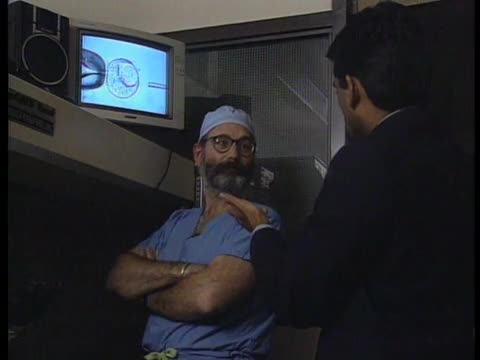
MR. MacNeil: Next tonight, cloning humans. A scientific frontier was crossed recently when two scientists at George Washington University announced they'd succeeded in making exact replicas of human embryos in a laboratory. Medical Correspondent Fred De Sam Lazaro of public station KTCA-Minneapolis-St. Paul reports on the implications.
MR. LAZARO: It was Hollywood that first made cloning a hot topic this year with the movie "Jurassic Park." But the idea upon which the idea is based, cloning entire animals, even dinosaurs, from tiny strands of DNA is real only in the movies. In real life, cells from different parts of the body have distinct rows. It's impossible to create a skin cell from say a liver cell.
DR. HUGH HENSLEIGH, Embryologist: This is a mouse embryo at the blastocyst stage. This is about four days after fertilization.
MR. LAZARO: However, at the very early embryonic stages cells are undifferentiated, and it's here that cloning is possible according to Dr. Hugh Hensleigh at the University of Minnesota.
DR. HUGH HENSLEIGH: Theoretically, all these cells that make up this inner cell mass are genetically identical at this point, and these cells could be used for cloning or they could be used for looking at the embryo to see if it's genetically normal.
MR. LAZARO: You just take one of the cells, put them into ovum, another egg --
DR. HUGH HENSLEIGH: Another egg.
MR. LAZARO: -- and you could create an identical individual.
DR. HUGH HENSLEIGH: Yes.
MR. LAZARO: And so on and so forth. If could take 16 out of here, you'd get 16 identical ones?
DR. HUGH HENSLEIGH: Right, right.
MR. LAZARO: It's a process that occurs naturally when identical twins are born. Cloning has also been used for some years by cattle breeders. In October, a couple of George Washington University scientists undertook the first such experiment with human embryos. Their motivation was to help countries like John and Karen Stern, patients at the University Hospital's fertility clinic in Washington, D.C.
KAREN STERN: We've been trying now to have children for about eight years and been quite unsuccessful. I'm gone through several different types of surgery to see where the problems are.
MR. LAZARO: As their last hope, the Sterns have been trying to conceive through a procedure called in vitro fertilization. In this process, sperm cells and eggs extracted from the parents are joined in the lab, and the resulting embryos are placed back in the womb. In most cases, the embryos don't take, i.e., they don't attach to the uterus to form a pregnancy. To increase the odds, several embryos are placed in the womb, and to create these several embryos, the prospective mother undergoes extensive therapy so her body produces more than the usual one egg during her monthly ovulation.
KAREN STERN: Each cycle of in vitro you have somewhere between forty and fifty injections, blood tests, daily ultrasounds. You know, it's a time consuming process. Your whole life is on "hold." I'm sure it's difficult on the body. Mentally, it's, it's a strain.
MR. LAZARO: This super ovulation therapy has cost the Sterns tens of thousands of dollars. Cloning could save much of this pain and expense according to Washington University's Dr. Jerry Hall.
DR. JERRY HALL: We could utilize the natural cycle where only one egg is normally produced and in that situation, again, make two eggs from one, or three eggs from one.
MR. LAZARO: It's a theory that has long intrigued scientists, and Dr. Hall and colleague Robert Stillman decided to test it when a set of defective human embryos became available. They were able to extract cells from these embryos to produce clones, a total of 48 out of an original 17.
DR. ROBERT STILLMAN: Now, these were only grown for six days, and that was the maximum that they do. Whether or not a normal embryo, if it were tried, would proceed on further than that is a total unknown.
MR. LAZARO: Stillman and Hall are emphatic about the limited scope of their research. They caution that it involved defective embryos which were likely to thrive for only a few days and that it's a giant step, scientifically and ethically, between their experiment and healthy cloned human embryos that would be useful for patients.
DR. JERRY HALL: What we did not show and did not intend to show their ability to implant in the uterus after they are transferred. Now, this is part two to the story which we did not investigate at the time.
MR. LAZARO: Even though Hall and Stillman didn't come close to a lab-created human twin, medical ethicist Arthur Caplan says their experiment was a historic landmark in modern medicine.
DR. ARTHUR CAPLAN, Medical Ethicist: The human experimentation committee at the medical center where the procedure was done didn't view it. Short of that, there was no comment, no discussion, no debate, no nothing. It's only after the fact that we've begun having a debate about the morality of, of doing cloning in human beings.
MR. LAZARO: Caplan agrees cloning would benefit infertile couples but he fears there's great potential for abuse. Among some of his nightmarish scenarios is a couple who grow a spare cloned embryo to term just to serve as a kidney donor for an older sibling, or a couple who would choose to have a duplicate of their first child by thawing its clone. Caplan says the idea of identical twins born years apart is both ethically repugnant and unnerving to what would be the younger identical twin.
DR. ARTHUR CAPLAN: Part of the fun of life is not knowing everything that our biological constitution sets for us. And you're going to be taking that away from someone who's got this exactly copy moving ahead through time.
MR. LAZARO: But in vitro patients like Allison and Jim Gaasadelen don't seen cloning in so sinister a light. After several years of trying, this couple finally had a son, Eric, earlier this year. They say they would consider cloning if they wanted more children.
ALLISON GAASADELEN: I think environment plays such a big part that their lives would be different. We all know twins who have very different personalities, even though their genetic makeup may be the same. People in families often look alike and have the same likes and talents. I don't really think that's a problem.
MR. LAZARO: The Sterns see diagnostic benefits in having an older sibling clone.
KAREN STERN: We're told if our own parents have high blood pressure or heart attacks that we're prone to it, so it would be a warning for the second, the younger sibling to watch for the signs closer.
MR. LAZARO: For his part, Dr. Stillman finds such use of cloning ethically dubious. Stillman says there have to be clear guidelines and an important overriding reason for using the technology.
DR. ROBERT STILLMAN: Our goal in our medical approximate theraputis is to provide those couples who haven't been able to conceive the ability to fulfill that biological right. And if it means by doing that research involving medications, involving surgical techniques, or involving embryo work, then I think that has a place to go forward. If I'm disagreed with as far as the society saying cloning under any circumstance is inappropriate, I would feel quite comfortable with abiding by that restriction.
MR. LAZARO: Would you really?
DR. ROBERT STILLMAN: Yes, I would. I would feel constrained.
MR. LAZARO: Can you say that for all your peers?
DR. ROBERT STILLMAN: The, the huge, huge majority.
MR. LAZARO: However, Caplan fears a potentially lucrative cottage industry could develop in so-called "designer babies." He says the big barrier right now is not human interest or values but the high cost of in vitro fertilization.
DR. ARTHUR CAPLAN: If the cost ratio shifts, it becomes cheap to do this, or cheaper, and the inconvenience factor shifts so that once pregnant somebody might be able to flush out an embryo, make copies, and then reimplant them with a high chance of success at low cost, then I think the answer to the question of who wants to do this becomes a lot of people. I haven't seen any shortage of customers for the Nobel Prize Sperm Bank that's been running for many years now out in California.
MR. LAZARO: The Nobel Prize Winners' Sperm Bank Caplan refers to is actually called the Repository for Germinal Choice. Here in Escondito, California, it's one of several sperm banks in the state, but this one screens its donors for intelligence.
DR. ROBERT GRAHAM, Sperm Bank Founder: The basic function of this organization is to provide children, certain children, with the best possible start in life. And we do that by collecting germinal material from some of our outstanding younger men and freezing it and offering it to these couples who want children.
MR. LAZARO: Dr. Robert Graham, an optometrist who made a fortune by inventing plastic eye glasses, opened this facility in the late 60's. His objective is to preserve what he calls humanity's best genes.
DR. ROBERT GRAHAM: We have almost 200 youngsters now. Not one is average. They're all very bright, very healthy, and they're happy youngsters.
MR. LAZARO: And as their proudly displayed pictures show, they're also mostly blond-haired and blue-eyed, stereotypically perfect kids. Critics charge such facilities help parents engineer these prejudices into their offspring.
DR. ROBERT GRAHAM: I, I can't agree that we're engineering and designing children. Child bearing is a risky, uncertain thing in many ways, so there are lots of elements of uncertainty involved, and we just fix the odds in favor of a very good outcome.
MR. LAZARO: Yet, Graham has no problem with the fact that cloning could potentially perfect his technique.
MR. LAZARO: Even with a facility like yours there is still a chance that you won't have a bright, intelligent child. Cloning seems to leave much less to chance. Do you have any discomfort with that notion that we can essentially design the kids we want with near certainty?
DR. ROBERT GRAHAM: Insofar as you can with near certainty, I think that's a splendid accomplishment. It would have to be regulated. It would have to be done with, with people of, of good intent.
MR. LAZARO: Are you confident that we can regulate good intent in this industry?
DR. ROBERT GRAHAM: I'm not at all confident that we can regulate good intent but we can at least rule out bad intent.
MR. LAZARO: Many experts don't think so. Arthur Caplan says subjects related to reproduction are ticklish for most lawmakers.
DR. ARTHUR CAPLAN: We've been in a situation in this society where we've found ourselves unable to even talk to one another about cloning or anything having to do with human experimentation regarding embryos because in the background is this, this 900 pound gorilla of abortion, and so politicians and society as a whole have simply ducked away from this topic because it doesn't want to reopen the abortion debate.
MR. LAZARO: As a result, Caplan notes that the in vitro industry, which is highly profitable, operates largely without government regulation, governed only by institutional ethics committees.
DR. ROBERT STILLMAN: You can break the law all the time, and just because there are obscene phone calls doesn't mean you shouldn't have telecommunications.
MR. LAZARO: Stillman and other scientists worry that with all the controversy surrounding potential abuses many responsible scientists will shy away from what otherwise is a very promising medical research field.
DR. HUGH HENSLEIGH: Cloning is a wonderful technique in the research area because it helps us understand how cells change from being an undifferentiated cell into a, into a multicellular organism, and it, you know, there's a lot of questions about what controls this and what's the difference between normal development and cancerous development and that sort of thing. So as -- as a research tool, cloning is amazing.
MR. LAZARO: Meanwhile, Stillman and Hall expect that the next step in their experiment, implanting normal embryos in patients, will be developed in about two years. What remains to be seen is once that technology is in place, which scientists, if any, choose to be first to use it. Stillman and Hall say they won't be among them, although they insist this is because they have gone on to other research interests, not because of the controversy surrounding their first cloning experiment. SERIES - CHINA IN TRANSITION - FOCUS - CULTURAL EVOLUTION
MS. WARNER: Next, another in our series of documentary reports on today's China. Tonight, a look at culture and the arts. China's change to a market-driven economy has reduced state subsidies for the arts, forcing artists to scramble for outside sources of income. Meanwhile, a stern government keeps a watchful eye on the political correctness of artistic expression. Our special correspondent is Robert Oxnam, president emeritus of the Asia Society. He's now at Columbia University and the Bessemer Group, a New York banking and investment firm.
MR. OXNAM: In the West, the term "cultural" might conjure up a night at a symphony orchestra, or a visit to a museum. In China, cultural sometimes has much more ominous significance. Just 20 years ago, China was caught in the so-called great proletarian cultural revolution. Spearheaded by Chairman Mao Tse Tung, the state tried to control all forms of artistic expression. His wife, Chiang Ching, ruled the cultural world with an iron fist, commissioning a small number of performers who she deemed ideologically correct. This ballet, "The White-Haired Girl," celebrated the triumph of downtrodden peasants over evil landlords. The joy of the execution scene is nothing like the joy of the performers when they meet Mao Tse Tung at the height of his hero worship. China has become a more open society since the cultural revolution ended in the mid-1970's, but memories of the Tiananmen episode in 1989 sent new shivers down Chinese spines.
YING RUOCHENG, Actor: The situation since then has changed a lot. I think it's fair to say that.
MR. OXNAM: Ying Ruocheng starred in "The Last Emperor." He is one of China's most famous actors and former vice minister of culture.
YING RUOCHENG: Beginning summer of last year, when some of the advocates of a harsh line were removed politely, but removed, and there has been a lot happening on the cultural scene, not directly political perhaps, but in China; the arts are always so closely linked with the political ambience.
MR. OXNAM: The Chinese film "Farewell My Concubine" promoted heavily in the United States has received rave reviews around the world and won awards at international film festivals, but the film has faced censorship in China presumably because it deals with touchy subjects like homosexuality and suicide. Director Chen Kaige has this reaction to the way the government treated his film.
CHEN KAIGE, Director: Very frankly, I don't think I can enjoy 100 percent creative freedom in China, you know. I always have a problem with, with censorship, you know. I don't want to -- I must say this -- I don't like, you know, confrontation. I just try to find a channel that people can understand, can communicate with each other, including those film officials. I think that they are pretty open minded. They want to support, but the thing is that they, they need to be educated in terms of filmmaking, you know, you know, taste.
MR. OXNAM: While overt censorship appears to be less frequent these days, the state watches the cultural world with an acute and often cold eye. This concert featuring China's leading rock star, Cui Jian, was jammed with 12,000 young fans. While they swayed to the music, they seemed more subdued than western audiences. Perhaps that's because there was one policeman for every ten ticket holders. Cui Jian explains that he has become accustomed to such large displays of security.
CUI JIAN: Some high leader of security, they're my friend. I understand because they have a boss; that's their job. So I can take that. That is no problem for me because I want the music. Music is first. Nothing else, nothing is first, except music.
MR. OXNAM: So rock exists in a twilight zone between government control and free expression. There were no rock concerts in China until the mid 1980's. Cui Jian was originally a classical musician, a trumpet player who learned rock while listening to tapes. His lyrics sometimes make veiled comments about individuality and freedom of expression, but the pounding rhythm, and this gesture, symbolic of the red bandanna of the guerrilla fighter suggests stronger messages. It's precisely that release of pent up feelings that Cui Jian seeks in his concerts.
CUI JIAN: Open people to themselves -- and try to get any kind of liberation.
YING RUOCHENG: Apart from all the other functions of art and literature this should be one of them, you know, to let off steam, to make people finally be more reasonable actually. I think even if ideologically culturally, we do, we have to face some chaos, even if we have to face that, finally it'll be good thing, it should not be suppressed. We have to trust history, trust the people, trust artists, themselves, to, not to go over the brink.
MR. OXNAM: Modern dance is another artistic endeavor on the cutting edge. The Guangdong Dance Company plays to full houses, including this performance in Beijing. When company director Yang Meiqi is asked about finances, she quickly explains that some money comes from outside.
YANG MEIQI, Director, Guangdong Dance Company: [speaking through interpreter] The financial support that we receive from outside of the country is relatively small. We have some small long-term support that comes from the head of Hong Kong Dance Company. He, himself, is an artist and has a good economic foundation.
MR. OXNAM: When asked about issues of politics, she says the cultural authorities accept their art even if they do not appreciate it. In this performance, there is no mistaking the message: Lively and individualistic people from various walks of life interact energetically, until a large red banner, presumably representing the state or perhaps the Communist Party, sweeps over them. Then they walk robot-like around the stage, devoid of personality and with no human connections. Like rock, modern dance tentatively explores non-verbal, artistic commentary. Both forms are winning substantial numbers of new fans. Among the losers are older cultural forms such as Beijing opera which was all the rage a hundred years ago when the biggest fan was the infamous Empress Dowager. Talented younger opera performers are becoming rare. This 33-year-old woman star makes an ironic observation.
CHEN SHUFANG, Beijing Opera: [speaking through interpreter] In Hong Kong and Taiwan, because they speak the same language we do, they like Beijing Opera very much. I personally feel they are even more interested in Beijing opera than people in Beijing. You get the feeling here that more old people see Beijing Opera and that it is in danger.
MR. OXNAM: Two older stars who have devoted their lives to Beijing Opera say young people infatuated with new wave art will return to their roots.
MADAME DU, Beijing Opera: [speaking through interpreter] Because at any time in history there are materialists and there are spiritualists. Materialists are secondary. Spirit is fundamental. Any nation, if it wants to be prosperous, has to have its own national culture. Only then can it go forward.
MR. OXNAM: After elaborate preparations, the opera opens to a house that is only half full. Modern tastes have pulled away much of the potential audience, and the technology of television gives older devotees a chance to watch at home. It is only in the past decade or so that China has fully entered the communications revolution. Satellite dishes sprouting from roofs and balconies attest to a new era. This southern village was truly remote not long ago. But today many residents can eat lunch and watch big screen TV with a range of programming, including much from the West, that skirts the control of the Ministry of Radio and Television. Freedom of expression competes with economic survival as the biggest issue for artists in modern China. Cutbacks in state funding force almost everyone to become an entrepreneur, even those in the cultural world. Actor Ying Ruocheng says as a vice minister for culture he pushed for streamlining state-run artistic groups.
YING RUOCHENG: Well, it creates a lot of difficulties for present companies but I think they deserve it. The companies were getting bigger and bigger and bigger because they couldn't fire anybody, and you, you gather lots of bad wood, and nobody could do anything about it.
MR. OXNAM: Members of the Beijing Symphony Orchestra are trying to make the transition to a market-driven economy. Government resources are declining, and western-style corporate philanthropy is not yet established. Leading musicians at this rehearsal for an upcoming concert also have taken second jobs in hotels and bars to make ends meet. Former Orchestra Li Delun describes his feeling when he sees these moonlighting artists.
LI DELUN, Former Orchestra Director: [speaking through interpreter] Of course, I feel very uncomfortable. I know that there is no other way. They have to live. We don't give them enough money, so that's one of my reactions. But another is to say, I don't see you. If I saw them, there would be trouble because this is not permitted. But I say, I didn't see you. I make it a joke.
MR. OXNAM: Some people describe this diversion of artists and intellectuals from creative pursuits as an internal brain drain, but Chun Shi, a leading baritone, describes it more politely, as a transition.
CHUN SHI, Leading Baritone: [speaking through interpreter] We musicians have to take a second job, you have to keep professional training and you have to support yourself, so there is this transition period.
MR. OXNAM: Transition, that's also the right term for the status of contemporary painting in China. North of Beijing in scruffy brick buildings near the old summer palace is a Bohemian artists colony. Its director, Mr. Wang, explains that some forty to fifty artists from around China live and work in the colony. He wants it to become like the Soho section of New York. The art works are often sold to foreigners for hundreds, even thousands of dollars. The income pays the rent for the residents. Mr. Wang says the government tolerates the colony and doesn't interfere. Others worry they might be closed down sometime in the near future. For the artists colony and for Chinese culture as a whole, clouds of uncertainty still linger. At dawn on Shanghai's waterfront, the ancient art of shadowboxing, which has always been politically correct, coexists with western ballroom dancing, unthinkable during the cultural revolution 20 years ago. That was in spite of the fact that both Chairman Mao and Premier Chou En- Lai both relaxed with western dance in the wartime years of the 1930's and 1940's. But none of the founders of the Communist movement might have imagined that JJ's Disco, owned by China's armed forces, would become the range for Shanghai's youth culture today. While YMCA might seem a little out of date in the West, it has them dancing on the tables at JJ's. Shanghai Vice Mayor Xu Kuangdi expresses concerns typical of his generation.
XU KUANGDI: We still want to keep our traditional culture. And I'm a little worried about the young generation. They like the popular music stuff from Hong Kong, Taiwan, and even from the United States. But I think we still need Peking Opera and our Shanghai Opera even, and also classic music, and traditional opera from Europe.
MR. OXNAM: As long as party officials like Vice Mayor Xu do not feel politically threatened by current trends in art, many newer forms of culture stand to benefit from China's economic boom. Popular artists, such as Cui Jian, will prosper from the box office receipts of young concert goers. Avant garde groups will have growing support from intellectuals and sympathetic foreigners. But certain older cultural traditions risk becoming endangered species. With small and aging audiences, they have to rely primarily on limited state subsidies for support. So in culture, as in all aspects of today's China, the power of the purse is becoming as important as the power of politics. RECAP
MR. MacNeil: Again, the major stories of this Thursday, the Clinton administration decided not to challenge the key parts of a landmark court ruling protecting the rights of gay service personnel. The Vatican and Israel signed an historic accord of mutual recognition, and the sales of new homes reached a seven-year high last month. Good night, Margaret.
MS. WARNER: Good night, Robin. That's it for the NewsHour tonight. We'll see you tomorrow night with a special year end wrap- up by our essayists and our political team. I'm Margaret Warner. Good night.
- Series
- The MacNeil/Lehrer NewsHour
- Producing Organization
- NewsHour Productions
- Contributing Organization
- NewsHour Productions (Washington, District of Columbia)
- AAPB ID
- cpb-aacip/507-tm71v5cd91
If you have more information about this item than what is given here, or if you have concerns about this record, we want to know! Contact us, indicating the AAPB ID (cpb-aacip/507-tm71v5cd91).
- Description
- Episode Description
- This episode's headline: Clinton's Agenda; Double Trouble?; China in Transition - Focus - Cultural Evolution. The guests include LANI GUINIER, Law Professor, University of Pennsylvania; REV. EARL JACKSON, Attorney; DEL. ELEANOR HOLMES NORTON, District of Columbia; ARTHUR FLETCHER, U.S. Civil Rights Commission; CORRESPONDENTS: FRED DE SAM LAZARO; ROBERT OXNAM. Byline: In New York: ROBERT MacNeil; In Washington: MARGARET WARNER
- Date
- 1993-12-30
- Asset type
- Episode
- Topics
- Social Issues
- Women
- Global Affairs
- Film and Television
- War and Conflict
- Religion
- LGBTQ
- Military Forces and Armaments
- Politics and Government
- Rights
- Copyright NewsHour Productions, LLC. Licensed under a Creative Commons Attribution-NonCommercial-NoDerivatives 4.0 International Public License (https://creativecommons.org/licenses/by-nc-nd/4.0/legalcode)
- Media type
- Moving Image
- Duration
- 00:59:02
- Credits
-
-
Producing Organization:
NewsHour Productions
- AAPB Contributor Holdings
-
NewsHour Productions
Identifier: 4831 (Show Code)
Format: Betacam
Generation: Master
Duration: 1:00:00;00
If you have a copy of this asset and would like us to add it to our catalog, please contact us.
- Citations
- Chicago: “The MacNeil/Lehrer NewsHour,” 1993-12-30, NewsHour Productions, American Archive of Public Broadcasting (GBH and the Library of Congress), Boston, MA and Washington, DC, accessed April 19, 2026, http://americanarchive.org/catalog/cpb-aacip-507-tm71v5cd91.
- MLA: “The MacNeil/Lehrer NewsHour.” 1993-12-30. NewsHour Productions, American Archive of Public Broadcasting (GBH and the Library of Congress), Boston, MA and Washington, DC. Web. April 19, 2026. <http://americanarchive.org/catalog/cpb-aacip-507-tm71v5cd91>.
- APA: The MacNeil/Lehrer NewsHour. Boston, MA: NewsHour Productions, American Archive of Public Broadcasting (GBH and the Library of Congress), Boston, MA and Washington, DC. Retrieved from http://americanarchive.org/catalog/cpb-aacip-507-tm71v5cd91