The NewsHour with Jim Lehrer
- Transcript
ELIZABETH FARNSWORTH: Good evening. I'm Elizabeth Farnsworth. Jim Lehrer is away tonight. On the NewsHour Presidents Clinton and Yeltsin agree and disagree at the summit. We'll discuss what they've accomplished, plus the week's politics with Shields & Gigot, and art, money, and the movies. It all follows our summary of the news this Friday. NEWS SUMMARY
ELIZABETH FARNSWORTH: President Clinton and Russian President Boris Yeltsin wrapped up their two-day summit in Helsinki, Finland, today. The two leaders agreed to hold a new round of talks aimed at significantly reducing the number of nuclear warheads in the U.S. and Russia. The goal will be to reach by the year 2007 an 80 percent reduction from Cold War levels. President Clinton was unable to gain Russian support for a proposed NATO expansion into Eastern Europe, but the two Presidents did agree to work towards a document to be signed by NATO members and Russia which would establish high-level political cooperation among them. We'll have more on this story after the News Summary. In the Helsinki press conference Mr. Clinton condemned the "slaughter of innocent civilians" in Israel today and urged the Palestinian Authority to take all possible steps to prevent terrorism. Four people were killed and forty-six wounded when a suicide bomber attacked a crowded outdoor cafe in Tel Aviv. The Muslim militant group, Hamas, took responsibility for the blast. We have more on the story from Sirah Shah from Independent Television News.
SIRAH SHAH: For days there have been warnings from both sides that terrorist violence was imminent. Towards mid-morning in a busy downtown cafe in Tel Aviv it came. There was panic among the crowds, many of whom were celebrating a Jewish holiday. A waiter said he'd seen a strange-looking man carrying two bags moving between tables. Seconds later there was a flash and he blew up. His still, smouldering body lay for some time at the scene. As the wounded were taken to hospital, a man called the police saying the Islamic resistance movement, Hamas, had carried out the attack. Israel's prime minister blamed Yasser Arafat's Palestinian Authority, which has recently released militant prisoners.
BENJAMIN NETANYAHU, Prime Minister, Israel: Two days ago our security forces alerted us, and we alerted the world that the terrorist organizations in the Palestinian-held territories understood that they received a green light from the Palestinian Authority and its leaders to perpetrate terrorist attacks against Israel. Unfortunately, this green light has now proved to be operative. They have done a criminal act, blowing up women, old men, children in the middle of Tel Aviv. And we view the Palestinian Authority gravely responsible for what has happened.
SIRAH SHAH: It seems no coincidence that the Tel Aviv attack comes as Palestinian anger is brewing. There were riots in the West Bank town of Hebron today, the culmination of protests at Israel's decision to build a new Jewish settlement in Jerusalem.
ELIZABETH FARNSWORTH: Palestinian Leader Yasser Arafat condemned the blast in phone calls to Netanyahu and Israeli President Ezer Weizman. In Washington the House approved $3.8 million to investigate presidential fund-raising practices, but it temporarily froze funding for 19 committees at last year's levels. The freeze satisfies 11 House Republicans who yesterday blocked a bill favored by Speaker Newt Gingrich to increase committee spending. Today Gingrich explained what happened.
REP. NEWT GINGRICH, Speaker of the House: When you manage with a nine-vote majority, which is the smallest majority since Sam Rayburn became Speaker in 1955, with what I think at that time was about a six-vote majority, you have to work extra hard. And we did work extra hard. We got it done. I would point out to you that every single penny we wanted for investigative purposes was passed today, and that we are, in fact, doing everything we set out to do yesterday. And we'll be back in 30 days with the rest of the committee funding. I think that's the way it should be.
ELIZABETH FARNSWORTH: Speaker Gingrich also attempted to clarify his position on tax cuts today. Earlier this week, Gingrich had suggested tax cuts could wait while Republicans concentrated on passing a balanced budget. Other Republicans disagreed with that idea. Today Gingrich said, "I am deeply committed to lowering taxes. The precise way we do it is less important than getting it done. The board of American Airlines Union met in Washington today to consider a new contract offer from the carrier. If the 18-member board approves the deal, it will be sent to the union's 9,300 members for ratification. If it is not approved, the pilots could strike as early as next month. Details of the proposal have not been made public. The major sticking point during negotiations have been pay and a dispute over who will fly American Airlines' smaller regional jets. In California today the state government launched a $22 million anti-smoking campaign paid for by tobacco taxes. It features 16 television, radio, and billboard ads that highlight the dangers of nicotine addiction and secondhand smoke. California voters created the tobacco tax in the 1988 ballot measure to counter advertising by cigarette makers. And that's it for the News Summary tonight. Now it's on to the Clinton-Yeltsin summit, Shields & Gigot, and art, money, and the movies. FOCUS - SUMMIT SUMMARY
ELIZABETH FARNSWORTH: First tonight the Clinton-Yeltsin summit. Charles Krause has the story.
CHARLES KRAUSE: After a full day of negotiations the two presidents said the summit had produced agreement on several major issues. While they continued to disagree on the wisdom of NATO expansion, they, nonetheless, said they'd worked out the parameters of the new agreement on cooperation between Russia and NATO. The new agreement should be ready for signing, they said, within the next few weeks. The two presidents also said they made progress on other issues ranging from strategic arms control to economic cooperation. At the news conference Mr. Yeltsin was asked about his statement that U.S.-Russian relations have now entered a new phase.
BORIS YELTSIN: [speaking through interpreter] Well, first of all, we finally were able to determine our positions on issues of European security. We--the parameters of the NATO-Russia agreement. Secondly, there's an unprecedented reduction of nuclear weapons; that is, of Start III. That's 85 percent of the overall arsenal of warheads has been reduced in connection with that. That is significant. This is a very principled issue, and this encompasses the interests of not only our two countries but of the entire European continent and the whole world. And the question on economics reflects a completely different approach. We won't conceal this, and I think that Bill Clinton will excuse me if I perhaps am incorrect here, but I think that a certain restriction on questions holding back on the American side on the Russia economic relations, there was along the lines of the ministry of energy, on anti-dumping laws, and also the Jackson-Vannic amendment, and many other items speak of the fact that the United States has not been that interested in developing a strong economic Russia or that trade would grow in a healthy way between Russia and the United States. Finally, a breakthrough has been made. A joint statement has been signed. We've discussed these issues in great deal with President Bill Clinton, and on chemical weapons that too. Any issue we handle we've been able to manage a major breakthrough. We didn't discuss small issues. We talked only about strategic issues. And on all five issues we were able to find an answer. We were able to find a common point of view. And that's what is reflected in our joint statements.
PRESIDENT CLINTON: If I might just support that question, I think that's a question all the Americans and all the Russians and others will be interested in, what came out of this meeting that was different? One, the idea that there will be a NATO-Russia agreement that all the leaders will support. That's a significant thing. We agree to disagree about the question of expansion, but we agree that there must be a partnership between NATO and Russia going forward into the future. Two, the notion that Russia should play a larger role in international economic institutions, and that if certain internal changes are made, which President Yeltsin has already announced his support for, then the United States will make a more vigorous effort to facilitate investment in Russia. And third, and I think almost unexpected even among us as we're working along here, hoping this would happen, we resolved a number of road blocks relating to Start II and other related issues which permitted us to say that President Yeltsin would seek the prompt ratification of Start II, and we would together support guidelines for Start III, which we would hope could be negotiated quickly after that, which would reduce the Cold War arsenals by over 80 percent from their Cold War height, the more or less 80 percent. These are dramatic and very substantial results, and I'm very pleased with them.
CHARLES KRAUSE: Now two perspectives: Sergei Gregoriev was spokesman for Soviet President Mikhail Gorbachev. He's now a senior research associate at the John F. Kennedy School of Government at Harvard University. And Coit Blacker, who served the past two years as senior director for Russian, Ukranian, and Eurasian Affairs at the National Security Council; he's currently a senior fellow at the Institute for International Studies at Stanford University. Gentlemen, welcome. Mr. Blacker, first to you. Tell me from what you heard today and what you know, what is likely to be in this agreement between Russia and NATO?
COIT [CHIP] BLACKER, Former National Security Council Staff: Well, I think first and foremost it will signify or it will confirm the fact that NATO and Russia can do business; they can do business over the longer-term. So in that sense it regularizes and normalizes, institutionalizes, if you will, arguably the most important post Cold War relationship in Europe. I think a lot of the details have yet to be finalized, and I expect an awful lot of hard work over the next two, two and a half months until we have a signed and sealed agreement.
CHARLES KRAUSE: There was though--there were some hints, in fact, today about an agreement that NATO would not put any nuclear weapons, for example, in the former Warsaw Pact countries, things like that. I wonder if you could expand on that just a bit.
COIT [CHIP] BLACKER: Sure. The agreement that I think will emerge from this is essentially a ratification of current NATO policy; that is, NATO has no plans, no intention, and no need to change its deployment policy with respect to nuclear weapons as long as current conditions prevail. So that is a longstanding NATO policy, and I think it's important that it conform, in essence, with the purpose of the agreement that's entirely consistent with current NATO policy.
CHARLES KRAUSE: From what you could tell, did President Clinton have to make any concessions with the Russians in order to get them to go along with this?
COIT [CHIP] BLACKER: No, I don't think so. The word "concession" I think is inappropriate in this context. After all, what the President is trying to do, what the administration is trying to do is build for the long-term, is put in place a durable, flexible, important set of relations between NATO and Russia. And in that context I think it's very important to think very hard and very clearly about what it is that needs to go into that kind of an agreement from both sides. I don't think of that as conceding anything. I tend to think of that as working positively for the longer-term but a very important role.
CHARLES KRAUSE: Mr. Gregoriev, I wonder if I might ask you, President Yeltsin came to the summit saying that he wasn't going to agree to anything that would allow NATO to expand, or at least he would never go along with it. In effect, is that what's happened today?
SERGEI GREGORIEV, Former Gorbachev Spokesman: Well, I think that what was most important--and it already sounded in your coverage of the summit--is that both presidents announced that they agree to disagree. And, nevertheless, I think what was most important that Mr. Yeltsin was not making any special fuss about this disagreement, but some constructive way out of this potentially very tense situation was found, and I think from that point of view, this was a very successful summit. I think that Mr. Yeltsin will certainly have to respond to domestic pressures and upon his return back to Russia will have to make a few strong and even maybe militant statements about his disagreement with plans for NATO enlargement. But, nevertheless, I think basically working solution has been found. It's been proclaimed today. And I think this is the significance of the conclusion of today's summit.
CHARLES KRAUSE: What would have to be in this agreement to allay Russian fears of the NATO expansion?
SERGEI GREGORIEV: Well, first of all, this agreement will be signed by all NATO countries. Second, what is also important is an agreement by the United States and I assume by other NATO member countries not to deploy nuclear weapons and not to use to their benefits the remaining Soviet military infrastructure in the former Warsaw Pact countries. But I think what is even more important here is the spirit of agreement about certain issues. And I think that if this agreement is binding, it's binding in terms of security not only for NATO members. It's also binding for Russia because I assume Russia will also have certain lines in the treaty which will make it think twice before thinking about violation of this agreement.
CHARLES KRAUSE: Thank you. Mr. Blacker, I wonder, there were a number of announcements around the arms control treaty, and I wonder if you might, very briefly, just explain what was most significant about the announcements regarding START II and then how was it possible to get beyond that to START III?
COIT [CHIP] BLACKER: Certainly, Charles. The START II Treaty has been languishing in the state duma in Moscow for sometime now. It's a complicated treaty. It's a complicated arrangement. It's got a certain lack of political energy, if you will, on the Russian side in securing ratification. This treaty is very much in the interest of both the United States and the Russian federation, and the two leaderships over the last two days I think have come up with a good strategy for inching the duma toward ratification. And that is to outline or to preview the essential features of a START III agreement, or a follow-on to the START II Treaty, the effects of which will be to reduce further U.S. and Russian strategic arsenals. This is good news, of course, for both sides, but, in particular, it's good news for the Russian side because they were looking at a rather expensive modernization program if we had stayed flat at START II. Moving toward START III levels, which are significantly lower, means we get more security at reduced cost for both sides. So I think this should--should help spur this process along.
CHARLES KRAUSE: What was the significance of the announcement regarding the ABM Treaty, Anti-Ballistic Missile treaty?
COIT [CHIP] BLACKER: The ABM Treaty of 1972 severely limits research, development, and deployment of strategic defensive system. And both sides understand and are of the view that the preservation of that treaty is terribly important. At the same time both sides are very, very interested in developing capabilities to combat shorter range missile systems from so-called end country threats. What the agreement today appears to allow--and this is very good news--is preservation of the ABM Treaty but increased freedom to research, develop, and deploy so-called feeder missile defensive systems. This has been a sticking point in the U.S.- Russian relationship for the last three years. And the fact that they're able to make progress--and I think it's real progress--is a good, powerful boost to the strategic relationship between the two sides.
CHARLES KRAUSE: Mr. Gregoriev, I wonder if you agree with Mr. Blacker's assessment that these announcements will help get START II through the duma in Moscow.
COIT [CHIP] BLACKER: Yes. I certainly agree with a lot of positive assessment which I just heard in this presentation. There is one thing, though, I would like to stress; that in the Russian duma the ratification of the START Treaty--START II Treaty in many ways was hostage to the whole militant rhetorics against NATO enlargement. And I think that if Russia now positively resolves at least the whole matter of attitude towards the whole thing, it will also make psychologically life very easy for those people who are now actively advocating the idea of ratification of START II Treaty. Besides, as it was already said, the entering of START III Treaty also makes it easy for Russia in terms of reduction of costs to consider some of the issues connected with redeployment or cutting down of some of its nuclear arsenals.
CHARLES KRAUSE: One of the other--well, in fact, President Yeltsin said that he would also send the agreement with NATO to the duma for their ratification as well. I wonder if you might respond. There was one of the Russian reporters today suggested that maybe President Yeltsin traded NATO and traded some of these other things for the economic help that President Clinton promised. Is that how this may be perceived in Moscow?
SERGEI GREGORIEV: Well, those who would like to perceive it so in Moscow would still say so whether it was the case or not, and Mr. Yeltsin--and I will repeat it again--is under strong domestic pressure, especially this NATO issue, and we have to give credit to his boldness and his frankness today at the press conference. At the same time I do not believe that it was too neatly tied together, and I think that it will not due to good PR effort made by both presidents, it will certainly not look like a cynical deal. It will certainly look like another landmark along the right track of development of cooperation between the two countries. And I think that both presidents today spent enough time explaining the benefits of their cooperation in military and in strategic spheres and geopolitical things and in terms of fostering a stronger alliance between the two countries. The economic package came later, and as Yeltsin jokingly said at the press conference, he wishes it were true because he says he still wants more aid and more investment to come from the United States.
CHARLES KRAUSE: Well, gentlemen, we'll have to leave it there. Thank you both very much.
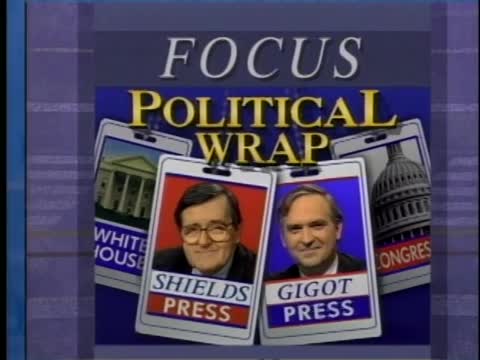
ELIZABETH FARNSWORTH: Still to come on the NewsHour tonight, Shields & Gigot, and Oscar and the movie business. FOCUS - POLITICAL WRAP
ELIZABETH FARNSWORTH: Now Shields & Gigot and to Margaret Warner.
MARGARET WARNER: For our end-of-the-week political analysis we turn to syndicated columnist Mark Shields and "Wall Street Journal" columnist Paul Gigot. Paul, while the President has been in Helsinki, there's been a lot of turmoil on the Hill over Newt Gingrich's apparent backing off of his tax cut proposals. What has he been up to? Explain this.
PAUL GIGOT, Wall Street Journal: A lot of Republicans would like to know, Margaret. They gave them an earful about it. I think he thinks he was beating a tactical retreat on taxes in order to outfox the Democrats. At least, this is what he was saying in explanation.
MARGARET WARNER: And he said this on Monday to reporters.
PAUL GIGOT: Right. He walked off the floor of the House and said it to reporters. It was a calculated statement. And what he was trying to do was to say--he's got a problem. Like a lot of Republicans he's very worried about getting beaten up again over cutting Medicare in order to cut taxes. And he wants to pass a budget that the President won't veto. And he wants to do it with Democrats. A lot of boll weevil Democrats in the House, the southerners, or more conservative members, don't like tax cuts. So he's saying, if I give up the tax cut first, pass a balanced budget, then we can come around and have a debate over tax cuts later. A lot of conservatives say if you give it up first, how are you going to get it later, and in fact, tax cuts have become a real leading edge, bedrock conservative principle, Republican principle. If you give it up, what do you stand for? Bill Clinton will take the balanced budget, pass that, and take all the credit, and then leave you with nothing. You're left there in the sort of historic pre-Reagan Republican mold of saying, no, no, no, and you don't stand for anything positive.
MARGARET WARNER: So, Mark, what happened this week? I mean--
MARK SHIELDS, Syndicated Columnist: Well, what happened, Margaret, was that the Speaker, who is a very smart man, violated one of the first rules of American politics. One of the first rules is--as learned nationally in the 1988 Dukakis campaign, and that is, you do not let stand the next news cycle, a misimpression, it is unflattering to you, or politically disadvantageous to you. Your rebut it. You rebuke it. You correct it. And Newt Gingrich made a statement on Monday. The statement was take tax cuts out of the equation and what's the liberal excuse now for not balancing the budget? A perfectly legitimate query, and probably not a bad political ploy for a minority leader in a strong position in his party. He is a majority leader in a weak position in his party and in the Congress, and he let this thing hang out there for four or five days.
MARGARET WARNER: But the President--
MARK SHIELDS: But the President--to the point, Margaret, where there's a rule in Washington, and that is when somebody switches his position and comes closer to you, we say that person has grown. When somebody leaves that position that he shares with you and goes the other way, he's caved, he's a moral cretin, or whatever else.
PAUL GIGOT: I thought you were really going to say the Speaker had done a wonderful thing.
MARK SHIELDS: Newt Gingrich was--Newt Gingrich was commended by the "Washington Post." He said quite boldly in the editorial, we know this is of no help to the Speaker, and he probably isn't welcome yet, but he did the right thing. So all this was going on, and Paul's absolutely right. There was restlessness, restiveness, and ultimately a revolution in the ranks of the conservatives.
MARGARET WARNER: Newt Gingrich goes to the Florida House today and says what?
PAUL GIGOT: What he's been telling Republicans elsewhere privately since then on Wednesday and Thursday, which is that, oh, the press blew this up, I'm deeply committed to tax cuts, we're going to cut taxes after all, after Jack Kemp had sent him a rocket saying, you'd better put tax cuts front and center. I think part of the problem here is that Newt Gingrich used the words--he said the balanced budget is a moral imperative. A moral imperative. Now, there are a lot of things that are moral imperatives. Putting money in working people's pockets is a moral imperative. Freedom is a moral imperative. Helping your children is a moral imperative. But I'll tell you the balanced budget is not a moral imperative. It is an accounting tool. And he makes--the Republicans have elevated this balanced budget to the only thing they seem to want. And it's become a boxed canyon for them. And as long as they're trapped into this, I think they're going to have a very difficult time doing anything. The deficit now is down at about $90 billion, $100 billion. Throw out the balanced budget and get to something that's a more assertive, positive agenda.
MARK SHIELDS: Wait a minute. The balanced budget was supposed to be out of reach because of the damn Clinton tax cut of 1993 was going to send the deficits through the roof. The Republicans are in a bad political problem. There's no doubt about it. Paul's right. There's a fault line in the Republican Party. The fault line is between those who are supply siders, who believe tax cuts are the road to salvation, political success, national honor, and better families. And there are those who the longest tradition in the Republican Party--Paul--
PAUL GIGOT: No, not salvation. Just take this earth.
MARK SHIELDS: This earth, and that would lead to salvation. But- -and there are those, and it's a long tradition of the Republican Party, who argue for fiscal responsibility; that you have to balance the budget. There's been a big, big fight between Main Street Republicans and the easy street Republicans.
MARGARET WARNER: But explain--if you were sitting at home and you now were wondering what is Newt Gingrich really planning to do when they go into budget negotiations with the White House, what is he going to do? I mean, which was the real Newt Gingrich, Monday or Tuesday?
PAUL GIGOT: Look, I think that is a question we don't know. What we do know is this. President Clinton ran on tax cuts in 1996. There are a lot of Democrats in Congress who still think tax cutting is a good idea. Five of them testified, and they were five not conservative members, liberal members in favor of tax cuts of one kind or another this week. There's a majority of 218 in this House of Representatives for cutting taxes. The Speaker's job and the task of leadership is to get there. Don't prematurely surrender. Say work, how we're going to do it, and then be quiet about how you're going to get there so that maybe at the end you can get something that your team likes and you can sell to the country. So, in other words, he made his job more difficult this week to do something like that.
MARGARET WARNER: All right. Mark, how serious--move it beyond the tax cuts into other leadership issues for Gingrich. How serious is the conservative disaffection with him?
MARK SHIELDS: Newt Gingrich's hold on power is increasingly tenuous. He has--there are those who snipe at him within his own party. There are others more ambitious, or equally ambitious, who would like to see a vacancy there, and they want to replace him. And Jerry Seib in the "Wall Street Journal" wrote this week, he didn't know whether it was reflecting a new Republican consensus on tax cuts or igniting a civil war. And I think that's what we're seeing. I think there are some people who would--who think that the Speaker's day has passed. I mean, you get that from conservative organizations like the Cato Institute, Steven Moore this week, and I think there's a real problem when he does this and when there is a lack of certainty and a lack of self-confidence, and I think in fairness to the Speaker, you have to acknowledge that the 104th Congress he was getting beaten over the head, the Republican Congress was in terrible shape in the spring of 1996, Margaret, and Newt Gingrich was shrewd enough in the summer of 1996 to rehabilitate his party, to save his majority by agreeing in practicality to pass minimum wage, to pass health care portability, to pass clean drinking water, to pass the welfare reform, get Bill Clinton to sign it, and so no one could make the charge against the Republican Congress, but they didn't do anything. Newt Gingrich, if, in fact, in--Paul's position--if, in fact, he were to pass a balanced budget, you know who's going to get credit for it, but that's the only way you're going to get tax cuts.
MARGARET WARNER: Was the other revolt we saw by Republicans yesterday over-funding for these House committees, including the campaign financing probe, was that related to problems over the tax cut?
PAUL GIGOT: I think the tax cut was something that they--seeming to walk away from tax cutting was one of their motives, but the immediate motive was to try to stop the Republican leadership at the behest of committee chairs to add to their budgets this year. I mean, they came in two years ago--two and a half years ago now- -out of these members--and what they said is, we're going to cut committees by a third. Congress is spending by a third. They did. And now the leadership--because the leadership is weaker--and that's one of the things that the Democrats have succeeded, you know, they decided they were going to cut off the revolution at its head and by going at the Speaker, they weakened it. So the committee chairmen are now feeling their oats and are saying, I want a little more turf. And these members said, we've got to do something to get their attention. And they walked away on a budget vote. And it was in real active principle on their part. It got their attention. They got what they wanted. They got a freeze in place for a while of last year's budget, but the bigger point, Margaret, is that there's nobody running this House. It's a headless house. It's a fifth--Republican members don't believe they want--everybody--it's every man for himself. In tactics, they're almost like President Clinton. No one wants to lead. Everybody's triangulating with everybody else, consulting their pollster, saying, what can I do for me, so you've got these ad hoc coalitions forming, but there's no common direction or common theme right now. And that's the frustration some of these members felt.
MARK SHIELDS: By following the Republican Contract with America, you know, and blindly supporting, loyally supporting it--they ended up the plank in the spring of 1996 by a 2 to 1 margin; the American people thought they were extremists.
PAUL GIGOT: They won re-election, Mark.
MARK SHIELDS: No, but they won--
PAUL GIGOT: They won the Congress.
MARK SHIELDS: They won re-election after Newt Gingrich saved their fannies in the summer of 1996, Paul. Your own "Wall Street Journal" poll in June of 1996, 2 to 1, extremist and non- productive, the Congress. By the summer--by September of 1996 that it turned around. What happened in the intervening three months? The Congress and the President worked together. It hurt Bob Dole who was trying to run against Bill Clinton, showed Bill Clinton could get things done, and it hurt every Democratic challenger in the country who couldn't argue that the Republican Congress had been extremist and non-productive.
PAUL GIGOT: Passed a good portion of the Contract With America.
MARK SHIELDS: That isn't what saved--
PAUL GIGOT: I don't think the minimum wage saved the day. I-- MARGARET WARNER: Are you saying it might have worked for the campaign, but it shouldn't--they shouldn't be doing that now?
PAUL GIGOT: I think they need to do something. The last time they were accused--the Congress was accused of doing too much. The problem now is they don't want to do anything at all, or don't give the appearance or having the confidence to do something. I mean, what they need to do, pick a fight, go after--try to pick some--I don't care if it's the National Endowment for the Arts--you want to zero it out--pick a fight that's rooted in your principles and go for it. Show that you're standing for something.
MARGARET WARNER: All right. We have to leave it there. Thank you both. FINALLY - BEATING THE ODDS
ELIZABETH FARNSWORTH: Finally tonight, art, money, and the movies. The annual Academy Awards will be presented Monday. Essayist Anne Taylor Fleming begins our look behind the scenes of the film business.
ANNE TAYLOR FLEMING: It's that night again when Hollywood does its thing, a night of cleavage and diamonds, of limousines and bleachers of fans, of winners and losers, over long and marked by less than spectacular production numbers, the Oscars are still must-see TV for the whole world. All the glitz and glamour looks no doubt to so many out there like fairy-tale time. But it's also a night of reckoning, a night when Hollywood, itself, like its expensively turned out stars, spends a little more time than usual looking in the mirror. Underneath all that glitz is always a little soul searching going on. This year what the industry sees is a kind of comeuppance. The big studios, those acres full sound stages and fake towns, and ghosts of movies past, aren't cutting it like they used to. Yes, they're turning out the special effects thrillers, the tornado and volcano extravaganzas. But those are hardly the stuff of Oscar consideration. Even the people who make them don't vote for them.
ACTRESS: Why did you follow me yesterday?
ANNE TAYLOR FLEMING: No, this Oscar night belongs to the little guy, the independent film companies like Miramax, which released "The English Patient," with 12 nominations.
ACTOR: Oh, sock it to us, Liberace.
ANNE TAYLOR FLEMING: Fine Line which gave us "Shine," up for seven Academy Awards. There is also the nastily witty "Fargo" from Gramercy. It has seven nominations.
ACTRESS: Oh, no, no sweetheart. No, darling. You've been ringing the wrong--
ANNE TAYLOR FLEMING: And "Secrets and Lies" from October films with five Oscar shots.
ACTOR: What can I do for you, Rod? You just tell me what can I do for you.
ACTOR: Show me the money.
ANNE TAYLOR FLEMING: Only one of the five finalists for Best Picture, "Jerry Maguire," with Tom Cruise as a soul-searching sports agent, came from one of the seven major studios. Does that mean the studios are out of touch, passe? Hardly. They'll go on doing their mega buck mass market thing, making big action films for a world audience. The average Hollywood film now costs $60 million, an increase of 148 percent in just a decade. To recoup costs studios are making big action kid picks, "Jurassic Park" and the like that can spin off into theme parks and toy store merchandise and will play overseas as opposed say to a film like "Slingblade," a modest slice of life about a retarded man in a small town which cost only $1 million to make and is holding two Oscar nominations this year--one for Best Actor, the other for Best Screen Play Adaptation. But the truth is the movie studios have always buzzed with the tension between art and commerce, vision and profit. I spent time around Hollywood studios when I was a kid. My parents were in the business--actors when I was young. And then my father became a director. They had good careers and there were days that my parents were optimistic and flush with work. But there were also days when they were idle, and we waited, sometimes anxiously, for those residual checks. That tension you don't see on Oscar night. You see everyone all gussied up, worried at the most about winning or not winning an Oscar. You don't see all the dreams denied, the longing of gifted people to do good work in a business that by its very nature makes that so difficult. With the stakes so high, doing good, honest, heartfelt work is harder than ever. Hollywood films are now road tested to the max, screened and re-screened for marketing experts and preview audiences, cut and re-cut. The audience didn't like the ending? Change it. So it is refreshing this year--I certainly find it so- -to see quirky, edgy, personally-stamped films get the Oscar nod. I don't like them all. I don't think they're all wonderful just for their relative modesty. But even the ones that aren't wholly successful, a film say like "Breaking the Waves," has its moments that stop the heart and moments, after all, are all a film is finally about, those incandescent moments of distilled loss or love or hate or joy, something that Hollywood in its big picture, go- for-broke mania seems to have lost sight of. I'm Anne Taylor Fleming.
ELIZABETH FARNSWORTH: For more on all this we go now to Jeffrey Kaye of KCET-Los Angeles.
JEFFREY KAYE: For a further look at the business of making movies I'm here with one man who makes them and one who watches them for a living. Saul Zaentz is the producer of the Oscar nominated "The English Patient" and many others films, including "One Flew Over the Cuckoo's Nest" and "Amadeus." At Monday night's awards he'll be presented with the prestigious Irving Thalberg Award for his body of work. Kenneth Turan is the film critic for the "Los Angeles Times." Gentlemen, welcome to you both. Mr. Zaentz, let me start with you. In that essay which we just saw Anne Taylor Fleming suggest that there was sort of a comeuppance to the major movie studios because of the many nominations independent films received, do you see it that way?
SAUL ZAENTZ, Producer, "The English Patient": No, I don't think it is. I think you have to understand the studios are in business. They're parts of big corporations and they--if art mixes with commerce, they're thrilled; they would love to he that, but commerce is their number one aim. And the other, the independents, are people who are just thriving to make films.
JEFFREY KAYE: Mr. Turan, do you attach any significance to the high number of nominations that independent films got?
KENNETH TURAN, Los Angeles Times: I think it really just is a fluke this year, that it's four independent films. It could have happened any year. But I think Saul's point is the correct one. Really the studios--I don't know that there's any studio that would trade "The English Patient" for "Independence Day." "Independence Day" is a dreadful film. It made close to a billion dollars worldwide gross. That's what they're aiming for. That's why they're not getting films that are getting Oscar nominations.
JEFFREY KAYE: But, Mr. Zaentz, explain something to me that I'm very confused about. We use this term "independent film companies." What is an independent film company?
SAUL ZAENTZ: I think it's independent film makers. And the four nominations--
JEFFREY KAYE: It's what? I'm sorry.
SAUL ZAENTZ: Independent film makers. The directors who are involved in making those pictures. Mike Lee makes a picture a certain way. No one will ever tell him how to make a picture. The Cohen Brothers have been making their pictures for many years. Scot Hicks, who made "Shine," waited three or four years before he could get the money to keep Jeffrey Rush in the picture.
JEFFREY KAYE: And, Saul Zaentz?
SAUL ZAENTZ: We made pictures our way, where we retained final cut always, including on the film, and cast it, and it was our script that went into the film.
JEFFREY KAYE: But this is what I don't get Miramax put in how much money into your film?
SAUL ZAENTZ: $27 + million.
JEFFREY KAYE: Out of how much?
SAUL ZAENTZ: Out of 33.
JEFFREY KAYE: And they're considered an independent film maker.
SAUL ZAENTZ: Well, they are. Their economists, even though in running their company, even though they're owned by Disney, they get the films they want to make and can make films up to 13 or 14 million dollars without asking anyone.
JEFFREY KAYE: Ken Turan.
KENNETH TURAN: I mean, I think it's mistake to focus on where the money comes from. Really, the answer is what's on the screen. There's a famous line by Supreme Court Justice Potter Stewart when asked about what obscenity was, what pornography was. He said, "I know it when I see it." And I think that's the best way to define an independent film. There's a quality to them, a quality of intelligence, of concern with character that you know when you see. You can put your finger on it, and it doesn't matter who signs the check. It's what's up on the screen that really matters with these films.
JEFFREY KAYE: How do these films get made, Mr. Zaentz? How did you go about getting the money for your film?
SAUL ZAENTZ: We used to finance our own film.
JEFFREY KAYE: But on this one in particular?
SAUL ZAENTZ: This one we started with trying to finance it separately in Europe. And American Fox was involved, 20th Century Fox, and we had a deal one night. The next day we didn't have a deal. And then--
JEFFREY KAYE: They turned you down, or--
SAUL ZAENTZ: Well, it fell apart over casting, as they say casting and money, which is about making a picture. The script was already written. And they wanted us to replace Chris and Scott Thomas in it, and another actor--not Ray Fiennes. And we wouldn't replace 'em. And then their offers went down to where we couldn't get the money. We didn't have enough money to make the picture.
JEFFREY KAYE: And you wouldn't replace them for artistic reasons or financial ones?
SAUL ZAENTZ: For artistic reasons, of course. Financial reasons, we could have made the picture if we accepted them. Their American stars they wanted in the picture.
JEFFREY KAYE: And then you went to Miramax.
SAUL ZAENTZ: We had been talking to them off and on. We always felt they were the best for the picture, but they didn't come up with enough money to make the picture. And finally they did. There are some heros in this, like Sidney Pollack, the director, who was- -who I had never met up till this film, who saw the script and went around to studios trying to get them to make it. And he had no financial interest in it.
JEFFREY KAYE: Kenny Turan, why do films like this not get made by the major studios?
KENNETH TURAN: All film making is a risk. What the studios are interested in is the risk with the biggest payoff. These films are more difficult to make because it's easier to do special effects, even though they're costly, than to get character rights and to get story nuance. So they'd rather take the risk with something like "Independence Day" that has a potential to make a billion dollars than something like "The English Patient," which will never make a billion dollars no matter how many Oscars it wins. The studios are in a different business.
JEFFREY KAYE: But it's cheaper to make a film like "The English Patient."
KENNETH TURAN: The mind set is different. The mind set here wants enormous profits. You just have to understand what the mind set is like. It's not what makes sense in the real world. It's what people think in Hollywood, and that's the way people think who make those decisions.
JEFFREY KAYE: Yes.
SAUL ZAENTZ: You have to realize they make 24--20 to 30 pictures a year they put out, each studio.
JEFFREY KAYE: Right.
SAUL ZAENTZ: Now, they very seldom have more than two pictures that are very expensive pictures. And they still have 20 some odd to make. And I don't understand why they aren't involved in other pictures.
JEFFREY KAYE: But Anne Taylor Fleming told us that the average cost of a major film is $60 million. Why so much?
SAUL ZAENTZ: I don't think that's the average cost to make the film. It might be counting marketing and everything else.
JEFFREY KAYE: Right.
SAUL ZAENTZ: Overhead and all that. But 60 is a lot of money to me.
JEFFREY KAYE: Why does it cost so much?
SAUL ZAENTZ: I have no idea. I think maybe their development and the people they have working for them who are not producing things. It's not to denigrate their operation, because I don't know what it is. But I don't understand why it costs that much, why an average picture should be 40. But I just read someplace, and Kenny might be able--that there are 10 pictures that cost over $100 million being made. I don't know if this--
KENNETH TURAN: There are a lot. I mean, again, it's this--it's kind of a mania to break the bank. I think you have to understand that many of the people who run these studios who make these decisions are gamblers by nature. They want to push all the chips in the middle of the table. They want to go for it. They want to know that they had the chance at all the money in the world. And this doesn't make sense on a rational level. But when you live here, you see this is what is going on.
JEFFREY KAYE: But now they're looking at the success, at least in nominations, of some of these independent films. Is that going to make a difference, do you think?
KENNETH TURAN: I think the only difference it might make is they may do what Disney did, which was to buy Miramax. They may set up entities that will make these kinds of films because they know they're in a different game now. They can't really day in and day out make these films. Every once in a while they'll still make Oscar type films. "Courage Under Fire" was an Oscar type film. "The Crucible" was an Oscar type film. The Academy didn't embrace them. So they're still trying, but the brunt of their energy is towards these multi-million dollar, billion dollar films.
JEFFREY KAYE: How do you feel about that? Do you think this might change anything this year?
KENNETH TURAN: I don't think it'll change anything on the upper level that he was talking about, but if they do start, and they are starting smaller divisions and not use it just to make pictures cheaper, which some of them do, get actors, cheaper directors, cheaper--and not worry about quality. They're still worried about money. And if they do it that way, they're not going to succeed with them. They've tried it in years past and failed because they don't have the mind set of the independent film maker, whether producer, director, or whoever.
JEFFREY KAYE: In that mind set--
KENNETH TURAN: The picture, only the picture. It's all about making that picture. It's not about the money. They want to get paid. They want to break even, but that's all they're thinking about. They're thinking about the picture.
JEFFREY KAYE: All right, gentlemen. We'll have to leave it there. Thank you both very much for joining us. RECAP
ELIZABETH FARNSWORTH: Again, the major stories of this Friday, President Clinton and Russian President Boris Yeltsin wrapped up their two-day summit in Helsinki, Finland. They agreed to hold a new round of talks aimed at nuclear warhead reduction in the U.S. and Russia. In Israel four people were killed and forty-six wounded when a suicide bomber attacked an outdoor cafe in Tel Aviv, and in Washington, the House approved $3.8 million to investigate presidential fund-raising practices. We'll see you on-line and again here Monday evening. Have a nice weekend. I'm Elizabeth Farnsworth. Thank you and good night.
- Series
- The NewsHour with Jim Lehrer
- Producing Organization
- NewsHour Productions
- Contributing Organization
- NewsHour Productions (Washington, District of Columbia)
- AAPB ID
- cpb-aacip/507-qf8jd4qf8p
If you have more information about this item than what is given here, or if you have concerns about this record, we want to know! Contact us, indicating the AAPB ID (cpb-aacip/507-qf8jd4qf8p).
- Description
- Episode Description
- This episode's headline: Summit Summary; Political Wrap; Beating the Odds. ANCHOR: ELIZABETH FARNSWORTH; GUESTS: CHOIT (CHIP) BLACKER, Former National Security Council Staff; SERGEI GREGORIEV, Former Gorbachev Spokesman; MARK SHIELDS, Syndicated Columnist; PAUL GIGOT, Wall Street Journal; SAUL ZAENTZ, Producer, ""The English Patient""; KENNETH TURAN, The Los Angeles Times; CORRESPONDENTS: CHARLAYNE HUNTER-GAULT; CHARLES KRAUSE; MARGARET WARNER; ANNE TAYLOR FLEMING; JEFFREY KAYE;
- Date
- 1997-03-21
- Asset type
- Episode
- Topics
- Global Affairs
- Holiday
- War and Conflict
- Religion
- Military Forces and Armaments
- Food and Cooking
- Politics and Government
- Rights
- Copyright NewsHour Productions, LLC. Licensed under a Creative Commons Attribution-NonCommercial-NoDerivatives 4.0 International Public License (https://creativecommons.org/licenses/by-nc-nd/4.0/legalcode)
- Media type
- Moving Image
- Duration
- 00:54:17
- Credits
-
-
Producing Organization: NewsHour Productions
- AAPB Contributor Holdings
-
NewsHour Productions
Identifier: NH-5790 (NH Show Code)
Format: Betacam
Generation: Preservation
Duration: 01:00:00;00
If you have a copy of this asset and would like us to add it to our catalog, please contact us.
- Citations
- Chicago: “The NewsHour with Jim Lehrer,” 1997-03-21, NewsHour Productions, American Archive of Public Broadcasting (GBH and the Library of Congress), Boston, MA and Washington, DC, accessed January 29, 2026, http://americanarchive.org/catalog/cpb-aacip-507-qf8jd4qf8p.
- MLA: “The NewsHour with Jim Lehrer.” 1997-03-21. NewsHour Productions, American Archive of Public Broadcasting (GBH and the Library of Congress), Boston, MA and Washington, DC. Web. January 29, 2026. <http://americanarchive.org/catalog/cpb-aacip-507-qf8jd4qf8p>.
- APA: The NewsHour with Jim Lehrer. Boston, MA: NewsHour Productions, American Archive of Public Broadcasting (GBH and the Library of Congress), Boston, MA and Washington, DC. Retrieved from http://americanarchive.org/catalog/cpb-aacip-507-qf8jd4qf8p