The NewsHour with Jim Lehrer
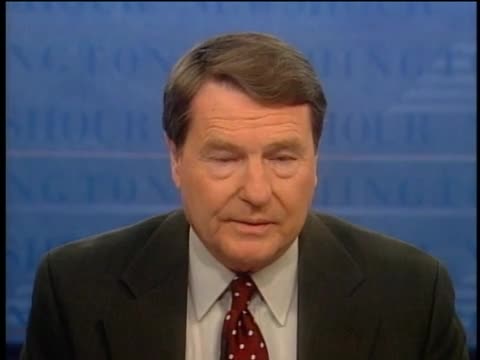
- Transcript
TJIM LEHRER: Good evening. I'm Jim Lehrer. On the NewsHour tonight Secretary of State Albright is here for a Newsmaker interview, and we have an update and a legal debate about the ongoing campaign money story, plus a report on the warming trend in that cold place called Antarctica. It all follows our summary of the news this Thursday. NEWS SUMMARY
JIM LEHRER: The Senate Rules Committee today approved a resolution setting the cost, scope, and deadline for a Senate probe of campaign fund-raising. On a party line vote the Republican majority passed a $4.3 million budget and a December 31st ending date. The inquiry would also include the fund-raising practices of members of Congress. Democrats have opposed a more costly and open- ended investigation that did not include Congress. The resolution now goes to the full Senate. Senate Majority Leader Trent Lott told reporters today he also wanted both parties to endorse his resolution calling for an independent counsel to investigate the Clinton-Gore re-election campaign.
SEN. TRENT LOTT, Majority Leader: We feel very strongly that there's more than enough reason to have an independent counsel. We don't quite understand why the attorney general has not moved to do that. There are many thresholds that can be met or have to be met under the independent counsel law. And we think they've probably been met on either one of the two fundamental bases. One of them is allegations of illegal activity by high officials that meet certain criteria in the administration, or, conversely, where there is the appearance of the potential of conflict of interest, that threshold surely is lower and has been more than met, in our opinion.
JIM LEHRER: Attorney General Reno has said there was still no reason to appoint an independent counsel.
JANET RENO, Attorney General: What is so important in all of this is that we take it very carefully, we do it thoroughly, we consider the case history, we consider the legislative history, and we do it the right way without somebody staring into the camera and saying something is inevitable or not inevitable. We have to look at the facts and make the best judgment possible.
JIM LEHRER: She also said the Justice Department would review a campaign contribution presented at the White House by California businessman Johnny Chung. The $50,000 check was handed to the First Lady's chief of staff, Margaret Williams, two years ago. It was then turned over to the Democratic National Committee. A DNC official said today the money will be returned because of questions about its origins. We'll have more on this story later in the program. President Clinton renewed his call for national testing standards for schoolchildren today. He did so to a joint session of the Michigan House and Senate in Lansing. He said, "Failing to measure students' knowledge risks selling their future right down the drain." He urged states to establish one set of performance standards for fourth-graders in reading and for eighth- graders in math.
PRESIDENT CLINTON: This is not a partisan issue. There is no Democratic or Republican way to teach. There is no Maryland or Michigan way to learn. Reading is reading. Math is math. No school board or state legislation can rewrite the rules of Algebra in Alaska to make them different than they are in Arkansas. It cannot be done. Every state must put politics aside, work in a bipartisan fashion, and test our children in the same rigorous way. Politics should stop at the schoolhouse door.
JIM LEHRER: Residents along the Ohio River braced for more flooding today. In Cincinnati the river spilled over much of the city's waterfront area. Forecasters expect the river to crest in Louisville, Kentucky tomorrow night 15 feet over flood stage. Residents there left their homes to head for safer ground. The flooding has left behind millions of dollars in damage throughout the Midwest and is blamed for as many as 27 deaths. In Washington a House committee voted today to decertify Mexico as an anti-drug partner. President Clinton last week decided last week mA deserved to continue receiving U.S. financial aid in the war against drug trafficking. Secretary of State Albright today defended the President's decision before a Senate committee. She said a finding against Mexico would undermine his cooperation in anti-drug efforts. We'll have a Newsmaker interview with Sec. Albright right after this News Summary. In Russia today President Yeltsin delivered a nationally televised state of the nation address. We have more from Lawrence McDonnell of Independent Television News.
LAWRENCE McDONNELL, ITN: In his first major appearance since he was re-elected president seven months ago there was at least as much interest in how Boris Yeltsin walked and talked as there was in what he said. On physical performance he scored well, sustaining a fairly vigorous pace for nearly half an hour. But on content his state of the nation address did little more than outline what a poor state the country was in.
BORIS YELTSIN, Russian President: [speaking through interpreter] The already low standard of life of the majority of Russian people is still dropping. People are suffering from delayed payments of salaries and pensions. We don't see any results from attempts to solve this problem.
LAWRENCE McDONNELL: He laid the blame squarely on the shoulders of the government led by his prime minister, Viktor Chernomyrdin. A cabinet reshuffle is imminent. He said he'd improve tax collection, an idea that some Russian politicians present clearly found amusing.
JIM LEHRER: Presidents Yeltsin and Clinton will hold a summit in Helsinki, Finland, March 19th and 20th. The historic Gdansk shipyard in Poland will be shut down. The announcement was made today by a bankruptcy official who said the facility was broke and could no longer operate. It was there that Lech Walesa founded the Solidarity labor movement in 1980, a development that led to the end of Communism in Poland and eventually elsewhere in Eastern Europe. In Albania today President Sali Berisha and an opposition leader said they had agreed on a 48-hour cease-fire, but armed insurgents in the southern part of the country continued displays of opposition to the government. Men at road blocks stopped and searched vehicles, and young rebels fired off rounds of ammunition. Under the cease-fire agreement Berisha said he would investigate the failed pyramid investment schemes that sparked the uprising. The Albanians were angry at losing their savings in the fraudulent deals. And that's it for the News Summary tonight. Now it's on to Sec. Albright, fund-raising legalities, and the warming of Antarctica. NEWSMAKER
JIM LEHRER: We go first tonight to a Newsmaker interview with Secretary of State Madeleine Albright. It's her first interview since returning last week from a trip that took her to nine countries in barely nine days. Madam Secretary, welcome.
MADELEINE ALBRIGHT, Secretary of State: Very good to be here, Jim.
JIM LEHRER: First, some of the news of the day. The Mexico story, there appears to be a serious move in Congress, the vote of the House committee today to rescind the certification of Mexico. How serious do you see that?
SEC. MADELEINE ALBRIGHT: Well, we hope very much that that will not take place because after a very difficult decision that President Clinton made to certify, we believe it's very important to uphold that because I think people need to understand that Mexico knows that it has a serious national security problem with the drug issue; that they are working with us. There is a very high level of cooperation. President Zedillo is committed to dealing with this problem, and decertification only complicates the factors. I think that we do have a high level of cooperation. He has done quite a lot of things that are very difficult to do in terms of eradication, seizing, a lot of drugs, trying to get rid of a lot of the corruption within the police system. He knows he has a big job. There is no question about that. And what we have to do is assure ourselves of continued cooperation and not have a backlash just against the United States for having taken a snapshot of an issue and blaming them. This is not a blame game. What this is, is an attempt to try to deal with a problem that's bad for Mexico and bad for the United States.
JIM LEHRER: What do you say to those who suggest that this whole certification process is ridiculous anyhow, that the United States ought to be concentrating on the demand problem here in the United States, rather than the supply problem in Mexico and other countries?
SEC. MADELEINE ALBRIGHT: Well, when I announced this decision, or when I talked about it at the State Department, I made very clear that the demand issue is a very serious one. We do have to deal with the demand problem. And there are a lot of countries that say to us, you know, you are grading us; we should be grading you. But the bottom line is that there are two parts to this. Clearly, demand is a problem. Supply is also a problem, and we need to get the cooperation of countries, more people with us, because they know they've got a problem. That's the whole thing, Jim, is it's a matter of trying to get cooperation on extradition, on dealing with the drug kingpins, and we are going to be following Mexico very closely.
JIM LEHRER: On the Koreas, there was a meeting yesterday in New York, the Koreas both North and South, and the United States. What--how would you describe the outcome?
SEC. MADELEINE ALBRIGHT: Well, I think it was an important beginning. We have wanted for some time to get the Koreas talking to each other. There is a dialogue that is necessary here in order to move for the reconciliation on the Korean Peninsula, there's never been an armistice, and--
JIM LEHRER: After 44 years--
SEC. MADELEINE ALBRIGHT: Exactly. I was just up at the DNZ. It's kind of the last outpost of the Cold War, and it is important for this dialogue to take place. This was really a talk about getting four power--four party talks going; that is, China, North Korea, the U.S., and South Korea. So it was a beginning. And we consider it a useful beginning.
JIM LEHRER: Under a dream scenario, what happens next?
SEC. MADELEINE ALBRIGHT: Well, the four parties would get together and begin to talk more about how to move the process forward. But this is an important step. And actually in the end, the two parties--the two Koreas have to try to come to an agreement.
JIM LEHRER: How would you characterize that situation now, just in terms of danger? I don't mean to each other in Korea, but elsewhere in that part of the world, I mean, a possibility of conflict between North and South Korea, as we sit here now.
SEC. MADELEINE ALBRIGHT: Well, I think when you go to the DMZ and you see our forces up there and you see the fact that this is kind of the vestige of the Cold War, you know how important it is to get this resolved. Clearly, there is a sense in North Korea, there is hunger. We have worked very hard now through a framework agreement to limit their--or to freeze their whole nuclear weapons--their whole nuclear capability. I think we are working very hard to make sure that it is not an unstable situation, that there is such a difference between a prosperous South Korea and a North Korea where they are very hungry.
JIM LEHRER: Where does this Korea problem come on your list of priorities? I've been reading that if Madeleine Albright said, "I'm going to get this thing resolved," it could probably get resolved. Do you feel that way?
SEC. MADELEINE ALBRIGHT: Well, there are lots of problems out there, and this is a very high up there. I mean, I think our issue here is we want a stable situation. We do not want to face a problem. We have 37,000 American forces there. We care a great deal about the security and stability of the Korean Peninsula and Asia. Frankly, the reason that I also went to Asia, as well as Europe, was because we have equal concerns and interests and challenges in both regions.
JIM LEHRER: And you wanted to send that message to Asia, that it wasn't just Europe.
SEC. MADELEINE ALBRIGHT: Well, that was the whole point here. I think that what was important was to show the equality of interests; that we have strategic and economic interests in both areas. I wanted, Jim, to go and meet with the major powers to talk about a network, a web of relationships, as we set up the framework for the 21st century. I thought it was important to show our interest in their security relations and economic and also, frankly, you know, the President, President Clinton has said so many times that we are the indispensable nation but we are not the only responsible nation. We need the help of others to carry out how to manage international--the international system now with how to deal with conflicts, and resolve issues, such as the Korean line or in Central and Eastern Europe. But we also have to have a 21st century framework where we deal with other countries to deal with these new threats: nuclear proliferation, terrorism, drugs, refugees. So in that regard, the trip was laying out a way of dealing with current problems and thinking about the future.
JIM LEHRER: Another specific. The Middle East, how serious is this problem over the 6500 new Jewish housing units that go into East Jerusalem?
SEC. MADELEINE ALBRIGHT: Well, let me put that into a context a little bit. The Hebron agreement which was reached in the fall was really a critical one there. It came at a critical time. What it did was to provide a way to defuse a very emotional situation, provide a road map for the future, and showed that Prime Minister Netanyahu could take some very important steps for peace. He freed some women prisoners. He dealt with a very troubling tax problem, and he showed that he would live up to the previous agreements. We also thought that it was a good way to move to the permanent status negotiations which would deal with such thorny issues as Jerusalem and the borders and the refugees, and water sovereignty, and in order to have creative solutions to those problems come forward, it's important to develop confidence, bonds of trust. And the Har Homa decision on these--
JIM LEHRER: That's the name of the housing project.
SEC. MADELEINE ALBRIGHT: Housing project--in a way detracts from this positive bonds that we wanted to establish. We now have to move on and try to--without making judgments--move on to manage a relationship so that they can get back on track.
JIM LEHRER: Have you expressed your distress to the Israeli government, to Prime Minister Netanyahu, about this decision?
SEC. MADELEINE ALBRIGHT: Well, when he was here, we made clear that it in many ways did not help this building of these positive bonds and the necessity to create a kind of positive atmosphere for moving forward to the permanent status talks.
JIM LEHRER: Well, there's this--a resolution--as you know, pending before the UN Security Council to condemn this action, and the U.S. has not announced its position. Feel free to do so.
SEC. MADELEINE ALBRIGHT: Well, as you know, I've had a lot of experience dealing with this in New York.
JIM LEHRER: Right.
SEC. MADELEINE ALBRIGHT: And these--the debate--the public debate has just concluded. And I think discussions about this are going forward. But I learned one thing up there, Jim. The U.N. is not a great venue for dealing with issues to do with the peace process and Israel. What is important is not for resolutions but for--or UN resolutions on this, but for people to get together on the ground and have these talks. So we have to see how the talks in New York progress.
JIM LEHRER: So it sounds like the United States is not about to vote for that.
SEC. MADELEINE ALBRIGHT: Well, we haven't seen anything yet that is--I mean, they're early drafting discussions, but the point that I would like to make is that the UN has not proven to be the best place to have these kinds of--or to have discussions that actually move the process forward.
JIM LEHRER: Now, when Palestinian Authority Leader Arafat was here this week, he said that he was given assurances of support on his position, in other words, condemning the 6500 housing thing by President Clinton. Is that an accurate description of the U.S. position?
SEC. MADELEINE ALBRIGHT: Well, I think that what he heard was what I told you, was that we thought that the timing of that decision was not one that helped to build these bonds of confidence that were necessary for there to be some creative thinking on the permanent status issues, and that we wanted very much to make sure that dialogue continued, and that there wasn't violence, and that steps were not taken that would make it more complicated to deal with the permanent status issues.
JIM LEHRER: On Albania, are the lives of the 1600 Americans in Albania in jeopardy?
SEC. MADELEINE ALBRIGHT: Well, we are obviously monitoring the situation very carefully, and we do not believe so. But we are concerned about having a peaceful resolution to that problem. Military solutions never work, and President Berisha seems to have taken some positive steps today. We are supporting an OSCE mission into the area to try to resolve the problem through political and diplomatic efforts.
JIM LEHRER: But it's not--it's not a--that's not a U.S. problem, as we sit here now, right?
SEC. MADELEINE ALBRIGHT: Well, we are obviously always concerned about instability, but the Europeans and the OSC mission is dealing with--there is a Europe--an American--Congressman Engel is on this OSCE delegation that is headed by Mr. Berniski of Austria.
JIM LEHRER: Now, back on your trip, you went to China. Is it true that you warned the leaders of China not to try to interfere in the U.S. political process by filtering money through illegal means to various political candidates?
SEC. MADELEINE ALBRIGHT: Well, what happened was that they were very much aware, as were we, obviously, of what had been alleged about this, and we did discuss it. I was told that they had nothing to do with it, and as I have made clear, and so has President Clinton, we are investigating the whole issue because it's a very serious one.
JIM LEHRER: Is there any evidence that the counter is true, that they, in fact, did try to influence the outcome of the election?
SEC. MADELEINE ALBRIGHT: I have no such evidence.
JIM LEHRER: Is this all the turmoil over political fund-raising affecting the operation of the State Department and foreign policy of the United States right now?
SEC. MADELEINE ALBRIGHT: It is not, absolutely not. I have, as you know, just taken over, and I see no evidence of that whatsoever. We are pursuing our foreign policy goals.
JIM LEHRER: But China is only one country that has been mentioned, among others, at mostly Asian countries that have--if the allegations are that they tried to influence foreign policy through campaign contributions. Have you, because of this flap, set up any special mechanism or anything like that to protect the diplomacy of the United States--
SEC. MADELEINE ALBRIGHT: Well, the diplomacy is just not affected by it. There is no--none--nobody in the State Department. We have not taken part in the political activities, and we carry on our diplomatic activities. And there is no evidence whatsoever of any impact or interference, nothing that I have seen at all in--when I was ambassador at the UN or now.
JIM LEHRER: On the more general issue of China, how would you describe the U.S. relationship with China right now?
SEC. MADELEINE ALBRIGHT: Well, first of all, I think it's very interesting, Jim, that they saw me because, after all, Deng Xiaoping had just died. And I use that as an example from their perspective and ours the importance of having a relationship where we're engaged in dealing with each other on a whole set of issues. They had a very good excuse to say, please, don't come, and I went there the night before the funeral and had a full set of talks where we talked about the issues that concern us. We have a very important strategic agenda where we deal with the Chinese on issues of nuclear proliferation, on the question of Korea that we just talked about, on cooperation in the peninsula, on dealing with issues, environmentalissues, and so we have a lot to talk about it. We have some things we disagree about. Those are human rights and some trade issues, but what I got a sense of is both the Chinese--and certainly from our part--that we understand that this is going to be a critical relationship in the 21stcentury, multi- faceted. We're going to be needing to talk about a whole set of issues, and that was very evident in these talks that I had in Beijing.
JIM LEHRER: After Deng Xiaoping's death we had a discussion on this program with two former colleagues of yours--Zbigniew Brzezinski and Winston Lord--and they both agreed that the first test of the post Deng relationship or the post Deng era in China is how they handle Hong Kong. Would you agree with that?
SEC. MADELEINE ALBRIGHT: Well, I think it's a very important issue, and we talked about Hong Kong, and what I thought was interesting was that they used the same vocabulary that we use, which is the necessity of preserving the way of life of Hong Kong and making sure that Hong Kong can go forward as it has. The test will be, is whether they have the same meaning for the vocabulary that we do. And we are obviously going to be watching that very carefully between now and the time that it goes back to China, which is in July.
JIM LEHRER: But as a practical matter, what could you say to them, about, oh, hey, if you don't handle this well, what's going to happen? I mean, what kind of consequences can the United States deliver if things don't go right from their point of view?
SEC. MADELEINE ALBRIGHT: Well, I tink that what they know is that the world is watching how this is working, how it is going to work; that it is important to the international community and the financial people within various countries that this go forward smoothly. And, frankly, Jim, from their own perspective, they need to have Hong Kong continue the way it is. It is--
JIM LEHRER: Did they say that to you?
SEC. MADELEINE ALBRIGHT: They said they understood the importance of Hong Kong. Now, again, I can't say that their meaning of the words is--
JIM LEHRER: Importance.
SEC. MADELEINE ALBRIGHT: --exactly the same. But this is clearly an issue that is front and center. We have discussed it with our allies. When I was in Great Britain, we talked about it, and everybody is going to be watching very carefully to make sure that the way of life of Hong Kong is preserved and for us specifically that some bilateral issues such as ship visits and consulate generals can go forward. It is an important--an important moment in terms of relationships, yes.
JIM LEHRER: On to Bosnia, Defense Secretary--we'll get around the world here by the time we're through here.
SEC. MADELEINE ALBRIGHT: As fast as my trip.
JIM LEHRER: Exactly. Defense Secretary Cohen said that U.S. commitment of troops to Bosnia is going to end in 18 months no matter what. I assume you agree with him on this?
SEC. MADELEINE ALBRIGHT: Well, we have said that--the President said that in roughly 18 months we would be out of there. And we are going to live up to that. The point that we're trying to achieve is to make sure that Bosnia is in a position to take over its own life. We don't want to be there forever. They have to run their own country, and we are working on military stabilization. That's what the train and equip program is about. We're working on helping them develop institutions, develop their housing, deal with refugees. So that part of the mission, the civilian part, needs to be worked on. And we're going to put a lot of emphasis on it with the allies, the donor conferences, and we don't want to be there. They have to run their own lives. We've done what we can.
JIM LEHRER: On NATO expansion, that's the NATO operation over there, Russian President Yeltsin made his speech today, as we reported in the News Summary. And let me quote what he said about NATO expansion. "We are against NATO's plans for Eastward expansion. Their realization will deliver a direct blow to our security. Behind them is the aspiration to squeeze Russia out of Europe and to leave it politically isolated." What do you make of that?
SEC. MADELEINE ALBRIGHT: Well, I have just had discussions about this in Moscow, both with President Yeltsin and Foreign Minister Primakov. There is no question that they do not like NATO enlargement, but they also know that it will go forward on schedule, and that the entire NATO alliance is behind that. What they're interested in, and so are we, is good relations between Russia and the United States and relations between Russia and NATO. And we are in the process of developing a Russia-NATO charter-- Secretary-General Salana is the negotiator on that--that will allow the Russians to be a part of European discussions. They will have a voice, not a veto. They will be part of consultations. Nobody's trying to squeeze them out of Europe. And we believe that that process is moving forward. I had good discussions with Foreign Minister Primakov. He's coming here, by the way, next Saturday. I invited him, and we are going to continue our discussions, and a lot of discussions about the overall U.S.-Russian relationship will take place in Helsinki between President Clinton and President Yeltsin.
JIM LEHRER: You have no sympathy for the Russian view, hey, wait a minute, NATO is expanding and expanding and suddenly it's just going to be NATO against Russia?
SEC. MADELEINE ALBRIGHT: I think, Jim, the issue here, and President Yeltsin said to me, you have to understand that there's a new Russia. And I said to him, you have to understand there's a new NATO. It is not us versus them or them versus us. We're all on the same side. And the side that we are on is trying to prevent instability in Central and Eastern Europe. The United States and Russia have had to deal with instability in Central and Eastern Europe two times in this century, actually three if you count the Cold War. And we think that trying to develop a network of democracies that will make those countries deal with problems between themselves-- as Romania and Hungary already have and the Czechs and the Germans--is a way to create stability. So there is no one enemy that NATO is directed at. It is the strongest alliance of democracies ever, and these countries want to be in it, and Russia is not to be excluded from Europe and also will have an ongoing relationship with the United States. And that relationship is political and economic and is much more than just this NATO issue.
JIM LEHRER: Finally, on a personal note, it's been six weeks now, you've been the first woman Secretary of State of the United States of America. It is about what you expected?
SEC. MADELEINE ALBRIGHT: Well, it's a lot of work, but it is fascinating, and I think that the trip went well. I had a feeling that I was showing the flag. Jim, we've talked a lot about when I was ambassador at the UN how proud I was to sit behind that sign that said the United States. I am even prouder now to be able to go around the world representing the U.S.. And it's really, for somebody that wasn't born here, the generosity of this country is unmeasurable, and the opportunity that President Clinton gave me is a sign of the opportunity that he wants all Americans to have. And so I'm very grateful, and I'm going to work hard, and I hope that Americans are proud of me in this job, as I am proud of representing the U.S..
JIM LEHRER: Madam Secretary, thank you.
SEC. MADELEINE ALBRIGHT: Thank you. UPDATE - THE MONEY TRAIL
JIM LEHRER: Still to come on the NewsHour tonight the campaign fund-raising money trail and warming trends in Antarctica. Money and politics is first. We begin with an update by Kwame Holman.
KWAME HOLMAN: Margaret Williams, chief of staff to First Lady Hillary Clinton, first became a public figure during the congressional investigation of the Whitewater affair. She was questioned repeatedly about her role in the removal of documents from the office of White House Deputy Counsel Vincent Foster on the night he committed suicide. Now, Williams is playing a role in the current controversy surrounding questionable campaign fund-raising activity. White House officials have confirmed that Williams accepted a $50,000 donation from California businessman Johnny Chung during Chung's visit to the White House in March of 1995. Federal law prohibits soliciting or accepting campaign contributions on government property. Williams apparently passed the check on to the Democratic National Committee, and a few days later Chung and several business associates were invited guests at one of President Clinton's weekly radio addresses. This latest revelation comes one day after it was learned Vice President Al Gore used a Clinton-Gore campaign calling card to make phone calls from the White House to solicit contributions to the DNC. That's not what the Vice President said during his hastily-called news conference late Monday afternoon.
VICE PRESIDENT GORE: All calls that I made were charged to the Democratic National Committee. I was advised there was nothing wrong with that. My counsel tells me there is no controlling legal authority that says that is any violation of any law.
KWAME HOLMAN: Despite this week's revelations concerning the Vice President and the First Lady's chief of staff, Attorney General Janet Reno again today would not say whether she will call for an independent counsel to investigate possible illegal fund-raising activities involving the Democratic National Committee and the White House.
JANET RENO, Attorney General: Anybody conducting this type of investigation has got to be guided by what is the evidence, what is the law, and how do we proceed based on the evidence and the law.
REPORTER: But you have the White House admitting that the First Lady's chief of staff accepted a campaign contribution on the premises of the White House. Does that change your mind at all?
JANET RENO: As you know, I've made it a practice not to comment on pending investigations, and I'm not going to do that now. But I think it's very important that as you make these allegations and as you portray them in television or on your headlines that you try to clarify just what the issues are. Let me read you the Section 607 of Title 18 of the United States Code. It states: "It shall be unlawful for any person to solicit or to receive any contribution within the meaning of Section 301, Subsection 8 of the Federal Election Campaign of 1971 in any room or building occupied in the discharge of official duties by a federal employee." Now, the significant phrase there is "any contribution within the meaning of Section 301, Subsection 8 of the Federal Election Campaign Act." If we receive information, we've got to review it based on that statute and what that meaning is. And we're in the process of doing that in a very careful, thoughtful way. When the statute--when the independent counsel statute is triggered, I will take appropriate action.
KWAME HOLMAN: The pace of Attorney General Reno's review has become a point of debate in the Senate, with most Democrats supporting the careful consideration she says she's giving to the matter.
SEN. TOM DASCHLE, Minority Leader: We've always said we're not adverse to the attorney general considering the--the necessity of a special prosecutor. But that is her call. It ought not be politicized. It ought not be influenced by pressure from the Senate.
KWAME HOLMAN: Today that pressure came from the Senate Judiciary Committee which was called into session suddenly this morning by its chairman, Orrin Hatch. The Utah Republican wanted to send a letter to Reno on behalf of the committee formally requesting she call for an independent counsel.
SEN. ORRIN HATCH, Chairman, Judiciary Committee: FBI Director Freeh yesterday testified that the Bureau is as part of its larger investigation, that is the FBI, is looking into whether the Vice President improperly solicited contributions on White House grounds. If the FBI and/or Justice Department believes there are reasonable grounds to be "looking into" these matters and whether laws have been violated, then it seems to me that we still have to move forward.
KWAME HOLMAN: But Vermont's Patrick Leahy, the ranking Democrat on the committee, used Senate rules to delay any committee action for at least a week.
SEN. PATRICK LEAHY, [D] Vermont: I got this 26 seconds before the committee being started this morning. I thought I'd like a little bit more time to consider an issue that may call upon a special prosecutor to go after the President or the Vice President.
KWAME HOLMAN: Senate Democrats, including Leahy, insist on broadening any investigation of campaign fund-raising to include members of Congress, as well as the President. But an obviously frustrated Hatch drew a sharp distinction between the two.
SEN. ORRIN HATCH: I'll be honest with you. I get a little tired of the partisan crap around here. I mean, it just gets on my nerves, to be honest with you. And I think to jump on some technical violations, yeah, they're violations, but technical violations in light of what we're talking about here that are really big, potentially big crimes, there are crimes that if the President were involved in them are impeachable crimes. I'm more concerned in the big picture here and what really are serious potential matters that could involve criminal conduct, to the detriment of our country.
JIM LEHRER: More now on this story and to Elizabeth Farnsworth.
ELIZABETH FARNSWORTH: To explore the legal issues involved in the story we're joined by two attorneys. Stanley Brand was general counsel to the U.S. House of Representatives under Speaker Tip O'Neill. C. Boyden Gray was White House counsel to President Bush. Both are now with law firms in Washington. Mr. Gray, Section 607 of Title 18, which we just heard Janet Reno read, is pretty specific in its language outlawing the accepting of political contributions on federal property which is--has official use. Do you think--in your understanding of the law--was it illegal for Vice President Gore to solicit campaign contributions in the White House?
C. BOYDEN GRAY, Former Bush White House Counsel: Well, there's a technicality here, although technicalities in the criminal law can be exonerations about whether it was hard or soft money. And the reference that the attorney general read I think defines contributions under the Federal Election law which may encompass only hard dollars, not false money, which is what they apparently were spending most of their time raising, and if it's $50,000, that would exceed any hard money limit. So Maggie Williams, it was probably accepting soft money.
ELIZABETH FARNSWORTH: Let's say with Vice President Gore just for a minute. So spell that out a little.
C. BOYDEN GRAY: Well, he would not be in violation if the money he was soliciting in his phone calls and in his coffees was all soft money. That probably made--I don't know--
ELIZABETH FARNSWORTH: And soft money is money that he would be soliciting for the Democratic National Committee.
C. BOYDEN GRAY: Committee, right.
ELIZABETH FARNSWORTH: Which is money that could be used for all sorts of things, not necessarily for the presidential campaign, itself?
C. BOYDEN GRAY: Right. That's correct.
ELIZABETH FARNSWORTH: But it would be illegal if--
C. BOYDEN GRAY: If it were hard money.
ELIZABETH FARNSWORTH: Which was directly for the campaign.
C. BOYDEN GRAY: Well, directly for the campaign. Well, once--once you've got the nomination, your campaign is federally financed. So there wouldn't be any need for money at that stage. This was a year earlier in 1995, and he was raising money for the DNC's ad campaign which was not strictly a campaign for his re-election. It was a campaign to promote President Clinton just generally and to fend off the Speaker of the House, Newt Gingrich.
ELIZABETH FARNSWORTH: Mr. Brand, do you have anything to add to that?
STANLEY BRAND, Former House General Counsel: I'd agree essentially with what Boyden said. I would caution, though, and recall the history of this statute. This is a statute that goes back to 1883. It's basically an anti-shakedown statute. The statute passed for the protection of, in theory, government employees against being shaken down for contributions by their superiors, clearly not was involved here. And while the literal language of the statute raises some issues, you always bring an informed judgment and discretion to that process. Occasional inadvertent or calls that aren't part of some orchestrated phone bank or large campaign have generally not been deemed prosecutable by the Department of Justice because they don't rise to the level of creating the evil the statute sought to prevent. So while there may be some question about the facial invocation of the statute, prosecutors usually look for more than that.
C. BOYDEN GRAY: But I should add here that the statute was broadened to cover so-called shakedown of people who had business with the U.S. government. And, of course, back in the 1880's it wasn't much. Contractors and what not today, of course, given the large regulatory state, there's a great deal, and when you have people in the White House, this life or death control over regulatory--includes EPA, FCC, FTC, SEC--a shakedown of someone who needs an approval from a regulatory agency then could become something very much in the target zone of the statute. And I should add that the White House had--looked like a phone bank operation dialing for dollars going. They had DNC phones in there. They were fund-raising. They were ignoring quite explicitly the advice that has been given by every White House, including by Judge Mikva, then White House counsel, not to do any fund-raising of any kind on White House property.
ELIZABETH FARNSWORTH: Mr. Brand, let me get one thing clear. Vice President Gore said several times, "My counsel advises me there's no controlling legal authority or case that says there was any violation." Would you explain that.
STANLEY BRAND: Well, he's talking about the case law.
ELIZABETH FARNSWORTH: Because there have been so few cases there's basically no case law.
STANLEY BRAND: Right.
C. BOYDEN GRAY: No. Vice President has ever been convicted, so there is no controlling--
STANLEY BRAND: And there is not even that much with respect to others. This statute, again, has been rarely invoked by the department, at least to the degree of bringing the case and getting a judicial construction. So he was emphasizing that in artful terms.
ELIZABETH FARNSWORTH: And just briefly, yesterday it was--he clarified that he was using a Clinton-Gore campaign credit card, rather than a DNC credit card. What is the significance of that?
STANLEY BRAND: I guess he used the wrong credit card. You know, it's like the difference between American Express and Master Charge. He's got to account--they have to account for that in the proper committee and campaign. There will have to be some--
C. BOYDEN GRAY: But the fiction--
ELIZABETH FARNSWORTH: But for legal purposes.
C. BOYDEN GRAY: For legal purposes the fiction was that this independent expenditures by the DNC. Well, the credit card is a little tip of the iceberg of revealing that, in fact, the White House is running the DNC. And this wasn't independent, an independent expenditure.
STANLEY BRAND: One point, though. To bring some parity between the President and his colleagues and the congress of both parties, those kinds of things have gone on. People don't seem to be reviled by a senator making scores of cars, or a member of Congress, so- -
ELIZABETH FARNSWORTH: You mean, from their office, from federal property.
STANLEY BRAND: And they have done that on occasion. And no one's raised a hue and cry under the statute. So, again, I think you have to be careful about throwing these standards around because there needs to be some consistency, in my view, between how we treat the elected officers in one branch and how we treat them in another.
ELIZABETH FARNSWORTH: Now, Mr. Gray, let's move on to the First Lady's chief of staff, Margaret Williams, who the White House has said did accept a $50,000 donation from a Los Angeles businessman, Johnny Chung, and then passed it on to the Democratic National Committee. What about the legality of that?
C. BOYDEN GRAY: Well, I don't want to really pass on the ultimate legality that for some jury ultimately, I suppose, if there's an indictment here, which I wouldn't want to prejudge that. But our rules were consistent with rules going back 20 years and rules consistent with what I believe Judge Mikva issued in 1995, when you get a donation, you don't redirect it; you hand it right back, or you send it right back to the donor with no instructions of what to do. It's very clear, very simple, and why she held on to it in a face-to-face meeting is a mystery to me.
ELIZABETH FARNSWORTH: What about that?
STANLEY BRAND: Again, a technical violation perhaps, but you have to again put it in context. There are. There is a specific exemption for members of Congress receiving contributions in their offices when they're inadvertently or mistakenly mailed there.
ELIZABETH FARNSWORTH: The staff of members of Congress, right?
STANLEY BRAND: Well--as long as you--as long as you--as Boyden indicates--don't do anything with that check. You don't deposit it, or hold it, or do anything with it, other than send it off to the campaign committee. So there is this background of practice that has grown up that has not grown up at the White House but it has in Congress.
ELIZABETH FARNSWORTH: But you're saying that in your White House people were asked not even to take a check and to pass it on.
C. BOYDEN GRAY: That's correct, did not take it. And if you got in the mail, put it in an envelope and sent it right back to the donor.
ELIZABETH FARNSWORTH: Now, you heard--we heard in Kwame's report that there's growing pressure for an independent counsel. Do you think one is warranted? Let me just read. The standard, as I understand it, for triggering this--the independent counsel-- specific credible evidence that a federal law may have been broken by a person covered under the independent counsel statute, is that right?
C. BOYDEN GRAY: Well, I'll tell you, to step back, I think the biggest potential damage that may come out of this is whether there were quid pro quos for the money that came in; were they selling them for intelligence, were they giving tip-offs, was this guy Huang who had a security clearance without a background check, was he passing information along? When the White House was in this fund-raising effort, were they giving favors, regulatory favors, or other favors in return? That, to me, is where the really serious harm could be, and I don't know enough about that at this point to make a judgment. And I have a--I suppose, maybe it's because of my own background in the White House--I don't like the independent counsel statute very much, but we have it. So it ought to be enforced.
ELIZABETH FARNSWORTH: So you think that it would be one way to get at the information that you want to find out?
C. BOYDEN GRAY: Yes, that would be one way to find out.
ELIZABETH FARNSWORTH: And how else would you get--
C. BOYDEN GRAY: Well, you'd have a hearing. You'd have a congressional hearing, but that's bottled up in a procedural and political fight. And that's not my job to sort that out. That's somebody else's.
ELIZABETH FARNSWORTH: Mr. Brand, what do you think of the independent counsel?
STANLEY BRAND: Yeah. I think the independent counsel statute is past its prime, especially with respect to these matters. These are matters that the Justice Department has from time immemoriam had the expertise on. There are 45 FBI agents assigned to this task force. They're full capable of understanding the statute to bring in essentially a private lawyer. To begin the wheels turning again for the first time and lose all that expertise to me makes no sense. We're likely to get fewer answers that will take much longer than if we let the Justice Department do its job.
C. BOYDEN GRAY: And the Congress.
STANLEY BRAND: And the Congress do its job.
ELIZABETH FARNSWORTH: So you think the Justice Department and Congress could also do this, or do you think an independent counsel really is necessary now?
C. BOYDEN GRAY: Well, under the statute, since we have it, I think there is a real conflict of interest in having the administration investigate itself, given the extent to which the White House was engaged in a comprehensive, systematic fund-raising in violation of certainly the way the law has been interpreted by White House counsels, myself and my predecessors, and my successors. So I think that it's a political choice. I'm glad I don't have to make it. But I do believe that we need to get to the bottom of this. And, to me, the answer is the quickest way to flesh out all the facts, who was getting called, what kind of pressure was put on them, what kind of shakedown were they feeling, I think to get that out as soon as possible by whatever rule is the way we ought to go.
ELIZABETH FARNSWORTH: Mr. Brand, you heard Sen. Hatch say these are "some potentially big crimes, crimes that if the President were involved with them are impeachable crimes." That's pretty serious language. How do you look at the seriousness or not of what we're talking about here?
STANLEY BRAND: I myself don't see 607 violations.
ELIZABETH FARNSWORTH: The Section 607 which we've been talking about.
STANLEY BRAND: A rise to that level. But everybody's entitled to their opinion. I think, again, we're in a mode of hyping these to a degree that's really based on the overall picture, not each individual violation. I think these things have to be looked at separately, lest we get overly-hyperbolic about it.
ELIZABETH FARNSWORTH: Mr. Gray.
C. BOYDEN GRAY: Well, there's one--there are a couple of points that I think are important to remember here. The first is that, unlike the Congress, the presidential elections are publicly financed. And there shouldn't, therefore, be any real need to raise money, especially since the two candidates can command the airwaves very, very easily. They can get on your program anytime they want to in the heat of a presidential campaign. This started a year before. This was in early 1995 that all this got started, and I think that's the source of the problem here. And so it does have to be examined very, very carefully. And it's unusual. It's unprecedented, and it's unchartered water. And I think we need to find out what they were doing to raise that kind of money off election year, off cycle, when people don't normally like to start giving right after they finished giving, if you will, just for the elections just past.
ELIZABETH FARNSWORTH: Okay. Well, gentlemen, thanks for being with us. FINALLY - WARMING TREND
JIM LEHRER: Finally tonight a report from Antarctica about warmer temperatures and their effect on animals there. The correspondent is Andrew Veitch at Independent Television News.
ANDREW VEITCH, ITN: Late summer in the crackling ice water of the Antarctic Peninsula. The leopard seals are waiting for their annual feast. Seals move faster underwater, but penguins are faster, so chasing them is a waste of energy. They wait in the channels the birds must use to reach their rookery and their ravenous young. On Torgason this year's chicks are fast losing their juvenile fluff. Within weeks their parents will leave to winter far out on the pack ice. The young must follow or starve. So now they're fattening on regurgitated krill, the tiny, shrimp- like creatures which fuel life in Antarctica. By the time they take their first swim, they'll be bite-size for the next link in the food chain. For the leopard seals the time of feasting is at hand. In this climate timing is everything. The cycle of life must match the cycle of the ice, and the cycle is changing. This stretch of shoreline held a thriving rookery last year, but this year when the penguins returned to their nests it was snowbound. Only three chicks have survived. The temperature on the Antarctic Peninsula has risen by 2 + degrees Centigrade over the past 50 years. The warmer atmosphere holds more moisture, so precipitation is greater. At these latitudes that means, in general, more snow and more cloud to prevent it melting. The reproductive cycle of the birds is out of step with the weather.
ANDREW CLARK, British Antarctic Survey: There is a strong seasonal cycle in the ice and the ice dictates much of the biology we see, so I think it's probably true that if climate change starts to bite in the sea, the most direct effect will not be through a temperature change in the water, but through the effect of that climate change on the pattern of ice distribution and the behavior of ice.
ANDREW VEITCH: The ice is stained yellow by phytoplankton, algae feeding on sunlight. This is the base of the Antarctic food chain. The baby krill depend on it, and without krill, the web of life in Antarctica begins to fall apart. SUSAN TRIVELPIECE, Montana State University: If the ice has extended over the krills' spawning ground, these larvae have their wintering grounds right above them, they have plenty of food to survive the winter; they'll live to the next summer and be a large group. If this ice does not extend over their spawning grounds, the larval krill die. As a result, there's not as much food for the penguins. So that's where we see the decline in the penguins.
ANDREW VEITCH: Records of the rookeries near Parma Station go back 25 years. The numbers of Adelie penguins have fallen by 19 percent. This year alone, after another warm winter, the numbers fell from 11,500 breeding pairs to less than 8,000. The numbers of chin strap penguins, however, are increasing. While the Adelies need packed ice, chin straps prefer open water. So in one way they benefit from warmer winters.
BILL FRASER, Montana State University: The worst possible case scenario obviously would be that the system changes quite drastically in terms of the distribution of species and that sort of thing but the way climate change seems to work, at least what we're seeing, is that it's not so much that the system is collapsing in some way. It's just that different species are replacing other species.
ANDREW VEITCH: A fur seal used to be rare sight on these islands. This summer, says Bill Fraser, there are 2,000 of them. And the numbers of elephant seals have tripled. Like chin strap penguins they prefer open water and the edges of ice flows. Seals like the same beaches as penguins, and that's breaking up the rookeries. If an elephant seal chooses to flop on a penguin's patch of pebbles, it's the penguin that moves. And these females who've come ashore to molt are comparatively small. A mature male weighs 4,000 kilos. The colonies become fragmented, less able to defend themselves against marauding skewers. The skewers will take the chicks, as well as the eggs. It seems that colonies of anything less than 40 breeding pairs are easy prey. The environment here is extremely sensitive. What seems to be a tiny increase in temperature is having a massive impact on the ice, on the wildlife that depends on it. What happens if the temperature continues to rise? Well, the penguins will either move out or die out. Simon Brockington and Martin White are diving at the British Rotherer Base on Adelaide Island. The seas are rich in life.
SIMON BROCKINGTON, British Antarctic Survey: Every group is represented there, with the exception of the decapods, which is the crabs and the lobsters, but everything else is there in abundance. And this is really common. They can get a lot bigger than this.
ANDREW VEITCH: Instead of crabs and lobsters, the Antarctic has an aquatic version of the British wood louse.
ANDREW CLARK: One of the other things about working on polar regions is the water is cold. So here we've got the two of them. The male is larger than the female. The female is beneath, the male on top, and you see that he has a pair of claws at the front which enable him to grip the female really quite hard. And they will stay like this for weeks on end. One of the reasons that many of the animals that do get large in the Antarctic is because they do everything slowly. Their metabolism ticks over slowly; they grow slowly. The reproduce infrequently, and they live to a ripe old age. As I say, this one is probably thirty or forty years old at least.
ANDREW VEITCH: The fish have evolved antifreeze to keep their blood flowing. Adaptation to the cold makes them vulnerable to warming.
ANDREW CLARK: Here, the fluctuation between the seasons are quite small, only maybe one or two degrees Celsius, and many of these animals appear to suffer thermal stress, high temperature stress, at all of about 3 or 4 degrees Celsius, water which for us would be freezing cold. So that suggests that if there is a gradual warming of the water here, these animals might have a problem.
ANDREW VEITCH: Across the bay on Leoni only island the plants are the most visible sign of the changes. Mossy banks are spreading over the rock. The plants are soaking up the sun. Pearlwort is flowering. So is the Antarctic grass.
ADRIAN HULSKES, Netherlands Institute of Ecology: This has spread quite fast over the last five or six years. The plants over here have been adapted for, for years, centuries, thousands of years to a very stable climate. And now since the last decade this climate is changing, and response to it by the plants is very rapid.
ANDREW VEITCH: Whales cannot respond rapidly. In the Bismark Strait a pair of humpbacks feast on krill. Like the seals and penguins they're dependent on a food source that is dependent on ice. Now this brittle ecosystem is facing the fastest rise in temperature for perhaps ten thousand years. RECAP
JIM LEHRER: Again, the major stories of this Thursday, the Senate Rules Committee approved a resolution setting the costs, scope, and deadline for a Senate investigation of campaign fund-raising. In a major address Russian President Yeltsin told his parliament the expansion of NATO into Eastern Europe would leave Russia politically isolated. But on the NewsHour tonight Secretary of State Albright said a new charter between Russia and NATO would keep Russia involved in Europe. We'll see you online and again here tomorrow evening with Shields & Gigot, among other things. I'm Jim Lehrer. Thank you and good night.
- Series
- The NewsHour with Jim Lehrer
- Producing Organization
- NewsHour Productions
- Contributing Organization
- NewsHour Productions (Washington, District of Columbia)
- AAPB ID
- cpb-aacip/507-pg1hh6d01v
If you have more information about this item than what is given here, or if you have concerns about this record, we want to know! Contact us, indicating the AAPB ID (cpb-aacip/507-pg1hh6d01v).
- Description
- Episode Description
- This episode's headline: Newsmaker; Money & Politics; Finally - Warming Trend. ANCHOR: JIM LEHRER; GUESTS: MADELEINE ALBRIGHT, Secretary of State; C. BOYDEN GRAY, Former Bush White House Counsel; STANLEY BRAND, Former House General Counsel; CORRESPONDENTS: KWAME HOLMAN; ELIZABETH FARNSWORTH; ANDREW VEITCH;
- Date
- 1997-03-06
- Asset type
- Episode
- Topics
- Politics and Government
- Rights
- Copyright NewsHour Productions, LLC. Licensed under a Creative Commons Attribution-NonCommercial-NoDerivatives 4.0 International Public License (https://creativecommons.org/licenses/by-nc-nd/4.0/legalcode)
- Media type
- Moving Image
- Duration
- 01:00:39
- Credits
-
-
Producing Organization: NewsHour Productions
- AAPB Contributor Holdings
-
NewsHour Productions
Identifier: NH-5779 (NH Show Code)
Format: Betacam
Generation: Preservation
Duration: 01:00:00;00
If you have a copy of this asset and would like us to add it to our catalog, please contact us.
- Citations
- Chicago: “The NewsHour with Jim Lehrer,” 1997-03-06, NewsHour Productions, American Archive of Public Broadcasting (GBH and the Library of Congress), Boston, MA and Washington, DC, accessed January 29, 2026, http://americanarchive.org/catalog/cpb-aacip-507-pg1hh6d01v.
- MLA: “The NewsHour with Jim Lehrer.” 1997-03-06. NewsHour Productions, American Archive of Public Broadcasting (GBH and the Library of Congress), Boston, MA and Washington, DC. Web. January 29, 2026. <http://americanarchive.org/catalog/cpb-aacip-507-pg1hh6d01v>.
- APA: The NewsHour with Jim Lehrer. Boston, MA: NewsHour Productions, American Archive of Public Broadcasting (GBH and the Library of Congress), Boston, MA and Washington, DC. Retrieved from http://americanarchive.org/catalog/cpb-aacip-507-pg1hh6d01v