The NewsHour with Jim Lehrer
- Transcript
MARGARET WARNER: Good evening. I'm Margaret Warner. Jim Lehrer is away this week. On the NewsHour tonight our summary of the news, then insurgents launch deadly coordinated attacks across Iraq, the Supreme Court rules the vice president's energy panel papers can remain secret for now and declines to overturn more than 100 death sentences; fighting in Sudan prompts a flood of refugees and international concern, post 9/11 rules discourage foreign students from attending U.S. universities; and stolen email addresses end up in spammers' hands.
NEWS SUMMARY
MARGARET WARNER: Iraqi insurgents launched wide-ranging attacks today, just six days before the transfer of power. They killed more than 100 people, and wounded more than 300. Most victims were Iraqis, but three U.S. soldiers were killed and a dozen wounded. We have a report from Lindsey Hilsum of Independent Television News.
LINDSEY HILSUM: Today, Iraq's insurgents showed they can operate on multiple fronts simultaneously. Morning both attacks across northern Iraqin five cities, Baghdad, Baqouba, Ramadi, Fallujah and Mosul, for the first time seemingly coordinated suicide bombs and commander-style raids. In Mosul, at least seven bombs exploded across the city, five at police stations. Scores of people were killed and injured. Policemen, security guards, passers-by. These were sizable car bombs which left craters in the road. Most of the pictures are too horrible to show. An Islamist website said this was the work of a group linked to al-Qaida and led by the Jordanian militant Abu Musab al-Zarqawi. The website said the strikes were against apostate police agents and spies, in other words, Iraqis who work with the Americans. Baqouba, northeast of Baghdad, saw dawn commander style raids. A militant keeps lookout from a rooftop, his black hood identifying him as one of the attackers. They seized a police station. It seems they stormed inside and murdered the police officers. Colleagues found at least 12 had been shot dead. Ramadi, in the heart of the Sunni Triangle. Here explosions destroyed at least two police stations, and insurgents are reported to have shot at the policemen. In Fallujah, insurgents battled the Americans. It was meant to be a truce here, but the Americans have been targeting from the air what they say are al-Zarqawi's hideouts. Today's attacks are aimed at derailing the handover to the interim Iraqi government in six days time. It's unlikely the violence will stop then.
MARGARET WARNER: Iraq's interim Prime Minister Iyad Allawi called the attacks "isolated incidents by increasingly desperate insurgents" he told reporters: "We are going to face them, and we are going to defeat them, and we are going to crush them." We'll have more on all this in just a moment. The incoming U.S. commander of coalition forces in Iraq acknowledged today the insurgents are much stronger than expected, and have support from external sources. Army General George Casey told a Senate hearing that today's attacks demonstrated again that Iraqi forces can't hold their own yet.
GEN. GEORGE CASEY JR.: My assessment is that they are not capable of providing security countrywide. They are capable in different places around the country, but not country wide. They need the support of coalition forces for an interim period here, as we build strong Iraqi security forces to take the role themselves
MARGARET WARNER: General Casey also said the U.S. has an agreement in principle, giving coalition troops immunity from prosecution in Iraqi courts. He said post-war administrator Paul Bremer is still negotiating the details with the interim Iraqi government, and trying to win the same protections for U.S. civilian contractors. The deal would last until a permanent government is elected early next year. Bombs went off in two major cities in Turkey today, heightening security concerns about an upcoming NATO summit there. In Ankara, a bomb exploded just outside the hotel where President Bush is scheduled to stay when his visit begins on Saturday. Several people were wounded. Later, four people were killed in Istanbul when a bomb ripped through a city bus. In Washington, a White House spokesman said the president still plans to attend the summit. The Supreme Court ruled today that Vice President Cheney's energy taskforce won't have to release its records, at least for now. But the 7-2 decision keeps the lawsuit alive. The court returned the suit to the lower courts, with directions to further review the Bush administration's claim to separation of powers. The Supreme Court also refused to retroactively apply its 2002 ruling requiring that jurors, not judges, must impose the death penalty. Today's 5-4 decision leaves on death row more than 100 inmates sentenced by judges before 2002. We'll have more on both cases later in the program. Federal prosecutors interviewed President Bush today, in the ongoing probe into who leaked a C.I.A. Operative's name. U.S. Attorney Patrick Fitzgerald questioned the president for 70 minutes in the oval office. Mr. Bush's private attorney was present as well. The name of the operative, Valerie Plame, was leaked a year ago, after her husband, former ambassador Joseph Wilson, disputed administration claims that Saddam Hussein tried to buy uranium from Niger. Iran released eight British servicemen today. They were detained Monday when their boats crossed into Iranian waters near the Iraqi border. Iran originally said it would prosecute them. Instead, they were turned over to British diplomats in Tehran this morning. Their boats and equipment will also be returned. Back in this country, federal prosecutors charged an America Online employee late yesterday with stealing 92 million e-mail users' addresses, and selling them. His Las Vegas buyer allegedly used the names to send gambling ads, and then sold them to other spammers. We'll have more on this story later in the program. A federal appeals court today overturned a significant portion of the FCC's new media ownership rules. The court threw out rules expanding the number of TV and radio stations a company can own in one market, but it let stand another new rule permitting a company to own a newspaper and a TV station in the same city. On Wall Street today, the Dow Jones Industrial Average lost more than 35 points to close below 10,444. The NASDAQ fell five points to close at 2015. That's it for the News Summary tonight. Now it's on to: Today's upsurge in attacks in five cities across Iraq; two rulings from the Supreme Court; refugees flee the fighting in Sudan; foreign students stay away from U.S. Universities; and a scheme to steal e-mail addresses.
FOCUS - ESCALATING ATTACKS
MARGARET WARNER: First, today's wave of violence across central and northern Iraq. Terence Smith spoke earlier today with Jeffrey Gettleman of the New York Times from Baghdad.
TERENCE SMITH: Jeffrey Gettleman, welcome. Today's attacks seem to have been not only widespread but nearly simultaneous. What does that tell you?
JEFFREY GETTLEMAN: Well, today for the first time we saw a widespread offensive across a number of cities. In the past, there had been some coordinated attacks, namely what happened in February during the Ashoura Holiday where there were a number of people killed in Baghdad and -- today's attacks showed a level of coordination that really hadn't been here that we witnessed until today. What happened was there was a number of attacks that sort of represented the classic insurgency attack of masked men running into the streets trying to take over police stations and attack Iraq security forces. At the same time there was a number of suicide bombs that actually ended up making the most deadly component of today's violence that killed, you know, upwards of 60 people.
TERENCE SMITH: Does it seem that the Iraqi security forces were the target?
JEFFREY GETTLEMAN: In most cases, yeah, it was the Iraqi security forces who were targeted. However, there were a number of American forces that were targeted, including two army soldiers who were killed in Baqouba, and today I went to a bombing in Baghdad where a man walked up with a bomb in his briefcase. He was dressed as policeman which was sort of a sign that this campaign is getting more sinister, and he presented this briefcase to a mix of Iraqi security forces and U.S. troops that were at this checkpoint and then he blew himself up, so it looks like they are sort of targeting the Iraqi security forces and the Americans with as, we've seep in the past year-and-a-half in Iraq, the Iraqi forces taking the
TERENCE SMITH: And are the authorities there linking this to the turnover of sovereignty to Iraq next week?
JEFFREY GETTLEMAN: Yeah, definitely. They have been bracing all of us here for an up tick in violence and a surge of violence leading up to the June 30 transfer of authority. Every day they say we're going to see more attacks. They are going to test us. It's going to get more and more violent. What's interesting about what happened today is it seems as though the attacks were coordinated and possibly led by this suspected terrorist named Abu Musab al-Zarqawi who is a Jordanian-born terrorist who went to Afghanistan in the '80s and '90s, fought alongside Osama bin Laden and then kind of drifted around the middle east for a bit and resurfaced in Iraq, maybe a couple years ago, maybe this year. They are not quite sure, and now he's supposed to be the mastermind behind all these attacks.
TERENCE SMITH: Well, if he's the prime and driving force behind them, what does that suggest about the size and reach and capacity of his organization?
JEFFREY GETTLEMAN: These types of groups are incredibly hard to pin down and to get a lot of information on. I mean, I've been here for about six months, and people have been blaming the attacks on this guy Zarqawi since I got here, even though whenever we as reporters ask for evidence, why do you think this attack or that attack was linked to Zarqawi, the authorities are often reluctant to give us any sort of hard proof. He has made a name for himself planning massive and spectacular suicide attacks, and there's a letter found in February that he supposedly wrote to Osama bin Laden and other leaders of the al- Qaida organization in which he claimed responsibility for a number of suicide attacks in Iraq so ever since that letter was published most out of the authorities have blamed the suicide attacks on him. However, today we started to see insurgents in the streets with their Kalashnikovs and their masks saying they were fighting for this man, Zarqawi, which was an unusual twist because before he was associated with the terrorist side of the insurgency and not so much the popular uprising side.
TERENCE SMITH: And do there appear to be Saddam loyalists involved as well?
JEFFREY GETTLEMAN: Well, that's what we hear and what we've been hearing for quite a time. Most of the violence today was in the so-called Sunni Triangle which sort of extends from Baghdad, west to Ramadi and up towards Mosul. It may or may not include Baqouba, depending on who you talk to, and this area has a lot of former Saddam loyalists, people who fought in his army, people who benefited from his patronage met works, people who were close to him and had a lot to lose when Saddam was overthrown, so when there is violence in the Sunni Triangle, it's often sort of passed off as instigated or encouraged by former Saddam loyalists, but the whole insurgency remains pretty shadowy so it's not clear if it's more of a popular uprising, more of a terrorist uprising, or some kind of combination of the two.
TERENCE SMITH: And what's the evidence of the goal here? Is it to destabilize the new Iraqi government that's supposed to take over?
JEFFREY GETTLEMAN: The American military keeps accenting the fact that these terrorists don't provide any type of political agenda. They don't provide any alternative to the current state of affairs in Iraq, so the thought is they are creating this disorder. They are trying to strike fear in the population to sort of bring Iraq to its knees, create an atmosphere of chaos in which maybe an Islamic state could be formed or at least the United States army would be driven out or some type of message would be sent, but what's not cleared is there's really no political message that has been shared about what the alternatives should be to the American formed government that's supposed to take over June 30.
TERENCE SMITH: Very briefly, what was the reaction of the Iraqi public and even the Iraqi officials today?
JEFFREY GETTLEMAN: The Iraqi officials take a very brave public stand. They say we were expecting this. It's going to get worse. We'll be able to withstand it, and we're going to crack down on these terrorists, but I think the public is pretty discouraged to see this sort of stream of suicide attacks go on unabated and increase in nature and in size as the days pass, and also there's really no sort of answer to stopping these attacks because the belief is that somebody is willing to give their life, there's really no preventing them from pulling off a suicide attack so I think the public is quite anxious. I've even interviewed a couple of people who said they were contemplating leaving Baghdad close to the June 30 date, who were staying in their homes and off the streets because they have no idea what type of mayhem or chaos that may erupt on the 30th or shortly afterward.
TERENCE SMITH: Jeffrey Gettleman of the New York Times, thank you very much.
JEFFREY GETTLEMAN: Thank you.
FOCUS - SUPREME COURT WATCH
MARGARET WARNER: Two long-awaited rulings from the supreme court today on vice president's Cheney's energy taskforce, and the death penalty. In May 2001, Mr. Cheney's taskforce issued a report filled with recommendations that critics said favored the energy industry. Judicial Watch and the Sierra Club quickly filed separate suits to gain access to records of the panel's meetings, arguing that the federal "open meetings law" applied because lobbyists and energy company executives had participated, along with government officials. Marcia Coyle of the National Law Journal is here to explain both of today's rulings. Welcome back, Marcia.
MARCIA COYLE: Thank you.
MARGARET WARNER: Now the court didn't actually take head on the major argument in this case. Today's ruling really involved how this -- these lawsuits should proceed.
MARCIA COYLE: Right, exactly. It was over this battle is in a very early stage of the lawsuit. It was over something called discovery, and that's where each side asks the other for information or documents to help it prove its case.
MARGARET WARNER: And the lower court had allowed discovery to go forward.
MARCIA COYLE: It did, over the government's objections. The government had taken a consistent position in the lower court all the way to the Supreme Court, that there should be no discovery, that separation of powers concerns were at play here and that the suit ought to be decided on the record as it existed.
MARGARET WARNER: And the discovery would have meant right away releasing at least the names who participated, I gather.
MARCIA COYLE: Yes, it did. In fact, the discovery requested was quite broad but it's common in trials for your initial discovery request to be very broad because, as you know, it will probably be whittled down as you go forward.
MARGARET WARNER: Now discovery is, as you said, pro forma in lawsuits like these.
MARCIA COYLE: Yes, it is.
MARGARET WARNER: What did the majority, the seven-member majority say in declaring that the lower court had erred in allowing the discovery to go forward.
MARCIA COYLE: Well, what happened here is the government, once discovery was ordered, leapfrogged over the district court to the U.S. Court of appeals for the District of Columbia and asked that appellate court to issue an extraordinary order saying there can be no discovery. The case should be decided as it is and the vice president should be dismissed from the suit. The supreme court today said basically, well, yes and no. The court felt that, yes, the discovery here is quite broad but the lower court did not fully consider the separation of powers concerned here. The government had argued that this -- that the information being requested was very intrusive and that the executive branch needs confidential communications in order to do its job, so the majority opinion written by Justice Kennedy directed the court of appeals to go back and reconsider the separation of powers concerned.
MARGARET WARNER: Now Justices Ginsberg and Souter dissented. What was their argument?
MARCIA COYLE: Justice Ginsberg wrote the main dissent and she wrote it from the bench which is an indication of how strongly she felt. She felt that the court was unnecessarily stepping in at this stage, that the lower court, the trial judge, was fully capable of deciding whether discovery was too broad and that the appellate court had the separation of powers concerns well in mind when it refused to issue the extraordinary order, so basically there's winning and losing on both sides. The government does get some delay. It gets its concerns about the separation of powers weighed again and the other litigants will -- they live to fight another day. This discovery battle will go on.
MARGARET WARNER: Now Justice Scalia's role in this entire case has been controversial over conflict of interest concerns. Remind us, first of all, briefly what those were about.
MARCIA COYLE: He went duck hunting with Vice President Cheney right after the court agreed to decide this case. There were numerous editorials calling for him to recuse himself, at least because of the appearance of bias. The Sierra Club moved formally for him to recuse and in really an unprecedented 21-page opinion he said he did not think a reasonable person would think he was biased because of a duck hunting trip.
MARGARET WARNER: Now Justice Scalia, didn't he join in a concurring opinion which does give a hint to where he is on the bigger issue of this case?
MARCIA COYLE: He did. He joined justice Thomas who concurred and dissented. They felt that the district court, the trial court here, overstepped its authority and that the appellate court should have issued the order.
MARGARET WARNER: So, in other words, he was signaling that he basically agreed with the government's position.
MARCIA COYLE: Yes, he favored the government's position.
MARGARET WARNER: Now what has to happen now? What do the lower courts have to do? What do they have to do that they didn't do before? Again taking up this discovery request?
MARCIA COYLE: It will start at the court of appeals level, and the court of appeals is going to have to decide again whether it should issue that extraordinary order halting discovery, dismissing the vice president, but it must consider the separation of powers. Many who observed the case say that it will probably return to this trial court, that the court of appeals will send it back, and as Justice Kennedy suggested, the answer here may be for the trial judge to simply narrow the discovery order.
MARGARET WARNER: So it may go down two levels.
MARCIA COYLE: It's going to be quite a while, yes. It may go down two levels, and it will probably last beyond the election which for some of those interested in this for political purposes would be unhappy because they wouldn't know the answer, was this task force dominated by energy company officials.
MARGARET WARNER: Now let's turn to the death penalty case. In 2002 the court ruled that only juries can impose the death penalty, but today it said, well, there are 100 death row inmates sentenced by judges that are out of luck.
MARCIA COYLE: Exactly.
MARGARET WARNER: What was their argument and reasoning?
MARCIA COYLE: The question before the court was whether that opinion two years ago had retroactive effect. The court has a very complicated procedure for complicated procedure for deciding retroactivity, but most Supreme Court decisions are not retroactive, particularly if it's a procedural versus a substantive decision. Here the majority of -- a 5-4 majority led by Justice Scalia said it was a procedural rule that they announced, but that it wasn't a watershed procedural rule, that implicated the fundamental fairness and accuracy of the criminal proceeding, so it was not retroactive.
MARGARET WARNER: So these 100 inmates who were caught in this, I don't know, time warp, they are now just totally out of luck.
MARCIA COYLE: They are. There was a dissent. Justice Breyer disagreed with the view that this was not a watershed ruling, and he said that the ordinary person will find it difficult to understand that two individuals convicted, sentenced under unconstitutional proceedings, one will go to his death, the other will be saved, simply through an act of timing.
MARGARET WARNER: So where does this leave, we've had this sort of ongoing evolution of the Supreme Court looking at death penalty cases, where does that leave this?
MARCIA COYLE: This basically will apply to those 110 death sentences, but the court continues to examine the death penalty. Next term we have a case involving the constitutionality, again, of the death penalty for juveniles.
MARGARET WARNER: And that's the -- but this was the only case this term?
MARCIA COYLE: On -- no, it wasn't the only death penalty case, but it was the only case involving the role of judges and juries. The court will continue, I think, to look at how judges and juries impose sentences. There was a second case today4 re the court reaffirmed that juries have to play the key role in deciding whether sentences can be bumped up from what the law lays down for a particular crime.
MARGARET WARNER: Marcia, thanks again.
MARCIA COYLE: You're welcome.
MARGARET WARNER: Still to come on the NewsHour tonight: A growing crisis in Africa's largest country; fewer foreign students on America's campuses; and selling e-mail addresses spammers.
FOCUS - CRISIS IN SUDAN
MARGARET WARNER: We begin our coverage of the Sudan story with some background from Fred de Sam Lazaro of Twin Cities Public Television, who visited the region recently.
FRED DE SAM LAZARO: It's been described as the world's worst humanitarian crisis and threatening to get worse.
U.N. Secretary General Kofi Annan warned of genocide on the order of the massacres in Rwanda a decade ago.
An estimated ten thousand people have been killed and more than a million driven from their homes in a brutal 16-month conflict in the region of Darfur in western Sudan.
About 5 million people or one-sixth of Sudan's population lives in an area the size of Texas.
Arab militias -- known as the Janjaweed, reportedly linked to the Sudanese government -- have attacked dozens of villages killing black African farmers, burning their homes and stealing their land.
The native tribesmen of Darfur had demanded a greater share of Sudan's wealth.
The State Department calls the violence ethnic cleansing ...and some villagers in Darfur seem to agree.
AHMED ADAM MOHAMED, Refugee (translated): The militia, they take our children, burn our houses. They're killing us because we are black.
FRED DE SAM LAZARO: Among those who have taken refuge in camps on the border with Chad are women have been raped, families whose homes have been looted and young people wounded in the fighting.
In the relative safety of Chad's refugee camps, the day usually begins around 5 AM. Women like Jamila Numere start a daunting pursuit of life's most basic needs. Water comes from a hastily dug, shallow well
Miserable as life seems for refugees like Jamila Numere, she's among the more fortunate who've managed to escape. She walked for four days to reach this camp with her mother, sister and two young sons...
JAMILA NUMERE (translated): I was with my husband at home and then when the planes started to bomb, he just disappeared. in the panic, we just ran, you know, in every direction and I haven't heard news from him since then. I think that either he's dead or he was arrested and taken to jail or kidnapped. He was a teacher
FRED DE SAM LAZARO: The government in Khartoum -- which has denied any involvement with the militia -- has drawn widespread international condemnation for human rights abuses and for not allowing relief agencies into Darfur.
Some relief is beginning to trickle in ... despite attacks on aid vehicles and efforts by the Sudan government to delay shipments of food.
The head of the World Food Program toured several hard hit areas last month -- and said an additional $140 million in aid is needed to prevent thousands from starving.
JAMES MORRIS, WFP, Executive Director: People are severely at risk without nutrition, have health problems, are away from their livelihoods.
FRED DE SAM LAZARO: But complicating matters is Sudan's long-standing civil war. Two million people lost their lives in Africa's longest -- and some say bloodiest -- conflict. For 21 years, the Islamic government in the North has battled rebel factions in the mostly Christian South over control of the country's oil reserves.
The United States and other countries were instrumental in brokering a ceasefire that was signed in April. but the ceasefire agreement does not cover the conflict in Darfur.
MARGARET WARNER: Ray Suarez takes the story from there.
RAY SUAREZ: For more we go to Andrew Natsios, the administrator of the U.S. Agency for International Development, and Jennifer Leaning, a professor of international health at Harvard University and a board member of Physicians for Human Rights. She recently spent two weeks in the refugee camps along the Chad-Sudan border.
And Dr. Leaning, maybe we could start with an update from that border. What are conditions like for people who have been dislocated in the Darfur region?
JENNIFER LEANING: They are pretty grim. There are about 200,000 refugees who have come over in the last several months from the conflict in Darfur. They are scattered along a vast border that is very isolated and hard to reach. UNHCR is trying to move people from the border into camps where they can begin to give them access to food and water. They accomplished that for about 100,000 of them. There are probably 100,000 still out there. The rainy season is coming from the south to the North, and an increasing number of these people are getting cut off because the few roads that are there have been completely swamped by the floods of the rains. And the humanitarian community is struggling, but needs a lot more manpower, a lot more infrastructure, and a lot more money to meet the needs of the people over the next several months.
RAY SUAREZ: Well, the people in this case, instead of looking to their government for help, appear to be convinced that it's their own government is responsible for their plight?
JENNIFER LEANING: That's exactly the case. They are very clear. As you talk to refugees as we did-- my colleague and I spent ten days in the region talking to refugees up and down this border area and to the humanitarians trying to take care of them. The stories are pretty consistent, that a linkage of the Janjaweed militia, who are labeled Arab, and the government of Sudan, is always part of the story. They come in the early morning, surround the villages, systematically go from one end of the village to the other, drive out the men and kill them if they resist, rape the women if they find them, burn down the houses, burn the grain stores, uproot the trees, poison the wells by dropping animals down them, and essentially create a scorched earth and killing field that is driving the people that are nearer the border with Chad into Chad. And if people are too far to flee to the border, too inferior Darfur, they go into towns and enclaves within Darfur where we're hearing about how dire the conditions are in terms of their desperate circumstance.
RAY SUAREZ: Andrew Natsios, the government of Sudan and Khartoum insists that it doesn't support the marauders, doesn't support these militia groups that are dislocating people from their homes. What's the position of the United States Government?
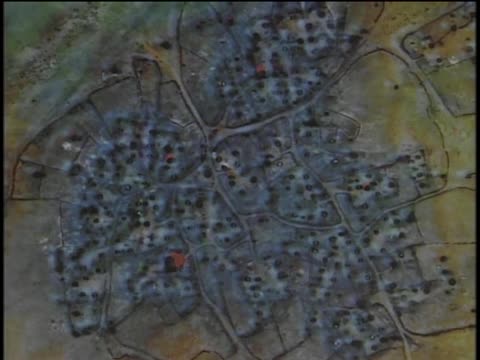
ANDREW NATSIOS: Utter nonsense. They organized them, because when they sent the regular military in to battle the militias last year, the rebel groups last year, they lost most of the battles and the military would not fight in Darfur. So in order to turn back the rebel forces, they armed these Arab militias on horseback, the Janjaweed. And instead of just battling the rebels, they have had this scorched earth policy. Two months ago we asked NASA to take aerial photographs of the villages that we're getting reports from the ground had been destroyed. We've now photographed 576 villages; 300 don't exist anymore. They have been destroyed completely and there are no people in them at all. All the animals are gone, in fact, almost all the shrubbery has been destroyed as well; 76 are partially destroyed. It's very interesting, and in the middle of the destruction there are villages that are completely functional, people are working in them, nothing has been touched in the photographs that we're receiving right now. In fact, some of them are on the air now. If you look at them, we've got several that will actually show you what's going on on the ground. Those villages that have been destroyed are either Fur, Masalit or Zaghawa; three African tribes in Darfur. By the way, they are all Muslim. There are no Christians or animists in Darfur. The Arab villages are untouched, so this is clearly and indisputably from our own research and U.N. research an ethnic cleansing campaign, at a minimum, at a minimum. The atrocities that have been going on we've recorded in our reports, the Physicians for Human Rights have recorded, the United Nations Commission on Human Rights has recorded; we have a DART team out there-- disastrous assistance response team. We've been interviewing people in the villages, and the atrocities which Dr. Leaning just described are exactly the same reports that we're getting.
RAY SUAREZ: By referring to it as ethnic cleansing, and there's been widespread condemnation around the world of what's going on in Darfur, a lot of people have been careful not to use the word genocide. Why?
ANDREW NATSIOS: Well, there is an international convention from 1948 on genocide, and what it means or does not mean is something that experts have to review. And in fact, there is a review going on right now of whether or not, from the U.S. Government's perspective, this is taking place or not. The review is not completed, but it is taking place at a very high level.
RAY SUAREZ: Dr. Leaning, does it meet your definition?
JENNIFER LEANING: We struggled with this as an organization, as a board, and as team members going out to look at what we could find. And we think that people of goodwill who have their eyes open are all acknowledging that this is a targeted, systematic, mass killing of an identifiable group. What we have concluded based on looking at a lot of evidence from other excellent groups, including U.S. Government, and from our own survivor testimonies that we got in the field, we've concluded that we should call this an unfolding genocide, that if we look at the terms of the convention it includes, as the definition, the attempt to destroy in whole or in part a people on the basis of, and there are four categories of basis. The non-Arab Darfurians are very distinct in terms of their language, their lifestyle, their culture from the Arab populations that are attacking them. And everything we can see in terms of destruction of life and livelihood and claims to the land and capacity to stay there, and attempts to drive them thoroughly from the region, would suggest that we are looking at a genocide in action, and that we think it's important to try to operationalize the term of genocide. It's an extraordinarily weighty and important legal term. We think it's important to try to operationalize it in an early warning mode so that there is an alert that goes out to the great powers to say, do something, intervene, and bring this to a stop, which basically requires a fair amount of pressure on the government of Sudan.
RAY SUAREZ: Andrew Natsios, however the internal review comes out on the legal definition of genocide, are you, in effect, working against the government in Khartoum to bring aid to the people of Darfur?
ANDREW NATSIOS: In March of this year, several months ago, President Bush sent Jack Danforth and I to peace talks. And while Sen. Danforth was there on the North-South agreement, he sent, President Bush, sent me to deliver the message that there will be no peace dividend, and there will be no normalization of relations with the Sudanese government while these atrocities are continuing in Darfur and while there is a stonewalling of the effort to provide humanitarian assistance and prevent famine. You see, whether you call it a genocide or not, the issue is that we have not yet lost 300,000 or 400,000 people. We will lose that many people this fall if we do not run this relief effort without any restrictions by the government of Sudan and without Janjaweed attacks, we could have as many as a million people die by the end of this calendar year. We carefully calculated this using epidemiological data - we're entering, for example, the meningitis season right now. We just found one instance of polio. We could have a polio epidemic. Malaria will start because of the rains. And there are already epidemics of measles in some of the camps, which will kill a lot of children under five. So the worst is yet to come. The worst will start in September to December when we'll have a massive loss of life. What we could do is dramatically drop the number of people who are dying. President Bush has called President Bashir several times now over the last couple of months, and warned him that there will be no normalization of relations with the Sudanese-- which the Sudanese government want very badly with us; they want normal relations with the outside world-- while these atrocities continue. Secretary Powell has spoken to Vice President Taha. I've spoken to the foreign minister delivering exactly the same message. We've organized with our European allies and with the Japanese and the Canadians an international aid effort. I'm in weekly contact with Jan Eglund, the head of the U.N. OCHA Office. I just spent a couple of days with Carol Bellamy, the head of UNICEF, and Mark Malloch Brown, the head of UNDP. We need to make this an integrated international effort to stop this tragedy before it gets completely out of hand.
RAY SUAREZ: Well, Doctor, Mr. Natsios mentioned Secretary Powell. He announced he's heading to the region. Does it help your work if more Americans know the name Darfur?
JENNIFER LEANING: Absolutely. It's splendid that he's going. It's a difficult trip. It's a remote part of Sudan which in itself is, you know, not on the beaten track. Our hope, in addition to the very symbolic and political power that his presence will bring, our hope is that he will demand... insist upon getting access to populations in Darfur that have not yet been seen. The risk here is that the Sudanese government is going to really block his movement the way it's trying to block the humanitarians and other senior government officials have gone from the United States. So one of the hopes we would have is he essentially, that is Secretary of State Powell, is quite vigorous about what he insists upon, and that he says publicly, if in fact he's disappointed by the cooperation of the government of Sudan, he says publicly that there is ongoing obstruction of his capacity to sever on the ground. That will be significant.
ANDREW NATSIOS: I will be going with Secretary Powell on the trip, so I will be with him in Darfur, I will be with him in Khartoum. AID has a mission in Khartoum or an office in Khartoum, and one of the most respected relief managers, Kate Farnsworth, is running it. She's been through this many times before. And we have a staff of 14 people who have just been deployed out there, and we're sending more staff in to help organize this relief effort and to get the roadblocks out of the way.
RAY SUAREZ: Andrew Natsios, Dr. Leaning, thank you both.
JENNIFER LEANING: Thank you very much.
FOCUS - STUDENTS STAY HOME
MARGARET WARNER: Next, a drop in applications from foreign students has U.S. universities worried. Betty Ann Bowser reports.
FU: This beam is from this mirror and this beam here...
BETTY ANN BOWSER: Yijing Fu is a graduate student at the University of Colorado in Boulder.
FU: Maybe we won't see anything out of that.
BETTY ANN BOWSER: A native of China, Fu has excelled for three years in the university's highly competitive engineering program.
SPOKESMAN: What happens if you play with little bit? Play with the angle a little bit and see...
BETTY ANN BOWSER: Fu's research in the United States could create a way to dramatically increase the amount of information sent on a single fiber-optic line.
SPOKESMAN: Hey, you got something there.
BETTY ANN BOWSER: But recently, Fu's academic career hit a major snag. When he went home to China to visit his wife, his return to the United States was put on hold. Fu learned that his visa had been sent to Washington, D.C., for a special federal government review, as part of the new heightened security measures put in place following 9/11. After six months of waiting, he was finally given the "okay" to return, but the loss of crucial research time was troubling to both the university and to Fu.
FU: I feel depressed, very depressed because my project is here, but I can do nothing about it.
BETTY ANN BOWSER: According to a survey by national educators, security delays like the kind that Yijing Fu experienced may be the reason many of the nation's top research universities are reporting a dramatic drop in applications for new foreign students, some down as much as 30 percent. Vic Johnson is with the Association of International Educators, one of the survey's sponsors.
VIC JOHNSON: The visa process is just unwelcoming. People seem to be coming to the conclusion that it's too hard to get into this country.
BETTY ANN BOWSER: The picture was particularly grim for doctoral and research institutions, with nearly 60 percent reporting a decline in applications.
VIC JOHNSON: People in the sciences, particularly graduate students, advanced graduate students, scholars, researchers, are subject to special screening. But after 9/11, as part of this sense that, "boy, we just got to institute every control we can think of to make sure that we're protecting ourselves against another disaster," what's happened is the number of applications that are sent to Washington has increased 20 times.
SPOKESMAN: ...Times a-squared, over epsilon zero.
BETTY ANN BOWSER: Fu's adviser, University of Colorado engineering Professor Frank Barnes, is frustrated with the government's heightened security. He says overly cautious officials have put university grant money in jeopardy.
FRANK BARNES: What's happening is that you've got a situation. Let's suppose you are a clerk in Washington., if make a mistake and let a terrorist in, you're in big trouble. On the other hand, if Yijing doesn't finish his thesis, it doesn't cost you a thing.
BETTY ANN BOWSER: As many as half of Barnes' graduate students are from foreign countries. Nationally, 13 percent of graduate students in the United States are from abroad.
FRANK BARNES: It's going to cost the United States in a big way. A large part of what's happened in the electronics industry in the United States... one of the reasons we're the leaders in the world in this area, or have been, is because of many of the people that have come to the United States as immigrants, or come as students, and they made major contributions.
VIC JOHNSON: For the scientific fields it mean that the best scientific talent is going to other countries, instead of this to participate in joint research at the frontiers of science. Our leadership in science depends on those people wanting to come here.
BETTY ANN BOWSER: Just south of the University of Colorado the prestigious Colorado School of Mines is reporting similar problems. Like many students at the School of Mines, student Ahmed Bukhamsin and Bachari Aloda came here to study petroleum engineering. Both are from Saudi Arabia and are sponsored by the Saudi oil company, IRANCO. And both experienced long visa delays trying to return to the United States after they made trips home. Academics a the Colorado School of Mines worry that they are losing lucrative foreign student scholarships from companies like IRANCO. Leslie Olsen is the director of international student and scholarship services.
LESLIE OLSEN: Most of our students are sponsored by the government or an oil company. And so they're choosing to go to school in Canada, England, because they're not having as many problems getting a visa, and the parents are afraid for them to come to the U.S. because they hear the stories about harassment or they feel they might be in danger and the hassle that they have to go through.
BETTY ANN BOWSER: Officials at the State Department say they are aware of reported visa delays and are working to speed things up. They point out that it is not just student but all visa requests that are being scrutinized. Maura Harty is assistant secretary for consulate affairs.
MAURA HARTY: We want to expedite those processes because we want students to come to the United States. We simply will always be engaged in a balance between, as Secretary Powell describes it, secure borders and open doors. ( Chanting )
BETTY ANN BOWSER: Since the visa troubles experienced by Meshari Alodah, and others last year, State Department officials say they eliminated many of the visa delays. They say they, too, realize the role foreign students play in spreading cultural understanding.
MAURA HARTY: We are not interested in hurting somebody who was in here, not only obviously spending money at an American academic institution, but learning about America. We want to give them the right impression about America. We need those younger people to come and learn about America, not through the prism of a foreign television station or foreign media, but through the experience of living in this lively, raucous, phenomenally interesting democracy that is America.
BETTY ANN BOWSER: For now, universities are anxiously awaiting their foreign student enrollment numbers for next fall.
FOCUS - SPAM SCHEME
MARGARET WARNER: Finally tonight, an alleged scheme to bring you even more spam. Jeffrey Brown explains.
JEFFREY BROWN: Call it a "spam scam." "Spam" is the popular term for the junk e-mail that many computer users are bombarded with. Yesterday, a 24-year-old employee of America Online was arrested for stealing and selling 92 million e-mail addresses. Also arrested was a 21-year-old Las Vegas man who runs an Internet gambling business. He allegedly bought the addresses, and sold them to other spammers. Joining us to look at this case and the anti-spam effort is David Bennahum, media and technology columnist for Slate Magazine. David, welcome. This was an insider named Jason Smathers who gained access to all these e-mails at AOL. How did he do it?
DAVID BENNAHUM: Well, apparently what happened is that he went to another employee's desk essentially, managed to get that employee's user I.D. And pass word and that employee had access to the lists of all of the accounts on A.O.L, meaning where the person lived, their zip code, all their different screen names and that amounted to about 37 million accounts on AOL He logged in without permission from AOL, Got all those names in batches, copied them on to discs or downloaded them and then sold them to this individual in Las Vegas who runs these Internet gambling sites.
JEFFREYBROWN: Explain to us why these addresses are so valuable.
DAVID BENNAHUM: Well, each address is a live address. It's a certified good e-mail address and that these are paying AOL Customers so, first of all, you're getting up to 37 million accounts that are good. There's no question that when you send an e-mail to that person there's no one there to receive it. That's at least the basic premise, so at that point you have 37 million valuable fresh e-mail addresses. It's unbelievably valuable. I can't think of any other way you could get it except illegally because who else would give you those addresses. They are closely guarded assets that belong to the company. So because of that, the value on these e-mail addresses just is probably much more than what was paid for them ultimately.
JEFFREY BROWN: Now as you said there was other information involved: street addresses, phone numbers, and I understand types of credit cards but not the actual credit card numbers. Are those numbers typically walled off somewhere more safely?
DAVID BENNAHUM: That's correct. The financial information connected to each customer is even more valuable in that if it's used for fraudulent purposes, i.e., stealing your credit card numbers, that would be even more problematic than someone getting junk mail, so thankfully those credit card numbers were separated out from the rest of the customer information, and this person at AOL couldn't get access to them.
JEFFREY BROWN: Now as you said, Mr. Smathers allegedly sells the addresses to a Sean Dunaway who uses them for his Internet gambling online.
DAVID BENNAHUM: Right.
JEFFREY BROWN: He passes them on to other spammers is this typically how the world of spam works? Give us some sense of who these people are, where they are, what are they selling?
DAVID BENNAHUM: Well, spamming is actually a big business in the sense that it's not mom and pop operations. They are very sophisticated operations that harvest, that's the language used, they harvest millions of e-mail addresses through all different sources and they consolidate those into massive e-mail data bases, so in that sense the idea that somehow these are small time operations, small time crooks is totally wrong. Most spam is generated by a very small number of organized groups that essentially resell these lists. Now the people marketing, using those names, might be varied, but the source of those lists actually isn't that best.
JEFFREY BROWN: Here we have one company, AOL, but there must be other large companies with big, huge e-mail listings like this. What are these companies doing to protect themselves?
DAVID BENNAHUM: Well, on some level this is an employee issue. When you hire a person to work at a company you trust that that person is going to not behave illegally, so it's tough for these companies to completely police this, because at some point you're making a gesture of trust because you're saying, yeah, you have access, you've got to manage these accounts and we trust you won't do something like resell all these names so the best thing a company can do internally is limit the people who can get access to it. I think AOL probably did that. Here's a case of an employee essentially stealing the other employee's access codes to get to that information.
JEFFREY BROWN: Do you know how he was caught in this case?
DAVID BENNAHUM: Well, in this case it started with AOL being very upset with the amount of spam coming through its users. It's perennial problem for all Internet service providers so they had begun an internal process to begin civil cases, as it were, to people who were sending junk mail to AOL users, and in the course of doing that they managed to track the junk mail to someone who is advertising I believe herbal sexual aids through the Internet, and that individual confessed to where he got his list, and that was from the individual in Las Vegas who ran the gambling sites and then he -- it became clear that he had to have gotten that list from inside AOL and he eventually gave up the internal person at AOL who had harvested this list illegally.
JEFFREY BROWN: Let me ask you a few questions that are in the category of where are we in this effort to slow on stop spam. What are companies first? What are they doing themselves to stop it? You just mentioned some of the efforts that AOL has taken. Tell us about them.
DAVID BENNAHUM: Well, there's two prongs of attack right now. One is the legal prong where there are now laws on the book making spam illegal. Congress passed the Can Spam Act this year which makes it illegal to send spam. Can you get up to a quarter million dollars in fine and up to ten years in prison if caught and convicted. That's what's happening now with this case of AOL; they are being essentially being prosecuted under this act.
JEFFREY BROWN: I think this is one of the first cases under that act, in fact.
DAVID BENNAHUM: That is correct, sort of the poster child for trying this theory out, that you can prosecute people for doing that. That's well and good and it takes a huge amount of effort and the amount of spammers out there exceeds the number of lawyers who want to prosecute this so the other side is the technology side. How do you create technological systems to essentially filter out spam? This is now very commonplace and most commercial e-mail providers, they create essentially programs that scan your e-mail and analyze the bottom of the message that says it looks like junk mail and essentially delete it or moves it to another folder and compares it to a list of name that you authorized to send that e-mail and if it doesn't match the list then it's shunted off to another folder and at some point the e-mail users is supposed to go in and go through all the e-mail and pick out the stuff that is not junk and train the system not to do it again.
JEFFREY BROWN: In the meantime, what can an individual do?
DAVID BENNAHUM: Well, the most important thing an individual can do at this point is to install junk mail filters on their computer. Now if you're using an e-mail program that runs off the web, oftentimes that's basically pre-installed. Like Yahoo!, A lot of these service provider will provide an e-mail filter within their service. If you don't have that, you can have a third-party service to do it. And this is a booming industry. There's hundreds of millions of dollars being spent each year on software licenses to run junk filters. That's probably the only thing a consumer can do at this point. Everything else is really up to other entities to deal with, whether it's the government or the people who organize and run the Internet policies that control how Internet mail is routed and programmed. There's some long-term issues that have to be solved there to help stop spam but in the short term it's up to you as user to get these junk mail filters installed on your computer.
JEFFREY BROWN: David Bennahum, thank you very much.
DAVID BENNAHUM: Thank you, my pleasure.
RECAP
MARGARET WARNER: Again, the major developments of the day: Iraqi insurgents launched attacks that killed more than 100 people and wounded more than 300. Bombs went off in two major cities in Turkey, two days before President Bush arrives for a NATO summit. And the U.S. Supreme Court ruled that Vice President Cheney's energy task force won't have to release its records, at least for now. We'll see you online, and again here tomorrow evening with Shields and Brooks, among others. I'm Margaret Warner. Thanks for being with us. Good night.
- Series
- The NewsHour with Jim Lehrer
- Producing Organization
- NewsHour Productions
- Contributing Organization
- NewsHour Productions (Washington, District of Columbia)
- AAPB ID
- cpb-aacip/507-nz80k2764b
If you have more information about this item than what is given here, or if you have concerns about this record, we want to know! Contact us, indicating the AAPB ID (cpb-aacip/507-nz80k2764b).
- Description
- Episode Description
- This episode's headline: Escalating Attacks; Supreme Court Watch; Students Stay Home; Spam Scheme. GUESTS: JEFFREY GETTLEMAN; MARCIA COYLE; ANDREW NATSIOS; JENNIFER LEANING; DAVID BENNAHUM; CORRESPONDENTS: KWAME HOLMAN; RAY SUAREZ; SPENCER MICHELS; MARGARET WARNER; GWEN IFILL; TERENCE SMITH; KWAME HOLMAN
- Date
- 2004-06-24
- Asset type
- Episode
- Topics
- Education
- Social Issues
- Global Affairs
- Technology
- Film and Television
- War and Conflict
- Health
- Religion
- Military Forces and Armaments
- Politics and Government
- Rights
- Copyright NewsHour Productions, LLC. Licensed under a Creative Commons Attribution-NonCommercial-NoDerivatives 4.0 International Public License (https://creativecommons.org/licenses/by-nc-nd/4.0/legalcode)
- Media type
- Moving Image
- Duration
- 01:04:00
- Credits
-
-
Producing Organization: NewsHour Productions
- AAPB Contributor Holdings
-
NewsHour Productions
Identifier: NH-7958 (NH Show Code)
Format: Betacam: SP
Generation: Preservation
Duration: 01:00:00;00
If you have a copy of this asset and would like us to add it to our catalog, please contact us.
- Citations
- Chicago: “The NewsHour with Jim Lehrer,” 2004-06-24, NewsHour Productions, American Archive of Public Broadcasting (GBH and the Library of Congress), Boston, MA and Washington, DC, accessed April 2, 2026, http://americanarchive.org/catalog/cpb-aacip-507-nz80k2764b.
- MLA: “The NewsHour with Jim Lehrer.” 2004-06-24. NewsHour Productions, American Archive of Public Broadcasting (GBH and the Library of Congress), Boston, MA and Washington, DC. Web. April 2, 2026. <http://americanarchive.org/catalog/cpb-aacip-507-nz80k2764b>.
- APA: The NewsHour with Jim Lehrer. Boston, MA: NewsHour Productions, American Archive of Public Broadcasting (GBH and the Library of Congress), Boston, MA and Washington, DC. Retrieved from http://americanarchive.org/catalog/cpb-aacip-507-nz80k2764b