The NewsHour with Jim Lehrer
- Transcript
JIM LEHRER: Good evening. I'm Jim Lehrer. On the NewsHour tonight: The news of this Friday; then a look at what it's going to take to rebuild the city of New Orleans; the latest on the CIA leak - Judy Miller source story; a conversation about the Iraqis of Iraq with author Anthony Shadid; and the analysis of Mark Shields and David Brooks.
NEWS SUMMARY
JIM LEHRER: Large parts of New Orleans reopened today. Thousands of people were allowed back into three major sections of the city. The French Quarter, the central business district and the uptown stayed mostly dry during Hurricane Katrina. They now have electricity, but still no drinkable water. Mayor Ray Nagin appealed to evacuees today not to give up on the city.
MAYOR RAY NAGIN: We want New Orleanians working. We want you to get contracts, big contracts. We want you cooking red beans and rice. We want to be back eating. We want our businesses to do business. We want to party on Bourbon Street. We want to bring this city back.
JIM LEHRER: Nagin also announced a commission to work on the rebuilding. We'll have more on the challenges involved in that right after this News Summary. Economic damage from Hurricanes Katrina and Rita may be less than expected. The Congressional Budget Office offered that assessment Thursday in a letter to congressional leaders. The CBO director, Douglas Holtz-Eakin, said rebuilding will make up for short-term losses. In fact, he said growth through the end of the year "could even be somewhat higher than was projected before the hurricanes."
New York Times reporter Judith Miller testified today in the CIA leak investigation. She appeared before a federal grand jury in Washington. Miller had been jailed for 85 days after refusing to identify a source. She said today the source had agreed to let her speak. The Times identified that person as Lewis Libby, the vice president's chief of staff. The investigation involves the leak of a CIA operative's name in 2003. And we'll have more on this story later in the program.
Fresh violence in Iraq killed 14 more people today. The worst attack happened in Hillah, south of Baghdad, when a car bomb killed at least ten people in a market. And to the north, in Balad, the death toll rose to 102 in a series of car bombings on Thursday. Those attacks, like today's, targeted Shiites.
The U.S. commander in Iraq said today Iraq now has more than 30 Army battalions that can lead a fight with U.S. support. Yesterday, Gen. George Casey told a Senate hearing only one Iraqi battalion is capable of fighting on its own. That's down from three a few months back. But Defense Secretary Rumsfeld warned today against being misled by those numbers.
DONALD RUMSFELD: What's important is the central fact is that the one and three are irrelevant. What's important is that every day the number of Iraqi security forces are getting bigger and they're getting better and they're getting more experienced. And Gen. Casey can tell you they are doing more.
JIM LEHRER: Also today, the nation's top military officer retired. Air Force Gen. Richard Myers became chairman of the Joint Chiefs just weeks after the 9/11 attacks. Marine Gen. Peter Pace was sworn in to take his place in a ceremony at Fort Myer, Virginia. Pace is the first Marine to hold that post. Firefighters in southern California gained ground today on a wildfire west of Los Angeles. They said it's now 20 percent contained. The blaze has burned more than 32 square miles of brush in the San Fernando Valley, and threatened hundreds of homes. Fire crews said cooler temperatures, calmer winds and rising humidity may help them get the upper hand.
The ban on gay marriage in California will stay in force for now. Gov. Arnold Schwarzenegger vetoed a bill yesterday to legalize same-sex marriage. He said it's up to the voters or the courts to overturn the ban. That came as Connecticut moves to recognize civil unions between gays. That new law takes effect tomorrow. Vermont is the only other state offering civil unions.
Congress approved a stop-gap spending bill today to keep the government running. The new fiscal year begins tomorrow, and only two of the eleven appropriations bills have been approved and signed into law. This is the ninth straight year that Congress has failed to make the deadline. The stop-gap measure will keep federal programs running through Nov. 18.
In economic news, the Commerce Department reported today consumer spending fell a full percentage point in August. Sharply higher gasoline prices were the main factor. On Wall Street today, the Dow Jones Industrial Average gained nearly 16 points to close above 10,568. The NASDAQ rose ten points to close above 2,151. For the week, the Dow gained more than 1 percent; the NASDAQ, 0.5 percent. And that's it for the News Summary tonight. Now it's on to: Rebuilding New Orleans; the CIA leak case; the Iraqis of Iraq; and Shields and Brooks.
FOCUS - REBUILDING
JIM LEHRER: How best to rebuild New Orleans. Kwame Holman begins with an update on how some sections of the city are doing.
KWAME HOLMAN: The floods that followed Hurricane Katrina hit hardest in the lower Ninth Ward of New Orleans, one of the poorest sections of the decimated crescent city. Just as it was finally drying out, a second hammer blow landed last weekend. Hastily-patched levees gave way once again as Hurricane Rita passed to the west.
This was the lower Ninth Ward yesterday, or what's left of it -- mostly dry, but still emptied of its people -- eerily silent except for a plaintive bird's call or buzz of a helicopter. Nearest the breach in the Industrial Canal levee nothing remains. Here, the scale of the destruction and the monumental task of rebuilding are most apparent.
But before any rebuilding can be done, the fatally breached levees must be repaired. The Army Corps of Engineers is studying how the levees can be made to withstand a Category 5 hurricane. Katrina was a four at landfall. For now, they are looking for a quick and reliable fix.
BRIG. GEN. ROBERT CREAR, U.S. Army Corps of Engineers: It's all we can do in that timeframe. But at the same time, we have done a study on bringing it to level five. So, what's been done on that study to date will be a basis for looking at the higher level of protection.
KWAME HOLMAN: It will take nearly a year, officials say, to restore the levees even to withstand a category three hurricane, and years more to fortify them further against a larger storm. But once the levees are repaired, who will come back, and what will they return to? Some New Orleanians have been allowed to reenter sections of the city, but there are only rudimentary services available-- spotty electricity and non-potable water.
They are returning to sectors that did not suffer heavy flooding. Areas like the French Quarter, the garden district and the uptown, and, across the river, Algiers, are on higher ground and comparatively were spared. In the French Quarter, there are signs of life and of the irrepressible spirit of the famously Bacchanalian district.
VAUGHN MORDENTI, Bourbon Street Shop Owner: The thing is, I miss the way the street was, the way it will be again, hopefully. But we had a great time last night. All the workers are here; they're having a good time. They have gotta have some fun. I mean, they just can't just work. So the bars are open, some of the shops are open, and we are going to continue to be open.
KWAME HOLMAN: That's a sentiment Mayor Ray Nagin hopes will endure, and will inspire the members of a new commission charged with guiding the restoration process.
MAYOR RAY NAGIN: And after their jaw's picked up from dropping and after they wiped their brow from sweating, they basically all collectively said, "We can do this."
New Orleans is not asking for a hand-out; we're asking for a hand up, and we're asking for you to help us to create the right environment for us to be successful.
KWAME HOLMAN: Nagin called on the federal government to help New Orleans rebuild the levees, fund a new light rail system that would provide another means of evacuation, and grant tax credits to returning business owners and residents. Still, the mayor admitted some neighborhoods are too devastated to be rebuilt.
JIM LEHRER: And to Margaret Warner.
MARGARET WARNER: There's no firm inventory yet of how many of New Orleans' buildings have been fatally damaged or destroyed, but it's clear that rebuilding the city is a huge task. How can New Orleans be successfully rebuilt? For that we turn to: Mary Comerio, professor of architecture at the University of California at Berkeley-- she's written widely on urban recovery after disasters; John Norquist, the former mayor of Milwaukee-- he is now the president for the Congress of the New Urbanism, a Chicago-based non-profit organization; and Paris Rutherford, director of planning and urban design at RTKL Associates, a private Dallas-based planning and architecture firm. RTKL has been hired by FEMA to design a temporary village for evacuees in Baton Rouge.
Welcome to you all. Mary Comerio, how do you begin a task of this magnitude after a disaster of such magnitude?
MARY COMERIO: Well, obviously the first part is the restoring of the services. After that, there's a wonderful opportunity for the city to plan for the city to look at local architects, to look at the environmental issues. And it is that piece that will happen simultaneous with entrepreneurs coming in, businesses coming in, et cetera.
MARGARET WARNER: Paris Rutherford, what do you think are the biggest challenges that this commission, this mayor face as they embark on this project?
PARIS RUTHERFORD: Well, I think it's looking towards the future and understanding what the city's going to be within its context, within its region, as an employment area and over time. Certainly we can look at structural issues, how to rebuild infrastructure of the levees, the coastal marshlands, et cetera.
But what kind of job growth is going to occur there over time and how that is going to be strategized, I think that's probably the biggest challenge. Clearly tourism alone won't be the only thing that drives that economy.
MARGARET WARNER: And John Norquist, what's your initial take on some of the biggest challenges that this commission faces?
JOHN NORQUIST: Well, you really need to know where before you need to know what to see what kind of flood criminal systems go in, what land can to be reopened. That can tell you what you can do. One of the things that I think is really important is to understand that New Orleans has a strong, strong urban form and it has culture attached to that. I mean, any city that has plays named after its streets, after its districts like Streetcar Named Desire by Tennessee William and Vaquera and so forth, it has a strong, strong presence in the mind of Americans and you really need to build on that.
And it's also a much more diverse economy than it's gotten credit for lately. The Port of New Orleans is actually big. It's one of the biggest ports in North America and the diversity of the economy, I think, is something they need to emphasize and build on, talk about the diversity of it now, because it is more diverse than it gets credit for. It's not just a tourism town.
And then finally I think it's really important to look it as a regional issue -- that poverty in New Orleans was not caused by the physical form of the city; it was caused by the form of the region where you had people with money isolating themselves from the poor.
New Orleans' poor wards were the few places where poor people were allowed to live in the region. So it's important to look at it from a regional standpoint and change some of the... I think the mayor's idea of a light rail system extending out into the metropolitan area would be a good thing and help create more job access for the people in the city.
MARGARET WARNER: Let's take each of those individually and Mary Comerio, back to you. Let's take preserving the special character of New Orleans. How do you balance between -- how do you make the decision between preserving and shoring up existing buildings versus bulldozing and start again? What has to be taken into account there?
MARY COMERIO: Well, there are obviously structural issues and technical issues building by building. But largely it's going to be a decision made by each individual property owner, perhaps with some pressure put on them by the city itself. But I think New Orleans is lucky that they have several higher-end districts: The French Quarter, Algiers, the Garden District, et cetera, which were not really devastated. And that's where they will start and they will build on the quality of the architecture in that place.
MARGARET WARNER: And staying with you for a minute, of course this commission is tasked with coming up with a master plan within 90 days, and you talked about the interest of individual property owners. Isn't that going to be another tension point between individual property owners who may want to get back and start rebuilding right away and the city's desire to have a master plan that may change the use of certain neighborhoods?
MARY COMERIO: Yes, it is. It has been in past disasters as well. Often property owners have been frustrated by city's planning efforts. But I think in this case, the benefit to the larger community by taking a few months to do some planning will be fantastic in the long run.
MARGARET WARNER: Paris Rutherford, how feasible do you think this idea of a master plan is and how particularly can it address the question of preserving distinctive architecture and a distinctive flavor of New Orleans?
PARIS RUTHERFORD: Well, I think it's something that needs to be done and will be done. The question is what kind of detail will it get into? From a strategy standpoint, clearly preserving the quality and character of the city where it existing strongly now is very important: It's important to put the city back into its position between new economy, addressing issues of life-style, why people would want to come and live in invest in New Orleans in the first place.
I think it has a lot to do with the physical form, as John mentioned earlier. But when you look at the overall land use patterns of the city and realize that the historic core is just a small portion of the larger city and presumably likely there are patterns out there that could take some re-shifting and refocusing to help frankly try and recreate the kind or create the kind of environment that the historic forefathers were able to make in the first place. So I think thinking about things strategically, about the quality of a physical form that is rebuilt is critical to their future success.
MARGARET WARNER: So, Mr. Rutherford, how would you advise this commission? Let's take the issue John Norquist put on the table of not recreating the concentration of urban poverty that was so bad in New Orleans. How do they do that?
PARIS RUTHERFORD: Well, that has a lot to do with programming and I think that's a much longer-term strategy to look at; it's certainly not something that's going to happen in 90 days. Ninety days is about getting the city back on its feet and looking at areas that ought to be rebuilt more quickly than others and over the long-term, say over the rebuilding process-- whether that's two years, three years, however long that takes-- start imagining a new New Orleans work force that combines all the diversity that they have currently with new forms of employment that may not exist. And I think those things need to be explored at all levels regional, statewide, and even national.
MARGARET WARNER: And that's what you meant by programming, that longer-range planning?
PARIS RUTHERFORD: Yes.
MARGARET WARNER: Yes.
John Norquist, answer your own question. How do you preserve the character, and as you said so often it is in the more upscale districts, but at the same time avoid recreating these whole areas of concentrated poverty?
NORMAN ORNSTEIN: Well, I mean, the physical form of New Orleans throughout the city is strong. It has a good street grid; they should try to keep the street grid; they should respect property rights and property lines that exist in New Orleans. The problem isn't the physical form of the city I mean, the flood protection is a big problem, they need to do something about that, but in terms of the economy, I think that they need to be creative in creating a better connection throughout the metropolitan area so that the poor aren't so isolated in the city. The mayor's idea is good on that.
I think the President of the United States, he injected the idea of school choice for the damaged regions of the Gulf; that could really help New Orleans where people need better options for schools. That's a creative idea that ought to be followed up that I think conservatives would like.
I think the opportunity is there in the short run and the long run to build a stronger New Orleans and one of the things that's driving it is that the American people, who are familiar with New Orleans, love it; it's just a wonderful place.
MARGARET WARNER: Paris Rutherford, back to you. When we looked at the commission -- we don't have all the names of them yet -- but a great many were the big business interests. There were some community leaders as well. But how much tension is there going to be between those two groups and how -- how much of a chance do ordinary New Orleanians -- more than 50 percent of whom were renters in the first place -- how much of a chance do they have to really have a voice in this?
PARIS RUTHERFORD: Well, they definitely have a chance to have a strong voice in this. I think it really comes down to how that process is organized and how it's facilitated and sort of who's driving the train, if you will, from -- if you think about the kind of a process, you realize that that there's different phases to it.
There's this initial phase and probably the larger interests are going to have some strong influence in that just to -- whether they're governmental or private or even community -- to help shape what that direction is going to be as they move forward, that direction being the communication program.
But as this goes on, it's not just a 90-day effort; this is going to take quite a while to get into the level of detail that constitutes the city itself. It's a detailed organism. And as you move into those details, I expect that the community will have a lot of say, and they should have a lot of say in what happens to their neighborhoods, areas that are rebuilt, areas that shouldn't be.
After all, there are people that own homes, have value on land that needs to be thought about. And if we are saying that they can't rebuild their home, then how are they repaid? How do they get that asset back?
MARGARET WARNER: Do you have an answer to that, John Norquist?
NORMAN ORNSTEIN: Well, it's really important to include the public in the -- the general public, the citizens of New Orleans in this process. Right now our organization is working with the state of Mississippi and the governor there with people in the Gulf Coast of Mississippi. And it's really an effort to reach out and have inclusive planning so that people can plan their own efforts. And we're going to be doing that the week of Oct. 11-18.
I think similar things are happening in New Orleans. The American Planning Association has already opened an office at the old at the Hyatt Hotel in the French Quarter in Louisiana -- in New Orleans and there's a lot of groups like that that are trying to help in New Orleans that know a lot about planning and inclusive planning, including people in the process and it's really important to do that for it to be strong, genuine, and long lasting.
MARGARET WARNER: And, Mary Comerio, finally back to you. Are there any models for rebuilding like this on this scale?
MARY COMERIO: Yes, there are. We actually had 15 neighborhoods destroyed in the Northridge Earthquake in Los Angeles in 1994; they were called ghost towns, they were empty and fenced. And HUD funding came into the city and the city used that to work with the private owners to rebuild that rental housing. And I think this is a really important component. Otherwise we'll see a New Orleans that's gentrified.
MARGARET WARNER: And what about overseas -- in Mexico City?
MARY COMERIO: In Mexico City, the government-funded housing reconstructions and they did a rather brilliant thing; they gave thousands of contracts to thousands of architects and gave them each a site. And so what we had was a rich and beautiful kind of reconstruction program that really helped the city. It happened very quickly and it was done incrementally at the small scale.
MARGARET WARNER: Mary Comerio and gentlemen I'm sorry, we have to leave it there. But thank you all very much.
UPDATE PROTECTING SOURCES
JIM LEHRER: Now to the latest in the CIA leaks investigation, and to Terence Smith.
JUDITH MILLER: Oh, boy, am I happy to be free.
TERENCE SMITH: These are the first public words New York Times reporter Judith Miller has had to say since going to jail 85 days ago for civil contempt of court for refusing to testify before a grand jury and disclose her source. For three hours this morning beyond closed doors, Miller testified before a federal grand jury, ending her silence in the investigation into whether White House officials leaked the name of a covert CIA operative, Valerie Plame Wilson. Miller testified as part of an agreement reached Thursday with special counsel Patrick Fitzgerald to disclose her conversations in July 2003 with Vice President Cheney's chief of staff, Lewis "Scooter" Libby.
JUDITH MILLER: Recently, I heard directly from my source that I should testify before the grand jury. This was in the form of a personal letter and, most important, a telephone conversation, a telephone call to me at the jail. I concluded from this that my source genuinely wanted me to testify.
TERENCE SMITH: Libby's lawyer said today in a statement that he and his client had released Miller long ago to testify and were surprised when miller's lawyers asked again for a release in the last few weeks. Until a few months ago, the White House maintained for nearly two years that presidential aide Karl Rove and Libby were not involved in leaking the identity of Valerie Plame Wilson, whose husband had publicly challenged the Bush administration's credibility in the run-up to the war in Iraq. Miller would not comment on what she told the grand jury today. She focused instead on why she went to jail.
JUDITH MILLER: I served 85 days in jail because I believed in the importance of upholding the confidential relationship journalists have with their sources. I am hopeful that my very stay in jail will serve to strengthen the bond between reporters and their sources.
TERENCE SMITH: The federal grand jury is due to expire Oct. 28. Miller would have been freed at that time, but prosecutors could have pursued a criminal contempt of court charge.
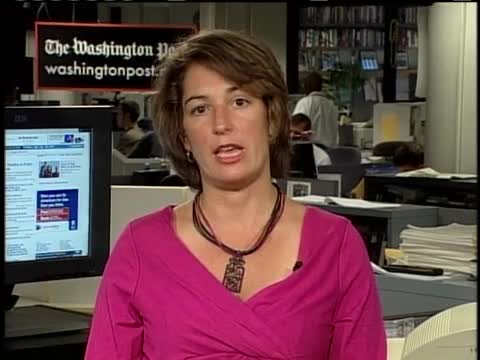
TERENCE SMITH: Joining me now to review today's developments in the investigation is Carol Leonnig, a Washington Post reporter who has been following this case. Carol, welcome to the broadcast.
CAROL LEONNIG: Thank you, Terry.
TERENCE SMITH: Judy Miller testified for nearly three hours today in front of the grand jury. What have you been able to learn about her testimony?
CAROL LEONNIG: Well, as you know, Judy Miller declined to answer any questions about her testimony. However, we do have some sources some information, some of it comes, actually, from people familiar with Lewis Libby's account of their conversations in July of 2003 that are at the center of what the special prosecutor wants to know. If Judy's account matches with Mr. Libby's, they met twice -- I'm sorry, they met once on July 8 and they had a telephone conversation on July 12 or 13, and in both cases they discussed Wilson, Ambassador Wilson, who was then a very public critic, had just published a large op-ed piece in the New York Times questioning the Bush administration and saying that they had twisted intelligence about uranium and Iraq to justify the war. There were a lot of people very concerned about any criticism of this claim. And one of them was Scooter Libby, Vice President Cheney's chief of staff.
TERENCE SMITH: Well, can you explain why Judy Miller was able to reach an agreement and go ahead and testify today after 85 days in jail when Scooter Libby's attorney says that more than a year ago they provided a waiver and told her to go ahead? What changed? Why now?
CAROL LEONNIG: There is a lot of consternation and speculation about just that. Cynics and even legal experts have said that Miller could have testified in July and avoided going to jail based on Mr. Libby's lawyer's insistence that this was a personal un-coerced waiver and that she was released from her promise of confidentiality to the chief of staff.
Others have said that there's another motive underneath this. People familiar with Miller and her defense team that are close to the defense have said that she and her lawyers were really quite concerned that Fitzgerald, the special prosecutor, Patrick Fitzgerald, was very thorough, had a reputation as dogged, was not going to give up and might have asked for her to be jailed for another 60 days.
TERENCE SMITH: And so this might have gone on and she might have remained in jail?
CAROL LEONNIG: Exactly. And that would certainly turn up the heat to strike a deal, get a more specific waiver, and be released. And, you know, in the footnotes of legal filings, Fitzgerald did indirectly threaten this by mentioning his authority to seek additional grand jury time and to request that a judge have her detained if she continued to refuse to discuss the conversation she had with her source.
TERENCE SMITH: And I believe the possibility of changing this to a criminal contempt citation, a much more serious charge with a potential for a jail term was out there as well.
CAROL LEONNIG: Yes, absolutely. Thank you for reminding me. That was out there, although what I heard from lawyers close to Miller was that they were less concerned about that and more concerned about additional jail time.
TERENCE SMITH: All right. Well, let's take this beyond Judy Miller here. What -- is there evidence that this much-sought-after testimony moved the investigation forward?
CAROL LEONNIG: It's not clear at this time. But remember that Mr. Fitzgerald has said for now going on ten months that the last two people he needed to talk to and interview and question before the grand jury were Matt Cooper of Time Magazine and Judy Miller of the New York Times. Presumably, Fitzgerald is done; unless he learned something unusual, unexpected, dramatic from Judy Miller's testimony today, she's the last person he needs to talk to and we should expect to see some sort of action on Fitzgerald's part in the near future, an indictment, a plea agreement, a report or a conclusion that his investigation has exonerated any senior Bush administration officials from breaking the law in the potential leak of this operative's name.
TERENCE SMITH: Right. Because in this investigation, testimony has been taken, has it not, from Karl Rove, from Scooter Libby, from the president, from the vice president, any number of very senior people.
CAROL LEONNIG: Colin Powell, Condi Rice, a lot of people.
TERENCE SMITH: Right. And it's gone on for how long?
CAROL LEONNIG: Two years now. It will be two years exactly in another two months.
TERENCE SMITH: One question that comes up repeatedly is whether or not the columnist, Robert Novak, has been called to testify or answer the prosecutors' questions. Do you know now whether it has? In the past he's declined to say one way or the other.
CAROL LEONNIG: don't know definitively, Terry, but the sources that I've talked to say that he began cooperating early in this investigation and had --didn't take the fifth, didn't try to strike any deal with the prosecutor but told the prosecutor what he knew.
TERENCE SMITH: All right. And so now you would expect these developments from -- from the prosecutor in what sort of time frame?
CAROL LEONNIG: Well, remember the grand jury's term expires Oct. 28, again with the caveat that he hasn't learned anything dramatically knew from Judy Miller, as he said he did when he interviewed Matt Cooper last year -- assuming that, some time before the middle of November.
TERENCE SMITH: All right. Carol Leonnig, thank you very much for filling us in. We appreciate it.
CAROL LEONNIG: Thank you, Terry.
CONVERSATION NIGHT DRAWS NEAR
JIM LEHRER: Now, a new book on Iraq and the challenges of covering it. Jeffrey Brown has our media unit conversation.
JEFFREY BROWN: From the dangers of a war zone to the differences of culture, covering Iraq has been an especially difficult assignment for American journalists. One of the most successful has been Anthony Shadid, Middle East correspondent for the Washington Post, who earned a Pulitzer Prize last year for his reports.
The 37-year-old Shadid is an Arab-American who grew up in Oklahoma and speaks Arabic fluently. With a decade of experience throughout the Middle East, his specialty has been getting beyond the guns and battles and into the homes and minds of Iraqis themselves. In his new book, "Night Draws Near: Iraq's People in the Shadow of America's War," he's woven together many of their stories. We spoke recently at his mother's home outside Washington, where Shadid took time off from his reporting to write the book.
You write in the prologue that the only way to respond to what you are experiencing in Iraq was to "surrender to the ambiguities and simply tell stories." Tell me what you mean by that.
ANTHONY SHADID: The longer I was in Iraq, the less I understood it. And I think that was, you know, part of the process of being a reporter there. Getting to know the place better, I appreciated how complex it actually was.
JEFFREY BROWN: The less you understood it?
ANTHONY SHADID: The less I understood it, the more I realized I had to learn to get a sense of Iraq, get a sense of the story in some ways. And you know I think as a reporter I realized that just telling many stories rather than one story was the way to maybe appreciate it, that there wasn't a lot of black and white in Iraq; there was a lot of gray. There were conflicting sentiments.
JEFFREY BROWN: We heard a lot about journalists being embedded during this war with the military. It's almost as though you embedded yourself with the Iraqi people.
ANTHONY SHADID: You know, it was early on in the war I think, and I had made a decision before the invasion began to stay in Baghdad to try to get a sense of how a city was going to react to an invasion, a city under siege. And it was pretty early on in the war that people started talking a little bit more honestly than they might have before the invasion.
And it was actually something my editor saw as well, that there was a story to tell perhaps in what people were saying, just popular sentiments, and that popular sentiments might be more revealing than we thought they would be.
JEFFREY BROWN: Now, in telling the stories of these individuals, you write of Iraq as a -- what you call a brutalized society.
ANTHONY SHADID: The biggest surprise that I encountered was how brutalized Iraq actually was, that the country the Americans inherited wasn't a Tabula Rasa. It was a country that had gone through a brutal eight-year war with Iran, a million dead and wounded on both sides, had gone through a decade of sanctions, one of the century's worst dictatorships. This is all before the invasion, you know, and an occupation and an insurgency.
JEFFREY BROWN: One of the running stories that you tell in the book involves a girl named Amal who showed you her diary. Tell us about her.
ANTHONY SHADID: You know, I met her during the war. It was in the early days of the invasion, and I was trying to do a story about a family who had sent their son to fight with the Iraqi army and what it was like to send their son off. And so I met her mother and did the story. And I was always struck -- here was -- she was a widow with eight children, and I was really struck by just her story.
I soon learned that she, the young girl, she was 14 during the invasion, was keeping this diary and it was too early I think in the relationship to ask for it. And in fact I didn't ask for the diary until a year later after getting to know the family pretty well. I mean, it was her own diary, it was in her own words, and there were passages in the diary that I still -- I think no journalist could ever hope to capture in an interview because it is so -- it's so from the heart, it's so visceral in a way, and it's so shorn, you know, of any pretenses.
JEFFREY BROWN: Such as? I mean, give a -- give an example of something that struck you.
ANTHONY SHADID: Yeah, I remember she was trying to make sense of democracy. This is a 14-year-old girl, and she's --
JEFFREY BROWN: Trying to understand the idea of democracy?
ANTHONY SHADID: Trying to understand the idea of democracy. And she realizes that, you know, democracy to her is that people -- people who have money can afford satellites; people who don't, can't. And then she goes, "I guess this is a democratic choice, that you can get a satellite if you have money."
Just her watching what's going on in her apartment building, basically, that it's TVs and satellites and generators and, you know, very much the impact on day-to-day life on material conditions. And they were on the, you know, the wrong end of that often.
JEFFREY BROWN: And her views changed during the course of the time you got to read the diary.
ANTHONY SHADID: You saw her evolve. You saw her mind becoming more critical. You saw her understanding what Saddam's legacy was, her trying to understand democracy, her trying to make sense of the violence that was going on around her. And she was mad at everyone. She was mad at the insurgents for the violence. She was mad at the American military for not protecting her. She was made at her own government for being ineffective. And she asked this question over and over, you know: Why do so many people have to die?
JEFFREY BROWN: Another interesting character that you wrote about is named Dr. Fuad, a psychiatrist.
ANTHONY SHADID: He was a remarkable guy. You know, Dr. Fuad, I think was the kind of Iraqi that Americans had hoped to meet. I mean, here was a person who thought this was a liberation, who thought the Americans were going to bring a new country, a new future. And I stayed with him as the years -- that year passed, and then -- and even today. And it was, you know, it was remarkable to see how his sentiments changed, how he became frustrated and increasingly gloomy that, you know, that this new future never did arrive.
JEFFREY BROWN: So how hard was it to work over there as a journalist? You have stories about writing by candlelight sometimes.
ANTHONY SHADID: You know, the logistical challenges during the invasion were probably the toughest. There was a point where electricity went out and we were -- you know, we had to charge our computers with a car battery that we were able to hook up. We had one light that we were able to wire, and then we could either leave that on or brew coffee, and we often chose the dark.
JEFFREY BROWN: Tough choice.
ANTHONY SHADID: Yeah. (Laughs) We chose the dark and had coffee.
JEFFREY BROWN: Obviously, there are dangers involved?
ANTHONY SHADID: It's more and more difficult for us to get to cities that we used to cover. I was in Basra a few weeks ago, and it was the most scared I've ever been as a reporter. I mean, there's a situation there --
JEFFREY BROWN: Really? The most scared only a few weeks ago?
ANTHONY SHADID: Yeah. This was I guess in August and, you know, what's going on in Basra is that you have militias taking over the security forces. So, as you drive around the city, whenever you look at a police officer, you're wondering if he's there to protect you or to assassinate you.
JEFFREY BROWN: Now you had the advantage of speaking the language. How important was that?
ANTHONY SHADID: You know, it was important during the invasion because I could get off -- get out on my own, and that was critical. I mean, during the invasion, you had to worry about your government escort, your minder, the person the government required you to always be with. My minder was cooperative and he would let me go off on my own, but only with language could you go off on your own and hope to do work.
You know, in the aftermath, I found language most helpful in trying to, I guess, create a fuller portrait of what was going on. In a way, I think language added the background noise sometimes. It was the, you know, the choice of words, the sayings, how they fit into the bigger conversation.
JEFFREY BROWN: You know there is a continuing effort to win what we call the hearts and minds in the Arab world. As someone who's looked at the culture and written about it and told these kinds of stories, what do you think?
ANTHONY SHADID: They do see a deep, deep resentment for U.S. policy. And I think it's a resentment that's gone on for ten, twenty, thirty years and it's not going to go away anytime soon. You know, I do worry that -- that attitudes are hardening, though, over the past few years. You know, I think that, you know, I've always been struck by how Arabs make a distinction between U.S. policy and between Americans. And I'm never treated badly as an American, you know, because of the policies that my government might represent.
You know, I see that distinction less and less, though, as the years pass, and I do, I guess, I have a certain -- certain worry that that distinction may be being blurred the longer this kind of conflict, the longer this tension remains.
JEFFREY BROWN: All right. Anthony Shadid, thanks for letting us come talk to you.
ANTHONY SHADID: My pleasure.
FOCUS SHIELDS & BROOKS
JIM LEHRER: And finally tonight, the analysis of Shields and Brooks: Syndicated columnist Mark Shields, New York Times columnist David Brooks.
Mark, the indictment of Tom DeLay, the House majority leader, a serious thing for Republicans, a serious development?
MARK SHIELDS: Very serious development, Jim. Tom DeLay has really been the most effective congressional leader that I can remember. I mean, as far as fashioning and forcing majorities, the decision was made rather early on in the Bush administration in cooperation with the House leadership that whatever they passed they were going to pass with Republican votes. And Tom DeLay has done that. The --
JIM LEHRER: You think he -- it could never have happened without Tom DeLay?
MARK SHIELDS: It never could have. I mean, he -- Tom DeLay joined the nexus of money and politics liked it had never been merged before -- I mean, Washington large big corporations, large trade associations, Washington became more of a pay-for-play town than it had ever been. And not only that, but the corporations had historically played both sides of the street-- they contributed to both Democrats and Republicans and DeLay was ruthless.
JIM LEHRER: Through Political Action Committees?
MARK SHIELDS: Through Political Action Committees.
JIM LEHRER: Right.
MARK SHIELDS: And DeLay was ruthless, quite franking, in saying, you give to us, you hire our people. Two dozen of Tom DeLay's former staffers now are major lobbyists in Washington.
So I think it's a big difference. The race to succeed him has already split the Republicans: Tom Reynolds, the chairman of the Republican Campaign Committee; John Boehner, the chairman of the House Education and Labor Committee.
JIM LEHRER: They want the job?
MARK SHIELDS: The next three months are going to be spent on this and everybody's looking over their shoulder because they're afraid DeLay will come back. And whatever DeLay is, he's a guy who's never forgotten; he never forgets a favor; he never forgets anybody who lets him down.
And I'll just finally say I talked to Charlie Stenholm today, a 13-term Democratic congressman from Texas, west Texas, and Charlie Stenholm was known as Mr. Bipartisan.' He had friends on both sides of the aisle. He supported Ronald Reagan's program. He was very close to George Bush.
And Tom DeLay set out to get Charlie Stenholm and --
JIM LEHRER: He got him; he got him.
MARK SHIELDS: He did with the redistricts. And Charlie Stenholm reminded me that when George Bush was introduced to the American people after the election of 2000, it was by the Democratic leader of the Democratic speaker of the Texas state legislature in the chamber. That's where he addressed the nation -- Bob Bullock, the Democratic lieutenant governor there. And the president emphasized, President Bush did, how cooperative things had been in Texas, how civil; how they worked across the aisle.
That was all changed by Tom DeLay. And I'll tell you right now, all civility, all courtesy, all comedy has been purged and it was purged in the 2002 election.
JIM LEHRER: That's not a very -- he didn't say any nice things about Tom DeLay.
DAVID BROOKS: Not very nice. I think Tom's hurt. I don't think Tom DeLay did all that. I think, you know, just in terms of how the Republican Party is doing
JIM LEHRER: Yeah I'm
DAVID BROOKS: -- it doesn't help to have your majority leader indicted, that's not a good thing. Nonetheless, I think in the long run, I think it's good for the Republican Party because what Tom DeLay and this a bit in tune to what Mark just said Tom DeLay abandoned conservatism in favor of party corporatism some sort of corporate state where you had K Street and the Republican Party merge.
JIM LEHRER: Remind people that K Street is a street in Washington where there are a lot of lobbying firms.
DAVID BROOKS: And as a result, first of all, you get the undertow of corruption and frankly, I think this indictment is a piece of garbage; I don't make sense of it. But nonetheless, you had the undertow, the tight connections between lobbyists and the House Republicans but then you had a complete loss of conservatism form and philosophy.
And that was what's tearing down the Republican Party we talked about the other week: No sense of priorities, just spending for special favors spending for everything, no sense of a governing philosophy. And Tom DeLay was the major part of that -- any loss of a sense of "what do we want to do with government." What he wanted to do with government was get reelected and get more Republicans reelected and nobody's going to elect a party that just wants to do that.
JIM LEHRER: But Tom DeLay a conservative by any definition, a real conservative, is he not?
DAVID BROOKS: Well, you know, there are different sorts of people. There are some people who are conviction conservatives who are there for a reason. Tom DeLay a conservative, he's pro-life, he's in theory for limited government but in practice totally against that. His main interest in everyday what do you do when you're going to work, his main interest was getting more Republican fannies in House seats. And he would the do it any way, whether it was conservative or not conservative. He just wanted to do that. And that's why I think he hurt the party. And that's why I think the accession of Roy Blunt and other people --
JIM LEHRER: He's taking his place
DAVID BROOKS: -- is going to be a good thing.
JIM LEHRER: The corruption issue. How badly does this hurt the Republican Party generally, which was what I was trying to get at with Mark?
DAVID BROOKS: I don't think any in the long run it helps him unless -- I don't think corruption helps -- hurts a party unless people have a sense that they are out of touch with the American people and they don't care.
In other words, I don't think corruption hurts the party unless there's a failure of policies -- unless the party has no policies that help the American people. And this last week is a perfect indication that we've had some big corruption stories. George Bush's approval ratings have shot up five points in the latest Gallup Poll and two other polls.
Bush is going up because there's something that's displaced corruption, which is Katrina. And as he's traveling around the country, it's sort of helping him, people see he's actually trying to do something and or both of them -- and so what you have is policy trumps corruption. The Republican Party have a reputation -- there's some corruption, there's some incompetence but if they have good policies, people will forgive that. If they don't have good policies it ties into a big swamp, those people don't get us.
JIM LEHRER: Now what do you think about the corruption thing? Add in also the other element of the week recently is the decision by the Senate Majority Leader Bill Frist. He has a blind trust and he had some stock that was held -- in a company that has been founded by his father and had been run by his brother and he asked the blind trust to sell the stock, this came out at the same time.
Is there -- do you see all of this well, first of all, you want to talk specifically about that? But I want to get at the general corruption.
MARK SHIELDS: Sure. And the point is he sold the stock and then it dropped 68 percent
JIM LEHRER: Exactly.
MARK SHIELDS: -- so he --
JIM LEHRER: Right.
MARK SHIELDS: It was a nice windfall for him.
JIM LEHRER: Right. But the issue, of course, is did he have inside information and that's what the investigation has yet to determine, et cetera, et cetera.
MARK SHIELDS: Right. As somebody said, if you're a public figure, you never want to have a Securities & Exchange Commission investigation with your name in the same sentence. And I don't know what the definition of "blind" that Bill Frist doesn't understand in blind trust how you sell what you've been holding for 11 years. And the explanation that Bob Stevenson, his press secretary, who's a very able guy, was that he wanted to avoid a conflict of interest a perception.
Well, he's been there for 11 years, he's leaving the Senate next year. It seems like a funny time to unload it. And I think probably what you don't want to have is the two leaders of your party in Congress answering questions, being cross-examined
JIM LEHRER: At the same time.
MARK SHIELDS: -- about malfeasance at the same time.
JIM LEHRER: Let me David specifically on the Bill Frist thing. Do you smell any corruption there?
DAVID BROOKS: No, I don't. Bill Frist has a lot of problems that we've talked to about on this show. To me, personal corruption is not one of them. I do not see him. I've looked at his career quite a lot. Any sense of venality, of trying to profit in financial terms, I just, for a guy who's led his life so carefully, to risk it for a few -- even a couple of million bucks or a couple of hundred thousand bucks, this plan of becoming President of the United States, I just don't buy it.
I mean, one of their defenses is that that he began this process I think back in April long before there could have been any information that the price dropped. So the point to make is there can be investigation, but then there's guilt and proof and in both in the DeLay case and the Frist case, we are a long way
MARK SHIELDS: Let me just address one thing of David's. I mean, the explanation is that it could be a conflict of interest, 11 years, that makes him one of the slowest learners in the western world. He's only going to serve 12. And 11 years into this he says, gee, I think I'll get rid of this because there could be a perception --
DAVID BROOKS: He said he was going to initiate legislation that would impact on this.
MARK SHIELDS: He had been one of the leaders on health care legislation all the time he's been in the Senate, the leading authorities. I think David is wrong about the case against Tom DeLay. I don't think there's any question that Ronnie Earle -- and he's already been attacked several times-- the district attorney of Travis County, Texas, Austin who bought this case --
JIM LEHRER: A Democrat.
MARK SHIELDS: A Democrat, who has brought cases against the Democratic speaker of the House, the Democratic attorney general of Texas, the Democratic chief justice of Texas, the Democratic state treasurer of Texas -- four times as many Democrats as Republicans and the point is that I don't think he would have brought the case unless somebody flipped inside. And that's Republicans
JIM LEHRER: Flipped meaning that somebody's prepared to testify against DeLay?
MARK SHIELDS: There's no argument that companies, major companies like Sears and Roebuck and the Bacardi Liquor Corporation who had no interest at all in who was the state legislator for Pecos, Texas, made major contributions.
JIM LEHRER: It's pronounced Pecos by the way.
MARK SHIELDS: Excuse me. Well, they didn't care a wit about that but did care about Tom DeLay and did care about --
JIM LEHRER: Well, let's explain to people who haven't been following this.
MARK SHIELDS: Okay.
JIM LEHRER: The allegation is that the money was taken from corporations, it was put in a political action thing and then sent to Washington where it was then laundered and sent back in violation of Texas law. They couldn't do it directly so they did it indirectly. But you say that's not --
DAVID BROOKS: I'm not attacking Earle. I'm just saying I read the indictment. I couldn't tell what individually this individual person, Tom DeLay, had actually done. There was not even an accusation. There's a committee and it's a committee that's been connected to DeLay. But you've got to commit a crime. You have to tell me what the person is accused of. I read through this thing and I couldn't see that -- it was just a gauze.
And so maybe it's there, maybe Mark's right. Maybe somebody did flip and we'll learn it. But so far I just don't see where that is.
MARK SHIELDS: Do I think that there's a -- the corruption issue works? Yeah, it does work. It works, Jim, at a time when people are looking at a 75 percent increase in their oil and home heating prices in the winter of 2005/2006. And oil companies have their highest profits in history. And --
JIM LEHRER: So the mix is not good.
MARK SHIELDS: When people want an excess profit tax on the oil companies, the administration fights it; so I mean, is there a sense where corruption seeps out, do the Democrats have a compelling, coherent message competing? No, they don't, but sometimes to win an election all you need to do is to be the other guy. It's no way to govern, believe me.
You can win by being the other guy but you have to govern, you have to have some ideas to do it.
JIM LEHRER: Now, the other major development of this week, obviously, was we now have a Chief Justice of the United States Supreme Court and nobody really paid that much attention to it because so much was going on. It happened the same day of the DeLay thing -- but we've talked about that before. No surprises in the final vote, were there?
DAVID BROOKS: No. Not really. I mean, if you looked at the -- the Democrats were the only interesting side of the vote the Democrats who voted for, the Democrats who voted against. Generally the people who have aspirations to run for president voted no. The exception, I think, was Russ Feingold who to me is the profile in courage head of all this.
I thought in the hearings he did an excellent job of asking tough prosecutorial questions; really some of the more critical questions that were asked were asked by Russ Feingold. I thought he did a much more competent job. And then he turns around and says, "well, I think he's a decent guy." So Russ Feingold looks very good.
MARK SHIELDS: I agree. I mean, the four horsemen: Bayh, Biden, Clinton, and Kerry, all four them mentioned as presidential -- all voted against. But I'd add to that Chris Dodd, former Democratic national chairman, Byron Dorgan of North Dakota, senator who's the chairman --
JIM LEHRER: Jay Rockefeller of West Virginia.
MARK SHIELDS: Jay Rockefeller of West Virginia; Patti Murray of Washington who got elected in the year of the woman in 1992 I mean, all card carrying liberals -- all of whom, in addition to Russ Feingold voted for --
JIM LEHRER: And of course Pat Leahy.
MARK SHIELDS: And Pat Leahy who led the fight took a lot of heat for it.
JIM LEHRER: Have those Democrats, the ones we've just mentioned, have they also set themselves up that if the second nominee, which is expected next week, the one to replace Sandra Day O'Connor, if the president goes too far to the right for them, they now have got credibility to jump?
MARK SHIELDS: I think they do have credibility and I think the question that comes to president right now, does he follow the model of John Roberts and somebody who's going to get four to five or better Senate votes or does he go the Clarence Thomas route and --
JIM LEHRER: What do you think he's going to do?
DAVID BROOKS: I think he's going to pick a person whose personality shines the way Roberts does. You know, everyone's been analyzing it by categories
JIM LEHRER: Sure.
DAVID BROOKS: -- what category is this person in. But in the end it will be a human person who will be sitting there in that chair and if that person seems impressive, I'm sure all the Democrats will vote against him. They'd vote against Oliver Wendell Holmes at this point. But they'll be hesitant to filibuster that person.
JIM LEHRER: I remember you said on this program that one of the reasons Bush ended up nominating John Roberts was because in the personal interview he was really taken with the guy.
DAVID BROOKS: We can see why.
JIM LEHRER: We'll see why. Okay. We'll see what happens. Thank you both very much.
RECAP
JIM LEHRER: Again, the major developments of this day: In New Orleans, thousands of people were allowed back into the French Quarter, the central business district and the uptown. Fresh violence in Iraq killed 14 more people. And New York Times reporter Judith Miller testified in the CIA leak investigation. She had been jailed for 85 days after refusing to identify a source. Washington Week can be seen on most PBS stations later this evening. Here on the NewsHour next week, we're going to launch a special Paul Solman series on the many faces and parts of the booming Chinese economy. And we'll see you online. Have a nice weekend. I'm Jim Lehrer. Thank you and good night.
- Series
- The NewsHour with Jim Lehrer
- Producing Organization
- NewsHour Productions
- Contributing Organization
- NewsHour Productions (Washington, District of Columbia)
- AAPB ID
- cpb-aacip/507-np1wd3qr25
If you have more information about this item than what is given here, or if you have concerns about this record, we want to know! Contact us, indicating the AAPB ID (cpb-aacip/507-np1wd3qr25).
- Description
- Episode Description
- This episode's headline: Rebuilding Protecting Sources; Conversation Shields & Brooks. The guest is MARY COMERIO.
- Date
- 2005-09-30
- Asset type
- Episode
- Topics
- Economics
- Social Issues
- Literature
- Environment
- Religion
- Weather
- Military Forces and Armaments
- Politics and Government
- Rights
- Copyright NewsHour Productions, LLC. Licensed under a Creative Commons Attribution-NonCommercial-NoDerivatives 4.0 International Public License (https://creativecommons.org/licenses/by-nc-nd/4.0/legalcode)
- Media type
- Moving Image
- Duration
- 01:04:13
- Credits
-
-
Producing Organization: NewsHour Productions
- AAPB Contributor Holdings
-
NewsHour Productions
Identifier: NH-8327 (NH Show Code)
Format: Betacam: SP
Generation: Preservation
Duration: 01:00:00;00
If you have a copy of this asset and would like us to add it to our catalog, please contact us.
- Citations
- Chicago: “The NewsHour with Jim Lehrer,” 2005-09-30, NewsHour Productions, American Archive of Public Broadcasting (GBH and the Library of Congress), Boston, MA and Washington, DC, accessed April 3, 2026, http://americanarchive.org/catalog/cpb-aacip-507-np1wd3qr25.
- MLA: “The NewsHour with Jim Lehrer.” 2005-09-30. NewsHour Productions, American Archive of Public Broadcasting (GBH and the Library of Congress), Boston, MA and Washington, DC. Web. April 3, 2026. <http://americanarchive.org/catalog/cpb-aacip-507-np1wd3qr25>.
- APA: The NewsHour with Jim Lehrer. Boston, MA: NewsHour Productions, American Archive of Public Broadcasting (GBH and the Library of Congress), Boston, MA and Washington, DC. Retrieved from http://americanarchive.org/catalog/cpb-aacip-507-np1wd3qr25