The NewsHour with Jim Lehrer
- Transcript
JIM LEHRER: Good evening. I'm Jim Lehrer. On the NewsHour tonight, keyed to the Bush-Blair meetings at Camp David, Ray Suarez looks at the continuing dilemma over Iraq, Margaret Warner opens a conversation series on tax cutting with former Treasury Secretary Robert Rubin, Elizabeth Brackett reports from Chicago on the real costs of higher natural gas prices, and Mark Shields and Paul Gigot assess President Bush's first news conference and the latest pardons storm. It all follows our summary of the news this Friday.
NEWS SUMMARY
JIM LEHRER: President Bush said today China had answered a U.S. complaint about Iraq. He said Thursday he was troubled about China's helping Iraq rebuild air defenses, in violation of United Nations sanctions. He spoke today at Camp David, at a joint news conference with British Prime Minister Blair. He characterized the Chinese response this way.
PRESIDENT GEORGE W. BUSH: If I could paraphrase, it was if this is the case, we'll remedy the situation. But we did get a response, because I told you yesterday that we filed a-- a complaint, and they responded this morning.
REPORTER: Do you trust that they'll keep their word in that regard?
PRESIDENT GEORGE W. BUSH: Well, I think you always got to begin with trust until proven otherwise.
JIM LEHRER: The President and the Vice President said they need to keep the pressure on Iraqi Leader Saddam Hussein. We'll have more on that story after the news update. Secretary of state Powell left today for the Middle East. It's part of his first solo foreign trip as secretary, a four-day swing that also includes stops in the Persian Gulf and Europe. He's to gauge prospects for renewing Middle East peace talks, push the case for a U.S. Missile defense system, and urge continued sanctions against Iraq. Violence between Israelis and Palestinians fared today, and Palestinians staged anti-U.S. protests ahead of Secretary Powell's visit. We have a report from Mark Austin from Independent Television News.
MARK AUSTIN: Anti-American feeling is always running high among the Palestinians. The air strikes against Iraq have only inflamed passions further. This is the West Bank town of Ramallah this afternoon where clashes between stone throwers and troops firing rubber bullets soon escalated once again in an all-out gun battle. (Automatic gunfire)The Israelis will come under pressure to bring an end to all this by easing the closure of the occupied territories and by limiting the use of battlefield weapons in places like Ram Allah. But today Israeli soldiers were responding to Palestinian snipers who fired first. In Gaza, they cut the main road, forcing Palestinians to abandon their cars and walk along the beach. Also in their sights, a Palestinian security outpost, from where the Israelis say mortars were fired on a Jewish settlement.
JIM LEHRER: A senior aide to Palestinian Leader Arafat said today he would ask Secretary Powell to stop what he called Israeli aggression. But Israel's Prime Minister-elect Sharon said this week he wants less emphasis on peace talks and more on U.S.-Israeli ties. On the submarine collision story today, Defense Secretary Rumsfeld ordered a temporary ban on allowing civilians at the controls of all military weapons. There were civilians at control stations on the U.S.S. "Greeneville" when it rammed and sank a Japanese fishing vessel. Also today, the "Washington Post" reported the submarine captain told investigators he knew sonar had spotted the ship, but he said a periscope check found nothing. The "Washington Times" said a crewman did not inform the captain the ship was close by. A Navy court of inquiry is now set to begin March 5. More of President Clinton's grants of clemency are under investigation. The Associated Press reported today the U.S. Attorney in New York City was looking at the commutation of the sentences of four convicted swindlers. They lived in a Hasidic Jewish community that voted overwhelmingly for Hillary Rodham Clinton in her Senate race. And last night, the former President's office confirmed his half-brother, Roger Clinton, tried and failed to win pardons for several friends, but it said he was not paid. He was pardoned himself for a drug conviction. That's it for the News Summary tonight. Now it's on to: What should be done now about Iraq; Robert Rubin on cutting taxes; the real costs of higher natural gas prices; and Shields and Gigot.
FOCUS - PERENNIAL PROBLEM
JIM LEHRER: Kwame Holman begins our look at Iraq, that problem that won't go away.
KWAME HOLMAN: All week long thousands of Iraqis have protested last week's bombing raids by U.S. and British warplanes. The attacks were President George W. Bush's first military action as commander in chief. They targeted radar towers and other facilities outside an area they patrol regularly, the so-called no-fly zone in southern Iraq. It was established by the first Bush administration a year after the 1991 Gulf War. The government of Saddam Hussein said the bombing killed at least two people and wounded others. President Bush defended his decision at his press conference yesterday.
PRESIDENT GEORGE W. BUSH: We had two missions; one was to send a clear signal to Saddam, and the other was to degrade the capacity of Saddam to injure our pilots. I believe we succeeded in both those missions.
KWAME HOLMAN: Mr. Bush said he also sent a signal to China, which is believed to be sharing radar technology with Iraq, in violation of UN sanctions.
PRESIDENT GEORGE W. BUSH: We're concerned about Chinese presence in Iraq, and we are... my administration is sending the appropriate response to the Chinese. Yes, it's troubling that they'd be involved in helping Iraq develop a system that will endanger our pilots.
KWAME HOLMAN: Yesterday, news reports suggested many state of the art bombs missed their Iraqi targets last week.
REAR ADMIRAL CRAIG QUIGLEY: Did each weapon perform perfectly during the strike? No, it did not. But we feel that, on balance, the strike had good effectiveness.
KWAME HOLMAN: The President used the term "Swiss cheese" to describe the leakiness of UN economic sanctions first imposed on Iraq after it invaded Kuwait. The trade embargo is supposed to allow Baghdad to sell oil only to purchase food and medicine. The sanctions are to remain in place until Iraq proves it has gotten rid of weapons of mass destruction. But a number of western and Arab nations now are permitting commercial flights into Iraq, buying Iraqi oil, and making diplomatic overtures to Saddam's government. And UN weapons inspectors who left the country in late 1998 have not been allowed to return. Secretary of State Colin Powell, who left today for a Middle East trip, has raised what he calls smart sanctions. They would target Iraqi military sales instead of blocking general economic transactions, a policy that's come under wide criticism as punishing Iraqi civilians. Today at the Camp David news conference with British Prime Minister Tony Blair, President Bush said the two leaders discussed changes in the sanctions on Iraq.
PRESIDENT GEORGE W. BUSH: Our beef is not with the people of Iraq; it's with Saddam Hussein. And secondly, anytime anybody suffers in Iraq, we're concerned about it. And I would, however, remind you that Saddam has got a lot of oil money, and it would be helpful if he would apply it to helping his people. Having said that, to the extent that sanctions are hurting Iraqi people, we are going to analyze that. Colin is really going to listen, he's going to solicit opinion from our friends and folks in the Middle East, and prior to formulation of any policy, we will have listened and then I will of course consult with friends and allies, such as the prime minister here, as we develop a policy that we hope and know will be more realistic. The prime minister said something interesting, though: A change in sanctions should not in any way, shape or form embolden Saddam Hussein. He has got to understand that we're going to watch him carefully, and if we catch him developing weapons of mass destruction, we'll take the appropriate action, and if we catch him threatening his neighbors, we will take the appropriate action. A change in a sanction regime that is not working should not be any kind of signal whatsoever to him that he should cross any line of... and test our will, because we're absolutely determined to make that part of the world a more peaceful place by keeping this guy in check.
SPOKESMAN: Thank you very much.
JIM LEHRER: Ray Suarez takes it from there.
RAY SUAREZ: For more on Iraq we get three views; Robert Pelletreau was Assistant Secretary of State for Near Eastern Affairs during the first Clinton administration, and ambassador to Tunisia and Egypt during the Reagan and Bush administrations. Clovis Maksoud was the League of Arab States ambassador to the UN from 1980 to 1990. And Richard Butler was executive chairman of the United Nations special commission on Iraq from 1997 to 1999.
Well, Robert Pelletreau, you heard it there. Leaving the door open for loosening sanctions, yet being unequivocal about the need to continue pressure on Iraq. How do you read that?
ROBERT PELLETREAU: Nobody in Washington believes that Saddam Hussein has changed his intentions or his ambitions to be the dominant force in the Gulf or his intention to reacquire weapons of mass destruction just as soon as he's able to do so. I think the President has signaled a determination by the United States and the United Kingdom to react strongly if there's evidence that that's happening.
RAY SUAREZ: But also signaled along with Prime Minister Blair an intention to relieve the pressures on the population of Iraq?
ROBERT PELLETREAU: That's right. There's been a crumbling of sanctions under propaganda pressure and under realization in the region and throughout the world that the Iraqi people have been bearing the brunt of the hardship more than the Iraqi regime. So there's talk about some smart sanctions now, sanctions that will be targeted more directly at the government, at its efforts to reacquire military strength or weapons of mass destruction and lessening or relieving the burden that's on the Iraqi people, allowing them to get back on their feet and lead more normal lives.
RAY SUAREZ: Clovis Maksoud, what do you make of the President's remarks?
CLOVIS MAKSOUD: Well, I think the President's remarks are on the one hand they seem to be saying that Secretary Powell is going to go to the region to listen, and I think that he's going to hear certain policy recommendations, I hope, and certain assessments that should be factored into the decision making and policy making processes in the United States and maybe in the United Nations also. I think that the question arises is how to deal with the new elements that have been introduced, especially in the last couple of years with diplomatic and commercial relations raising between and among many Arab states which were part of the coalition. There is a deep crisis of conscious throughout the Arab world and in many other parts of the world about the suffering and the nature of the indefiniteness of the sanctions on the people of Iraq, and this has now become superseding much of the anxieties and concerns that many regimes have about Saddam Hussein's regime itself. I mean, irrespective of the judgment that many countries in the Arab world have about the regime, they do have a major concern about the people of Iraq and then there is also the anxiety arising out of Sharon's elections in the region, and the fact that this is being subordinated to the geopolitical context, which President Bush seems to imply about how to deal with the regional affairs as a whole. And in that respect I think the visit might be a learning lesson as well as an unlearning lesson, and I think that is necessary at the beginning of the new administration of President Bush.
RAY SUAREZ: Richard Butler, in today's news conference with the prime minister and the President implicit in all of their remarks was the assumption that Saddam Hussein and his regime in Iraq is still a danger to the region. Is he?
RICHARD BUTLER: Yes, he certainly is, Ray. I find it curiously almost historically appropriate that the new President's first entry into the harsh world of international politics is on the Iraq issue. You think about how the wheel of history turn from his father ten years ago, and next Monday is the 10th anniversary of the liberation of Kuwait, and now to another President Bush. And here he is on the world stage for the first time dealing with Iraq. I believe that one of the things that we've seen in the last 18 months, when the previous administration put Iraq policy somewhat into limbo, is the truth of the principle that if you postpone a truly serious problem, then the solution of it only gets harder. Now, what we heard from the President, I think, was a very encouraging start to find the new policy that the United States clearly needs. It emphasized fundamentally the thing that is of basic importance, that is, Saddam is still a very dangerous man. He remains connected to, I would say addicted to weapons of mass destruction, and the need to get that under control will be the core of a new policy. But there was also a realistic recognition that the sanctions instrument, I think, is irretrievably broken, and that he and Prime Minister Blair have indicated that they're prepared to look at that. I think it was very important that the point was made earlier that Saddam Hussein holds a very serious responsibility himself for sanctions. Clovis Maksoud a moment ago talked about not only the impact but the duration. Ray, they could have been removed seven or eight years ago because they've always been tied to disarmament -- if Saddam had given us the illegal weapons seven or eight years ago, as was hoped and expected, those sanctions would have been removed. Nevertheless, sanctions are now a broken instrument, and they need to be part of a new policy mix -- the core of which has to be arms control, but clearly for that to be acceptable to get those inspectors back in there, there will have to be a revisiting of, an adjustment of the sanctions regime. I see a good start towards that new policy being made today.
RAY SUAREZ: Robert Pelletreau, you heard Clovis Maksoud talk about the powers in the region, Saddam Hussein's neighbors, and Mr. Butler talked about a broken sanctions regime. How do you uncouple the sanctions that hurt the rank and file Iraqis and those that seek to keep Iraq from developing weapons of mass destruction?
ROBERT PELLETREAU: I think you revise the list of permissible imports to expand those imports which directly affect ordinary people's lives, including such things as water treatment systems, the electric grid, things like that, but you remain absolutely rock solid on anything that has a direct bearing on increasing military power, any spare parts, any new weapons systems, and certainly any precursors to weapons of mass destruction.
RAY SUAREZ: Can inspectors ever get back into the country?
ROBERT PELLETREAU: I'm very dubious myself that Iraq is ever going to let inspectors back into the country and I don't think you should put too much weight of your policy on that. The worst danger would be to have an inspection system back in that is ineffective and that cannot uncover what Iraq has now had months and months to prepare for and to be absolutely covered up about. Chemical weapons and biological weapons can be produced in very small, very remote bathroom - bathtub-like facilities. I think a weapons inspection regime would have a great deal of difficulty trying to track them down, and we shouldn't be lulled into a false sense of security.
RAY SUAREZ: Richard Butler, how do you answer that?
RICHARD BUTLER: The fundamental requirement, if there's to be any chance of getting inspectors back into Iraq is that a consensus in the Security Council, which disappeared two and a half years ago, be restored. Saddam Hussein has been the main beneficiary of this division in the Council. If that were healed, if it were put back together, his political position would be changed overnight. The first step towards putting that consensus together is for the U.S. to develop a new policy and I see those first steps being taken now. But just a quick word on inspections themselves: This is not understood by many people. We are in the most shocking situation with Iraq today; not only do we not have the inspections that were specially mandated after the end of the Gulf War, but Iraq is even below the normal standard, because as a party to the nuclear nonproliferation treaty, like 160 other countries in the world, it should be the subject of normal, regular inspections from the international atomic energy agency in Vienna. It's not even receiving those. And people should understand that. Some of what's being asked of Iraq is what's being asked of all manner of countries around the world, not just the special post-Gulf War arrangements. And, with all respect to Robert Pelletreau, I know it's difficult in the biological field in particular, but absent human beings on the ground with their eyes and ears to watch what is happening in Iraq's manufacturing industries, we don't have a chance of knowing what is going on. And I think the core of a new policy has to be absolute insistence that those eyes and ears be put back on the ground in Iraq.
RAY SUAREZ: Ambassador Maksoud, in the time that we have left, let's look forward to Secretary Powell's trip. You already suggested he's going to get an earful. Is it significant to you that this is a trip by a major American policy leader that is not focused on the Arab-Israeli problem?
CLOVIS MAKSOUD: Well, there's no question that the question of Arab-Israeli conflict is going to be factored in, whether it is American priority or not. There seems to be a lob sided priority. The Arabs are more concerned about the growing right-wing efforts in Israel, the new government of Israel, and between the anxieties that they fear about the Iraqi situation. They're trying to normalize... maybe not successfully as much as they would want-- with Iraq, but they're trying really to sharpen their strategy concerning the rise of Sharon and the failure of the peace process. I think at this moment there are three landmarks which we must focus on: One is that there is going to be a summit meeting on the 27th of-- this is an institutionalized summit meeting of the Arab League in March. Secondly, there is going to be a dialogue between the Secretary-General and the Iraqis and I hope that in this dialogue that there is a formula where the Iraqis don't talk at the Americans and the British in the same way as the Americans don't talk at the Iraqis in the same way. So I think a simultaneity -- a formula, a resolution in the Security Council of a simultaneous nature between lifting the sanctions on the people of Iraq and having the compliance with the inspectors' presence in the Iraqi to monitor the fact that there is no production of mass destruction. I think this simultaneity has to be worked out, and I think there is enough room to do so.
RAY SUAREZ: Gentlemen, thank you all.
CONVERSATION - TALKING TAXES
JIM LEHRER: Still to come on the NewsHour tonight, the tax cuts debate, the impact of higher natural gas prices, and Shields and Gigot.
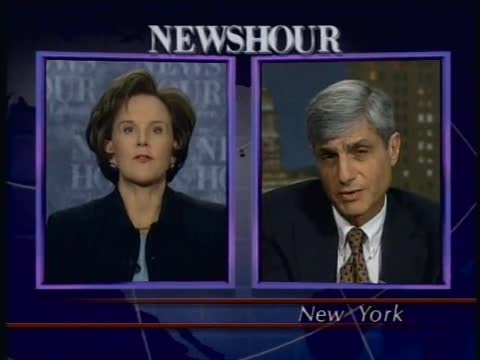
The major opening thrust of the Bush administration has been for a tax cut; tonight we begin a series of conversations and reports on the issues raised. First up, Margaret Warner talks with former Treasury Secretary Robert Rubin.
MARGARET WARNER: Robert Rubin served as President Clinton's Treasury Secretary from 1995 to 1999. He's now with City Group, the financial services company. He recently wrote an op-ed piece in the "New York Times" sharply criticizing the Bush tax cut proposal.
Welcome, Mr. Rubin.
ROBERT RUBIN: Good to be with you, Margaret.
MARGARET WARNER: So what is it about the Bush tax cut plan that you don't like?
ROBERT RUBIN: Well, in a nutshell, Margaret, I think it's a very, very serious error of economic policy. If you look back over the last eight years, we've had remarkable economic conditions. I don't think there's any question fiscal discipline has been central to this in terms of bringing interest rates down and keeping confidence up. And I think that the Bush tax cut as announced would undermine fiscal discipline. I think there's a high probability it would lead to deficits on the non-entitlement, that is to say the non-Social Security, non-Medicare side of the budget. And I think those kind of deficits could lead to exactly the kind of economic conditions that we had in the early '90s.
MARGARET WARNER: Now, you know the White House is citing the Congressional Budget Office that those non-Social Security... That surplus is going to be something like three-plus trillion dollars over the next ten years, and they're only proposing they say to give about half of that back. What do you say?
ROBERT RUBIN: I think in reality, Margaret, you've got a $5.6 trillion projected surplus. If you take out Social Security and Medicare, which most people in Congress think should be excluded, it gets you down to 2.7 trillion. If you take out realistic projections with respect to discretionary spending and to dealing with expiring tax cuts, you probably come to somewheres around $2 trillion or $2.1 trillion available over the next ten years. And the administration proposed tax cut would cost $2 trillion, including the interest that would have to be paid on the debt that you don't pay down. In addition, Margaret, all of this is based on five- and ten- year projections, and five- and ten-year budget projections are enormously unreliable.
MARGARET WARNER: So I assume you would then take great issue with what the President said on Saturday in his radio address, when he said essentially we can have everything we want: We can have increase on education and spending on defense, we can protect Social Security and Medicare, we can pay down the debt, and we can have a tax cut.
ROBERT RUBIN: I think, Margaret, that that is not a realistic notion. I think what we should do... if we're to have a tax cut-- and I think a moderate tax cut at this point would be very sensible-- I think we should have a moderate tax cut. I think there are some programs we should support, like prescription drug benefits. But I think we should operate prudently, and we should wait at least two or three or perhaps four years before we consider having a very large tax cut, something I wouldn't have in any case. But even if you want to have it, wait two or three or four years, probably three or four years until we know how reliable these projections are likely to be. And all the past history of such projections is that they have a very high tendency not to be reliable.
MARGARET WARNER: Now to guard against that one the ideas some of the Democrats on the Hill are talking about is some sort of trigger mechanism in which you would enact tax cuts, but each year it wouldn't take effect if the budget surplus didn't materialize.
ROBERT RUBIN: I think the trigger is conceptually an attractive idea. I think the problem-- and I've given a lot of thought to it, Margaret-- is that I think it's very hard to design one that as a practical matter will work when you actually face difficult circumstances. I also think that there's a very real... probably a very high probability that a trigger would result in unintended consequences. For example, if the economy is doing badly and at the same time the trigger hits so that you have to raise taxes because the surplus is no longer what you thought it would be, you're doing something counter- cyclical. I think it is much sounder, much sounder, to start with a moderate tax cut. And then if what you want is a very large tax cut-- something I personally would not choose to use the surplus for, but if that's what you wanted-- then after two or three years, if the budget surplus projections look like they're realistic, then you can increase your tax cuts somewhat and phase into it over time, not by enacting it now, but by enacting a moderate tax cut now and additional moderate tax cuts some years down the road as the surpluses eventuate, if they do.
MARGARET WARNER: Now, you said that you thought this could actually put us on the road to deficits. Give us a scenario from where we go from these incredible surpluses it a deficit.
ROBERT RUBIN: Well, I think it was broad-based agreement that if we have deficits on the non-entitlement side of the budget-- that is to say the side of the budget excluding Social Security, Medicare-- that that is a serious...or could present a serious economic problem in terms of increasing interest rates and reducing confidence being associated with the low level of confidence that we had last time we had very large deficits, which was the early '90s. And the numbers that have been laid out leading to that conclusion that this tax cut could very well lead to a deficit. As I said a moment ago, the $5.6 trillion realistically is probably about $2 trillion at most available for tax cuts, and the proposed tax cuts would lost $2 trillion, including the interest on the debt that wouldn't be paid down because the money was being used for tax cuts. And you're basing all of this on five- and ten-year budget projections, which all serious students in budget would agree are substantially unreliable. So I think this is a very real chance that this could lead to deficits on the non-entitlement side of the budget.
MARGARET WARNER: All right. Let me get your response...
ROBERT RUBIN: And I think is bad with respect to interest rates, bad with respect to confidence, and therefore with respect to jobs and incomes.
MARGARET WARNER: All right, let me get your response to the specific arguments that the Bush team is making. One that both he and his Treasury Secretary, his successor Paul O'Neill, are making is that if this tax cut were done quickly and effect made retroactive to January 1 of this year, that it would stimulate the economy, and would at least avert a worse slow down than we're in right now.
ROBERT RUBIN: Margaret, virtually all mainstream economists would agree that... do agree that a tax cut enacted this year is likely to have relatively little stimulative effect in this year. But if what you want is a stimulative effect from a tax cut this year, then you can do that with a moderate front-end loaded tax cut. Most of the proposed tax cut has absolutely nothing to do with economic conditions this year or, for that matter, even next year, because the effects occur in far outer years. For example, the almost the entire state tax cut would occur in outer years. If in fact you think that a tax cut is important for this year or next year, you could accomplish the exact same purposes with the a moderate front-end load tax cut, and I would aim it towards middle- and lower-income people because they have a higher propensity to spend.
MARGARET WARNER: Do think that's a good idea. In other words, do you think we're in a situation in our economy right now where we need that stimulative effect?
ROBERT RUBIN: I think the most important thing we can do with respect to the current economic conditions-- and think conditions are difficult at this time-- is to make sure that we stay on the path that was so central to the last eight years, which is a path of fiscal discipline, creating confidence and lower interest rates. But if people feel that a tax cut would also be useful-- and I think you could make a good argument to the effect that it might be useful-- then you can accomplish exactly the same purpose with a moderate front- end loaded tax cut aimed toward working people, and avoid the adverse impacts on fiscal discipline that come from the vast tax cut that's been proposed, most of which will occur in outer years that have nothing to do with economic conditions right now.
MARGARET WARNER: Another argument that the President and his advisors make is that basically Americans are taxed too much, and that for the wealthy it's a disincentive, and that for working Americans, I think the President's phrase is it's "a toll booth on the road to the middle class," that it really is a... It's too much of a burden.
ROBERT RUBIN: Well, the key for middle- income and working people is to have a good economy, a strong economy. Incomes at all levels rose over the last roughly eight years. The bottom half of Americans basically had falling inflation adjusted incomes during the 1980s. So the key for working Americans is to have a good economy. But you can also provide, as I said a moment ago, a moderate tax cut, aim it at working people-- that is to say the middle- and lower-income people-- and you can avoid the vast tax cuts but, for the most part, by not having the estate tax repealed, perhaps having some adjustments but not a repeal, and not lowering the top brackets or perhaps having some minor adjustment at the top brackets. You can accomplish for middle- income people what you need to do, what you could... what is aimed to do with the large tax cut with a far smaller tax cut, and at the same time continue to effectively promote a strong economy and have low interest rates, which help people with mortgages.
MARGARET WARNER: Are you saying you wouldn't advise any tax cut for the wealthy?
ROBERT RUBIN: I'm saying, Margaret, that the most affluent people in our society benefited most during the 1980s, and even during the 1990s, when all incomes rose, they benefited most. So I think that a tax cut should be aimed at middle-income people and working people. You might want to have some adjustment for the most affluent, but I wouldn't do very much in that area. And if you eliminate most of what you're doing for those people, then you would eliminate a good bit of the... of this vast tax cut, and pare it back to something that's considerably more moderate. About 40% of this tax cut is estimated to go to the top1% of taxpayers, and they're the people who have done best over the last ten years and also the last 20 years.
MARGARET WARNER: Finally, what about the ideological or philosophical argument they make, which is, and the President says this often, that this is the people's money. If the people have been overtaxed-- and he believes the surplus shows they've been overtaxed-- they ought to get that money back, that they deserve to get that back, if you leave it here in Washington, it will just get spent.
ROBERT RUBIN: I believe it is the people's money, and I think what ought to be done with it is what is best for the American people. What is best for the American people-- I think there is no question what is best for the American people: The overridingly best thing for the American people is to do what is best for economic well-being. In that case at the present time it seems to me, that which is best for the American people is to pay down the debt, because remember, the debt is also the debt of the American people. But as I said a moment ago, you can do that and also have a moderate tax cut aimed towards working people, and accomplish a lot for working people in terms of a tax cut, and do it as best to maintain a strong economy. As far as the spending is concerned, if you look back over the last roughly ten years, Margaret, a discretionary expenditure, even non-defense... Discretionary spending even away from the defense budget, has come down considerably as a percentage of the total economy, and is lower now than it was in the 1980s. There's been some ups and downs in individual years, but basically there's been discipline, and I think it is up to the President to provide strong leadership. He controls both parties and both the Houses of Congress, and that's something he should be able to accomplish.
MARGARET WARNER: All right, Bob Rubin, thanks so much for being with us.
ROBERT RUBIN: You're more than welcome. Thank you, Margaret.
JIM LEHRER: On Monday, we hear the other side of the tax cuts argument from former Housing Secretary Jack Kemp.
FOCUS - PAYING THE PRICE
JIM LEHRER: Now, the rising cost of natural gas; Elizabeth Brackett of WTTW-Chicago reports.
ELIZABETH BRACKETT: Caridad Vasquez needed help. The gas bill to heat her home had tripled from the year before, and she couldn't pay it. She was not alone. Because of the record cold and snow and the record high natural gas prices this winter, several hundred Chicagoans showed up for an event sponsored by Peoples Energy, the company that distributes gas to northeastern Illinois. Desiree Rogers is the gas company's chief marketing officer.
DESIREE ROGERS: This is an extreme year. We understand that there is quite a bit of hardship in terms of what these bills are.
ELIZABETH BRACKETT: Vasquez was told she qualified for help from the federal low-income home energy assistance program, or LIPEAP. In Illinois, LIHEAP grants are up 41% over last year. Nationwide, the increase is 25%. Congress has had to add $855 million in emergency funds since September. Vasquez fell well within the guidelines, which allow a $25,500 income for a family of four. $440 is the average one-time grant paid directly to the gas company. City worker Vi Hand was taking LIHEAP applications.
VI HAND: Some of the bills that I look at, I can't believe it. I cannot believe it. There's some of them as not just doubled, almost tripled. And you have people's income that's at a minimum and barely making it. You have seniors and people that's on fixed income. You have people that's on disability.
ELIZABETH BRACKETT: A $926-a-month Social Security disability check is the only source of income for Caridad Vasquez and her 52-year- old husband Salvador. After 23 years as a factory worker, Vasquez lost his legs and much of his vision to diabetes. He's also had three strokes and triple bypass surgery. When the January gas bill for their small house jumped to $500, Caridad Vasquez had to start making some hard choices.
ELIZABETH BRACKETT: What's more important to you, paying the medicine for your husband or paying the gas bill?
CARIDAD VASQUEZ: (speaking through interpreter) Both things are important. The medicine, because he does need his medicine to survive and keep healthy the way he should. The other thing is where the gas is needed for the heating, for the hot water. He needs all this attention, so both are important.
ELIZABETH BRACKETT: Can you pay for both?
CARIDAD VASQUEZ: (speaking through interpreter) No.
SPOKESPERSON: And you said your bill was how much last month?
MAN: Last month it was $451.
SPOKESPERSON: And you rent?
MAN: Yes, I do rent.
SPOKESPERSON: Okay.
MAN: The total bill was $1,123.14.
ELIZABETH BRACKETT: Victor Castro was faced with the same kinds of difficult choices. He had come for help from the gas company's own grant program, Share the Warmth. The program, administered by the Salvation Army, allows a little higher income than the federal program, $34,000 for a family of four. Utilities in several states across the country have funded similar programs.
DESIREE ROGERS: Households that are eligible, they are eligible for $300 toward their energy bill. It is a plan that the company has put $500,000 in this year. We hope to spend, you know, all that money. We match employee and customer donations in that program, and we have about $900,000 in the program right now.
ELIZABETH BRACKETT: Castro, who shares a home with his elderly mother and disabled sister, has been diagnosed with lung cancer. All three receive Social Security disability checks, bringing the monthly income to about $1,500, not nearly enough, says Castro, to pay the rent, buy food, and pay the heating bill.
VICTOR CASTRO: It's not fair. I mean, if I want to go and get a can of tuna and I don't have it because I had to cut that off from my food list, it's ridiculous. I shouldn't have to starve because the gas company decided to hike the prices, you know.
ELIZABETH BRACKETT: Just over 200,000 grants have been given out by the gas company and the federal government's heating assistance program since the heating season began in Chicago. But it's just a one-time check, and often doesn't even cover one month's heating bill.
SPOKESPERSON: Could you hold for one second? I'll see if you qualify.
ELIZABETH BRACKETT: The Salvation Army, which has tripled its staff to handle the flood of calls about the gas companies grant, says demand has also increased at their food pantries and homeless shelters, a ripple effect from the high gas bills. Social services director William Fillmore says clients' needs are far from being met.
WILLIAM FILLMORE: Well, I'm particularly concerned for the poor, and also the growing ranks of the working poor, folks who have been making some progress, you know, with welfare reform and so on.
ELIZABETH BRACKETT: So how would you rate the adequacy of the city and the federal government and the gas companies response to this crisis?
WILLIAM FILLMORE: It's paltry, it's paltry.
ELIZABETH BRACKETT: So what should be done?
WILLIAM FILLMORE: I think what the city could do certainly is to set aside the tax.
ELIZABETH BRACKETT: The utility tax.
WILLIAM FILLMORE: The utility tax, I think there's a starter as a place to begin.
ELIZABETH BRACKETT: But the city has its own budget problems, caused by the harsh winter and high gas costs, according to Chicago's Commissioner of the Environment, William Abolt. Instead of dropping the 8% utility tax, Abolt says the city has responded to the crisis in other ways.
WILLIAM ABOLT: Our belief was the best thing to do was to have targeted assistance for the most needy people. So every dollar that doesn't go to pay the city's gas bill above and beyond what was normally budgeted, every single additional dollar is going into targeted assistance.
ELIZABETH BRACKETT: Abolt admits that the utility tax receipts are way up, because of the higher cost of gas. And for the first time, the city put $250,000 into People's Energy's Share the Warmth grant program. The city's mayor, Richard M. Daley, leaned on the gas company to be more responsive to its customers.
MAYOR RICHARD DALEY: We thought they should have warnings about high gas prices coming up, and also tips to customers. We think they should have done that. We think they should have talked about how to reduce usage during the winter months, insulation, a lot of things that go on.
SPOKESPERSON: Peoples energy, Miss Holt speaking. How can I help you?
ELIZABETH BRACKETT: The gas company says it's trying.
PERSON ON PHONE: Okay, if your bill is $687.06 and you can pay at least 10%, although you said you could pay $200, that will leave you owing $487. Okay, we can divide that by 12, so that means you would be paying $41 a month for 12 months.
ELIZABETH BRACKETT: The company says it's fielding about 13,000 calls a day from customers. There's also a place to sign up for a budget payment plan on the monthly bill. But for many, there is no simple solution. Mary Elizabeth Shober says she's done everything she can think of to keep her bills down. She wears as many clothes inside her two-bedroom apartment as she does on the street, and she's turned the heat down to 62 degrees. She makes too much to qualify for any grants, but the bills are still too high for her to pay.
MARY ELIZABETH SHOBER: This energy crisis is reducing us all to the working poor. In other words, we cannot save for the future. We cannot buy something discretionary. We cannot buy a gift for someone. We can't replace appliances that we need.
ELIZABETH BRACKETT: The pain is not likely to end soon for Shober or the millions of others across the country struggling with high energy costs. In Chicago, Peoples Energy has promised not to turn anyone's heat off for non-payment until May 1. But it will take many customers years to pay off this winter's bills.
FOCUS - POLITICAL WRAP
JIM LEHRER: Finally tonight, Shields and Gigot; syndicated columnist Mark Shields and "Wall Street Journal" columnist Paul Gigot. Mark, President Bush's week. He had his first news conference among other things. How is he doing?
MARK SHIELDS: Well, he's doing fine, Jim. You'd have to say. He's a little low-level criticism building. Bill sapphire, the conservative columnist for the "New York Times", he criticized him for not having a press conference, Helen Thomas, the First Lady of the Washington Press Corpse, raised the same criticism. So they wake up yesterday morning, what's on the screaming headlines in the paper? Hugh Rodham, Hillary Clinton's brother is involved in pardons. They've got a free news day. Within an hour's notice they say let's have a press conference. They bring in the President, he answers questions.
JIM LEHRER: Not in the East Room.
MARK SHIELDS: Not in the East Room but in the White House briefing room. And what happens, Jim, is that he gets through it, he gets through it with some grammatical slips, no particular master details. You might have expected at one point he would be compared to Bill Clinton. Bill Clinton's command of details, his ability to explain, his knowledge of nuance was unmatched. But instead he's being compared to Bill Clinton's sleaze, and he looks good. And so it's working very much to George Bush's advantage to be compared to the man who is still very much dominating the news much to the despair and dejection of Democrats.
JIM LEHRER: We'll get to that in a minute. How do you feel about Bush's performance? Do you agree with Mark's thesis here?
PAUL GIGOT: I do. I do. He wanted to be low key, they don't think Bush does very well at news conferences. He didn't do all that well really. I mean, he had a hard time with a couple of foreign policy questions. But they didn't want to build up expectations by having it in the East Room - just have it lower key in the press room where he'd sort of surprise everybody. I thought he did fine, got his message out. But he should probably have more of these.
JIM LEHRER: I was going to ask you, what can he do about this problem - because there's always going to be either news conferences or a cry for more news conferences?
PAUL GIGOT: You don't have to have them. Clinton doesn't have one for months and months in his presidency. But I think at the beginning people do want to see a new President, take him to his measure, and he can help himself by practice. One thing Bush has shown over the past two years is he gets better, he learns. He hasn't done this for a long time. If you have press conferences, you make grammatical mistakes, the chattering classes are going to criticize you, but the public isn't going to do that. Eisenhower made them, Ford made them, Reagan made them, other people have made them. They want to know does he seem to grasp the job and the subject matter? And I think if he does that, has more of them, it will focus the White House attention on briefing him, on keeping him up to speed, and will make him more comfortable with it.
JIM LEHRER: Do you agree?
MARK SHIELDS: I do. Just two quick points though: Because of the dominant story, he could look about magnanimous. All right. They asked him about the Clintons - oh, no, no piling on - so it gives him the chance to look magnanimous and say, look, what's going on up on the Hill and what the folks are doing. At the same time, Jim, this is a man who said this week, you teach your child to read he or her will be able to pass a literacy test; this is the education President. I mean, this is fifth grade grammar. And he said, Tony Blair, I'm looking forward to having dinner with he and Mrs. Blair on Friday night - at the press conference. Absent the dominant story, that would have been-- Paul raises the question of Ike and sin tax and so forth, but that was before the televised press conference.
PAUL GIGOT: I can tell you every voter in America who voted in this election knew what they were getting in terms of George W. Bush's grammar. And they knew they had the most articulate President maybe in American history but it came with a lot of other stuff they didn't want. And they're willing to take the grammatical slips and the misuse of the nominative case if they get a guy who seems to be--
JIM LEHRER: Obviously an English major.
PAUL GIGOT: If he gets his-- if he seems to understand the job and looks to be dignified in carrying it out.
JIM LEHRER: But, Mark, same question I asked Paul a moment ago, what does President Bush do about this now? Does he-- eventually the Clinton story is going to go away, I promise you, it's got to go away.
MARK SHIELDS: Promise? I'm taking your word on that one.
JIM LEHRER: All right, I take that back. It's probably going to go away. So then all of the attention is going to be on him. So how does he learn to deal with this problem that you said he would have had if he hadn't had this other distraction -- what's he going to do about it?
MARK SHIELDS: It is a problem, because, as Paul knows, a central part of his program has been testing. I mean, it's the fifth grade test, we're going to test all the students in America. Jim, every President has to find out what he's comfortable doing. With some Presidents-- I mean, Ronald Reagan was absolutely magnificent in the face to camera presentation and in an auditorium speech. Jack Kennedy was the master of the press conference. I mean, there are others who do it better on a small group interview. George W. Bush has to figure out what he does best, where he's most effective getting his message across, because you're right, if the Clinton thing does eventually go away, he's got to be the guy that carries the ball on the tax cut, which needs some real momentum and some championing.
JIM LEHRER: And not do what somebody else wants him to do, do what he wants to do.
PAUL GIGOT: Sure and what he feels comfortable with, I agree with that. There's one problem, though, that underlies, I think, their hesitation on press conferences, and that is the desire for control. They're so afraid... I think he's overcautious because they really want to control the message, and they're afraid that if he rambles at a press conference, somehow then it will be the reporter's message and the press corps' message. And this is a White House that is extremely disciplined. This is a President who when he was governor of Texas was extremely disciplined. And they want to keep it on their turf, on their message. And I think sometimes that hurts them, because a little expansiveness sometimes can help explain things to the public and sell a policy.
JIM LEHRER: All right. Now, on the pardon story, Mark, the Hugh Rodham development, and there have been others of course from the very beginning now, we're 30 days into this story. What's it doing to the Democrats and the Democratic Party?
MARK SHIELDS: Jim, I talked to a leading national Democrat, close to a household word, his name today, who's been involved--
JIM LEHRER: You want to guess who that is?
MARK SHIELDS: Every major Democratic campaign since 1972. He said to me this is a disaster. It is truly a disaster of epic proportions. He said the sense of despair and disillusionment all the way through the party and the sense that how are we ever going to get our own message out? There are Democrats basically feel what the President did is indefensible, Democrats as loyal as James Carville who was with Bill Clinton every mile of the long march through New Hampshire and Gennifer Flowers and the draft story and the impeachment and attacking Ken Starr, I mean, he's basically said, you know, he's my friend, but I can't defend what he's done. I mean, it is... I cannot calculate, I cannot express just how dispiriting this has been for Democrats.
PAUL GIGOT: Well, they're saying the same things in private, the difference this time is there are also many Democrats say in public. This has liberated them in a wayto say in public what some of them have been thinking in private about this man's lack of discipline, his lack of respect for the office and many of its powers, and a lot of Democrats are speaking out. Jimmy Carter did something extraordinary. This is a former Democratic President, who's known for his own caution and respect for the office, coming out this week and calling those pardons the behavior -- disgraceful and saying he assumes there was a quid pro quo involved. His former chief of staff, Hampton Jordan said-- wrote an op-ed piece in the "Wall Street Journal" calling the Clintons grifters or confidence men.
JIM LEHRER: That was a devastating piece.
PAUL GIGOT: Very, very tough. And I think that's a sense of a couple of things. One, is it's a declaration I think, at least a desire of independence by a lot of Democrats to separate themselves. They realize that if the Clintons dominate the party, become the public face of the party, keep being the public face of party, they run the risk of him becoming their Newt Gingrich, somebody who is not liked by the majority of the public. And I think the other thing is the Democrats coming to terms with why they lost this last election. They shouldn't have lost it. A lot of Democrats say two months ago were thinking well, maybe it was Al Gore was a lousy candidate. But more and more are coming to the terms with the fact that they had lost their moral authority and they lost the culturally traditional part of the country, some of the states they hadn't lost in years.
JIM LEHRER: You buy that, Mark?
MARK SHIELDS: Not completely. I think, you know, Jimmy Carter, who is an admirable figure has always had a problem with Bill Clinton. There's no question about it. Hamilton Jordan made one compelling argument, and that was, he said, other Presidents and their pardons -- there's a theme that runs through them - the pardons. Gerry Ford --when he was President of the United States -- made an important decision, an historic decision to pardon Richard Nixon -- probably cost him his reelection in 1976. Jimmy Carter, who was the post Vietnam President, used his pardon to commute the sentences or repatriate a number of Americans who had avoided the draft, who had fled to Canada and so forth. This, Jim, what's distressing to Democrats about this is there's no pattern. I mean, these are bottom feeders we're talking about. We thought we got through Marc Rich and then we get to Vignali and Braswell, who are two-- these are people not you say have done great work or somehow rehabilitated themselves -- one guy selling 800 pounds of cocaine, Jim, to be converted into crack cocaine. So there is a sense --
JIM LEHRER: And Hamilton Jordan made that point that there was a feeling that this was a perk of the President, and that's the way they dispensed it.
MARK SHIELDS: In the sense everybody was cashing in is the other part.
JIM LEHRER: Yeah. Thank you both very much.
MARK SHIELDS: Thank you.
RECAP
JIM LEHRER: Again, the major stories of this Friday: President Bush said China answered a U.S. complaint that it was helping Iraq rebuild air defenses in violation of United Nations sanctions. He said the Chinese promised that if that was happening, they would remedy the situation. And Secretary of State Powell left for the Middle East, part of his first solo foreign trip as secretary. A couple of editor's notes before we go tonight. First, we should have said the photographs featured in Richard Rodriguez's essay last night are from the new book, "Hutterites of Montana," by Laura Wilson. And we note with sadness the passing of a man who was a frequent guest on the NewsHour, Michel Oksenberg. He died of cancer yesterday at his home in California. He was a China scholar who served as Asia director on the National Security Council under President Carter. He was 62 years old. We'll see you online and again here Monday evening. Have a nice weekend. I'm Jim Lehrer. Thank you and good night.
- Series
- The NewsHour with Jim Lehrer
- Producing Organization
- NewsHour Productions
- Contributing Organization
- NewsHour Productions (Washington, District of Columbia)
- AAPB ID
- cpb-aacip/507-n00zp3wn8k
If you have more information about this item than what is given here, or if you have concerns about this record, we want to know! Contact us, indicating the AAPB ID (cpb-aacip/507-n00zp3wn8k).
- Description
- Episode Description
- This episode's headline: Perennial Problem; Paying the Price; Political Wrap. ANCHOR: JIM LEHRER; GUESTS: ROBERT PELLETREAU; RICHARD BUTLER; CLOVIS MAKSOUD;ELIZABETH BRACKETT, MARK SHIELDS; PAUL GIGOT;CORRESPONDENTS: KWAME HOLMAN; RAY SUAREZ; SPENCER MICHELS; MARGARET WARNER; GWEN IFILL; TERENCE SMITH; KWAME HOLMAN
- Date
- 2001-02-23
- Asset type
- Episode
- Topics
- Economics
- Social Issues
- Global Affairs
- Film and Television
- War and Conflict
- Energy
- Employment
- Military Forces and Armaments
- Politics and Government
- Rights
- Copyright NewsHour Productions, LLC. Licensed under a Creative Commons Attribution-NonCommercial-NoDerivatives 4.0 International Public License (https://creativecommons.org/licenses/by-nc-nd/4.0/legalcode)
- Media type
- Moving Image
- Duration
- 01:04:18
- Credits
-
-
Producing Organization:
NewsHour Productions
- AAPB Contributor Holdings
-
NewsHour Productions
Identifier: NH-6970 (NH Show Code)
Format: Betacam
Generation: Preservation
Duration: 01:00:00;00
If you have a copy of this asset and would like us to add it to our catalog, please contact us.
- Citations
- Chicago: “The NewsHour with Jim Lehrer,” 2001-02-23, NewsHour Productions, American Archive of Public Broadcasting (GBH and the Library of Congress), Boston, MA and Washington, DC, accessed May 9, 2026, http://americanarchive.org/catalog/cpb-aacip-507-n00zp3wn8k.
- MLA: “The NewsHour with Jim Lehrer.” 2001-02-23. NewsHour Productions, American Archive of Public Broadcasting (GBH and the Library of Congress), Boston, MA and Washington, DC. Web. May 9, 2026. <http://americanarchive.org/catalog/cpb-aacip-507-n00zp3wn8k>.
- APA: The NewsHour with Jim Lehrer. Boston, MA: NewsHour Productions, American Archive of Public Broadcasting (GBH and the Library of Congress), Boston, MA and Washington, DC. Retrieved from http://americanarchive.org/catalog/cpb-aacip-507-n00zp3wn8k