The NewsHour with Jim Lehrer
- Transcript
JIM LEHRER: Good evening. I'm Jim Lehrer. On the NewsHour tonight, George W. Bush chooses Ashcroft for attorney general, Whitman for the EPA. Ray Suarez talks with new U.S. Senators Cantwell, Ensign, Stabenow, and Allen; Mark Shields and David Brooks offer some political analysis; Spencer Michels updates California's power troubles; and Ambassador Richard Holbrooke explains the deal to finally pay U.S.' United Nations bill. It all follows our summary of the news this Friday.
NEWS SUMMARY
JIM LEHRER: President-elect Bush filled more top jobs in his administration today. He nominated outgoing Missouri Senator John Ashcroft to be attorney general, New Jersey Governor Christie Whitman to head the Environmental Protection Agency. Bush said Ashcroft filled the need to lead the Justice Department with someone of "proven character and executive ability."
PRESIDENT-ELECT GEORGE W. BUSH: As I looked around to find the appropriate person to lead this important office, I looked for three things: One, a person of unquestionable integrity; secondly, somebody who knows how to manage -- an executive -- somebody who can handle a large agency; and thirdly, I wanted someone who would have a commitment to fair and firm and impartial administration of justice. I'm confident I found that person in John Ashcroft.
JIM LEHRER: Bush also named Eli Lilly executive Mitch Daniels as White House Budget Director, and Virginia Governor Jim Gilmore to head the Republican National Committee. We will have more on today's selections right after this News Summary. President Clinton today pardoned Dan Rostenkowski, the former House Ways and Meanschairman. He pleaded guilty in 1996 to two charges of mail fraud involving misuse of public funds. The Illinois Democrat had been one of the most powerful figures in Washington. His pardon was one of 59 issued today by President Clinton. An agreement was struck today to reduce the US share of the United Nations budget. It would drop from 25% to 22% with CNN Founder Ted Turner paying the $34 million difference. We'll talk to Ambassador Holbrooke about the deal later in the program tonight. Voters in Serbia will go to the polls tomorrow to complete a peaceful revolution. Pro-democracy reformers are expected to win a landslide in elections for a new parliament. That would cement their control of Serbia, the dominant Republic in Yugoslavia. A mass uprising in October ousted Yugoslav President Milosevic. Russia acknowledged today that Soviet officials wrongfully jailed Raoul Wallenberg in 1945. The Swedish diplomat saved thousands of Jews from being sent to Nazi death camps during World War II. He disappeared in January 1945, in Soviet-occupied Hungary. Today's statement said he died after more than two years as a political prisoner. It did not say how he died. On Wall Street today, technology shares and Blue Chip stocks staged a pre-holiday rally. The Dow Jones Industrial Average gained 148 points to close at 10,635. The NASDAQ index closed up 176 points, about 7.5%, at 2517. And that's it for the News Summary tonight. Now it's on to Bush chooses a pair of political opposites, four new Senators, Shields and Brooks, power problems in California, and U.N. Ambassador Holbrooke.
FOCUS - BUSH SELECTS
JIM LEHRER: The Ashcroft and Whitman choices. Jeffrey Kaye reports.
JEFFREY KAYE: President-elect Bush disclosed his nominee for attorney general at a news conference in Austin.
PRESIDENT-ELECT GEORGE W. BUSH: John Ashcroft will perform his duties guided by principle, not by politics. He will be faithful to the law, pursuing justice without favor. He will enforce the law, and he will follow the truth.
JEFFREY KAYE: The recently unseated Missouri Senator is a favorite of Republican conservatives. Ashcroft is a deeply religious conservative and a strong foe of abortion. The 58-year-old Ashcroft served one term in the Senate, and was the governor of Missouri until 1993. He spent eight years as the state's attorney general.
SEN. JOHN ASHCROFT: Almost every day for the last six years I have walked past the back of the United States Supreme Court building on my way to my Senate desk. Last week, when the most recent Congress ended, so, too, did my routine. And on the final day of the session, I recall walking past the high court beneath the words etched in marble, "justice: The guardian of liberty." That inscription, if less quoted than its counterpart, "equal justice under law," is no less profound. And both perfectly capture my aspiration in serving the next President and in working in the Department of Justice. President-elect Bush, you have my word that I will administer the Department of Justice with integrity. I will advise your administration with integrity, and I will enforce the laws of the United States of America with integrity.
JEFFREY KAYE: The President-elect was asked how the Justice Department under his administration would differ from President Clinton's.
PRESIDENT-ELECT GEORGE W. BUSH: I can only tell you what it's going to be like in the future, and you can draw your own conclusions. John Ashcroft is a man of deep convictions and strong principle. His job will... to bring... to enforce the law -- that's what his job's going to be, in an impartial way, not in a political way. I'm sure there's going to be ample opportunity to be critical of the administration, which I'm not going to do. It is now time to move forward. That's what the election was all about. It is time. We've had our debates, we've had our discussions, and this administration is going to move forward.
REPORTER: Mr. President-elect and Senator Ashcroft, the Clinton administration has questioned the fairness of the federal death penalty. Will you consider a moratorium on the federal death penalty? And, Senator Ashcroft, as incoming attorney general, is that something that you think should be done?
PRESIDENT-ELECT GEORGE W. BUSH: I've obviously been the governor of a death-penalty state. I support the death penalty when it's administered fairly, justly, and surely, because I believe it saves people's lives. And as I stand here now, David, I see no reason for there to be a moratorium at the federal level. I believe this administration should enforce the laws on the books. You're welcome to say something, if you'd like to. Just don't tell them what your advice is. ( Laughter )
SEN. JOHN ASHCROFT: Well, I would say that I've had many of the same experiences that the President-elect has had as Governor, and frankly, his views are, I think, the correct views. And they're obviously his views, but I believe that they are the appropriate views, and I agree completely.
JEFFREY KAYE: President-elect Bush answered questions regarding Ashcroft's civil rights record. Ashcroft once blocked the nomination of a black judge to the federal bench, and he has been critical of the justice department's civil rights division during the Clinton administration.
PRESIDENT-ELECT GEORGE W. BUSH: There's no question in my mind that he will uphold and enforce the law, the civil rights laws on the books of America. He has had a very good record of reaching out to people from all walks of life. He was a Governor who appointed African Americans to the bench. He's a man who has got a good and decent heart. And he had his reasons of blocking a single nomination, and I thought about that, and I looked at the facts, and I listened to him. And there's no question in my mind that this is a person who believes in civil rights for all citizens.
JEFFREY KAYE: Later this afternoon, Mr. Bush announced his choice to head the Environmental Protection Agency New Jersey Governor Christine Todd Whitman.
PRESIDENT-ELECT GEORGE W. BUSH: Governor Whitman reflects a growing consensus in this country about environmental policy. She and I share the same point of view. We share a philosophy that moves beyond the old central command and control mindset that believes Washington has got all the answers to environmental issues. In asking Governor Whitman to join my administration, I also... I told her how much I will value her advice, to the point of which I'm going to name her position as a cabinet officer.
JEFFREY KAYE: The 54-year-old Whitman became New Jersey's first female Governor in 1994. She has one year left in her second term. She served as the President of New Jersey's Board of Public Utilities for two years.
GOV. CHRISTINE TODD WHITMAN: My job has given me the best preparation for this new opportunity, an opportunity that I embrace with great enthusiasm and great expectation. New Jersey, we've had... has been challenged. We've had to meet all the environmental concerns. We know the challenges of reclaiming abandoned industrial sites. We know the need to protect our cities, their quality of water, their quality of life, to ensure that our suburbs and rural areas aren't overrun by suburban sprawl. We also face the responsibility of being good stewards to 127 miles of beaches, thousands of acres of forest and woodlands, and a farming tradition that we cherish-- all of this in the context of a dynamic and growing state economy.
JEFFREY KAYE: Mr. Bush took no questions after he announced the Whitman nomination. The President-elect is scheduled to begin a five-day holiday break this weekend.
FOCUS - CLASS OF 2001
JIM LEHRER: Now, how it all looks to four new U.S. Senators, and to Ray Suarez.
RAY SUAREZ: There will be 11 new Senators when the 107th Congress is sworn in next month. For the first time in over 100 years, the Senate will be evenly divided along party lines, with Vice President Dick Cheney the tie-breaking vote. We're joined by four members of that freshman class. Newcomers to the Senate but not to Capitol Hill, all once served in the House of Representatives. Two Republicans, George Allen of Virginia, an attorney and the former governor, and John Ensign of Nevada, a veterinarian and casino operator; and two Democrats, Maria Cantwell of Washington, a former Internet executive, and Debbie Stabenow of Michigan, a veteran state lawmaker who was in both the Michigan House and Senate.
Well, Governor Allen, let me start with you. What do these cabinet appointments, both the ones made today, posing John Ashcroft and Christie Todd Whitman, and the ones already made tell you about the incoming President's approach to government and to the Congress that he has to get these nominees past?
SEN.-ELECT GEORGE ALLEN, (R) Virginia: I think it shows that President-elect Bush wants to surround himself with people of great experience and competence. In particular the two that were sect selected today, Governor Whitman and Senator Ashcroft, I think are outstanding picks. The administration of justice, as attorney general is very important; that there is a very credible, stable and fair way of administering justice. And I think that Senator Ashcroft, as you stated in the introduction, has experience as attorney general in the state, as a Governor and a Senator. Governor Whitman also has the practical experience of sometimes having to be shown the brunt of the federal government, the command and control from the central government approach to cleaning up the environment. And as a Governor, I think she has looked at practical solutions. And what I'd like to see done there, is we all share the desire of making sure we have clean water and clean air and clean land, but let's not just use political science. Let's use some actual science and some practical common sense approaches to improve our environment. So I think both these individuals are strong people in their own rights, and Governor Bush as President Bush is going to want to have some good, quality people who I think will have the confidence of the American people as we move forward whether it's in safety and administration of justice, whether it's in commerce or whether it's environmental matters, so that we are protecting the environment, but also taking into account the impact of a federal regulation on people and their property and their jobs.
RAY SUAREZ: Debbie Stabenow, it was a close election and closely divided Capitol Hill, is that reflected in the flavor of these picks as you look at them?
SEN.-ELECT DEBBIE STABENOW, (D) Michigan: I think that it is. And I would agree that these are experienced nominees and strong. I think there's a question about differences in philosophies that whether have to sort through. Frankly, the split in the country and in the United States Senate itself really is either an opportunity for us to reach across party lines to build consensus, to get things done, or to have stalemate. And I'm choosing to be a part of this centrist coalition that is coming together with members of both parties, to govern in the middle of. Last year as a member of the U.S. House of Representatives, we passed a patient bill of rights and campaign finance reform and were ready to address the issue of prescription drugs and lowering the cost for our senior and modernizing Medicare all those things stopped in the United States Senate. We now can build on what was done last session and pass these things if we work across the aisle. I think one of the first tests will be how we continue the great economic prosperity of this country. I personally want to see us balance both paying down the debt, very aggressively focusing on paying down the debt, keeping interest rates low, and at the same time providing middle class tax cuts. And I think one of the first tests will be how we approach the question of the budget surplus and keeping this great economy going.
RAY SUAREZ: John Ensign, why don't you bounce off what your new colleague just said. Do you think a lot of the emphasis is going to be directed at the middle is now and that you can get some things done fairly quickly right after the session begins?
SEN. ELECT JOHN ENSIGN, (R) Nevada: Well, I think that any time have you a Senate that's divided 50-50, whatever you are going to accomplish, you are going to have to reach across the aisle to be able to accomplish that, whether we're talking about a patient bill of rights or prescription drug coverage or some tax cuts or doing something about Social Security, hopefully for the future. All of those issues are going to take people of principle being willing to reach across the aisle to each other, sit down and nobody is going to get everything that they want and you have to know that going in. So if you want to get something done, have you to be willing to compromise, and-- but at the same time, go forward with what will hopefully be better for the people of the United States. I think that the first couple of weeks since we've been elected and now that the presidential election is all behind us, I think that there's great optimism on both sides. During our orientation week, I had some great conversations with many of my new colleagues as well as some of the people that are back there. I mainly been trying to reach out to Democrats because if you can form relationships and people don't think have you horns on top of your head, then I think you have a better chance of getting something done. I think people are pretty optimistic that we can accomplish some things in this next Congress.
RAY SUAREZ: Maria Cantwell, let's talk about that optimism. First, do you share it?
SEN.-ELECT MARIA CANTWELL, (D) Washington: Well, I know there are a lot of political pundits who would say that the chances of us having bipartisan cooperation is not going to be a reality. I think there was a poll that I heard about today, too, that somewhere around 56% of the American public wasn't convinced that the Congress would be able to work together in a bipartisan way. But I think if you look at the history of the last Congress, there were probably in the Senate ten members from either side of the aisle that often worked together to try to get legislation passed. And I know that Senator Tom Daschle, our leader, is very committed to working in a bipartisan way in making sure that we make progress on the tough issues that Senator-elect Stabenow mentioned -- to make sure that we pay down our debt and get a prescription drug bill and move the economy forward. Those are the key issues that we will be focusing on.
RAY SUAREZ: Is your caucus ready to concede certain things to the Republicans on committee assignments, the number of members on each of those committees, how responsibilities get divvied up in the Senate?
SEN.-ELECT MARIA CANTWELL: Here in our state legislature we have had a 50-50 split. In fact the last session was. They had co-chairmen and a process in which the committees had joint representation. I know that Senator Daschle is trying to communicate with Senator Lott on how we can best represent the fact that the public has delivered a 50-50 split in the United States Senate. So we're looking forward to how we can work together successfully.
RAY SUAREZ: George Allen, three out of four of you beat incumbents to be with us tonight -- and not by a heck of a lot in some cases. Does that temper the attitude with which you come to the United States Senate?
SEN.-ELECT GEORGE ALLEN: I think that each of us, regardless whether it was a long race such as in Washington State with Maria, or others outside of the margins of recounts all come with ideas, we made promises to our constituents. And I think what we need to do is work together. I made promises about what ought to be done with the surplus such as protecting Social Security, investing in priorities of national defense, education, and law enforcement, and then making the federal tax code more fair and less burdensome, such as getting rid of the majority penalty tax and eliminating death taxes. So I think that regardless one is from Michigan or Nevada or Washington State or Georgia, it doesn't matter which state, I think we can find common ground. And you're talking about the committee assignments. I know I speak for everyone regardless of party. We wish they had all these committees figured out by now, because then we could hire staff appropriate for whatever committees we get assigned to. But I really do think there is a spirit and a difficult sire... A desire on the part of all of us to work for the people of our states, keep our promises. But in the meanwhile, while doing that, moving a proper positive agenda forward, to constructively improve the lives of the people of America. And I do see that will and desire. For example, Maria and I may not agree on a lot of issues, but I guarantee you I think we'll find a lot of common ground on how we need to embrace technology in this country, not just for communications and manufacturing but also in education and life sciences. And so those are areas where I think we can find some good leadership that we can provide to those who have been there for a while.
RAY SUAREZ: Debbie Stabenow, do you think that there is enough agreement on some key issues, some low-hanging fruit, if you will, that might go a long way toward reassuring the public that you can work together?
SEN. ELECT DEBBIE STABENOW: Well, there should be. For instance, on a patients' bill of rights putting doctors and nurses back in charge of our medical decisions, it passed the House of Representatives last year and failed in the United States Senate by only one vote. I'm replacing one of those members who voted against the patients' bill of rights. So we should have the votes in place in order to be able to pass a patients' bill of rights. Campaign finance reform failed on a very narrow margin. So we should be able to do that as well if the leadership is willing to take it up. I think there are issues like eliminating the marriage tax penalty which I helped to co-sponsor in the House of Representatives; it was a bipartisan bill. We should be able to do that and address other important issues related to education and tuition tax credits for college, which I think all of us support, allowing families to be able to deduct more of that college tuition so their children can go to school. So I think there are a number of different things. And if I might just add that when we come to the question of committees, what's most important is to have equal representation on the committees because we have an equal... equally divided Senate, and we all want to have the opportunity to bring those issues to our committees and to the Senate floor that our constituents are concerned about. I'm going to be there fighting for the middle class families of Michigan every day and want to have an equal opportunity on committees to make a difference. We in Michigan had a split House of Representatives a few years ago and it worked extremely well because the leadership came together, they actually had co-speakers as well as co-chairs of committees and equal committee assignments, so it can be done when people of goodwill come together, listen to what the people have said, and operate based on issues rather than partisanship.
RAY SUAREZ: John Ensign, before we go, let me get your comment on that last point. Do you think there is room for power sharing?
SEN. ELECT JOHN ENSIGN: Like I said before earlier in the show, that neither side is going to get everything they want, even in this committee assignments, but what we have to do is we have to be at the table with the right intentions. And we have to be willing to compromise. And I think that if we do that, we start this Congress with the right spirit. It is very important, with some of the issues that were mentioned, there is so much common ground. For instance on the Patient Bill of Rights, the Democrat bill and the Republican bill are 95% the same. It's just a question of working out the details. Nobody really wanted a Patient Bill of Rights last year. The Democrats didn't want it because they saw it as their way to increase power, and the Republicans, some people flat out just didn't want anything. So this year we had a different attitude. I think people coming together, whether it's talking about committee assignments and the ratio of the committees or whether it's talking about actually what's going to be in a particular bill, people are going to have to get along. They're going to have to be willing to give a little bit. I'm very optimistic that this can be a very exciting year for the Senate, the House and really for the country.
RAY SUAREZ: Maria Cantwell, an exciting year?
SEN.-ELECT MARIA CANTWELL: Definitely exciting year. Something I said on the night our election was finally declared is that, you know, we all run as Democrats or Republicans, but you govern as Americans. So I know that I'm looking forward to the challenge as is others in our caucus, Tom Daschle our leader, and others, to make sure the representation that the public has put out there in a 50-50 split really does result in the legislation that the American people care about and that those bubble up from the committee assignments all the way to the floor of the Senate and on to the President's desk.
RAY SUAREZ: Senator-elects, thank you all.
JIM LEHRER: Still to come on the NewsHour tonight, Shields and Brooks, California's power crisis, and paying the United Nations.
FOCUS - POLITICAL WRAP
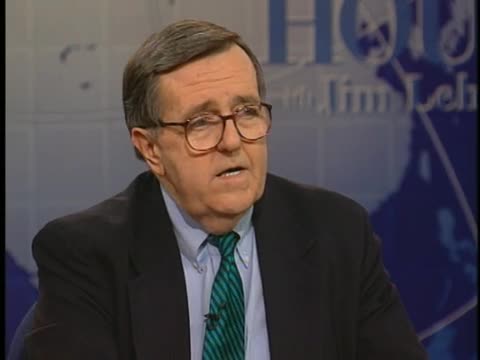
JIM LEHRER: Shields and Brooks, syndicated columnist Mark Shields, Weekly Standard editor David Brooks. Paul Gigot is on vacation.
First, Mark, do you see any sign that the leadership, the respective leaders of the Senate have worked out anything on power sharing or headed toward any kind of peaceful resolution?
MARK SHIELDS: Not really, Jim. The comments I had were from Don Nichols, the Republican deputy leader in the Senate who said that somebody has to drive the car, and that's why there ought to be a Republican chairman. I don't think you can argue with that quite frankly. But there had to be some compromise made on staff, that what most people don't know is the party that controls the majority in both Houses has always had a big edge, twice as many staff on the key committees. There is a parity on some of the minor committees. And that's what Democrats I think are going to fight for.
JIM LEHRER: And, of course - but Senator Daschle said on this program just this week is what he wants is 50-50 on committees and Senator Lott has said no way.
DAVID BROOKS: That's not going to happen. As Don Nichols probably knows, Aristotle said the problem with democracy is nobody is in charge. There's no one to hold responsible for, and that is what -- the argument the Republicans have been making. If anything, I see people laying down markers saying, you know, what is wrong with a little partisanship?
JIM LEHRER: Does this mean -- what does it mean? Is there going to be stalemate, is there going to be blood on the floor? Or are they going to say okay, great, fine -- we'll work it out and we'll move on?
MARK SHIELDS: Well, I mean, John McCain has already infuriated the chairman of the Senate Commerce Committee as folks are quick to remind you -- the most popular elected official in America according to public opinion data has said that he would be happy to go 50-50 and so has Ted Stevens, the chairman of the Senate Appropriations Committee. So there's some... there's not total unanimity in the Republican ranks on this either.
JIM LEHRER: All right. Let's go to the Bush cabinet choices: Ashcroft for attorney general -- a message is being sent. What is it, David?
DAVID BROOKS: Conservatives, we remember you. The conservatives were about to go down to Florida and demand a recount, get some of those dimpled chads for Gore because they were getting kind of upset, but they got a conservative. And Bush got a guy who is an executive. That's obviously extremely important for him, looking at somebody who can do something administratively. A lot is being made that the guy is very pro-life, quite conservative. But one of the other things that is striking about Ashcroft is he is incredibly morally earnest. I mean that as a compliment. It is going to make life difficult for the Bush administration because he is a bit aloof from people, very into his own conscious. And there will come times when it comes time to appoint a prosecutor, not an independent prosecutor like we have now because that is gone, but somebody to look into Bush scandals and he will actually be quite independent I think because of that incredible moral earnestness.
JIM LEHRER: Mark, what do you think?
MARK SHIELDS: It's an interesting choice, Jim. I mean, they say if you want to send a telegram, go to Western Union and Gary Bauer sent a message when he spoke for a lot of conservatives and said this is a bipartisan cabinet being assembled except for conservatives. And I think John Ashcroft more than exceeds theconservative standard. He briefly flirted with a campaign for President in 2000. And he had the initial support of the group that ended up supporting George W. Bush against John McCain. That was the Christian Coalition and a number of the religious conservatives. He was their first choice. It won't be total smooth sailing to confirmation.
JIM LEHRER: You think the Democrats will...on the pro-life issue?
MARK SHIELDS: No, I think the resistance will be on his... he spearheaded the opposition to the confirmation of a judge from.. an African American judge from the state of Missouri named Ronnie White. It became a pretty ugly battle in the Senate. And John Ashcroft carries some scars from that. But I think that by nominating John Ashcroft, and I still think the Justice Department is heart, soul, lungs and vital organs of any administration because you've got civil rights, you've got the environment, you've got criminal, you've got antitrust. I mean it's all there. I mean, Attorney General really sets the tone and the temper. But I would say this, in a strange way, it probably hurts the chances of Dan Coats, the conservative's choice to be Secretary of Defense because the conservative....
JIM LEHRER: They only get one slot.
MARK SHIELDS: But it certainly takes some of the urgency. If it had been John Danforth, for example, from Missouri, I think -
JIM LEHRER: Or Racicot from Montana.
MARK SHIELDS: Or Mark Racicot from Montana.
JIM LEHRER: Do you agree with that, David?
DAVID BROOKS: From what I hear Dan Coats is in trouble.
JIM LEHRER: What's the problem?
DAVID BROOKS: I think Bush wants -
JIM LEHRER: Make sure, he is the former Senator from Indiana. He has been out of the Senate now for. what, four years.
DAVID BROOKS: Very conservative.
JIM LEHRER: Very conservative. And he was the leading candidate to be secretary of defense. Everybody thought it was a done deal and then boom.
DAVID BROOKS: Apparently. He didn't have a great meeting with Bush. Bush likes junior achievement guys. I mean, look at who he's picking, people who can really run an organization. There is another person he's talked about, Paul Wolfowitz who runs CEISS -
JIM LEHRER: The Center for Strategic Studies of at John Hopkins. He was in the old Bush administration - the first Bush administration.
DAVID BROOKS: He was an ambassador and then defense - Bush -- his problem I think might be that he is incredibly smart. And other people in the foreign policy team don't want somebody so smart around the table, especially people who already have a lot of interest in the Pentagon, like Cheney and Colin Powell.
JIM LEHRER: Where is he going?
DAVID BROOKS: My guess would be another executive. Why should any corporate boardroom be left full of somebody? Bush has to get corporate boardroom people. One of the persons they're talking about is Donald Rumsfeld, who was secretary of defense.
JIM LEHRER: Had the job before.
DAVID BROOKS: And could come back.
JIM LEHRER: Do you have anything to add to that?
MARK SHIELDS: One of the complicating factors is Colin Powell, Jim. I mean, Colin Powell, unlike most Secretaries of Defense -- not only comes with a national constituency but comes with military credentials -- and there is a certain apprehension among other power centers or would-be power centers in the Bush administration-to-be that Colin Powell could become the 800-pound gorilla.
JIM LEHRER: What about the Vice President -- he's the former secretary of defense.
MARK SHIELDS: He's running the whole thing.
JIM LEHRER: That's another story.
MARK SHIELDS: They need a counter weight or at least some people who don't agree with Colin Powell need someone who is a formidable counter weight at the pentagon.
JIM LEHRER: Speaking of counter weight, where does Christi Whitman fit into this?
DAVID BROOKS: Sort of the poster person of liberal Republicanism - she will -
JIM LEHRER: Is she a real liberal Republican?
DAVID BROOKS: I think so, yeah. She's a Northeastern liberal Republican from an affluent family, she will keep the wilderness areas safe for steeplechase over at the EPA. You know, a few years ago....
JIM LEHRER: He said that, you didn't.
MARK SHIELDS: Beat me to it.
DAVID BROOKS: A couple of years ago... I try to get serious here. A couple years ago, people were talking about the southern captivity of the GOP, all these populists from Texas, but now we've got a President from Texas but the southern captivity sure is over. We've got Northeastern Republicans and we've got the corporate Republican wing, you know, the people who own the country are going to get to run it for four years.
JIM LEHRER: What do you make, Mark, of this flap over... well, the Clinton administration accused President-elect Bush of talking done the economy, talking about a recession, and a slowdown and all of that. And the President-elect came back and said hey, come on, I'm just talking straight and that's what you better get used to. What do you think?
MARK SHIELDS: Can I just say one thing on Christi Whitman?
JIM LEHRER: You may indeed.
MARK SHIELDS: The environment was the Achilles Heel of George W. Bush on the campaign. The Democrats used it against him in the Pacific Northwest and the upper Midwest. The fact under his second administration, Houston became the smoggiest city in the country. I think if you come from Midland, Odessa Texas where it isn't the end of the world but you can see it from there, I think it's fair to say, Jim -
JIM LEHRER: Watch it, Shields. (laughter among group)
MARK SHIELDS: I think it's fair to say that anybody who will rise from the hounds is seen as an environmentalist. You don't really think of New Jersey as being the mint standard for environmental protection. I think he bought - I think he bought what he perceived to be somebody, as David described, a as sort of a moderate Republican who is not stridently anti-business but certainly doesn't have the enmity of environmental groups.
JIM LEHRER: And now, as they say on television, now to my question.
MARK SHIELDS: Okay. I finally concluded what the Republican position is on Bill Clinton, and not Mr. Bush but the Republicans, the prosperity of the past eight years Bill Clinton had nothing to do with. But if there's any prospective economic adversity in the next four years under George W. Bush, it's all Bill Clinton's fault. I mean, this seems to be the position of Cheney and the President-elect at this point. The argument for a tax cut was that there was so much money in Washington that people had to get it back. Now it's a new argument, which is we have to have it to stimulate the economy which sounds a little Keynesian.
JIM LEHRER: David.
DAVID BROOKS: I'm not sure anybody is blaming Clinton for the recession. We had eight years of fantastic growth started by Ronald Reagan and George Bush the elder and that carried through, but now there are clear signs of recovery. And we're in this silly fighting war -- the Bush people talking this recession into being -- which is like watching two crows to talk about who caused the sun to set. The thing's happening, and the interesting thing is how it will affect our politics. It does give some reason to have a stimulating tax cut but it also is going to hit the surplus projections and it also really may upset some international economies. So one of the things -- that's really going to put tremendous pressure which we haven't had on the budget process and it's really going to cause a lot of the poor people in Congress on both sides of the isle to really have some problems.
JIM LEHRER: So we have may a big wave that says never mind in terms of the campaign. And then now have the new reality.
DAVID BROOKS: If all those surpluses go away, there will be still tremendous pressure for a tax cut.
MARK SHIELDS: I'd still point out....
JIM LEHRER: You have to do it next week.
MARK SHIELDS: Okay.
JIM LEHRER: Thank you though. Good-bye.
FOCUS - POWER CRISIS
JIM LEHRER: Now, power problems in California. Spencer Michels updates the situation.
SPENCER MICHELS: It may not look like it, but the lights could go out, at least temporarily, in California, and the prices for electricity could, and probably will, skyrocket. Several times in the past few weeks, state officials have called energy emergencies, indicating the supply of electricity was at dangerously low levels. Rolling blackouts are threatened, where one neighborhood gets no power for a few hours, and then another neighborhood is blacked out, because there isn't enough electricity to go around. Southern California Edison threatened to begin rationing electricity over the Christmas weekend. Utilities and consumer groups, at odds on most issues, agree the situation is a disaster.
NETTIE HOGE, Consumer Advocate: It's a financial tsunami. It has the capability of creating a deep recession for California.
SPOKESMAN: If you look at the potential impacts to California as a whole, to the economy in California or even the economy in the entire West Coast, it can be certainly viewed as a crisis.
SPENCER MICHELS: The crisis stems from the fact that California is not producing enough electricity to meet the demands of a fast- growing state at a time when other states, which sell to California, are using more power as well. Hydroelectric plants are running at full bore, drawing down water levels, which bodes ill for water supplies in the summer, when electricity demand increases. The shortage has been aggravated by the deregulation of electricity, which has unexpectedly reduced the supply. Four years ago, the state legislature told the investor-owned utilities, which were regulated monopolies, to sell off their power plants and stick to the distribution of electricity only. By opening up the generation of power to anyone, deregulation was designed to bring more companies into the electricity producing business, competing with each other, and resulting in more power and lower prices. State Senator Steve Peace was optimistic when he created the plan in 1996.
SEN. STEVE PEACE, Deregulation Author: California consumers can expect at the end of the four- year transition period, to have electric bills that are about half of what they are today.
SPENCER MICHELS: But competition has not developed, and the utilities no longer produce much power. As a result, desperate utilities are buying power, much of it from out of state, on the wholesale market at very high prices. And even then, they can't get all they need. In San Diego, electricity prices tripled last summer. In most other cities, protected during the transition by a price cap, rates will rise shortly. Pacific Gas & Electric, which serves much of Northern California, says it has borrowed $4.6 billion to buy electricity to meet the demand, but can't pass those costs on, because of the price freeze. PG&E Spokesman Jon Tremayne argues that the high prices are causing economic disruption.
JON TREMAYNE, Pacific Gas & Electric: We're paying 25 to 30 cents per kilowatt hour to purchase electricity on the wholesale market, and we're turning around and selling it to our customers for 5 cents per kilowatt hour. That's a scenario that can't go on for any length of time, logically speaking. We're currently borrowing money from the financial markets to pay our customers' bills so that we can keep the lights on here in California.
SPENCER MICHELS: PG&E, which serves 13 million Californians, wants to end the price freeze and raise rates. It has gone to the state public utilities commission seeking increases, hinting it will go bankrupt without quick help.
NETTIE HOGE: The utilities are pulling the wool over people's eyes and talking about this notion of bankruptcy. The parent companies are making astounding profits.
SPENCER MICHELS: Nettie Hoge, executive director of the Utility Reform Network, a consumer group, says on radio talk shows and in interviews that rate increases are not the answer to California's electricity woes. She says utilities are part of the problem, not the victims. And she says they are actually making money as a result of the crisis, because their parent corporations own power plants.
NETTIE HOGE: PG&E's parent corporation is making astounding profits, paying dividends, and in addition to that, the utility is making money in this market. They're selling their own generation and getting these astronomical prices.
SPENCER MICHELS: But at least one Wall Street firm takes the utilities' complaints at face value, and is warning it could downgrade their credit ratings to junk bond status. Many power producers have been silent on allegations they have exploited the market. But some, like Calpine, which has facilities in and outside California, say prices were fair, considering the circumstances.
JAMES MACIAS, Calpine Energy: The prices were high but they weren't they weren't excessive, and this economy can't sustain those prices. That's why we need new supplies, new competition to drive down those prices.
SPENCER MICHELS: PG&E would like to see the state force electricity producers to refund some of the money they've made. But high prices are only part of the problem. California has had a hard time buying enough electricity. The utilities claim the generators were withholding power from the market. State officials persuaded Secretary of Energy Bill Richardson to order producers to sell electricity to California, and federal agencies to provide emergency power.
BILL RICHARDSON, Energy Secretary: (December 14) I've also invoked my emergency authority to make sure the generators send all available power to California and not use excuses that the price isn't right or they don't have enough credit. I will not allow the people of California to be subject to blackouts and without lights.
SPENCER MICHELS: The threat of blackouts and the possibility of extremely high prices for electricity, have turned a major economic crisis into a political problem as well. Politicians, especially California's Governor, have been scrambling to find solutions. But deregulation has progressed to far to easily turn it back, and there doesn't seem to be a quick fix. California political analysts are writing that Governor Gray Davis' political future may ride on whether he can solve the electricity problem. The Governor signed a bill to put a cap on San Diego's rates, but he admits a long-term solution is difficult.
GOV. GRAY DAVIS, California: The challenging and somewhat frustrating problem is that we don't have all the power or authority necessary to solve the problem. The Federal Deregulation Act took a lot of it away from us. So I can't solve this problem with the help of the legislature alone. I need the help of the federal government.
SPENCER MICHELS: Davis and others lobbied the Federal Energy Regulatory commission, FERC, to put a cap on wholesale prices and to authorize refunds to San Diego. But FERC commissioners said they wanted to let the market set the prices.
CARL HEBERT, JR., Federal Energy Regulatory Commission: The solution to the suffering is to promote the evolution of truly competitive markets.
SPENCER MICHELS: Meanwhile, in California, where electricity demand is increasing as the weather gets colder, high-level talks between utilities and state officials took place this week over how much of a rate increase consumers will have to pay, and how soon the rate freeze will come off. Consumer groups are furious they were not included, since they believe they have some solutions.
NETTIE HOGE: We have to keep the utilities on the hook, and we have to look at more radical solutions, including public ownership of the transmission system, and central dispatch of power, and much, much more severe restrictions about manipulation of market power and gouging.
SPENCER MICHELS: Consumer groups also are pushing for more conservation of energy and more emphasis on wind, geothermal, and solar power, so-called renewable energy. The crisis was temporarily eased last week by the energy secretary's order. But this week supplies fell off once again. All sides point to increased power generation as the long- term solution. Only a few power plants are under construction, but applications to build two dozen more are pending.
JON TREMAYNE: California needs more generation, and what we need to do is just get through this transition period, this time in which the market's broken, it's out of control. We're waiting for a new generation to come on line, but over the course of the next two to three years, those power plants will get built, and they will start delivering electricity, and that will help alleviate much of the problem California currently faces.
SPENCER MICHELS: The organization that buys emergency power for California, says that the current crisis could last until 2002, which is when one consumer group intends to offer a ballot initiative to scrap deregulation.
JIM LEHRER: Yesterday, California's Public Utilities Commission indicated it would order electricity rates increased. The commission will study the utilities' books and decide on the size of the rate hike on January 4.
NEWSMAKER
JIM LEHRER: Finally tonight, paying the long-overdue bill from the United Nations, and to Terence Smith.
TERENCE SMITH: Negotiations have been going on for months over what share the US will pay for both regular UN operations and peacekeeping. A deal was finally worked out early this morning. The key US negotiator was Ambassador Richard Holbrooke, and he joins us now.
Ambassador, welcome.
RICHARD HOLBROOKE: Hi, Terry.
TERENCE SMITH: Of course, it's been years now that the United States has been in arrears to the United Nations. Explain to us the main points of this deal and whether it has a prospect of resolving those difficulties.
RICHARD HOLBROOKE: Well, it's awfully complicated. Let me try to be very succinct. There are two budgets involved here: The regular budget, which pays the UN administrative costs, and which is about $1.1 billion a year, of which have the US has been paying 25% since 1972. Prior to '72, we paid much more. But since 1972, we have paid 25%, and the peacekeeping budget, which goes up and down, depending on how many peacekeeping operations we have, it is a larger budget. And we have been paying about 31%. The Congress negotiated under the leadership of the Senate Foreign Relations Committee Chairman and ranking minority member Senator Helms and Senator Biden of Delaware, negotiated with the State Department, the so-called Helms-Biden provisions, which said we would pay our debt to the UN, or most of it, if we reached certain specific benchmarks or conditions. Those conditions... we met some of them last year and gave the UN back $100 million. The Congress left another $836 million in the kitty to be turned over to the UN in two sections -- $584 million this year... excuse me, $582 million this year and $244 million next year if we could meet some new conditions. The key condition was that we lower the amount of money the US pays in the regular budget from 25% to 22% and we lower the amount of money we pay in peacekeeping from 31% to 25%.
TERENCE SMITH: And have you met those goals?
RICHARD HOLBROOKE: I hope you're still with me. I hope we haven't lost all our viewers to some other program. The amount of money involved in the regular budget was only $34 million. And we did meet our goal. We were reduced from 25 to 22% early this morning after what really was a fantastic struggle. Now how will that extra $34 million be made up? Starting in 2002, the other member states will absorb it by redistribution. But during the transition year of 2001, a year in which most of the countries had already done their national budgets and they didn't know where the money could come from, we found an extraordinary solution. Ted Turner, the same one you're thinking of, Ted Turner of CNN, came up with an offer to us which he made to me in private six weeks ago, that he would put forward those $34 million personally, not out of his other UN Foundation money which he has already given the UN a billion dollars. This would be additional money. He would make it available one year only to ease the transition. Until early this morning, nobody knew Turner was the source of the $34 million, but we had put that offer into play and it did the trick. So on the regular budget, we are down to the 22% mandated by Helms-Biden. On the peacekeeping budget, we were asked to go from 31-25%. The numbers just weren't there, Terry. There was no way we could get down in one year. So we are going to get to about 27% next year, which is a tremendous step forward. Then we will go down progressively after that. So we fell a little bit short of the exact target is, but it's a tremendous step forward. And by the way, the first time in 27 years, that the budgets have been reformed.
TERENCE SMITH: Ambassador, what does it say to you that the United States, the nation's sole superpower, has to go to private funds to pay its bills to an organization like the UN?
RICHARD HOLBROOKE: A point of law first, Mr. Smith. We didn't go to them. It would have been illegal for us to solicit private funds. The genesis of this was that I was in a meeting with Ted Turner as I have been in hundreds of meetings, explaining the issue in detail. And Ted turned to me and Senator Tim Wirth was there with me in the room and various other people, and Ted Turner came to me and said you mean that no one can pick up the money for about a year because their budgets are locked in and it is only, "only" $34 million? I said that's right. Ted said on the spot let me make it up for one year but only if it's the money that makes the difference. What does it say? It says different things. It says that this is a great country where people can make great gestures. And this one is more than a normal bequest of a philanthropic nature. This is a highly leveraged, highly targeted, visionary gift and it will make a huge difference. I think we should all be grateful to Ted Turner. What does it say about the United States? The Congress asked us to go down -- the UN membership is willing to let us go down. But there was this one-year gap. And Ted Turner is going to make it up for one year. So I don't see... you're the third journalist this afternoon to ask me this question, but I guess I'm myopic because I don't quite see it that way.
TERENCE SMITH: Well, let me ask it this way. Does it not reflect a very deep-seeded skepticism on the part of the Congress, certainly about the United Nations and about paying its bills? Normally we would pay our bills through the government.
RICHARD HOLBROOKE: Well, it is a very unusual arrangement. I don't think there is any precedent at all. And by the way, a point of law, the money will be turned over to the State Department. Ted Turner and Madeleine Albright exchanged letters on this today. That money will be turned over to the UN. But let me get back to your point. The United Nations is an indispensable but deeply flawed organization. It is valuable to the United States, and the United States is invaluable to it. We need to reform it. What you're talking about now is just a tiny tip of the iceberg towards the reforms which are necessary. We've had other reforms; in the last week we have started to reform the peacekeeping office. So we don't have any more Sierra Leones and Rwandas and Bosnias. Yet, I am fearful there will be more anyway. The UN is still administratively not adequate. We need to strengthen the power of the Secretary-General, Kofi Annan, who is a wonderful leader for this organization, but does not have enough power. And by the way, I hope will he continue to serve when this term runs out, for another term. But there are so many things that need to be done, and I am delighted that as this administration comes to an end, we can present the incoming administration and the new Congress with a radically improved support of the UN, a significant improvement in US efforts, and an improved UN, but the job is far from finished. For example, the Information Office here has 800 people in it. There are 120 people in the library in this building from which I'm talking. This kind of stuff cannot go on. So I hope that the reform efforts that we pushed so hard with the support of the Senate and particularly Senators Helms and Biden will continue.
TERENCE SMITH: Have you had a chance to discuss this with the Bush administration, with the incoming secretary of state and are they on board?
RICHARD HOLBROOKE: Secretary-designate Powell and I have known each other a long time and I greatly admire him. I think he is going to be a great secretary of state. He and I have had two long talks about this, one late last night. Madeleine Albright has also talked to him. He was well aware of what was going on, was very supportive. And I look forward to speaking to him in person now that this sleepless in Manhattan ordeal is coming to an end.
TERENCE SMITH: All right. Well, it's a major Christmas gift for the United States, for the UN. Thank you very much.
RICHARD HOLBROOKE: Thank you, Terry.
RECAP
JIM LEHRER: Again, the other major stories of this Friday: President-elect Bush nominated outgoing Missouri Senator John Ashcroft to be attorney general, and New Jersey Governor Christie Whitman to head the Environmental Protection Agency. And President Clinton pardoned Dan Rostenkowski, the former House Ways and Means Chairman; he pleaded guilty to mail fraud in 1996. We'll see you online, and again here Monday evening. Have a nice holiday weekend. I'm Jim Lehrer. Thank you and good night.
- Series
- The NewsHour with Jim Lehrer
- Producing Organization
- NewsHour Productions
- Contributing Organization
- NewsHour Productions (Washington, District of Columbia)
- AAPB ID
- cpb-aacip/507-jh3cz32x2d
If you have more information about this item than what is given here, or if you have concerns about this record, we want to know! Contact us, indicating the AAPB ID (cpb-aacip/507-jh3cz32x2d).
- Description
- Episode Description
- This episode's headline: Class of 2001; Bush Selects; Political Wrap; Newsmaker. ANCHOR: JIM LEHRER; GUESTS: SEN.-ELECT GEORGE ALLEN, (R) Virginia; SEN.-ELECT DEBBIE STABENOW, (D) Michigan; SEN. ELECT JOHN ENSIGN, (R) Nevada; SEN.-ELECT MARIA CANTWELL, (D) Washington; RICHARD HOLBROOKE; CORRESPONDENTS: FRED DE SAM LAZARO; BETTY ANN BOWSER; SUSAN DENTZER; RAY SUAREZ; SPENCER MICHELS; MARGARET WARNER; GWEN IFILL; TERENCE SMITH; KWAME HOLMAN
- Date
- 2000-12-22
- Asset type
- Episode
- Rights
- Copyright NewsHour Productions, LLC. Licensed under a Creative Commons Attribution-NonCommercial-NoDerivatives 4.0 International Public License (https://creativecommons.org/licenses/by-nc-nd/4.0/legalcode)
- Media type
- Moving Image
- Duration
- 00:58:41
- Credits
-
-
Producing Organization: NewsHour Productions
- AAPB Contributor Holdings
-
NewsHour Productions
Identifier: NH-6925 (NH Show Code)
Format: Betacam
Generation: Preservation
Duration: 01:00:00;00
If you have a copy of this asset and would like us to add it to our catalog, please contact us.
- Citations
- Chicago: “The NewsHour with Jim Lehrer,” 2000-12-22, NewsHour Productions, American Archive of Public Broadcasting (GBH and the Library of Congress), Boston, MA and Washington, DC, accessed April 2, 2026, http://americanarchive.org/catalog/cpb-aacip-507-jh3cz32x2d.
- MLA: “The NewsHour with Jim Lehrer.” 2000-12-22. NewsHour Productions, American Archive of Public Broadcasting (GBH and the Library of Congress), Boston, MA and Washington, DC. Web. April 2, 2026. <http://americanarchive.org/catalog/cpb-aacip-507-jh3cz32x2d>.
- APA: The NewsHour with Jim Lehrer. Boston, MA: NewsHour Productions, American Archive of Public Broadcasting (GBH and the Library of Congress), Boston, MA and Washington, DC. Retrieved from http://americanarchive.org/catalog/cpb-aacip-507-jh3cz32x2d