The NewsHour with Jim Lehrer
- Transcript
JIM LEHRER: Good evening. I'm Jim Lehrer. On the NewsHour tonight, Ray Suarez talks with the head of Ford Motor Company about the decision to bring Ford employees into cyberspace; Elizabeth Brackett reports on the governor of Illinois' decision to halt executions; Paul Gigot and Tom Oliphant analyze the busy week of presidential politics; Elizabeth Farnsworth discusses Jack Dempsey and boxing with Roger Kahn; and essayist Anne Taylor Fleming contemplates America and the world. It all follows our summary of the news this Friday.
NEWS SUMMARY
JIM LEHRER: Investigators today located parts of the tail section from Alaska Airlines Flight 261. They said one of the pieces is the horizontal stabilizer. The pilots were having were having problems with that device before they lost control of the plan. The jetliner crashed Monday off the South of Southern California killing all 88 people onboard. Overseas today, a new coalition government took power in Austria. It included the far-right Freedom Party, despite criticism abroad and in Austria itself. We have this report from Bill Neely of Independent Television News.
BILL NEELY: This is the new Austria. And this is the reaction to its new government -- the paving stones outside the president's office hurled at riot police, hand-to-hand fighting, injuries, and arrests. Nearby, for the first time in Europe since the 1930's, an extreme right-wing party took power, led by Jeorg Heider, a man with a Nazi background. Austria was a country known for its stability and order and is tonight in a state of upheaval, where the unthinkable has become reality. A clearly unhappy Austrian president on the left swore in a party, which now dominates the government. He said he was dismayed at today's turmoil and at the international isolation Austria now faces. Jeorg Heider isn't in the government but he's pulling the strings; a man who once praised Hitler's policies and the SS, whose parents were nazis, who lives on an estate confiscated from Jews. (Crowd chanting) They call Heider a fascist. Three out of four people in Austria didn't vote for him, but he's the country's new power broker.
WOMAN IN CROWD: We're desperate. We don't want a brown government. We hate it.
GIRL IN CROWD: He's racist. He is not Democratic, that's all.
BILL NEELY: There were tears today. Austria is being diplomatically isolated by the rest of the European Union.
JIM LEHRER: The United States temporarily recalled its ambassador from Austria. And Secretary of State Albright said Washington would limit its future contacts with the new government. She spoke in Washington.
MADELEINE ALBRIGHT: We are deeply concerned about the Freedom Party's entry into the Austrian government. There is clearly no place inside the governments who make up the Euro Atlantic community in a healthy democracy for a party that does not clearly distance itself from the atrocities of the Nazi era and the politics of hate.
JIM LEHRER: Britain moved ahead with plans to strip Northern Ireland's new government of its power. A bill was introduced in parliament to take that step unless the Irish Republican Army promises to decommission its weapons. The IRA's political allies condemned the move, but British Prime Minister Blair said the issue cannot be ignored.
TONY BLAIR: We just got to work at it very hard, as we always try to do. But it is a serious moment, it's a critical moment because this issue of decommissioning has just got to be confronted and resolved. So everyone knows where they stand. And that's what we need to do now. Let us hope that that is so. But we can't any longer have uncertainty.
JIM LEHRER: In Washington, President Clinton called on all sides to honor the Northern Ireland peace accord. Another huge telecommunications merger took shape today. The board of a Germany company, Mannesmann, approved a buyout offer from Britain's Vodafone Airtouch. Together they'd be the world's largest wireless provider. The deal is worth $180 billion, topping the America On-Line Time Warner merger as the biggest ever. U.S. Unemployment fell to a 30- year low last month. The Labor Department said today the rate was 4% in January. That was better than December's 4.1%, and the lowest since January 1970. The economy created nearly 390,000 new jobs, far more than expected. Delta Airlines said today it's offering home computers with discount Internet access to its 72,000 employees. Ford Motor Company announced a similar offer yesterday for its 350,000 workers. We'll talk with the president of Ford about it right after this News Summary. Gary Bauer dropped out of the Republican presidential race today. He finished last in the New Hampshire primary, but he said his stands against abortion and gay rights influenced other candidates. He spoke at a Washington news conference.
GARY BAUER: Sometimes in the debates, you know, I found -- I heard my words even when my lips weren't moving. So I think my message was catching on and has caught on with the other candidates. I think we've moved this debate a great deal. That's not why I was in it. I was in it to get the nomination of the Republican Party because I believe and continue to believe I can most effectively make my own message and deliver my own message. It just didn't work.
JIM LEHRER: Bauer did not endorse any of the four remaining republican candidates. That's it for the News Summary tonight. Now it's on to Ford's computers, capitol punishment in Illinois, Gigot and Oliphant, boxing and Jack Dempsey, and an Anne Taylor Fleming essay.
FORD - BRIDGING THE DIGITAL DIVIDE
JIM LEHRER: Ray Suarez has the Ford story.
RAY SUAREZ: The old economy has taken another big step into the new economy. Yesterday the Ford Motor Company announced it will provide a personal home computer and Internet access to each of its 370,000 employees worldwide. Here to explain is Ford's President and CEO Jack Nasser. Well, let's talk a little bit about what exactly you're offering. Any employee who want a personal computer can get one?
JAC NASSER: Ray, it is about providing computers. But the essential part of this program is really about developing personal skills and making sure that every one of our employees is connected to the marketplace and that we're at the leading edge of technology throughout the company. At this stage, we have more workstations within the Ford Motor Company than any other company in the world. And, of course, we're very connected with our suppliers and our dealers and the marketplace. And we felt to complete the circle of an integrated Internet strategy, we needed to go that one step further and make sure that our people at all levels in the company are connected with technology, are aware of the capabilities of the Internet and it also of course enhances the communication channels throughout this company around the world.
RAY SUAREZ: You mentioned those workstations in your plants. I'm sure the workers who have to use them were taught how. A more conventional model might be to just offer a wider training program, make sure that those who want to learn can learn but not go that extra mile and start giving out hundreds of thousands of computers. Why did you choose this approach?
JAC NASSER: We wanted to make sure that the computers and the capability that they offer were available to people at any time that they wished to use them. So it isn't only at your workstation. But if you needed to communicate while you were at home, if you wanted the family to participate in that development of your own skill, you could do that. If you wanted to communicate across the global operations of Ford, you had the access basically anywhere, any time that was convenient for the employees. And we felt this is really pushing the automotive industry into the 21st century and we wanted to take the lead.
RAY SUAREZ: What's the up side for ford of such a no-strings policy? Some of those computers are going to go home and stay in the box, some of them are going to be playing computer games with ten and 11-year-olds. Your employee might not be looking at it very much. There's really no way to know what happens once it leaves your place.
JAC NASSER: That's true. But on the other hand, we want to make sure the tools are there. And we will provide the training. We'll make sure the capabilities are well understood. And we feel that if we can mobilize the hearts and minds and the technical capability of 370,000 people around the world, then that has a power that is very difficult to match.
RAY SUAREZ: Some estimates have placed the price tag on this program as high as $170 million, $175 million. I'm sure you're going to want to know whether you're getting your money's worth down the road. What are the kinds of things you'll be watching to see if the program has taken hold among your workers?
JAC NASSER: Ray, interesting enough, I think the program is worth considerably more than the investment numbers that were quoted. But we managed to put together a very innovative and I'd say novel business structure together with our partners. And over the life of the program, which is a three-year program, the cost to the Ford Motor Company is quite nominal. We think the benefits are going to be a better educated workforce, a workforce that is very technology literate. We'll be able to attract better people ongoing, and we'll be able to keep the communication links very well lubricated throughout the company.
RAY SUAREZ: Are there things that are in the works at Ford that you're going to need more computer-able people to be able to pull off, in parts supply, in just-in-time delivery, in making sure that if a consumer wants a red car that he's not going to have to wait a month to get one?
JAC NASSER: When you see some of the recent initiatives that we've announced, partnerships with Oracle, partnerships with Microsoft, they're all aimed at making the supply chain more efficient, and allowing to us connect to consumers in the marketplace much more directly. The good example is the joint venture between Ford and Microsoft called Car Point, which is an Internet capability for purchasing vehicles. And that will come in over several stages this year. And the ultimate objective is that consumers will be able to choose the vehicle of their choice, personal customization of their vehicle through the Internet.
RAY SUAREZ: I can't imagine that your dealer network is very happy about that prospect.
JAC NASSER: Oh, I think the dealers are very happy because all of this extra business will actually go through Ford Motor Company dealers, and they will be able to reduce their capital requirements, reduce their overhead costs and be able to please customers because they will order the vehicles that customers really want, not those vehicles that just happen to be in the lot at that particular point in time.
RAY SUAREZ: And this is a program that you'll be monitoring what, for two or three or five years? How will you be able to check whether it's really working?
JAC NASSER: It's a three-year program. And we think at the end of the three-year period we'll probably go on to something else. And during this three-year period, we'll monitor how satisfied our employees are, whether they think it's useful. We'll look at the business results and we'll see what progress we're making in terms of our Internet strategy. And we'll see whether communication and efficiency has improved over that period also.
RAY SUAREZ: Well, the funny thing about three years in the world of these machines that we're talking about is it's more outdated than any automobile is after three years. The things are moving so quickly in the world of personal computers.
JAC NASSER: That's true. The hardware, I think, tends to have a longer life than much of the software. And we'll have the capability of upgrading as we go along.
RAY SUAREZ: One of the interesting aspects of all of this is that I guess five, certainly ten years ago, this would have been a bank breaker. The powerful kind of computer that you're offering to your employees would have cost almost half the price of a car not too long ago. But memory has gotten a lot cheaper, the microprocessors have gotten a lot cheaper very, very quickly. And now suddenly this looks like an economical play for you.
JAC NASSER: I think several things have happened, Ray. First of all, the computers themselves are obviously a lot cheaper as volume increases. But also the services that are available are a lot broader and a lot more relevant to industry and technology, and their value has improved considerably over that period as well. So you're right when you introduced it as a subject of the last century's economy merging into the next century's economy. And Ford Motor Company wants to take a leading role in that because we view the automotive industry as a leading indicator of the application of usable technology.
RAY SUAREZ: But there's something that's a little counterintuitive about this as far as this is something that's big, expensive. I mean, a car is a big thing. It's not like a diskette that you can slip in your pocket. It is the epitome of the old manufacturing and distribution system in this country. It doesn't easily fall into the slipstream of what we're thinking of as this new economy.
JAC NASSER: Well, I don't agree with that because the automotive industry is an industry that catches all of the technologies that are leading edge. Whether you're talking about exotic material science or polymer technology, environmental research, safety research, crash, power train research, whatever you're talking about in terms of leading technology, whether you're looking at marketing, finance, all of it is involved in the production, design and distribution of the car and truck. And I think what we have in the automotive industry is a magic mix of all of these leading-edge technologies, plus the specialized skills of mass production, manufacturing and engineering. So it's very complex. And I think it mates itself very, very well with the Internet strategies that we're developing.
RAY SUAREZ: Well, today Delta got into the game as well, announcing that its 72,000 employees would be able to get a free PC.. Do you expect to see a lot of this?
JAC NASSER: I think every company has to decide for itself. But I think there's going to be a considerable amount of pressure to continue to upgrade the skills of all employees in all industries, to give our employees the tools that they need to be able to do the best that they possibly can. And I think technology is going to run across industries and the service economy at a very fast rate. So those companies that are thinking ahead, those companies that are connected with the Internet, those are companies that understand the power that the Internet gives the consumer and also the supply chain, then they'll be at the leading edge. And we want to be right there with them.
RAY SUAREZ: Ford Motor Company's chief executive Jac Nasser. Good to talk to you.
JAC NASSER: Thank you.
FOCUS - SUSPENDING EXECUTIONS
JIM LEHRER: Executions in Illinois: Elizabeth Brackett of WTTW-Chicago has our report.
ELIZABETH BRACKETT: The work is hard but, Gary Gaugher appreciates life on a small organic farm about two hours north of Chicago. Seven years ago Gaugher's life was in the balance. He was convicted and sentenced to death sentence for the brutal murders of his parents in 1993.
GARY GAUGHER: I was prepared to die. If they were going to take this absurdity to its conclusion, there was nothing I could do about it. Of course I was prepared to die. They lock you up, you go from room to room, you do what they tell you, and eventually they lead you down the hall, strap you to a gurney and kill you.
ELIZABETH BRACKETT: Any you were innocent?
GARY GAUGHER: I was innocent, and I knew it and everybody who knew me knew it.
ELIZABETH BRACKETT: Gaugher lived with his parents at their farm when they were killed. He found their bodies, called police, and after a long night of questioning was charged with their deaths. He says he never confessed, but police said he knew details of the murders only the killer would know.
GARY GAUGHER: The best reason I can think of that police did this was for pure selfish ambition. They all received promotions very soon after my trial.
ELIZABETH BRACKETT: His wife and family remained supportive. And one year later courts ruled that Gaugher's confession had been illegally obtained, and prosecutors dropped the death penalty request. Three years later Gaugher was released and got back to his farm. Two members of the Wisconsin Outlaws Motorcycle Gang have now been indicted and are awaiting trial for the murder of his parents. Gaugher is one of 13 Illinois men whose death sentences have been overturned since the death penalty was reinstated in Illinois in 1977. The reversals prompted Illinois Governor George Ryan to act.
GOV. GEORGE RYAN, Illinois: I now favor a moratorium, because I have grave concerns about our state's shameful record of convicting innocent people and putting them on Death Row. I can't support a system which, in its administration, has proven to be so fraught with error and has come so close to the ultimate nightmare, the state's taking of innocent life.
ELIZABETH BRACKETT: Governor Ryan was careful to say he still supports the death penalty. But those who don't, like Northwestern University Journalism Professor David Protess, saw the governor's moratorium as the first step in abolishing capital punishment.
DAVID PROTESS, Northwestern University: I think it's very significant, not only because its the first state in the country to declare a moratorium on executions, but because the man who declared it is a Republican governor who is pro death. And therefore he has taken a bold action that I think sends a signal throughout the country and I think may well affect the presidential campaign since he is the campaign chairman for George W. Bush in Illinois.
ELIZABETH BRACKETT: In 12 of the 13 Death Row cases in Illinois, new evidence of the condemned men's innocence was brought to the attention of the court, not from within the system, but by outsiders, private investigators, law students, and even undergraduate journalism students. Anthony Porter was only two days away from execution when David Protess' undergraduate journalism students unearthed evidence that led to the real killer. Porter was released for a joyful reunion with his defenders.
ANTHONY PORTER: Thank God everything happened. All glory goes to God.
ELIZABETH BRACKETT: How had the students done it?
DAVID PROTESS: The reason my students were able to do this when the prosecutors did not is because the police started with the assumption that Anthony Porter was guilty and tried to build a case around him. They railroaded him. We started with no assumption at all. We started with an objective view of this. We didn't know if he was guilty or innocent. Our goal was to search for the truth. And if the police had done that here an innocent man wouldn't have spent 16 years on Death Row.
ELIZABETH BRACKETT: Shawn Armbrust was one of the students who worked on the porter case. After graduation she joined the Center on Wrongful Convictions to continue to work with Protess and others on Death Row cases. She sees the Porter case as a wake-up call.
SHAWN ARBRUST, Center for Wrongful Convictions: I think it was really important, first of all, because Anthony was going to be executed and he was innocent -- and second of all because I think the fact that it was a bunch of 21-year-old kids basically skipping class to unearth new evidence was really sobering to a lot of people. I think it clued a lot of people in that the justice system really is broken.
ELIZABETH BRACKETT: An earlier class of Protess's students and pro bono lawyers helped find the DNA evidence that exoneratedDennis Williams in 1996. Williams thanked that class, but after 18 years on Death Row he couldn't mask his anger.
DENNIS WILLIAMS: If I were to describe my bitterness or anger, I don't think I could give a description to it, you know, but it's here. It exists.
ELIZABETH BRACKETT: But there are others, like Donald Mikesh, who are very angry about the governor's moratorium. His 27-year-old son left two young daughters when he was brutally murdered in 1996. Donald Mikesh, Jr. had returned home after nine years in the military, and had just purchased a new condominium where he and two friends were beaten and stabbed to death by two men and a woman. Mikesh was stabbed 41 times, his head cracked open with an iron pipe. Prosecutors asked for the death penalty, but one juror refused, and all were given life sentences. It wasn't enough for Mikesh.
DONALD MIKESH: They were such brutal savages that they should not be breathing this air on earth. It's not only because of my son. I'll walk with other family members that I just met, and I still believe their offenders that are under the death penalty should get it also.
ELIZABETH BRACKETT: Though he didn't like the result, Mikesh thought his son's murderers got a fair trial.
DONALD MIKESH: They had 14 jurors-- 12 and two alternates-- and they all come out with the same end result that they were guilty. So everything was presented to them -- all the evidence, all the technicians and everything that came in there -- caught red-handed, saturated with blood and admitting to the guilt of what they had done.
ELIZABETH BRACKETT: But a "Chicago Tribune" investigation last November found that nearly half of the Death Row cases in Illinois were so rife with errors they were reversed on appeal. In 33 Death Row cases, the defendants attorneys had been disbarred or suspended. Rita Fry heads the Cook County Public Defenders Office. She agrees that inexperienced defense attorneys are a serious problem.
RITA FRY, Cook County Public Defender: It is a nationwide problem. It is not just an Illinois problem. It's nationwide. I mean, there have been cases where real estate lawyers have been appointed to represent people who have no concept. I mean they've done a death penalty case in two days. I mean, that's ridiculous.
ELIZABETH BRACKETT: Cook County's top prosecutor, Richard Devine, is so concerned about errors he called for a review of all Cook County cases on Death Row, and decided, even before the governors moratorium, not to ask for any execution dates until the review is complete.
RICHARD DEVINE, Cook County State's Attorney: We have to have a process that guarantees that we don't charge and convict the wrong people. I fully believe in that; we're not doing anything for that victim or for the community if we don't have a system that has the highest standards to make sure that we get the right person.
ELIZABETH BRACKETT: Both Fry and Devine support the establishment of a trial bar with specific experience and training qualifications for defense attorneys and prosecutors who try capital cases. But Protess says even that won't fix the system.
DAVID PROTESS: I think it's broken probably in an overriding sense in that it's run by human beings who are fallible. And when it comes to the death penalty, we expect infallibility.
DONALD MIKESH: I didn't see any mistakes being made, and it was all humans doing the presenting. And I didn't see any mistakes whatsoever. People have got to realize don't come in there and be Mr. Do-gooder and stop a death and save a life. Get in there and see. What about the victims life? Where are their voices being heard?
ELIZABETH BRACKETT: Since 1976 when the Supreme Court ruled that states could reinstate the death penalty, 85 men and women who once faced the death chamber have had their cases overturned. And ten of the 38 states with a death penalty are now considering moratoriums.
JIM LEHRER: Still to come on the NewsHour tonight: Gigot and Oliphant, the Jack Dempsey story, and an Anne Taylor Fleming essay.
FOCUS - POLITICAL WRAP
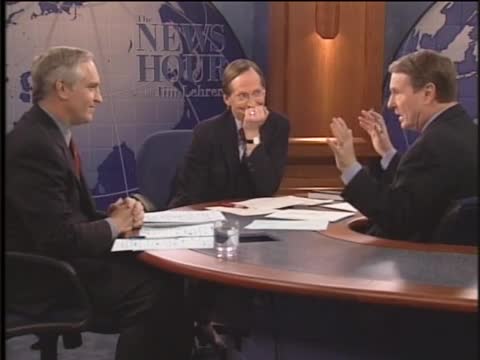
JIM LEHRER: And to our Friday night political analysis with "Wall Street Journal" columnist Paul Gigot, and "Boston Globe" columnist Tom Oliphant, substituting for Mark Shields.
Tom, the poll surge by John McCain in South Carolina, how do you read his going from here -- going up 20 points just in a few days just since New Hampshire?
TOM OLIPHANT: Well, after a political earthquake, I think you can expect a political tidal wave. This is as big a one as I've seen since Gary Hart 16 years ago in the Democratic presidential primaries. The thing that was most interesting about this surge for Senator McCain, it came in a poll that was taken by John Zogby, who has a very good reputation these days. The poll found -
JIM LEHRER: He does them for Reuters.
TOM OLIPHANT: Yes, indeed. In this case he found not only some indication of the surge in interest in the race among people who think of themselves as independents, even some who think of themselves as Democrats, what made the Zogby poll a threat to Bush was that he found a willingness to consider John McCain among normal Republicans, including born-again Christians. The result was to transform the landscape overnight from something that had been presumed to be a firewall to something that is now an even-up contest that's anyone is capable of wining.
JIM LEHRER: Do you read it the same way, Paul?
PAUL GIGOT: Yeah. Absolutely. It's a contest. All along, one of George Bush's big strengths was that he was ahead in the polls because he was ahead of the polls. He was inevitable. Everybody said he was inevitable. Why? Because he could win in November. Why? Because everybody said he could win in November. When you lose so decisively in a state like New Hampshire, everybody r everybody sudden says, and Republicans who want to win in November suddenly say, well, if he can't take on John McCain, Al Gore, that terminator over there who's taking apart Bill Bradley, could do something like that to George W. Bush. It gives everyone a second look at the race. I think that's what's happening in South Carolina. The other thing about South Carolina is this is the first time that South Carolina is really going to have a hotly contested primary. I mean, when Pat Buchanan was going against Bob Dole in 1996, Buchanan had nothing in the state. He had him and his PR guy.
JIM LEHRER: He had the same situation. Buchanan had done well in New Hampshire, not as well as McCain. But he had done well and he was to be stopped in South Carolina.
PAUL GIGOT: He had no money. He was eating off nuts and berries. He's trying to call up radio stations. It wasn't a campaign. It was just Pat on a -- doing what Pat does. This is a real threat and a real fight. I think you're going to see South Carolina voters really interested in this because it's going to go down to the wire.
TOM OLIPHANT: Though there are obstacles to it. This is a primary that occurs on a Saturday. Unlike New Hampshire, South Carolina doesn't have much of a tradition of voting. I think the turnout four years ago was not really very much higher than in New Hampshire, a much smaller state. But I don't think there's any question that Bush is going to respond to this by going at McCain as hard as he can. It's not going to be pretty from here on in.
JIM LEHRER: Well, we'll get to that in a minute. But what about McCain? McCain said today that something magic going on. He was talking about the poll, talking about 2,000 people at this huge rally that showed up in Myrtle Beach today. Is something magic going on?
PAUL GIGOT: I think he's captured the public mood, the mood of the country, at least of the Republican and Independent electorate of the country. They do after seven years of Clinton want somebody they can admire in the White House. They want somebody they can look up to and tell your children, that's the kind of life I want you to lead. And he's setting that kind of example. People have been looking for that. And there is some magic with that. And he's captured something that none of the other candidates so far with all their ideas and their agendas and their plans have captured.
JIM LEHRER: Okay. What does George W. Bush do about this?
TOM OLIPHANT: Pick up a two by four and hit him first on one side of the head and then the other. It may start this weekend.
JIM LEHRER: You mean from the left and then from the right?
TOM OLIPHANT: Exactly.
JIM LEHRER: You mean that symbolically?
TOM OLIPHANT: Absolutely. And any other direction he can think of. The initial strategy we understand tonight because they've put out the text of a television ad that's begun running is to go right at him negatively.
JIM LEHRER: Read a couple of those --
TOM OLIPHANT: Like all attack ads these days, it begins with injured innocents -- things McCain has been saying are not true and then it gets to the point - and it's on taxes -- first of all, smaller than Clinton's. That's as bad as it can get among Republicans.
JIM LEHRER: The accusation being that McCain's tax proposal is smaller than Clinton.
TOM OLIPHANT: And then, secondly, even worse is that he echoes the views of the dreaded Washington Democrats. And for Bush to do this --
JIM LEHRER: And then he adds a line about conservatives, right?
TOM OLIPHANT: That we need a conservative leader to challenge what he's done. So, you put all that together. And compared to what's been going on in this campaign up until now, that's a frontal assault right at John McCain, to which, by the way, he'll have to respond quickly and effectively in order to maintain his position in South Carolina.
PAUL GIGOT: If that's a negative attack, man, we have entered the Marquis of Queensbury's Rules - I mean - campaign -- this is something George Bush should have done two weeks ago in New Hampshire. Because John McCain was running an ad that said "George Bush wants to cut your taxes and he doesn't want to do a thing about Social Security." That's flat not true. Bush does take a lot of money from the payroll tax and devotes it to Social Security. Bush left that McCain ad unanswered and he left it too long unanswered in South Carolina and McCain defined the tax issue in a way that neutralized it. If Bush can't turn that around in South Carolina, he's going to lose.
TOM OLIPHANT: It does set the stage for an interesting debate again on the Republican side on how to use the non-Social Security surplus. McCain would put most of it also into Social Security. Bush would not. There is both a political and substantive debate here waiting to happen.
JIM LEHRER: All right. Now, there's another development regarding the Republicans. That is the New York ballot decision, Bush and Governor Pataki backed off, McCain will now be on all the ballot in all districts, in all ballots in the March 7th, New York primary. What happened there, Paul?
PAUL GIGOT: First of all, it's about time. I mean, New York's Republican Party is in many ways old Tammany Hall Democratic politics; it is designed for the front-runner, designed to protect the favorite. It's been used against candidates for years. Steve Forbes suffered from it in 1996 against Bob Dole and McCain was going to take it this time. But McCain had a couple of assets. One, Steve Forbes had fought a court fight in 1996 which loosened it somewhat. And McCain was following that up with his own court challenge, which he was likely to win. The second thing he had, and this is where the media support for John McCain comes in because he had a media echo chamber that was beating this like a drum and turning around to George W. Bush and saying, "aren't you playing unfairly?" The fact is he was. This was an affront to democracy and McCain deserves to be able to get on the ballot.
TOM OLIPHANT: Interesting view of the Bush campaign as this lumbering battleship that is very slow to turn. A week ago, Jim, a federal judge in New York essentially signaled --
JIM LEHRER: He said he was going to get McCain --
TOM OLIPHANT: Beginning a week ago the bush campaign had the option of taking that towel, throwing it into the middle of the ring and maybe getting some credit.
JIM LEHRER: Before New Hampshire.
TOM OLIPHANT: That's right. And before it looked like they were being forced to. But by dragging it out six days, they gave McCain a bonanza of free publicity in New York that you could not buy for $5 million.
JIM LEHRER: And he's still got the issue, doesn't he?
TOM OLIPHANT: Right through to the primary.
JIM LEHRER: What did Pataki and his folks think they were going to do?
PAUL GIGOT: They were going to rig it so they could deliver the state for George W. Bush.
JIM LEHRER: And he thought nobody was going to notice?
PAUL GIGOT: There's precedent here. In 1996 the only people that noticed that I remember were the "Wall Street Journal" editorial page. We kept running editorials saying, this is an outrage. Al D'Amato is sewing it for his pal. Nobody paid attention This time McCain had the "New York Times," he has every columnist -
JIM LEHRER: The "Times" was on this every day editorially.
PAUL GIGOT: Sure. McCain is their guy now.
TOM OLIPHANT: With the same fervor that the "Wall Street Journal" showed for Steve Forbes indicating that perhaps it was a matter of whose ox was being gored.
PAUL GIGOT: It deserves to be opened up for whatever challenger.
JIM LEHRER: All right. Now, Gary Bauer dropped out today. What memories does he leave behind, Tom?
TOM OLIPHANT: I'll tell you. Some real passion on a subject that still divides Republicans, you'll see it in Congress all this year, even if it's no longer reflected in the presidential campaign. And that is that the increasingly close economic relationship with China is at the express expense of basic American values and even national security interests. Other than Pat Buchanan, I can't think of somebody who brought more passion to that point of view and it's gone. But there are still Republicans who think he's right. And secondly, you get this somewhat with Alan Keyes, but not with the kind of policy-grounded fervor you got from Gary Bauer, that if your right to life as a matter of conviction, you have to be right to life and you have to stop fudging. And that clarity, again, is reflected in all kinds of Republicans who continue to believe that way but may not have anybody to speak for them as the election starts to be directed toward the center.
JIM LEHRER: Toward the middle. How do you see Gary Bauer?
PAUL GIGOT: He made a contribution on the anti-abortion movement. He brought a civility, even an eloquence to the argument, framing it in terms of Lincoln and bringing everybody to the table. I think he did a service to his cause there. The passion that Tom sees on China I don't think was there. I think he made a colossal blunder to make China trade his signature issue. He spent budget deficit 400,000 in the last week in Iowa on TV and radio ads to try to make that an issue.
JIM LEHRER: It just doesn't resonate.
PAUL GIGOT: He said in his defense if I hadn't been talking about it, nobody would. Yes, that's right. Nobody cared. And I think with that failure has probably done more to guarantee the World Trade Organization - China's entry into it passes this year - than anything -- all the TV ads that Boeing and everybody else could run.
JIM LEHRER: Finally, before we go, the Democratic race, Gore, Bradley, how does it look at the end of this New Hampshire week?
TOM OLIPHANT: Coming out of something as enormous as this McCain earthquake, the real question was whether one or both of the Democratic candidates could be heard over the din. Obviously Bill Bradley has the greater need to be heard. And my sense throughout the week that was he was not able to come up with something that provided a message over this noise. So in a sense, ever since Tuesday night, it's as if McCain -- it just didn't happen for him.
PAUL GIGOT: Page a-21, "New York times" I think. That's where Bradley is now relegated, at least until this McCain wave crashes. That's not good news for the Bradley campaign.
JIM LEHRER: We got e-mail from viewers from people say, you folks, meaning people like us, need to be reminded it was Al Gore who won the Democratic race in New Hampshire and all the talk was about Bradley. Did we, I don't mean "we," the three of us - but the big we, overstate what Bradley did in New Hampshire?
PAUL GIGOT: Well, no, I don't think so. I mean, Bradley did catch up, but he probably -- but in the comparison with McCain, his victory was so large and it changed that race so much that Bradley is having so much of the oxygen and the energy sucked out of that that he doesn't have the same lan, the excitement on the Democratic side. And he does need that excitement, as Tom says, to overcome Gore's significant advantage. But we both said that Gore is the front runner for sure --
JIM LEHRER: But a lot of people thought, tom, that McCain's storm would help Bradley because, oh, my goodness this is the year of the insurgence and this would help him. The last few days it has not.
TOM OLIPHANT: I don't think the system has room for more than one insurgent. And in a sense in New Hampshire, McCain could be said to have beaten Bradley just to an extent Gore beat Bush.
JIM LEHRER: A Democrat looking for a choice that doesn't --
TOM OLIPHANT: Not yet. He has to provide that reason and then he has to do it in such a way that he can be heard. Just hasn't done it yet.
JIM LEHRER: Okay. Still plenty of time. Thank you both very much.
CONVERSATION
JIM LEHRER: Now, another of our conversations with authors of recent books. Tonight, a sports legend, and to Elizabeth Farnsworth.
ELIZABETH FARNSWORTH: The new book is "A Flame of Pure Fire," and it tells the rags-to-riches story of prize fighter jack Dempsey and his era, the Roaring 20's. Dempsey was heavyweight champion of the world for seven years, from 1919, when he defeated Jess Willard in Toledo, Ohio, until 1926, when Gene Tunney took the title in Philadelphia in a match fought in the rain. The next year Dempsey lost to Tunney again in a fight sports enthusiasts still argue about. Roger Kahn wrote the new Dempsey biography. He's the author of 16 books, including "Boys of Summer," a portrait of the Brooklyn Dodgers. Thanks for being with us. What drew you to Dempsey, Mr. Kahn? Why Dempsey?
ROGER KAHN, Author, "A flame of Pure Fire": Well, I met Dempsey when I was a young journalist, and I met Dempsey under unusual circumstances. He had a restaurant on Broadway long after he'd ceased fighting, and I would go up there from time to time to ask him about boxing. He was very generous, and would give me his views and give me his thoughts, and after a long discussion one day, he said, "you know, I'd really like to get my story set down right. Would you be interested?" And I said, "yes, I would, champ." And he said, "well, there's another writer I have to talk to first, because he's a little older than you, and I promised him first crack. But if he doesn't want to do it, maybe you'll do it for me." And I said, "who's the other writer, champ?" He said one word: "Hemingway."
ELIZABETH FARNSWORTH: (Laughs) You write that at his peak, he was the greatest fighter that ever lived. Why? What do you think made him so great?
ROGER KAHN: Well, when you see Dempsey fight, you see somebody coming out of the mining camps, out of the tremendously rough America at the turn of the century in the Rocky Mountains, where he would walk 30 miles through the desert to pick up a five-dollar purse. He said, that five-dollar purse meant I could maybe get a hot meal. He always fought that way, he always fought like somebody with the hounds of hunger and poverty at his heels. And aside from the technical gifts of his boxing, which were very profound, this was somebody the writers called a cougar or a wolf or a tiger or a cyclone, there was such intensity in his boxing, and the answer was... His thought was, "I have to get you quick 'cause otherwise you might get me."
ELIZABETH FARNSWORTH: And you came up against that ferocity once when you said something to him about how a fight maybe should be fought, right? Read to us from that part of your book.
ROGER KAHN: Well, there was a fighter named Ingemar Johansen who had been fairly impressive, with a big right hand, and I went up to see Dempsey to ask how he would fight Johansen if indeed there was such a match. And Dempsey said, "well, let me ask you something, son. How would you fight Johansen?" And I said, "I'd crowd him." And Dempsey said, "why would you do that? "I'd stay inside his big right hand." And Dempsey said, "okay, show me." "And I've done it now," I thought, "first I tell Dempsey how to fight, now I've got to spar with him. But he's always been a genial sort, at least to me. After these years, he's probably harmless." He was 65. "I want you to crowd me," Dempsey said, "and then I'm going to show you my old one- two." I looked at him. Quite suddenly, Dempsey was considering me with no geniality at all. His eyes were pitiless. It was as if he neither knew nor cared who I was. The knuckles on his fists looked like an eagle's talons. As ordered, I moved in. The fastest left-hand punch I ever saw creased the right side of my face. A right I never saw cracked into my mid-section. I spun back and lowered my hands. Dempsey drove an even harder left along my jaw. "One-two," I said, "one-two-- that's three." "Keep your guard up at all times," Dempsey said in a cold, flat voice. Then it was over. He put his own hands down, the menace fled from his face, he patted my back. "Pal, you deserve a drink. This is my place, so I'll be buying." And for the next three hours, until the dinner customers came in, Dempsey told me stories from the saga, the epic poem that was his life.
ELIZABETH FARNSWORTH: Hmm. The book is about that epic poem. It's also about the era in which he lived, and it's really about the beginning of sports as big business. You see our time of very big business sports as going back pretty much to him, don't you? Why? How did he start big-money sports?
ROGER KAHN: Well, when Dempsey began, when he fought for the championship, there were less, fewer than 20,000 people in Toledo, Ohio, watching him. When he was fighting at the end of his championship career there were crowds of 130,000 in Philadelphia, 110,000 or so in Chicago to watch him fight Gene Tunney. And there were suddenly not million-dollar gates, there were two-million-dollar gates. And boxing became a social event. People like John D. Rockefeller went to see it, Al Jolson, George M. Cohan, Franklin Delano Roosevelt. Dempsey made millions and millions of dollars, far, far more than Babe Ruth. He became, for a time, Jack Dempsey, Inc., the richest athlete of his time. With Dempsey, there was suddenly an awareness: Sports is not only sports; sports is a big-money business. And I think we see that every day today.
ELIZABETH FARNSWORTH: And yet he became famous partly because of the great writing about him. Your book is about the sportswriters, too. There was just... There was some great writing about Jack Dempsey. You quote much of it in the book.
ROGER KAHN: Well, it was a flowering. People talk about an Elizabethan England, the flowering around Shakespeare. There was a flowering after World War I of American sports writing. Heyward Broun, Ring Lardner, Damon Runyon, Grantland Rice. Grantland Rice would do a poem before a Dempsey fight. He'd said, "when Homer smote his loom and lyre--" people then knew that homer was not a long ball, but was a Greek epic poet. Ring Lardner assumed the persona, the American rube. Dempsey was going to fight Willard in Toledo, and he wrote something, "The Toledo blues: I do not care whether Dempsey win or lose 'cause I got them there Toledo blues." Damon Runyon... (Laughter) Damon Runyon, of course, was in "Guys and Dolls." It was just such an amazing flowering, and even H.L. Mencken, the dour sage of Baltimore, covered a big Dempsey fight, Dempsey-Carpentier. It was a terrific fight. Mencken did not do much of the story because seated two rows behind Dempsey was a young lady... Two rows behind Mencken was a young lady in a tight pink dress, and instead of watching the fight, H.L. Mencken, the great H.L. Mencken watched the lady in the tight pink dress.
ELIZABETH FARNSWORTH: Tell us just briefly about that second fight with Tunney, the long count that people still talk about. You believe Dempsey should've regained the title that night.
ROGER KAHN: I did. In the very early fights, Dempsey would hit his opponent from behind, the way he had in the bar fights, in the fights in the saloons of the old West. So now the rule was changed, that when somebody was down, you had to go to a neutral corner to give the man a chance to rise. In the great second Tunney fight, there was tremendous betting action, Al Capone being on the side of Dempsey and a crowd from Philadelphia being on Tunney's side, and there was much maneuvering with thereferee. In the seventh round, Dempsey knocked Tunney down. Referee would not start the count until Dempsey went to a neutral corner, and maybe Tunney had 18 seconds to get up. A round later, Tunney hit a quick right hand into Dempsey's jaw. Dempsey was off balance, he went down, and the referee sprang over Dempsey-- there's a picture of it in the book-- and the referee said, "One..." He did not say to Tunney, "Go to a neutral corner." The long count is famous as an American miscall. The short count, the following round says, at least to me, that here was a referee in the pay of gamblers, here was a crooked referee.
ELIZABETH FARNSWORTH: Hmm. And just briefly in the time we have left, what happened to Dempsey after the fighting stopped? He actually lived... He lived to be 88, didn't he, and he had a very full life, and he also gave money to poor fighters.
ROGER KAHN: He lost $3 million in the 1929 crash. He lost his beautiful movie star wife. He began to referee fights, he fought exhibitions, he started a restaurant in New York. Any broken-down fighter-- and boy, their name is legion-- went into that restaurant and said "I'm in trouble champ" would get a $100, $200, $500. He became just an enormous figure helping indigent fighters. And at the age of 80, he was still riding his bicycle through Central Park. People say, "well, wasn't he afraid to be mugged?" Nobody mugged jack Dempsey.
ELIZABETH FARNSWORTH: Roger Kahn, thanks for being with us.
ROGER KAHN: My pleasure, Elizabeth.
ESSAY - WE ARE THE WORLD
JIM LEHRER: Finally tonight, essayist Anne Taylor Fleming considers the world America lives in. (Chanting)
ANNE TAYLOR FLEMING: What a joy it was to see the world on New Year's Day. It was hard not to be enraptured as some invisible curtains seemed to be pulled back from the globe, time zone at a time, East to West, while everyone in turn paused before the momentousness of the dawning of the first day of the first year of the first decade of the first century of the brand new millennium. From shanghai to Red Square, to a thronged beach in Rio, the world's citizens were out in force. Who will ever forget Paris, or Nelson Mandela lighting a candle in the prison cell where he spent almost two decades? Unless there's some sort of major upheaval or tragedy somewhere, a massive mud slide or avalanche, we don't see much of the world. We certainly don't see it doing a normal, celebratory thing, don't take its measure country by country, people by people. It's ironic. We think we're overdosed with news and images, and in a way that's true. We do live in a 24-hour-a-day drumbeat of information. But most of that, when you think about it, is about us Americans- - a crisis here, a shooting there, a crime drop everywhere. Of the three main TV networks, two only got really rolling when News Year's crept up on the East Coast of the United States-- Times Square specifically. It was as if they were saying, "forget the world. America is what matters. That's all people want to see." It's a strange contradiction. The world has shrunk in many ways, due to the media, access to travel, the Internet, the global economy, all of that. But at the same time America, while has been enjoying its solo superpower status, it has in effect narrowed its vision. We don't see much foreign news on television, or read much about it in the newspapers and newsmagazines. And what news we do see, be it from Russia or Africa or the Middle East, is almost always refracted through an American lens: "How will it effect us, will we have to get involved? We will have to send money or troops? Will this or that uprising or problem affect our well being, our economic boom? Will it jeopardize our markets, our ability to place products, make a buck?" In short, while expanding our markets, we've contracted our view of the world. America triumphant is America myopic, a global Goliath. That myopia has cost us before. Out of ignorance of other people and other places, we have sometimes misread international situations. We have jumped too fast too often, listening too rarely to others-- arguably in Vietnam or more recently, Somalia-- or too slow when faced, for example, with the rise of European fascism, or more recently, Balkan ethnic cleansing. And now we can hear, if we listen, the growing rumbles of resentment about our world dominance and the attitude that comes with it from small countries in Asia; from Europe, France in particular; from Seattle, where the city and country were caught surprised by the agitators at the world trade organization meeting. But will we listen? Will we hear? Will we see?
NELSON MANDELA: I hand this flame of freedom to you.
ANNE TAYLOR FLEMING: What we did see, the millions of us who did turn in on News Year's Day, was not some techno millennial glitch, but a whole world doing a dance in both local and universal vernacular, a pointed if celebratory reminder that America is not the only kid on this miraculous planet, and that the American way is not the only way, and that in the days and years ahead, we had best remember as much. I'm Anne Taylor Fleming.
RECAP
JIM LEHRER: Again, the major stories of this Friday: Investigators said they had found parts of the tail section from Alaska Airlines Flight 261. And a new coalition including a far-right party took power in Austria, despite U.S. and European objections. An editor's note before we go: Last night a guest said the March 7 California primary was an open one; independents could vote in either party's primary. Well, technically, that's true, but only the votes cast by registered Democrats and Republicans will count towards delegate selection in their respective parties. We'll see you on-line, and again here Monday evening. Have a nice weekend. I'm Jim Lehrer. Thank you and good night.
- Series
- The NewsHour with Jim Lehrer
- Producing Organization
- NewsHour Productions
- Contributing Organization
- NewsHour Productions (Washington, District of Columbia)
- AAPB ID
- cpb-aacip/507-jh3cz32w6c
If you have more information about this item than what is given here, or if you have concerns about this record, we want to know! Contact us, indicating the AAPB ID (cpb-aacip/507-jh3cz32w6c).
- Description
- Episode Description
- This episode's headline: Bridging the Digital Divide; Suspending Executions; Political Wrap; Conversation; We Are the World. ANCHOR: JIM LEHRER; GUESTS: JAC NASSER, CEO, Ford Motor Company; PAUL GIGOT, Wall Street Journal; MARK SHIELDS, Syndicated Columnist; ROGER KAHN, Author; CORRESPONDENTS: TERENCE SMITH; BETTY ANN BOWSER; RAY SUAREZ; MARGARET WARNER; GWEN IFILL; TERENCE SMITH; KWAME HOLMAN; ANNE TAYLOR FLEMING
- Date
- 2000-02-04
- Asset type
- Episode
- Topics
- Social Issues
- Global Affairs
- Race and Ethnicity
- Employment
- Transportation
- Politics and Government
- Rights
- Copyright NewsHour Productions, LLC. Licensed under a Creative Commons Attribution-NonCommercial-NoDerivatives 4.0 International Public License (https://creativecommons.org/licenses/by-nc-nd/4.0/legalcode)
- Media type
- Moving Image
- Duration
- 01:04:12
- Credits
-
-
Producing Organization:
NewsHour Productions
- AAPB Contributor Holdings
-
NewsHour Productions
Identifier: NH-6657 (NH Show Code)
Format: Betacam
Generation: Preservation
Duration: 01:00:00;00
If you have a copy of this asset and would like us to add it to our catalog, please contact us.
- Citations
- Chicago: “The NewsHour with Jim Lehrer,” 2000-02-04, NewsHour Productions, American Archive of Public Broadcasting (GBH and the Library of Congress), Boston, MA and Washington, DC, accessed May 13, 2026, http://americanarchive.org/catalog/cpb-aacip-507-jh3cz32w6c.
- MLA: “The NewsHour with Jim Lehrer.” 2000-02-04. NewsHour Productions, American Archive of Public Broadcasting (GBH and the Library of Congress), Boston, MA and Washington, DC. Web. May 13, 2026. <http://americanarchive.org/catalog/cpb-aacip-507-jh3cz32w6c>.
- APA: The NewsHour with Jim Lehrer. Boston, MA: NewsHour Productions, American Archive of Public Broadcasting (GBH and the Library of Congress), Boston, MA and Washington, DC. Retrieved from http://americanarchive.org/catalog/cpb-aacip-507-jh3cz32w6c