The MacNeil/Lehrer NewsHour
- Transcript
MR. LEHRER: Good evening. Leading the news this Wednesday, inflation jumped last month to its highest rate in two years, President Bush began his five day trip to the Far East and the Senate Armed Services Committee appeared seriously divided over the Tower nomination. We'll have the details in our News Summary in a moment. Robin.
MR. MacNeil: After the News Summary, we have three views from Senate Armed Services Committee members who will vote tomorrow on the Tower nomination, Senators Alan Dixon, John McCain, and Tim Wirth. Next, excerpts from today's testimony by Energy Secretary- Designate Admiral James Watkins on the nuclear plant cleanup. We have a documentary report from Texas on the new immigration rules for refugees seeking political asylum, then a News Maker Interview with U.S. Attorney Andrew Maloney on the mammoth drug bust in New York, and we close with a Penny Stallings essay on rock'n roll and the Grammies. NEWS SUMMARY
MR. LEHRER: The nation's inflation rate has taken a leap upward. The Consumer Price Index jumped .6 percent last month, the Labor Department reported today. That is the largest monthly increase in two years and would mean a 7.2 annual increase it sustained for the entire year. The 1988 inflation rate was 4.4 percent. The government announcement said higher prices for gasoline, poultry, fish, eggs and tobacco were primarily responsible for the January increase. Robin.
MR. MacNeil: George Bush set out on his first overseas trip as President today, a five day mission to the Far East principally for the funeral of Japanese Emperor Hirohito. The President and Mrs. Bush left Washington before dawn on the first leg of a trip that will take him to China for a weekend visit and briefly to South Korea. At a refueling stop at Anchorage, Alaska, the President described his trip to Japan as a measure of our respect for a valued ally and fellow democracy. In Tokyo, security measures were intensified after police found two projectiles on launchers aimed at the runway of an airport where dignitaries have been arriving for the funeral. We have a report by Jeremy Thompson of Independent Television News in Tokyo.
JEREMY THOMPSON: Tokyo is like a city under martial law, locked in a 10 million pound security operation. Thirty- two thousand police have been drafted in to guard over the biggest international gathering Japan has ever hosted. With hundreds of foreign dignitaries arriving, Japan is obsessed by the threat of terrorism. Ultra left groups who oppose the emperor system claim they'll disrupt the grand funeral. Seventy radicals have already been arrested but the fanatics said that won't stop them. In 1986, one guerrilla group tried unsuccessfully to attack the Tokyo summit with homemade mortars. At their fortresslike headquarters in North Tokyo, the same revolutionary faction told me they had plans to destroy the funeral with rockets. Now they had better weapons. Their spokesman said foreign leaders might die in the attack. The discovery of two homemade grenades and launchers near Tokyo Airport has intensified concern over the safety of world leaders and royalty now being ferried into Tokyo for the state occasion.
MR. MacNeil: Japanese officials said all international mail and cargo will be subjected to increased security checks and delivery and pickup delayed for several days.
MR. LEHRER: There may be a vote tomorrow on John Tower. The Senate Armed Services Committee appeared badly split on whether the former Texas Senator should be confirmed as Secretary of Defense. Most Republicans on the committee said their reading of the most recent FBI report led them to conclude there was no reason to vote against Tower. Democrats reading the same report said there remained substantial questions about Tower. The committee met in closed session this afternoon and will do so again tomorrow before deciding whether to go ahead with a vote. After today's meeting, Committee Chairman Democrat Sam Nunn and the ranking Republican, John Warner, spoke to reporters.
SEN. JOHN WARNER, [R] Virginia: I have reviewed this material very carefully, each increment that has come in, including the most recent, and it would be my judgment, I'm speaking solely for myself, that reasonable men and women can look at those stated facts and have credible differences of opinion. And beyond that, I will not comment on any specifics but to say that in my judgment there could be reasonable and honest, credible differences of opinion with respect to some facts.
SEN. SAM NUNN, [D] Georgia: There are continuing concerns that I think I have and I'm sure that other members have. There will be differing interpretations by different Senators as to the facts that have come forth in the FBI report and how to weigh those facts.
REPORTER: But, Senator, President Bush said that all of those concerns were resolved by the FBI report.
SEN. SAM NUNN: Well, that's the President's opinion and I'm sure that he has thought about that carefully. That is not my opinion.
MR. MacNeil: James Watkins, the Bush choice as Energy Secretary, told Congress today that his first priority would be to change the way the troubled nuclear weapons plants are run. At his Senate confirmation hearings, the retired Admiral was sharply critical of the way things had been run. Watkins said, problems relating to safety, health and the environment have not only been backlogged to intolerable levels, but, in effect, hidden from public view until recently.
MR. LEHRER:The jury in the Oliver North trial heard its first witness today. He was Congressman Lee Hamilton, Chairman of the House Intelligence Committee. A prosecution witness, he said North lied to him in 1985. Hamilton said the former White House aide denied he was involved in giving military support to the Nicaraguan contras. One of the main felony charges against North is obstruction of a Congressional inquiry into his activities.
MR. MacNeil: Several hundred American writers demonstrated outside the Iranian United Nations Mission in New York to protest against Iranian calls for the murder of British writer Salman Rushdie. In heavy rain, the members of the National Writers Union paraded outside and tried unsuccessfully to deliver a letter of outrage at the Ayatollah Khomeini's reaction to Rushdie's novel, "The Satanic Verses". The writers also marched on the Fifth Avenue stores of Barnes & Noble, and B. Dalton, two national book chains which have pulled the novel from their shelves. Later, several leading U.S. authors publicly read passages from the novel and some offered their criticisms of the Ayatollah's threat.
NORMAN MAILER, Author: But now the Ayatollah Khomeini has offered us an opportunity to regain our frail religion which happens to be faith in the power of words and our willingness to suffer for them. He awakens us to the great rage we feel when our liberty to say what we wish, wise or foolish, kind or cruel, well advised or ill advised, is endangered. We discover that, yes, maybe we are willing to suffer for our idea. Maybe we're even willing ultimately to die for the idea that serious literature in a world of dwindling certainties and choked epitologies is the absolute we must defend.
MR. MacNeil: The Ayatollah lashed out today against the West's reaction to his death threat against Salman Rushdie. He said the criticism of his execution order proves that opening Iranian contacts to the rest of the world was wrong. He said, "As long as I am here, I will not let the government fall into the hands of liberals.".
MR. LEHRER: Former Ku Klux Klan Leader David Duke was sworn in today as a Republican member of the Louisiana legislature. There were two attempts made to prevent his taking the oath as a state representative. Both had to do with his technical credentials, one through a court, the other with a House resolution; both failed. Duke won the seat in a special election Saturday in a suburban New Orleans district.
MR. MacNeil: The Supreme Court today ruled on a child abuse case in which a four year old boy was beaten so badly by his father that he suffered brain damage. A suit was filed against the county workers assigned to the case. The suit charged that the social workers had evidence that the boy was being beaten and, therefore, were required to come to his rescue. The Court ruled in a 6 to 3 vote that the social workers could not be held accountable, that the state does not have to protect people, even abused children, unless they're in the state's custody.
MR. LEHRER: An argument over treating breast cancer patients erupted today in a medical journal. At issue is the National Cancer Institute's recommendation last year that all early breast cancer victims be given chemotherapy in addition to surgery and any other treatments. Today in the New England Journal of Medicine studies were cited that showed chemotherapy made no significant difference in the death rate and that 80 percent of women getting it were still free of the disease after four years compared to 72 percent of those who didn't. Critics said the $338million cost of the additional treatment was not justified by such small results.
MR. MacNeil: In Cairo today, Soviet Foreign Minister Eduard Shevardnadze had talks with his Israeli counterpart Moshe Arens. Later, Shevardnadze met PLO Leader Yasser Arafat. We have a report from Louise Bates of Worldwide Television News.
LOUISE BATES: The Soviet embassy in Cairo was the venue for the historic meeting during the first trip to the Middle East by a Soviet foreign minister for nearly 15 years. Shevardnadze was seeking Aron's support for an international Middle East peace conference involving all parties to the Arab/Israeli conflict. The meeting reflects the Soviets' desire to play a key role in the region. The foreign ministers emerged after nearly three hours of talks. Shevardnadze said the meeting had been frank and honest and while they did not produce any breakthroughs, they were a step forward. Both agreed to discuss their differences at another meeting, and there were indications that diplomatic ties severed nearly 22 years ago could be restored. Hours later, another historic meeting for the Soviet minister as Palestinian Liberation Organization Chairman Yasser Arafat arrived at the Soviet embassy. It had been carefully planned so he wouldn't cross paths with Israel's foreign minister. The PLO Chairman was greeted by Shevardnadze on the embassy steps. It was a warm welcome in this leg of the Soviet shuttle diplomacy. The purpose of the meeting was to thrash out a PLO role in any international conference on peace in the Middle East, a seemingly impossible task as long as Israel refuses to talk to the PLO.
MR. MacNeil: That's it for the News Summary. Still ahead, more questions about John Tower, the Bush choice for Energy Secretary, new rules for political refugees, the biggest drug bust, and rock'n roll's enduring sound. FOCUS - LINGERING DOUBTS
MR. LEHRER: Judgment day may have finally arrived for John Tower. Tomorrow the Senate Armed Services Committee is expected to vote on his nomination for Secretary of Defense. It has been 10 weeks since President Bush announced the Tower choice, 10 weeks of news and FBI reports about the former Texas Senator's drinking and sex habits, as well as his financial dealings since leaving the U.S. Senate. Members of the Senate Armed Services Committee met this afternoon behind closed doors to go over the latest and presumably final FBI report. Three of those Senators are with us now from the studio on Capitol Hill. They are Republican John McCain of Arizona and Democrats Alan Dixon of Illinois, Tim Wirth of Colorado. Sen. Dixon, first, is there going to be a vote tomorrow? Is that now set?
SEN. ALAN DIXON, [D] Illinois: I think it's pretty much of a certainty that there definitely will be a vote tomorrow. Some of us had felt that there were other things that we'd like to look at, but I think everyone is now resolved that we should vote tomorrow.
MR. LEHRER: Is that your reading of it too, Sen. McCain?
SEN. JOHN McCAIN, [R] Arizona: Yes, it is, Jim, and I think it's important that we move ahead with the process. We know that the budget, defense budget, has got to be worked on, we've got to move forward with the appointees in the Defense Department and basically from a national security standpoint, we can't afford to delay much longer. It's been 10 weeks now, as you mentioned.
MR. LEHRER: All right. Sen. Wirth, Sen. Nunn, the Chairman of your committee, came out a short while ago and told reporters that he still had some questions about the Tower nomination. Where do you standat this point, after this final report?
SEN. TIMOTHY WIRTH, [D] Colorado: Well, I agree with Sen. Nunn. I think there are a great number of questions. The statements that have been made that all of the allegations have been shot down simply aren't true. As Sen. Warner also said, there are a lot of different ways of reading the report, but I remain with a lot of doubts about this. I think there is a lot of history in that report that's very troubling.
MR. LEHRER: Troubling enough to deny him the confirmation as Secretary of Defense?
SEN. WIRTH: Well, we're all moving right to all of the final information coming in in the meeting tomorrow and I hope that we have a vote at that point, but, you know, I'm extremely skeptical. It's very troubling to me all of the allegations that are made, the perception of him as a Secretary of Defense and what that means to a lot of the people in the military and so on.
MR. LEHRER: What, Sen. Wirth, are the most troubling aspects of this to you?
SEN. WIRTH: Well, first of all, the history of drinking is a problem for me. This is a man who's going to very close to -- he's right in the chain of command, can move troops and so on, and I think that that raises questions. Second, I'm concerned about the charges related to womanizing. People can do what they want to do obviously in their private lives, but in the military we've made it a very very clear policy that the country is going to integrate women completely into the military, that women are going to be treated as individuals and not as objects at all. And I think that we want to adhere to that policy very closely and the example set at the top should be one that pervades the whole of the military. We can't be a little bit like the Congress saying to everybody else in the country, you all take a cut in programs, we're going to ask for a pay raise. You know, it's got to go all the way across-the-board.
MR. LEHRER: Sen. McCain, where do you stand tonight as far as your judgment on the fitness of Sen. Tower to be Secretary of Defense?
SEN. JOHN McCAIN, [R] Arizona: Well, my judgment, first of all, Jim, is that John Tower's case is vivid affirmation of Harry Truman's statement about if you want to have a friend in Washington, go buy a dog. For 24 years, he was a member of the Senate. He was also chairman of the committee on which the three of us reside. There were never any of these allegations. In fact, in my recollection, he was very highly regarded up to this point. I notice that my friend from Colorado has not stated any specifics. There is a cloud, a veritable blizzard of allegations, and I will admit that some of these allegations are open to interpretation as my two colleagues may do so, but in my view, there is not any substantive evidence that would indicate John Tower cannot serve capably as Secretary of Defense.
MR. LEHRER: So when Sen. Wirth says he's concerned particularly about the drinking and the womanizing, you do not share those concerns?
SEN. McCAIN: No, and I think there has to be some concrete evidence which I would hope that my friend could cite of cases and examples at the proper time that would indicate that John Tower was somehow impaired. Lots of people use alcohol. I have not seen any evidence that John Tower has abused alcohol, nor has he disqualified himself.
MR. LEHRER: Sen. Dixon, do you agree with Sen. Warner and also Sen. Wirth has said the same thing, Sen. McCain has not, but that the information that has been made available to the committee is subject to different interpretations?
SEN. ALAN DIXON,[D] Illinois: Well, there's no question it's subject to different interpretations, but, Jim, let me say when the White House suggests that there's nothing of a very recent origin to concern us, that is not correct. There is considerable evidence in this latest FBI accumulation that has been added to the file in the last 10 days that would cause one to have some concerns, and we've discussed specifically in the committee today as well the concerns I've expressed in the committee and the concern Sen. Levin of Michigan has expressed in the committee, about $3/4 million that the Senator earned since leaving the Senate which is not very well documented, and the documentation that we now have that we talked about in the committee today I would have to say is relatively sparse. Now I'm not going to make up my mind about what I'm going to do until tomorrow afternoon. I'm going to meet with staff both from the Armed Services Committee in my own office tomorrow to evaluate everything once again, but I think it's certainly true that one has to ponder the accumulated evidence that has now resulted in a file about that thick.
MR. LEHRER: Are you less concerned than Sen. Wirth is about the drinking and the womanizing charges?
SEN. DIXON: Well, I would have to say that it's my impression that the womanizing charge is, on the basis of all the evidence I've seen, it's pretty much hearsay and innuendo, with all due respect to what other interpretations others would have, as a trial lawyer, I'd say that. The drinking, I think it's fairly clear that up to recent dates contrary to what has been speculated upon in the committee and other place, and I think the testimony of the Senator, himself, there's more than a little white wine involved here, on a current basis. Now I don't mean to imply by that that I would set a standard on this man different than we would set on society as a whole, but for the administration, for instance, to suggest that there is nothing since the '70s that's occurred that would cause one some alarm, I don't believe that's a fair interpretation of what this Senator has seen in the FBI file as recently as yesterday and today.
MR. LEHRER: Sen. McCain, do you read the report the same way on drinking, recent drinking?
SEN. McCAIN: Obviously I do not. At the same time I understand where there may be varying interpretations put on these allegations. Frankly, it's very disturbing to me to see person unknowns who refuse to identify themselves, who make anonymous charges, who are not even identified as he or she, who allege certain incidents of which there is no corroborating evidence. That's where, in my view, there is some difference of opinion here.
SEN. DIXON: I would agree with that point, may I say, but I would also add, John, that there are also names that have accumulated of quite a number of people in recent times other than T-1, No. 13, he/she.
SEN. McCAIN: And may I also say there are many many names in that file of people who have known him all his life who strongly insist that they've never seen any misbehavior.
MR. LEHRER: You challenged Sen. Wirth a moment ago, Sen. McCain, to be specific. Sen. Wirth, is there a specific that supports your concerns at this point, or is it the whole stack?
SEN. WIRTH: Well, it's both. I mean, I think leadership is in part perceptions. We learned that under Ronald Reagan. It doesn't have to be the reality of the program. It's the perception of the reality and the perception I think is pretty lousy of this whole package. Specifically, yes, there are a number of very very specific instances cited in the FBI report and a number of those coming from specific individuals who are named and identified to suggest that there are not specifics and there is not I don't think a correct reading of the report to suggest as the White House has done that all of these allegations is simply untrue.
MR. LEHRER: Can you give us one specific that you would cite to Sen. McCain because he says there aren't any and you say there are, so why don't you clear it up? Give us one.
SEN. WIRTH: Well, let me just, I would refer to Sen. McCain to read Page 77 of the last section of the FBI report. I think that's as close as we ought to come at this particular point without violating what's in the specifics of the FBI report.
MR. LEHRER: Do you know what's -- Sen. McCain, do you know what's on Page 77?
SEN. McCAIN: I certainly didn't memorize the pages, Jim, but I have read the entire report. I'm sorry I can't recall what was on Page 77.
MR. LEHRER: Can you give him another clue, Sen. Wirth, seriously, so that he knows what you're referring to?
SEN. WIRTH: Well, there are just a number of instances, and I do not think that it is appropriate for us to get into specifics in the report. The White House has taken some of the absurd allegations and pointed out that those are simply untrue. And that, it seems to me, is a way of manipulating what's in the report in a very inappropriate fashion. I don't think any of us should be picking out specifics in the report. I've read the report, Alan's read the report, I think, I hope all of the members of the committee have read the report and have had the opportunity to digest that and come in and vote tomorrow.
MR. LEHRER: Sen. McCain, let me ask you this question. Are Senators, would you hear what Senators Wirth and Dixon are saying tonight, are they speaking in your opinion as partisan Democrats, or are they speaking as honest brokers trying to resolve an issue as United States Senators?
SEN. McCAIN: I think they are attempting to do the best job they can in ascertaining whether John Tower is qualified to be Secretary of Defense, and I think it would be a terrible thing for me or anyone else to accuse them of any base motives, including the chairman of the committee.
MR. LEHRER: So you agree with Sen. Warner that honest people could disagree over what's involved here?
SEN. McCAIN: Yes, they could, but don't forget that if there is a loss of power in the executive branch, that power is taken up by the legislative branch, and I would also like to point out if I could that there has been rumor and innuendo rampant, even things such as something that was printed in the Style section of the Post was run on one of the major networks. There has been, on both sides of this issue there has been a great deal of exaggeration and hyperbole which has prevented the American people I think from adequately judging this issue.
MR. LEHRER: All right. I wanted to ask about that, because the President mentioned this yesterday as well. Who's been doing this? Has it been the Wirths and the Dixons and the Nunns on the Democratic side in the Senate, or has it been -- who's behind these rumors?
SEN. McCAIN: Jim, I think it's endemic in this town. There's no such thing as a secret meeting. There's no such thing as a secret document. I'd like to have a lot of prescriptions as to what to do about it, but it's a way of life.
SEN. WIRTH: Jim, I think it's fair to say that this has been handled I think very very well and in a very nonpartisan fashion by Sen. Warner, the ranking Republican, and Sen. Nunn, the Chairman. I think all of us have extraordinary respect with the care in which they've done it and are attempting not to have any partisan claimers on this. I don't think there are. In the confirmation proceeding, I think we should also point out that President's appointees have been confirmed 100 to nothing, 99 to nothing in the United States Senate. This is not something that is partisan in nature at all. Some of us are just deeply concerned.
MR. LEHRER: Sen. Dixon, let me ask you the question. Do you believe that based on what you have read now in the FBI report that what you have also read and heard either in the hallways or in the newspapers and on television, has Sen. Tower been mistreated in some grossly unfair way?
SEN. DIXON: Well, I would agree that there's been a lot of hearsay and innuendo. I've said that repeatedly in a variety of interviews that I've had over the period of time that the committee has met, but, on the other hand, may I make it clear that when the administration characterizes the FBI file to date as completely absolving the Senator of any problems within recent years, I think that's not a correct characterization either. I think the important thing here to understand is there is some hearsay and innuendo in there. There's also some documented stuff of recent origin coupled with the questions of the amount of money he received as a consultant in recent times, all of which require our careful evaluation. I haven't decided how I'm going to vote tomorrow, but I want to say that between now and tomorrow afternoon I want to make a careful evaluation of that and I can assure you that the decision I reach will be predicated upon what I see in that file, and my understanding of what was alluded to in the hearings that we held.
MR. LEHRER: Sen. McCain, what's your reading? You were in that closed meeting today? What's your reading? Is Sen. Tower going to make it or not?
SEN. McCAIN: Well, I think he is, Jim, and I don't think, I think it is only the first step. I think there may be spirited debate on the floor after that. I think he'll make it. I think it's well to remember only 11 Presidential nominees in history have been turned down, and I also think it's important to recognize that John Tower still has a lot of friends. He obviously has some enemies, but he still has some friends.
MR. LEHRER: Is that what this is all about, friends and enemies of John Tower?
SEN. McCAIN: No, I don't think so at all. I think that there's some honest agonizing decisions being made by many of my colleagues and I don't think that friendship or enemies does play a role in this and I would hesitate to think so.
MR. LEHRER: Do you agree with those who have said that how goes Sam Nunn there goes the shooting match on this?
SEN. McCAIN: I think it depends on the basis. If Sam Nunn votes against John Tower because he is convinced that there is substantive evidence that there is something wrong, then I think it will have enormous weight. If it's because accumulated weight of evidence without specifics troubles him a great deal, then I don't think that that would make that significant a difference, but there's no doubt that Sam Nunn's opinion has enormous weight in the Senate on both sides of the aisle.
MR. LEHRER: Sen. Wirth, how's it going to go tomorrow, sir?
SEN. WIRTH: I think it's jump ball. I think it's very hard to say how it is going to go. There wasn't any really discussion today in the meeting that we had. It was really procedural in nature and not discussing the substance of the Tower nomination and so I think, you know, we really each of us talked to other individuals I'm sure but there has been no committee consensus in all and I would guess, this is an Alan Dixon term, it's a jump ball.
MR. LEHRER: Do you agree jump ball, Sen. Dixon?
SEN. DIXON: I think it's a close question. I don't know what's going to happen in committee tomorrow and I don't know what I am going to do, but I think that probably it is a very close question at this point in time.
MR. LEHRER: Well, Senators, all three, thank you very much for being with us tonight. FOCUS - CONSIDERING THE CABINET
MR. MacNeil: Next, today's confirmation hearing for Admiral James Watkin, the Bush nominee to head the Department of Energy. Watkins is a former chief of naval operations who trained in nuclear energy in programs run by the late Admiral Hiram Rickover. Watkins also won public notice as the outspoken chairman of President Reagan's Commission on AIDS. Today he addressed the problems facing DOE's nuclear weapons plants. The 17 sites have been forced to close because of safety concerns with estimates as high as $2 billion to repair and clean them up. Watkins promised to bring a new look to the Department's management.
ADMIRAL JAMES WATKINS, Secretary of Energy-Designate: For a variety of reasons, DOE's defense program has not brought itself into line with nearly all other public and private nuclear ventures that have now capitalized on lessons learned during the intervening 10 year period since Three Mile Island. The DOE culture has evolved from such heavy emphasis on achieving defense production goals made within an atmosphere of collegial secrecy that problems relating to safety, health and the environment have not only been backlogged to intolerable levels, but, in effect, hidden from public view until recently, so we are now playing with a price for this long-term cultural misdirection. I will organize a management team that understands how to motivate people, how to achieve and reward excellence, and how to reject and deal firmly and fairly and swiftly with incompetence. Currently, for example, there is little risk in being careless, little incentive to excel.
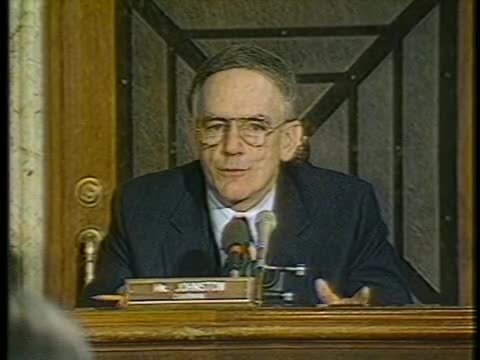
MR. BENNETT JOHNSTON, [D] Louisiana: Nobody seems to be minding the store as far as the nuclear waste program is concerned. When I tell you it is in shambles, I mean it is really in shambles in terms of management that will set a goal and do it, I don't mean in terms of safety. I mean in terms of management.
ADMIRAL JAMES WATKINS: I agree with you. I think we've got to look at the entire panoply of things that go on related to production reactors with particular emphasis on waste. We're now at that critical point that we've waited 35 years and we're between a rock and a hard place on the waste and we've got to move it.
SEN. HOWELL HEFLIN, [D] Alabama: Have you given any thought as to what mechanism or modus operandi or machinery that you will employ and use as the determining causation of the various problems that we have?
ADMIRAL JAMES WATKINS: Well, I grasp your point very well, Sen. Heflin, and I think that the worst thing we can do is move rapidly on poor intelligence. On the AIDS Commission we found out that if we listened to good people that were knowledgeable around the nation and we tried to integrate that into a broader strategy that we found it much easier to do that than take on any one single issue and try to solve it. So I have to wait until I can take a look, almost look at Savannah River as the template for the future across all DOE activities and try to put that in some kind of strategic context where every single element is addressed and I believe when I do that, the light may come on as to how to build the broader energy strategy that I think we've talked about in here that we think we all need. That is the one I want consensus on. It will not make everybody happy, but it might make everyone equally unhappy and that's not a bad strategy in this area where we have so many different conflicting views.
SEN. DON NICKLES, [R] Oklahoma: I didn't see anything in your statement dealing with Shoreham or Seabrook. Does it bother you the fact that we'd have two power plants both in excess of $5 billion, right now it looks like they would be permanently shut down?
ADMIRAL JAMES WATKINS: Yes, sir, it bothers me and we can demonstrate to the American people an understanding that we in this country can manage these plants responsibly and safely, then I think it's going to take off on its own. It's unfortunate that we had to have Three Mile Island in the first place, but maybe we'll look back at it one day as a blessing to get our attention on an alternate source of energy which is very critical to the total energy package and will be in the years to come and not because of what I do, because we will manage it responsibly and I think we're at that turning point now and we ought to get on with those two plants.
SEN. McCONNELL: Looking at your statement and read with interest, it says, "The President stated his firm conviction we must have a strong domestic oil and gas industry because the United States cannot afford to be too dependent on such unreliable imports. At what level is too dependent?
ADMIRAL JAMES WATKINS: Everybody kind of feels that we're getting close to it. I do believe that it's a serious problem and the worst thing is the trend analysis shows it up. Nothing in the data I've been given shows other than consumption going up and production in this country going down, so, therefore, we have to look at the degree to which we can change course in the nation on alternate forms of energy to try to bring that into better balance and I think that's what all of our discussions here today have really been pointing toward, and that's part of the strategy I think that has to be laid out, so we can show over the next five years that we can begin to grasp and control this and to begin to send it in another direction.
SEN. CONRAD BURNS, [R] Montana: With your managerial expertise and sort of coming in here with a military background, and the chain of command is very important in management, how long do you think it will take you to put maybe some new practices in place to where we can tighten this ship so to speak?
ADMIRAL JAMES WATKINS: It'll take me six months to get the fundamental embryo of such an organization going but in the meantime I'm going to fill in some of that void personally because I have no other choice and I hope to bring before this committee additional assistant, deputy assistant secretaries who are highly talented in the field of waste management, in defense programs, in managing downtrodden reactor plants and I think you'll see a very talented group come in and as soon as I can get them on board which I'm moving very expeditiously to try to do, I think that within six months you'll see a whole new face on it. In the meantime, I'm going to stay personally involved in it myself because, as I say, I think I'm it right now.
MR. MacNeil: The Senate Energy and Natural Resources Committee plans to vote next Wednesday on the Watkins nomination.
MR. LEHRER: Still to come on the Newshour tonight a refugee update from South Texas, the big New York City drug raid, and a Penny Stallings essay on rock. FOCUS - NO REFUGE
MR. LEHRER: Next, the latest in the crackdown on illegal aliens seeking political asylum in the United States. The Immigration & Naturalization Service Monday announced a new way to detain immigrants while they wait. Our update is from the Rio Grande Valley of Texas. It is by Betty Ann Bowser of public station KUHT- Houston.
BETTY ANN BOWSER: Two thousand Central American refugees line up each week at this rural processing center outside of Brownsville, Texas. They ask the Immigration & Naturalization Service for political asylum, many claiming they are fleeing persecution in their own countries. The INS says if they keep coming at the current rate, 100,000 people will apply for asylum by the end of the year and officials say they can't all be political refugees. Some of the refugees like Jorez Menendez say they have legitimate claims for asylum. Menendez says he left El Salvador after police tortured him for his political activities. But the INS says most Central Americans come here for economic reasons and this week INS Commissioner Alan Nelson announced a crackdown.
ALAN NELSON, INS Commissioner: [Feb. 20] We do fully intend to send a strong signal to those people who have the mistaken idea that by merely filing a frivolous asylum claim they may stay in the United States. This wilful manipulation of America's generosity must and will stop.
MS. BOWSER: Under the old policy, refugees seeking asylum came through South Texas INS offices, filled out the necessary papers, and were free to travel to other cities to be with relatives and friends. But from now on, the INS intends to process the claims in one day and immediately detain those people whose claims are found to be frivolous. This week more than 400 government workers were being readied to help speed the processing of claims, to rule on them, and to shore up border patrol operations. Nelson says he hopes this effort will stem the tide of illegal aliens.
ALAN NELSON: We don't know of any other alternative to begin with, so if we don't try this, we're sort of admitting defeat, and I don't think any of us will do that. We're very hopeful and optimistic that this can turn it around --
MS. BOWSER: And Nelson says because most of the claims for asylum aren't legitimate, many people will be deported.
ALAN NELSON: But the only way to get the word back down the pipeline to Central America and throughout this country is that we must enforce our laws and we must use detention and deportation because other people of course disappear into the woodwork, are hard to find, the longer they're here, the more difficult it is to locate them, so that is --
MS. BOWSER: The refugees will be housed in this detention center about 40 miles from the Mexican border. The current population is about 500, but INS officials say they are prepared to shelter as many as 5,000. If necessary, the INS says it will erect a giant tent city inside the detention center complex on unused land. Families with children would be held at other minimum security locations like this Red Cross Center in Brownsville. Local refugee support groups were quick to criticize the new INS policy.
MARY CARNESI, Brownsville Ad Hoc Refugee Committee: The new INS policy is a mean spirited attempt to deter political refugees from applying for political asylum. Refugees with legitimate claims to political asylum will suffer most. They will be forced underground by fear of imprisonment and further victimized by smugglers.
MS. BOWSER: Linda Yanez is an immigration attorney who represents some of the refugees.
LINDA YANEZ, Immigration Lawyer: It is absolutely outrageous to expect people to have the meaningful opportunity to pursue that asylum claim while they're behind a fence. That is just, that is totally violative, in my opinion, of any sense of due process. I have yet to see a case of fraud in any of these proceedings and yet they're throwing around these words to intimidate people.
MS. BOWSER: Virginia Kice is spokesperson for the INS in the Rio Grande Valley.
VIRGINI KICE, Immigration Service: People continually call this one stop processing, but that's really misleading because this process is no different than this procedure they would encounter in these other onward cities. It's just by virtue of the fact that we have all the personnel concentrated here that we're able to speed things up. We don't have to send paper work off to the Department of State and wait for it to come back for instance. But I want to emphasize the applicant will be afforded the same due process that he would receive in any other INS office anywhere in the country.
MS. BOWSER: For months, the Mayors of Brownsville and nearby Harlingen have been critical of the INS for allowing refugees to wander at will, leaving piles of trash to be picked up. Now that the INS says it will detain, feed and house the aliens, local officials are less concerned.
MAYOR IGNACIO GARZA, Brownsville, Texas: And from that standpoint, we're pleased with the plan that has removed from the local governments that responsibility and has placed it squarely or has been accepted by the federal government. From the standpoint of the biggest concern that we've had being the housing and feeding of these people as they came through or into our communities, it addresses that. The other issue in terms of whether it's fair or not fair to detain them I think goes back to the ability of the federal government to control their borders and to enforce their own immigration laws.
MS. BOWSER: Critics of detention say it will leave people locked up indefinitely because the system is already jammed with cases.
LINDA YANEZ: The community should know that this is going to be long-term detention because the immigration judges are already backed up, so if you're going to add these other numbers to it, it's going to back up an already overburdened system.
MS. KICE: I don't really understand why detention per se has a negative connotation. We were criticized previously because many of these asylum applicants who were coming here were sleeping in the streets and were sleeping in makeshift tent cities. Now under this new procedure we're going to provide them with shelter, we're going to provide them with food, we're going to provide them with basic medical care. All of these humanitarian needs will be met. The fact that they can't come and go at will, granted, that may be seen as a down side by some, but I think overall it's a very very positive thing.
MS. BOWSER: As the new INS policy went into effect, one of the area's shelters was practically empty after being filled to capacity for months. Sister Norma Pimentel said most of the aliens got out of the valley to avoid detention, but she says the new policy will not stop them from coming.
SISTER NORMA PIMENTEL, Casa Oscar Romero Shelter: That doesn't mean because I am going to enforce the borders these people are going to stop coming. They are overlooking the fact that people are uprooting themselves of a situation in their country that they're feed up with, you know, they can't take it anymore.
MS. BOWSER: INS officials disagree. The first two days of the new policy brought a drop in the number of aliens applying for asylum. The first group of 13 refugees denied asylum yesterday was detained. INS officials say it will be weeks before they can tell if the new policy will keep people from coming here or simply drive them underground. NEWS MAKER - THE ASIAN CONNECTION
MR. MacNeil: Next tonight we turn to an issue that won't go away, drugs. Yesterday New York City police and the FBI concluded what they called the biggest U.S. drug raid ever. A hundred FBI agents and policemen raided three New York locations and arrested 19 suspects linked to a major Southeast Asian drug ring. They also seized more than 800 pounds of heroin, most of it packaged in these tires, and confiscated $3 million in cash. The drugs were shipped from the infamous golden triangle, an area that includes Thailand, Burma, and Laos. The raids followed an 18-month international investigation involving police departments from Hong Kong to New York. Worldwide, 45 members of the Southeast Asian drug ring have been arrested. Officials say the raids confirm that the Chinese have now replaced traditional organized crime groups as major suppliers of heroin to the U.S.
JAMES FOX, F.B.I.: Over the last few years, the Chinese have greatly increased their activity in the illegal heroin distribution. We estimate that today they control 70 to 80 percent of the heroin operation here in New York City.
MR. MacNeil: Officials say the amount of heroin seized would supply about half of New York's addict population for a year. Joining us now for a News Maker interview is the U.S. Attorney for the Eastern district here in New York, Andrew Maloney, the principal prosecutor in charge of the investigation. Mr. Maloney, James Fox of the FBI just gave the facts about the Chinese now controlling, as he said, 80 percent. When you say Chinese, which Chinese do you mean?
ANDREW MALONEY, U.S. Attorney: Well, the people who are Chinese by birth, many of them of course living in Hong Kong, Singapore, and in this country as well.
MR. MacNeil: These are not mainland Chinese, the People's Republic of China?
MR. MALONEY: They originally, some of them originally were mainland Chinese, but for whatever reason they're Chinese extraction of course.
MR. MacNeil: Does this implicate the government of mainland China?
MR. MALONEY: No, it does not.
MR. MacNeil: It does not. What problems does it pose for the FBI and in this case the New York City police to be dealing with a ring or an alleged ring that is largely Chinese, in terms of the appropriate number of agents, languages, all that kind of thing?
MR. MALONEY: Well, there are problems that are being addressed, but they are still being addressed and that's the problem No. 1 of language. One of the problems we have with the wire taps in this case and there were numerous wire taps that went on for some 18 months was recruiting Asian Americans, both FBI and New York police, who could monitor these recordings and understand them; as well as the normal surveillance you want to do and undercover work you want to do with these Asian groups, it is a problem and it's being addressed by the FBI. I understand from Mr. Fox that right now the FBI have aboard 100 Asian American agents for this kind of work.
MR. MacNeil: Does the pattern of Chinese control of the trade apply only to heroin?
MR. MALONEY: Well, it's principally heroin. In this particular case, we didn'teven make a point of it when we announced the arrests here, but we had seized at least 25 kilograms of cocaine from this same organization. They were trading heroin for cocaine for their own uses but they are principally heroin.
MR. MacNeil: What effect does the seizure have on the drug scene here in the New York area do you think?
MR. MALONEY: Well, based on my experience of some years ago, I happened to work some of the old French connection cases, a seizure of this size should have an effect short-term and it should show up in about six months. There's enough heroin in the pipeline not to be felt for about six months, but in about six months or so, we should see signs of a street bag of heroin going up and the quality going down, but that won't continue.
MR. MacNeil: And that would last for --
MR. MALONEY: A period of time, but until other networks take over like this particular one.
MR. MacNeil: Yeah. You'd mentioned the French connection which had a very big publicity a few years ago. How does this compare in size to the French connection?
MR. MALONEY: It's much much bigger. The original French connection case which was in the mid sixties, the movie version, was about 72 pounds of heroin. There were other French connection cases which I, myself, prosecuted in the early seventies in Manhattan, and the largest individual seizures were about two hundred and ten, two hundred and twenty pounds, so this is humongous compared to those particular seizures.
MR. MacNeil: What does heroin represent, what part of the drug traffic and consumption in the New York area does heroin represent nowadays?
MR. MALONEY: Well, unfortunately, New York City is still the heroin capital of the world. We have half the addicts of this country are in New York City, and we estimate anywhere from two hundred to two hundred and fifty thousand heroin addicts in New York City.
MR. MacNeil: Is that a growing population of addicts or stable or dwindling?
MR. MALONEY: Well, up until some recent reports, we believed it was stable and it was getting older. There are some indications that it may be expanding again, but in recent years, it's been an older population and the drug of choice, of course, right now is crack.
MR. MacNeil: And can you divide, can you say if there are 250,000 heroin addicts, how many cocaine and crack addicts there are in comparison with that?
MR. MALONEY: There's many more cocaine addict, I don't have a number off the top of my head. I think one of the numbers you see is there are some 6 million cocaine users in the country. How many of them are firmly addicted is anybody's guess.
MR. MacNeil: When the authorities pull off a coup like this, you are justifiably proud because it is an amazing piece of first undercover work and then follow-up and everything else, but you all continue to say you get only a fraction of the drugs that are in the trade. Is that still true?
MR. MALONEY: I think it is. Last year, unheard of numbers of pounds of cocaine, for instance, were seized in my district alone. There was some 15,000 pounds of cocaine seized in Long Island, Queens, and Brooklyn. That was unheard of years ago, yet, we estimate that's only maybe 20 percent of what's coming into the country.
MR. MacNeil: If there is one Asian ring operating which you now, if your allegations turn out to be true, have stopped, how many others are there likely to be on the same kind of trade route would you say?
MR. MALONEY: I couldn't guess at that, but we think that particularly in Hong Kong that the criminal elements in Hong Kong are doing all they can to get all the money they can before 1997, because come 1997, the People's Republic will take over and they'll hang them. So they're trying to move all their money and all their goods as fast as they can over the next decade. But the main source, the principal source of course of all this heroin is Thailand, back in the jungles and the hills most from what is called the Chen United Army, which is an old contingent of the old national Chinese army. It's run by a fellow named Con Sah and he accounts for about 50 percent of the heroin sold or produced in the entire world, but he's insulated up in the jungles and mountains of Thailand.
MR. MacNeil: Does finding out one pattern help you predict other ones? Does this give you insight into other possible rings, or is it all purely accidental? Are they all so ingenious that finding one doesn't give you real clues to the way the others work?
MR. MALONEY: Methodology changes from day to day. They will smuggle heroin in any number of places from tins of molasses to ski poles, to fish -- mind demand is just infinite the number of methods they would use to smuggle heroin. It really doesn't help us.
MR. MacNeil: Do you really depend on tip-offs, blind tip-offs, for a big coup like this?
MR. MALONEY: No.
MR. MacNeil: Or is that what originally started the --
MR. MALONEY: No. What originally started this was some confidential information about Mr. Woo. Mr. Woo was a well known businessman in Chinatown, he was a onetime chairman of the Democratic club in Chinatown, a very well known figure, and in October of '87, we were told by some confidential informants that he was doing more than just that, that he was brokering heroin, and that what we discovered during the course of this 18 months of investigation, mostly through wire taps and surveillances, and this 820 pounds that was seized on Monday night, during the course of the investigation, there was another 150 pounds seized rather skillfully by the FBI and Canadian police so as not to tip off this network that we were on to them and an additional $2 million, so we're talking about $5 million in cash that had been seized out of this one case along with over 950 pounds of heroin total.
MR. MacNeil: There's a debate going on in this country right now briefly about where the emphasis should be when funds are scarce and everything, interdiction of the trade just as you've just successfully done in one part or education of users, potential users and all that. You've been at this for a long time. What's your own personal feeling about that?
MR. MALONEY: I think everybody in law enforcement preaches the same gospel, namely that all we can do is contain it and reduce it, and in the long run it's going to be education, it's going to be rehabilitation demand side, and that may take a generation or more to turn that attitude around.
MR. MacNeil: Well, thank you very much for joining us.
MR. MALONEY: Thank you, sir. ESSAY - ROCK OF AGES
MR. LEHRER: Finally, tonight's the night when people in the music industry hand out awards to themselves otherwise known as the Grammy Awards. Penny Stallings, our essayist on pop culture, has some thoughts about the creeping gray hair on some of their nominees and their audience.
PENNY STALLINGS: Wednesday night is one of those stay at home TV nights, the annual broadcast of the Grammy Awards. It's a night for flashy musical numbers, endless thank yous, and most of all live performances by the rare and exotic birds of the rock world. Now there was a time when these very same stars barely rated an invitation to the Grammies, back in the fifties when rock was regarded as an idiotic teenage fad, crude and hormonal, but as rock got richer, the industry's elite began to see the virtue in all that. In recent years, the Recording Academy has tried to make up for past omissions by adding new rock categories and saluting pioneers like Chuck Berry, but by then, many of the original rock greats had slipped into obscurity, spurned by an audience that's notoriously fickle. Rock has always been the province of the young and for them, nothing was worse than watching an aging teen idol try to hang onto the moves that made him famous unless it was watching him trying to grow up and go straight. At best, a rock star's time at the very time lasted no more than a few short years, but then something interesting began to happen. Brash newcomers began covering old chestnuts. Reigning super stars began teaming up with the idols of their youth. The super stars of the past were transformed into more than just curiosities. They were a new kind of pop royalty. As its audience has grown more and entrenched, rock has been integrated into the mainstream -- commercials -- movies -- and television exploit its mystique, not to mention the Republican Party and the new President. Rock stars may not be the folks next door but they're not exactly social outlaws either. Their time at the top is still brief but their fans now sometimes allow them to grow, to explore new, more sophisticated territory. Their extended shelf life has resulted in some transcendent achievements. Vintage ballads from a raunchy rock belter -- the fusion of two diverse, yet related musical cultures by an ex-folky -- cool jazz from a hot, pop, pinup boy -- even Mick Jagger, who once said he'd be rather be dead than singing rock'n roll at 40, continues to shake a tail feather. Not only are the stars still playing but their old fans are still listening. That's not exactly a surprise coming from a generation that stressed its adolescence well into 30 something, that obsesses endlessly over its past. And yet, they don't just listen to that old time rock'n roll, they occasionally sneak a peak at MTV and they help make super stars and new talents like Tracy Chapman. The stars of my generation refuse to simply fade away. In fact, almost all the rock nominees at this year's Grammies are 40 and over -- Eric Clapton, Robbie Robertson, Robert Palma, George Harrison, Joe Crocker, Tina Turner, Frank Zappa, The Beach Boys, Willie Dickson, Aretha Franklin, Gladys Knight & The Pips. No doubt about it, rock has come of age -- just like us. RECAP
MR. MacNeil: Once again, Wednesday's top stories, consumer prices rose at an annual rate of over 7 percent in January, the largest monthly rise in two years, President Bush began a five day trip to the Far East, the Senate Committee considering the John Tower nomination appeared seriously divided and late today the bookstore chain B. Dalton and its subsidiary, Barnes & Noble, announced that they will resume selling Salman Rushdie's novel "The Satanic Verses" as soon as the publisher makes more copies available. Good night, Jim.
MR. LEHRER: Good night, Robin. We'll see you tomorrow night. I'm Jim Lehrer. Thank you and good night.
- Series
- The MacNeil/Lehrer NewsHour
- Producing Organization
- NewsHour Productions
- Contributing Organization
- NewsHour Productions (Washington, District of Columbia)
- AAPB ID
- cpb-aacip/507-j96057dk3m
If you have more information about this item than what is given here, or if you have concerns about this record, we want to know! Contact us, indicating the AAPB ID (cpb-aacip/507-j96057dk3m).
- Description
- Episode Description
- This episode's headline: Lingering Doubts; Considering the Cabinet; The Asian Connection. The guests include SEN. JOHN McCAIN, [R] Arizona; SEN. TIMOTHY WIRTH, [D] Colorado; SEN. ALAN DIXON, [D] Illinois; ADMIRAL JAMES WATKINS, Sec. Energy-Designate; ANDREW MALONEY, U.S. Attorney; CORRESPONDENT: BETTY ANN BOWSER; ESSAYIST: PENNY STALLINGS. Byline: In New York: ROBERT MacNeil; In Washington: JAMES LEHRER
- Date
- 1989-02-22
- Asset type
- Episode
- Topics
- Music
- Economics
- Social Issues
- Global Affairs
- War and Conflict
- Energy
- Consumer Affairs and Advocacy
- Employment
- Transportation
- Food and Cooking
- Politics and Government
- Rights
- Copyright NewsHour Productions, LLC. Licensed under a Creative Commons Attribution-NonCommercial-NoDerivatives 4.0 International Public License (https://creativecommons.org/licenses/by-nc-nd/4.0/legalcode)
- Media type
- Moving Image
- Duration
- 00:59:21
- Credits
-
-
Producing Organization:
NewsHour Productions
- AAPB Contributor Holdings
-
NewsHour Productions
Identifier: NH-1412 (NH Show Code)
Format: 1 inch videotape
Generation: Master
Duration: 01:00:00;00
-
NewsHour Productions
Identifier: NH-3372 (NH Show Code)
Format: U-matic
Generation: Preservation
Duration: 01:00:00;00
If you have a copy of this asset and would like us to add it to our catalog, please contact us.
- Citations
- Chicago: “The MacNeil/Lehrer NewsHour,” 1989-02-22, NewsHour Productions, American Archive of Public Broadcasting (GBH and the Library of Congress), Boston, MA and Washington, DC, accessed April 16, 2026, http://americanarchive.org/catalog/cpb-aacip-507-j96057dk3m.
- MLA: “The MacNeil/Lehrer NewsHour.” 1989-02-22. NewsHour Productions, American Archive of Public Broadcasting (GBH and the Library of Congress), Boston, MA and Washington, DC. Web. April 16, 2026. <http://americanarchive.org/catalog/cpb-aacip-507-j96057dk3m>.
- APA: The MacNeil/Lehrer NewsHour. Boston, MA: NewsHour Productions, American Archive of Public Broadcasting (GBH and the Library of Congress), Boston, MA and Washington, DC. Retrieved from http://americanarchive.org/catalog/cpb-aacip-507-j96057dk3m