The NewsHour with Jim Lehrer; December 21, 2007
- Transcript
. . . . . . . . . . . . . . . . . . . . . . . . . . . . . . . . . . . .
. . . . . . . . . . . . . . . . . . . . . . . . . . . . . . . . . .
. . . . . . . . . . . . . . . . . . . . . . . . . . . . . . . . . . . . . . . . . . . . . . . . . .
. . . I. . . . . . . . Every day, it seems, talk of oil, energy, the environment. Where are the answers? Right now, we're producing clean, renewable, geothermal energy. Generating enough energy to power 7 million homes. Imagine that, an oil company as part of the solution. This is the power of human energy, the new AT&T, Pacific Life. The William and Flora Hewlett Foundation, working to solve social and environmental problems at home and around the world. And with the ongoing support of these institutions and foundations.
This program was made possible by the Corporation for Public Broadcasting, and by contributions to your PBS station from viewers like you, thank you. A federal judge asks for answers today on the destruction of CIA interrogation tapes. In Washington, U.S. District Judge Henry Kennedy heard from lawyers for the Justice Department and detainees at Guantanamo Bay, Cuba. They're hearing focused on whether the CIA's actions violated earlier court orders. We'll have more on this story right after the news summary. A suicide bomber killed at least 50 people in Pakistan today. The bomb exploded at a Muslim religious service in a village near the Afghan border. We have a report narrated by Jonathan Miller of Independent Television News. What sort of Muslim would do this one worshipper asked a bloodbath at Friday prayers
during the festival of Eid al-Ada, commemorating Ibrahim's willingness to sacrifice his son? The sacrifice was great today, 50 dead, 80 wounded. The suicide bomber detonating in a middle row among 1,200 worshippers at Chasada Mosque, just as prayers had ended. Suddenly there was a blast. I saw dead bodies everywhere, many wounded. We took them and sent them to the hospital. The mosque was in the residential compound of Aftab Ahmad Khan Sharpal, Pakistan's former interior minister, and almost certainly the target. He was just too rose in front of the bomber, somehow he survived and scathed a number of his bodyguards were killed. Desperate scenes outside the hospital as news spread of what had happened and relatives arrived as the bloody dead, then the wounded, young and old came in thick and fast, and President Perbez Mishara, for at least a statement condemning what he called the distorted
thinking of the militants he blamed for this abhorrent act. This injured boy said he was in the third row back when the bomb went off and people landed on top of him from all sides. Aftab Sharpal, whose own son was injured in the blast, visited the wounded. It's his second close call this year. In April, another suicide bomber struck in his same home village, the former minister who heads a small, promischera party is running in next month's elections. There have been waves of suicide attacks by Islamist militants in Pakistan over the past six months. A bomber on a bicycle struck here at the gate of an army college last weekend. Together more than 800 people have been killed across the country since the army assault on militants who seized Islamabad's Red Mosque in July. The threat posed by these Islamists was the pretext, cited by Perbez Mishara for his imposition of a state of emergency during which he promised fresh elections.
There was no immediate claim of responsibility for today's attack. Secretary of State Rice pressed North Korea today to disable all nuclear weapons facilities by years' end and list all nuclear programs. The North Koreans have pledged to take both steps. Rice did leave some room for flexibility on the timetable. She said, I sincerely hope it will be by the end of the year, but the key is to get this process right. The U.S. has agreed to lift some sanctions if North Korea keeps its promises. U.S. Defense Secretary Gates criticized Congress today for the way it's funding the wars in Iraq and Afghanistan. At the last minute, the House and Senate approved another $70 billion for the wars. That was only half what President Bush requested. Gates said it could hurt the military and the long run. Absent timely congressional action in the new year, we will again face the risk of running out of money.
I'm also very concerned that funding the war in fits and starts is requiring us to make short-term plans and short-term decisions to forego needed actions and to put at risk critical procurement, training, and other activities important to deploying a ready and effective force. Gates said he won't have to furlough any civilian workers at the Defense Department for now, but he said that could still happen in the months ahead unless more money is approved. We'll talk to Senate Majority Leader Reid about war funding and other issues later in the program tonight. In Iraq today, the leader of the largest Shiite political party said Sunni militias must aid government forces, but not trying to replace them. The so-called awakening councils have helped chase al-Qaeda from parts of Iraq. Also today, the UN Children's Fund, UNICEF, reported some 2 million Iraqi children are now at risk from fighting disease and poor nutrition.
In U.S. economic news, consumer spending surged last month. The Commerce Department reported it rose more than 1 percent in November, the most in three and a half years. That news fueled a rally on Wall Street, the Dow Jones Industrial Average, gained 205 points to close above 13,450, the Nasdaq rose 51 points to close at nearly 26-92. For the week, the Dow gained almost 1 percent, the Nasdaq rose 2 percent. The nation's oldest living veteran of World War I has died at the age of 109. Jay Russell Coffee passed away Thursday near Toledo, Ohio. He'd been in failing health since October. In all more than 4.7 million Americans served in the First World War, now only two are left. One in West Virginia, the other in Florida. Again, Jay Russell Coffee was 109 years old. And that's it for the news summary tonight.
Now, the video tapes go to court, Senate Majority Leader Reed and Shields and Brooks. Our CIA video tapes update and to Jeffrey Brown. News reports this week said a wider than originally named Circle of White House officials were involved in discussions about the destruction of two CIA interrogation tapes. The CIA has agreed to cooperate with congressional investigators. And today, Justice Department lawyers were in federal court in Washington to answer complaints that the destruction of the tapes was in violation of an earlier court order. We get an update on all this from Ari Shapiro, Justice Correspondent for National Public Radio. Welcome. Thanks. Let's start with today's court hearing. You were there. First, remind us what the case was about. Well, back in 2005, this Judge Henry Kennedy had issued an order telling the government to preserve any documents relevant to abuse, torture, or otherwise mistreatment of detainees at Guantanamo Bay prison.
Five months later, the CIA destroyed these video tapes depicting interrogations of two detainees at CIA prisons. And so this hearing was into whether the government, sorry, whether the court rather should open an inquiry into whether the government violated that court order from 2005. The original lawsuit, to go back, was brought by detainees at Guantanamo. That's right. And so, for what purpose? Filing habeas corpus claims, petitions challenging their detention at Guantanamo. And so in court today, you had government lawyers from the Justice Department arguing that the judge should not open this inquiry. And on the other side, you had attorneys representing Guantanamo detainees, saying that this inquiry is necessary to determine whether the government destroyed evidence. All right. Through that, start with the lawyers for the detainees. What fill in that argument? What were they saying? The detainee lawyer, David Reims, essentially said the government can't be trusted here. He said the government has admitted to destroying evidence that could have been relevant to an investigation.
After all, at the time, Congress was investigating interrogation practices. And there were various court cases challenging interrogation practices. And the detainee lawyer, Reims, said once the government has admitted that, you can't trust them to have retained other evidence that they're required to preserve for court cases. He said, when there's smoke, there's fire. And even if I can't present specific evidence that the government destroyed evidence about interrogations of detainees at Guantanamo in 2005, the facts that we know now he said should be enough to raise serious concerns. Well, that's what I was going to ask you. Are they suggesting that there is a direct relevance or tie between those tapes and the cases of these detainees in Guantanamo? He said there may very well be. For example, he talked about one of his clients, a man named Muhammad Hassan, who was a Guantanamo detainee. And he said that Hassan was labeled an enemy combatant because senior al-Qaeda leaders fingered him. And so the detainee lawyer, Reims, said in court today, we don't know which senior al-Qaeda leader fingered him. It could have been one of the al-Qaeda leaders on the videotapes that were destroyed.
He could have fingered my client under torture. He said that's something we'll never know. But it's a relevant question, and he said that goes to the point of why the court needs to investigate. All right, so then this was the first time that administration lawyers have spoken publicly and under oath. Since the CIA let the world know about these tapes, what was their argument? They made two arguments. First they essentially said the Justice Department is investigating this. You should leave us alone. They said that if the courts start to do their own investigation, that could compromise the inquiry that the Justice Department is already doing into whether there should be any potential future criminal prosecution. So that was one problem of the government's argument. The other problem was these interrogations took place in 2002. They took place at a CIA prison. There's no connection here to the judge's 2005 order to preserve evidence of abuse at Guantanamo. A CIA prison, not in the U.S. Right, CIA prisons overseas. Not in Guantanamo, Cuba, the government attorney said these men were detained in 2002. The interrogations took place in 2002.
The men did not see any other detainees from the time they were captured to the time that these videos were made. And so he said it's impossible that these could relate to Guantanamo interrogations. And therefore they're not violating the court order that had been in place. That's what he argued about. That's the argument. But there's a catch here. The detainee lawyer pointed out that the government appeared to be working very hard not to say whether the detainees were at Guantanamo in 2005 or not. Now this gets a little thorny, but the president said that the two men depicted in these videos were transferred to Guantanamo in 2006. But the detainee lawyer pointed out that people are bounced from prison to prison all the time. And we have nothing on the record yet that says for certain that these men were not at Guantanamo in 2005. So what did the judge make of all these questions that he asked, did he tip his hand in any way? He frankly seemed a little skeptical. This judge is a difficult... Sorry, a skeptical of the detainees' arguments, the detainee lawyers' arguments. This judge is a Clinton appointee. But in court, he asked the detainees lawyers more questions than he asked the government lawyers.
He said, why shouldn't I just let the justice department do its own inquiry? And why shouldn't I... He said, do you have any evidence that the government specifically violated this 2005 order? And the detainee lawyer responded to that. I don't have any specific evidence, but given what we do know about the CIA tape's destruction and given how little we are able to access information about the subject, he said the burden should be on the government, not the detainees lawyer to show that they were in compliance with the 2005 order. Did we learn anything more about what's actually on these tapes today? Not today in court, but the government lawyer said some things under oath that had been reported previously by anonymous sources, by news reports, and the fact that the government said the under oath means it's now airtight. For example, he said there are only two detainees depicted in these videotapes. Those two detainees were Abu Zubayta, Abd al-Rahim, al-Mashiri. Those were names that we knew before, but the fact that the government said this in court means we can now take it as absolute fact. He said, as I mentioned before, that these two detainees were not in contact with any other
detainees. And so these are facts that we can now nail down for certain. We don't have to rely on anonymous sources to report them. All right, now, in the meantime, the questions of who knew about the tapes, who authorized their destruction is still out there. I referred in our introduction to the reports this week, largely from New York Times story, that more White House attorneys, several, at least four, were involved, at least in discussions about whether they should be destroyed, bring us up to date on what's known about any possible connections between White House attorneys and the destruction. Well, we're just learning more and more day by day, and at first the report was that it was only Harriet Meyers, the White House counsel, who advised against destroying the tapes. And then other names started to come out, as you mentioned this week, al-Bertogon-Zollis, who preceded Meyers' White House counsel and later became Attorney General. David Addington, who works on the vice president's staff as one of Dick Cheney's attorneys, and apparently some of these lawyers were advising against destroying the tapes, some of them were advocating for destroying the tapes.
And the White House has said that while the Justice Department investigates this matter, they're not going to comment on it. So this is a big question mark. We certainly don't know now and may never know exactly what role each member of the White House staff played in this argument as it played out whether or not to get rid of the tapes. Of course, yesterday at his press conference president Bush said, repeated again, that his first recollection, his words, of being told about the tapes were only recently from the CIA director. And he also said, we're not going to discuss the facts until the Justice Department does its own investigation. And so those of us in the media are certainly hoping that when that investigation concludes the report, we'll be public, but we have no guarantee of that. Now you said that the Justice Department is doing its investigation with the CIA, and one of their arguments today in court was let us do it. In the meantime, Congress is also doing investigation, that's about that. So there's a total of three investigations. The courts, the Justice Department with the CIA, and Congress. And the congressional investigation took a major step last night issuing its first subpoena. The House Intelligence Committee subpoenaed Jose Rodriguez, who is the CIA official, who
issued the order to have the tapes. He's the one we know actually did issue the order. That's right. And his attorney has said that he was given the green light to issue the order to destroy the tapes. Now we don't know what that green light means. We look forward to hearing what he testifies to before the House Intelligence Committee. He may be able to shed a lot more light on this. We may also hear from John Rizzo, who is the CIA's top lawyer, the CIA's Acting General Counsel. He may also be able to shed a lot more light on this. And in the meantime, there is one war in the meantime here, which is the existence of some other tapes that has come out. These are tapes that were done by a foreign government that the CIA may have access to. Yeah, this is so interesting, because this came out a couple of months ago, and nobody paid a lot of attention to it. The trial of Zacharyus Musawi, the so-called 20th hijacker, captured the country's attention. And during that trial, defense lawyers said, we want any tapes of interrogations of terrorism suspects that may relate to our case, and the government said, we don't have any tapes.
So the trial took place. It concluded Musawi was sentenced to life in prison fine. Then a few months later, the government says, we actually do have some tapes. And the phrase that they used was interesting, the CIA acquired these tapes. This is tell us that what that means is that foreign governments recorded these interrogations and gave the tapes to the CIA. We don't know for certain who is in these tapes. It could be a narrow range of al-Qaeda operatives who are in custody at that point. And we haven't seen the tapes either, but it suggests that there may be more out there than we are aware of. As far as we know these tapes still exist, though. Right, as far as we know these tapes still exist. And there could be yet other tapes, even. There's one human rights attorney who's a group of human rights attorneys actually, including the ACLU, representing former detainees from the CIA prisons. And one of those detainees described an interrogation at a prison in Afghanistan, where he was accused of something that he said he didn't do. And after that interrogation, he was very upset. A medic apparently came to his cell and said to him, the important thing is, you told
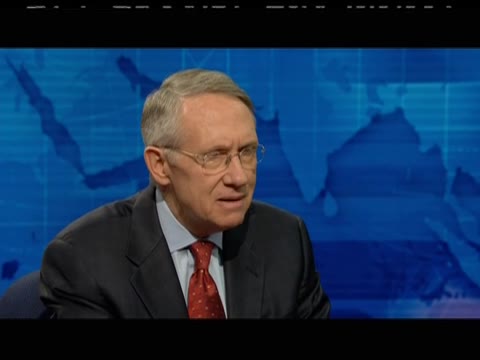
your side of the story, and it was recorded. And this detainee says there were video cameras all over the prison. Now, we didn't know what that means, but it certainly suggests that there could be other tapes out there that we're just not even aware of yet. All right. More to come. Ari Shapiro, then, Pierre. Thanks very much. Pleasure to be here. Now, our newsmaker interview with Senate Majority Leader Harry Reid, Democrat of Nevada, and Erase Suarez. Senator Reid, welcome to the program. Thank you very much for allowing me to be on your show. Well, at the beginning of this year, the Democrats returned to the majority after 12 years in the minority. You and Speaker Pelosi announced a very ambitious agenda now that one year has passed. And you look back. How has it gone? Well, we've been able to accomplish quite a bit, but not very much. Certainly not as much as I wanted to.
I'm kind of frustrated like the American people. There are a lot of things that need to be done. We've found a blockage on nearly everything we tried. But in spite of that, I in spite of the fact that in just a few short months, rather than two years, the Republicans blocked us 62 times. The record for two years was 61, so in just a few short months, they had more fillbusters in the history of the Congress before. But in spite of that, we're able to get things done with the most sweeping ethics and lobbying reform, we're able to get good things done as a relates to a balanced budget. We passed that. We're able to get relief for the 9-11. We got the Commission recommendations there. We were able to just recently get some good energy legislation passed. But not enough. We still have so much more to do. And what I've learned, I guess, during the past year is that we want to change and the Bush Republicans want to keep things the way they are.
But we want to change things, and we're going to work very hard next year to see if we can get the Republicans to join with us more often than they did last year and not have as many things block and try to do some more things. Well, earlier this week, the Senate Minority Leader, Mitch McConnell of Kentucky, was on the program. And he said, when asked the same question, regretfully, we've spent most of the year having repetitious Iraq votes and investigations of the administration. It seems like all that happened was the approval rating of Congress kept getting lower and lower. Well, Ray, if I were one of those people in one of those polls that said, what do you think of Congress, I would vote with the people that said, we're not doing very well. I think we have so much more to do. And as far as Iraq, we have a responsibility for the people of this country, recognize that the war in Iraq is the worst foreign policy blunder in the history of this country. And we've done everything we can to support the troops. It was us, the Democrats who realized that parents should be my armoring, sending it to
Iraq for their sons and daughters. So we pushed and we got body armor, we're the ones that pushed for armoring, up armoring the humvees and other vehicles. We are the ones that put in the budget that we just passed, $3.7 billion more for veterans. So the soldiers have done valiantly. But we recognize that spending $12 billion a week, I'm sorry, a month is what we're spending in Iraq, which is all borrowed money is too much. And it's destabilized that whole part of the world in addition to lessened our standing in the world community. And we need to get bring our troops home. I had a long plan trip to go to Walter Reed today. I didn't know it was going to be on this show. I went there today for lunch and met with staff and some of the soldiers who were wounded and some who weren't wounded. And without exception, when I said we're doing everything we can to help you, appreciate your service, but I want to get the troops home.
And without exception, they said, get them home as fast as you can. You and your colleagues have approved a partial allocation of what the president asked for continuing funding of the Iraq and Afghanistan operations. The president called it a down payment in his news conference. But today Secretary of Defense Gates said, paying for the wars in Iraq and Afghanistan this way, as he called it, in fits and starts, undermines U.S. military planning and risks gains made by U.S. troops over the past year. And he responded. Ray was just a few weeks ago that the Secretary went asked the question, if we give you no money for this supplemental, how long can the troops, how long can you take care of things? And he said the Army is good until the first of March, Marines are okay to the middle of March. I confirmed this within the Secretary and I had a conversation he was in Afghanistan. I was here.
And he confirmed that. Just a few days after having said this, the spin starts, you've got to give us some money and we're going to have to start laying people off that, that's not valid. And I think it speaks volumes. The Republicans don't even accept that. We just had a vote in the Senate of the United States. House confirmed this, where the president asked for $196 billion, even the Republicans of the Senate didn't have the nerve and the audacity to ask for it all. They asked for about a third of it. And so $70 billion has been just approved. Couldn't they wait just a little while before they start the political drum roll? We have done everything we've been called upon and more for the troops. We have been there. We support the troops. But this war is costing us $12 billion a month in borrowed money. There are some who say it's already cost us about $800 billion. And that's direct costs for the war. So I think what we need to do is recognize that the political situation Iraq is no better than it was two years ago, three years ago, a year ago.
They've got to take care of their own situation. We have done a lot. We've done and some say far too much. We've got to start bringing our troops home. We have taken our eye off the prize in Afghanistan. The Taliban is resurgent. We have Osama bin Laden who is still taunting us. He is still free and loose. So I think that we have to recognize that we don't have unlimited resources to an unlimited time to spend in Iraq. But if they must take over their own government and their own country. But if the president asks for $196 billion and he's appropriated $70, he's going to have to come back to you anyway. Isn't he? What's the idea behind giving him just part of that? If in four months or five months, he has to come and ask for more. Ray, the Republicans offered the amendment for $70 billion. We didn't. The reason is the money is not necessary now. Secretary Gates said if we gave them no more money, they're OK to have a first of March, the middle of March for the Marines.
This is all a political game that the president is using. He should just focus on work with us. The president needs to work with us. If there's a problem with the money, send the secretary down and tell us. But the secretary told us there's not a problem. And I don't know who he's talked to in the White House. It's suddenly there's probably just the American people just been asked to spend $70 billion more in borrowed money. I think that's OK. Let's see how things go. Let's see if we can bring some of the troops home and not have to spend all that money. One thing that's changed a great deal since the beginning of the year is the number of American troops that are dying in Iraq and the rate at which they're dying and being wounded. The increase in the number of American troops in the theater by many accounts is having its desired effect. And the day-to-day violence in Iraq is in decline. Does that change your approach to Iraq?
Does it force a change on your body, the Senate, in how you respond to calls to change direction now? Ray, you can't have it both ways. The President said, let's send some more troops over there. And that'll give the Iraqis the time to take care of themselves. They sent the other troops over there and there are a lot of reasons the surge certainly hasn't hurt. It's helped. I recognize that. But also on your radio program, Public Radio today, there was a story about the fact that one of the academics said, it was a long interview that said, you know, the ethnic cleansing is taking place all over Iraq. There's not the conflict because there's separation, there's segregation in effect. So it's time that the American people were given the benefit of the ballot and not have to spend all this broad money, start bringing our people home. Even as enough enough, how much longer we can be asked to spend $12 billion a month on
this war when we have money for health care, we try to get 10,000 poor children health insurance. The President said there's not enough money to do that. We've tried to do some good things with having alternative energy. That is, have enters this developed by Sun and wind and geothermal. The President is not enough money for that. There's not enough money needed for education to leave no child behind that is leaving children behind. We need money to take care of that. There isn't enough money because of the war in Iraq. When he was on the program earlier this week, Senator McConnell said that he gets the feeling that your side of the aisle is coming to the understanding that you all are going to have to meet in the middle to get anything done in the Senate. Because of the closely divided nature of the chamber, a 51-49 split, he said approval rating of Congress will begin to inch up a little bit now that our friends in the majority
understand you really have to meet in the middle to accomplish things for the American people. Are you getting along better now? In the last couple of weeks, we passed some legislation under the gun with deadlines looming. Ray, the majority that we've had in the Senate has been very narrow, Tim Johnson, a year ago, got deathly ill. He lived. He was out of the Senate for almost 10 months. He's made a remarkable recovery. So now we're back, we're in the majority 51-49. I've always recognized, I understand Congress. I've been in Congress for quite a few years. I understand the only way you can get things done is working together. I've always felt that. It hasn't been the last couple of weeks. It's been always, the only way we can get things done is working together. When we get things done, there's credit for everybody. But I repeat what I said earlier in the show, everything we've tried has been blocked. We've had 62 filibusters that have stopped us from moving forward. We've had to work and around all that.
It's very difficult to do and I'm glad to have Mitch saying that he thinks things are better. I appreciate that very much. I want to work together. I want to work with a White House. I want to work with Republicans in the Senate. And I hope that the things work out better and extra. If it doesn't, it certainly won't be because I haven't tried. How is your relationship with President Bush? There have been some pretty rough exchanges in the past year. Well, I'd love to go to a baseball game with President Bush. Have dinner with him. But that is not the important thing. The important thing is that we have to get results for the American people. And I disagree with President Bush's policies much of the time. We have to do a better job with health insurance. We have 50 million people with no health insurance. We have global warming that is here and the president doesn't recognize there's a thing called global warming. We've got education, the child's ability to be educated should be dependent on how much money their parents have. The COPS program just bring down crime, the president doesn't believe in that program.
So the president, as a person, he and I are just fine. But his policies, I don't agree with, and the majority of the American people don't agree with them. Any poll you see recognizes them. When you and the other 99 members come back to work in the third week in January, it'll still be 5149. But Joe Lieberman, who caucuses with you, routinely votes against the Democrats on questions involving the war. And four other members are outrunning for president. And you muster your troops when you need them. Has that been a challenge having four Democratic members of the Senate out there on the campaign trip? First of all, Joe Lieberman. Joe Lieberman is my friend and he has a good Democrat, votes with us on everything except the war. So Joe Lieberman is easy to work with. And it'll be good to get three of my senators back. It appears that the nominee will be chosen very soon. And I have to be very candid, it'll be good to have at least three of them back.
So do you think the coming year is going to be much different from the year that's just transpired? I hope so. I hope so for a number of reasons. One is that I think the Republicans are going to see that marching in tune with the president has not been helpful to them. It's not Harry Reid, the Democratic leader, talking now. As any pundit that you talk to, we're going to pick up Senate seats. If election were held today, we would pick up four seats. That would bring us up to 55. And there's some who say, for example, Greenberg, the famous pollster said, we'll pick up nine seats. I think that's far too many, but we're going to pick up seats. I think as a result of all these forecasters, I think you're going to see the Republicans wanting to work with us more and not blocking things 62 times during one year. Senator Harry Reid, if Nevada, Senate Majority Leader, thanks for coming by. Thank you very much. And to the analysis of shields and Brooks syndicated columnist Mark Shields, New York Times
columnist David Brooks. Mark Senator Reid says that the president has been playing political games with war funding. How do you read it? Well, I mean, the president has rediscovered the fiscal sanity portion of the Republican brain, having put it on the shelf for seven years. And I think we've learned a constitutional lesson this past year, and the Democrats came in after Minaj Parav at 13 years. Senator Reid's brand-new was a majority leader, as is Speaker Pelosi. And it's a lot tougher trying to keep it together in the majority. And the constitutional system, it's always easy to stock things than it is to pass them. And I think the president has played that card and played it strongly. How about specifically David, the issue that Senator Reid talked about that the president wanted 196 billion dollars for the war, Afghanistan and Iraq, ended up getting 70. And that was okay.
It seemed to be okay with everybody. Why wasn't suddenly okay with everybody? Well, I think people just wanted to get it spent. There are actual reasons why you want to have some sort of stability. They wanted more. They didn't want to have so many votes over in the near term. But I actually thought the end of the Senate ended up a lot better than it could have. We could have seen some real conflict on energy on the AMT, the ultra minimum tax, and in Iraq we saw a little bit of the parties coming together. I thought we could have seen a lot more of that earlier in the term, and especially on the subject of Iraq. The Republican unhappiness with the rock policy back six, eight months ago was high. And I thought Senator Reid and Mitch McConnell could have actually done something a little more of a bipartisan nature at the time they didn't. I think the big change since then has been the surge. And the surge has changed the circumstance. And I'm not sure either party has really adapted to what the surge presents as far as opportunities go. Senator McConnell said this on the program the other night, that what really changed the attitudes in the Senate at least on Iraq among the Democrats was the surge worked. Well, do you agree? The surge has worked in this sense, Jim, it has reduced violence, and it has there has for it has reduced the saliency and the urgency of Iraq as an issue to the American voters.
But I found it revealing that in the most recent Wall Street Journal NBC poll unchanged where the judgment, the overwhelming majority judgment of Americans, that the war was a mistake to go into, and three out of five still want American troops out of there in one year. The thing that Senator Reid didn't say that was surprising to me is even after a bad session where the Congress's White House loves to point out is even less popular than the President who has been more unpopular for longer than any President in American history. Even after that, by a 48 percent to 34 percent margin, voters, according to Wall Street Journal NBC poll, want a Democratic Congress after 2008, rather than a Republican Congress. So I mean, that's a real message to the Republicans that just being against is not enough of an agenda. You read the message the same way? Well, I do think this is still a Democratic country. The party identification, all the signals indicate the Democrats who are in the Ascendant
and the Republicans are not. And that's essentially because the Republican party is shrinking. The party is aged 10 years in the past few years, and that's because all the young people who have left the Republican party. And that's hurt the Republicans in the Senate. It's affected the entire presidential race. And I essentially think Mark's right about that. The Democrats have not distinguished themselves. They're not proud, as we heard Harry Reid say. They're not proud of what they've accomplished in Congress, but the Republicans are still basically in worship. Do you think this President Bush used the term high point? He said he thought the Congress ended on a high point, and you kind of said the same thing, David. Do you think that there was a kind of, oh my goodness, we've got to do something here or it's going to hurt both of us or what do you think finally led to? Doesn't just Iraq voting, but the Iraq funding, but a lot of other things, energy, a lot of other things. The energy issues, something both have talked about the same sort of thing, the fuel efficiency standards, both parties have talked about that. So there were some meeting of the minds on that on the alternative minimum tax you really had a sword hanging over people's heads, which was going to affect all these people.
Now the downside is, and this is what made it so easy, is they didn't pay for it. And if you don't pay for it, it's kind of easy to be Santa Claus. I mean, Mitch McConnell said it would be offensive to pay for it. That, I just point out, failure to pay for it, $1.3 trillion, it will add to the national debt in 10 years to failure to pay for it, to just say, oh, where are we going to find the money to cover this, as David just pointed out, this gift that has saved our skins. Well, what's your reading of why we have this quote high point? I missed the high point. I thought it was get out of dodge. I agree with David. I agree with David. I think that sense of self-congratulation, I thought it was a little over at the top. Quick thing here, then we want to get to the presidential campaign. You heard the news of the day about the judge and the CIA videotapes, anything new, any new development that Pat Caffsony further clouds or light?
I don't see a big political shift. It'll depend on who was lied to and what we find out from the internal investigations if they're really serious and internal investigation. I agree with that. I do think it's interesting, and they said that the tapes apparently were not done. The interviews, the tapes came into the possession of the CIA, and so now we're getting into the parsing that we always expect in these investigations. Okay. The presidential campaigns and politics here, the Iowa caucuses are now less than two weeks away, and the candidates will take a short holiday break from campaigning, but several candidates, as many of you know, are on tunnel vision, airing holiday greetings. Here are five and no particular order. Are you about worn out of all the television commercials you've been seeing? Mostly about politics. I don't blame you. At this time of year, sometimes it's nice to pull aside from all of that and just remember that what really matters is the celebration of the birth of Christ and being with our family
and our friends. I hope that you and your family will have a magnificent Christmas season, and on behalf of all of us, God bless and Merry Christmas. I'm Mike Huckabee, and I approve this message. We'd like to take a moment to thank you and your family for the warmth and friendship that you've shown ours for sharing your hospitality and your stories. In this holiday season, we're reminded that things that unite us as a people are more powerful and enduring than anything that sets us apart, and we all have a stake in each other and something larger than ourselves. So from our family to yours, I'm Barack Obama, and I approve this message. Merry Christmas. Happy holidays. There are many things I wish for this holiday season. I wish for peace with strength, secure borders, a government that spends less than it takes in, lower taxes for our businesses and families, and I really hope that all the presidential candidates can just get along.
I was with you right up until that last one. Can't have everything. I'm Rudy Giuliani, and I approved this message. Merry Christmas. Happy holidays. Where did I put Universal Pre-K? Ah, there it is. I'm Hillary Clinton, and I approve this message. One night after being mistreated as a POW, a guard loosened the ropes binding me, easing my pain. On Christmas, that same guard approached me, and without saying a word, he drew a cross in the sand. We stood wordlessly looking at the cross, remembering the true light of Christmas. I'll never forget that no matter where you are, no matter how difficult the circumstances,
there will always be someone who will pick you up. May you and your family have a blessed Christmas and happy holidays. I'm John McCain, and I approve this message. Well, David, those were five of the messages that Chris has, or the holiday greetings. What are they, what are they at up to to you? Well, I thought that Giuliani and Clinton ones were cringe-making, frankly. Cringing. They're trying to humanize their candidates, and you're going to do that, you've got to do humor that works, and I just thought it was made to look un-human, so I had that view. John McCain ones were fine, and I thought that could be one of the one we're all talking about. He didn't do it in our Aramaic, so he was not as purely religious as he could have, but a lot of people are talking about A, he mentioned the word Christ, and B, there's a lot of talk about the floating cross, if you looked in the background, there was a book shelf in the background, which had the sign of the cross, and I'm completely fine with this. I think Christmas, I'm not Christian, but I understand Christmas has something to do with the birth of Jesus Christ, so I'm fine with mentioning that, and a lot of people were
upset by that, but I think it's a perfectly fine reference, and I'd be curious to see if a Democrat would mention the word Jesus Christ in a Christmas ad. Hey, what about the... Well, let me just say, as a Christian, I agree with David. The last time I checked Christmas is a Christian feast day commemorating the birth of Jesus in a legal holiday in most of the Western world, so I mean, Mike Huckabee mentioning it was a stroke of genius. Well, here's a man, Jim, who was at 1% in the polls last summer. One percent, he has less money than any candidate in either party. He has no establishment backing in the religious establishment of this party, the economic establishment of the political establishment. He is now vying for the lead nationally, not only simply in Iowa, and today in Michigan, he's now effectively tied in Florida. These aren't Bible belt states. He has done something. He just got $15 million worth of free discussion about this spot.
How many times have we seen this spot? I mean, you can't turn on cable news without seeing the Mike Huckabee spot. If you're in Iowa, as I have been recently, and Mitt Romney comes on with the tax, and here he is, getting rid of all these prisoners and letting them go free and everything else. I want, because this guy looks like Perry Cuomo to put myself in a different generation. He's easy going. He wish you a Merry Christmas. It's not political. I agree with David on the Hillary Clinton thing. I thought it was so bad. It was so inauthentic. I mean, when authentic is the word this year, I thought, Huckabee was authentic. I thought McCain was authentic. It came out of McCain's experience. It projected, yes, his courage, his toughness rather than his Maverick impulses. I thought that Obama thing was a wash. It was sort of a hallmark hall of fame. It was nice. I mean, it didn't touch anything. But Rudy and Hillary were synthetic. It was both synthetic. So where are we now, David? We've got all these wrapped poles, just as Mark said, just in the last 24 hours.
It's all. McCain, who was supposed to be a goner or not too many weeks ago, Huckabee never even came. Now, these two guys are one and two, or one of them. They're both searching. McCain is searching in New Hampshire and is now a clear second behind Romney. If you average up the latest polls by about 8 percent, he's second. Rudy is falling back quickly. And Romney still remains strong. A lot of us who look at all the punishment and all the attacks, Huckabee has taken from Rush Limbaugh from the entire Republican establishment, expect to see him fall back. So far, there's been no actual evidence of that. And I think that's for a couple of reasons. One, he's got a network of pastors who communicate in a more intimate way than even Rush Limbaugh with a lot of Republican voters. And then he does have a populist message. The only populism that sells in the United States is William Jennings-style populism, which combines social conservatism with the sort of economic middle-class populism. And Huckabee's got that. He's doing the Republican Party in my judgment and doing this favor. I mean, he's reminded that party that it is lost touch with its base.
It's electoral base at a time of economic anxiety when a majority of Americans are convinced there's going to be a recession that we're facing, that Republican Party's policies on economic matters are seen as tilting to those at the very top of the economic ladder. He's a man that preaches, we have to be for helping the poor, for even if it means increasing taxes as I did down there. I mean, I just think that it's a remarkable message. And David's right, the economic, the economic leadership part, K-Street, the lobbying arm of our politics in Washington doesn't have a piece of Mike Huckabee and it's driving them bets. I mean, he's done this without any support from these statutes. It's a little bit like Obama's relationship in a strange way with the African American political establishment, most of whom have endorsed Hillary Clinton, okay? And here comes Obama, and they've all had a police at the table. White candidates had to come to negotiate to them. All of a sudden, up comes Obama, and he represents a threat to the established order.
Mike Huckabee represents a threat to the established order right now. And I think like Barry Goldwater in 64, he's sending a message to his party that they'd be well-advised to listen to. Quickly on the Democratic side, what do you see the shifts of any, any major way going in? It's still very tight with Obama and Clinton. To me, the crucial argument is between those, some of people think we're in the midst of a sort of a domestic civil war. The Republicans are so tough, we've got to be so tough, and those people tend to side with Hillary. The people who think, no, we can get rid of this civil war. The country is actually more unified than sometimes it seems. Those people tend to side with Obama. And I think that's basically how it divides not on policy, but just on how you view the issue of toughness. Great. Tightness? Not policy. Well, I hadn't thought of it that way. The way I look at it is, I mean, when they're as partisan Iowa, are you more concerned or candidate who represents real change, a break with the past and a new direction? New ideas?
Or do you want someone who's experienced better than three to two? They say they want a new ideas, new direction. And you saw Hillary Clinton's campaign respond to that by trying to transform her from the experience ready to take over on day one to this agent of change this week. I mean, they went through several incarnations, which tell me something about the Clinton campaign. I mean, it she became the one-cuddly Hillary on Monday with her mother and her daughter. Like a ability, the likability, when the race, the likability, then she became the change agent. Then she wanted to talk to real people. And then the end of the week, they opened up a couple of websites dedicated to attacking Obama, she comes to the first candidate to do that, so there seems to be a scurrying after strategy there. Speaking of likability, I've enjoyed very much being with you tonight, both of you. Thank you, Jim, and speaking of the David, I agree. OK. And finally tonight, a debate on privacy and the effort against terror.
This part of an ongoing series on issues of national importance at the Miller Center of Public Affairs at the University of Virginia. Ray Suarez moderated the privacy discussion, and here's an excerpt on the collection of personal information by the government. We are now able to not only amass, but store vast amounts of personal information on every aspect of people's lives. We are able to watch them through much of their work and play day. We can cross reference information from various sources and create a profile of almost every individual in the United States that has any commercial relationship with any institution. Can the public demand proof that this information is only possessed as needed, cannot be stored in perpetuity, and cannot be used for phishing expeditions? Well I think that's the crux of the problem.
Part of what I'm saying is that because all of this information is available, it's unreasonable to create some structure where we're not going to under the right circumstances for the appropriate uses and against the right threats allow government, government is us, to access that information to prevent those threats from resulting in catastrophic attacks. That's not to fear-monger catastrophic attacks. One could argue that there's fear-mongering on the privacy side where when argues that the slightest intrusion, the innocuous intrusion, there is no system that we can guarantee that there aren't going to be errors, that there aren't going to be privacy invasions. The issue is can you minimize those in a way that is reasonable and responsible in the context of the threat? That information is available, and we have a decision as a society, are we going to use that to our benefit or are we not? And it seems to be unrealistic to think that you're just going to ignore that it's there, and we need to have, as Mark has suggested, procedures and oversight to make sure that those abuses don't occur, but it's like guns.
Guns can create harm, but we don't deny them to police officers. We allow them to use them subject to procedures, and if they violate those procedures, we sanction the officer and compensate the victim. I think one of the difficulties is that we all can get information overlooked, and there's a kind of fantasy round, that if we have more and more and more information, that means more understanding and more appropriate reactions to things. We knew from the Madrid bombing, for example, that three separate components of the Spanish police were following three separate components of the group that eventually did the bombing, but they weren't relating properly to each other, not because of laws, issues, not because of privacy issues, but because they were only following their own line. And I think there's a real question as to whether this notion of massive trolls of information is really a substitute for more thoughtful relationships and ways of working on the security side, and cooperating with the population as a whole.
You did say, Kim, a couple of times, something about government and government is us. I think a lot of people don't really feel that government is us, and when government demands intrusions into our privacy, it's very strange that the same governments are more covert in their approaches and more resistant to openness on their part than they are, giving an example to the population of what openness and transparency is about. That Miller-centered debate can be seen in its entirety on PBS. Please check your local station listings for more information about that. And again, the major developments of this day, government lawyers went before a federal judge in Washington on the destruction of CIA interrogation tapes, a suicide bomber killed at least 50 people in Pakistan, and defense secretary Gates complained Congress has jeopardized the military by funding the war in Iraq and fits and starts, but on the news hours and
up majority leader Reid rejected that charge. He said the administration has claimed a political game. And editors note, as you probably suspect, our switch to high-definition broadcasting this week prompted many questions. We have responded to many of them. Our answers and more on HDTV are on our website at pbs.org. And once again to our honor role of American service personnel killed in Iraq and Afghanistan, we add them as their deaths are made official and photographs become available. Their in silence are 10 more. Washington Week and be seen later this evening on most PBS stations.
We'll see you online. And again, here Monday evening. Have a nice weekend. I'm Jim Lara. Thank you and good night. Major funding for the news hour with Jim Lara is provided by retirement, it may be a long way off or another adventure waiting just ahead. Pacific life can help provide income you can enjoy for the rest of your life. Because retirement could be a very long ride. Pacific life. The power to help you succeed. Proud sponsor of the Pacific Live holiday ball. The new AT&T, the Atlantic Philanthropies. And with the ongoing support of these institutions and foundations.
And this program was made possible by the Corporation for Public Broadcasting and by contributions to your PBS station from viewers like you. Thank you. To purchase video of the news hour with Jim Lara, call 1-866-678-News. We are PBS.
- Series
- The NewsHour with Jim Lehrer
- Episode
- December 21, 2007
- Producing Organization
- NewsHour Productions
- Contributing Organization
- NewsHour Productions (Washington, District of Columbia)
- AAPB ID
- cpb-aacip/507-j09w08x555
If you have more information about this item than what is given here, or if you have concerns about this record, we want to know! Contact us, indicating the AAPB ID (cpb-aacip/507-j09w08x555).
- Description
- Episode Description
- This episode features segments including an update to the CIA videotape story with Ari Shapiro of NPR, an interview with Senator Harry Reid, and analysis by Mark Shields and David Brooks.
- Date
- 2007-12-21
- Asset type
- Episode
- Rights
- Copyright NewsHour Productions, LLC. Licensed under a Creative Commons Attribution-NonCommercial-NoDerivatives 4.0 International Public License (https://creativecommons.org/licenses/by-nc-nd/4.0/legalcode)
- Media type
- Moving Image
- Duration
- 00:59:54
- Credits
-
-
Producing Organization:
NewsHour Productions
- AAPB Contributor Holdings
-
NewsHour Productions
Identifier: NH-9025 (NH Show Code)
Format: Betacam SX
Generation: Preservation
Duration: 01:00:00;00
If you have a copy of this asset and would like us to add it to our catalog, please contact us.
- Citations
- Chicago: “The NewsHour with Jim Lehrer; December 21, 2007,” 2007-12-21, NewsHour Productions, American Archive of Public Broadcasting (GBH and the Library of Congress), Boston, MA and Washington, DC, accessed September 10, 2026, http://americanarchive.org/catalog/cpb-aacip-507-j09w08x555.
- MLA: “The NewsHour with Jim Lehrer; December 21, 2007.” 2007-12-21. NewsHour Productions, American Archive of Public Broadcasting (GBH and the Library of Congress), Boston, MA and Washington, DC. Web. September 10, 2026. <http://americanarchive.org/catalog/cpb-aacip-507-j09w08x555>.
- APA: The NewsHour with Jim Lehrer; December 21, 2007. Boston, MA: NewsHour Productions, American Archive of Public Broadcasting (GBH and the Library of Congress), Boston, MA and Washington, DC. Retrieved from http://americanarchive.org/catalog/cpb-aacip-507-j09w08x555