The MacNeil/Lehrer Report; Boycott of J. P. Stevens
- Transcript
ROBERT MacNEIL: Good evening. If you haven`t heard about it already, you probably soon will. American labor has embarked on its fourth major national boycott. If you didn`t eat grapes or lettuce, or refused to buy Farah pants, you aided labor`s cause. This time the public is being asked not to buy textile products manufactured by J.P. Stevens, after Burlington the nation`s second-largest textile company. J.P. Stevens operates some 85 textile plants, the bulk of them in small towns in North and South Carolina. It has steadfastly opposed unionization and has preferred to pay fines for violating the National Labor Relations Act rather than change its policies and deal with the Union. J.P. Stevens is currently defending itself in legal proceedings against a National Labor Relations Board charge that it has failed to bargain in good faith with the Amalgamated Clothing and Textile Workers Union. When the Chairman of the Board of J.P. Stevens was honored by the textile industry at a luncheon in New York recently, the Union pickets were outside.
The boycott of J.P. Stevens is Labor`s latest tactic in a thirteen-year organizing battle. AF of L-CIO President George Meany has branded the company the nation`s number one labor law violator because .of Stevens` record of convictions for illegal firings, coercion of employees, discrimination and even wire-tapping of Union organizers. The textile industry considers J.P. Stevens its standard-bearer in the ongoing fight to prevent the unionization of some 700,000 southern textile workers. Acclaimed as Textile Man of the Year and chosen President of the American Textile Manufacturers Institute, J.P. Stevens. Board Chairman James Finley is seldom willing to comment publicly about the Union or its boycott.
JAMES FINLEY: Well, frankly, I didn`t come here today to discuss the question of unionization of the textile industry; I came here to be honored by the Textile Section of the New York Board of Trade, and I don`t think this is the time nor place for this.
MacNEIL: We offered Mr. Finley and other Stevens executives an opportunity to appear in this program, but they all refused. Mr. Finley did comment on the boycott earlier this year when he spoke to a meeting of New York securities analysts. He said then, "If a boycott were invoked there is no reason to believe it would be effective. This is because of the diversity of the company`s product mix, the non-identifiable nature of a large portion of our goods and the wide geographic dispersion of our customers." J.P. Stevens manufactures towels, sheets, draperies, blankets, carpeting and other textile products. About seventy percent of the company`s output does not carry the J.P. Stevens name. It remains to be seen whether the diversity of products and the anonymity of some of them will defeat the boycott. Tonight we examine the issues behind the boycott.
The Union has opened boycott headquarters in twenty-seven major cities, and reportedly is willing to spend ten million dollars to ensure its success. The Union`s first-goal: a contract in Roanoke Rapids. Nicholas Zonarich of the AF of L-CIO`s Industrial Union Department explains.
NICHOLAS ZONARICH: Our strategy is to use the boycott in lieu of a strike, but we feel that it would be suicide to engage into a strike here with seven plants where the company has in its capacity some seventy-five-odd plants in operation. And we`re not going to permit the company to engage us into a strike to play these here seven plants against the other. We believe that the boycott is going to have an effect in bringing the company to the bargaining table.
MacNEIL: In Roanoke Rapids, North Carolina, Textile Union and J.P. Stevens negotiators have met at least fifty-seven times in more than two years, and have still failed to sign a contract. In August, 1974, the Union won an election to represent workers in the seven J.P. Stevens plants in Roanoke Rapids. In this eastern North Carolina town of 15,000 near the Virginia border J.P. Stevens is by far the largest employer. The sign on the Union hall in the town`s main street still bears the old name. But last July the Textile Workers and the larger Amalgamated Clothing Workers merged to form a stronger union. The southern regional director of the Union`s textile division is Scott Hoyman.
SCOTT HOYMAN: People here work for less than the same jobs earn elsewhere, and a person who only gets enough to get by on can`t pay enough taxes for a good school system, can`t participate as a full fledged citizen in his state or his country; and this has been going on for generations. There`s a kind of economic slavery in this part of the country which has been ignored by everybody else, and that essentially is the issue that underlies the effort of these people in J.P. Stevens to get some equality through collective bargaining.
MacNEIL: The Union knows it can`t mobilize wide public support for just a labor dispute; it must attack industrial paternalism in the name of civil rights and social justice. But what appeals nationally raises the spectra of unemployment in Roanoke Rapids.
GENE PATTERSON, Anti-Union Worker: We were doing fine in J.P. Stevens. as far as the employees were concerned. This union come in, they didn`t win by that really great majority, and we -- they put a boycott against our company, and that`s forcing us out of our jobs, and I don`t think that the people in Roanoke Rapids really need that. I seen the weave room when I first come to work in there was running full steam, we didn`t have any trouble, the people were more happy than they are right now, they worked together; and in the last two years we have seen three quarters of my weave room wrapped up from the gantry down, and it just scared me. I can`t afford -- I come so close to being laid off -- I can`t afford to do that...my three young tuns, and like that. I`ve got to get in through school, too, so that`s really what worries us most.
DANNY BLACKWELL, Pro-Union Worker: I`d say the majority of the older whites are more afraid to stand up for their rights, because they are older and they`re afraid if they do lose their job they won`t be able to find another one. And the younger whites, they`re not as much afraid because they feel like they`re young and they can always look out for another job.
JOYCE BLACKWELL, Pro-Union Worker: That`s because of the Stevens history for firing people for union activities. They`ve been through it before, they`ve seen it done, they`ve seen people lose their jobs, and once you lose your job in this town over union activities you don`t get another job.
MacNEIL: J.P. Stevens has had to pay more than a -million dollars in back pay awards to employees who were illegally fired for union activities. The AF of L-CIO industrial union department`s chief organizer for the Stevens campaign is Harold McIver.
HAROLD McIVER: I`ve been trying to organize J.P. Stevens since 1963. When we first started out we had organizers assigned to twenty-one J.P. Stevens plants. Out of all of those plants we wound up with massive discharges; I believe there were seventy-one employees discharged in the first J.P. Stevens round. Just last week I filed a charge involving twenty-two employees in Montgomery, Alabama; fourteen of those twenty-two were discharged, eight others were discriminated against. Half of the employees came out to union meetings in Montgomery, Alabama, and signed the union card expressing a desire to be represented by the Union. The company was firing in 1973 and they were firing as of last week. Something has to be done. We`ve been going through the National Labor Relations Board, the courts, and now we`re appealing to all fair-minded people in this country to do what they can to help bring a company like J.P. Stevens into line and to show them that they also should abide by the law and they must abide by the law.
MacNEIL: J.P. Stevens` latest trip to court involves a National Labor Relations Board charge that the company has bargained unfairly in contract negotiations with the Union in Roanoke Rapids. The company says the Union doesn`t want a contract unless it can have everything it wants. The Union`s chief negotiator, Clyde Bush, doesn`t feel that what the Union wants is so unreasonable
CLYDE HUSH, ACTWU: We would like to have a good seniority clause in the contract where. employees with length of service would be able to bid and receive better jobs. Arbitration -- we`d like to have a good grievance procedure here with binding arbitration where workers could settle their problems and disputes without carrying people out on strike; and check-off of union dues. This company will not agree to check-off of union dues, and there`s no way that you can keep a live, functioning union without some form of revenue coming in.
Safety and health -- we need a good safety and health clause in the contract where workers can have better jobs in the plant, cleaner jobs where you have dust and noise levels out of government standards, so we need some real good safety and health clauses. The issues that we`re asking for here is issues that we have under contract with other textile employers in the South. I think that when we put enough pressure on the company I believe that the company will change and it will sit down and bargain a contract for the workers in Roanoke Rapids.
MacNEIL: Some J.P. Stevens workers in Roanoke Rapids were satisfied with their jobs before the Union came, and with it would go away. A group of them recently formed the J.P. Stevens Employees` Educational Committee, and acquired a lawyer and a labor consultant, both of whom declined to be interviewed. The Committee says emphatically that it is not company- supported. Its purposes, to stop the boycott and oust the Union.
JANIE HAWKINS, Anti-Union Worker: I have no complaints with J.P. Stevens. I`ve worked for twenty-four years; I worked for Simmons Company and when J.P. Stevens took over I continued to work for them, and I could not work for anybody that has been any nicer to me. And they are the reason -- my job is the reason that I had a chance to send my daughter to college, and that is the reason that she has had an education, because of J.P. Stevens giving me a job. And I am proud to work for J.P. Stevens. We are paid about as well as...well, more than we could get a job anywhere else, and we also are in the category with the rest of the plants; when one plant gets a raise we get a raise, too. I make $3.34 an hour.
KERMIT SMITH, Anti-Union Worker: Several years ago, I had to take one-of my children to an orthodontist in Rocky Mount, and I took him for three years to an orthodontist. And this meant that about once a month for three years I had to get off my job -- get off work -- and .leave; and the company was completely understanding about this, there was never any complaint about me getting off, never any kickback about it at all.I mean, this is just one of the benefits that you get that you can`t measure in dollars and cents.
EULA McGEE, Anti-Union Worker: One thing, J.P. Stevens has a lot of people that`s not educated, like myself; and to work at the paper mill where they`re unionized, here in this town you have to have a high-school education. There`s quite a few people that work for J.P. Stevens that doesn`t even have grammar school.
OPAL NETHERY, Anti-Union Worker: One of the things that I appreciate in J.P. Stevens is the fact that they are trying to keep our prices down along with keeping our wages on -- you know, a regular level. Now, we have had increases in our salaries from time to time throughout the fifteen years that I`ve been working, and I consider them reasonable increases. And I`ve been perfectly satisfied with mine, and I`d much rather see our country come back to a level of normal living than to see it just keep going like it`s going, and there`s bound to be a stopping point somewhere.
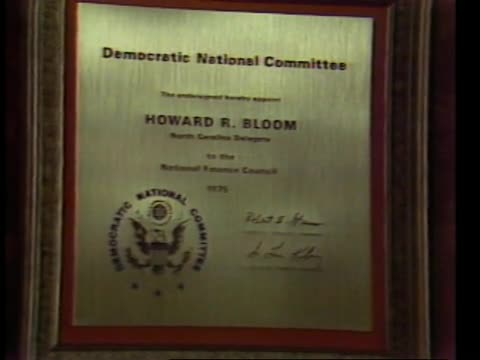
MacNEIL: A fairly prosperous community, Roanoke Rapids has its share of new homes and suburban shopping plazas. But while things are going well now, some of the town`s merchants fear that the struggle between J.P. Stevens and the Union may hurt them in the future. Howard Bloom runs a number of businesses in Roanoke Rapids. A member of the Democratic Party`s National Finance Council, Mr. Bloom attended the Carter-Mondale victory breakfast the morning after their nominations. His guests to that event were the President and the Chairman of the Board of J.P. Stevens.
HOWARD BLOOM: As far back as I can remember the mills were sort of the pivot of the community. They gave employment, but they also gave good deeds. They attracted good executives here, and they also gave us a feeling of security. In the very beginning the mills built the water lines that are here in Roanoke Rapids, and the filter plant, -and have turned them over to the city. They had a mill village which they owned, and in the early fifties turned it over to be bought by whoever wanted them. They contribute heavy to the charitable funds here. Even here in this restaurant they offered to help me one time when I was a little bit in dispute about what I needed to do as far as carpet. I mean, it was just a good foot forward in every area, it seems to me. And when someone comes in here and wants to start a disagreement, you know, it`s sort of looked down on.
INTERVIEWER: You`re speaking of the Union?
BLOOM: Well, whether it be the Union or some vandal that would come in and want to break the windows, or whether it would be some tramp that would want to embarrass somebody, or whatever.
INTERVIEWER: Well, you`re not comparing the Union to a vandal or a tramp, are you?
BLOOM: No, but I would compare it so someone who would be coming in to upset the general and normal nature of life. that goes on day to day.
INTERVIEWER: How do you see the Union upsetting the nature of life there?
BLOOM: When they talk about boycotting, I`m not naive enough to think it`s just a boycott on this mill. Because if these people can`t -- if the product here can`t be sold, they won`t make it any more, and if they won`t make it any more, there`s no employment here. And with times and conditions like they are, when employment goes down one percent in this city, it`s tough. And we just don`t need that sort of thing.
LUNDIE CANNON, Pro-Union Worker: Since the businessmen of this community thinks that the people that is in favor of a union is screwing up the whole community, I think it gives us a clear picture of how much these businessmen appreciate the people here making them fat off the salary that we have made:
CLARA WILLIAMS, Pro-Union Worker: These business, people are making a profit off of what I have to charge by charging me interest. If we could make a decent living we could go like other Americans and shop and pay cash for what we get, but here you can`t do it; at $3.x+0 an hour, it`s just me and my husband. He works and I work, and we don`t even make enough to pay the bills and have fun. You either have fun or you pay bills; there`s not enough money left over for both.
MacNEIL: The average hourly wage in the textile industry is $3.80 an hour, compared to $5.20 an hour for all manufacturing industries. Figures from the American Textile Manufacturing Institute also show that the percentage of women and blacks in textiles is greater than it is for all manufacturing. Forty-six percent of textile workers are women; the proportion of blacks has been increasing, and is now seventeen percent. Both sides in Roanoke Rapids agree that blacks have been important to the Union`s organizing effort.
KERMIT SMITH: I believe -- this is just my personal belief -- I believe because the Union is about eighty-five percent black people, that they have been promised -- or maybe they tend to believe more what they`re promised, I don`t know what it is -- but they have been promised -a lot of things that the Union cannot possibly deliver. And so if you win over the black people, then you`ve got half the battle won right there, whereas the people in the Educational Committee tend to be a little more wait-and-see attitude.
MacNEIL: Linwood Ivey waited, but what he saw was discrimination on the job. For that reason he and most other blacks feel the need for Union representation.
LINWOOD IVEY, Pro-Union Worker: I was the first black servicer in that plant. There was about four servicers in the plant when I went to work there-three white, and the other one black. Well, two of the whites are still there; one is a general overseer, one is a master mechanic and the other one has left the plant. So I`m still servicing. I figure I`m the senior servicer.
MacNEIL: While pro-Union workers concentrate on the boycott and the court battle over alleged bad-faith bargaining, the anti-Union workers are waging a campaign for a new election to oust the Union. They need thirty percent of Stevens workers in Roanoke Rapids to sign cards calling for an election. The petition drive has heightened tensions at the plants.
KERMIT SMITH: When we were getting these white cards signed to try to get people to sign the petitions to get rid of the Union in the first place, James Boone, who is a Union steward in the department right next to mine, the shipping department, he told all of the workers out there that if they signed these white cards they would leave themselves open for lawsuits-and what have you. I mean, while the violence wasn`t there in the form of actual physical violence, he still made threats; he intimidated the people.
JAMES BOONE, Pro-Union Worker: I feel like I believe in the Unions and that`s why I stood up from the first beginning. That`s why I went in there and helped sign cards. If that man believes in the Education Committee, that`s that man`s right; he has a right to stand up for what he believes in. I can`t help that. And that`s why I give him the same opportunity that he give me. I give him the same respect he give me. But I feel like that he have a certain time to sign up cards -- not on the company working time, but as long as he on his break, it`s all right with me for him to sign cards. But if he`s not on his break, I will go to the boss man and tell him that he`s not on his break; and I think he should be signing his cards on his break time, not on company time. Because you know the history of J.P. Stevens. All you got to do is go to the courts and find out; they`ll tell you the whole story. You can`t roll over, because they`ll sure stab you in the back.
That`s the way I feel about the company. I feel like that they would go into different people`s homes and talk to them just to get the Union out. But this is our livelihood, and if we let this go down the drain I feel like it would set us back another fifty years, and setting back fifty years is a long time. And this is all the hope`-we get. And we`re not just doing it for us; we`re doing it for the other Stevens workers. But if they`re getting the same treatment we`re getting: they`d feel the same way. But what an evil, working on the job, if you`ve got fear in your heart. That`s the most important thing. Fear and I just don`t want that. And I just want, if my son decides not to go to college, I want to make sure it`s better for him if he wants to work at the mill. I want it so he can go in there, won`t breathe cotton dust, he`ll go in there and won`t slip, grease on the floor, water on the floor. I want him so that he can go in there and hold his head up-and give the man eight hours a day of work -- that`s all I`m asking. And to respect him and pay him a decent salary. And the only way we`re going to do that is by letting the Union represent us.
JANIE HAWKINS: I don`t think J.P. Stevens will sign a contract. They have said that they would not sign a contract, and they will not and they will close these plants down. It has been done before, and they are shutting them down little by little now. And they cannot say that we are closing down on account of the Union, but they could lose enough money till they can show that they`ve lost this money, and if they`re losing money they can close down. And they`ll do it before they sign a contract. I believe that..
MacNEIL: Given the history of the textile industry, Janie Hawkins has reason to believe that J.P. Stevens just might pack up and move away rather than sign a Union contract. About fifty years ago, when the unions came into the textile mills in New England, those plants closed up and went South, where they were welcome and unions were not. As we`ve seen, however, that situation is now changing. Jim?
JIM LEHRER: Robin, the Stevens story raises political, philosophical and economic questions in great abundance. Also involved, of course, are many concerning the state of federal labor laws and Dan Pollitt is here to help sort out some of them. Mr. Pollitt is a Professor of Law at the University of North Carolina, Chapel Hill, and is a consultant and counsel to the House Committee on Education and Labor. Professor Pollitt, this overall dispute, now, has been going on between Stevens and the Union for thirteen years, and it`s been over two years, for instance, just since that election. Why have the labor laws not been able to resolve this once and for all?
DANIEL POLLITT: Well, the labor laws have not been able to take care of the problem because the labor laws as they were written back in 1935 did not contemplate that there would be what is known as a rogue employer like J.P. Stevens. J.P. Stevens has flaunted the law continuously since 1963; it has flaunted the Labor Board decisions, it`s flaunted the Court of Appeals decisions, and Congress did not contemplate that there would be such a major scofflaw and it did not give the Labor Board the weapons to deal with this problem.
LEHRER: You say they`ve flaunted the law, but in each case whatever fines that needed to be paid, or whatever, they have abided by that, have they not?
POLLITT: The whole problem is that there have been something like sixteen adjudication`s that J.P. Stevens has violated the law. The first adjudication involved the eighty-one people who were discharged, so each violation is a major violation. It`s not one or two people, it involves three or four plants. But what J.P. Stevens does, is promptly -- in three or four years, which is promptly in this area it pays the back pay which the people would have make had they not been illegally fired. It`s paid over 1.3 million; but what it does is, it puts the fear of God in these people. And you saw the anti-Union women, and they said that J.P. Stevens would never sign a contract.
LEHRER: Never sign a contract, and would close the plant down.
POLLITT: Close the plant, and it did close a plant down in Statesboro, Georgia. In Statesboro, Georgia, they were required to bargain with the Union -- the fifth circuit told them to bargain, they refused to bargain and they closed the plant.
LEHRER: All right. Now, there have been some recommended changes in the labor law that would possibly resolve these kinds of things. From a pro- labor standpoint., what are they, in general terms?
POLLITT: The first thing is to hit people like J.P. Stevens in the pocketbook. If J.P. Stevens signed a contract with this union, for ten cents an hour, which is minimal, for forty thousand workers. that would be something like eight million dollars a year in an additional wage bill, so J.P. Stevens is much better off violating the law, scaring people out of their rights and paying the $1.3 million fines. So if you can hit J.P. Stevens in the pocketbook, it might... if it`s more expensive to violate the law than to comply with the law, you`re going to get more compliance.
LEHRER: Then as it`s set now, your point is that it`s cheaper to violate the law.
POLLITT: Yeah, it`s much cheaper to violate the law. So the first thing is to make it more expensive to violate the law, and that means treble damages for these people when they are discharged. This means authorizing the purchasing agencies in the government to deny contracts to the people who repeatedly violate the federal laws.
LEHRER: All right, now, the other side of this. Of course, there are objections to all of this; what is the basic objection on the other side to any kind of changes in these laws?
POLLITT: I think the basic objection is illustrated in the opening scenes, when the New York Board of Trade gave J.P. Stevena` president their award. Here he`s been the number one scofflaw, the number one law violator since 1963, and they give him an award. So they don`t like the federal law, and they don`t want it to be strengthened.
LEHRER: In any way?
POLLITT: In any way.
LEHRER: All right. Thank you very much. Robin?
MacNEIL: Thank you, Professor Pollitt, and thank you, Jim. I`ll Just repeat what I said at the beginning: we gave J.P. Stevens every opportunity to put their case on this program. Jim Lehrer and I will be back tomorrow night. I`m Robert MacNeil. Good night.
- Series
- The MacNeil/Lehrer Report
- Episode
- Boycott of J. P. Stevens
- Producing Organization
- NewsHour Productions
- Contributing Organization
- National Records and Archives Administration (Washington, District of Columbia)
- AAPB ID
- cpb-aacip/507-h41jh3dt5c
If you have more information about this item than what is given here, or if you have concerns about this record, we want to know! Contact us, indicating the AAPB ID (cpb-aacip/507-h41jh3dt5c).
- Description
- Episode Description
- This episode features a discussion on the boycott of J.P. Stevens The guests are Daniel Pollitt, Carol Buckland. Byline: Robert MacNeil, Jim Lehrer
- Description
- Taped 12/12 but aired 12/22.
- Broadcast Date
- 1976-12-22
- Created Date
- 1976-12-12
- Topics
- Social Issues
- Business
- Employment
- Rights
- Copyright NewsHour Productions, LLC. Licensed under a Creative Commons Attribution-NonCommercial-NoDerivatives 4.0 International Public License (https://creativecommons.org/licenses/by-nc-nd/4.0/legalcode)
- Media type
- Moving Image
- Duration
- 00:31:31
- Credits
-
-
Producing Organization:
NewsHour Productions
- AAPB Contributor Holdings
-
National Records and Archives Administration
Identifier: 96317 (NARA catalog identifier)
Format: 2 inch videotape
If you have a copy of this asset and would like us to add it to our catalog, please contact us.
- Citations
- Chicago: “The MacNeil/Lehrer Report; Boycott of J. P. Stevens,” 1976-12-22, National Records and Archives Administration, American Archive of Public Broadcasting (GBH and the Library of Congress), Boston, MA and Washington, DC, accessed June 4, 2026, http://americanarchive.org/catalog/cpb-aacip-507-h41jh3dt5c.
- MLA: “The MacNeil/Lehrer Report; Boycott of J. P. Stevens.” 1976-12-22. National Records and Archives Administration, American Archive of Public Broadcasting (GBH and the Library of Congress), Boston, MA and Washington, DC. Web. June 4, 2026. <http://americanarchive.org/catalog/cpb-aacip-507-h41jh3dt5c>.
- APA: The MacNeil/Lehrer Report; Boycott of J. P. Stevens. Boston, MA: National Records and Archives Administration, American Archive of Public Broadcasting (GBH and the Library of Congress), Boston, MA and Washington, DC. Retrieved from http://americanarchive.org/catalog/cpb-aacip-507-h41jh3dt5c