The MacNeil/Lehrer Report; Inside Cambodia
- Transcript
ROBERT MacNEIL: Good evening. Communist China charged today that Vietnam, with Soviet support, was fighting a full-scale war of conquest in Cambodia, now called Kampuchea. The charge appeared in China`s of ficial newspaper, the People`s Daily, as the Cambodian government radio reported fighting on eight fronts all along the border with Vietnam; and the Cambodians charge that the Vietnamese planes were carrying out bombing raids within thirty- five miles of the capital, Phnom Penh. According to Vietnam, the fighting is by Cambodian rebels, the Kampuchean United Front for the National Salvation, set up last month. Yesterday that front claimed to have captured three provincial capitals, including the port city of Kratie on the Mekong River. The Cambodian government has asked the United Nations Security Council to meet, and the Carter administration says it supports that request. The heavier fighting has coincided with the decision by Cambodia to open their hidden country to Western eyes for the first time since the Communists took over there nearly four years ago. Tonight: inside Cambodia. Jim?
JIM LEHRER: Robin, Cambodia, the new Democratic Republic of Kampuchea, has been virtually sealed off from the outside world for nearly four years, since April 1975 when the old U.S.-backed government fell to the Communists. Most of the information since has come from refugees, who told stories of forced evacuation, of atrocities, of mass genocide. Some estimates said two million people had died, many of them murdered, since the Communists took over. Kampuchea officials occasionally denied such reports, but for the most part the questions and the criticisms from the rest of the world were ignored. But as the armed hostilities with Vietnam have heated up, Kampuchea has begun to open up -- primarily to claim the Vietnamese are seeking to take over their country by force, all with the backing and support of the Soviet Union. That Soviet element, of course, gives a big-picture tinge to what otherwise might be seen as two centuries- old enemies settling some ancient scores. The Chinese are supporting the Kampucheans; that`s the prospect of a major confrontation between the Communist world`s two superpowers over the Cambodia fighting.
The opening up of Cambodia has included the invitation to U.N. Secretary General Kurt Waldheim to visit, allowing tourists to visit the ancient temple ruins at Angkor, among other things; the most recent, the most dramatic step was the admission of two American journalists, Elizabeth Becker of the Washington Post and Richard Dudman of the St. Louis Post Dispatch. They have just returned from two weeks in Camboia and are with us tonight.
First, Ms. Becker, on the war: did you get the impression that the Kampucheans, the Cambodians, see this as a real fight for their survival, or is all of this just rhetoric?
ELIZABETH BECKER: At first it seemed as if it was mostly rhetoric. In our tour, which was a very carefully guided tour, we saw very, very few signs of war unless we were near the border, and we visited the border exactly once, and closer to the border in the south. Otherwise it seemed anything but a country going through an overall military preparedness. But every day, whenever we tried to venture out on our own, we were told that to do so would endanger us because they were a country at war. So we didn`t take it seriously. But since it was constant, and since it was underlined in every talk we had with an official, I think it`s deep-seated and I think it was far beyond rhetoric. And the events since have proved that`s the case.
LEHRER: Is that your impression, too, Dick Dudman?
RICHARD DUDMAN: I think they were taken by surprise by this new offensive. They told us repeatedly that the offensive of a year ago was a very serious one, that they beat them back in the great victory of last January 6th, and that the buildup of the Vietnamese along the border was only about one quarter what it was at that time, and they spoke very confidently that all there were were a few probing actions.
LEHRER: Elizabeth, you said that there was no -- for instance, here is a picture of somebody explaining to you... is that a typical war room picture? Was this part of a briefing?
BECKER: No, that is a shot taken inside the old headquarters of Lon Nol`s army, and it`s now a museum. And this man is pointing out how the Communists won in 1975.
LEHRER: I see. But that has no relationship... BECKER: No.
LEHRER: Now, here`s a picture you took on the border.
BECKER: On the border, two kilometers from the border at Krek.
LEHRER: You were not allowed to actually be on the front lines themselves.
BECKER: No, they would not. We came within two kilometers, and all we could hear were the planes over us and the sound of artillery, but we saw no fighting.
LEHRER: Dick, did you get any feeling for the state of military strength or readiness of the Cambodians to fight a major war with Vietnam?
DUDMAN: Not really. We got some indication of the Chinese assistance, which we know from other sources is important. We heard two Mics go overhead in Phnom Penh one day near the end of our visit; they are, we understand, part of the Chinese gift or sale or whatever of, I understand, about forty MiGs.
LEHRER: Were there any other outward signs of the Chinese presence?
BECKER: No, and I think that was on purpose. However, when we flew down, we came the only way you can, through Peking; and our flight was overwhelmingly filled with Chinese. And the same on the way back. But once we were there, they more or less disappeared from our sight. I have no idea how many there are or where they are or what they`re doing, from my own experience.
LEHRER: What about near the border? Did you see any up there with what military forces you did see?
BECKER: No. No, and it`s a point they came back to, that the Chinese are not acting as advisors. They accuse the Vietnamese of having Soviet advisors and Soviet pilots, and they wanted to make a point that they did not have Chinese; so if the Chinese were acting in any way like that we would not have seen it.
LEHRER: Well, look, the two of you barely escaped with your lives in that terrorist attack in Phnom Penh, and a British political economist traveling with you was killed. Dial you get the impression, Dick, that that attack was somehow tied in with the war in any way?
DUDMAN: Well, I don`t know. Either that, or with a domestic faction that wanted to make this government look bad. It could have been either source. I think their explanation, that this was an effort to show that they could not protect important guests, is probably the correct one. But beyond that it`s hard to say.
LEHRER: You don`t think it was a setup of some kind by the government, but it was a legitimate terrorist attack?
BECKER: I think you`d have to be a terribly cynical person to think that. Humanly, it`s impossible for me to imagine it.
LEHRER: Was there any question on that night that the gunman or the gunmen -- apparently it`s still unclear, is it not, as to how many were there, how many terrorists actually came?
BECKER: Now, Dick had a different view than I did; I saw only one. Dick, however, was on the second floor and he could answer how many people were outside the house because he had a view to the front gate and the road in front of us. But I saw only one, and we were told that at least three were involved: the gunman who probably killed Dr. Caldwell, and...
LEHRER: Here`s a picture of Dr. Caldwell with a Cambodian official.
BECKER: That`s Ieng Sary, the foreign minister.
LEHRER: Was there any question that those people came to kill all three of you?
BECKER: I have a lot of questions about that, and I don`t know.
LEHRER: What is your major question about?
BECKER: My major question is why Dick and I survived, because both of us were threatened by the gunman before Dr. Caldwell was, and we were both in close range and -- well, I wasn`t shot at. Dick was shot at, but he missed....
LEHRER: Dick, what`s your feeling on that? Did you have a feeling that the gunman who came at you and fired at you was trying to kill you, or was he looking for Caldwell, or what? What`s your impression?
DUDMAN: I`m not sure. I know he was trying to shoot at me, but... but I had the impression at first that he was motioning me out of the way. I shouldn`t have been out in the hall at all, and they took this shot at me and then fired two shots through the door. I have no doubt he was trying to get me, but his major target could well have been Caldwell, who was known as a friend of Cambodia. We were there as reporters.
LEHRER: All the questions about this are questions that`ll probably never be answered, too, right, Elizabeth?
BECKER: Well, we asked that a report be sent us, but I haven`t heard anything from the government.
LEHRER: All right. Robin?
MacNEIL: Richard, if you can leave aside your harrowing experience, as I guess it must have been, what are your general impressions of the new Kampuchea, which has undergone an incredible upheaval, we understand, as a country?
DUDMAN: I was not prepared to find a people that looked as well fed as they did. I didn`t see any signs of malnutrition, and certainly not starvation. I didn`t see backbreaking hard work; it was comparable to what our grandfathers used to do on farms in the United States. They work long hours, but so did they.
MacNEIL: I`ve read from your stories that you went -- as I guess any reporter would -- with uppermost in your mind trying to find some evidence for these stories that we`ve been reading for the last two years of mass executions, as many two million people having perhaps been eliminated, and that you were able to find no evidence for that, is that so -- for or against the stories?
DUDMAN: Yes. It was a very hard thing to get at. We thought of various ways to do it. We asked to see any prisons that they had; they said they had no prisons. We asked to see re-education camps, which they acknowledged they had; we weren`t given an opportunity. We asked about their system of justice; we were told that they had people`s courts and that the national justice organization, the ministry, did no more than ratify the findings of people`s courts. Now, that has an ominous sound.
MacNEIL: What kinds of sentences do those courts mete out?
DUDMAN: Well, they wouldn`t tell, but you can imagine, in the heat of one of the most extreme revolutions that the world has seen, that there must have been a lot of death sentences; I have no doubt of that myself.
MacNEIL: What was the attitude of the officials you asked when you asked them point-blank, What happened to all those people, are these atrocity stories true?
DUDMAN: They resented it, and I kept asking in connection with the evacuation of Phnom Penh also. They asked why we were so interested in a small minority of the people. They said that what they were more interest ed in was the eighty percent or ninety percent -- they used various percentages -- of the people that they said were ground-down peasants before whose lot had improved.
MacNEIL: Well, after all the changes -- you`ve brought some photographs back that you took there, and we have some of them here -- after all the changes that there have been, for instance, how is the agriculture organized now? We`ve read that people have been driven into the countryside to look after the agriculture; how does it appear to be organized?
DUDMAN: Well, they literally are driven; you see them being carried around by truck all the time; and walking to work in the fields. They get up at five and go to work either by truck or walking at seven o`clock every morning.
MacNEIL: A lot of women there, I notice.
DUDMAN: Women, and little children, too. Long lines of little children carrying firewood.
MacNEIL: And this is a shot inside one of their factories. How does the state of their economy look in terms of industrialization now?
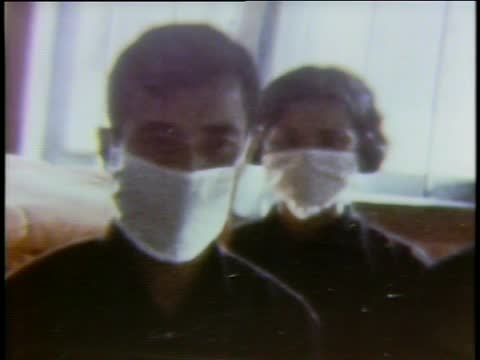
DUDMAN: Well, it`s pretty primitive. We saw some sophisticated plants. This textile plant, where they`re wearing face masks to prevent white lung, that looked like a reasonably efficient, fairly modern plant for a backward country. They`re using Chinese machines that had been put in in 1967. The rubber plant that we saw was fairly modern; it seemed to produce a good quality product for export in large quantity.
MacNEIL: But other aspects -- you have a picture here; what is that?
DUDMAN: That`s a blacksmith`s shop, and it`s very primitive. They`re making all their own tools, and there`s a fellow on a bicycle operating a bellows for the forges, and they`re hammering out ...I think that`s a hatchet head, probably.
MacNEIL: This sort of thing wouldn`t be uncommon in many parts of Southeast Asia, would it, especially more rural and less advanced parts?
DUDMAN: Well, as the principal way of producing tools, I think it`s unusually primitive.
MacNEIL: It is. And what about -- you say they didn`t look underfed to you -- what about things like housing? You have some pictures here.
DUDMAN: Housing is the most dramatic single thing I saw in the way of upgrading the life of the peasants. I happen to have stayed in some of those houses some years back, in the peasant houses, the grass shacks they very quickly get rat- and mice-infested, and bugs and things, and go to pieces in a hurry. Now they`re building them of lumber, hand sawed right there on the site, and they have cement footings, concrete footings that keep the stilts up out of the mud so that they won`t go to pieces with termites. They`re somewhat larger, these houses; they`re very simple. No kitchen. There`s no home cooking in Cambodia now. They all eat in mess halls. That`s one of the big changes. But they live in individual families in their houses.
MacNEIL: So you would score their revolution with some upgrading of the standard of peasant life, would you?
DUDMAN: Some upgrading.
MacNEIL: Or at least materially.
DUDMAN: But a lot of regimentation.
MacNEIL: I see. Now, everybody in the West, if they know anything about Cambodia, has heard of the temples, the famous ancient temples at Angkor Wat, and I believe you went by them and have a picture, and there has been a lot of concern in the West that they would be desecrated or destroyed or something. What condition did you find them in?
DUDMAN: We spent two days there and had a pretty good look at them. They`re not in bad condition. There was one place where they`d been shelled during the war. There was another place where very recently a tree fell down on one corner of one of the temples.
MacNEIL: Are they being maintained?
DUDMAN: Not at all. That`s a low-priority thing, and they will go to pieces. We saw plants growing up from between the cracks of the masonry, the stones, and that gradually will cause it to tumble down. We saw lichens growing on them; we saw bat dung in some places, that corrodes the surface. And it does take some maintenance and it`s not getting the maintenance it needs. They speak of doing it in the future, but they haven`t begun yet.
MacNEIL: All right, we`ll come back. Jim?
LEHRER: All right, Ms. Becker, yours was a special perspective. You`d been the Washington Post`s resident correspondent in Phnom Penh for two years,`73-`74. In general terms, what change struck you the most?
BECKER: The first change was, oddly enough, that it was no longer at war. It was a shock to go into the cities and to the countryside and not see any sign of war. The barbed wire is gone, the military equipment is gone -- at least from what I could see. But that was the most superficial beginning. The main impression that was so strange was the way of life. There are very few people; I didn`t see the people gathering together in the market or in a pagoda. It just seems that the whole rhythm had changed and it was a different country in that respect.
LEHRER: Different country in what way?
BECKER: In Cambodia before, first of all there were a lot of people who lived in cities and provincial capitals. When the Cambodians talked to us about how the ninety percent of the population had formerly been peasants, that`s not true. A much larger percentage than they would admit used to live in the cities and in the market towns. And that life which we all take for granted -- the ability to go down and gossip in the marketplace, buy some fruit juice, have your children go to a pagoda for education, go visit the monk if you have a problem -- that whole village life was gone, and the city life of course was gone.
LEHRER: Were you able to get any line on this question of genocide, of the two million people allegedly who died there?
BECKER: Certainly not by direct questions. A direct question would lead to a lecture on how irresponsible we are for caring only about a small number of people. I asked if there were elements of society that the government considered so corrupt that they couldn`t integrate them, a sanitized way of asking if, for instance, you thought all the officers of the army were beyond redemption. And I got a strange answer to it. We went about looking for clues by looking for people from the city; and Phnom Penh at the end of the war was between two million and three million people, out of a population estimated at the most at around six million, at the end of the war, that`s half the people. Yet in our travel we saw -we met two.
LEHRER: Two people who said they had come from Phnom Penh.
BECKER: Yes.
LEHRER: Were you able to talk to them?
BECKER: Yeah.
LEHRER: Did you ask them, "Hey, did they force you to do this?"
BECKER: Yes, we asked. And no, it was all voluntary, they said.
LEHRER: Did you ask them about mass killings and that sort of thing?
BECKER: Yes; they knew nothing about it. They told a very small little personal story about what they did during the war and then how they voluntarily went to a cooperative. And since then they were made part of the cooperative. One man told us it took him two years to win the confidence of the cooperative.
LEHRER: You must have come away with some kind of impression in your heart of hearts or your gut of guts about whether or not those mass killings took place. What is it?
BECKER: I`ll tell you what first triggered it, the opinion. We went to a dinner given us by the foreign minister, Ieng Sary. And first he chastised us for not asking enough questions about the war with Vietnam. Then, in the middle of his talk -- this is before dinner -- he gave an impromptu answer to the questions he must have known we`d been asking. He said something like, "About these so-called massacres and slaughters" -- and now I`m paraphrasing -- he said, "About these killings. Our Communist Party solved this problem in the best way. And if we hadn`t taken the route we had it would have been worse." Which I took as an admission that yes, in fact there were killings and it had to do with the radical change in the country.
LEHRER: Were there signs of mass graves or anything like that?
BECKER: No; nothing at all.
LEHRER: What is your feeling about the agricultural move, the forced evacuation, as it`s called? Is that working?
BECKER: (Laughing.) "Working."
LEHRER: The agricultural part?
BECKER: Well, working -- first, in their minds, it works if they become self-sufficient. So if you can agree that a goal is to be totally self- sufficient and not to depend on other countries, which is so radical that it`s almost incomprehensible for us, our world is so interconnected. So they believe it`s working, these-crude foundries...
LEHRER: Is there an ideological basis for the primitiveness of their workplace, so to speak?
BECKER: It is so they can truly consider themselves independent, self- sufficient and never having to rely on another country. They`re the most extreme reaction against a small country in the developing stage, deciding that they can`t trust a great power. Even though they rely quite a bit on China, it seems to me that they`ve gone out of their way to build this up themselves, regardless of the cost for the people.
LEHRER: Okay. Thank you. Robin?
MacNEIL: Yes, considering the social upheaval that Cambodia has undergone, which must be more extreme, in a sense, than any other revolutionary country has, how is that apparent to you as a visitor who has been there before during the war, covering the war there? Is it a nightmarish place for the people who survived to live in, or is all that behind them now?
DUDMAN: It must be a very restricted place. Nightmare? I don`t think so. It seemed to me we saw people who had a degree of spontaneity; children playing, people turning around and maybe yelling or smiling or laughing to see the strange sight of three Westerners go past in a Mercedes Benz. I didn`t see it as nightmarish.
MacNEIL: Elizabeth, did you get the same feeling?
BECKER: First I was taken aback by seeing all these Cambodians in black pajamas and the women in black sarongs. And I sort of get all those reactions, when you think, I`m now in a country that`s Communist and every body`s robots. But as soon as I started speaking to them, saying in Soksabaay, explaining to them in their language who I am, they were Cambodians again. And they smiled and they reacted to me.
MacNEIL: How is it organized? You gave us a small insight a moment ago when you said that they have new homes but the peasants eat in sort of communal eating arrangements. Is the basic structure of society or unit of society still the family, or has the Party intervened?
DUDMAN: No, it`s the co-op; these really are communal groups. They can be very large, up to 100,000 people; but then there`s subdivisions that eat together and so on.
MacNEIL: Is it your impression that it is more regimented than life in China, for instance?
DUDMAN: I think so.
MacNEIL: More regimented, more disciplined.
DUDMAN: I think so.
MacNEIL: Elizabeth, what do you think the revolution has achieved, you who knew Cambodia quite well up to a few years ago? Has it any positive achievements?
BECKER: Again, within their context. It`s very hard to compare the old with the new, because what the other society was working towards this one is not, in the sense that during the war I saw quite a few beggars and quite a few people who were very poor; malnutrition was a tremendous problem at the end of the war. Yeah, they`ve fed their people, they`re housed and they`re clothed. However, I did not know a Cambodia in peace before, I did not know it under Sihanouk.
MacNEIL: Do you think this is a regime, Pol Pot`s regime, the premier, that the United States should have diplomatic relations with? We don`t at the moment.
DUDMAN: I don`t think we ought to rush into it, but my own view is that the regime -- well, I don`t know how stable they are. I think that there really has to be an appraisal to see that they are a lasting regime, and these hostilities that are going on right now may well determine that. If they do last, I should think that it would be good to recognize them as a way of bringing them more into the family of nations. For so long they didn`t want that; now at least they want it, and we could help bring them out a little bit.
MacNEIL: Elizabeth, do you have a view on that, finally? The State Department, in saying that we supported the idea of an appeal to the Security Council yesterday, also stuck in the line that we still abhor the human rights situation there. Would we have to swallow something horrendous to recognize them?
BECKER: I`m not that well versed on the way that the human rights policy affects recognition of countries, and I`m confused on that, but generally, as an American, I can`t oppose recognition of any country, I don`t think.
MacNEIL: I see. And how long would you give the present regime, given the war situation and everything? Do you think we`re looking at something very temporary?
BECKER: It`s very unstable, I`d say.
MacNEIL: We`ll have to end it there. Thank you very much, Elizabeth, for joining us. Good night, Jim.
LEHRER: Good night, Robin.
MacNEIL: Thank you, Richard. That`s all for tonight. We`ll be back tomorrow night. I`m Robert MacNeil. Good night.
- Series
- The MacNeil/Lehrer Report
- Episode
- Inside Cambodia
- Producing Organization
- NewsHour Productions
- Contributing Organization
- National Records and Archives Administration (Washington, District of Columbia)
- AAPB ID
- cpb-aacip/507-h41jh3dt14
If you have more information about this item than what is given here, or if you have concerns about this record, we want to know! Contact us, indicating the AAPB ID (cpb-aacip/507-h41jh3dt14).
- Description
- Episode Description
- The main topic of this episode is Inside Cambodia. The guests are Richard Dudman, Elizabeth Becker. Byline: Robert MacNeil, Jim Lehrer
- Created Date
- 1979-01-04
- Topics
- Literature
- Global Affairs
- Race and Ethnicity
- War and Conflict
- Journalism
- Politics and Government
- Rights
- Copyright NewsHour Productions, LLC. Licensed under a Creative Commons Attribution-NonCommercial-NoDerivatives 4.0 International Public License (https://creativecommons.org/licenses/by-nc-nd/4.0/legalcode)
- Media type
- Moving Image
- Duration
- 00:30:47
- Credits
-
-
Producing Organization: NewsHour Productions
- AAPB Contributor Holdings
-
National Records and Archives Administration
Identifier: 96771 (NARA catalog identifier)
Format: 2 inch videotape
If you have a copy of this asset and would like us to add it to our catalog, please contact us.
- Citations
- Chicago: “The MacNeil/Lehrer Report; Inside Cambodia,” 1979-01-04, National Records and Archives Administration, American Archive of Public Broadcasting (GBH and the Library of Congress), Boston, MA and Washington, DC, accessed April 1, 2026, http://americanarchive.org/catalog/cpb-aacip-507-h41jh3dt14.
- MLA: “The MacNeil/Lehrer Report; Inside Cambodia.” 1979-01-04. National Records and Archives Administration, American Archive of Public Broadcasting (GBH and the Library of Congress), Boston, MA and Washington, DC. Web. April 1, 2026. <http://americanarchive.org/catalog/cpb-aacip-507-h41jh3dt14>.
- APA: The MacNeil/Lehrer Report; Inside Cambodia. Boston, MA: National Records and Archives Administration, American Archive of Public Broadcasting (GBH and the Library of Congress), Boston, MA and Washington, DC. Retrieved from http://americanarchive.org/catalog/cpb-aacip-507-h41jh3dt14