The NewsHour with Jim Lehrer
- Transcript
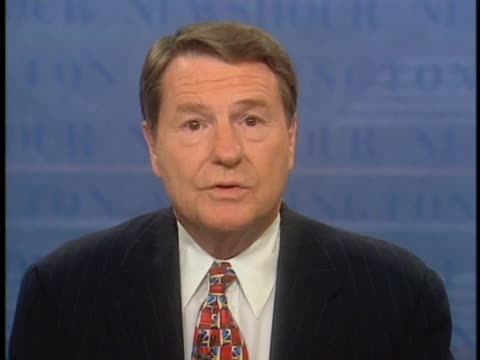
JIM LEHRER: Good evening. I'm Jim Lehrer. On the NewsHour tonight a Newsmaker interview with U.S. Ambassador to the United Nations Bill Richardson; a report on home health care in Louisiana; two views of the spat between William Weld and Jesse Helms; and a show and tell about the summer's news by four political cartoonists. It all follows our summary of the news this Monday. NEWS SUMMARY
JIM LEHRER: The budget and tax cut negotiations moved closer to a deal today. Those representing President Clinton and the Congress said the plan is to finish tonight or tomorrow, and legislation could be passed quickly by the House and Senate before Congress adjourns Friday for a month-long summer recess. House Budget Committee Chairman John Kasich said he expected a positive outcome.
REP. JOHN KASICH, [R] Ohio: There is nothing that I see that I think is not resolvable, and the fact is what has been different in this session of Congress, as opposed to the last session, is that there appears now to be a will on the part of the administration to get this done, and we certainly have the willpower. And when there's will, there's always a way.
JIM LEHRER: In Las Vegas today President Clinton told the National Governors' Association he was optimistic about an agreement. He said Wall Street expected one too.
PRESIDENT CLINTON: One of the things that keeps the economy going is confidence that we're serious about fiscal responsibility. So if we walk away from the budget agreement, we don't know what impact it would have on the stock market and on individual investment decisions and on the other things that keep our economy growing. So I think it would be a mistake. More important, this is a remarkable budget. Because of the prosperity of our country we have an historic opportunity to balance the budget in a way that reflects our values and strengthens our economy as well.
JIM LEHRER: Mr. Clinton also urged the governors to subsidize child care for welfare recipients entering the work force. And he repeated his call for performance standards for grade school students. Massachusetts Governor William Weld resigned today. He said it was so he could win confirmation as ambassador to Mexico. President Clinton formally nominated Weld for that job last week, but he's opposed by a fellow Republican, Sen. Jesse Helms of North Carolina. Helms is chairman of the Foreign Relations Committee, which must consider the nomination. Helms has said he would not even hold hearings on Weld. Weld made his announcement today in Boston.
GOV. WILLIAM WELD, [R] Massachusetts: Some have suggested, perhaps accurately, that my leaving state government will hurt my confirmation prospects, but by giving up the bully pulpit of the Governor's Office, I'll be surrendering a powerful tool with which to fight for confirmation. First of all, if you know me, you know I don't play by the Washington rules, but the more powerful point is that is not something the Governor's Office should be used for.
JIM LEHRER: A Helms spokesman called Weld's resignation a publicity stunt. And he wished him luck. We'll have more on this story later in the program. Air Force Chief of Staff General Ronald Fogelman today asked for early retirement. He submitted his request to Air Force Sec. Sheila Widnall. There were reports last week Fogelman would resign if Air Force generals were punished for not doing enough to prevent the bombing at the military barracks in Saudi Arabia last year in which 19 U.S. airmen were killed. The Israeli and Palestinian peace talks will resume within the next few days. That announcement followed Israel's decision to halt construction of new Jewish homes in a part of Jerusalem. Israeli Prime Minister Netanyahu said it was not the right time or place for such a project. The peace talks broke down in March partly because of a dispute over another housing venture. In Cambodia, Khmer Rouge Leader Pol Pot was denounced by his comrades in a show trial, an American journalist reported today. Nate Thayer, a correspondent with the "Far Eastern Economic Review," is the first western journalist to report seeing Pol Pot in 18 years. Thayer said the 69-year-old Communist leader was sentenced to life in prison. He's blamed for the killing of more than a million Cambodians during his four-year reign that ended in 1979. FBI Director Louis Freeh admitted today that his agents probably violated the legal rights of Richard Jewell. Jewell was later cleared as a suspect in the Olympic bombing case last year. The agents pretended they were making a training video and asked Jewell to waive his right to remain silent when they questioned him. Freeh testified before a Senate Judiciary hearing on the FBI's investigation of the bombing.
LOUIS FREEH, FBI Director: Once the instruction was given to provide Miranda warnings to Mr. Jewell, it was a major error of judgment to incorporate those warnings into the training videos areas. It is a matter of legal speculation whether a court would have ruled that Miranda warnings were required in that circumstance; however, if Miranda warnings were found to have been required, the training video ploy would almost certainly have rendered a waiver involuntary and resulted in suppression of any incriminating statements.
JIM LEHRER: Two agents were disciplined for the way they handled Jewell. Also at the capitol today federal investigators told a Senate committee that an estimated 40 percent of Medicare's home health care bills were fraudulent. The report was issued by the General Accounting Office. It said the home health care program was losing billions of dollars a year. An official explained how it happened.
GEORGE GROB, Health and Human Services: The payments that should not have been made were for services that were not medically necessary to patients that were not homebound, to patients with service plans that did not have adequate physician authorization, and in a very few cases where the documentary evidence did not support that any service had been provided.
JIM LEHRER: We'll have more on this story later in the program. Also coming, Amb. Richardson, Weld vs. Helms and vice versa, and what's funny in the news this summer. NEWSMAKER
JIM LEHRER: Bill Richardson, the U.S. ambassador to the United Nations, is first tonight. Margaret Warner is in charge.
MARGARET WARNER: Since Amb. Richardson assumed his UN post in February, he's been involved in negotiations as far away as the Congo and as close as the U.S. Congress, of which he was, until recently, a member. In this new job he has served as the President's special envoy to help negotiate the transition to a new government in the democratic Republic of Congo, formerly Zaire. He's also been the Clinton administration's point man in trying to persuade Congress to pay off America's outstanding debt to the United Nations. Welcome, Mr. Ambassador. You have finally gotten the Senate to pass a bill to pay at least part of the U.S. debt to the U.N., but attaching a lot of conditions, involving downsizing UN activities and personnel and also reducing future U.S. obligations. Can you sell that to the other UN members?
BILL RICHARDSON, U.S. Ambassador to the United Nations: Margaret, I believe we can. The President's policy of linking reform measures at the UN, alongside with paying our debt, I think has resulted in a bipartisan effort that we can live with, not perfect, that involves paying off the debt over a three-year period, close to 90 percent of it, coupled with some serious reforms that America wants, a smaller, leaner UN, consolidation, consistent with the new secretary-general's reform efforts. At this very moment, House & Senate negotiators are meeting on this bill, which we hope will be completed very soon, and we can put this issue behind us, paying our bills, having serious reform at the UN, and using the United Nations as a positive tool for America's foreign policy interests. I think we're on the way to resolving this problem. It's going to take an effort at the UN to sell it because it involves the United States wishing to pay a lesser assessment from 25 to 20 percent of UN dues that is more reflective of international economic conditions, and at the same time, other significant reforms that will make the UN more effective, more efficient, smaller, more efficient in going into peacekeeping operations, human rights, refugee issues, and many other basic functions that the UN does so well.
MARGARET WARNER: Now, the UN Secretary-General, Kofi Annan, told reporters that a lot of other members of the UN are offended, was his word, at what they see as sort of a unilateral U.S. declaration of what it will or won't do. What are you finding? What are they telling you in their private talks with them?
BILL RICHARDSON: Well, in my private talks I believe that the 184 other members of the UN are rooting for us to have a successful negotiation with Congress. They know it's been a difficult three years where the UN has not received its three-year arrears from the United States. But I believe that in the end, after we negotiate this package with Congress, which I believe is a moderate package, not entirely perfect, that in the end, the members of the United Nations will want an active America in the UN; they'll know we've been a constructive force, not just in peacekeeping but in the reform area, in the human rights area, in the refugee area, but also they will recognize that if we put this issue behind us, the issue of arrears, we can all focus as an international community on the big problems affecting us, where the UN can be effective, such as international terrorism, drugs, nuclear non-proliferation, the rise of Islamic fundamentalism, environmental degradation, the plight of women, areas of international concern that multilaterally through the UN the United States, by marshaling forces on a multilateral basis, can more effectively deal with these problems.
MARGARET WARNER: All right. Sticking with the politics of getting this deal done, when Mr. Annan, Secretary-General Annan, came out with his reform plan about--earlier this month, it was immediately criticized by Sen. Helms' staff and others. Do you think it meets the sort of conditions or requirements that these congressional Republicans want to put on U.S. money to the UN?
BILL RICHARDSON: Margaret, in our view, in the Clinton administration's view, Annan's reforms are consistent with the reform package that we negotiated with Congress. It's not perfect. There are some areas there, for instance--there's a new division on disarmament. There's a revolving fund thatwe're concerned about. But on the whole, Annan had staff cuts, consolidation, cabinet-style department. He brought a number of women into high policy jobs. We think that he has cut the UN by almost 10 percent. In the end, we do think that the Congress will see that this man is a reformer; that the Clinton administration is sincere and serious about reforms also, and in the end, I think the Congress will have done a good job of pressing reforms, getting the arrears paid, and moving ahead with the United Nations, where we've paid our arrears off, and we can really dedicate ourselves to resolving multilateral problems through this international institution.
MARGARET WARNER: And not to press this too much, but then it sounds like you're saying you're not encountering among other UN members the kind of resentment that Kofi Annan was saying publicly there was; that privately they're saying this is great because you're pushing the UN to reform?
BILL RICHARDSON: Well, privately, they're saying, we hope you succeed. The package is not totally negotiated. We're trying to make improvements in it. Publicly, yes, we have gotten a lot of grief from member states. They don't like the conditionality. They don't like the U.S. saying that our reforms are going to be a reduction in our assessment because they're going to have to pay more, but in the end, I believe that the international community will accept this arrears package as the best we can do, as one that is sound, and one in the end that will help reform the UN. It's not over yet, Margaret. We have the whole summer, till September. Negotiations are going on very positively, seriously on a bipartisan basis, and I think in the end, the member states will see that the Clinton administration has made a good faith effort; that the Republican Congress has cooperated; and that we will have paid off 90 percent of the debt with some significant and good reforms for the UN.
MARGARET WARNER: All right. Let's switch to the Congo. When you met with Laurent Kabila, the rebel leader who's become the president, six weeks ago, you said you thought you had a real breakthrough in terms of his commitment to democratization and human rights. What's your assessment now?
BILL RICHARDSON: Well, the jury is still out on Kabila. The next step has to be whether he allows full access for a UN investigative team that has gone in there to look at some very serious reports of massacres, repatriation, and refugee problems. The next step has to be Kabila respecting human rights, continuing his efforts to have elections in two years, having a bipartisan cabinet, not having these riots where there are alleged reports of killings. The jury is still out on this guy. The United States and the international community are prepared to help him but only if he pursues significant political, economic, and social reforms, and these human rights issues. If he doesn't, he's going to end up isolated. So far, the jury's still out. He made some positive steps. I say let's wait until this UN team is in there. There's been an advance team. They're about to go in, appointed by the Secretary-General. Let's see how Kabila reacts to them. That's going to be his big testing ground. If he is reluctant to give them full access and plays games with the team, as he has in the past, he doesn't live up to the commitment he made to me and to Secretary-General Annan and in the international community. But he's going to be isolated, and he's not going to get help.
MARGARET WARNER: Human Rights Watch and some other human rights groups were critical of Secretary-General Annan for essentially letting Kabila, if not dictate the membership of this investigative commission, to reject the first choice to head it. What's your view on that? Did Annan do the right thing, or should--
BILL RICHARDSON: I believe Annan was pragmatic and did the right thing. What happened was the previous human rights team got into horrendous negotiations with Kabila. Both sides lost credibility with each other, and the issue was going to be, is there going to be a team or not? Annan chose to name a team headed by distinguished UN human rights investigators. It's going to happen. It's not the perfect solution because the Kabilas of the world should not be able to dictate who investigates or doesn't. I think Annan was being pragmatic. We supported him in that effort, and we hope that Kabila totally gives access to this team that is looking at the massacres. If he doesn't, then there are going to be some very negative repercussions on Kabila and the way the international community can respond to help him.
MARGARET WARNER: Finally on Haiti, the UN mission, peacekeeping mission after three years, is supposed to end this Thursday, but the Secretary-General wants to extend it for four more months. You were just down there. Why now? Why is it necessary to do this?
BILL RICHARDSON: We need four more months of an international presence, of a UN presence, mainly to train local police there. We believe that four more months will allow us to get a very young, inexperienced Haitian national police to get the necessary mentoring and training. We believe after the four months there can be a reduced UN presence. We are confident in the Security Council in the next couple of days that we will get the mandate to renew it for four more months. The Russians and Chinese have agreed to support us. We believe that this investment in Haiti has resulted in a more peaceful, stable Haiti. There are still problems there, but if we pull out prematurely, not complete this police training, appear to be just leaving lock, stock, and barrel, without a foundation that develops democratic institutions there, elections, a lot of other important civilian implementation measures, civilian police so that there can be law and order in a country that has a lot of crime problem, that we would be premature in leaving, but we're confident through American leadership and Canadian leadership and others that we've managed to keep the presence of the UN for four more months, and we think that's going to help enormously in rebuilding Haiti.
MARGARET WARNER: All right. Well, thank you, Mr. Ambassador, very much for being with us.
BILL RICHARDSON: Thank you. FOCUS - HOME HEALTH CARE
JIM LEHRER: Now, some more in our ongoing reporting on the changing health care system in America. Government auditors told a Senate Committee today that Medicare fraud has been rising with the costs of home health care. Tom Bearden recently reported on the problem in Louisiana. Here's a second look.
TOM BEARDEN: Virtually every day a nurse or nurse's aide comes to visit the Gills' residence just outside Baton Rouge, Louisiana. Charles Gills has diabetes, Alzheimer's, and Parkinson's Disease.
HEALTH CARE WORKER: Let's check your vital signs before we get started.
TOM BEARDEN: The nurses check his blood pressure and breathing, clean the wounds on his feet, and make sure he's been taking the proper medication.
HEALTH CARE WORKER: You forgot to take your pill with your lunch today.
TOM BEARDEN: Gills' wife, Matty, is in the hospital because of heart problems. When she's home, the nurses take care of her too. Daughter Mona says she doesn't know what she would do without the help.
MONA GILLS COLLINS: Instead of trying to take care of him, you know, himself, and juggle his medications and everything, someone is there to give him the medications when he has to take 'em and everything. It was hit and miss when he was doing it himself, but, no, someone's there to do it for him. He's gotten much better, much stronger.
HEALTH CARE WORKER: [talking to patient] Hello. Morning. How are you doing?
PATIENT: All right.
TOM BEARDEN: Scenes like these are repeated hundreds of thousands of times each day across the country, courtesy of the federal government's home health care program. It's designed to bring medical services to Medicaid and Medicare recipients recently discharged from the hospital, or to provide treatments that will prevent hospitalization. The goal is better health care at a lower cost. The patients love it. Shirley Falsetta has received two visits a day from a home health care nurse ever since surgery a month ago to remove a blood clot in her leg.
SHIRLEY FALSETTA: They took me out of the hospital. I was in the hospital for three weeks doing nothing really. And I was able to come home and be in my own home and still have the same thing done.
TOM BEARDEN: Is that important to you, the fact that you can be at home?
SHIRLEY FALSETTA: Of course. Of course. Well, everybody wants to be at home. No one likes to look at four walls in a hospital.
TOM BEARDEN: The government pays about $80 for each home care visit, far less than a day in the hospital.
HEALTH CARE WORKER: [talking to patient] No pain up here?
TOM BEARDEN: But Medicare's spending for home health care has risen at an average of 30 percent every year for the last five years, far exceeding expectations. In 1995, Medicare paid out $16 billion to home care agencies. Bill Dombi is a vice president for the National Association for Home Care. He says costs are growing because the need is growing.
BILL DOMBI, National Association for Home Care: The fastest growing segment of our population is over 80, and invariably, they're afflicted with some kind of chronic illness or disease, which is going to require some support, so we have that growth in need, accompanied by growth in service. Over the last few years the Medicare home health expenditures have grown significantly, but in looking at where that growth is we see more than double the number of people receiving care. And I think that has to be viewed quite positively. People are going to home care, rather than in a nursing home.
TOM BEARDEN: That rapid growth in home visits has become a major concern for officials at the Health Care Finance Administration, the agency that pays the bills. Judy Berek says the growth has been accompanied by massive fraud.
JUDY BEREK, Health Care Financing Administration: We've had a major effort inside HCFA to look at what we call provider enrollment to make sure that we are doing a better job of only allowing into the program providers who are coming into the program for the purposes of providing services to beneficiaries and not people who look at the Medicare program as a program they can rip off.
TOM BEARDEN: Ripping off the program was apparently what Jack and Margie Mills had in mind. Last year in Georgia they were convicted of defrauding Medicare of more than a million dollars, billing the government for services that were never rendered. Several agencies in Louisiana are also getting special scrutiny from Washington.There are some 550 home health care agencies in the state, while neighboring Mississippi has just 75. And billings per patient are higher in Louisiana than anywhere else.
BOBBY JINDAL, Louisiana Secretary of Health & Hospitals: They're asking for a lot more money than I think we want to give 'em.
TOM BEARDEN: Bobby Jindal is Louisiana's Secretary of Health & Hospitals. In the year he's been on the job, the Department has found widespread abuse and conflict of interest.
BOBBY JINDAL: We have in certain cases where physicians are referring patients to their own home health agencies, which is not allowed by the law. We've got other home health agencies where they go and they perform shopping, or house cleaning, or they just do other types of services for individuals that are not medically covered, services you and I might like to have, but we don't ask the state to pay for them. We've got over-billing. We've got billing for patients that don't exist. We've been billed for patients that have been long dead. Those are the kinds of abuses we see throughout the entire program.
TOM BEARDEN: Investigators found that 40 percent of the billing in just 25 targeted agencies in Louisiana was improper.
BOBBY JINDAL: Part of the attraction of the home help is also its danger. Part of the attraction of allowing someone to live at home means that it's also unsupervised. It's obviously easier to supervise or check on an institution. It's much harder for the state to be in everybody's home, to watch over their shoulders, to know what's really going on.
HEALTH CARE WORKER: [talking to patient] Just relax your arm down.
TOM BEARDEN: When Jindal took office last year, home health agencies were growing so rapidly that his department didn't have enough people to keep up with inspecting them. The legislature passed a moratorium on new agencies, and Jindal is asking it be extended to the year 2000. That has stirred some debate.
RODNEY ALEXANDER, State Representative: If you've been keeping up with the news, if you know anything about what's happening in the state of Louisiana, you know that home health agencies, for instance, have skyrocketed in the numbers. This will again place a moratorium on those agencies and stop that--give the department some latitude in trying to get a handle on this.
RAYMOND JETSON, State Representative: The home health agencies are little folks. They are persons who--who display the entrepreneurial spirit and start small businesses and go into business. And I believe that there's a fundamental problem with saying to folks that you can't start a business; you can't go into a particular business, not because you aren't capable of it, not because you don't have the expertise necessary to be successful, but simply because government says you shouldn't go into that business.
TOM BEARDEN: Not surprisingly, current owners of home care agencies support a continued moratorium.
BECKY LINGUITI, Home Care Agency Owner: We're not dealing with a fruit stand or a grocery store, or just a private business, so to speak. We're dealing with people's lives. We're dealing with state and federal funds, and there are some problems.
TOM BEARDEN: Becky Linguiti was a nurse for eighteen years before starting her own home care agency six years ago. She also heads the Louisiana chapter of the Home Care Association of America.
BECKY LINGUITI: We need to figure out what's going wrong, what do we need to do differently, how can we improve to really focus on patient care and the intent of the program. There's going to be people that entered into this program that aren't going to want to be in it anymore.
TOM BEARDEN: One of the reforms being talked about both in Louisiana and in Washington is whether to move home care agencies toward a payment plan called "capitation" that puts a limit on the amount paid out for various health problems.
JUDY BEREK: We want to set rates of payment on an episodic basis that says, you know, if you've been in a hospital and you come out and you need home health care, odds are this is how much home health care you need. And that's what we'll pay the agency for.
TOM BEARDEN: Members of the National Association for Home Care aren't opposed to that but warn that if care is limited too much, it can be more costly in the long run. They point to a government study of people in managed care plans whose home care was limited.
BILL DOMBI: What they have found there were the patients are significantly under-served with negative outcomes--negative outcomes mean they go back into the hospital, they get sicker for a longer--stay sick for a longer period of time, or they're not rehabilitated appropriately. So what we'd have to do on the payment reform side is make sure the quality of care is maintained, the patient outcomes are appropriately achieved, and that resources be developed to focus in on that.
TOM BEARDEN: Benny Lanoix is watching all this with some anxiety. He suffers from emphysema and receives three home care visits a week.
BENNY LANOIX: I couldn't do without it because my wife, she couldn't--she couldn't take care of me because she done had a heart operation and broke her hip, so she couldn't take care of me, so I need somebody.
TOM BEARDEN: Lanoix hopes he will continue to get help while the government tries to figure out how to deal with fraud and rising demand for the service, without defeating the whole purpose of the program, reducing costs by keeping people out of hospitals and in their homes, where studies show they clearly stay healthier and happier.
JIM LEHRER: Louisiana Secretary of Health Bobby Jindal, who was in that report, did testify today about home health care fraud before the Senate Committee on Aging. Still to come on the NewsHour tonight, the Weld-Helms scrap, and the cartoonists' view of summer. FOCUS - FACE-OFF
JIM LEHRER: Weld versus Helms and vice versa. Kwame Holman begins our coverage.
KWAME HOLMAN: Massachusetts Gov. William is a very popular Republican in a very Democratic state. In an attempt to win a Senate seat last year, Weld appealed to voters with everything from dancing the macarena to diving into Boston's Charles River to demonstrate his commitment to clean water. The 51-year-old moderate's effort to unseat equally popular liberal John Kerry was a gentlemanly, tightly contested affair. The two did split on taxes and welfare reform but shared views in support of abortion rights and gay rights. In the end, Weld lost by 7 percentage points. The White House publicly floated the prospect of nominating Weld to be ambassador to Mexico three months ago. But the reaction from conservative Republican Senator Jesse Helms, chairman of the Senate Foreign Relations Committee that controls such nominations, was swift and negative. Helms stated Weld is "not ambassador quality." He objected to Weld's support for medicinal use of marijuana and needle exchange programs for drug addicts. Helms also criticized the governor's record of prosecuting drug offenders. Weld served as a federal prosecutor during the 1980's, and as the feud with Helms grew more public he asked the President not to back off from the nomination. And he spoke directly about Senator Helms.
GOV. WILLIAM WELD: Sen. Helms's opposition has nothing whatsoever to do with drug policy. It has everything to do with the future of the Republican Party. In plain language, I am not Senator Helms's kind of Republican.
KWAME HOLMAN: In spite of the well-publicized war of words, President Clinton officially nominated Weld last week.
GOV. WILLIAM WELD: The next step, as I say, is try to persuade everybody that we should have a hearing, which I think is only in the interests of American fair play and then persuade people that I am, despite the contrary opinion of some, ambassador quality.
KWAME HOLMAN: But yesterday, Senate Majority Leader Trent Lott said Weld's public statements about Helms were ill-advised.
SEN. TRENT LOTT, Majority Leader: The biggest problem right now is Gov. Weld shot his foot off. He held a press conference and bashed the chairman of the committee that holds his fate on this nomination. I don't think his chances are very good, and he hurt himself by attacking the chairman unfairly and with political rhetoric that was just uncalled for.
KWAME HOLMAN: Today, the President was in Las Vegas at a meeting of the National Governors' Association.
PRESIDENT CLINTON: I wish Governor Weld were here for me to thank him, but I appreciate the fact that he's willing to go to Mexico. And I hope we can get him there. [applause]
KWAME HOLMAN: This afternoon in Boston, Weld announced his resignation as governor, saying he'll devote full time to a fight for the job of ambassador to Mexico.
GOV. WILLIAM WELD: Mexico is of critical political and economic importance to the United States, including Massachusetts. With the North American Free Trade Agreement and the regionalization of political systems and economies all over the world, our relationship with our hemispheric neighbors has never been more important. Both the opportunities and problems facing us in Mexico are huge, and I am genuinely excited by the prospect of taking them on. I've been nominated by the President to be ambassador to Mexico. That obviously changes the situation somewhat. And it looks as though that's going to be a long fight. I'm not sure that I see it's appropriate for me to use the governor's office to advance my own prospects in that fight. I think it's better for the people of Massachusetts to have Paul take over, with a fresh charge, and have me go and ask a question in Washington, a very simple question, which is: Why shouldn't there be a hearing on our country's representation in Mexico and our relationship with Mexico, one of our most important allies? I think you could make a case that the job of a committee chairman is to schedule hearings, not to block hearings, so that the people's business can be done. Maybe that's Washington rules. Washington is such a respecter of persons, but I don't play by those rules. I haven't played by those rules up here the last six and a half years. And if I have, let me tell you something, we wouldn't have gotten anything done.
KWAME HOLMAN: Weld comes to Washington later this week for meetings with State Department officials.
JIM LEHRER: Mike Barnicle is a columnist of the "Boston Globe" and a NewsHour regular. Ralph Hallow is senior national correspondent for the "Washington Times." Mike Barnicle, does Weld think he can overcome Jesse Helms, or is something else at work here?
MIKE BARNICLE, Boston Globe: Oh, I think there's probably a couple of different ball games going on here. I think the ball game that he's playing with--the inner ball game with Jesse Helms, the Senate, and the President, but I also think he's probably talking a lot to people who live in Scranton, Pennsylvania; Concord, New Hampshire; Des Moines, Iowa--you know, Concord, New Hampshire, where the first presidential primary is going to be held in a couple of years. He's got ambitions I think beyond Mexico, far beyond Jesse Helms, so, yes, there's a lot going on here.
JIM LEHRER: Do you agree with that, Mr. Hallow?
RALPH HALLOW, Washington Times: Oh, yes. There are two--there's the real reason that he did this, not the reason he said. The reason he said, of course, was to campaign full-time in the United States Senate to get those folks to pressure Sen. Helms to schedule a hearing. The real reason behind that is that he wants his lieutenant governor, Paul Salucci, to have fourteen/sixteen months in office as the incumbent governor to give him an edge over Joe Kennedy or whoever the Democrats--
JIM LEHRER: Whoever the Democrats want.
RALPH HALLOW: But the real reason behind that is--was I think revealed by what the governor said. In attacking Sen. Helms, he said he doesn't represent what I represent in the Republican Party. This is--his objection is not my drug policy. This is about the future of the Republican Party. And I think what we saw here was the opening salvo in the upcoming fight of the liberals and centrists in the Republican Party to take that party--they would put it--take it back--I think they'd say. If not, in next year's- -the 2000 election for the presidency--at least sometime later.
JIM LEHRER: So you believe too then, Mike Barnicle, that Bill Weld wants to be President of the United States.
MIKE BARNICLE: Sure. Yes, I think he does. And I think, you know, he looks around, and he saw Michael Dukakis run for President from the governorship of Massachusetts, and if he could, who couldn't, and I think he sees Bill Clinton, who he's known a long time as President of the United States and he's smart enough and arrogant enough, and self-assured enough to think why not me and why not now and why not start today?
JIM LEHRER: All right. Now, let's go to the other side of the equation, Mr. Hallow, and that's Jesse Helms. What's motivating him to hold this up like that and to refuse to have even a hearing on this nomination?
RALPH HALLOW: Senator Helms does not like what this governor stands for when it comes to drug policy doesn't think it's appropriate to have the United States ambassador to Mexico, where we have one of the biggest problems, that is, the importation of drugs from Mexico, a man who is more than soft on drugs. He is a libertarian on drug use, believes that drugs should be de- criminalized or illegalized. His record as a United States attorney ranked him, I think, in the bottom two or three when it came to drug prosecutions, so his personal philosophy on drugs carried over to his official duties, so it's argued. On top of that, conservatives in the Republican Party would be displeased to see a man like Governor Weld, who has been so in-your-face about his views compared to those of what Republicans like to think of as their mainstream conservative views.
JIM LEHRER: But that explains why you would be opposed. But why would he not--why would he not even allow a hearing on the nomination? Why is that big a thing to Jesse Helms?
RALPH HALLOW: The course of events were a slap in the face to Sen. Helms from the beginning. Before the White House- -first of all, the governor shopped around a job with this administration--wanted the attorney general's job, Janet Reno's job. When it was decided that he was offered three ambassadorships, and they settled on Mexico. Before the administration had a chance, the White House had a chance to clear that with Sen. Helms, which is normally what's done behind the scenes. You go to the chairman of the committee, say, is this going to work, is this going to fly, is this okay? The governor leaked word that that was going to be his appointment from the Clinton administration. That was a calculated mistake, I believe, because I think he was less interested in the ambassadorship than, as I say, in leading the liberaling of the Republican Party in 2000 and beyond.
JIM LEHRER: Mike Barnicle, how do you read Jesse Helms's motivations?
MIKE BARNICLE: Well, I think it's, you know, hard for anyone other than Jesse Helms to read his actual motivation. I think part of it is pretty basic, much more basic than what has just been said, and it gets to the root of human nature. During the course of his campaign for the Senate last fall against John Kerrey during one of the debates Gov. Weld was asked whether or not as a sitting Republican member of the Senate, whether he would vote for Jesse Helms to retain the chairmanship of the Foreign Relations Committee, and he pretty much said no, went out of his way to say no, and indicated that why he wouldn't vote for him; that--as he did last week--that Jesse Helms didn't represent what Bill Weld represented. So now what goes around comes around. And I imagine Jesse Helms is sitting there, saying, fine, you wouldn't vote for me to retain the chairmanship, I'm the chairman; see you later.
JIM LEHRER: What about the issue? What do you think the viability of the issue that Weld is raising--he raised today--hey, look, I don't play by the Washington rules, the Washington rules--as Mr. Hallow just said--you're supposed to check with the committee. Nobody did that. He's playing it his rules, his way. Is that a winning selling point, do you think, for William Weld, out in the country?
MIKE BARNICLE: Well, just as an average television viewer and citizen all I can think of is what I saw on the television during the Republican Convention in Houston five years ago when Jesse Helms's wing of the Republican Party took the presidency away from George Bush, I think, and that they frightened a great deal of Americans, who were watching that convention. I think Weld is thinking of that, and I think he's thinking of the larger country beyond Washington, beyond this insider baseball, this inside Senate politics, this inside administration politics, and he's trying to tell people who are listening--if any are listening--that he's a moderate guy; that he's not Pat Buchanan; that he's not Newt Gingrich; that he's not Jesse Helms; and maybe the Republican Party--if they're ever to have a chance to win nationally across the board--they'd better start looking at people like him.
JIM LEHRER: Is there mileage in that, Mr. Hallow?
RALPH HALLOW: No, I don't think so. With all due respect to Mike Barnicle, the fact is that the Republican Party scored great successes when it had a conservative standard bearer, if not Jesse Helms, Ronald Reagan, for example. Nixon was thought to be a conservative, at least by liberals. It took over the Congress--on the conservative platform.
JIM LEHRER: But about the point--the original question I asked Mike--which is: do you think his argument, Weld's argument with the public that here's a United States Senator, won't even give me a hearing, is going to sell out in the country?
RALPH HALLOW: I think it'll sell, and he's got it calculated right--it'll sell enough with the people "he" wants it to sell to, to get his name known and remembered nationally.
JIM LEHRER: As somebody who made this case, you mean? He's out there fighting and--
RALPH HALLOW: Yes. I'm a rebel with a cause. Most people I think who know Weld say he's a rebel--a liberal without a cause, but the idea that I'm selling myself as a rebel with a cause--and I'm not your average Washington bureaucrat or conformist, and that's nice; that has a nice appeal. How far it will go, I don't know.
JIM LEHRER: Do you think he's going to be the U.S. ambassador to Mexico, in a word?
RALPH HALLOW: No.
JIM LEHRER: Do you, Mike Barnicle?
MIKE BARNICLE: No.
JIM LEHRER: Thank you, gentlemen, very much.
RALPH HALLOW: A pleasure. FINALLY - DRAWING THE LINES
JIM LEHRER: Finally tonight, a special perspective on the political and other events of this summer. It is that of editorial cartoonists who regularly appear on the NewsHour. Elizabeth Farnsworth talked with them last week.
ELIZABETH FARNSWORTH: They are: Doug Marlette of Newsday; Steve Kelley of the San Diego Union-Tribune; Ann Telnaes of the North American Syndicate; and Michael Ramirez of the Memphis Commercial Appeal. Welcome to all of you. Michael, are the campaign finance hearings giving you some great material?
MICHAEL RAMIREZ, Memphis Commercial Appeal: You know, these hearings are always great material. You know, we're anticipating who's going to be the next Ollie North. And it's just a lot of fun. In fact, it's covered three or four days worth of material. And I'm sure it's going to get more and more exciting as they reveal more and more information.
ELIZABETH FARNSWORTH: Show me something you've done.
MICHAEL RAMIREZ: Well, the one that I just--I did recently was I was viewing the Democrats really as an impediment to the process. So I drew them in the old three monkeys--See No Evil, Hear No Evil, and Speak No Evil--with Fred Thompson kind of sitting on the side. And it was just generally--it was actually a literal interpretation, I think, of the events when you see what John Glenn was doing, even before the hearings started. He had this campaign out there to kind of sidetrack it, and then following Bob Torricelli's comments, it just seemed like they didn't really want the information to come out. So I just kind of do that in the cartoon.
ELIZABETH FARNSWORTH: Steve Kelley, are cartoons generally great for cartoonists--I'm sorry--I mean, are hearings generally great for cartoonists?
STEVE KELLEY, San Diego Union Tribune: Well, I don't think generally they are. In fact, there's been a lot of criticism of these hearings, if they are deadly dull. I don't know what the public expects. You can't really have the--you know--the Rockettes come out there doing high kicks during these hearings. But what amazes me is that although they find--the public finds these hearings dull, they can't get enough pictures of the surface of Mars. That, to them, is really exciting. So actually the cartoon that I did on the hearings was pin the donkey's tail on the scapegoat. I had the Democratic donkey walking over the old party game, getting ready to stick a tail on--the blame on John Huang, who is shown as a goat in the cartoon. A lot of the Democrats are saying that this John Huang character--well, he was just a rogue fund-raiser and, you know, he wasn't really working on behalf of us. He was sort of out on his own, sort of the way Republicans talk about Ollie North.
ELIZABETH FARNSWORTH: Doug Marlette, what about House Speaker Newt Gingrich's troubles, what have you been doing on that?
DOUG MARLETTE, Newsday: I drew a couple of tourists in Washington saying, "Didn't you used to be Newt Gingrich?".
ELIZABETH FARNSWORTH: Yes. Let's see that.
DOUG MARLETTE: But Newt is--
ELIZABETH FARNSWORTH: There it is.
DOUG MARLETTE: I find Newt Gingrich to be very much like Bill Clinton. I just got in this--the last time I was here- -you know, black-eyed peas in a pod. They're both kind of--Gingrich is kind of Clinton's evil twin. And I think of them as--as a matter of fact, I think of them as like this movie "Face Off," with John Travolta and Nicholas Cage. It's like they've exchanged faces, and they have, you know--Clinton is not sufficiently mean-spirited for the right-wing Republicans, and Gingrich is now, you know, shifting--mutating into kind of a more liberal--and so they're both--I think it's because they've exchanged souls.
ELIZABETH FARNSWORTH: Ann Telnaes, is Newt Gingrich, in general, a really good subject for cartoonists?
ANN TELNAES, North America Syndicate: Well, lately, yes. I mean, we have just gone through that coup in the House of Representatives.
ELIZABETH FARNSWORTH: Or attempted coup.
ANN TELNAES: Or attempted coup. That's right. It didn't actually happen, but I actually did a cartoon on Newt Gingrich about a month ago when they were trying to pass the--
ELIZABETH FARNSWORTH: Let's see that one.
ANN TELNAES: --flood relief bill. And at the time, they were having a lot of problems because the Republicans had attached some provisions to the bill. And Newt Gingrich, when he finally did talk to the press about it, said, oh, you know, you guys are making a mountain out of a mole hill; we're not having any problems; we're just all very tired because we're staying up all night long, trying to pass this bill. So I drew Newt Gingrich tied to a stake with a bunch of little Republican elephants running around with their spears and their axes and things. So it's kind of funny since I did this cartoon a whole month ago, and now it actually has come true.
ELIZABETH FARNSWORTH: Okay. Let's look at some of the substantive issues that are being dealt with this summer--taxes, for example, tax reform, the budget. These are pretty dry and difficult issues. How do you approach such a complex subject?
ANN TELNAES: You know, I do find it difficult. Anything to do with the budget or tax cuts, because there's so much information you have to take all the information and put it into one little cartoon. You know, it's not like you have a column, and you can write words and words and words and describe what's going on or how you feel about it. But the whole thing about the tax issue now, you know, the three different plans from the House, the Senate, and President Clinton, at least what I got out of it, they're pretty similar. So I just thought, you know, where is all this talk that we had during the elections about tax reform? You know, everybody hates to fill out their taxes.
ELIZABETH FARNSWORTH: Tax simplification.
ANN TELNAES: Right. The simplification of actually having--
ELIZABETH FARNSWORTH: So what did you do? Show us what you did.
ANN TELNAES: So what I did is I drew a maze, and I stuck Clinton in the middle of it, along with a Democrat and a Republican. And, of course, that's Joe Public there. And I just had them proudly proclaim to us we've expanded it, like, it's supposed to be wonderful; all we're going to have to do is spend more time filling out our tax forms.
ELIZABETH FARNSWORTH: Steve Kelley, do you have to understand a subject to do a cartoon on it?
STEVE KELLEY: Well, I think--
ELIZABETH FARNSWORTH: I know this is a very intimate question.
STEVE KELLEY: I get phone calls and letters from readers suggesting otherwise, but I like to think that I understand issues before I comment on them. I find the budget process fascinating because it's where the two--the two grand philosophies collide is at the budget. You know, what people talk about is one thing; what gets funded is the actual business of government. So that's right where the rubber hits the road, is the budget process.
ELIZABETH FARNSWORTH: And, Michael, what about you, do you think that these subjects are inherently so difficult it's hard for cartooning, or no?
MICHAEL RAMIREZ: Well, no. I think they lend themselves to cartooning really because I think Steve is correct. These are the battles that are fought, and especially with the budget process, when you look at all that's going on, the different proposals, they're balancing the budget for the first time in twenty-eight years. I think that's an amazing accomplishment. But, yet, with this budget plan that they're putting forward right now, I think they're going to be more--the deficit's going to grow like $97 billion. If they left it alone, it would be $67 billion. And these are things that I think people are interested in, and ask any American around tax time if they're concerned about their budget and their taxes and, believe me, they're dedicated to find out in detail what's going on. And it's kind of complex. If we can fashion it into a good visual metaphor, it really represents what is going on out there, I think we've accomplished something.
ELIZABETH FARNSWORTH: How do you fashion it into a good visual metaphor? What do you do, Doug?
DOUG MARLETTE: Well, you know, it is our job to enliven these subjects. There's a reason economics is called the dismal science. I mean, I frankly am bored by these topics. But I try to find something to keep me interested. And whenever we have these topics like the Mike Tyson--you know, we have--it seems like we have tabloid subjects, like the Cunanan thing, and then we have, you know, taxes and--
ELIZABETH FARNSWORTH: Cunanan--
DOUG MARLETTE: We have the weird extreme. So whenever I can use those--as I did with Mike Tyson--
ELIZABETH FARNSWORTH: Let's see this cartoon, the one that you did about the--
DOUG MARLETTE: I have Clinton stand there with a tape over his ear looking at tax cuts. And a couple of aides are saying, the Republicans are getting desperate; Gingrich bit his ear. Trying to find an off-the-nose way to talk about what's going on and something that is interesting. I mean, I naturally associated that because Gingrich and Tyson remind me of each other. You know, Gingrich has--they both speak in an adenoidal register. And they're both, you know, fairly vicious, so naturally I was attracted to that.
ELIZABETH FARNSWORTH: Naturally. Moving on to space. Michael, lots of news from space this summer with the Mars and Mir. Tell me what you did on space.
MICHAEL RAMIREZ: Space is the final frontier for editorial cartoonists. It's just been wonderful. And there are stories about John Glenn at 65 wanting to go into space. A lot of editorial cartoonists believe that he's actually already there. I did a cartoon on the Mir spaceship, though, and it kind of seemed to me, with all the things that they are doing, they are pretty much putting it back together with duct tape. And it kind of reminded me of that neighbor down the street with the old Chevy Impala just trying onelast thing to get it to run, so my cartoon is basically- -I've got the cosmonaut out in the back, and he's fiddling around under the hood of the Impala, which is kind of a combination of Russian Volga and an Impala, trying to get it to turn over. And he's going to try it one more time.
ELIZABETH FARNSWORTH: Steve, what about--you had an interesting take on Mars.
STEVE KELLEY: I did Politicians on Mars get a new hot button issue, and I drew this little Martian up there at a podium--he's a politician--saying, "It's time to get serious about these illegal aliens," and the Sojourner was coming off the mother ship. And I just thought it was interesting to consider what it would be like for us to be illegal aliens somewhere. And I thought that was amusing.
ELIZABETH FARNSWORTH: You don't find the space story inherently so interesting.
STEVE KELLEY: Well, you know, I found it fascinating that we landed on Mars. Now that we've done that, seen, you know, photographs of rocks with--I mean, think of--it has to be dull if they have to name the rocks after cartoon characters, doesn't it, just to make it interesting.
ELIZABETH FARNSWORTH: Okay. Ann, what else has caught your imagination this summer?
ANN TELNAES: Well, like most people, I've been watching the Cunanan story, the Versace murder, and they actually just found him, unfortunately. He had committed suicide. But I found it very interesting that there was so much media coverage on this murder. Now--
ELIZABETH FARNSWORTH: Cunanan is the person who is suspected of being the murderer.
ANN TELNAES: That's right. Andrew Cunanan.
ELIZABETH FARNSWORTH: Of Versace.
ANN TELNAES: Right. And I found it very interesting there was so much media coverage. You could not turn the TV on for more than a few minutes, and there would be a story about it, or there would be somebody talking about serial murders, or something that they'd have to dissect every single thing. Is he dressing as a woman? Where is he now? And I thought it was just very interesting, the fact that we had that, and then we have had Radovan Karadzic, the Bosnian Serb leader who has been wanted for over a year now for war crimes.
ELIZABETH FARNSWORTH: Let's look at that cartoon.
ANN TELNAES: And what I did was I put them both in a "wanted" poster and for the Karadzic one, I put "Sort of Wanted," because, you know, we've gone for so long. You know, supposedly he is--he's wanted for genocide, and it doesn't get the same media attention. And the public doesn't seem to be as interested. No one seems to be as interested because it's just not as sensational as the Cunanan thing. So I just thought it was interesting. It's sometimes very effective when you put two images like that together because it kind of puts things in perspective a little bit.
ELIZABETH FARNSWORTH: Doug, what's caught your interest this summer, besides what we've already talked about?
DOUG MARLETTE: The talk about apologizing for slavery has been, you know, one of those trial lead balloons that was floated by the Clinton administration. I just find the whole subject interesting.
ELIZABETH FARNSWORTH: Let's see that.
DOUG MARLETTE: I did this drawing of a bunch of Disneyesque animals, standing in the glade, and a little Thumper type character saying, "It's an apology from President Clinton for natural
- Series
- The NewsHour with Jim Lehrer
- Producing Organization
- NewsHour Productions
- Contributing Organization
- NewsHour Productions (Washington, District of Columbia)
- AAPB ID
- cpb-aacip/507-g44hm53776
If you have more information about this item than what is given here, or if you have concerns about this record, we want to know! Contact us, indicating the AAPB ID (cpb-aacip/507-g44hm53776).
- Description
- Episode Description
- This episode's headline: Newsmaker; Home Health Care; Face-Off; Drawing the Lines. ANCHOR: JIM LEHRER; GUESTS: BILL RICHARDSON, U.S. Ambassador to the U.N.; BILL BARNICLE, Boston Globe; RALPH HALLOW, Washington Times; DOUG MARLETTE, Newsday; MICHAEL RAMIREZ. Memphis Commercial Appeal; STEVE KELLEY, San Diego Union Tribune; ANN TELNAES, North America Syndicate; CORRESPONDENTS: TOM BEARDEN; MARGARET WARNER; CHARLES KRAUSE; ELIZABETH FARNSWORTH; KWAME HOLMAN;
- Date
- 1997-07-28
- Asset type
- Episode
- Topics
- Economics
- Education
- Global Affairs
- Fine Arts
- Health
- Parenting
- Employment
- Politics and Government
- Rights
- Copyright NewsHour Productions, LLC. Licensed under a Creative Commons Attribution-NonCommercial-NoDerivatives 4.0 International Public License (https://creativecommons.org/licenses/by-nc-nd/4.0/legalcode)
- Media type
- Moving Image
- Duration
- 00:58:48
- Credits
-
-
Producing Organization: NewsHour Productions
- AAPB Contributor Holdings
-
NewsHour Productions
Identifier: NH-5920 (NH Show Code)
Format: Betacam
Generation: Preservation
Duration: 01:00:00;00
If you have a copy of this asset and would like us to add it to our catalog, please contact us.
- Citations
- Chicago: “The NewsHour with Jim Lehrer,” 1997-07-28, NewsHour Productions, American Archive of Public Broadcasting (GBH and the Library of Congress), Boston, MA and Washington, DC, accessed April 2, 2026, http://americanarchive.org/catalog/cpb-aacip-507-g44hm53776.
- MLA: “The NewsHour with Jim Lehrer.” 1997-07-28. NewsHour Productions, American Archive of Public Broadcasting (GBH and the Library of Congress), Boston, MA and Washington, DC. Web. April 2, 2026. <http://americanarchive.org/catalog/cpb-aacip-507-g44hm53776>.
- APA: The NewsHour with Jim Lehrer. Boston, MA: NewsHour Productions, American Archive of Public Broadcasting (GBH and the Library of Congress), Boston, MA and Washington, DC. Retrieved from http://americanarchive.org/catalog/cpb-aacip-507-g44hm53776