The MacNeil/Lehrer NewsHour
- Transcript
Intro
ROBERT MacNEIL: Good evening. Here are today's news headlines. A protest filibuster by farm senators delayed Edwin Meese's confirmation as attorney general. Federal Reserve Chairman Paul Volcker predicts smooth economic sailing this year. British Prime Minister Margaret Thatcher warns of a coming Soviet political offensive over arms control. Jim?
JIM LEHRER: There are four focus segments on the NewsHour tonight. We look at the stalemate in the Senate over emergency farm legislation, at what Federal Reserve Board Chairman Paul Volcker had to say about interest rates and other matters economic, at the economic fallout from the racial strife in South Africa and at the fight over the right to move sports teams from city to city at the will of the owner.News Summary
LEHRER: The U.S. Senate is in a state of filibuster tonight. At 2:23 this afternoon, Senator David Boren, Democrat of Oklahoma, began reading from the 385-page independent counselor's report on Edwin Meese, President Reagan's nominee for attorney general. But the issue for Boren and other senators involved in the filibuster is not Meese. It's the farm crisis. They say they will talk and thus delay a vote on Meese's confirmation until emergency farm credit legislation is agreed on. Senate Majority Leader Robert Dole called it blackmail; President Reagan and his spokesman Larry Speakes deplored it. But the farm state senators said they will not budge. The met off and on all day with the Senate leadership and Agriculture Secretary John Block to try for a compromise that would head off the filibuster, but nothing happened.
Sen. JAMES EXON, (D) Nebraska: We will continue with thefilibuster. We will continue our procedures until they come forth with some kind of a program that we think would begin to get our family-sized farmers, ranchers and small businessmen out of the dilemma that they're in. I consider it a failure of the leadership of President Reagan not recognizing the serious situation in rural America today.
Sen. NANCY KASSEBAUM, (R) Kansas: It could mean that that is going to be a discussion that will go on for some time. I really believe we'll be able to work out some means because I have great confidence in Senator Dole as majority leader that something will be worked out so that the Meese nomination will not be held up for any length of time.
LEHRER: Similar legislation to ease the farm credit burden won the endorsement of a House appropriations subcommittee today. We will attempt to sort through it all in our lead focus segment later. Robin?
MacNEIL: Federal Reserve Board Chairman Paul Volcker told Congress today that the Fed had ended the easier money policy it instituted last fall. In controlling the money supply the Fed would not be trying to push interest rates down or up but to provide enough money to support healthy economic growth this year. He told the Senate Banking Committee why he favored this careful approach.
PAUL VOLCKER, Chairman, Federal Reserve Board: We're not interested in getting some brief spurt in activity which may, indeed, reduce the unemployment rate a little faster in the short run at the expense of generating forces that are going to bring that to an end in a short period of time. What we want to do is sustain growth, and if we're going to sustain growth I think it is terribly important that we not let those inflationary forces get the upper hand once again, and that involves a balancing judgment, I suppose, as to the economy moving ahead in a context of, hopefully, further progress against inflation that may not produce as much unemployment reduction in the next six months as you would otherwise get, but offers a lot more promise that those reductions in unemployment can continue and that we won't fall back into recession. And I think that's far more important.
MacNEIL: Later in the program we'll have a focus section analyzing the impact of Federal Reserve policy on the economy. In other economic news today the government said Americans' personal income rose half a percent in January and consumer spending increased by 0.6 . Overseas the U.S. dollar was on the rise again against European currencies, setting new highs against the French franc and the Italian lira.
LEHRER: British Prime Minister Margaret Thatcher addressed a joint session of the U.S. Congress this morning, and her message was one of warning about the Soviet Union. She placed her government in full support of President Reagan's Star Wars anti-missile program and the U.S. defense buildup, and she said the coming arms talks with the Soviets will be difficult, among other things.
MARGARET THATCHER, Prime Minister of Britain: They will be intricate, complex and demanding, and we should not expect too much too soon. We must recognize that we shall face a Soviet political offensive designed to sow differences among us, calculated to create infirmity of purpose, to impair resolve and even to arouse fear in the hearts of our people. Hope is such a precious commodity in the world today that some are tempted to buy it at too high a price. We shall have to resist the muddled arguments of those who have been induced to believe that Russia's intentions are benign and that ours are suspect or who would have us simply give up our defenses in the hope that where we led others would follow. As we learned cruelly in the 1930s, from good intentions can come tragic results. Let us be under no illusions; it is our strength and not their good will that has brought the Soviet Union to the negotiating table in Geneva.
LEHRER [voice-over]: Mrs. Thatcher went from the Capitol to the White House for a first session with President Reagan. They ended their meeting with mutual words of affection and respect.
Pres. RONALD REAGAN: We've had a cordial discussion on a wide range of matters. Our conversations reflected the excellent relationship which exists between our two countries, as well as the warm friendship between Mrs. Thatcher and myself.
Prime Min. THATCHER: This meeting is a special one, because 1985 marks the 200th anniversary of diplomatic relations between Britain and the United States, and I think I can safely say that our relations are now better than when John Adams presented his credentials to King George III. Indeed, I feel no inhibitions about describing the relations as very, very special.
LEHRER: The toughest subject between the two friends and political allies will be the record and ever-rising value of the U.S. dollar against the British pound. Official sources say Mrs. Thatcher will ask Mr. Reagan for help, but the same sources say Mr. Reagan believes the resolution should be left to the free market.
MacNEIL: American and Soviet officials concluded a two-day dialogue on the Middle East, the first exchange of its kind since 1977. After the meeting in the American Embassy in Vienna, neither Assistant Secretary of State Richard Murphy nor Vladimir Polyakov of the Soviet Union would say anything about what happened. Statements were expected from the State Department in Washington and the Soviet Foreign Ministry in Washington.
In Lebanon, the French of the U.N. observer force reported that one of its officers was shot and killed at a mountain outpost near Beirut on Tuesday night. Here's a report from Colin Gray of Visnews.
COLIN GRAY, Visnews [voice-over]: Apparently five as yet unidentified gunmen pumped four bullets into battalion commander Paul Rhodes, killing him instantly. The killers were not strangers to the French officer because only 10 minutes earlier they'd sat with him, drinking coffee in the observation post he commanded on the outskirts of Beirut in the town of Shoueisat. Major Rhodes was not alone at the time. He had four French soldiers with him. Yet the attackers escaped without identification and apparently without harm. French officials later denied the survivors had fled leaving Rhodes alone. Nevertheless, the position of the 80-man French observation post is growing increasingly precarious by the day. The latest killing is the fourth the French force suffered this year.
MacNEIL: In southern Lebanon, Israeli soldiers stormed a village and rounded up 200 suspected guerrillas. Two of the guerrillas were reported to have been killed, and Shimon Peres, the prime minister of Israel, said today for the first time that he would be willing to go to Jordan for peace talks. So far as is known, King Hussein has issued no such invitation.
LEHRER: There were two war stories, one past, one present, from Southeast Asia today. In Laos, a team of American and Laotian soldiers continued efforts to identify the remains of 13 Americans whose gunship was shot down 12 years ago. The excavation of the crash site in Laos is the first since the war ended in 1975. The present-day battle report comes from Thailand. Vietnamese troops clashed with a Thai army unit defending a hilltop near the Thailand-Cambodia border. A Thai army officer was killed and two soldiers wounded. The Vietnamese were chasing Cambodian guerrillas who were pushed out of their refugee camp bases last week. According to the Thai army, the Vietnamese units were pushed back into Cambodia.
MacNEIL: A Spanish pilots' union said today that the TV tower struck by an Iberia jetliner yesterday, killing 148 people was not shown on the pilots' maps. The plane hit the tower and then crashed into a 3300-foot hill and burst into flames. Manuel Lopez, head of the union of Spanish commercial airline pilots, said that neither the tower nor the hill appear on the 1981 maps used by Iberia pilots flying into Bilbao in northern Spain. He said, "Something's not functioning in the aviation industry." Yesterday's crash was the third in Spain in 14 months. Iberia Airlines confirmed that the hill and the tower do not appear on the maps.
LEHRER: John Zaccaro, husband of Geraldine Ferraro, was sentenced today to serve 150 hours of community service. The sentence was for scheming to fraudulently obtain a loan. Zaccaro pleaded guilty to that misdemeanor charge in January. He told the judge he hoped today ended his microscopic viewing by the press and by people in general. The 150 hours of service will be divided among three New York social service centers, a settlement house, a home for the aged and a legal aid society.
And a word from Louisville on the two artificial heart patients was all upbeat today. William Schroeder is doing much better, so much better, doctors said, he may be able to go home next week. And Murray Haydon, who got his mechanical heart Sunday, continues to make excellent progress. Farm States: Struggle for Aid
LEHRER: Focus item number one tonight is the Senate filibuster on the Edwin Meese vote which is really about farms. Judy Woodruff takes it from there. Judy?
JUDY WOODRUFF: That's right, Jim. Even though Meese's nomination to be attorney general has been pending for more than a year now, some have decided that the current credit crunch among many American farmers ought to take precedence over the Meese confirmation vote. These senators from farm states are insisting that Congress put everything else on hold and get right to the business of passing an emergency farm credit bill. They started a filibuster this afternoon, and they are threatening to stay with it over the protests of the White House and Senate Republican leader Robert Dole, who has accused them of blackmail. Joining us tonight are senators representing both sides of the dispute; first, Senator David Pryor, a Democrat from Arkansas who supports the filibuster; and Senator Alan Simpson of Wyoming, the assistant Republican leader, who opposes it.
First of all, Senator Pryor, I know you are upset about the farm situation, but why has it come to this?
Sen. DAVID PRYOR: Well, Judy, I think this is the only way that a point can be made today in the Senate with regard to establishing priorities, and the first priority, we feel, is coming forward immediately with a farm credit bill that would allow farmers either a yes or no answer, whether they're going to be able to plant the 1985 crop. It is much more critical and much more important for the entire economic and social fabric of this country that we consider this question first before we consider the question of whether Ed Meese gets a job as attorney general. And that's our point.
WOODRUFF: Senator Simpson, how do you respond?
Sen. ALAN SIMPSON: Well, it seems a littleuntimely to me. We have work to do. The first item of business of our leader is the Ed Meese nomination. We'd like to get that out of the way. We've only been waiting about 392 days to get that done. And so let's be about our business. We have an interstate highway bill. I think that people who are messing around in this remarkable project would want to remember that there is something that's even bigger than this out there, and that is construction of the interstate highways of the United States.
WOODRUFF: You're saying that is more important than the farm situation?
Sen. SIMPSON: Well, the farm situation can be taken care of administratively. We have 680 million bucks in the pipeline, can lay our hands on much more, but the problem at the present time is that the banks are not participating. And if you don't have the banks participating, I guess it doesn't matter how much money we choose to put up there. But this is getting to be a bank bill marauding in farmer clothes, maybe, and I think we ought to be about that.
WOODRUFF: What about that, Senator Pryor?
Sen. PRYOR: Well, Judy, thank you for letting me respond to that. I don't have better or closer friend in the Senate than Al Simpson. We came together, we're on opposite ends of, let's say, the spectrum on this issue, however. I truly believe that there is no more important piece of legislation than farm credit -- farm credit for the 1985 farm crop. And I truly believe also that if we continue to go forward with all of these other issues, we're truly not going to see any progress made. I think we've made progress today. Senator Dole has called two or three meetings of agriculture senators, and in fact at this moment I think there is a meeting of agriculture senators going on. And I think that we have forced some progress to be made.
WOODRUFF: Well, what about Senator Simpson's point, though, that this may turn out to be a bill to help the banks more than anything else?
Sen. PRYOR: Well, actually, if the farmers go under the banks go under. We're talking about the entire economic infrastructure, the social and economic fabric of America.
Sen. SIMPSON: Yeah, well, wait just a second, Dave -- because -- in the last -- we've laid out 60 billion bucks for the farmers of America in the last four years. Sixty billion bucks, and more of 'em went out of existence than at any time in our history. But, look. When you got 9 of the wheat farmers getting 42 of the money, don't come to the U.S. Senate and try to talk about a guy with his "Oshkosh-by-Gosh" overalls on wandering around in the middle of a cornfield. The big boys are picking off the money, and PIK was pickpocket.
Sen. PRYOR: Well, I think what Alan is doing, and he doesn't mean to, he's demeaning those poor small farmers out there.
Sen. SIMPSON: We have to go through this all the time. That's applesauce. I'm ready to help any poor farmer, but I'm not ready to pour the rathole cornucopia down the biggest guys in the United States.
Sen. PRYOR: Look, 1.5 of our entire budget goes for so-called "farm subsidies." That is a miniscule amount --
Sen. SIMPSON: I agree.
Sen. PRYOR: -- to support the entire economic fabric of the United States of America.
Sen. SIMPSON: Well, let's get the money to where the farmers are.
Sen. PRYOR: One out of every five jobs in America depends on a farmer, and if those farmers go down, we're going to see Detroit go down, we're going to see banks go down, and we're going to see, in my opinion, the sole most important part of our economic struggle go by the wayside.
Sen. SIMPSON: Dave, you are adear guy and one of my best chums, but I tell you, this whole arena here works on a formula of guilt, fear, emotion or racism, and you either pass something or kill it with some combination of that, and I tell you I have heard more hype and stuff in the last couple of days. How about the -- how about the poor guy, the farmer, that was sitting out there feeling good 10 years ago and the banker went to him and said, "Why don't you get in a little deeper? You got some equity, your property's worth $4,000 an acre out there in the cornfield, why don't you get wet all over, Pal?"
WOODRUFF: You're referring to all the loans, the credit that was extended.
Sen. PRYOR: Well, sure, Alan and Judy. Ten years ago that was the policy of this country, to plant fence-row to fence-row. That's what our farmers did. They said there was going to be a huge world need for food. Our farmers followed the edict of the president and the administration 10 years ago and that is exactly what happened.
Sen. SIMPSON: And, Dave, we got the taxpayers paying them to take care of their excess, we got them paying 'em to take care of their less, and then when we're all done with that, we pay 'em to help subsidize the exports because the prices went up so bad with the way we fixed 'em up that they can't compete in the world market. We're nutty.
WOODRUFF: Senator Pryor, what about the administration proposal? They came out with a package, a proposal, a few days ago. What was wrong with that?
Sen. PRYOR: Well, I hate to say it, but it's a farce. I asked 400 farmers in Desark, Arkansas, just a week ago Wednesday how many would be able to comply with the provisions and be able to apply for a loan under that particular farm law, and absolutely none of them were eligible to apply because it takes 100 of your income. In other words, you have to have 110 income flow to be able to apply. No farmer is eligible. Farmers are not paying taxes anymore. It's not because they don't want to. They just don't have any income to pay taxes.
WOODRUFF: You said a minute ago it looks like something's in the works. What exactly is going to be necessary? What are you all asking for?
Sen. PRYOR: Well, first I think we need an immediate plan, and I think that we need an immediate program whereby we say to the farmers either you're going to get a loan or not get a loan to plant this year's crop. That's the first thing. They want certainty. They want a yes or no answer. Today the Farmers Home Administration, for example in my opinion, is merely trying to just keep putting these people off, putting them off, and finally they're going to give up in frustration, and that's exactly what I think the overall scheme or plan is of the present administration. I hate to say it.
WOODRUFF: Well, let me stop you. Let me ask Senator Simpson, what's wrong with that?
Sen. SIMPSON: Well, it's too bad to get it into a partisan arena. That's not what we're talking about. The farmers didn't get here through Ronald Reagan. They got here through lots of administrations, and you know why? Because we're going to do again, just about to do again, what we've always done -- do something in an emergency way, go crazy, drag it all up, pretend that, you know, we're talking about the little guy when the money really goes to the big heavies, and then we're going to say, please do it that way, please do the emergency, then when we get to the farm bill we'll handle it. Well, when we get to the farm bill we won't handle it because the wheat barons'll get in the game and take their share and the cotton guys'll get in and the rice guys'll get in and the sugar beet guys and the tobacco guys get in --
WOODRUFF: Senator Pryor --
Sen. SIMPSON: -- all split it up themselves, and that's the way it works.
WOODRUFF: Senator Pryor, you don't agree that the money's all going to end up going to the wealthier farmers and the banks and so forth, which is the point?
Sen. PRYOR: No, absolutely not, Judy. I take exception once again to my friend Alan.
Sen. SIMPSON: Look at the figures.
Sen. PRYOR: I also take exception to the figures that he has used about the $60-some-odd billion. That's the food stamp program, that's the nutrition program; it is not the agriculture subsidies, which amount to only 1.5 of the budget -- is the best investment we make; in fact, it's better than investing, in my opinion, in a new Trident submarine.
WOODRUFF: A quick response?
Sen. SIMPSON: Thirty-three percent of the cotton guys, you know, get -- 33 of the cotton money goes to about 11 of the cotton people so, you know, you tell me how that works. How's that good for the little guy?
WOODRUFF: Both of you, how much does all of this have to do with Ed Meese? Is it just a coincidence that it came up right now? I notice it's mostly Democrats who are on your side, Senator Pryor.
Sen. PRYOR: Well, I think Republicans are as worried about this matter as the Democrats are. It's just the Democrats that feel right now that we've got to push the administration on moving forward -- united with liberals and conservatives, Democrats and Republicans -- forward immediately on a farm bill either this week or next week. And we can't wait much longer. Those farmers are waiting to plant. It is that much of an emergency. In fact, if the farmers, I might say, as it relates to Ed Meese -- don't want to be too cute here, Alan, but if the farmers had the same -- if they had the same credit contacts and loan contacts that Ed Meese had, they wouldn't be in the same problem that they're in today.
Sen. SIMPSON: Ed Meese would be a good one. He paid his $66,000 bucks in interest, you know. Everybody would like to loan Ed money.
Sen. PRYOR: Well, the farmers are trying to. If you give them half a chance they will.
Sen. SIMPSON: Well, we won't if we just go to patchwork stuff where we put $50 billion bucks down the rathole and nothing happens to help 'em. So, you know, keep going because that's exactly where you're headed.
WOODRUFF: Quick prediction --
Sen. SIMPSON: And for the first time, instead of having a filibuster on a bill, we're having a filibuster on a bill that isn't there yet. That isn't the way you do business the a legislature.
Sen. PRYOR: Well, there is a bill before the Senate. It's at the desk. It could be called up immediately --
Sen. SIMPSON: It's Ed Meese's. That's what the pending business is, Ed Meese. Not the farm bill.
Sen. PRYOR: Well, Senator Dixon of Illinois has a bill that we could bring to the Senate floor tonight --
Sen. SIMPSON: But it isn't on the floor.
Sen. PRYOR: -- or in the morning.
Sen. SIMPSON: It isn't on the floor.
Sen. PRYOR: It's ready to go to the floor.
Sen. SIMPSON: Well, it ain't there.
WOODRUFF: Quick prediction from each one of you. How long is this going to go on? How long before it's resolved?
Sen. PRYOR: You're the majority whip.
Sen. SIMPSON: Well, put it this way. You finally come to a leadership test and either you have a leader and you're doing it, so I would advise my colleagues to scrub whatever they had in mind for the Saturday night basketball game, and we might even just stay here 'til Sunday, and we see who's who in this great, marvelous, dazzling array of stuff.
WOODRUFF: This is an early test of leadership for your new regime in the Senate, isn't it, Senator?
Sen. SIMPSON: Well, it's too bad that it's being placed on that basis. I think it's fish-or-cut-bait time, and get in and show 'em who's who.
WOODRUFF: Okay. Senator David Pryor, Senator Alan Simpson, thank you both for joining us.
Sen. PRYOR: Thank you.
Sen. SIMPSON: Thank you.
WOODRUFF: Robin? Federal Reserve Board: Steady Course?
MacNEIL: Next tonight we focus on today's report to Congress by Federal Reserve Board Chairman Paul Volcker and what it means for consumers and the economy. The Fed influences growth in the economy by controlling the amount of money in circulation. Today Volcker said the central bank would supply enough money to support healthy economic growth with low inflation. This year Volcker renewed his attack on what he considers the greatest threat to continued recovery, the massive federal deficits; but added that the deficit problem would be worse without the strong dollar.
PAUL VOLCKER: So long as we have this deficit and it has to be financed, we ought to be down on our knees every night in some sense thanking our lucky stars that we got a strong dollar and got a big capital inflow, because that's the way we're getting the budget financed. And if we didn't have it, I don't know how we'd get the budget financed.
Sen. MACK MATTINGLY, (R) Georgia: Well, I think, you know, that a strong and healthy economy of the United States are like a welcome mat for the dollars coming in, and you know, I don't think it's going to change.
Chairman VOLCKER: Well, what will --
Sen. MATTINGLY: Which is strange to me.
Chairman VOLCKER: Well, if nothing else changes, what will eventually change is that the more and more money you borrow, that fact in itself begins to undermine the confidence the people now have. That's true of any borrower. He gets enough loans, at some point a guy says, "Enough." It may be too late at that point, but that eventually happens.
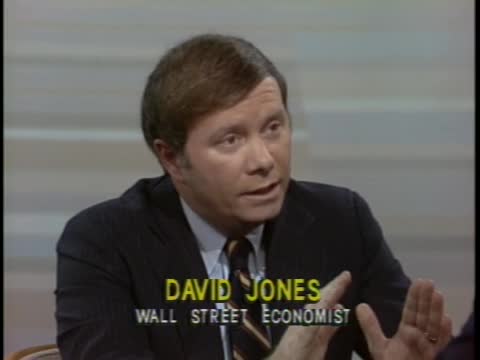
MacNEIL: For the rest of this year Volcker forecasts mostly good economic news, economic growth measured by a gross national product expanding from 3 to four percent, inflation easing to the same range -- 3 , four percent; unemployment running between 6.7 and seven percent by year's end. For a further interpretation of what Fed policy may do to the economy, we have a leading Fed-watcher, David Jones, senior vice president and chief economist at Aubrey G. Lanston, a Wall Street securities firm. Is this, David, a change in Fed policy?
DAVID JONES: Not really. I think Fed Chairman Volcker was actually very happy with the economic circumstances he faced in his testimony today. The economy is moving ahead in an orderly, moderate way; inflation is low. And when the Fed a week or so ago put together this testimony and talked about it, the Fed policymakers, I think they were relatively satisfied with the near-term economic outlook.
MacNEIL: What everybody wonders about is interest rates when the Fed talks. What impact is this policy declared today going to have on interest rates?
Mr. JONES: Well, we had a fascinating market impact today. In the discussion following the Fed chairman's testimony, the Fed chairman observed that they had stopped easing monetary policy, stopped pumping funds into the banking system and pushing rates lower back in January, and with that announcement the bond market today literally collapsed. Apparently those trading bonds began to like that period of pumping funds in and pushing rates down. It is over for the time being, but I would say what the Fed chairman will be trying to do, near term, is essentially not rock the boat, keep things on an even keel, keep interest rates essentially unchanged for the next month and a half or so. We can't look too far beyond that right now, but for the present time I think generally speaking the Fed chairman is happy.
MacNEIL: And what will this do to the value of the dollar following on the discussion we just heard?
Mr. JONES: Well, the dollar improved today. One of the points here is that the Fed chairman made very clearly is that even if the budget deficit, that federal budget deficit which is much too large, is reduced, he still sees the dollar very strong. With that pronouncement the dollar went up. It seems as soon as the words left the chairman's mouth today we had all the markets moving, the dollar getting stronger, the bond market weakening. So in effect that dollar looks strong, and I would add quickly that, as we look out a little bit further, maybe past the end of the current quarter into the April-June period of this year, there's at least a chance this economy could pick up a bit of steam. Housing and other sectors could pick up. If that's the case, then we'll see some upward rate pressure, and that could make the dollar even improve further. So right now the bond market is weakening --
MacNEIL: Upward rate pressure on American interest rates, which makes dollars a better investment.
Mr. JONES: More attractive for foreign savers.
MacNEIL: Well, if the dollar remains as strong as it is or continues to rise in value, what areas of the American economy is that going to hurt?
Mr. JONES: Well, we just heard one talked about, those people who export, including the distressed farmers are going to take it on the chin even further. As I was listening to that debate I said things may be relatively stable in interest rates, not perfectly stable, but relatively stable, for the next month and a half. But as we move toward midyear, if U.S. interest rates rise and if the dollar does become stronger, it's going to make our exports of farm products that much more expensive and deepen the distress of farmers that much more. So there is --
MacNEIL: But besides farmers, what areas besides farmers are --
Mr. JONES: Well, we have virtually all borrowers. The energy sector, in which there was a lot of financing, a lot of exploration, a lot of estimates that energy prices would go up when in fact they've turned down. We have major sectors of commercial real estate in many cities, which is overbuilt and where prices are falling. We have many resources, mining resources and other resources in the ground, that are falling in value and even, of course, coming back to farmland, which is falling. So there is a soft underbelly to this economy which could be damaged if in fact we have that conflict between too much government borrowing, a speed-up in the economy, and a Fed which is willing to give us enough new money to finance orderly growth, but without inflation, which is an important point.
MacNEIL: And there's also the question of as the dollar rises in value, imports become more attractive, and that competes with American industry here.
Mr. JONES: Exactly. We've seen in some major sectors of the economy significant strain. In the export areas, as we've just mentioned, in the import areas, where imported goods are competing with competing very aggressively with many businesses -- the auto industry is about to see some more aggressive competition as it appears the import quotas will be taken off of Japanese cars and we'll have another flood of imports coming into the market. So in most of our basic industries we'll be faced -- steel is another case in point -- with major competition.
MacNEIL: Our economics beat, listening very carefully today to Volcker, thought that they detected less passion or concern in his discussion of the deficit.
Mr. JONES: He may be wearing out a bit on this subject. He's been saying it for a long time now. Many economists, including myself, have been saying it, almost like Paul Revere, "The deficit is bad. The deficit is bad." In fact, it hasn't been so bad in the first two years of recovery, and I sensed in the Fed chairman's testimony a little bit of that feeling. After all, we cut taxes and increased spending, and it gave the economy a boost. We had a very good two years of recovery. And so I think after speaking about it so long he may be easing off a bit. I would simply say that in terms of that deficit there should be no easing off because the dilemma for the farmers and other borrowers is going to be intensified if something isn't done about that deficit.
MacNEIL: So do you agree with the Fed's prognostications on the growth rate this year, 3 , four percent? Inflation in the same range, unemployment, 6.7 to seven percent?
Mr. JONES: It looks generally that way, but we should break the year quickly into two halves. The first half looks a bit stronger than that, and that's why interest rates could move up around mid-year. This difficulty in the economy that we've seen talked about in the farm sector and elsewhere in the trade sector may begin to hurt us late in the year. So I would feel that by the end of 1985 we could be faltering again. The trade deficit, weak exports and major imports, could pull this economy down late in the year, and that may give us a chance to bring rates lower. So I would split the year into two halves, in effect.
MacNEIL: Finally, Mrs. Thatcher was reported to be urging the Reagan administration to do something about the value of the dollar. What could the Reagan administration do about it if it wanted to?
Mr. JONES: Not too much. The intriguing thing the Fed chairman mentioned, as I stated earlier, was that the possibility is the dollar is going to continue to get stronger, no matter what happens, with the budget deficit, even if we should see some miracle in Washington, which I don't expect immediately, of a major cut in the deficit, that would simply say we're keeping our fiscal policy even in better order, and inflation would be low and foreign investors would like our currency even more. So as soon as that was stated off went the dollar again. And the answer is there couldn't be too much done on a short-term basis to change that dollar very much.
MacNEIL: The U.S. Treasury has been intervening in the markets overseas to try and hold the dollar's rise. Does that work?
Mr. JONES: It does not. We have literally floods of more than hundreds of billions of dollars in terms of capital movement, $100 billion last year in terms of capital coming into the economy. The amount of foreign exchange intervention by the foreign central banks is at most less than $100 million. It's too little and probably too late, so it won't do much good.
MacNEIL: David Jones, thank you again.
Mr. JONES: Thank you.
MacNEIL: Jim?
LEHRER: Still to come on the NewsHour tonight, a documentary report on the economic fallout of the growing racial strife in South Africa, and a debate over the right to move sports teams from city to city and city to city. Squeeze in South Africa
MacNEIL: In our next focus section tonight we have a documentary report from South Africa. Again this week South Africa has been the scene of violent protests by blacks. The 16th person died today after two days of riots and clashes with police at a black shanty town outside Capetown. Also this week police began arresting leaders of the anti-apartheid movement. As of today, eight were in custody. The latest political disturbances take place against a background of economic difficulties. We have a report on the state of the South African economy from Michael Burke of the BBC.
LIQUIDATOR: -- for this magnificent home, what am I asked? Any starting bids? Come on. No. Everybody's waiting. You know the house is worth a million rand. You know the house is worth a million rand.
BURKE [voice-over]: Bailiffs are into millionaire's row. The liquidator is out in the courtyard auctioning off Johannesburg's house of the year. The millionaire owner is bankrupt and gone. Recession is cutting deep into the highest standard of living on earth; the white man in South Africa is feeling the pinch.
LIQUIDATOR: Ladies and gentlemen, this is not selling. It's a gift. It's an absolute gift, and you know it. It's got a swimming pool, it has a tennis court, it has everything.
BURKE [voice-over]: With mortgages at 22 , these people have come to look, not buy, to look at a mansion going for half price.
RAY WINTERSTEIN, liquidator: Sold right here. Thank you, sir.
We find that our main business is insolvent estates and liquidations, and this has probably trebeled in the last six months. It's really shot up to enormous proportions.
BURKE [voice-over]: On a hillside in a faraway tribal homeland, black men lie around outside a recruiting office all day every day hoping for a chance of a job. Leonard Motsape has been standing here for three months. He doesn't know when he'll work again. That's his recession. The roots of South Africa's economic problems go two miles underground, to the gold mines that made her rich. The republic is the world's jewel box. On the reef and out in the free states lie half the earth's known reserves of gold. These bars represent nearly 50 of the country's foreign earnings. But gold is out of fashion now. Five years ago an ounce would have cost you $850; today, barely $300. The people who count would rather have dollars in the bank than Krugerrands. The rand has dropped through the floor of the foreign exchanges; worth nearly a dollar and a half five years ago, 50 now. The result? Inflation, three times higher now than most of the country's competitors and rising. Last week petrol prices went up by more than 40 overnight, threatening many a lavish lifestyle. For some people, nothing is going right.
CITIZEN, buying gasoline: It's dreadful. Can't afford it at all. Worst thing that's happened to me all year. This is worse than Tutu getting the Peace Prize, really.
BURKE [voice-over]: South Africa's economists worry about the blacks being retrenched.
JOHN CLOETE, economist, Barclay's Bank: The main impact is on the principal part of our workforce, which of course is the blacks in South Africa. And their unemployment is increasing very rapidly. In fact, we see daily reports of considerable numbers of workers being retrenched in the malachite industry, in the [unintelligible] industry, and so on.
BURKE [voice-over]: This man might soon be one of them. The Ford plant is in Port Elizabeth, South Africa's Detroit. Once it was prosperous; now it has the highest urban unemployment rate in the country. Last week Ford announced it was in an impossible financial squeeze. Blacks in particular weren't buying cars at the rate they'd hoped. Ford had decided to merge with a local manufacturer; a factory would close, 2,000 more jobs here would have to go.
That night, in the black township, Ford workers, members of one of the now-legal unions, gathered in a church hall. They sang "Umkhonto We Sizwe," name and anthem of the terrorist wing of the banned African National Congress, an ominous sign of what might happen if this worsening recession goes on too long, if unemployment and poverty pile up on top of deeper grievances caused by the system of apartheid.
LES KETTLEDAS, car workers union: It's not only a question of not being able to have a say in the running of the country, but it's also a question of now having to almost starve because you've lost your job, there are no benefits and it is very bad for people in a situation like this.
BURKE [voice-over]: There's poverty enough already in Port Elizabeth. Here, beyond the official black township, is an unofficial city called, confusingly, Soweto, a giant sprawl of shanties, many made from scrap wood and metal scavenged from the car factories. This place began in 1974 and has just grown ever since. More than 100,000 people live like this now in Port Elizabeth. This is how desperate the blacks are to move to the cities and the jobs they hope to find there. If there are no jobs, discontent could fester here like the germs in the open sewers amongst those for whom the present is bad, the future perhaps worse. The last thing South Africa's president needs is a recession as he moves cautiously toward reform. That reform is expensive with its separate MPs and bureacracies now for colored and Indian as well as white affairs. But in truth the apartheid system as it stands is a crushing burden for a faltering economy.
The tiny, overcrowded homeland of Qwa-Qwa is a creation of apartheid, a place the size of Birmingham the government would like to see an independent country. At least 250,000 South Sutu people have moved or been moved here, to a putative republic that can't even feed itself. To make this figment of an ideology's imagination real, to sustain these people, to keep the black ministers in mansions on the hill, takes money, lots of money. No expense has been spared to attract industries to new factories the government's built here, but there'll probably never be enough work for the crowds who gather at factory gates. Firms who do move here get the factory almost free. The government puts up the money for half the equipment, effectively pays the workers' wages for seven years. So far, though, only 9,000 jobs have been created here at a cost of 50 million pounds, and nearly all of those jobs are for women. Quaqua's men have to wait outside the homeland recruiting office for a chance to work in the mines of white South Africa.
Senator Edward Kennedy came to look apartheid, though more at squatter camps than new factories, and with his judgment seemingly already made. It's clear he 'll add his prestige to the mounting campaign for America to disinvest in South Africa. American bank loans, investments, gold sales are all threatened, despite President Reagan's policy of constructive engagement with the republic. In more prosperous times the threat would have been shrugged off by Johannesburg's business community, but the economy is vulnerable now.
Winnie Mandela, banned and banished to a dorp in the free state, met Senator Kennedy and told him --
WINNIE MANDELA, opposition leader: We are sick and tired of the West telling us that if they disinvest the black man is going to suffer in this country. It is part of that prescription by whites, whites again prescribing for the black man in this country. We know that we shall suffer. We know that we may suffer more than we are suffering. We are suffering anyway with that investment of theirs. And we have told the West time without number to get out of our country. Leave us to fight our struggle, if need be, in completely empty bellies. We don't want to be well-fed slaves.
BURKE [voice-over]: John Khalli is well fed. He works for an American company and is a boss, not a slave.
JOHN KHALLI, on phone: I must have it tomorrow morning. If I don't get it, Lee, I'm going to cut the order out.
BURKE [voice-over]: He's head of the computer department of the Dresser Company, one of the few blacks here who tells whites what to do. It's an important job and he doesn't want to lose it because of American politicians campaigning on his behalf.
Mr. KHALLI: I am treated the same as a white, and I feel as a white. But unfortunately when I go home it's different.
BURKE [voice-over]: The realities of life as a black in South Africa begin at the factory gates, the daily trip from a black station in a black train to a black home in a black township. He thinks things are changing here, but attitudes, he says, change slowly.
Mr. KHALLI: Even in the shop -- I have a credit card, if I come in there, they look at me. They are stunned, a black man having a credit card. They cannot understand it. When I speak they cannot understand me. A black man shouldn't speak thus.
BURKE [voice-over]: The 350 American companies here employ 70,000 blacks in their mixed workforce and say they're an important motor for change and reform. If they and the 15 billion pounds of investment they represent are forced to pull out while South Africa is in economic difficulties, the consequences could be grave. Moving the Home Team
MacNEIL: Our final focus section tonight takes us into the continuing controversy over the relocation of sports franchises. It's a controversy that's been smouldering for almost 30 years, ever since the Brooklyn Dodgers disappointed their fans by moving to Los Angeles. More recently, in 1982, the city of Oakland, California, lost a bitter court battle to keep its football team, the Raiders, from moving to Los Angeles. Since then lots of professional teams have been hopscotching the country looking for bigger and better stadiums and larger revenues. The Baltimore Colts went to Indianapolis. The San Diego Clippers of the National Basketball Association moved to Los Angeles. The Philadelphia Eagles football team recently decided not to move, but only after the city agreed to ante up millions of dollars in benefits. The Senate Commerce Committee today held hearings on two bills which would prevent professional teams from changing cities unless they could show they were losing money or playing in inadequate arenas. One bill would require that the National Football League add four more teams, with two of them going to Baltimore and Oakland. Today's hearings drew both supporters and critics of government intervention.
STEVEN KATICH, Denver Basketball Commission: We believe that congressional legislation mandating expansion is, from a public policy perspective, improper. It could in fact ultimately prove to be counterproductive to the long-term goals of both the sport and the communities this legislation seeks to protect. As a result, congressional intervention at the present time is not only unnecessary but would also set a dangerous precedent by dictating the time and place for growth in professional sports leagues.
Rep. BARBARA MIKULSKI, (D) Maryland: Very often when this legislation is discussed we're told that government, and particularly the United States Congress, has no role in the issue of sports teams. I would respectfully disagree with that because we find that sports teams, number one, come to government whether it's local or state, to ask for guaranteed, fancy, often lavish and luxurious sports arenas. They want guaranteed ticket sales. They want state and local exemptions. And, in the case of Louisiana, they even wanted the state legislature to put up a substantial amount of money. Then they come to us wanting anti-trust exemptions, and they call that free enterprise.
WILLIAM SCHAEFER, Mayor of Baltimore: It is an important issue, because every time you take something away from a city that's struggling like ours, we lose. We lose. The city loses. Jobs, assessable base, taxes, entertainment, all the things that keep a city alive. And that's the important thing. And, second, is there a need for legislation? Why should Congress be interested in this? Why should you intervene, and should you intervene, and my answer to that is yes. And, you know, no one really worried about it when Oakland lost their team. They just went away. And then all of a sudden Irsay floats in and our team goes away, and no one is really too concerned because it was only two cities. Then all of a sudden a city down in Louisiana, they may lose their team. And a team up -- in St. Louis they may lose their team. And somebody else may lose their team, and you begin to figure this could happen to every city in the United States, no matter how much this team was supported.
LEHRER: We pursue the debate now with two men who see it differently. From Philadelphia there is Howard Eskin, sports commentator for KWY-TV and, from Phoenix, former major league baseball player Ron Swoboda, who covers sports for KTVK-TV. Philadelphia almost lost its National Football League team, the Eagles, last year to Phoenix. Mr. Eskin, to you first. Why do you believe Congress should get involved in something like this?
HOWARD ESKIN: I think you have to stop teams from doing what they're trying to do. And Mayor Schaefer made some pretty valid points. I think basically you have fans, and that's pretty much the way I'm looking at this thing. Fans form loyalties. Sure, the cities benefit from the teams. The National Football League didn't really get that upset, or really Congress, I guess it was, didn't get that upset until Philadelphia, a major-market city, decided they wanted to move or Leonard Tose decided he wanted to move. I don't think you can penalize the fans for owners that don't know how to run their business. Now, in the case of Robert Irsay, I don't know how he ran his business.
LEHRER: He was the owner of the Colts.
Mr. ESKIN: Right. He's the owner of the Colts. In the case of the Philadelphia Eagles, Leonard Tose lost a lot of money. He's in debt for close to $30 million. And I don't think you can penalize fans for a man that doesn't know how to play blackjack. I think it's basically that simple. And the fans form loyalties and when you start juggling teams and moving them from one city to another, I think you start to lose those loyalties and you start to lose what sports is all about. Now, I'm talking about this in a purist sense. I know that sports now is not really -- not really pure in the sense of the word. But that's basically, I think, the people that you really hurt, and you do not form those loyalties, and you start losing teams and then fans don't know who to root for.
LEHRER: Ron Swoboda in Phoenix, what's wrong with that argument?
RON SWOBODA: Well, I don't see the great migration of teams. The legislation that's been proposed, one set of legislation, by our own Dennis DeConcini, a senator from Arizona, really would give them the option of moving an NFL franchise if they could prove financial hardship. And the only people that are moving are really moving for a better deal. If I owned a franchise in the NFL, I'd want the right to say where I'm going to do business. If I was the city manager or the mayor of Phoenix, I'd want to do business directly with the team that was going to come here, and if Tose is so rotten to the people in Philadelphia, maybe it's a good idea they lost him.
LEHRER: But if you were the owner of a team, why should you have the right to move it anywhere you want to?
Mr. SWOBODA: It's my team, and I think it's a business and nobody -- you know, there is one aspect, as an owner of an NFL franchise I am sort of capitalizing on a degree of irrationality, a fan following, if you want to give it another name. And I don't mean to come down on the fans, because I was a .240 hitter who stayed in their favor somehow. So I don't want to be coming down on them hard, but there is a degree of irrationality there, where territorial imperative -- my team, my town. Yeah, they do make money off of that. But that's sort of the chance you take in love and in being a football fan. And the owner really should have the say.
LEHRER: Mr. Eskin, what's wrong with that?
Mr. ESKIN: Well, we talk about financial hardships, and I think in part, and I think the NFL's trying to form some kind of guidelines for legislation, and in part I think that could be good and I think we could get along with that.
LEHRER: Yeah, but what about his basic point? Hey, wait a minute, this is a business. The guy owns something; he ought to be able to do anything he wants to with it.
Mr. ESKIN: Well, yeah, but when you come into the National Football League or when you come into a professional franchises, you pretty much know you should set up shop in that city. And that's the premise you come into it with. As far as financial hardship, if the guy's got problems, then maybe yes. And if he can find a better deal in this case in Philadelphia, there was nothing wrong with the fans of Philadelphia. They supported that football team. And, I'm telling you, I grew up in this town. They were a bad football team for a lot of years.
LEHRER: Yeah, but what about his basic argument? "Look, I own this car. I can drive it to New Jersey. Why can't, I own a football team, I do the same thing." That's all he's saying.
Mr. ESKIN: Well, you can buy the same car in Phoenix as you can in Philadelphia, but you can't get the same football team in Phoenix.
LEHRER: Yeah, but, so what? So what?
Mr. ESKIN: Business is different.
LEHRER: Sure, it's business. You know, I'm trying again to look at this in the purist sense of the word, and it's not totally pure. But it's not the same as the steelworkers, it's not the same as the autoworkers, it's not the same as a car dealership or a drugstore. It's a football team or it's a baseball team. And fans don't get upset if a business moves from Phoenix to whatever the suburb is outside of Phoenix. But they would get upset if Phoenix -- and the football out there is good in terms of the college, and you're not going to be able to move the university. But if theydecided to move, I think those people would be upset. I think in the case of Phoenix they just want a team, and they don't care how they're going to get it. And they may get the Cardinals and they may get another football team, and they may get an expansion team. But this business is different, and Ron was a part of it. He knows that. The fans, they loved him. A .240 hitter and they loved him. I mean, how can you want to move out of that town?
Mr. SWOBODA: Irrational, I told you.
Mr. ESKIN: Yeah, very irrational. So that's the point here. It's not the same. It's business, but in a different sense of the word. And if the guidelines are set up and the team cannot make money, fine. But there are teams that want to move that are making money, and you just destroy, I think, what fan relationships have, and without fans you don't have the interest in the sports that you have nowadays.
LEHRER: Is that right, Ron Swoboda?
Mr. SWOBODA: Well, I would suggest that in the case of football, where you have mostly full stadiums and diminishing returns bedause the USFL has created a much more --
LEHRER: That's the United States Football League --
Mr. SWOBODA: -- a much more interesting bidding war for players. It's kind of simmered down now, but they've upped what it costs you to operate talent-wise in the NFL. That a pot of gold down the line, that big TV contract they had that's supposed to pay $16 million a team in 1986 or so, the last year in it, isn't a pot of gold anymore. Their television ratings are down because of overexposure and dilution. It's not as easy to operate in the NFL. They're coming close to that fiscal reality. They're coming close to that red-ink line. And I think that's probably what's caused some teams to talk about moving, and I think they have a right to survive and take care of themselves on their own. But remember one thing. It's not as easy as it was at one time. And, you know, I just don't believe that we should be playing -- I don't see a wholesale run out of established markets. I don't see that happening. I don't see where we need legislation to stop something that's only going to affect two, maybe three franchises. I think it's Pete Rozelle, commissioner of football, who wants to say it's not that he doesn't want movement, but he wants to decide when and where it's going to happen. And he would like to bestow an expansion franchise on a Phoenix or an Oakland or a Baltimore or a Memphis or a Jacksonville, or someplace like that.
LEHRER: And you're saying that Phoenix ought to have the right to just buy it. In other words, whoever has the most money will have the professional football teams in this country, or the professional sports teams?
Mr. SWOBODA: Well, the city of Phoenix really has three prongs of effort right now. They've got a group that's waiting very patiently, the Firebird Group, that's hired Bart Starr as a coach, Joe Foss as their head man. He was the former American Football League commissioner. They're sitting there quietly not doing anything to upset the NFL or Pete Rozelle. There's another group, the Metropolitan Sports Authority, a wing of the Chamber of Commerce. They have aggressively sought everybody. They jumped in bed with Irsay. They jumped in bed with Tose. Everybody that -- you know, they took anything they could get. They talked with Bill Bidwell of the Cardinals. They'll take anything they can get. There's also the USFL sitting here who thinks that they've got some clout with a $1.3-billion lawsuit that eventually may force the NFL to accept them, maybe six or eight teams, as its newest expansion, if there's any teeth in that antitrust lawsuit the USFL is instituting.
LEHRER: Mr. Eskin, why should the sports fans of Phoenix be deprived of the right, if they've got folks out there who have the money, to buy them a sports team?
Mr. ESKIN: They shouldn't be deprived of the right, but what they should get is a franchise that may in fact be struggling or may in fact be an expansion franchise. But they're going to have to wait like other cities, like New Orleans had to wait for quite a while. See, the grass is always greener on the other side, and somewhere along the line, after that team is in Phoenix and after they put down the deposits for season tickets, there's going to be some other Phoenix somewhere else in the country that's going to want that football team, and they're going to make the same offers. And there's always going to be more down the line.
LEHRER: Mr. Swoboda says that's just the way the game is played in American business.
Mr. ESKIN: Well, he also said there won't be a wholesale shift in franchises. What is wholesale? We've talked about, okay, the Raiders left and then there was a little bit of a lull. Then the Baltimore Colts went to Indianapolis. Then the Eagles said that they were going to move. Now the St. Louis Cardinals are going to decide --
Mr. SWOBODA: But they didn't move. That's two teams that moved for very different reasons. And Tose was going to move for very different reasons. Tose was in trouble. Yeah, it's his own trouble. It's not the city of Philadelphia that's bailing Tose out. It's the NFL's promise -- none of which has been delivered yet. The city of Philadelphia would be glad to bail out his debts, but they also wanted him out of the franchise.
Mr. ESKIN: Well, because he doesn't know how to run the franchise.
Mr. SWOBODA: That seems fair enough to me.
Mr. ESKIN: Yeah, but that doesn't say that the team should leave because he doesn't know how to run a football team. This team can make money in this city..
Mr. SWOBODA: As long as he owns the franchise, he's got a right to survive. I certainly wouldn't go belly up even if I had a few bad habits. 'Course, I don't operate in the NFL. I'm, you know, just a little guy out here in Phoenix TV. But you got a right to survive on any level of business.
LEHRER: Well, look, I'm glad we could resolve this, gentlemen. Mr. Eskin, who joined us tonight from the studios of public station WHYY in Philadelphia, thank you; and Ron Swoboda from Phoenix, thank you.
Mr. SWOBODA: You're welcome.
LEHRER: Robin?
MacNEIL: Once again the main stories of the day.
A protest filibuster by farm senators delayed Edwin Meese's confirmation as attorney general.
Federal Reserve Chairman Paul Volcker predicts smooth sailing for the economy this year.
British Prime Minister Margaret Thatcher warns of a coming political offensive over arms control.
Good night, Jim.
LEHRER: Good night, Robin. And we'll see you tomorrow night. I'm Jim Lehrer. Thank you and good night.
- Series
- The MacNeil/Lehrer NewsHour
- Producing Organization
- NewsHour Productions
- Contributing Organization
- NewsHour Productions (Washington, District of Columbia)
- AAPB ID
- cpb-aacip/507-ft8df6kr91
If you have more information about this item than what is given here, or if you have concerns about this record, we want to know! Contact us, indicating the AAPB ID (cpb-aacip/507-ft8df6kr91).
- Description
- Episode Description
- This episode's headline: Farm States: Struggle for Aid; Federal Reserve Board: Steady Course?; Squeeze in South Africa; Moving the Home Team. The guests include In Washington: Sen. DAVID PRYOR, Democrat, Arkansas; Sen. ALAN SIMPSON, Republican, Wyoming; In New York: DAVID JONES, Wall Street Economist; In Philadelphia: HOWARD ESKIN, Sportscaster; In Phoenix: RON SWOBODA, Sportscaster; Reports from NewsHour Correspondents: COLIN GRAY (Visnew), near Beirut; MICHAEL BURKE (BBC), in South Africa. Byline: In New York: ROBERT MacNEIL, Executive Editor; In Washington: JIM LEHRER, Associate Editor; JUDY WOODRUFF, Correspondent
- Date
- 1985-02-20
- Asset type
- Episode
- Rights
- Copyright NewsHour Productions, LLC. Licensed under a Creative Commons Attribution-NonCommercial-NoDerivatives 4.0 International Public License (https://creativecommons.org/licenses/by-nc-nd/4.0/legalcode)
- Media type
- Moving Image
- Duration
- 00:59:47
- Credits
-
-
Producing Organization: NewsHour Productions
- AAPB Contributor Holdings
-
NewsHour Productions
Identifier: NH-0372 (NH Show Code)
Format: 1 inch videotape
Generation: Master
Duration: 01:00:00;00
-
NewsHour Productions
Identifier: NH-19850220 (NH Air Date)
Format: U-matic
Generation: Preservation
Duration: 01:00:00;00
If you have a copy of this asset and would like us to add it to our catalog, please contact us.
- Citations
- Chicago: “The MacNeil/Lehrer NewsHour,” 1985-02-20, NewsHour Productions, American Archive of Public Broadcasting (GBH and the Library of Congress), Boston, MA and Washington, DC, accessed April 2, 2026, http://americanarchive.org/catalog/cpb-aacip-507-ft8df6kr91.
- MLA: “The MacNeil/Lehrer NewsHour.” 1985-02-20. NewsHour Productions, American Archive of Public Broadcasting (GBH and the Library of Congress), Boston, MA and Washington, DC. Web. April 2, 2026. <http://americanarchive.org/catalog/cpb-aacip-507-ft8df6kr91>.
- APA: The MacNeil/Lehrer NewsHour. Boston, MA: NewsHour Productions, American Archive of Public Broadcasting (GBH and the Library of Congress), Boston, MA and Washington, DC. Retrieved from http://americanarchive.org/catalog/cpb-aacip-507-ft8df6kr91