The NewsHour with Jim Lehrer; October 11, 2007
- Transcript
I'm Ray Suarez, today's news, a strain on the U.S. Turkey relationship, former President Jimmy Carter, U.N. Secretary Pangi Moon, and the Nobel Prize for Literature, all tonight on the news out. Good evening, I'm Ray Suarez.
On the news hour tonight, the news of this Thursday, then an international argument heats up over branding the World War I killing of Armenians, genocide, then two views of the state of the world from former President Jimmy Carter and from U.N. Secretary General Pangi Moon. Plus, the winning work of Doris Lessing, Nobel laureate for Literature. Major funding for the news hour with Jim Lehrer is provided by... Every day, it seems, talk of oil, energy, the environment. Where are the answers? Right now, we're producing clean, renewable, geothermal energy, generating enough energy to power 7 million homes.
Imagine that, an oil company as part of the solution. This is the power of human energy. The new AT&T, Pacific Life, the Atlantic Philanthropies, and with the ongoing support of these institutions and foundations. And this program was made possible by the Corporation for Public Broadcasting and by contributions to your PBS station from viewers like you. Thank you. Turkey struck back today over a move in the U.S. Congress to condemn genocide against Armenians. A House committee approved the measure yesterday. It involves the killing of an estimated one and a half million Armenians by the Ottoman
Turks during World War I. Today, Turkey condemned the vote and recalled its ambassador to Washington, but House Speaker Nancy Pelosi said the issue has been put off for far too long. There's never a good time. And all of us in the Democratic leadership have supported our make reiterating Americans' acknowledgement of a genocide. In Rwanda, so as long as there is genocide, there is a need to speak out against it. President Bush and top officials in the administration warned against pursuing the issue. They said U.S. operations in Iraq are heavily dependent on cargo flights coming through Turkish airspace. We'll have more on this story right after the news summary. A U.S. raid on al-Qaeda leaders in Iraq killed 19 suspected insurgents today, but the military said 15 civilians were killed as well, including nine children.
It happened during an air and ground raid northwest of Baghdad. And to the north, a car bomb killed seven Iraqis at a busy market in Kirkuk. A police chief, the apparent target, was among more than 50 people wounded. The U.N. mission in Iraq will examine recent shootings by private security guards as possible war crimes. The announcement came today in Baghdad. A U.N. official there said there cannot be rogue elements that are above the law. Last month, guards for blackwater USA killed up to 17 Iraqis, and this week, guards for a company owned in Australia killed two Iraqi women. Also today, relatives of several shooting victims and one survivor filed suit against blackwater in federal court in Washington. They asked for unspecified damages. Authorities in Afghanistan shut down two private security companies this week. Both were run by Afghans, but the Associated Press reported 10 others face closure, including major Western firms.
There was no word on the names of those companies. Afghan officials said some of the contractors are suspected of murder and robbery. There was word today, the U.S. Marines want to pull out of Iraq, and instead take a lead role in Afghanistan. The New York Times reported Marine leaders think their force is better suited to the Afghan fighting. In turn, U.S. Army units would focus solely on Iraq. But in London today, Defense Secretary Robert Gates played down the report. I have heard that they were beginning to think about that, and that's all that I've heard. I have seen no plan, no one's come to me with any proposals about it. My understanding is that it's, at this point, extremely preliminary thinking on the part of perhaps some staff people in the Marine Corps. But I don't think at this point it has any stature. About 25,000 U.S. Marines are currently serving in Iraq. There are no major Marine units in Afghanistan.
The Bush administration considered its options today. After a federal judge ruled against part of an immigration crackdown, the Homeland Security Department wanted employers to fire workers if their taxpayer ID or social security numbers do not check out. The judge in San Francisco said officials did not consider the costs or give illegal basis for the plan. Today, White House spokeswoman Dana Perino said Congress needs to act. We can work as hard as we possibly can on border enforcement issues, but if they get turned over by the courts or turned over by localities, we're going to result in a situation that is absolutely unsustainable. And so the president would like for Congress to get back to the table and work on that. But I don't think he anticipates that's going to happen within the next year. Homeland Security officials said they were still considering whether to appeal the ruling. Drug makers today ended U.S. sales of over-the-counter coffin cold medicine for infants. The brands included P.D.A.K.A.R, Daimatap, Robitussen, Tylenol and others.
The Food and Drug Administration had warned of deaths linked to overdosing in children under two. The FDA holds a hearing next week on whether children under six should ever take the drugs among other questions. British writer Doris Lessing won the 2007 Nobel Prize in Literature today. She turns 88 this month and is the oldest recipient of the Literature Prize. Her 1962 novel, The Golden Notebook, was seen as inspiring a generation of feminist writers. Today in London, Lessing said she thinks her age was the deciding factor for the Nobel Committee. Have you ever been on any of these committees? Nope. You sit around. You see, and you think, well, now, is that one and is that one, is that one? Now, she's getting on a bit, they think. You better give it to her this year. She might pop up and will never give it to her. This is what I think happened. The selection drew some criticism today. Literary critic Harold Bloom called it Pure Political Correctness.
We'll have more on this story later in the program. The federal government reported today the deficit for fiscal year 2007 was the lowest in five years. It totaled just under $163 billion, down nearly 35% from the previous year. The government included revenues from Social Security and calculating the deficit, as it has for many years, otherwise the shortfall would be much larger. The Commerce Department reported today the U.S. trade deficit in August was the smallest in seven months, a week dollar, and recalls of Chinese goods were the main factors. But on Wall Street today, a sell-off of technology companies pushed stocks lower. The Dow Jones industrial average lost 63 points to close at 14,015. The Nasdaq fell 39 points to close at 2772. That's it for the news summary tonight. Now, a question of genocide and of U.S. Turkish relations. Two world views from former President Jimmy Carter and U.N. Secretary General Pangimun.
Plus the winning work of Doris Lessing. Turkey, the Armenians, and the U.S. Congress. We start with a report from NewsHour Congressional correspondent Kwame Holman. In Turkey today, there were street protests decrying a vote by a committee of the U.S. Congress. That vote labeled as genocide, the mass killings of Armenians, by Ottoman Turks, in the early 20th century. Turkish politicians joined demonstrators in Istanbul, denouncing the vote of American politicians. Ercon Unsell is Vice President of Turkey's Labour Party. In London, the United States of America legitimized the Armenian genocide claims, which has swung over Turkey's head like a stick, and which has posed a threat to Turkey for years. U.S. has made it clear once again that it targets Turkey.
Turkey's President Abdullah Ghul also harshly criticized the non-binding resolution telling the state-run news agency Anatolia. Some politicians in the United States have once again sacrificed important matters to petty domestic politics, despite all calls to common sense. And late today, the Turks recalled their ambassador to Washington. The Bush administration had lobbied hard against a resolution sure to upset a key American ally that plays a crucial support role for U.S. forces in Iraq. We all deeply regret the tragic suffering of the Armenian people that began in 1915. This resolution is not the right response to these historic mass killings. 70 percent of all air cargo going into Iraq comes – goes through Turkey about a third of the fuel that they consume, goes through Turkey, or comes from Turkey. But despite the administration's pressure, the Democratic-controlled House Foreign Affairs
Committee adopted the resolution by a vote of 27 to 21. There are those that say that every time we discuss this resolution in committee, it's an irritant to our relationship with Turkey. That's the best reason to vote for it here and on the floor. Let us do this and be done with it. We will get a few angry words out of Ankara for a few days and then it's over. Some Republicans voted for the resolution, but most opposed it, saying the timing was particularly bad. The strongest ally in the area and has been for over 50 years is Turkey. And I just don't understand why we're going to cut our nose off, shoot ourselves in the foot at a time when we need this ally. Democratic leaders say they will bring the measure before the full House within weeks a promise welcomed by the country's several hundred thousand Armenian Americans, some of whom were on hand for the committee vote. My grandfather was a survivor.
I think it's a day of relief somehow and I think I'm starting getting that quest for justice and I hope that down to the road we will have that. We were standing strong on this historical record. We were not being coaxed into being silent by somebody who calls themselves an ally of ours. The dispute came amid rising tensions along the Turkish Iraqi border where Turkish troops have been skirmishing with Kurdish nationalist guerrillas. Within days, President Ghoul is expected to ask parliament for authority to cross the Iraqi border and engage Kurdish guerrillas known as the PKK. Robert Warner takes the story from there. And for more on all this, we get two views. California Democrat Tom Santos is the chairman of the House Committee on Foreign Affairs. He voted for the resolution yesterday. And Mark Parris, a retired career diplomat, served as U.S. Ambassador to Turkey during the Clinton administration.
He's now a visiting fellow at the Brookings Institution and directs their project on Turkey. Welcome to you both Congressman Santos. This happened nearly a hundred years ago. Congress House has passed this same resolution twice once in the 70s and 80s. Why do this now? What are you trying to accomplish? Well, let's put it in perspective. Nazi Germany was responsible for the Holocaust. And the Ottoman Empire was responsible for this genocide. We have the highest respect for and the best friendship with the democratic modern Germany and with the democratic and modern Turkey. This is not a criticism of Turkey. This is not a criticism of the Turkish people today or of the Turkish government today. And our Turkish friends know this. This is one of those events, Margaret, which has to be settled once and for all. One and a half million, utterly innocent, Armenian men, women and children were slaughtered.
And the Turkish government, until now, has intimidated the Congress of the United States from taking this measure. This is not aimed at them, and they know it very well. I'm glad that the ambassador was called back for consultation. Hopefully he will be able to explain to his colleagues that this has nothing to do with contemporary Turkey. Mr. Ambassador, why has Turkey reacted so sharply to this resolution, which the Congressman says was not aimed at what Turkey is today, modern Turkey, which wasn't even a country then. Inevitably, criticism is in the eyes of the beholder, and you visited Turkey, you visited Turkey as well. I don't think that anybody who's ever visited Turkey can be in any doubt that Turks at all levels, of all levels of education, in all parts of the country view this kind of a resolution as criticism.
And frankly, as interference in their own responsibility for coming to terms with their own history. There are a lot of Turks who recognize and frankly admit and use words like genocide that this is a part of their history that they've got to come to terms with. I don't know any of them who believe that this will assist that discussion going forward, or make it easier for them to deal with neighboring Armenia. All of them believe this will be a major setback, because it is perceived as a major insult to Turkish credibility, honor, by a longstanding ally. So why do they feel this way? They're human beings. They know something terrible happened. At some level, I'm sure that they recognize that that's going to have to be dealt with, but they don't appreciate third parties coming in and legislating the means by which they should reconcile themselves with their own history and with their neighbors. All right, let me stay with you now and ask you, so what is the likely fallout other than recalling the ambassador?
Well, we don't know. My guess is that the Turkish government, as we sit here today, doesn't know. If this were happening in a vacuum, they would look at this issue and their interest and how to deal with it. It comes at a time when they're also dealing with another problem, led to the United States, as you're lead and suggested. The loss of over 30 citizens in the last two weeks to PKK terrorists, that they believe we haven't done Kurdish terrorists, our part to deal with, you're wrong. Defense Secretary Gates, Congressman raised the specter that Turkey might yank its support or its approval for the United States to use air base and air, port and air base in southern Turkey to bring in material and supplies into troops in Iraq. I have a much higher regard for the intelligence of our Turkish friends and for their sense of responsibility than to predict that. I don't think they will do that. I think they understand that we are allies, we have been NATO partners for over half a century
and I think it is demeaning to the Turks to claim that they will take such an irresponsible action. Let me give you another example if I made of just a few weeks ago. The Imperial Japanese government used tens of thousands of young Asian women and girls as military prostitutes. We passed the resolution in my committee denouncing this. This was not aimed at the current Democratic government of Japan, it was aimed at the wartime military government of Japan. And while the Japanese government made some critical comments briefly, the whole thing has blown over. This will blow over. I think it is important at a time when genocides are going on, in Darfur and elsewhere, not to be an accomplice in sweeping an important genocide under the rug.
Mr. Ambassador, do you think this will blow over in Turkey? I would be surprised, I think a lot depends on what happens on the House floor if it comes to a vote. And I think one of the reasons that the Turkish initial response will probably be restrained is that they want to see what will happen there. And they want to decide, frankly, what they are going to do about this PKK problem on their border. Is the government under any pressure to do more? What is the feeling among the Turkish sort of body politic about the cooperation that Turkey is giving the United States and the Iraq war? Well, there's a sense that they are playing an important role. I think the fact is that more Turks have died in Iraq than any other nationality because their truck drivers are an important part of the supply effort there. And our use of their facilities in Intriloq and the port in Adana to bring in heavy transport is critical. There is therefore a very strong expectation among the Turkish public that this can
not be allowed simply to blow over. They're expecting their leadership to do something to show that third country's legislators cannot interfere in their history. So if this doesn't blow over, are you saying, Congressman, that this nonetheless was worth the risk? One of the worst things that happened to the United States in recent years has been the plummeting globally of our moral authority. This is a significant step in restoring the moral authority of U.S. foreign policy. U.S. foreign policy was strong when it was based on a sound foundation of a moral authority. It's Abu Ghraib and similar episodes which have diminished our standing globally. And the international community is not critical of the fact that the United States calls a genocide, a genocide.
So if the Turkish government makes clear, as the investors seem to be suggesting, that a vote in the full house could really put the cooperation at risk, it sounds like you would not recommend holding back. Well, let me say one other thing if I may. Next week, I am bringing to the committee a very strong pro-contemplary Turkey resolution. We shall explain in exquisite detail that we consider Turkey, our friend, our democratic ally, and we expect to be that for generations to come. This is an ugly chapter in Turkish history which the House Foreign Affairs Committee described as such. Would that delay Turkish concerns? With due respect to the Congressman who have known for a long time, it simply won't wash. The Turks, the defined distinctions here are going to be totally lost on the Turkish general
population and their politicians and the military. They will view this as part of a pattern of American ignoring of Turkish interests, including the problem in northern Iraq which is resulting in the killing of Turkish citizens and soldiers as we speak today. So are you saying briefly, are you saying that a vote in the full house, that's the red line? You could see, you could see graduated responses up to a vote in the House to indicate that the Turks are serious about this. I think a vote in the House will precipitate something that the Turkish political leadership can take to its population and say, we've shown we're serious, honor reserved. Former Ambassador Mark Parris, Congressman Tom Lanto, thank you. That's a pleasure. Next two views of the world and its crises. Beginning with that of former President Jimmy Carter, he's the author of a new book
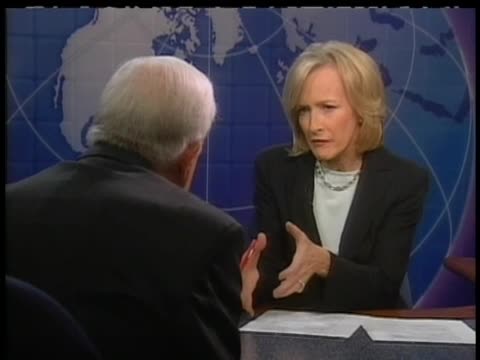
Beyond the White House. He spoke with Judy Woodruff yesterday. President Carter, thank you for joining us. We appreciate it. Thank you, Judy. I'm delighted to be with you again. The book Beyond the White House, your latest, what your 24th book is around? Yes, 24th. Not as controversial as the last one. Well, if it were more controversial, it might sell a few more copies, but no, it's not as controversial. You're writing about the work in here at the Carter Center, your work since you left the White House 25 years of working in Panama, Sudan. I made a list to your Bosnia, China, Haiti, North Korea on issues from Guinea War and river blindness, malaria, fair elections, human rights, nuclear arms control, 70 countries along list of issues. How do you decide what to focus on? Well, we have an almost unlimited menu from which to choose with a lot of requests coming in to monitor this election or that election or to try to negotiate a peace agreement between these two fighting forces or to resolve this problem in producing more food grains to
eat or to eradicate this disease, so we don't have any problem finding enough things to do. The problem we have is making sure we don't overload ourselves inadvertently. So we have a very finely tuned and I think highly efficient organization now adequately financed and with experience, as you pointed out in more than 70 nations on earth, 35 of which are in Africa, but the basic premise of the Carter Center is to fill vacuums in the world. If United Nations or the World Health Organization or UNICEF or US government or Harvard University is taking care of a problem, we don't get involved in it. We just kind of go where they are not adequately treating a very important issue. You do talk in the book about conflict resolution, you talk about monitoring elections, fair elections, fighting disease, human rights, I mentioned all that. Do you ever worry you're spread too thin? No, I know we're very careful about that, although I might say that the Carter Center has had a policy of not fearing our failure.
I mean we sometimes we're willing to take a chance on subject that seems to be doubtful of success if we think that it might be worthwhile. But we limit ourselves, we've done I think 68 elections, so for everyone in trouble to elections, if it weren't we wouldn't be there. But we only take on about four or five per year and we husband our energy and then focus very sharply on a particular problem until we assure that it's been successfully resolved. I want to ask you about Sudan and Darfur. You were there last week, you met with Sudan's president, just in this period of time there have already been what two serious attacks on villages in Darfur, the latest one against this one group that signed a ceasefire last summer. Is the situation they're getting worse or is it getting better? It's hard to say, I think it's not nearly as many casualties as they were a year or so ago and most of the displaced persons who would be refugees if it were outside of
country, but most of them are in camps and they are safe. The major violence now is because of a plethora of explosion, almost of a rubble groups, all of whom oppose the government and they're fighting each other. Precipitated by the fact that the United Nations and African Union has now planned peace talks to begin on the 27th of this month in Tripoli, Libya. And so these rubble leaders see themselves as trying to qualify to go to the international peace talks so they're struggling to get money and vehicles and weapons and fuel and so forth so they can be branded as adequately important to go to the peace talks. So that's causing a lot of the problem in Darfur now. You were there with this group of distinguished world leaders, Archbishop Tutu and others. The elders is the name of the script. Do you feel you accomplished something?
I've written a trip report and maybe in a two-hundred-two subjective way I'll list the five or six things that we have accomplished. Nobody knows when you make an effort, when you plan to see if it'll bear fruit or not. And we understand the situation much more clearly and I've sent my trip report to the White House and the State Department and to the Secretary of General of the United Nations outlining what we learn which may be informative to them. There are two major peace agreements. One is a comprehensive peace agreement that was consummated by the extremely beneficial inner station of the George Bush administration who called on John Danforth, the former Senator from Missouri to negotiate a peace agreement after eight years during which President Clinton did not want to promote peace in the Middle East in Sudan. And that's holding so far. So you're saying the Bush administration has been better in Sudan than the Clinton administration? It's an interesting footnote to history.
I don't know if we have time, but after the Florida election when all the Democrats will grieve because the Supreme Court said Bush would be the president, Rose and I decided to go to their inauguration. We were there. I think we were the only volunteer Democrats on the reviewing stand. And afterwards the new president and his mother-in-law then is right, we're very glad to see us there. So George Bush asked me if there was anything he could do for me and I said, yes, you can help promote peace in Sudan after eight years of different policy. And he said, I'll do it. So to make a long story short, he did it, not necessarily because I request him. And they were very successful. At the same time, you've been critical of President Bush and others in the administration for saying that the Sudanese government has committed genocide in Darfur. I don't want to. I don't want to. I don't want to. I don't want to. I don't want to. I don't want to. I don't want to. I don't want to. I don't want to.
I'm not trying to minimize the attacks on the innocent people in Darfur by saying that. But the United Nations and the most of the human rights groups around the world, we have one of them. And the International Criminal Court and the International Court of Justice, none of them would identify what's happened in Darfur as genocide because genocide, in my opinion, contract contradicted by some, is an attempt by a powerful group completed to eradicate from the face of the earth, the existence of people because of their ethnic makeup or because of their race or religion. And that was a case with Hitler trying to exterminate the Jews. And that was a case in Rwanda, when the tootsies were attacked and over 500,000 were killed in two or three days, that has not been the case in Darfur. But I don't know if I have time to explain. But the Darfurian problem was caused when some of the people in Darfur rose up in a revolution against the central government, and obviously the president used a judge
of weed that are the Arab Muslims, everybody's a Muslim, were called upon by him to attack the black Muslims and that's when the atrocities took place. Well, I read the Darfur pro-Darfur activists are saying by criticizing the use of that term, you take some of the pressure off the best-year government to Sudan government. And in effect, I read one said, you played into the hands of the government, I don't know that was, but it should be held accountable. No, the elders put tremendous pressure on Abhishear. We had a long meeting both times. Our group was led by Desmond Tutu, Archbishop, then by Nelson Mandela's wife, Russell Michelle, and by me, and by like Brahimi, who was the number one negotiator for the United Nations for many years. So we put tremendous pressure on Abhishear to go to the peace talks, and to stop all of his attacks that were orchestrated from the government, and to perpetuate and carry out all the terms of the peace agreement between him and the Darfurians and between him and
the South. So we put tremendous pressure on the government of Sudan. So looking ahead, reason to be at all hopeful there? Or? Yeah. I was hopeful that it was four or five years ago before the comprehensive peace agreement. That agreement is holding so far in a very fragile way. But the leader of the southern Sudanese, a man named Sava Keir, and the leader of the northern Sudanese, that is Abhishear, they both, I think, are deeply committed not to violate the peace agreement bad enough to cause a re-arruption of war between the two. So that's a positive development. The success of the peace talks that are now contemplated at the end of this month, in Tripoli, on Darfur, I think that's highly conjectural, and it depends on how it's constituted and how much influence and attention is given by the international community, and how well they can implement the United Nations Security Council decision to have a strong so-called
hybrid force between Africans and outside Africa forces to stabilize the situation in Darfur. All those things are still unpredictable. I just want to ask you about one of the thing I was intrigued to read in the book. You write American presidents of intervene more than a hundred times in foreign countries since you left office. You said in most cases, using military force unnecessarily, do you think this is because the world is a more dangerous place, or do you think that your successors have been too eager to intervene and use knowledge? Maybe both. It's hard to say why, it's hard to believe it. That's true, but it is. I've seen the statistics and anyone that wants to look it up. But you know, when you invade Grenada, all when you invade Panama to capture a disreputable person, or when you bomb the Bosnian area, you can always find justification for those military actions.
But it's really surprising how many times in those 25 years, it's a long time, the United States has interceded. I wouldn't say most of the time, military, but a lot of those have been military actions, and tens of thousands of people have died, and I can't say that I disagree with all of those military actions. For instance, I think it was fully justified after 9-11 to initiate a military action against Afghanistan, because we hope to create a democracy, and have a flourishing economy, and do away with al-Qaeda, and to capture some of bin Laden. We didn't do any of those things. We made a mess out of Afghanistan because we were so eager to go into Iraq. So Afghanistan was justified, Iraq was not, you could go down to the list and make your own judgments. Speaking of Iraq, any plans for you to go there? No, I don't think so. I wouldn't be calling the fund to do that. One of the restraints on the Carter Center, as I mentioned in this book, is that we don't go into a sensitive area of the world, politically speaking, without approval from the White
House. And sometimes those approvals are not easy to come by. President Jimmy Carter, with yet another book, this one, Beyond the White House, thank you very much for talking with us. I've enjoyed it, Judy. Thank you. Now, to the worldview of the new Secretary-General of the United Nations. When he took over his Secretary-General of the United Nations 10 months ago, Pangimun acknowledged the challenges ahead. I start my duties with a daunting time in international affairs, starting from Darfur to Middle East, Lebanon, Iran, Iraq, North Korea, Pang's a career diplomat. He was South Korea's foreign minister before taking the UN's reigns from Kofi Annan.
He's the first Asian to hold the post in 35 years. The Harvard-educated Pang is laid out an ambitious agenda. He's pledged to restore trust in the 192-nation world body, hit by scandal in recent years. I received to act as a harmonizer and preacher-builder. The Secretary-General says the UN has important skills to offer in Iraq, but security can't yet be guaranteed for his staff. Other top priorities include stepping up UN efforts to stem the violence in Sudan's State-off for region, addressing global climate change issues, and more recently, the Secretary-General has been a vocal critic of the military crackdown in Myanmar, also known as Burma. I spoke with Secretary-General Pangimun before he started a round of meetings today in Washington. Secretary-General Pang, welcome to the program. It's a great pleasure to each other. Does the United Nations have any leverage in Myanmar? Can it really stay the hand of a government that means to suppress the democracy movement?
United Nations itself has a highest moral voice, as far as principle matters, of democracy, human rights are concerned. And we have been mobilizing all possible political influences of leaders in the region and in the world. We have spoken many leaders in ASEAN. And ASEAN recently has taken very strong position vis-a-vis Myanmar's human rights situation. We have put forward some proposals demanding the release of political detainees and make social economy and political democratization. These efforts will be continuously done at the level of a myself and through my special envoy.
You've just recently returned from Darfur. You spoke to people in the camps, spoke to people in the government of Sudan. Where do things stand now? Now we are looking forward to the political negotiation which will be held on October 27th. The necessary preparations are going on at the final phase. What we are now working hard is to have all the rebel group leaders participate in these political preparations, political negotiations. We hope that they should show demonstrate their commitment as leaders of all this river movement if they think about the future of their country that they must participate rather than staying out of this political negotiation. Now the deployment of joint hybrid operation in Darfur is also going on smoothly. The government in cartoon has said all along that not enough attention has been paid to
the rebel groups that are fighting against the central government. What Sudan says is the real cause for the humanitarian crisis. Does the rebel movement, these various armies, have to be part of the peace process in order for the dying and the killing to stop there? It is necessary for those faction groups to participate in these political negotiations. Because they are the important stakeholders. We will have political negotiation where their concerns could be heard. And the continuing violence will gain nothing. They must seize these violent means and there should be a cessation of hostilities immediately. And Sudan's government has assured that as soon as this political negotiation begins,
they really declare unilateral cessation of hostilities. I do hope that all other river groups will participate in this cessation of hostilities. Now another big world problem facing the UN that you've spoken out about is global warming. But in your view, global warming is part of the Darfur crisis as well. Tell us about that. Darfur crisis, in fact, was a man-made crisis, but you cannot rule out the oldest aspect of environmental degradation, the absolute poverty as well as the scarcity of natural resources, particularly water, that has exacerbated all these assidations. Therefore, we must take some comprehensive resolution of this Darfur situation. This is what I have been doing.
I have three action plans. One is ensuring peace and security in Darfur. Then resolve this issue through a political negotiation. Without political negotiation, you cannot ensure a smooth peace and security there. Then there should be some hope, a sign of hope to Darfurian people through developmental packages. Therefore, my plan is to have all these comprehensive addressing in three tracks. They are now moving, and we have made some credible progress, but the important thing will have to come from now, until we see the final resolution of this issue. But if there's no worldwide approach toward greenhouse gases in global climate change, will there be more Darfur's in the world? I am very much encouraged by the level of a strong support from the world in recognizing the urgency of this global warming situation.
The science has made it quite clear, and we have been feeling the impact coming from global warming. If we do not take actions, you cannot guarantee that we will see any second Darfurian situations there. I will continuously be engaged, but we need strong support. This is a global challenge, which requires global response. Come on and consult it efforts. But let's take a look at the permanent five in the Security Council. Sitting on the permanent five are two of the world's biggest polluters, China and the United States, a major oil exporter, Russia, and two very carbon-intensive societies in Britain and France. Are these the five countries that are really going to help get the world to agree to emit fewer greenhouse gases? It's true that each and every country, not necessarily P5s, but all the countries, they
have their own domestic challenges. What is encouraging is that all the countries now recognize this significance and urgency and importance of taking common action to address these global warming issues. I'm encouraging that the United States has also confirmed that the United Nations should take a leading role and the United States is also very much committed to this process. The United Nations hasn't had a large-scale presence in Iraq since the attack on the UN compound there. It's been some time since then, and now the American political leadership and the candidates to take over the presidency are talking about having fewer American troops there over time. Will this create an opening for the re-engagement of the world community in Iraq, the re-engagement of the UN?
As a separate general, I'm in the process of very seriously considering how United Nations can increase our presence there, how we can make a different contribution to peace and security there. However, United Nations does not have all these necessary resources or tools. Our security and safety have been largely dependent upon the MNF forces of them. However, we've been taking necessary, again, preparations to have integrated security accommodations for our staff and our activities of them. We are going to help promote national reconciliation, national dialogue, and help promote the regional cooperation. United Nations has competitive edge in a political facilitation and humanitarian assistance. This is what we are now considering, but you also have to have a welcome from the United
States and from the government of Iraq to be involved there. Do you have that now? As the situation develops in the future, I know that United Nations will have to be engaged more there and in these United Nations needs full cooperation and support from all international community, including United States and other big powers and particularly Iraqi government. Recently, there was a meeting between the heads of state of the two careers. Is this an encouraging sign? Do you think it actually helps build down the tension on the peninsula? I am very much encouraged as Secretary-General of the United Nations as one of the Korean citizens to have seen this very moving development of situation, it will suddenly pave the way to solidify the common ground law and stop the North Korean nuclear program. North Korea has committed to be seen in enabling the nuclear facilities with the ultimate
purpose of dismantling all nuclear weapons and nuclear programs. This is again a very good encouraging sign toward the denuclearization of the Korean Peninsula. This will again bring the peace and security, not only in the Korean Peninsula, but beyond the Korean Peninsula in a North East Asia. Thank you, Moon. Mr. Secretary-General. Thanks a lot. It has been a great pleasure. Thank you. We have an insider forum on the Darfur Crisis on our website. You can send your questions to Sargio Ba, an African expert with the Center on International Cooperation at New York University. To participate, go to PBS.org. And finally tonight, the Nobel Prize for Literature goes to British author Doris Lessing.
We begin with a report from John Sparks of Independent Television News. Five o'clock this afternoon at Doris Lessing's home in London, wine to celebrate, but she was in a contemplative mood. The Red Prize in Literature for 2007 is awarded to the English writer Doris Lessing. Eight hours earlier in Stockholm and the big announcement, Ms. Lessing had been on the shortlist for the world's biggest literature prize for years. At the duty of informing the prolific author, it fell to a journalist outside her home. We're photographing you, have you heard the news? Yep. You won the Nobel Prize for Literature. As Lessing's first novel was published in 1950, dozens of works of fiction followed along with plays and non-fiction and autobiography. She was a child of the British Empire born in Persia and raised on a farm in Rhodesia. There was little formal learning, but her parents loved books. Well, they also read and told stories, and my mother ordered books, now in the middle
of Africa, you understand, ordering books from England. So I had the most wonderful list of books as a child. Doris Lessing inspired a generation of feminists with her breakthrough novel, The Golden Notebook. Women were depicted as they really were, and as they can be, angry, bored, aggressive. For many, it was a revelation. When I wrote The Golden World Book, and I wrote these things that women were saying, it was absolutely astounding to everyone, my god, what an extraordinary revelation. But I was writing down what women were saying, what surprises me is, that everyone reading that book would have heard women saying these things. But they weren't listening to what they were saying. She's attracted her fair share of critics labeled at various times the black writer, the communist writer, the mystical writer, the series of science fiction books written in the
1980s were judged harshly by some. This is what one has to expect from the literary establishment I'm afraid. Well, they didn't like what so-called science fiction. Why should they? It's absolutely outside what they were used to. But in my view, my personal view, there is some of the best writing I've ever done. And when they get round to notice here, still, Miss Lesson, who's 88 this month, has one most of the big literary prizes. Now she says she's got the royal flush. Well, I feel a bit like the icing on the cake. That's what it is. I mean, it's such a glamorous prize. And so many good people have won it. So you can't say you don't care about it. Jeffrey Brown has more. And with me is Margaret Soltan, Professor of Literature at George Washington University. Welcome to you. Thank you.
For those not familiar with the work of Doris Lesson, what themes stand out? She's interested in conflict. She hates conflict. But she's interested in the ways in which lives inevitably seem to resolve themselves into conflict, either conflict between men and women or conflict between nations. But she generally her novels and short stories focuses on people under pressure, people who've tried to live meaningful lives and made certain decisions toward a meaningful life. But somehow, everything is falling apart. And the basis of their existence is under question. So for instance, in her most famous novel, The Golden Notebook, the main character has been a very committed communist in England in the 1950s. And she begins to realize this has been a terrible error. And the novel really is sort of anatomizing how it is she goes about recognizing the error and fixing it. Is there a distinctive, lessing style? We heard how prolific she is. Is there a distinctive style or is that changed over time? Her style has changed a lot over time. She's been at this for more than 60 years and she's a compulsive writer.
She says she can't stop writing. And I mean, she gardens and she goes to the opera. But basically, she just writes, she's essentially a realist in the tradition in England of someone like George Elliott. She doesn't do particularly experimental fiction. She experiments with theme and her science fiction novels obviously are very surreal and various respects. But the novels that I think she's best known for and the short stories are essentially realistic in nature. She doesn't, it's not fancy prose. It's just strong, confident, beautiful prose. And how much of her own biography we heard about growing up as a girl in Africa? How much of that appears in the work? Tons. She's a very autobiographical writer. Even when the context is science fiction, you can tell that she's incorporating her life into it, the Golden Notebook again is profoundly autobiographical. She herself, of course, was a member of the party. And underwent this kind of traumatic choice to leave it with all that that meant. Her sexual relationships, her marriages, her having lived in various countries.
And her always, I think, trying to lead a committed political life as well as a committed and meaningful personal life is inherent in all that she writes. The Golden Notebook has this status as a classic of a feminist novel. And yet it sounds as though she herself didn't want that tag, or she was at least ambivalent about it. That's right. I think not ambivalent. She's pretty annoyed about, as I take it from reading interviews with her, about that status, the sort of feminist icon novel. And I think it's, for a couple of reasons, one is simply that all serious novelists want to be taken as dealing in universal themes. So I think you'd find Philip Roth being unhappy about being called a Jewish novelist, and you'll find lessing unhappy about being tagged as, in some sense, a feminist writer. She wants universal themes, and then to her attitudes toward feminism have changed radically over the years. And she has lots of trouble with it, considers it to be a species of political correctness, and to have dehumanized men.
She sees it as sort of founded, fairly or unfairly, founded on a certain kind of male bashing, which she objects to. So, no, I think it's quite true that she doesn't want to be now, as well. We heard her in that clip, the tossing aside the criticisms that have come from some in the literary mainstream, but they have been there. It was certainly last couple of decades, and was certainly with some of the science fiction that she's reading. Sure. And about that, I would say, that I think, like Norman Mailer, who she resembles in some respects, and who she admires, she's a writer who has a long history of writing and a long history of engagement and serious engagement. And maybe on some level, somewhat naive engagement, in intellectual questions and moral questions. And I think anyone who's a serious fiction writer who has 60-plus years of engagement in various modes of existence and various spiritual ideas, you know, she's interested in sufism, et cetera, is going to look silly sometimes, and it's going to be subjected to some ridicule. But I mean, you know, talk about Blake, or Whitman, or D.H. Lawrence, or any of them, you know.
There are people who are forging new ideas and trying out things, and they're very vulnerable and they specialize in human vulnerability and their work. So I'm not surprised. She's been attacked. Well, we only have a short time here, and you teach 20th century literature. I know where do you put her in terms of her overall legacy? What will last? What will stand? I think what will stand out is the Golden Notebook. I think what will stand out are her short stories, which are brilliant and beautiful. You know, even when she was very young, writing short stories, really good, among those listeners might be most, and viewers might be most aware of Two Room 19, which is a story about a woman who commits suicide, and it's much anthologized and discussed. It's really a gem of a short story. I mean, she was, so I think she'll be remembered as someone who wrote brilliant short stories and who accomplished the Golden Notebook and all that it has in terms of literary qualities and also in terms of global impact. All right. Margaret Sulte, on door is lasting. Thanks very much. Thank you. Again, the major developments of this day, Turkey rejected a U.S. House committee vote that condemned genocide among Armenians during World War I.
The Turks recalled their ambassador to Washington. The U.S. military in Iraq announced a raid killing 19 suspected al-Qaeda members, but also 15 civilians, including nine children. And drug makers ended U.S. sales of over-the-counter coffin cold medicine for infants. The FDA warned last week of deaths linked to overdosing. We'll see you online and again here tomorrow evening with David Brooks and E.J. Dion, as well as Republican presidential candidate Ron Paul, among others. I'm Ray Suarez. Thanks for joining us. Good night. Major funding for the news hour with Jim Lehrer is provided by... Now headquarters is wherever you are, with AT&T data, video voice, and now wireless,
all working together to create a new world of mobility. Welcome to the new AT&T, the world delivered. Pacific Life. Chevron. And the National Science Foundation, supporting education and research across all fields of science and engineering. And with the ongoing support of these institutions and foundations. And this program was made possible by the Corporation for Public Broadcasting, and by contributions to your PBS station from viewers like you, thank you. To purchase video cassettes of the news hour with Jim Lehrer, call 1-866-678-News.
Thank you for the both. . .. .. .. .. .. .. .. ..
.. .. .. .. .. .. .. .. .. .. .. .. .. .. .. .. .. .. .. .. .. .. .. .. .. .. .. ..
.. .. .. .. .. .. .. .. .. .. .. .. .. .. .. .. .. .. .. .. .. .. .. ..
.. .. .. .. .. .. .. .. .. .. .. .. Good evening. I'm Ray Suarez. On the news hour tonight, the news of this Thursday, then an international argument heats up over branding the World War I killing of Armenians genocide. Then, two views of the state of the world from former President Jimmy Carter and from UN Secretary General Pangimun. Plus, the winning work of Doris Lessing, Nobel laureate for literature. Major funding for the news hour with Jim Lehrer is provided by. ..
Every day, it seems, talk of oil, energy, the environment. Where are the answers? Right now, we're producing clean, renewable, geothermal energy. Enough energy to power 7 million homes. Imagine that, an oil company as part of the solution. This is the power of human energy. .. .. .. .. .. .. .. .. .. .. .. ... ... .. .. .. ..
- Series
- The NewsHour with Jim Lehrer
- Episode
- October 11, 2007
- Producing Organization
- NewsHour Productions
- Contributing Organization
- NewsHour Productions (Washington, District of Columbia)
- AAPB ID
- cpb-aacip/507-dz02z13f18
If you have more information about this item than what is given here, or if you have concerns about this record, we want to know! Contact us, indicating the AAPB ID (cpb-aacip/507-dz02z13f18).
- Description
- Episode Description
- This episode of The NewsHour features segments including a report on the argument over the branding of the World War One killing of Armenians as genocide; an interview with Jimmy Carter about the state of the world; an interview with UN Secretary General Ban Ki Moon; and a look at Doris Lessing, winner of the Nobel Prize for literature.
- Date
- 2007-10-11
- Asset type
- Episode
- Rights
- Copyright NewsHour Productions, LLC. Licensed under a Creative Commons Attribution-NonCommercial-NoDerivatives 4.0 International Public License (https://creativecommons.org/licenses/by-nc-nd/4.0/legalcode)
- Media type
- Moving Image
- Duration
- 01:04:04
- Credits
-
-
Producing Organization: NewsHour Productions
- AAPB Contributor Holdings
-
NewsHour Productions
Identifier: NH-8974 (NH Show Code)
Format: Betacam: SP
Generation: Preservation
Duration: 01:00:00;00
If you have a copy of this asset and would like us to add it to our catalog, please contact us.
- Citations
- Chicago: “The NewsHour with Jim Lehrer; October 11, 2007,” 2007-10-11, NewsHour Productions, American Archive of Public Broadcasting (GBH and the Library of Congress), Boston, MA and Washington, DC, accessed January 23, 2026, http://americanarchive.org/catalog/cpb-aacip-507-dz02z13f18.
- MLA: “The NewsHour with Jim Lehrer; October 11, 2007.” 2007-10-11. NewsHour Productions, American Archive of Public Broadcasting (GBH and the Library of Congress), Boston, MA and Washington, DC. Web. January 23, 2026. <http://americanarchive.org/catalog/cpb-aacip-507-dz02z13f18>.
- APA: The NewsHour with Jim Lehrer; October 11, 2007. Boston, MA: NewsHour Productions, American Archive of Public Broadcasting (GBH and the Library of Congress), Boston, MA and Washington, DC. Retrieved from http://americanarchive.org/catalog/cpb-aacip-507-dz02z13f18