The NewsHour with Jim Lehrer
- Transcript
JIM LEHRER: Good evening. I'm Jim Lehrer. On the NewsHour tonight, the Bush position prevails in important decisions of a state court in Florida and the U.S. Supreme Court. We have the full stories, with campaign reactions, legal analysis, and the perspectives of former Senators Danforth, Bumpers, Rudman, and Boren. The other news of this Monday will be at the end of the program tonight.
RECOUNT REFUSED
JIM LEHRER: The position of George W. Bush won out in two major court rulings today. In Florida, State Court Judge N. Sanders Sauls rejected Vice President Gore's challenge to the statewide results, and to have 14,000 disputed ballots hand-recounted. Gore's lawyers immediately appealed the decision to the Florida Supreme Court. And in Washington, the U.S. Supreme Court vacated the Florida Supreme Court's earlier decision that allowed hand recounts after the original deadline. The Justices said the grounds for that decision must be clarified. We begin with the state court decision. Here is part of the statement by Judge Sauls, delivered from the bench late this afternoon in Tallahassee.
JUDGE N. SANDERS SAULS: It is the established law of Florida, as reflected in State V. Smith that where changes or charges of irregularity of procedure or inaccuracy of returns in balloting and counting processes have been alleged that the court must find as a fact that a legal basis for ordering any recount exists before ordering such recount. Further, it is well established, as reflected in the opinion of Judge Jonas and Smith V. Tines, that in order to contest election results under Section 102.168 of the Florida statutes, the plaintiff must show that but for the irregularity or inaccuracy claimed, the result of the election would have been different and he or she would have been the winner. In this case, there is no credible statistical evidence and no other competent, substantial evidence to establish by a preponderance a reasonable probability that the results of the statewide election in the state of Florida would be different from the result which has been certified by the state elections canvassing commission. The court further finds and concludes the evidence does not establish any illegality, dishonesty, gross negligence, improper influence, coercion or fraud in the balloting and counting processes. Secondly, there is no authority under Florida law for certification of an incomplete manual recount of a portion of or less than all ballots from any county by the state elections canvassing commission nor authority to include any returns submitted past the deadline established by the Florida Supreme Court in this election. Thirdly, although the record shows voter error and/or less than total accuracy in regard to the punch-card voting devices utilized in Dade and Palm Beach Counties, which these counties have been aware of for many years, these balloting and counting problems cannot support or affect any recounting necessity with respect to Dade County absent the establishment of a reasonable probability that the statewide election result would be different, which has not been established in this case. Further, this court would further conclude and find that to properly state a cause of action under section 102.168 of the Florida statute to contest a statewide federal election, a plaintiff would necessarily have to place in issue and seek as a remedy with the attendant burden of proof a review and recount of all ballots in all of the counties in this state with respect to the particular alleged irregularity or inaccuracy in the balloting or counting processes alleged to have occurred. In conclusion, the court finds that the plaintiffs have failed to carry the requisite burden of proof, and judgment shall be and hereby is entered that plaintiffs shall take nothing by this action and the defendants may go hence without Dade. All ballots in custody of the clerk of this court shall remain pending review. Judgment will be entered and filed with the clerk immediately following this hearing. Court will stand in recess.
JIM LEHRER: Now Betty Ann Bowser reports on today's ruling by the U.S. Supreme Court.
BETTY ANN BOWSER: It took the U.S. Supreme Court just three days to issue its opinion. In a seven-page statement released today, the Justices found what they called considerable uncertainty as to the precise grounds for the decision of the Florida Supreme Court. Florida's highest court had extended the deadline for certifying the state's final presidential vote by 12 days so that some hand-counted ballots could be included. The extension narrowed Governor Bush's lead over Vice President Gore from 930 to 537 votes. But the U.S. Supreme Court Justices were unclear how much consideration the Florida High Court gave to a century-old federal law, which for bids the mechanism for choosing electors to be altered after Election Day. In its ruling, the U.S. Supreme Court said there was sufficient reason not to review federal questions raised by the case, and, in conclusion, stated the judgment of the Supreme Court of Florida is therefore vacated, and the case is remanded for further proceedings not inconsistent with this opinion. Speaking from the Governor's Mansion in Austin, George W. Bush said he was gratified by the Supreme Court's decision.
GOV. GEORGE W. BUSH: We're pleased with the decision. I think America ought to be comforted to know that the highest court of our land is going to make sure that the outcome of this election is a fair outcome. And I'm grateful that the court made the decision that it made. Remember, it wasn't all that long ago that a lot of people boldly predicted that the court wouldn't even hear our case, and now they're involved in making sure the outcome of the election is fair.
BETTY ANN BOWSER: Bush's election observer James Baker called today's decision a win.
JAMES BAKER: This decision was unanimous. This decision vacated the Florida Supreme Court ruling, and it did so on the reservations that we have expressed about this decision in the past. The United States Supreme Court has also remanded the case to the Florida court for further consideration, as we all know. In so doing, it instructed the Florida court to consider and resolve both of the grounds that we had raised in our appeal: First, that a court's rewriting of Florida's election laws during a presidential contest is prohibited by Article II of the United States Constitution; and second, that any construction of the Florida election code deemed to be a change in the law after Election Day could cost Florida's electors conclusive status and could be overturned under the federal statute Title III, United States code. Any future decisions now by the Florida courts must be made in compliance with the United States Supreme Court decision and any further action will be subject to United States Supreme Court review.
BETTY ANN BOWSER: But lawyers for Vice President Gore said the court decision was no decision at all.
DAVID BOIES: The Florida Supreme Court's decision has not been reversed. The Florida Supreme Court's decision has been sent back to the Florida Supreme Court for the Florida Supreme Court to give its interpretation of what it was doing.
RON KLAIN: This court could have done one of three things: It could have ruled for us, it could have ruled against it, or it could have done what it did today which is to say, "There isn't enough here for us to decide. Go back to the Florida Supreme Court, get a clear ruling from the Florida Supreme Court and then we'll look at it then." From our perspective that's neither good news nor bad news. It's just no news.
FOCUS - DECISION DAY
JIM LEHRER: More now on both of these decisions today from the Gore campaign, and to Margaret Warner.
MARGARET WARNER: And joining us now is Congressman Jerrold Nadler, a Democrat from New York.
MARGARET WARNER: Welcome, Congressman. Your reaction to today's rulings?
REP. JERROLD NADLER: Well, there are two rulings. The Supreme Court of the United States just punted. It sent it back to the Supreme Court of Florida and invited the Supreme Court of Florida to say, no, no, we were not deliberately disobeying a federal statute. We did not make new law. We were simply construing the law with...and doing it in accordance with the constitution of Florida but not using the constitution of Florida to overturn federal law. That's what we meant, and that's all it has to say to the Supreme Court. Now the reality, of course, is that I'm not sure how relevant any of that is. The real question is the decision by Judge Sauls today which was a total negation of all the arguments that the... that Vice President Gore's campaign made. Now, of course, both... and if that decision stands, then the Gore campaign is in very poor shape. Now, of course, both sides have said from the outset that whatever Judge Sauls decided that would be appealed speedily to the Supreme Court of Florida. And I think that-- I'm not an expert in Florida law-- but looking at it and having followed it fairly close, I think there's a good shot - a good chance that the Supreme Court of Florida will overrule Judge Sauls as it overruled Judge Lee I think his name was a week ago. It seems like a long time ago. But that's where the real action is going to be. And the Supreme Court of the United States put very little limitation on what the Supreme Court of Florida does. It told it in effect what to say to make sure there's no federal question. And I think the whole case is going to be decided by the Supreme Court of Florida in the next few days, the next week.
MARGARET WARNER: The latest polls show that the public, 57% in the latest "Washington Post" poll, really think it's time for the Vice President to concede even though they have some questions about the Florida count. At what point do Democrats on Capitol Hill start telling him it's time to concede?
REP. JERROLD NADLER: Well, I think that question is getting a little irrelevant at this point. All of these court matters are going to be decided by next Tuesday one way or the other. And if the Florida Supreme Court decides that Judge Sauls was right and if the Seminole County case does not look as if it's going anywhere, then will be the time when all of the... when everything is played out and the game is over, that's when you concede. Frankly, and let me say very clearly, this is not for Governor Bush or Vice President Gore to concede. It's for the courts to determine what the voters of Florida said, who got a plurality of the votes. They will determine that. And that will be dispositive. I think to ask Vice President Gore to concede while some of these court fights are still going forward, he would look very foolish if he conceded and the courts came along a day or two later and said you won. So you let the courts decide this. It's all going to be decided within a week, one way or the other. That will be that.
MARGARET WARNER: Now you mentioned next Tuesday. I assume you mean December 12, the dates by which states are supposed to choose their electors.
REP. JERROLD NADLER: Yes.
MARGARET WARNER: David Boies, the Gore attorney, said late this afternoon he thought the Florida Supreme Court would end it. So it sounds like-- and that he thought that would happen by December 12.
REP. JERROLD NADLER: Yes.
MARGARET WARNER: It sounds like you agree with that, that that should be the final word?
REP. JERROLD NADLER: Well, there were two cases going forward that could have an impact on this. One is the case we've all paid attention to, that's now going to be appealed to the Supreme Court. The Supreme Court either will sustain the lower court's decision, or it will overturn it and order the ballots counted and Gore will emerge the winner or he won't. And that will decide that one way or the other. The other case is the Seminole County case which alleges-- and the facts are clear; everybody admits them-- that the Republican registrar in Seminole County allowed Republicans to come in and, to the board of elections, and to rehabilitate by putting on information that voters had left off -- about 4700 I think it was -- absentee ballot applications and refused to allow Democrats to do the same thing throughout Democratic applications of a similar nature. And some voters have brought suit there to overturn all the absentee ballots. That case will be argued Wednesday, the day after tomorrow, Wednesday. It will be decided probably Thursday -- I assume appealed to the Supreme Court. That will be decided by the Supreme Court over the weekend also probably. So it will all be over by the end of the weekend.
MARGARET WARNER: All right, Congressman, but on "60 Minutes" last night, Vice President Gore seemed to suggest that he could imagine it going beyond the 12th. Do you see any scenario where you think that would be a wise course?
REP. JERROLD NADLER: Well, I've seen some legal scholars say it could go an extra day or two and I'm not enough of an election expert to say....
MARGARET WARNER: I'm looking for your political judgment actually.
REP. JERROLD NADLER: I don't think the political judgment frankly - and I've said this consistently -- is all that relevant. It will go as long as the courts let it go. I think it will be over by the 12th. If it takes an extra day or two and if that's permissible by law, so be it. But the courts will decide this. The voters voted. The courts have to decide which votes count, which votes don't, what was properly done. And they'll decide this. That will decide it, you know, this is not a tennis match where it's all personal and you hop over the net and you say congratulations on a good game. Gore and Bush both have responsibility to the 50 million or so voters who voted for them, to the people who support the pro-choice or pro-life or whatever issues it may be. And they have to, both of them, right now it's on Gore but it could turn out to be on Bush in a few days, they have to both of them pursue it as far as the courts will take it and that will all be over in a week more or less.
MARGARET WARNER: All right. Congressman, thanks for being with us.
REP. JERROLD NADLER: You're quite we will-- welcome.
JIM LEHRER: And to the Bush campaign's response, and to Ray Suarez.
RAY SUAREZ: Joining us is Montana Governor Marc Racicot. Governor, welcome back to the program.
GOV. MARC RACICOT: Thank you kindly.
RAY SUAREZ: We just Representative Nadler say this isn't a political question anymore. It's moving in its stately pace through the courts and you just have to wait. Is this a political question?
GOV. MARC RACICOT: Well, I think it's inextricably inter-woven, the two questions, that is. There's no question that you have a legal proceeding that has a profound political impact upon the country. So I think that it probably involves both of those dynamics engaged in this decision.
RAY SUAREZ: Are those two clocks calibrated in slightly different ways. Are there political calculations made in the Bush camp that run independently of what the courts did today and may do tomorrow?
GOV. MARC RACICOT: Well, I don't think you can run independently of what is going on in the judicial arena. This just simply capable of disposing of all of the issues at any given moment in time. So, clearly you have to be involved with both. It's a very difficult challenge because on the one hand you're trying to make certain that you don't move too quickly. On the other hand you have to be prepared in the event that you are going to be called upon presumptively to lead. It's a bit of a difficult challenge.
RAY SUAREZ: Well, along with being a governor you're a former attorney general. Would you caution patience on your own side of the net because this is now going back to the Florida Supreme Court, because the Supreme Court has to now reconsider what's been kicked back by the U.S. Supreme Court?
GOV. MARC RACICOT: Well, I would have a very strong disagreement with how it's been described here this evening. It's just not that simple in terms of its distillation to say that somehow the Florida or the United States Supreme Court punted or it didn't make a decision today. The fact of the matter is by granting review in the first place, by having a speeded-up schedule, a hearing almost instantly and then almost instantly thereafter a rule, unanimously vacating the Florida judgment, sending, I think, a warning shot over the bow to the Florida court that if you were dealing with these issues namely whether or not the Article II considerations for the state legislature were in any way invaded or you violated the federal law by creating new standards after the ballgame was complete, then you have to know that this case is coming back in this direction. That's a very, very substantial ruling. And the ruling before the circuit court in Florida today in Tallahassee is incredibly substantial because now all of the burdens of proof are assigned to the Gore team and they have a very, very large burden of proof to overcome at this moment in time.
RAY SUAREZ: Let's take those cases one at a time. The Gore legal team and many of the Vice President's political supporters are saying, now it's just in the lap of the Supreme Court to explain their justification for their original ruling, this isn't time to set off the alarm bells. They'll explain what they did, and this court is loathe to overturn a state court. But you don't see it that way?
GOV. MARC RACICOT: I don't. I watched of course the presentation of the evidence as all of America did. It seemed to me that the case that was presented was incredibly marginal at best. I don't believe that it even came close to sustaining the burden of proof that was required. The judge enunciated the burden of proof and it's a fairly substantial burden. Now you not only have to establish that burden but you have to convince the court that this judge abused his discretion in essence, and I just don't think that the Florida court will move in that direction even though they've been aggressive with other cases that have been before them.
RAY SUAREZ: So do you agree with Congressman Nadler that this is just a question of maybe a week outside before it -
GOV. MARC RACICOT: I think it's highly possible. I think the walls are closing in here rather rapidly. I think it's highly possible if the Florida Supreme Court does not want to engage in a process that calls for an absolute reversal of their judgment under any circumstances by the United States Supreme Court, because I don't know quite frankly how they can invent something that doesn't in some way invade the providence of Article II or the federal statute that's applicable. And the ruling of Judge Sauls, his appeal to the Supreme Court, and they do not see that there's a clear evidence for reversal, you could end up with an intersection of these dynamics before the end of the week,and that could be incredibly important to the finality being brought to this particular process.
RAY SUAREZ: You're saying that by going up to the court of appeals, this isn't just a question of rearguing at a higher level the case that we've already seen presented? They have to, in your view, show that the lower trial court was... Had abused the law, had not listened to the evidence?
GOV. MARC RACICOT: I think you're absolutely right. I would probably phrase it in slightly different terms but I think you're essentially right. The bottom line is the rules that apply virtually every appellate court in this land are that you have to establish that the lower court erred in substantial fashion and by abusing discretion or not properly applying standards. And this was such a decisive judgment by the judge in Tallahassee, I think that it's going to be very difficult in view of the evidence that was presented during the hearing to overcome that burden. I would be very, very surprised if that's possible ultimately and that they're successful before the Florida Supreme Court.
RAY SUAREZ: So what's the political prescription at this point -- wait and just let things run their course?
GOV. MARC RACICOT: Well, I think you are confined by those dynamics unfortunately I think in this respects because it does leave the country somewhat vulnerable to the possibility of not having enough time to prepare, but that is the process. And the wonderful thing about this nation is that it's large enough and flexible enough to be able to deal with these principles in a thoughtful, civil way. And I suspect that's not true all around the planet. So America is big enough to handle this. This is the way it's being handled and I think in as constructive a way as possible.
RAY SUAREZ: Governor Racicot, thanks for coming by.
GOV. MARC RACICOT: Thank you.
FOCUS - LEGAL LABYRINTH
JIM LEHRER: Now Gwen Ifill looks more specifically at the legal side of today's court decisions.
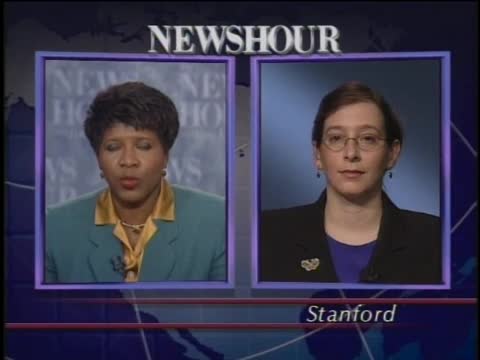
GWEN IFILL: And to help us with that I'm joined by former Florida Supreme Court Justice Gerald Kogan, he retired from the court two years ago after 12 years there, including two as Chief Justice; Pam Karlan of the Stanford University Law School; and John Yoo of the Boalt Hall Law School at the University of California, Berkeley. He formerly clerked for Supreme Court Justice Clarence Thomas.
Judge Kogan, the Judge handed down a pretty definitive rebuff to the Gore campaign. Even the Gore lawyers said they won, we lost. He said that the plaintiffs failed to carry the requisite burden of proof. Can you walk us through why he would reach that conclusion?
GERALD KOGAN: Well, he obviously felt from the evidence that he heard during the trial of this case over the weekend that the Gore campaign did not sustain its burden of proof. In other words, he felt that the evidence that he heard did not leave him with the feeling and the conclusion that, in fact, had they gone ahead and recounted these ballots that they probably... there's a reasonable probability that the result would have been different. And that's the way he ruled the way he did. Now, when this particular decision goes to the Supreme Court, as far as it deals with facts, it's really presumed to be correct. And unless the Gore faction can show that the judge completely abused his discretion, they are not going to go ahead and override his finding of facts. However, as to whether or not he applied the correct law to the facts as he found them, that, of course, is another decision entirely. They could find that he did find facts but he applied the wrong law in his finding of them.
GWEN IFILL: Judge, the court seemed to say, in fact, said very directly that there was no reasonable probability that the outcome of this... any challenge in this case would overturn the results of this election. This, as the Gore folks pointed out, without looking at any of the ballots that were taken to Tallahassee. Is that a basis for challenge?
GERALD KOGAN: Well, sure, it's a basis for challenge because you can then argue before the Supreme Court that that's how he abused his discretion by not looking at the ballots, and then it's up to the court to make that particular decision.
GWEN IFILL: Pam Karlan, how about that? Is that relevant, the fact that the judge didn't look at ballots?
PAM KARLAN: Well, it is if what the Gore people argue on appeal is that he made a legal error in deciding without looking at any of the ballots that there was no reasonable probability of there being a change. So it's really a question of what the legal standard is for deciding which votes should count, and if he got that legal standard wrong, then the Florida Supreme Court can review his decision without giving him any deference, whereas, if he applied the correct legal standard, then it's very hard to get him reversed on appeal.
GWEN IFILL: Professor Karlan, the Judge said no to the argument that the ballots were bad, no to the extended deadline for counting these ballots, no for any evidence that additional counting would change anything-- is there any realistic reason to believe that the Florida Supreme Court, where the Gore folks have now appealed this, any reason could find any daylight in that?
PAM KARLAN: Well, you can always find daylight. Courts are very good at saying that although a trial court judge found the facts in a particular way, his finding of the facts was informed by an incorrect view of the law. How likely the Florida Supreme Court is to do in this case I would defer to Justice Kogan who has a better sense of just how tightly they rein in judges on findings of fact and conclusions of law. But there's always daylight until they turn off the lights.
GWEN IFILL: Well, before we go to John Yoo, let's ask Justice Kogan that. What's your sense of that?
GERALD KOGAN: Well, as I pointed out before, finding of fact comes with a presumption of being correct. And the Supreme Court will accept that as being correct unless, from the record, they ascertain that the Judge abused his discretion. Now, if he, in fact, went ahead and applied the wrong law in the opinion of the Supreme Court to arriving at his factual conclusion, then, of course, they can say that that was an abuse of discretion, it was error on his part and they can, in fact, reverse his findings.
GWEN IFILL: John Yoo, what is your sense about the chance of appeal in this case with the Florida Supreme Court?
JOHN YOO: I think it's quite unlikely that the Florida Supreme Court will reverse here. And the reason for that is because as the other two speakers have said, when trial judges make factual findings, they're given discretion. It's called a clearly erroneous standard. And basically appellate courts because they haven't sat in the position of the trial judge, looked the witnesses in the eye, made judgments on their credibility, appellate courts are very, very loathe - it's happens very rarely -- to reverse factual findings. So it would have to be some kind of legal determination perhaps that the district judge in just completely excluding the use of these ballots as evidence at this portion of the trial was a legal error. But I might add when the Gore campaign made an emergency appeal to the Florida Supreme Court asking them to order the district judge to do precisely that, they denied that appeal. So I can't say I would think they would be sympathetic to that claim.
GWEN IFILL: Well, the Florida Supreme Court seems to be the hot spot today, John Yoo. The U.S. Supreme Court today kicked back a Gore appeal and said that the deadline for counting ballots should be once again decided by the Florida Supreme Court but based on their reasons for reaching this conclusion. Explain to us exactly what the Supreme Court was trying to say today.
JOHN YOO: The Supreme Court essentially said that the Florida Supreme Court did not explain whether it had considered the federal law at issue here, Article II, Section 1 of the Constitution and Section 5 of Title III of the U.S. Code -- whether the Florida Supreme Court had considered those federal laws in reaching its own decision. And so it sent the case back for the Florida Supreme Court to explain itself. Now, one of two things can happen at this point. One, the Florida Supreme Court can come back and say, "we didn't consider the federal law. Now that we do, we were only engaged the process of interpreting conflicting statutes. We did not try to override the Constitution/s vesting of this authority in the state legislature." And then we're back to where we were on Friday. If the Florida Supreme Court does however say that we did use the Florida state constitution to override state election laws in violation perhaps of Article II, Section 1, then I think the Supreme Court might well come back in and reverse the Florida Supreme Court.
GWEN IFILL: We should just mention that the Florida Supreme Court has asked for briefs to be delivered at 3 o'clock tomorrow afternoon on that very argument. Pam Karlan, what do you think about the Supreme Court's distinctions today? Were they clear? Did they give any other hints in their decision about what they really thought about the merits of this case?
PAM KARLAN: They didn't give a lot of hints; they gave somewhat contradictory hints about it, because I think they sort of realized by the time they got the case and by the time they heard oral arguments that events had moved past them and that the real question in Florida was the question that Judge Sauls was deciding today, rather than the question of the extension of the certification. And I agree with John Yoo that essentially what they did is send the case back to the Florida Supreme Court giving the Florida Supreme Court some hints as to how it could write an opinion if it doesn't want to be reviewed again, which the Florida Supreme Court then says we were engaged in pure statutory interpretation and we simply referred to our state constitution because it helps us to understand what the legislature intended to do here. Or the Florida Supreme Court could issue a kind of mea culpa and say oh, well, now that we've looked at the federal statutes we realize that we should have interpreted our own law differently. But it leaves both of those really open for the Florida Supreme Court, and the hints that you get in oral argument don't tell you very much about what the Supreme Court would actually decide if the issue was put it to squarely today.
GWEN IFILL: So, Judge Kogan, did we get any more clarity at all in your opinion on whether the Supreme Court felt that basic threshold of federal jurisdiction had been answered by the Florida Supreme Court?
GERALD KOGAN: Well, you know, my belief in this particular matter is that if the U.S. Supreme Court felt that the action by the Florida Supreme Court violated the law-- whether it be federal law or whether it be U.S. constitutional law-- I think they would have said so. I agree with our other two guests tonight that basically they were giving the Florida Supreme Court a way out and also, by the way, giving themselves a way out because if the Florida Supreme Court picked up the hints that they were giving in their opinion, then what would have happened was it would have gone back up or can still go back up and the U.S. Supreme Court can then say, "well, we're satisfied and we're not going to interfere because this particular decision was decided on state grounds" and did not violate the federal Constitution or federal law.
GWEN IFILL: I heard someone today describe this as a traffic circle where people are continually going around from circuit court to Supreme Court to appeals court and now we also talk about a circuit court decision which is pending in Seminole County, Judge Kogan. Do we have a sense even though Gore is not a party to that case that challenge about whether those absentee ballots were filled out correctly in Seminole County that that will have an effect on all this?
GERALD KOGAN: Well, actually it would. It depends on how the trial judge rules. If she rules that she is going to throw out all of those absentee ballots and if that is upheld by the Florida Supreme Court and any subsequent appeal to the United States Supreme Court, then what's going to happen is Al Gore is going to win the vote in Florida.
GWEN IFILL: So, Pam Karlan, is there always going to be another legal avenue no matter what judgments we talk about here every night?
PAM KARLAN: No, I think that the opera is almost over. My sense is that by December 12 the Florida state courts are going to have to have finished up their business because after that point a whole new round of provisions kick in that either give the Florida legislature or the United States Congress the final say in who Florida's electors are but I think sort of make it harder for the state courts to continue to engage in lawsuits. The other thing I should say I think is as a matter of state law in Florida the time for filing an election contest has now passed. So we're now into a period where we have a finite universe of lawsuits, and it's just a question of they're all working their way through the system.
GWEN IFILL: John Yoo, a finite universe of lawsuits, we can only hope?
JOHN YOO: I think so. You know, Germany could only fight a two-front war and they lost. Now the Al Gore campaign has to fight a three-front war and they've lost on each front -- and the Florida Supreme Court now, the U.S. Supreme Court and in the state legislature. It's important to note I think Pam's quite right the December 12 deadline is an important one. I think the litigation has to resolve itself by then or it looks like the state legislature would step in any event and settle the whole thing.
GWEN IFILL: Judge Kogan, do you agree with that?
GERALD KOGAN: Oh, I think that it has to be over by December 12 because if it's not over then, and as I understand the law, the state legislature has the authority to choose the electors. And I don't think the courts in Florida are going to allow that to happen.
GWEN IFILL: Thank you, legal experts, all.
FOCUS - NEXT MOVE?
JIM LEHRER: Finally now, the perspectives of four former United States Senators: Republicans John Danforth of Missouri and Warren Rudman of New Hampshire; Democrats David Boren of Oklahoma and Dale Bumpers of Arkansas. Senator Danforth, is the opera almost over?
FORMER SEN. JOHN DANFORTH: I think it is. This has been going on now four weeks since the election. I think today was really a very decisive day particularly the decision by Judge Sauls. It's very difficult to see how Vice President Gore is going to end up winning in Florida. So therefore, I think this is really... this is the end of it.
JIM LEHRER: The end of it, Senator Bumpers?
FORMER SEN. DALE BUMPERS: Well, certainly the bar has been raised today, Jim. I won't say it's the end of it. But obviously this whole... everything that's happened today makes it much more difficult for the Gore forces.
JIM LEHRER: Should the vice president preempt this appeal and just get it over with?
FORMER SEN. DALE BUMPERS: No, absolutely not.
JIM LEHRER: Why not?
FORMER SEN. DALE BUMPERS: Well, because it's important that the people of this country know that every judicial avenue has been pursued and the one thing that's going to be a real tragedy when this is over is that everybody knows-- there are thousands of votes that weren't recounted and the Miami Herald reported in a story today, according to an in-depth study they did, Al Gore won Florida by 24,000 votes. It's a real tragedy. I happen to personally believe that he carried Florida by a substantial vote. And yet nothing in the Florida... nothing in the judge's decision this afternoon, nothing in the Supreme Court decision... they followed the letter of the law. I'm not suggesting they haven't - but nowhere in there do you find it saying that... I always said on the floor of the Senate talking about the Constitution, the Constitution -- if you're going to summarize it -- says each one of us counts. In this particular case, each one of us didn't count. And that's a tragedy.
JIM LEHRER: A tragedy, Senator Rudman? Is that what this is?
FORMER SEN. WARREN RUDMAN: Well, I don't think so. I have to disagree with my friend, Dale. It's certainly a great moment in American history. It's been a great lesson in democracy. And I think we ought to be proud of how all the institutions have, in fact, acted. I think that the voices have lowered a bit in the last week. They should stay lowered. Governor Bush had his day in the United States Supreme Court, although he didn't win, he certainly didn't lose. He won more than he lost. It's been remanded, not reversed. Vice President Gore took a real shellacking in court in Florida. I listened to the opinion, tightly drawn, carefully supported by statutory construction, very hard to overturn. I think everyone should do whatever they want to do up until the 12th. And at that point, it's over.
JIM LEHRER: But you don't think it needs to be over tonight?
FORMER SEN. WARREN RUDMAN: Hardly. I don't think the American people are pre-occupied with it. I think the American people-- I will agree with Dale-- I think the American people want to feel that it was dealt with fairly. It now appears that Governor Bush will prevail, and as long as people think that's fair, it's going to help him as the new President of the United States.
JIM LEHRER: Yeah. But Senator Bumpers says that on the issue of fairness, "hey, wait a minute, Governor Bush may get Florida, but he didn't win Florida in terms of the number of votes."
FORMER SEN. DALE BUMPERS: Well, Jim, that may or may not be true. The Miami Herald thinks it's true and I'm not going to argue with them. I haven't done any research. But the fact is that mistakes are made in elections all over the country, and there were some big mistakes made in Florida. I would agree with Dale that if that is what really happened, that probably would be a very sad outcome. But we'll never know. We're a nation of laws. Everyone has taken their case to the court of competent jurisdiction. It will be decided and we will have a new president - and hopefully by the 12th.
JIM LEHRER: Senator Boren, how do you feel about what today means in terms of where this country is and what must happen next?
FORMER SEN. DAVID BOREN: Well, I agree with those that have said I think we're very close to the end of it. And I think that we have to keep in mind that the national interest, the institution of the presidency, is more important than the political agenda of either party. And I do think that it would be tragic if the decision on the selection of Florida electors were ultimately forced into the Florida legislature where a very blatantly political decision would be made. So I believe that if we come up to the 11th, if we come up to next Monday and we don't have a final resolution of this in the courts, I do think for the good of the country and the good of the presidency at that point that Vice President Gore should concede the election. But, Jim, I think, the important thing is what happens after that. That will determine whether or not this has been a tragedy. Clearly the American people have given us almost a tie in the presidential election -- a virtual tie in the congressional elections. They don't want to give either party, either political party, a mandate. I think the only way for the next President to really succeed for the national interest is for the next President to say, "I don't take the election as a party mandate. The people are sick of the bickering between the two political parties. I'm going to create what you really wanted: That is, an American government. I'm going to build a cabinet that's a bipartisan cabinet. I am going to work with a bipartisanship leadership, as Senator Danforth and I suggested a few years ago, creating literally many cabinets within the Congress, the leaders in both parties, the national security, economic policy, and I'm going to try to put an agenda before the Congress that is a product of that bipartisanship. I think that's really the only way for the next President to succeed.
JIM LEHRER: Senator Danforth, how likely do you think it would be that Governor Bush, if in fact ends up being President would do what Senator Boren just suggested?
FORMER SEN. JOHN DANFORTH: I think that's exactly what he will do. I think it's what he has to do. I think David Boren is exactly right. We have to put this election behind us. It's been very contentious, very strong feelings on both sides, but we have to end it. We have to put it behind us. And we have to try to reconstitute a bipartisanship in this country and a willingness to get along with each other. I think that the big problem that's occurred in the last few weeks is that on both sides, there have been those who have challenged the legitimacy of the other side's candidate if the other side's candidate gets elected. That really is a very dangerous thing. Republicans have talked about Democrats stealing the election. Democrats have said there is only one way to count ballots, that's the accurate way, that's manually, which doesn't happen to be the case. I mean the fact of the matter is we will never know for sure who won in Florida. It's too close. The mechanics of an election, whether it's manual counts, holding up ballots, looking for chads and so, or mechanical counts are not that accurate so we will never truly know, so what we have to do is to say, okay, we've done the best we can, it's behind us. Let's move on.
JIM LEHRER: But Senator Bumpers says, Senator Danforth, that that's a tragedy -- if, in fact, Al Gore got 24,000 more votes than George W. Bush in Florida.
FORMER SEN. JOHN DANFORTH: There is no way to know that. And there never will be. You know, people have said under the Sunshine Law in Florida various groups will go and look at ballots. There is no way to look at ballots and to know with that degree of certainty. For example, we've all seen the television broadcasts of the election commissioners holding up the ballots and looking for a dimpled chad and so on and seen that with three commissioners they've often voted two votes to one, which means it's a judgment call; it's a matter of opinion. Democracy isn't perfect. Elections aren't perfect. And it's a mistake to think that they are perfect. And I think that the sooner we realize that this is a rough approximation, we hope the person with the majority won, but we will never clearly establish that.
JIM LEHRER: Do you agree, Senator Bumpers?
FORMER SEN. DALE BUMPERS: Well, I agree with one thing. One of the things we don't know precisely what the vote is, is because we didn't count the ballots. That's one of the great tragedies too. There's no point in getting into that. One of the things that is very... that should be a great benefit out of all this is that the states all across America are going to look very closely at the way they cast their ballots in the future, what kind of voting machines they use. We can do much, much better. One of the real tragedies in this whole thing is that we hadn't done that a long time before. This butterfly ballot, all of these things, it's terrible.
JIM LEHRER: What about Senator Danforth's point, no matter how you do it, it's always going to be a rough approximation -- there is no such thing a perfect electoral system -- I'm paraphrasing but that's -- will you buy that, Senator Danforth?
FORMER SEN. JOHN DANFORTH: Yeah, you said it well.
FORMER SEN. DALE BUMPERS: Jack is a good friend. We served together a long time. I've always had a great respect for his intelligence and his judgment. But I must say I have a tendency to disagree with that to this extent. It will never be perfect. But it certainly can be much more perfect than it is now.
JIM LEHRER: Now what about another point? Senator Lieberman on this program last week said that if those votes that were at issue and Judge Sauls said today they will not be counted, he said if they are not counted there will always be a cloud over this result. Is he right?
FORMER SEN. DALE BUMPERS: Absolutely.
JIM LEHRER: Describe the nature of the cloud.
FORMER SEN. DALE BUMPERS: Well, the nature of the cloud is, for example, when the votes were certified, Palm Beach....
JIM LEHRER: No. I mean the cloud coming out of this -- not how we got the cloud. What's going to be the impact of that cloud?
FORMER SEN. DALE BUMPERS: Well, the cloud is going to be over George W. Bush's head if he is the next President. And the cloud is going to be that... you know, you're going to have this 50-50 split, for example, in the Senate. And that's going to be... that's just a manifestation of what the people in this country can expect over the next four years. The cloud is going to be that not very much is going to happen. Some of the things that have to take place is going to happen but it's going to be a difficult four years.
JIM LEHRER: Senator Rudman, difficult four years for anybody, for everybody?
FORMER SEN. WARREN RUDMAN: Actually, you know, I really believe that what Jack said about what Governor Bush would like to do is accurate based on his performance as governor. However, what we don't know, which Dale has referred to, is what is the Congress going to do? Are they going to essentially get into gridlock for the next two years? Are they going to try to be more bipartisan, as Jack and David Boren suggest, with Governor Bush leading them, or are they going to form some sort of a collective leadership in the House and the Senate? I will tell you that that will have, in my opinion, more to do with the success or failure of a Bush or a Gore presidency than any other single factor.
JIM LEHRER: I will ask David Boren this. It was your idea. How does anybody, you or anybody else, sit down and convince a Democrat in the Congress of the United States now it's in his or her interest to help George W. Bush be a successful President when he's going to have to run for re-election presumably against a Democrat in four years? Senator Boren.
FORMER SEN. DALE BUMPERS: Well, I think that can happen because the only way for the country to succeed-- and clouds have silver linings-- if the next President, he's the one that will determine this, really doesn't claim a partisan mandate, doesn't seek an advantage for his own political party but says I'm going to form a coalition American government.
JIM LEHRER: You mean a real coalition government?
FORMER SEN. DALE BUMPERS: A real coalition. Pardon?
JIM LEHRER: You mean a real coalition government?
FORMER SEN. DALE BUMPERS: I'm talking about a real coalition in the sense that you put a very significant part of the cabinet from the other party, people you can respect and work with certainly, probably moderates. You put together the ranking Democrats and Republicans on key committees like foreign policy and armed services and national security affairs, for example, and you really work together in national unity and you share the credit. You give the credit where it's due when you get support from the Democratic side if it's a Bush presidency. I really think one person has the ability to determine whether or not this is a cloud or whether there's a silver lining to it: That's the next president of the United States. And if he comes in, pushed on by some militant advisors to say we've won the election now we're going to use the presidency for the gain of our political party, I think you will have gridlock. You'll have the other party winning the off-year election because Jack Danforth is right, we'll never know with certainty who actually won this election. And if the next President claims to have a mandate, he'll make a tragic mistake.
JIM LEHRER: Senator Bumpers, let me ask you -- not ask you personally but a Democratic Senator, powerful Democratic Senator in the present tense is sitting there and he is approached by, say, President George W. Bush and let's say this is a liberal Democrat, who ached for Al Gore to be President of the United States, is he going to agree to be a part of the kind of thing that David Boren is suggesting?
FORMER SEN. DALE BUMPERS: I think this, Jim. I think that this election, with pick-ups of four seats in the Senate and two or three seats in the House, means that the... and this vote. I think it means that the Republican Party, for example, is going to have to move toward the center. If George W. Bush wants to accomplish anything, he is going to have to move toward the center. I think the Democrats will be happy to move in that direction in orderto get some things done. But you're not going to be able, for example, his Supreme Court appointments. People are going to be watching that very carefully. That's the most important function a President of the United States has is Supreme Court appointments. And people are going to watch that very carefully. I don't know that he'll have any, but the suggestions are he could have as many as three. And if he appoints, you know, if he appoints some right-wing ideologue, you can almost forget the rest of his term in the United States --
JIM LEHRER: It will just go down the tubes.
FORMER SEN. DALE BUMPERS: Well, I think so.
JIM LEHRER: Let me ask Senator Danforth, would conservative Republicans, positions of power, after having gone through and supported George W. Bush and he ekes out this victory -- now he's the President and he turns around and says we're going to have to share power with these liberal Democrats, are they going to go along with that?
FORMER SEN. JOHN DANFORTH: Well, they have to. And I think on the question of gridlock, we've already had gridlock. We've had gridlock for years between Congress and the President. A good argument could be made that we've got no place to go but up. I agree with David Boren. I think that there is a silver lining in this. I think the American people have spoken not to give a mandate to George Bush or to Al Gore but the American people have said to both parties, "work it out" and try to establish some kind of constructive relationship with each other. I think that that is a message that has been heard. There have been a number of very positive comments from people in Congress, and as a matter of fact, from both Vice President Gore and Governor Bush. So I am very hopeful. I think that there is a positive message in all of this.
FORMER SEN. WARREN RUDMAN: Jim, I really would wish that my friend Jack Danforth was right, but I must say observing what's been going on there lately and with an election coming up in two years that could be decisive in terms of putting Republicans or Democrats back in power, I hope Jack is right but I have very serious doubts.
JIM LEHRER: All right. We have to go. Thank you all four very much.
NEWS SUMMARY
JIM LEHRER: In the other news of this day, President Clinton established the largest protected area ever in the United States. By executive order, he set aside 84 million acres near the Northwestern Hawaiian Islands. It contains nearly two-thirds of the nation's coral reefs. Mr. Clinton said he acted to protect the reefs from pollution, dynamite fishing, and coral poachers.
PRESIDENT CLINTON: By any measure creating this coral reserve is a big step forward not just in marine conservation in the United States but for the health of oceans and reefs around the world. For thousands of years people have risked their lives to master the ocean. Now suddenly the ocean's life is at risk. We have the resources and responsibility to rescue the sea, to renew the very oceans that give us life and thereby to renew ourselves.
JIM LEHRER: The President said his order allows for continued commercial and recreational fishing at current levels, but it bars oil and gas drilling and removal of coral. We'll see you online and again here tomorrow evening, as the search for a President continues. I'm Jim Lehrer. Thank you, and good night.
- Series
- The NewsHour with Jim Lehrer
- Producing Organization
- NewsHour Productions
- Contributing Organization
- NewsHour Productions (Washington, District of Columbia)
- AAPB ID
- cpb-aacip/507-d50ft8f70d
If you have more information about this item than what is given here, or if you have concerns about this record, we want to know! Contact us, indicating the AAPB ID (cpb-aacip/507-d50ft8f70d).
- Description
- Episode Description
- This episode's headline: Decision Day; Legal Labyrinth; Next Move?. ANCHOR: JIM LEHRER; GUESTS: REP. JERROLD NADLER; GOV. MARC RACICOT; GERALD KOGAN; JOHN YOO; PAM KARLAN; FORMER SEN. JOHN DANFORTH; FORMER SEN. DALE BUMPERS; FORMER SEN. WARREN RUDMAN; FORMER SEN. DAVID BOREN; CORRESPONDENTS: FRED DE SAM LAZARO; BETTY ANN BOWSER; SUSAN DENTZER; RAY SUAREZ; SPENCER MICHELS; MARGARET WARNER; GWEN IFILL; TERENCE SMITH; KWAME HOLMAN
- Date
- 2000-12-04
- Asset type
- Episode
- Topics
- Politics and Government
- Rights
- Copyright NewsHour Productions, LLC. Licensed under a Creative Commons Attribution-NonCommercial-NoDerivatives 4.0 International Public License (https://creativecommons.org/licenses/by-nc-nd/4.0/legalcode)
- Media type
- Moving Image
- Duration
- 01:04:05
- Credits
-
-
Producing Organization: NewsHour Productions
- AAPB Contributor Holdings
-
NewsHour Productions
Identifier: NH-6911 (NH Show Code)
Format: Betacam
Generation: Preservation
Duration: 01:00:00;00
If you have a copy of this asset and would like us to add it to our catalog, please contact us.
- Citations
- Chicago: “The NewsHour with Jim Lehrer,” 2000-12-04, NewsHour Productions, American Archive of Public Broadcasting (GBH and the Library of Congress), Boston, MA and Washington, DC, accessed April 2, 2026, http://americanarchive.org/catalog/cpb-aacip-507-d50ft8f70d.
- MLA: “The NewsHour with Jim Lehrer.” 2000-12-04. NewsHour Productions, American Archive of Public Broadcasting (GBH and the Library of Congress), Boston, MA and Washington, DC. Web. April 2, 2026. <http://americanarchive.org/catalog/cpb-aacip-507-d50ft8f70d>.
- APA: The NewsHour with Jim Lehrer. Boston, MA: NewsHour Productions, American Archive of Public Broadcasting (GBH and the Library of Congress), Boston, MA and Washington, DC. Retrieved from http://americanarchive.org/catalog/cpb-aacip-507-d50ft8f70d