The NewsHour with Jim Lehrer
- Transcript
JIM LEHRER: Good evening. I'm Jim Lehrer. On the NewsHour tonight a Newsmaker interview with Defense Secretary William Cohen; today's House and Senate hearings on campaign finance problems; some thoughts about a retiring college basketball coach, Dean Smith; a look at the work of Italian playwright Dario Fo, who won the Nobel Prize for Literature today; and a Roger Rosenblatt essay about art that lasts. It all follows our summary of the news this Thursday. NEWS SUMMARY
JIM LEHRER: Attorney General Janet Reno said today she was mad at the way videotapes of White House coffees were handled. Her anger came from the tapes being turned over to investigators on Saturday, three days after they were discovered. She had concluded a day earlier there was no need to name an independent prosecutor to investigate the White House events. The tapes show President Clinton meeting with supporters at the White House. Some Republicans say those meetings violate the federal election law. The attorney general spoke to reporters at her weekly news conference.
JANET RENO, Attorney General: Some have claimed that I have not vigorously pursued evidence by failing to secure production of White House tapes. These claims are not true. As I have said before, we have an active grand jury investigation underway. In general, the law relating to grand juries does not allow me to discuss grand jury subpoenas and their enforcement. Thus, all I can say is that we sought the production of these tapes and are as disturbed as anyone about their delayed production.
JIM LEHRER: White House Spokesman Mike McCurry said he understands why Reno is mad. He spoke to reporters at this daily briefing.
REPORTER: What's your reaction to Attorney General Reno's statements being very disappointed about the tapes?
MIKE McCURRY, White House Spokesman: It's easy to understand and easy to agree with.
REPORTER: Well, how can the White House work with the Justice Department if the attorney general says she's mad at the White House and that the relationship, as you heard, is--
MIKE McCURRY: You get mad at me and I get mad at you from time to time, and we work together reasonably well, so I don't think that's hard to imagine.
JIM LEHRER: House and Senate committees continued to investigate alleged fund-raising abuses. The House Committee heard from the sister of Democratic fund-raiser Charlie Trie. Madeleine Fong said she made two donations at her brother's urging and was reimbursed with funds from foreign sources. The Senate Committee focused on a scheme to swap donations between the Teamsters Union and the Democratic Party. A former Democratic fund-raiser said he was pressured about the deal but it never went through. We'll have more on these hearings later in the program. In the White House Rose Garden today President Clinton brought gun manufacturers and police officers to announce a plan to make guns safer. He said within a year 80 percent of all new handguns will have child safety locks.
PRESIDENT CLINTON: Today because of the voluntary action in the firearms industry millions of our citizens will receive this protection. As is well known this administration and the gun industry from time to time have stood on different sides of various issues: the Brady Law, the assault weapons ban. And there may be other disagreements in the future, but today we stand together and stand with the law enforcement community to do what we all know is right for our children.
JIM LEHRER: Mr. Clinton also honored some of the police officers for heroism, and he asked Congress to extend federal law enforcement scholarships to the children of state and local officers killed in the line of duty. Defense Secretary Cohen today issued a warning to Iraqi President Saddam Hussein. He said the United States would not tolerate more violations of Iraq's no-fly zones .He said both Iraq and Iran scrambled planes in the area last week. U.S. military jets stepped up their patrols and the aircraft carrier Nimitz is headed to the Persian Gulf with more planes to enforce the flight ban. Cohen spoke to reporters at the Pentagon.
SEC. WILLIAM COHEN: We have taken measures to cut down his ability to simply skip across the no-fly zone and duck back into Iraqi territory above the zones. But he is posing a risk to himself, his pilots, as such, whenever they start to challenge a no-fly zone. If they make a mistake, they will have to bear the consequences of it. But we have taken measures to tighten the area around which they seem intent on seeking to exploit on a very quick and piecemeal basis.
JIM LEHRER: We'll talk to Sec. Cohen right after this News Summary. Hurricane Pauline struck Acapulco, Mexico today, killing more than 59 people. Streets were flooded with mud and debris, buildings collapsed, and buildings were destroyed in fierce rain and 100 mile an hour winds. At least five others were killed in areas outside Acapulco. Italian playwright Dario Fo won the Nobel Prize for Literature today. The Swedish Academy cited the 71 year old writer and actor for using both laughter and gravity to open our eyes to abuses and injustices in society. He's best known for the plays "Comic Mystery," "Accidental Death of an Anarchist," and "Can't Pay, Won't Pay." We'll have more on Foe later in the program. The most successful college basketball coach retired today. Dean Smith announced he was stepping down as head coach of the University of North Carolina's men's basketball team. He won 879 games and two national titles over his 36- year career. NBA star Michael Jordan was among his former players. We'll have more on Dean Smith later in the program. Also coming up Sec. Cohen, more campaign finance hearings, playwright Dario Fo, and a Roger Rosenblatt essay. NEWSMAKER
JIM LEHRER: It was nine months ago that William Cohen, the just retired Republican Senator from Maine, became Secretary of Defense in the Democratic administration of President Clinton. He joins us now for a Newsmaker interview. Mr. Secretary, welcome.
WILLIAM COHEN, Secretary of Defense: Good to be here.
JIM LEHRER: This warning that you issued to Saddam Hussein today, what's going on?
SEC. WILLIAM COHEN: Well, I think Saddam Hussein is probing for weaknesses, trying to flaunt the ban on the no-fly zones, sending his aircraft in on a sort of a quick kind of run and hide and seek, and so we have sent a message that we're going to enforce that no-fly zone, and to the extent that it has aircraft across that 33rdparallel. They are going to risk being shot down.
JIM LEHRER: And that is in process. I mean, the word has gone to U.S. planes. You see--you catch an Iraqi plane in there, shoot 'em down.
SEC. WILLIAM COHEN: The word has gone forth that any violations will be strictly dealt with, and that would include shooting them down.
JIM LEHRER: Now, Iran has been doing the same thing, right, from the other side?
SEC. WILLIAM COHEN: Iran last week--a little bit more than a week ago did have some incursions, but I have not detected any since that time, and we have not detected any. So it really is Iraqi violations to this point.
JIM LEHRER: Well, what are they each up to? Is there a problem between Iran and Iraq, and that's what's causing these violations?
SEC. WILLIAM COHEN: I think prior to Iran coming across into Iraqi territory to strike what they consider to be terrorist camps that Saddam Hussein was intent on trying to break the no-fly zone prohibitions. And so I think he's using this as an excuse to see how far he can go, how much he can get away with, how strictly we're going to enforce those rules. And so he's probing. He's probing the weaknesses to see what our resolve is and the message should go forth. Our resolve is very strong on this, so is that of our allies. I've talked to our British counterparts, the French, and others. And so we intend to enforce those very strictly.
JIM LEHRER: Is there a danger that the United States could get caught in a resurgence in an Iran-Iraqi war, get in the middle?
SEC. WILLIAM COHEN: I don't think there's that danger. I think the danger is for Iraqi planes to fly in the no-fly zone, or should Iranian planes be in that zone, they, of course, would bear a risk also. It's very difficult.
JIM LEHRER: Because we'd shoot them down too, right?
SEC. WILLIAM COHEN: Well, we have no way of telling in a time of split second decisions as to whether it's an Iraqi plane or an Iranian plane. So the message is for the Iraqis. To the extent that there are other aircraft in the region flying in that zone, then they bear a substantial risk.
JIM LEHRER: Give us a feel for how serious a matter this is, the aircraft carrier, Nimitz, is on its way there. Is this a big deal potentially?
SEC. WILLIAM COHEN: Well, we ordered the Nimitz to sail five days sooner as a signal to Saddam Hussein that we're serious. And obviously that adds to the fire power that we have in the region, which is substantial. But to the extent that we need to augment it in any fashion that's a pretty good signal and a symbol that we intend to do so.
JIM LEHRER: But you don't see this escalating into some big deal.
SEC. WILLIAM COHEN: I don't see it escalating unless Saddam Hussein decides to take on the United Nations once again and the U.S. and French and the British aircraft that are flying to protect those no-fly zones.
JIM LEHRER: And no indication at this point that he intends to do that?
SEC. WILLIAM COHEN: No. I think that what they do is they skitter across the line, they see our planes coming, and get right back in line, and go home. So they're constantly sort of out there teasing and testing, and we want to make sure that they don't go too far, and if they do, they'll pay for it.
JIM LEHRER: Okay. On Bosnia, Mr. Secretary, some confusion has developed as to when the United States troops are actually going to leave. Is it still June of next year?
SEC. WILLIAM COHEN: I recently completed a trip to Maestricht where we had a conference of all the NATO defense ministers and there was unanimous agreement that S-FOR's mission was going to end in June of '98. President Clinton has indicated--
JIM LEHRER: S-FOR is the--
SEC. WILLIAM COHEN: Stabilization force.
JIM LEHRER: That's the stabilization force that's there now.
SEC. WILLIAM COHEN: That's going to end in June of 1998, and what we have to do is to do everything we can between now and then to see that we can enforce the compliance with the Dayton Accords. President Clinton has indicated that he believes the international community has a longer-term interest in the stability of the region, and as does the United States. What form that interest will take, will be manifested, remains to be decided. They have been--there has been no decision made--what we intended to--as a United--the NATO alliance, itself, is to make sure that we take whatever measures we can to enforce compliance between now and June, but no decision beyond that. Obviously, there will be an interest reflected by the international community. WE will have an interest, but no decision has been made beyond that period of time. Secondly, Congress will have a major role to play in this. Congress has indicated that it will terminate funding as of June of '98 unless the President comes forward with some rationale, an explanation, as for a need to be there, in what numbers, how long, how much, and what that would do to readiness and morale, so that Congress wants to play a significant role, as they should, and this is something that we will have to work with Congress on if the United States is going to play a role beyond June of '98. No decision has been made at this point.
JIM LEHRER: Gen. Shalikashivili in his farewell interview here on this program a week or so ago said that he thought it was generally a mistake, as in Bosnia, to give any kind of deadline as to when troops are going to go in, or when they're going to come out because what that does is invite mischief. Do you agree with him?
SEC. WILLIAM COHEN: As a general proposition I think he's absolutely correct. In this particular case because of the circumstances in which we went in and because of the controversy about the U.S. involvement.
JIM LEHRER: Sorry about the fly there, Mr. Secretary. You're doing very well. You're holding up very well.
SEC. WILLIAM COHEN: As long as it's not one of Saddam Hussein's planes it's okay. But I think as a general proposition setting time lines is not helpful. In this particular case it has served a very positive and solitary benefit, namely it has forced all of the countries to focus their energies on what we can do between now and next June. As a result, you're seeing a great deal of momentum take place. The farmers are going back into the fields; our troops have done just an outstanding job in keeping the peace. No killing is taking place. Children are able to play in the streets without being sniped at by those sniped again from great distances. So we're seeing the economy start to take hold. A great deal of progress has been made. We had 10 war indictees who've turned themselves in voluntarily this past week.
JIM LEHRER: They're Croats, right. Yes.
SEC. WILLIAM COHEN: And a lot of progress is being made. So we intend to intensify our efforts to see to it that we can do as much as we can between now and next June.
JIM LEHRER: Has Bosnia been the most difficult problem you've dealt with as Secretary of Defense these last nine months?
SEC. WILLIAM COHEN: It hasn't been the most difficult. It's a difficult issue for all of the countries involved, but I must say I come back to the principle that we should all be very proud of the young men and women who are serving not only from the United States; they're doing a terrific job, but from all of the nations who were there. There are some 30 plus nations who are sharing in that effort. Russian soldiers are standing alongside of U.S. soldiers as well. And so Bosnia has been a problem, obviously, to deal with, but it's one that our soldiers are measuring up to magnificently.
JIM LEHRER: What has been the impact--moving on to some other things--what has been the impact of the sex harassment and abuse scandal in the military in the various services in terms of morale and other factors?
SEC. WILLIAM COHEN: From my vantage point it has had very little impact. I have made every effort to go around to visit all of our training centers. I've been out in the field visiting with soldiers, Marines, sailors, airmen, Coast Guard men. I just came back--my wife, Janet, and I were in Bosnia together. There is very little concern out in the field where our men and women are performing on a day to day basis in a fashion that the American people are really very, very proud ofand should be proud of. And so I don't see that it's having much of an impact out in the field as such. The problems that we have will be addressed. They are being dealt with. Sex in the military is obviously a problem that we have to contend with but it's a problem for all of America, in corporate America, throughout our communities, on the Internet. We are going to deal with it in a fashion as we have dealt with the problems of racism in the past, of drug abuse in the past. We'll deal with this problem as well.
JIM LEHRER: Do you feel you're on top of it now, and you feel it's behind you? Is it still an ongoing problem?
SEC. WILLIAM COHEN: No. It's still an ongoing problem, obviously, when we're talking about gender integration and the problems that have persisted in terms of stereotypes and how people have treated each other in the past, but I think that we will deal with it in a very constructive and ultimately very successful fashion.
JIM LEHRER: Was the decision not to promote Gen. Ralston, chairman of the Joint Chiefs of Staff, the most difficult decision you've had to make these last nine months?
SEC. WILLIAM COHEN: Well, first of all, I did not submit his name for nomination but he was one of my top choices, obviously. I think it was difficult for him; it was difficult for me because I think he was treated unfairly. I believe that he would have been an outstanding chairman of the Joint Chiefs of Staff. He is performing admirably today as Vice Chair.
JIM LEHRER: Vice chair. He's still vice chairman.
SEC. WILLIAM COHEN: Yes. He is. And on a--
JIM LEHRER: Sorry about that.
SEC. WILLIAM COHEN: On a day-to-day basis he does an outstanding job. But he and now the new chairman, Hugh Sheldon, will make a terrific team. And so it was I think difficult for him because he has an outstanding record as a member of the Air Force and now as a member of the Joint Chiefs of Staff. He has just done a terrific job. He enjoys the confidence of virtually everyone. The President has him--holds him in very high regard. Gen. Shali, in his retirement ceremony, mentioned how important he is to us. I mentioned him. It was difficult, I think unfortunate, but he's a true professional, and he is serving admirably today.
JIM LEHRER: Mr. Secretary, when you came in, of course, as I said, you were a Republican, and there were a lot of questions, hey, there's a Republican going into a Democratic cabinet. How has that worked, the fact of being a Republican in a Democratic cabinet?
SEC. WILLIAM COHEN: Well, it may be a new enterprise as such but it has worked just on a magnificent level. The President has treated me with the same care and comfort that he would any Democrat. I have a great relationship with the Secretary of State, Madeleine Albright, with our national security adviser, Sandy Berger. We have a terrific team. We work together very closely. Whatever disagreements there are we work out in a very cordial basis, and I am treated as one of the family. And I treat them as family members as well, and so it's a good team.
JIM LEHRER: You've worked with him closely now for nine months. What's your impression of President Clinton?
SEC. WILLIAM COHEN: I think he's one of the most capable people to ever hold that office certainly during my lifetime and my involvement in politics. He's very intelligent. He absorbs an enormous amount of information. He is--has a very curious mind, and wide-ranging and a variety of areas of interest, and is able to not only absorb the information but digest it, collate it, and to use some analytical powers, which I think are quite extraordinary.
JIM LEHRER: Does he care about these things we've been talking about?
SEC. WILLIAM COHEN: He does, indeed, and, in fact, I write a memo to him once a week, and he reads every memo and brings it to my attention on our subsequent meetings.
JIM LEHRER: How would you describe your relationship with him?
SEC. WILLIAM COHEN: Very cordial, friendly. It's a very good relationship. It's a very positive one and one that I enjoy immensely.
JIM LEHRER: You went from being a United States Senator where you had freedom to speak out any given day about anything that you wanted to, to being now a member of a team. Has that been frustrating to you when you hear a story like tapes involving the White House, you've been a United States Senator, you might have gone to the floor of the Senate and said something--is that a problem for you, or not?
SEC. WILLIAM COHEN: No, it's not a problem. I'm part of the administration, part of a team, and I knew that when I accepted the position, and I act accordingly. I think the biggest constraint that I feel is that as Secretary of Defense my words may carry a little more weight than they do as a Senator so that I might be able to say anything I'd like to say on the Senate floor, and few people beyond perhaps the immediate beltway and my own constituents back in Maine might have noticed. As Secretary of Defense every word is measured, every word carries certain implications, even though silence can imply certain thing, so I have to be a bit more cautious and constrained, and that's something that I've learned to do quite quickly.
JIM LEHRER: Now, when you were a United States Senator you were also a writer of fiction and of poetry. Are you still doing that as Secretary of Defense?
SEC. WILLIAM COHEN: Not much time for writing these days. I did some writing prior to taking the job, but it will not be published until after I leave.
JIM LEHRER: I mean, are you planning to write about your experiences when you do leave?
SEC. WILLIAM COHEN: At some point I hope to capture some of my experiences certainly in non-fiction but hopefully even in fiction. As a fellow writer you understand nothing that occurs during our lifetime goes unnoticed by the mind and it eventually winds its way into fictional accounts.
JIM LEHRER: Is this a job your into?
SEC. WILLIAM COHEN: I am really enjoying this job. It's one of the most difficult, challenging, and stimulating jobs that one could ever hope to have. The days and nights are long, and can be exhausting, but they're exhilarating as well. And I take a great deal of pleasure in being able to really represent the men and women who are serving in the military and to do my level best to see to it that we take as good care of them as they're taking care of us.
JIM LEHRER: Do you feel it matters, what you're doing?
SEC. WILLIAM COHEN: It absolutely matters. Every day, every decision I make has consequence for everyone that is involved in providing for the security of our country.
JIM LEHRER: And you're aware of that as you go about your day?
SEC. WILLIAM COHEN: I am indeed. I sign every deployment order, no--the troops don't move unless I sign those deployment orders. I read them carefully. I want to know where our troops are going at any given time, and so I look upon them as our sons and daughters and want to make sure that I take as much care and concern for them as I would my own sons.
JIM LEHRER: Mr. Secretary, thank you.
SEC. WILLIAM COHEN: Thank you. SERIES - THE MONEY CHASE
JIM LEHRER: Now the day's campaign finance hearings. Kwame Holman reports.
KWAME HOLMAN: After much delay the House Government Reform Committee this morning finally called its first witnesses as the committee began its investigation of campaign fund-raising abuses during the 1996 presidential campaign.
REP. DAN BURTON, Chairman, Government Reform Committee: We have three witnesses today. These individuals have admitted to making conduit contributions to the Democratic National Committee. Testifying on our first panel will be Manlin Fong, the sister of Charlie Trie. Joining her will be her companion, Joseph Landon. Testifying on our second panel will be David Wang, a businessman from Los Angeles. Our witnesses today are not villains; they are victims. They are ordinary people who were put on the spot by someone they trusted, and they got burned.
KWAME HOLMAN: Committee Chairman Dan Burton was referring to Ya Lin Charlie Trie, a former Little Rock, Arkansas restauranteur and longtime associate of President Clinton's, who's suspected of funneling illegal foreign contributions to the Democratic National Committee.
REP. DAN BURTON: Ms. Fong and Mr. Landon contributed $35,000 to the DNC in 1996 at Charlie Trie's request. They were promptly reimbursed for each contribution. Our investigators have traced $10,000 of this amount directly back to the Bank of China in Macao.
KWAME HOLMAN: However, the witnesses--subpoenaed and appearing under grants of immunity-- wouldn't answer any questions before television cameras, a right granted under House rules.
REP. DAN BURTON: While I'm disappointed that this hearing will not be televised, we believe the American people have the right to know what these witnesses have to say.
KWAME HOLMAN: But once the cameras left the room Manlin Fong said she knew little about her brother's business practices and nothing about his political activities. She said she made contributions to the DNC simply because he asked her to. Landon gave similar answers. Well aware of what the witnesses would say based on their earlier depositions the committee's top Democrat, Henry Waxman, questioned the need to hear from them since the Thompson committee on the Senate side had heard the same stories from similar witnesses three months ago.
REP. HENRY WAXMAN, [D] California: There is nothing in their deposition that ads to the knowledge to what Sen. Thompson uncovered in his July 19 hearing.
KWAME HOLMAN: and as for the third witness, David Wang, Waxman accused him of giving false testimony because in his deposition Wang claimed to have meet with DNC fund-raiser John Huang on a day when records show Huang actually was three thousand miles away.
REP. HENRY WAXMAN: It is now clear that David Wang never should have received immunity. He has repeatedly misled this committee and Chairman Burton and his staff and our staff. The essence of his testimony appeared to be a fiction.
SEN. FRED THOMPSON, Chairman, Governmental Affairs Committee: Let's come to order, please.
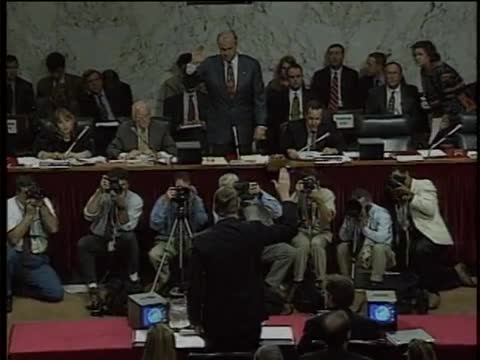
KWAME HOLMAN: Meanwhile, at the Senate Governmental Affairs Committee members spent a second straight day looking into how fund-raising abuses during the 1996 presidential campaign may have intersected with illegalities in a number prominent national election. Last December Ron Carey narrowly was elected president of the Teamsters Union, an election plagued by charges Carey's supporters used a variety of improper methods to raise campaign funds. The alleged schemes now are being investigated by several entities, including a federal grand jury in New York. This morning Senate Committee Chairman Fred Thompson described a so-called contribution swap involving the Teamsters Union and the Democratic National Committee.
SEN. FRED THOMPSON: The swap will we will look at today is relatively simple. The plan was the DNC persuades a wealthy donor to give $100,000 to Ron Carey's election campaign. In return, the Teamsters contribute some multiple of that amount, perhaps a million dollars out of its Treasury or PAC funds to the DNC and state Democratic Parties. It's not a bad deal for the DNC, but it's illegal.
KWAME HOLMAN: The witness was Mark Thomann, a DNC fund-raiser. He described pursuing a Filipino businesswoman named Judith Vasquez as a potential donor.
MARK THOMANN, Former Midwest Finance Director, DNC: I talked to a number of individuals close to Judith Vasquez to ascertain that Ms. Vasquez did not hold a green card, nor was she a resident of the United States, therefore, direct donation to the Democratic National Committee and/or an in kind contribution to the Democratic National Committee was not--was not legal.
KWAME HOLMAN: Thomann said he spoke to his superior, then DNC Deputy Finance Director Richard Sullivan.
MARK THOMANN: You've said we have a change of direction, would she--and she being Judith Vasquez-- be willing to contribute to the Teamsters for a Corruption Free Union. I laughed at the name of the committee, having no knowledge of what that Teamsters for a Corruption Free Union was. It sounded a little bit strange. And Richard also laughed when he told me the name. And I asked what the--what the committee was. At that time he told me it was a Ron Carey committee. And I asked at that point what the legalities of her--and her being Judith Vasquez--would be as far as contributing to this committee. And he went over the parameters of legality.
HAROLD DAMELIN, Sr. Majority Counsel: Now, using again your words in the deposition is it fair to say that you were "upset and distraught" because the DNC had put you in the position of asking a donor to give to a labor campaign?
MARK THOMANN: I was upset at the pressure that I was receiving mainly from the Teamsters directly. I was upset and distraught. That is an accurate description of how I was feeling at the time.
KWAME HOLMAN: Thomann said he found a way out of his dilemma when he discovered Vasquez was an employer. Employers are barred under the U.S. labor law from contributing to union elections.
MARK THOMANN: The reason she couldn't contribute to the Teamsters for a Corruption Free Union was that her holding company--and I believe that's how you'd refer to it as-- had a 116 employees. That was my way of--my way out. It didn't meet the parameters that I was given. So I did tell Nathaniel 216 employees--that was my way of--my way out--it didn't meet the parameters that I was given.
KWAME HOLMAN: This afternoon the committee's very first witness last July and Thomann's former superior at the DNC, Richard Sullivan, gave an angry statement about his recent treatment by investigators for the Republican-controlled committee.
RICHARD SULLIVAN, Former Finance Director, DNC: When U.S. marshals interrogate my 70 year old, sickly next door neighbor about my whereabouts, that has a cost. When they flash their badges at my landlord, who I hope may someday serve as a reference when I want to buy a home of my own, that has a cost. And when the committee's staff treat me and my testimony as nothing more than a political issue, they can exploit for partisan purposes, irrespective of the truth, that too has a cost.
KWAME HOLMAN: Sullivan thenwent on to deny he told Mark Thomann to secure a contribution to the Ron Carey campaign from business woman Vasquez.
RICHARD SULLIVAN: I am aware that Mark recalls that I instructed him to have this woman make a contribution to the Carey campaign. I do not recall being that definitive with him, but I am not bothered by the difference which is hardly material. Our recollections are clear on the key points judged by any objective standard that I asked him to determine the woman's willingness to contribute; that I asked that the legal requirements be checked; that those requirements were not satisfied; and that she did not contribute.
SEN. ARLEN SPECTER: On that state of your testimony isn't it pretty plain that it was a direct quid pro quo, a direct swap?
RICHARD SULLIVAN: Were you here when I read my opening statement?
SEN. ARLEN SPECTER: Yes, I was, and I read it again.
RICHARD SULLIVAN: I said clearly I did not consider this a swap, a scheme, or a quid pro quo.
SEN. ARLEN SPECTER: Well, you'll pardon me, Mr. Sullivan, if I do not accept your opening statement.
KWAME HOLMAN: After a sometimes contentious partisan debate, Chairman Thompson denied Democratic subpoena requests and the Republican majority voted to subpoena the White House Communications Agency for any remaining videotapes of White House coffees. The Senate Committee is scheduled to reconvene October 21st.
JIM LEHRER: Still to come on the NewsHour tonight Dean Smith retires, Dario Fo wins, and Roger Rosenblatt considers lasting art. FOCUS - DEAN OF THE COURT
JIM LEHRER: The dean of college basketball steps down. Phil Ponce has the story.
PHIL PONCE: After 36 years, Dean Smith, the all-time winningest coach in college basketball history, is retiring. A native of Emporia, Kansas, Smith began his college basketball career as a player with the Kansas University Jayhawks, where he won a national championship in 1952. In 1961, at age 30, he became the head basketball coach with the University of North Carolina Tar Heels. After a losing season in 1961, Smith's team had 35 straight winning seasons, won more NCAA tournament games than any coach in history, reached 11 NCAA tournament Final Fours and won two NCAA championships in 1982 and 1993, and last season he became the all-time winningest coach winning his 879th game. Smith did not just win basketball games. He broke a regional color barrier by recruiting the first African-American player in North Carolina history, Charlie Scott. Smith has coached 14 all Americans, including NBA stars Michael Jordan and James Worthy. Smith announced his retirement at a press conference at the stadium that was named after him, the Dean Smith center, otherwise known as the Dean Dome.
DEAN SMITH: If I can't give this team that enthusiasm, I said I would get out. And that's honestly how I feel. I'm the luckiest guy in the world, and I've said that, to be in Chapel Hill, to be at the University of North Carolina, with this faculty, this student body. And I've been through a few of them. This is 39 student bodies. Actually, it's 40. My only guilt, if there is such a word, as I said, is some team, some day would be my last team, and so, yes, there's guilt, and I look in their faces, and I just couldn't handle that yesterday, and I couldn't if I turned right now, but I still believe it's best for them, unless I could give them what I want, but I'm going to work for them. And I owe 'em. Any player who's played for me, I owe 'em. What loyalty I've had any man-- from my players over there--they're really special. That's all. [Applause]
PHIL PONCE: For a look at the legacy of Dean Smith we're joined by John Feinstein, sports author and commentator. His new book about coaching and the Atlantic Coast Conference is due out in December. John, welcome. First of all, for people who may not follow basketball, why was Dean Smith a big deal?
JOHN FEINSTEIN, Sports Author: Well, you have to start with the numbers. That's the easy way to explain it because he was the winningest coach of all time. He surpassed Adolf Frup last March. He won national championships. He went to Final Fours. He graduated most of his players. His graduation percentage was higher than his winning percentage. And that's a significant thing because what he proved over all these years at North Carolina was that you could win games and win championships with players who went to class and graduated. But beyond that was what we saw at the end of the piece, it's not insignificant that he started to break down talking about his players and their loyalty. When he broke the all time record last March for wins dozens and dozens of his former players flew in to Winston-Salem, North Carolina just to be there. He told them not to come. You know, don't make the effort; come in during the off season, we'll go play golf, but they wanted to be there because he'd meant so much to them. And I think the significant thing you have to remember about Dean Smith is not the 879 wins but the number of lives he touched because that's what he did all these years as a coach; he touched lives.
PHIL PONCE: And one of the ways that he touched lives, according to the reports, is his emphasis on sportsmanship.
JOHN FEINSTEIN: Oh, yes. Dean was always like that. He always insisted--for example, if you watched him when the other team was being introduced before a game, he would stand there and clap for the opposing players. He just felt that was the right thing to do--small things. Lefty Drizelle, the Maryland coach, once--they were having a big battle, and Lefty wrote him a letter saying, next year when we play I don't want to shake hands with you after the games. And Dean wrote back and said, "I will always shake your hand, win or lose." And he did; he literally chased Lefty off the court after their first game the next year to make sure they had their handshake.
PHIL PONCE: As far as innovations, how he affected the game, what things did he contribute to the game that made him sort of unique?
JOHN FEINSTEIN: Well, there were some things on the court. He ran the four-cornered delay offense in which he would just give the ball to a great point guard like a Phil Ford, who played for him and was a great player, and let him dribble out the game the last four or five minutes when North Carolina had a lead. That offense led to the shot clock because players and coaches and fans got so frustrated watching the game grind to a halt that they said we've got to put in a clock. He told his players to give his signal when they were tired, and then they were allowed to put themselves back in the game. But another thing that was significant to me was when he was a senior at Kansas he wasn't a starter, and he didn't get to start in his last home game, and he always remembered that. So when he became a head coach, he always started his seniors, even walk-ons who weren't on scholarship in their last home game, and now that's a tradition. At every college in America the seniors start their last home game; they call it Senior Day, and that's because Dean Smith didn't start his last game as a senior at Kansas.
PHIL PONCE: In spiteof the fact that he was so successful against opposing colleges, what was the level of respect that other coaches had for him?
JOHN FEINSTEIN: Well, the respect was always tremendous but there was also a good deal of animosity, especially in the ACC, which is a league where geographically for most of Dean Smith's career only went from the University of Maryland in College Park as far as the University of South Carolina, then moved South to Atlanta and eventually into Florida. There was a lot of antagonism between he and other coaches. He and Mike Shashefsky, the Duke coach, had been great rivals for the last 18 years, and there have been moments when they've had angry exchanges both on the court and away from the court, but when you're talking about respect, they would also say over and over again how could he do it for so many years, the competing, the recruiting, the wins, the losses, and come back and come back and come back, and finally after all these years he ran out of energy.
PHIL PONCE: How did he do it for so many years?
JOHN FEINSTEIN: I think Dean Smith is the most competitive human being I've ever met in sports, and that's a pretty long list. Guys who play golf with him will tell you two words you will never hear from him are "that's good." He never concedes anything. He is the most competitive person I've ever interviewed in the sense that he would never give you an easy answer to something. He would say, why do you want to know that, or try to turn the question around, and as long as he had that competitive spirit and because he--he's a brilliant guy. He was a math major in college; he read a lot. He isn't just a jock. He was a very bright man. That and the competitiveness kept him going.
PHIL PONCE: Is the world of collegiate athletics, collegiate basketball passing him by as far as--I mean, is he an anachronism, with his emphasis on team work and sportsmanship?
JOHN FEINSTEIN: I don't think he's an anachronism in the sense of being able to win. Dean Smith could have kept winning for another five, ten, fifteen years, as many years as he wanted to, but the way the athletes have changed I think made coaching less fun for him. He had some players in the program the last few years who he found frustrating to coach, who didn't respond to him, who wanted to do it in their way, who wanted to thump their chest when they dunked after big plays, who wanted to trash talk the other team, and Dean didn't enjoy that. He told me that in 1996 when he had a difficult season that he almost quit then but wanted to come back because if he was going to go out, he wanted to go out on a good note. And this team last year going to the Final Four gave him that good note to go out on.
PHIL PONCE: Were recent players--would they respond to him when he would tell them don't trash talk, that is, don't--
JOHN FEINSTEIN: Not always. Not always. I mean, I had never seen North Carolina players trash talk until the last couple of years, and then they had a couple of players who would actually talk to the fans during games when they were on the road. And Dean's attitude was on the road you go in, you beat 'em and you get out of there. And that's the way you shut up the fans is by beating them.
PHIL PONCE: Early on, and he continued to have an interest in civil rights.
JOHN FEINSTEIN: Very much so. His father was the first high school coach in Kansas to coach an integrated team. The school board there told him not to do it, and he said, no, I'm going to do it, or I'm going to resign. They won the state championship, and then nobody complained about having an integrated team anymore. When he got to North Carolina, Chapel Hill was still a segregated city, and the minister at his church and he and a black member of their church went into a restaurant in 1959, when he was still an assistant coach, not famous or anything, and it was segregated, and they basically dared the management not to serve them. And they did serve them, and that was one of the beginnings of breaking down the color lines in Chapel Hill. And he was very much a civil rights activist throughout the 60's and was the first coach to recruit black players at North Carolina, obviously--recruited a walk-on nobody'd heard of named Willie Cooper in 1964 and then Charlie Scott two years later.
PHIL PONCE: What is the world of collegiate athletics losing by his stepping down?
JOHN FEINSTEIN: Besides losing an icon they're losing someone who stood for the things we want college athletics to be that very often too often it's not anymore. As I said, Dean never backed away from his principles. He insisted his players go to class. They did graduate. He would never--you know--do the things that we hear about in the news all the time that go on in college athletics. Dean Smith could have made a lot more money than he did, but he turned down endorsement opportunities because he felt the players should be making more money. He was always outspoken on behalf of the players. And that's gotten lost a little bit in this rush for all these coaches to have their fancy suits and their endorsement contracts the last few years.
PHIL PONCE: John, I thank you for being here.
JOHN FEINSTEIN: My pleasure. FOCUS - PRIZED PLAYWRIGHT
JIM LEHRER: Now the Nobel Prize for Literature and to Elizabeth Farnsworth in San Francisco.
ELIZABETH FARNSWORTH: The art of Italian playwright Dario Fo is rooted in a very old comic tradition as John Tatlin of Independent Television News reports.
JOHN TATLIN, ITN: Dario Fo, acting here in one of his own plays, was described the judge as emulating the jesters of the Middle Ages in scourging authority and upholding the dignity of the downtrodden. He's an unexpected choice, not least because he's a playwright but a popular one. He's more widely known than some recent Nobel Prize winners. He's still writing copiously, but his heyday was in the 70's when he wrote "The Accidental Death of an Anarchist," and "Can't Pay, Won't Pay." They both had strong political messages. The Nobel prize could help to keep his popularity alive. There's a large body of work, 70 plays, to choose from, and wherever they're performed he loves to get personally involved.
TOM SUPPLE, Director: He brought a great clarity of mind about the political intentions of the work that he had written, but also a great sense of fun, pleasure. By that stage we were taking it rather too seriously, and he literally gave us jokes and created things for us that would work on stage, but more importantly than that, he taught us about the simple truths, the serious simple truths that make up great comedy.
JOHN TATLIN: His energy and versatility mean that whatever the honors he'll keep working. This is a rap video he's recently produced. At 71 he doesn't believe in standing still.
DARIO FO: [speaking through interpreter] I improvise tonight. I have to change because audiences have changed, and this process of adaptation, transformation, and renewal in front of the audience enables the public to sense the freshness of what you're doing.
ELIZABETH FARNSWORTH: For more now we turn to Ron Jenkins, who directs and teaches theater at Emerson College and who has translated for Dario Fo during his travels in the United States, and to Carey Perloff, artistic director of San Francisco's American Conservatory Theater. Thanks to you both for being with us. Ron Jenkins, this is a very political playwright. Were you surprised by the award?
RON JENKINS, Translator/Writer: Yes. I was surprised, not because I didn't think that Dario deserved the award but because I thought it took a lot of courage to give the Nobel Prize to an artist who is a clown, is a great clown, and it's easy to dismiss clowns as being trivial or superficial. But Dario's a clown in the deepest sense of the word, and his language and literature of the theater goes to the heart of clowning and tragedy and in its deepest sense.
ELIZABETH FARNSWORTH: Ron Jenkins, tell us a little about him and how he came to use the persona of the jester, of the clown?
RON JENKINS: Well, he did a lot of research into the medieval traditions of comedy and he brings them to life in his work. And he went back to medieval times when clowns were the voices of oppressed people. And he tries to bring those voices to life in modern contexts.
ELIZABETH FARNSWORTH: Carey Perloff, how does he do that? What does he do in his plays? What's he doing with the clown persona?
CAREY PERLOFF, American Conservatory Theater: I think he's tapping into what is pure theater, which is that you break what we in the theater call the fourth wall and you land sort of right in the emotional and sort of political lap of the audience. You know, he will wander through a crowd, talking to people, arguing with people, improvising. He's an astonishing improviser, and create larger than life archetypal characters, which we all recognize. So it's impossible to sit in a Dario Fo performance and not feel implicated, not feel made fun of, not feel I think enormously amused and also I think in many ways profoundly moved.
ELIZABETH FARNSWORTH: And he plays all the characters in some of these performances, right?
CAREY PERLOFF: Not always. I mean, he has had many companies in his time, and he collaborates with his wife, who's also an important artist, Franco Rama, for whom I think this award is also a tribute to her, but he is the consummate transformational clown. He can play, you know, the head of Fiat and transform into that- -his wife--and then transform into a laborer--and then transform into the automobile itself, you know, in the space of 30 seconds. I mean, he has an amazing ability that way.
ELIZABETH FARNSWORTH: Tell us what happened when you performed a Dario Fo play in San Francisco.
CAREY PERLOFF: Oh, we got in terrible trouble, which he probably would have loved, because he is controversial, without at all being didactic. I think that's important--well didactic in the negative sense. I think that's important to say I think that Dario Fo wakes up an audience through comedy, rather than through bludgeoning them over the head with his point of view, but we did a new play called "The Pope and the Witch" in which the Pope has a visionary diversion and decides that he believes in free abortion on demand, and this did not go over well with the Catholic Church or other people in this town and it generated a lot of controversy.
ELIZABETH FARNSWORTH: Ron Jenkins, explain the way that Dario Fo thinks about his audience. He has such a respect for the audience he has said, and how does that affect what he does? He establishes intimacy immediately with the audience, is that right?
RON JENKINS: He has a very intimate sense of the audience.He has the ability to make contact directly. Sometimes before the play begins he'll be in the audience ushering them to their seats and inviting them to sit up on stage with him. And that rapport with the audience is imbedded in his language as a writer because he's writing with the rhythms of the audience built into the language that he speaks to the audience. He turns his monologues into a dialogue, and the audience's role is right there in the works.
ELIZABETH FARNSWORTH: And, Ron Jenkins, you've called what he does epic clowning. What did you mean by that?
RON JENKINS: Well, it's epic clowning because it's the kind of clowning that goes deep into human hungers. It's--like all great clowning, like Chapman, like Keaton--he's talking about people who are hungry not only for food but hungry for dignity, hungry for justice, and his clowning gives you an epic sweep and understanding of those very deep human hungers.
ELIZABETH FARNSWORTH: And, Ron Jenkins, why was he kept out of the United States?
RON JENKINS: Under the McClaren Act in the 70's and 80's he was refused a visa to the United States, and it wasn't until Bob Brucestein at the American Repertory Theater had the courage to invite him to come and perform here in 1986 that he made his first American appearance for which he thanked Ronald Reagan for all the publicity for keeping him out of the country.
ELIZABETH FARNSWORTH: Carey Perloff, has he had much influence in this country?
CAREY PERLOFF: Sometimes not as much as one would wish, I think, but yes, here in San Francisco there's a very famous company called the San Francisco Mime Troop, which performs free public outdoor performances, scripted newly every year, and one of their great successes was a Dario Fo play called "We Can't Pay, We Won't Pay," and Joan Holden, who's their resident playwright, translated our production of "The Pope and the Witch," and I think has that whole company--has brought that anarchic and wonderful spirit of political comedy to the Bay area and to the country.
ELIZABETH FARNSWORTH: Just briefly, what was "We Can't Pay, We Won't Pay" about, so we give people a sense of what he's writing about?
CAREY PERLOFF: It's very hard to describe Dario Fo plots because they are anarchic. And all of them deal with subverting either church ideology or government ideology or capitalism in some way by refusing to do something--in this case refusing to pay for goods that were substandard. All of his plays in some way tackle basic givens, societal givens, and question why society is set up that way, and why some people have and some people don't. In a sense I think that's the role of any great clown is to make us look at ourselves in a defamiliarized way. Another great American artist whom I think has been very influenced by Foe is the clown and performer Bill Irwin, who won a MacArthur Award for his work and also grew out of this tradition of theatrical clowning.
ELIZABETH FARNSWORTH: Ron Jenkins, he has his detractors too, doesn't he? The Vatican will not be happy about this award for example.
RON JENKINS: Yes. Dario was censored from Italian television for doing his portrayal of a 12th century Pope who was known for being particularly cruel and hanging monks by their tongues from the church doors when they didn't agree with him, which is a pretty vivid emblem of censorship. And what happened to Dario Fo when he presented that, that he essentially was censored by the national television in Italy and removed from the airwaves. But that didn't stop him from performing in factories, football stadiums, and anyplace he could find to get his, his words across.
ELIZABETH FARNSWORTH: And, Carey, just very briefly, what do you hope will be the effect of this in the United States? We have a little time left.
CAREY PERLOFF: I think it will make people celebrate theater as a live art form that is worthy of recognition as great literature, that the liveness of theater and the sound of people responding in a collective way to rich language is something that's both a very ancient art form and something that I hope even in our media-driven age is something that we still treasure.
ELIZABETH FARNSWORTH: Well, thank you both very much for being with us. ESSAY - EVERLASTING ART
JIM LEHRER: And finally tonight and on that same subject Essayist Roger Rosenblatt considers art that lasts.
ROGER ROSENBLATT: Two recent events bring a question from my generation. One is an A&E biography show about the life of Oscar LeVant, and the other an autobiography by the great English actor Alec Ginnis. I wonder who will be interested in much less moved by such retrospectives outside my generation and our elders. More than that, I wonder who will remember the value and the valuable feelings created by such people after my generation is dust. There's an odd feeling of helplessness in not being able to transmit not just the excellence of these artists but the affection one has for them. [music in background] We gave rock'n roll to our children but there's more to life than rock'n roll. People in their 50's today are the last repositories of cultural valuables like LeVant and Ginnis. We were too young for Ginnis's early pictures but we grew up on gems like "The Man in the White Suit" and the "Lady Killers." LeVant we caught only in his super crazy period when he would appear on the Jack Parr show high on his neuroses.
OSCAR LE VANT: I was asked to go on "This is Your Life" but they couldn't dig up one friend.
ROGER ROSENBLATT: Still, we knew that he was the conduit for the music of George Gershwin, who grew up on the echoes of Gershwin too, and that LeVant was the symbol of the sweet pain of the devotion of talent to genius.
ACTRESS: You know, George has often spoke about you. I understand you compose too.
ACTOR: If it wasn't for Gershwin I could have been a pretty good mediocre composer.
ROGER ROSENBLATT: Another example are the movies of Hitchcock. [scene] Much of his best stuff came before our time, like "The Lady Vanishes" and the "39 Steps," but they were handed down to us by our parents, and so they seemed a part of our world. "Rear Window," "Psycho," and "Vertigo" were parts of our world. We were also alive for the last works of Hemingway, so Hemingway was a portion of our reading life. [music in background] Louie Armstrong and Ella Fitzgerald were still growing strong when we were teenagers; they kept jazz, the blues, and Cole Porter in our air. It wasn't merely that we appreciated such things; we felt them. [music] When we were kids, Fred Astaire was our age now. He was as much a part of our lives as if only yesterday. He'd look out at the camera and asserted "They Can't Take That Away From Me," a song by Gershwin.
FRED ASTAIRE: [singing] Oh, no, they can't take that away from me.
ROGER ROSENBLATT: There's a middle distance of culture in which things are too old to be accepted as current and too recent to be consigned to history. History is untrustworthy enough. Who knows what it will decide to preserve and honor from century to century. John Dunn remained buried for a couple of hundred years until T.S. Elliot resurrected his poems and sermons. Even Shakespeare had to be resuscitated from age to age. History is fickle enough in the long run, but in the middle distance it is particularly careless. So who will be the inheritors of LeVant, Ginnis, Gershwin, Astaire, Hemingway, and Ella, and Garbo and Groucho and Harpo and on and on? How does my generation get it across to those in their 40's and younger that all that was wonderful? You can't shackle kids to chairs and force feed them "Rhapsody in Blue." This is a test of one's faith in popular taste and judgment. Should we just allow things to shake out and trust on the cream rising to the top? Can we depend on the goods to prove they're the goods? In any case, we have no choice but to hope that somehow the next generations catch and cling to something in the air that looks and sounds so special they will know its worth at once, like the sight of Alec Guinness in the "Lady Killers," or the toot of Louie's horn, or that scene in "Rear Window" when Raymond Burr stares blankly out the window at Jimmy Stewart in the dark. They may even catch a clip of Oscar LeVant playing Gershwin and see a display of talent devoted to genius that could render a work of art powerful, beautiful, and everlasting. I'm Roger Rosenblatt. RECAP JIM LEHRER: Again, the major stories of this Thursday, Attorney General Reno said she was mad at the way videotapes of White House coffees were belatedly turned over to her investigators, and Secretary of Defense Cohen said on the NewsHour U.S. planes would shoot down any Iraqi aircraft violating the no-fly zone. We'll see you on-line and again here tomorrow even with Shields & Gigot among others. I'm Jim Lehrer. Thank you and good night.
- Series
- The NewsHour with Jim Lehrer
- Producing Organization
- NewsHour Productions
- Contributing Organization
- NewsHour Productions (Washington, District of Columbia)
- AAPB ID
- cpb-aacip/507-cr5n873m3g
If you have more information about this item than what is given here, or if you have concerns about this record, we want to know! Contact us, indicating the AAPB ID (cpb-aacip/507-cr5n873m3g).
- Description
- Episode Description
- This episode's headline: Newsmaker; The Money Chase; Dean Smith; Prized Playwright; Everlasting Art. ANCHOR: JIM LEHRER; GUESTS: WILLIAM COHEN, Secretary of Defense; JOHN FEINSTEIN, Sports Author; RON JENKINS, Translator/Writer; CAREY PERLOFF, American Conservatory Theater; CORRESPONDENTS: PHIL PONCE; KWAME HOLMAN; ELIZABETH FARNSWORTH; JOHN TAITLIN; ROGER ROSENBLATT;
- Date
- 1997-10-09
- Asset type
- Episode
- Topics
- Performing Arts
- Literature
- Sports
- Theater
- Military Forces and Armaments
- Politics and Government
- Rights
- Copyright NewsHour Productions, LLC. Licensed under a Creative Commons Attribution-NonCommercial-NoDerivatives 4.0 International Public License (https://creativecommons.org/licenses/by-nc-nd/4.0/legalcode)
- Media type
- Moving Image
- Duration
- 00:58:46
- Credits
-
-
Producing Organization: NewsHour Productions
- AAPB Contributor Holdings
-
NewsHour Productions
Identifier: NH-5973 (NH Show Code)
Format: Betacam
Generation: Preservation
Duration: 01:00:00;00
If you have a copy of this asset and would like us to add it to our catalog, please contact us.
- Citations
- Chicago: “The NewsHour with Jim Lehrer,” 1997-10-09, NewsHour Productions, American Archive of Public Broadcasting (GBH and the Library of Congress), Boston, MA and Washington, DC, accessed April 2, 2026, http://americanarchive.org/catalog/cpb-aacip-507-cr5n873m3g.
- MLA: “The NewsHour with Jim Lehrer.” 1997-10-09. NewsHour Productions, American Archive of Public Broadcasting (GBH and the Library of Congress), Boston, MA and Washington, DC. Web. April 2, 2026. <http://americanarchive.org/catalog/cpb-aacip-507-cr5n873m3g>.
- APA: The NewsHour with Jim Lehrer. Boston, MA: NewsHour Productions, American Archive of Public Broadcasting (GBH and the Library of Congress), Boston, MA and Washington, DC. Retrieved from http://americanarchive.org/catalog/cpb-aacip-507-cr5n873m3g