The NewsHour with Jim Lehrer
- Transcript
JIM LEHRER: Good evening. I'm Jim Lehrer. On the NewsHour tonight a summary of what happened today; then reports and discussions on the latest military action; the various warring elements within Afghanistan; the reaction in Indonesia, the world's most populous Muslim nation; the worries over the anthrax incidents in Florida; and the pre-and post-attacks story of the Seattle Mariners, a most unusual baseball team.
JIM LEHRER: U.S. planes attacked Afghanistan in daylight for the first time today, and continued into the night. Anti-aircraft fire and bombing were reported in Kabul and at least two other cities. In Washington, Secretary of Defense Rumsfeld said the raids had worn down air defenses enough to permit round-the-clock operations. He voiced regret about the deaths of four Afghans working for the United Nations. But he said it was unclear if a bomb or Afghan anti-aircraft fire hit their office outside Kabul. It was near anti-aircraft batteries. President Bush formally notified Congress of the military action. In a letter he said: "It is not possible to know at this time either the duration of combat operations or the scope and duration of the deployment." The President confirmed he had limited future intelligence briefings to a handful of congressional leaders. He blamed leaks after earlier briefings. He spoke at the White House, and Senate Majority Leader Daschle addressed the issue at the Capitol.
PRESIDENT GEORGE W. BUSH: I'm having breakfast tomorrow with the members of Congress. I will be glad to bring up this subject. I understand there may be some heartburn on Capitol Hill, but I suggest if they want to relieve that heartburn that they take their positions very seriously and that they take any information they've been given by our government very seriously because this is serious business we're talking about.
SEN. TOM DASCHLE: The Congress has a role, a constitutional role, involving oversight, involving participation in the decision- making process; and I think, in part, that requires a sharing of information that may be required at least to make these decisions.
JIM LEHRER: In Afghanistan, the Associated Press reported the Taliban leader, Mullah Omar, had assured his commanders by radio that he was alive. But the Taliban claimed the air raids had killed dozens of civilians. They said they had "two million more martyrs," if need be. A spokesman for Osama bin Laden warned there would be more airline hijackings aimed at U.S. interests everywhere. He said there are thousands of young people who look forward to death like the Americans look forward to life. In neighboring Pakistan, 500 Afghan refugees attacked a police station near Quetta, protesting the U.S. raids. Police shot and killed four of them. In Indonesia, police fired warning shots and tear gas to disperse 400 Islamic activists outside the U.S. Embassy in Jakarta. In the anthrax investigation in Florida, FBI agents closely examined an office building in Boca Raton. One man who worked there died Friday of a rare form of anthrax, and another tested positive for the bacteria. More than 700 other people have now been tested. In New York City, Mayor Giuliani ordered a 15% cut in most city ending. He said the September 11 attacks would cost an estimated $1 billion in revenue.
FOCUS - AFGHANISTAN'S ALTERNATIVES
JIM LEHRER: Now, to some of the details, first on the military campaign in Afghanistan. Kwame Holman reports.
KWAME HOLMAN: This morning, strike aircraft from the U.S.S. "Enterprise" took off for the first daylight assaults on Taliban and Al-Qaeda targets in Afghanistan, underscoring the Pentagon's belief that most anti-aircraft capability on the ground is neutralized. The third consecutive day of U.S. air attacks saw fewer planes involved-- some two dozen going after fewer targets. Like the last two days, bombing runs andCruise missile launches began in earnest today after nightfall in the region, around 9:00 P.M. local time. The Pentagon said last night's bomber and Cruise missile assaults from destroyers in the Arabian Sea focused on training camps, airfields, and remaining anti-aircraft radars and launchers. The sites were near Afghanistan's capital city of Kabul, Kandahar in the South, and Herat. And near Kabul today, workers excavated the site of a building near communications tower hit by a U.S. bomb yesterday. Four Afghans who were working with a United Nations mine-clearing group were killed. At his Pentagon briefing this afternoon, Defense Secretary Donald Rumsfeld talked about the civilian casualties.
DONALD RUMSFELD: We've seen the reports that four Afghan men, who may have been associated with a contractor dealing with the UN, may have been killed. We have no information from the ground to verify this, and we have no information that would let us know whether it was a result of ordnance fired from the air or the ordnance that we've seen fired from the ground on television. Nonetheless, we regret a loss of life. If there were an easy, safe way to root terrorist networks out of countries that are harboring them, it would be a blessing. But there is not. Coalition forces will continue to make every reasonable effort to select targets with the least possible unintended damage. But as in any conflict, there will be unintended damage.
KWAME HOLMAN: Joint Chiefs of Staff Chairman General Richard Myers presented the first Pentagon pictures of results of the three days of attacks.
GENERAL RICHARD MYERS: We did well in our initial strikes, damaging or destroying about 85% of the first set of 31 targets. But as in any military operation, we were not perfect. I did, however, promise you some damage assessment, and have some examples of targets and damage. The first one is a terrorist training camp in Southeast Afghanistan near Kandahar. As you can tell from the first photo, it's fairly empty, but it is part of Al-Qaeda's infrastructure. Here you see the camp pre-strike, and now here is the post-strike photo.
REPORTER: You said they don't have armies, navies and air forces but yet you say you have hit ground forces in Afghanistan. I'm wondering if you can give a sense of the size of the troop masses and -
GENERAL RICHARD MYERS: Modest.
REPORTER: Modest. Can you give a rough estimate of what modest means?
GENERAL RICHARD MYERS: Well, you know, they're in relatively small sizes -- hundreds not thousands.
REPORTER: You say you're running out of targets though, Mr. Secretary, and going back to the field forces, what are you going to continue to hit?
DONALD RUMSFELD: Well, for one thing we're finding that some of the targets we hit need to be rehit. Second, we're not running out of targets. Afghanistan is. (Laughing) And I would add that they are emerging as we continue. That is to say that if you figure out a set piece before the fact, select categories of targets, make judgments as to which day or what period you're going to hit them, and you do that, and then you say that coming up now, and tomorrow, and whenever, that we will be gathering additional intelligence from the ground and through various intelligence assets that will enable us to seize targets of opportunity, that means you have to wait until they emerge. Now, that's the way it is.
KWAME HOLMAN: Secretary Rumsfeld said U.S. aircraft continue to drop food rations to displaced Afghan citizens, and the Pentagon is examining methods of getting medicines to them as well.
JIM LEHRER: Now, a look at who might control Afghanistan after the military campaign. We start with a report from Gaby Rado of Independent Television News. He is with the Northern Alliance, one of the contending opposition groups.
GABY RADO: There were visible signs of mobilization amongst opposition forces. We filmed these Mujahadin troops arriving at the key Northern Alliance stronghold of Jabald Seraj from the Panjshir Valley. They were being brought south to act as reserves. General Babajan is the man who commands the anti-Taliban troops of Bagaran, the nearest part of the frontline to Kabul. He took us to the top of his command center to show us how close the capital lay, only some 20 miles away. During two nights of western alliance air strikes, there have been exchanges of fire in this highly volatile area.
SPOKESMAN (translated): Last night, the enemies' troops, vehicles and artillery were grouping on the other side of the line. We fired our missiles at them, and there were casualties amongst their forces.
GABY RADO: The Northern Alliance's hardware is virtually all made up of weaponry abandoned by Soviet troops, as they withdrew from Afghanistan 12 years ago. The Mujahadin, whose guerilla tactics drove them out, have ever since used the aging military stock to continue their civil war. There are, of course, two ways in which the preparations which we're witnessing here could be interpreted. One is that the Northern Alliance are getting ready to push on to Kabul further South. The other is that they're getting their defenses ready for the mass strength of the Taliban, but on the other side. The Northern Alliance admits its troops on this frontline are outnumbered by more than 3-1, but their claim to have intelligence of the recent offer of amnesty to any Taliban forces who defect is already having the effect of destroying the Taliban leadership's trust in its own homegrown fighters. "They are worried about their Afghan troops, that they will use this amnesty to change sides. That's why they put their Arab and Pakistani soldiers here, because this is the most important part of the frontline. This and the strategic mountains overlooking Kabul." The Northern Alliance won't say whether they're waiting for a signal from the Americans before making any move. On this frontline, it may be more a case of holding their ground, hoping the warplanes above destroy the Taliban's will to fight.
JIM LEHRER: Other Afghan opposition groups are also preparing for the future. ITN's Tristana Moore, in Pakistan, reports on some of them.
TRISTANA MOORE: Here in Quetta, police have been out in force today, determined to avoid a repeat of yesterday's demonstrations. They've already banned a march by one of the main Islamic religious parties here, but police couldn't prevent that party from holding a meeting just around the corner. And here they are. "God is great," the crowd screams. "Afghanistan is the graveyard of America." These men are bent on Jjihad, their hero, Osama bin Laden. An Islamic cleric condemns the attacks on Afghanistan, and appeals to support from Muslims around the world to help the Taliban. Although Quetta is a pro-Taliban stronghold, it's also a center for many Afghan opposition leaders. Channel 4 News has learned that even in the early stages of this military campaign, the Taliban are in retreat and have abandoned Kandahar, their headquarters. We were driven to the homes of several Afghan opposition leaders. They have no links at all with Afghanistan's Northern Alliance. Instead, they want a post- Taliban administration madeup of a tribal council, or Loya Jirga, headed by the former Afghan king, Zahir Shah. An ex-governor of Kandahar told us he had been in regular contact with his commanders, and said the air strikes had decimated the Taliban's power base.
SPOKESMAN (translated): Most of the Taliban city leaders have left Kandahar. Mullah Omar has gone up to the mountains about 30 miles north of the city. We think Osama bin Laden is with him as well. The Taliban administration does not exist.
TRISTANA MOORE: According to Afghan leaders, the question of how long the Taliban can hold out depends on how quickly the opposition movement around Zahir Shah could capitalize on the air strikes.
TRISTANA MOORE: Are you already now strengthening your contacts in the light of the allied action?
SPOKESMAN: Oh, definitely. We think that the contacts are not only there but actually are being intensified. One of our fear -- is we are really close to the frontline. Our fear is that in case the Taliban falls down, there will be a total vacuum of power. That has got to be occupied or has got to be filled with a way that it should be peaceful without any extra damage to the country, to the social life of the people.
TRISTANA MOORE: But already the air strikes on Afghanistan are damaging people. Reports of civilian casualties only serve to heighten the sense of panic. Aid agencies say hundreds of Afghan refugees are trapped on the other side of the Chaman crossing. Taliban forces are also said to be digging trenches along the border.
JIM LEHRER: And to Elizabeth Farnsworth.
ELIZABETH FARNSWORTH: As we saw in the ITN reports, there are many groups vying for power in Afghanistan. The Northern Alliance ruled the country until it was driven out of Kabul by the Taliban in 1996. Its titular leader, Burhannudin Banni, is still recognized by the UN as the Afghan president. Allied with him are three guerrilla groups: An ethnic Uzbek force, led by General Abdul Rashid Dustum; a predominantly Tajik group that was led by General Ahmed Shah Massoud until he was killed last month; and a smaller group made up mainly of Hazaras. These groups, plus Pashtun leaders in the South and others, are working to pull together a grand council known as a "Loya Jirga," as we just heard, which would then form a transition government. The former king of Afghanistan, Zahir Shah, who is in exile in Rome, is part of this effort. And with me to discuss the anti- Taliban opposition are Ashraf Ghani, a native of Afghanistan who taught at Kabul University. He is now adjunct professor at Johns Hopkins. Haron Amin -- a spokesman and Washington representative for the Northern Alliance. And Qayum Karzai who is an Afghan citizen and the founder of "Afghans for Civil Society," which seeks to promote inter-Afghan dialog. His family has been hosting meetings of Afghan tribal leaders in Quetta, Pakistan. And, Qayum Karzai, before we go into details about the efforts to build an alternative government, are you getting reports similar to those we just heard in the ITN reports?
QAYUM KARZAI: Yes, there are reports coming to us that the Taliban forces are deserting the city and there is even a report that the Taliban governor has left the city....
ELIZABETH FARNSWORTH: You're talking about Kandahar now, that city?
QAYUM KARZAI: Yes, Kandahar. That left Kandahar and went to the western district, and another report is that there are civilian refugees that have left Kandahar and are returning back to the city judging that the attack is designed against the extreme forces and the civilian will be spared fromthe attack.
ELIZABETH FARNSWORTH: And, Ashraf Ghani, what are you hearing from your sources
ASHRAF GHANI: It's a series of movements across the Pashtun built from southern to eastern Afghanistan, men who are leaders of fifty to one thousand men in groups are making decisions to distance themselves from the Taliban. Also in areas where they were seen much more as conquerors rather than having a local base, people are really distancing themselves. The critical question, however, is that they are simultaneously posing as champions of nationalism today, and it requires a group of leaders to articulate that it's an alternative group and not the Taliban that represent the nation that would be critical in the next phases, and that depends on having a very clear political road map. The military action, unfortunately, is not being accompanied as yet by clear political road map, and that is still causing some anxieties.
ELIZABETH FARNSWORTH: I'll come back to that, Mr. Ghani. And, Haron Amin, what can you add to the report that we had from the Northern Alliance?
HARON AMIN: There has been a defection today around Talibafax, which connects into Northern Afghanistan, the main highway of some 40 commanders that have altogether with them some 1200 fighters. They have defected. There was also reports of uprising in Zaran, which is in the western part of the country. But earlier last week, there was also defection of some 800 people in Badris, as well as some 200 people in the eastern parts Afghanistan. Overall there are clear signs of Taliban disarray.
ELIZABETH FARNSWORTH: Staying with you, Haron Amin, let's get into some of the questions Mr. Ghani was beginning to raise, from the point of view of the Northern Alliance what's the current status of the efforts to form some kind of a grouping that could win the alliance of a broad range of Afghans if the Taliban falls?
HARON AMIN: Well, we have been over the years requesting that some sort of political dialogue ought to continue regardless, and in our attempt to try to have the Taliban even in the talks we have attempted to somehow go through some sort of national reconciliation. But, of course, given that theirs was an agenda that had cross-border links that that was never feasible. As of now we had a delegation that was sent to Rome, had held extensive talks with the former monarch of Afghanistan, King Zahir Shah. To come back to Afghanistan in the post Taliban era and head what's known as Loya Jirga or the traditional Afghan assembly that would get all the various factions or various segments of Afghan society to come together. There were two points to the agreement. One was that there would be some council of unity, that council of unity would be comprised of 120 people and at least Rome has finished s homework in sense that it has nominated its members to the National Unity Council. Our delegation recently arrived in Kabul is holding currently talks with the Supreme Council of the United Front. Hopefully that will be made available.
ELIZABETH FARNSWORTH: And Haron Amin, what will the Northern Alliance do no can you answer the question that was raised in the ITN report, is the Northern Alliance awaiting for some kind of word to march on Kabul or will it not march on Kabul at this point?
HARON AMIN: Well, remember, that we still believe, we initially asked for coordination between the attacks, the air raids into Afghanistan, so that when the right time comes when the Taliban military installations or military infrastructure has been decimated that we would take the initiative then. Of course it would be coordinated, but our intention is not to take over Kabul even though, although it seems to be seen as to what developments will follow, but one thing that needs to be addressed as of now is a premature collapse of the Taliban and some sort of political set-up to somehow look into that.
ELIZABETH FARNSWORTH: Quayam Karzai, explain what's happening in the South and, in Quetta with your family and go into some detail. What is happening actually? How are people brought together, where do they meet, that sort of thing?
QAYUM KARZAI: Well,....
ELIZABETH FARNSWORTH: I should say that your brother is a former deputy minister. Your father has been part of the tribal council structure for a long time, right?
QAYUM KARZAI: Yes. I think it is very important that we should think that in this part of equation, which is peace-making, the traditional Afghan political framework of Loya Jirga is paramount. In this, the tribal leaders trying to create the consensus as to how to mobilize the Afghan people ad how to sit down and forge peace. It is in this context that people in the southern Afghanistan inside the country as well as in Quetta and other cities in Afghanistan are mobilizing to do that. However, the question that Mr. Amin addressed is a very important question. That is the second part of the equation is peace keeping. I think for peacekeeping you need different skills and institution-building and civil- society building and economic reconstruction. For that, I think the staying power of the international community to stay in Afghanistan and help the Afghan people is a very important thing.
ELIZABETH FARNSWORTH: I just want to get more specific though about what's happening in your own family house right now. I gather that because Pashtun- speaking people are the majority of the country in your family comes from that group, right, that you're bringing, your family is bringing people in order to get them to form a grand council at some point? Is that what's happening?
QAYUM KARZAI: Yes. People are... It is also very important that there is still, regardless of how much trouble we have in Afghanistan, there is still certain social and political decorum in Afghanistan that one does not speak about the solution in ethnic terms. So national unity remains the paramount prerequisite for the peace making as well as for the peacekeeping in Afghanistan. I might say that, yes, a lot of people are now mobilizing. I think the Taliban are losing their grip on the people, and they're mobilizing to see if they can put together this political framework of Loya Jirga to address the question of peace.
ELIZABETH FARNSWORTH: Ashraf Ghani back to you and the points you were making. The political process is too far behind the military process. Is that your view at this point?
ASHRAF GHANI: Yes, it is, because military action was not welcomed by most Afghan groups. They were taken aback by it because the consensus that is required to pick up the pieces after the Taliban have been scattered is really not in place. Secondly, the commitment of the international community to the reconstruction of Afghanistan is still in generalities rather than in specific forms like a trust fund to which major commitment would be made to give the Afghan people a sense that this commitment would be there.
ELIZABETH FARNSWORTH: Let me interrupt you one second. When you say the pieces are not in place. What is in place and what isn't?
ASHRAF GHANI: What is in place is the beginning of the dialogue with the former king and the relationship betweenNorthern Alliance and the king. But the rest of the Afghan population is still not in this process. Secondly, the role to be played by the United Nations is still not in high gear, and the administration is as yet not made any arrangements to address the critical question of how security will be... security arrangements would be made for Kabul because if the Northern Alliance actually conquers Kabul, it would be a recipe potentially for a new civil war. Kabul's security really needs to be protected and the military forces need to be kept outside the parameters of the city in order to give the new government a space of peace from which to spread their efforts.
ELIZABETH FARNSWORTH: Okay. Haron Amin, I'll come to you in minute to respond to that but I want to ask Mr. Ghani one other question. Where is the king now? I mean he's north of Rome. What is he doing? Is he in radio addresses to the country? What is his relationship to this home effort now?
ASHRAF GHANI: He's rather silent, which again is posing a problem and is giving the Taliban actually the opportunity to claim that they are speaking for the nation. This is one of those periods where he and others really need to take an active effort to reaching towards the Afghans via the radios and other means of communication to really start articulating a program as to what are the next steps, how they're going to be carried and what his role-- again which is largely being referred to as a symbolic role-- would actually be and how he would be a center of unity and not further divisions.
ELIZABETH FARNSWORTH: Haron Amin, on that and on what Mr. Ghani said right before that.
HARON AMIN: I can say that definitely there are... There are multi-faceted problems that is on the ground right now. One is, like I mentioned earlier, a premature collapse of Taliban. What happens in the event? We have credible information on the ground right now that some of the members of the Taliban are showing their allegiance or declaring their allegiance to the chief of Islami that rained rockets into Kabul City -- in fact in 1992 prior to the collapse of the communist regime was able to infill trait into the city with the help of the community ministry of interior and was able to create much trouble. He is back in the picture again. Given in light of this and then again a collapse of the Taliban that there needs to be something thought of right now politically before the grand assembly or the traditional Loya Jirga would be in place.
ELIZABETH FARNSWORTH: Now there is a UN representative in Afghanistan. Is that right?
HARON AMIN: Yes.
ELIZABETH FARNSWORTH: And what role should that person be playing?
HARON AMIN: Well the role that the UN Special -- or the Secretary General's special envoy for Afghanistan should play is one in a capacity as the special envoy and hopefully through the United Nations. But I would say that that person has a lot of work to do between now and this coming weekend, I presume, in consulting both in Washington since most of the strikes are occurring with the allied or the coalition forces predominantly by American forces so that needs to be well thought prior.
ELIZABETH FARNSWORTH: And Qayum Karzai briefly in the few seconds we have left, what do you think the UN should be doing and do you have any final words for us?
QAYUM KARZAI: I think the most important thing that we must remember that the problem in Afghanistan is not of the Afghan making, and we believe that in this critical time the UN should make sure that in this case in particularly that Pakistan has a hands-off policy of Afghanistan and they should not be leveraging to forge an Afghan government, a government that is based on self-determination after the Afghan people is the best alternative for the stability of the region.
ELIZABETH FARNSWORTH: Thank you all three very much for being with us.
FOCUS - TROUBLE IN INDONESIA
JIM LEHRER: Still to come on the NewsHour tonight, a view from Indonesia; the anthrax story; and baseball, Seattle style.
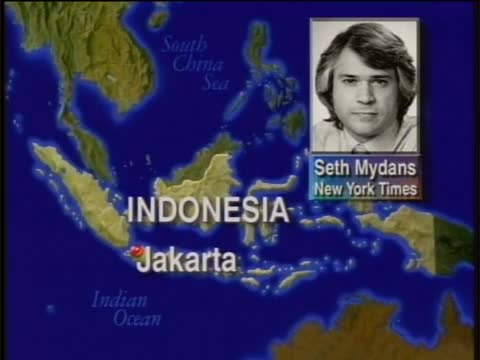
JIM LEHRER: Now we look at the world's most populous Islamic nation, Indonesia. Ray Suarez talked this afternoon with the "New York Times" correspondent there, Seth Mydans.
RAY SUAREZ: And Seth Mydans, welcome to the program. What form has the reaction in Indonesia taken to the growing hostility toward the Afghan regime and the hunt for Osama bin Laden?
SETH MYDANS: Well, the most visible form is anti-American demonstrations at the United States Embassy and in several towns elsewhere in the country. Small, radical groups are making a lot of noise -- the banners, the flags, chants, portraits of Osama bin Laden that they're holding up. Today a small group of about 500-- in fact, that's the largest group that there's been lately-- made such a fuss in front of the U.S. Embassy that the police reacted with teargas, high-powered hoses, warning shots in the air. Broadly, this is a moderate Muslim country, and it's often repeated that these radical fringes don't represent the majority of Indonesians. However, they do tap into a broad sense of discontent with the United States, not only on the terms of Islam, but generally because of the power that the United States wields, and the effect that that has on other nations around the world.
RAY SUAREZ: Have these demonstrations mostly been targeted at the embassy rather than American corporate interests or American citizens themselves?
SETH MYDANS: Mostly at the embassy, although in another town, Maqatar, today, there was a demonstration outside of McDonald's, I guess because that was the best symbol of the United States in that remote city. There have been threats against American citizens, and that's making a lot of people here nervous, but nothing has happened to anybody yet. The American embassy is taking the threats seriously, giving warnings of very high alert, offering its non-essential personnel the option of leaving the country; advising other Americans to stay indoors. But nobody knows yet how serious the threats are, how bad it could get.
RAY SUAREZ: The last several years of government in Indonesia, I think it's fair to say, has been more nationalist than Islamist. How has the government been reacting to this unrest against the United States' interest?
SETH MYDANS: Rather tentatively, because there is this tension between moderate nationalism in Indonesia and Islamic politics. That's one of the great tensions in politics in Indonesia. The government is moderate. President Megawati Sukarnoputri made a statement to George Bush when she was in Washington recently, that Indonesia supports the United States, but she hasn't said very much since. She has mildly suggested to her countrymen that foreigners are guests here; they should treat their guests well. Apart from that, the government has made statements mildly critical of the United States not to push its warfare too far to avoid hurting citizens -- civilians in Afghanistan, and this reflects the political delicacy here of the situation because there are strong Islamic tendencies in politics, which are getting a boost from the anger here against what the United States is doing.
RAY SUAREZ: When the bombing campaign ban, the Taliban leadership said that this should be seen by Muslims all over the world as an attack on fellow Muslims. Is there that kind of solidarity feeling in Indonesia, or does Afghanistan, for most Indonesians, seem very far away?
SETH MYDANS: Afghanistan is far away, but there's a surprising degree of sense of solidarity here. Indonesia is quite far from most other Islamic countries in the Middle East, and yet there has emerged a broad sense of solidarity here. People who... there are people who are signing up to go fight in a Jihad in Afghanistan, perhaps most of them not really serious about it but carried it's not sure anybody would away by emotion. It's not clear anybody would ultimately go. But the sense of solidarity, Islamic solidarity, is quite broad and widespread in Indonesia.
RAY SUAREZ: Seth Mydans, thanks for joining us.
SETH MYDANS: My pleasure. Thank you.
FOCUS - ANTHRAX THREATS
JIM LEHRER: Now, back in this country to the anthrax story in Florida and beyond. Gwen Ifill has that.
GWEN IFILL: Hundreds of people lined up at the Palm Beach County Health Department today to be tested for exposure to the dangerous bacteria, anthrax. Nasal swabs and blood tests were offered to anyone who has worked at or visited the offices of American Media since August 1. American Media, publisher of the "Globe," the "National Enquirer," and the "Sun" newspapers, is located in Boca Raton, not far from Palm Beach County Park Airport, where at least one of the September 11 hijackers took flight lessons. Federal officials confirmed the first case of anthrax last week. By Friday, that victim, Robert Stevens, a "Sun" editor, had become the first person in 25 years to die from inhaled anthrax in the U.S. Yesterday state health officials said they found inhaled anthrax spores in the nasal cavity of a second employee. That man has not contracted the illness.
DR. STEVE WIERSMA, State Epidemiologist, Florida: This is not a second case. We have evidence of someone being exposed to this bacteria. That is very different than a case. We don't believe this person is suffering from the disease caused by anthrax.
DR. JEAN MALECKI, Palm Beach County Health Department: We do know that there has to be a certain dosage, a dose of the number of spores to be inhaled to be able to come down with this disease. So yes, it is very likely you can have one or two spores and not come down with this disease.
GWEN IFILL: The flu-like symptoms of anthrax can show up within twelve hours to five days after exposure. Timely antibiotic treatment can stop the disease, but, untreated, it infects the lungs and is often fatal within days. No one knows how anthrax got into the Florida building, but yesterday, anthrax spores also were found on a computer keyboard. FBI officials sealed the building, and began treating the case as a criminal investigation. Attorney General John Ashcroft would not rule out terrorism.
JOHN ASHCROFT: We are unable to make a conclusive statement about the nature of this as either an attack or an occurrence, absent more definitive laboratory and other investigative returns. We regard this as an investigation, which could become a clear criminal investigation.
GWEN IFILL: The reports out of Florida, and scares elsewhere, have made for a jittery public.
WOMAN ON STREET: I don't know -- it is hard to avoid things, because you don't know what. Do you not eat food? Do you not open your mail? You not open your bills and send them back? What do you do?
GWEN IFILL: But President Bush, speaking at the White House today, said the government has the situation well in hand.
PRESIDENT GEORGE W. BUSH: There is a system in place to notify our government, and governments, in the case of some kind of a potential biological incident or chemical incident. And the system worked. And now the system is even working better, because we have, in essence, gone into the building, cleaned the building out, taken all the samples as possible, and are following any trail, any possible trail. Thus far, it looks like it's a very isolated incident. But any type of incident, any type of information that comes into our government we take very seriously.
GWEN IFILL: Since Sunday, federal officials have taken more than 100 cases of antibiotics from the national pharmaceutical stockpile and shipped them to Florida.
GWEN IFILL: For more on anthrax threat, we turn to three public health experts. Dr. Margaret Hamburg, Vice President for Biological Programs at the Nuclear Threat Initiative, a Washington-based foundation. She was also an assistant secretary for Health and Human Services during the Clinton Administration, and New York City's Health Commissioner in the early 1990s. Dr. Mohammed Akhter, executive director of the American Public Health Association, an organization representing over 50,000 public health professionals. And Lawrence Halloran, staff director and counsel for the House Government Reform Subcommittee on National Security. Welcome, everyone.
Dr. Hamburg, how serious are these cases that we're hearing about in Florida and how unusual are they?
DR. MARGARET HAMBURG: Well, as reported, this is an isolated case of anthrax but it's a very unusual form of anthrax, inhalational anthrax. There hasn't been a case of inhalational anthrax reported in this country since the late 1970s and only about 18 since the turn of the century, so it obviously is something that is of great interest and concern to both the public health community and more broadly.
GWEN IFILL: Is this the kind of a disease that can be naturally occurring, whatever that means?
DR. MARGARET HAMBURG: Well, anthrax does occur naturally. It's mainly a disease in livestock but humans can get it. Often they get what's called coetaneous form or skin-related form through handling of an infected animal or animal materials. You can also ingest infected meat and occasionally breathe it in and get the kind of disease we're talking about today, inhalational anthrax.
GWEN IFILL: Dr. Akhter, from what you have read about this particular case, how does it strike you that this kind of anthrax could have come to find its way into an office building?
DR. MOHAMMED AKHTER: It's quite unusual. There's no question in my mind that there were no cows or sheep or wool being processed in the building. This is a new building. And to find two cases where one is actually... A person has died from the disease and the other one has the anthrax spores in his nasal cavity, that these were brought in by a human. This is clearly a criminal case where further investigation by the intelligence agencies is warranted to really make sure where this came from so that we can get to the source of it and make sure that this kind of stuff will not happen in the future.
GWEN IFILL: Mr. Halloran, this is not a contagious disease. How can there be two people with the same....
LAWRENCE HALLORAN: The most likely scenario at this point is the situation that the FBI deals with all the time. They get... Before were hoax calls to say someone has mailed an envelope containing a suspicious powder to a building; we had onehere in DC a year or so ago. In this case it looks like someone got ahold of some anthrax, put it into an envelope and sent it through in the mail to a building addressed to the reporter, who appears to have opened it at his keyboard, spilled some, inhaled some, and gotten quite ill.
GWEN IFILL: So this had to be deliberate?
LAWRENCE HALLORAN: I think there's very little alternative. It's like watching the World Trade Center. One plane might be a pilot who had an accident. Two planes you connect the dots and somebody had to be behind it I think.
DR. MARGARET HAMBURG: I mean, it could be potentially a more benign story that maybe he received a goat skin in the mail and opened it up and it spread some spores - but -- an infected shawl, who knows what. But it's very hard to imagine and clearly there was a common source that dispersed the spores through the air. He breathed it in, got terribly sick and someone else was exposed.
LAWRENCE HALLORAN: Particularly inasmuch as this turned out to be a lethal strain. There are many strains of anthrax, many which are lethal to animals, not all lethal to people. And to narrow it down to lethal strains to human again has to raise suspicions that this was perniciously planned.
GWEN IFILL: Dr. Akhter, is our public health system prepared to cope with this kind of whatever it is, infection, spread?
DR. MOHAMMED AKHTER: Let me say that the way the florid people acted is commendable. Truly the system worked. We were about to identify the case very quickly. We were able to deal with the people there. But the system isn't as ready as we would like to see it. We are under prepared. You saw these people just a moment ago, lines around the health department waiting to get their drugs. Just imagine if there were 5,000 or 10,000 people in the building. That's when really the trouble starts. So we don't have the surge capacity to deal with this additional number of people that would be around, that will stretch our resources. So what we need to do is really expand our resources, to make sure that we are able to deal with the larger incidents.
GWEN IFILL: When you say we, do you mean government, state, local, private institutions?
DR. MOHAMMED AKHTER: I think we're all in this together. Certainly the governments take the lead. It is the people who are first contacted. These are the folks, the medical community. They then call the health departments. The health department calls the CDC, we then call the FBI, so we are all in this together as the private sector, as the government. Everybody needs to work together to make sure....
GWEN IFILL: But none of us ready for it?
DR. MOHAMMED AKHTER: I think we're quite ready in Florida. But for the rest of the country, that may not be true.
LAWRENCE HALLORAN: We're ready for a smaller or isolated outbreak in one, maybe two occasions that we can identify quickly enough and deal with. We're not ready for a scenario such as unfolding in a dark winter exercise where you have deliberate release of an infectious agent in three locations of this country, which would overwhelm. The other thing is we're not prepared to deal with the media's role in this. This is very much a public event an outbreak. And we are definitely not prepared in our public health system to deal with a mass of the worried well who hear it on TV or that there's a disease outbreak and will rush to the emergency room and definitely would swamp the system; we don't have - we're not prepared to deal with that.
GWEN IFILL: The worried well. That's a new phrase. Dr. Hamburg how about beyond justanthrax? We are all focused on this particular one disease. What about something like smallpox? You've dealt with tuberculosis outbreaks.
DR. MARGARET HAMBURG: Well I think whether you're looking at naturally occurring infectious disease or intentionally caused infectious disease, we as a nation can and must do better in terms of preparing. We need to really support our public health infrastructure because they are the first line of response to an incident, particularly a bio terrorist attack. We would not have a lights-and-sirens kind of reaction where we would know that something had happened and be able to mobilize a response. Instead days, even weeks later, we only learn about it -- unless there was an announcement that says an attack had occurred -- when cases started to appear in doctor's offices, emergency rooms and hospitals.
GWEN IFILL: Where is the front line in a war like this? How do you begin to cope with it? What should we be doing now to prepare for what may happen?
DR. MARGARET HAMBURG: Well, there's an array of activities that need to be undertaken but with respect to the public health and medical preparedness, first and foremost we need to invest in a critical set of public health needs -- the ability to do disease detection -- outbreak investigation on the ground, the need to educate medical professionals to recognize these kinds of diseases or unusual clusters of symptoms and report them to the public health department. There needs to be someone on the other end of that line to answer and respond. We need to improve our laboratory capacity to make these diagnoses, and we need as a nation to have a pharmaceutical stockpile as mentioned in the film clip that can rapidly mobilize the drugs or vaccines that are needed in the event that a major attack occurs.
GWEN IFILL: D r. Akhter, this sounds very expensive getting ready.
DR. MOHAMMED AKHTER: I think it's going to cost money. This is terrorism. To deal with it is not cheap. We as a nation have no other alternative but to prepare ourselves. When unthinkable happened in New York, it just... All bets are off. We can't simply say it may not happen or it's going to cost too much. I think the only choice we have is to prepare ourselves and do the kinds of things that we have been advocating for many years to do, and having all our front line workers-- the doctors, the nurses, the people who the patients come in-- educated. We have not seen a case of smallpox in this country. We have not seen many of these tropical diseases. Having them prepared and then having them connected to local health departments and somebody be vigilant watching every day. By the way, many of these local health departments are 9:00 to 5:00 operations at this time. If something happened on Friday night, there would be nobody there to take your call until Monday morning, so we've got to change that.
GWEN IFILL: Mr. Halloran, what should we do?
LAWRENCE HALLORAN: The good news about public health expenditures is that just as the technology of making weapons is called dual use technology -- you can make a vaccine as well as you can ferment anthrax. Public health capacity is truly dual use technology. It is good every day, all day against the flu, against a natural outbreak and against a terrorist outbreak. And so it is really a very wise investment of public dollars that serves us well every day even when the terrorists aren't lurking about.
GWEN IFILL: Is the risk truly greater since September 11 or are we just paying attention for the first time?
DR. MARGARET HAMBURG: Well, I don't think the risk has changed or our vulnerability but certainly the perception has changed dramatically and I think has changed forever just as Dr. Akhter was saying. After having witnessed the devastation that occurred in the World Trade Center and the clear intention to cause as much damage as possible I think nobody feels comfortable saying that certain groups or terrorists wouldn't use these kinds of weapons if they could get their hands on them.
GWEN IFILL: Do those changed perceptions create the potential for an overreaction?
DR. MOHAMMED AKHTER: I don't think that I fully agree that risk has not changed. I think the risk has changed. With us declaring war on terrorism, the risk of a response on us, doing something to us, has increased. All our intelligence agencies tell us to be prepared. We should be prepared. So it's not only the issue of perception. It's what our intelligence agencies tell us. We should be prepared to deal with those things and deal with those things adequately because consequences of those things are so horrendous that hundreds of thousands of people will die and what-happened in New York will just look like something very small.
GWEN IFILL: Briefly, Mr. Halloran.
LAWRENCE HALLORAN: Our same intelligence agencies tell us that there are still technical barriers that terrorists have yet to overcome to our knowledge to create mass casualties with these weapons. So we have some time in ranking our public health threats; I don't think is first behind what nature might throw at us everyday. But they're getting better at it.
GWEN IFILL: Lady and gentlemen, thank you all very much.
JIM LEHRER: Finally tonight, playing games after September 11. Four weeks after the terrorist attack, baseball began its post- season playoffs today. Lee Hochberg of Oregon Public Broadcasting reports on a remarkable team in what has become a very unusual season.
ANNOUNCER: The American league West Champs. The Seattle Mariners 2001! ( Cheers and applause )
LEE HOCHBERG: When Major League Baseball's Seattle Mariners clinched the American League West division title only eight days after the terrorist hijackings, there were hugs but no wild pile-ups on the field diamond.
ANNOUNCER: ...As the Mariners remember those who lost their lives in New York and in Washington
LEE HOCHBERG: Instead, the players knelt, and together with 45,000 fans, prayed. (Cheers and applause) They honored the U.S. with a solemn ceremony on the infield, Mariner Mark Maclemore placing the American flag and leading the team around the bases.
SPOKESMAN: You know what, folks? There is crying in baseball.
LEE HOCHBERG: The sobering celebration underlies the uncertain role of sports in America since the September 11 tragedies, especially in a city like Seattle, which is in the midst of an historic and joyous season. The Mariners entered the post-season play-offs tied for the all- time record of 116 wins. All summer, the wild success of a Mariner team whose superstars had left for greener pastures was a great story...
SPORTSCASTER: A 2-2 delivery on the way now...
LEE HOCHBERG: ...Sweetened by the unusual international flavor of the players who filled their shoes.
SPORTSCASTER: Belted to right field. He reaches out and catches the baseball!
LEE HOCHBERG: Two imports from Japanese baseball ignite the team. Outfielder Ichiro Suzuki was a seven-time Japanese batting champion before coming to Seattle this year. Pitcher Kasahiro Sasaki is Japan's all-time saves leader. Suzuki is an icon in Japan, known solely by his first name, Ichiro. He plays with a swiftness that agitates opposing teams until they come unglued.
SPOKESMAN: From the first baseline...
LEE HOCHBERG: In his rookie year in the U.S., Ichiro led the league in batting; Sasaki, meanwhile, the second in the league in saves this year. So beloved are the two in Japan that all Mariner home games are televised live to the Far East. As a result, Safeco Field has become a magnet for both Japanese Americans and many who travel all the way from Japan to see the game.
SPOKESPERSON: He made a big Ichiro sign for this game.
LEE HOCHBERG: Early last month, many Japanese fans waited hours with thousands of Seattleites to receive Kasuhiro Sasaki bobble head dolls.
SPOKESPERSON: He say they dam about going to see them in Safeco Field, and get the days off and then come all over from Japan.
LEE HOCHBERG: At the outfield sushi bar, fans line up to buy "ichi-rolls." Although Japanese tourism was down all year throughout most of the U.S., Seattle tourism boomed. Tour operator Haruko Mukasa says she brought 14,000 Japanese to Seattle this spring and summer, four times last year's number.
SPOKESMAN: Before, some tourists came and asked for the White House tour because they thought it was Washington, you know, D.C., but that's changed. Now Seattle is where Ichiro is.
LEE HOCHBERG: "Seattle Times" columnist Steve Kelly says Suzuki and Sasaki have been a perfect fit in Seattle.
STEVE KELLY: We think of ourselves as the hub of the Pacific Rim. The Mariners are owned by Nintendo, and the main owner is Mr. Yamauchi, who lives in Japan. So I think that it was logical that the first great Japanese player in Major League Baseball would be in Seattle.
NEWSCASTER: Well hit. Right centerfield. On the run, he dives and he makes the catch!
LEE HOCHBERG: For all of the intrigue around its Japanese stars, Seattle has had record seasons from many players. Eight played in the League's all-star game, which in this magical Seattle season also took place at Safeco field.
SINGER: God bless America.
LEE HOCHBERG: But the wild ride slammed to a halt on September 11. The Mariners' extraordinary play hasn't changed, but the world has. Tour operators say Japanese tourism to Safeco Field stopped. Local fans kept coming, but some said their hearts were heavy.
FAN: There's a lot of emotion there. I still feel that, you know, just thinking about it, it's just emotional. But I think we need to get with our lives, and we can't let these evil people defeat us.
LEE HOCHBERG: Mariner CEO Howard Lincoln says this greatest moment in Mariner history has been unalterably changed.
HOWARD LINCOLN: I think all of the Mariner records are going to have to be put in context with what happened on September 11, and that doesn't mean that our players or our fans cannot be excited and cannot share the joy of what has happened, but they also will have to remember that some terrible, terrible things happened at about the same time.
LEE HOCHBERG: Indeed, as the regular season came to an end with more Mariner victories, fans may have appreciated and needed as never before the simple joy of watching baseball played at its best.
RECAP
JIM LEHRER: A programming note before we go. Later tonight, on most PBS stations, "Frontline" will air a documentary, "Looking for Answers," that traces e roots of radical Islam and the terrorism network. Please check your local listings for the time. We'll see you online and again here tomorrow evening. I'm Jim Lehrer. Thank you, and good night.
- Series
- The NewsHour with Jim Lehrer
- Producing Organization
- NewsHour Productions
- Contributing Organization
- NewsHour Productions (Washington, District of Columbia)
- AAPB ID
- cpb-aacip/507-cf9j38m61w
If you have more information about this item than what is given here, or if you have concerns about this record, we want to know! Contact us, indicating the AAPB ID (cpb-aacip/507-cf9j38m61w).
- Description
- Episode Description
- This episode's headline: Afghanistan's Alternatives; Trouble in Indonesia; Anthrax Threats. ANCHOR: JIM LEHRER; GUESTS: QAYUM KARZAI; HARON AMIN; ASHRAF GHANI; SETH MYDANS; DR. MOHAMMED AKHTER; LAWRENCE HALLORAN; DR. MARGARET HAMBURG; CORRESPONDENTS: KWAME HOLMAN; RAY SUAREZ; SPENCER MICHELS; MARGARET WARNER; GWEN IFILL; TERENCE SMITH; KWAME HOLMAN
- Date
- 2001-10-09
- Asset type
- Episode
- Topics
- Social Issues
- Global Affairs
- Sports
- War and Conflict
- Religion
- Military Forces and Armaments
- Politics and Government
- Rights
- Copyright NewsHour Productions, LLC. Licensed under a Creative Commons Attribution-NonCommercial-NoDerivatives 4.0 International Public License (https://creativecommons.org/licenses/by-nc-nd/4.0/legalcode)
- Media type
- Moving Image
- Duration
- 01:04:09
- Credits
-
-
Producing Organization: NewsHour Productions
- AAPB Contributor Holdings
-
NewsHour Productions
Identifier: NH-7175 (NH Show Code)
Format: Betacam
Generation: Preservation
Duration: 01:00:00;00
If you have a copy of this asset and would like us to add it to our catalog, please contact us.
- Citations
- Chicago: “The NewsHour with Jim Lehrer,” 2001-10-09, NewsHour Productions, American Archive of Public Broadcasting (GBH and the Library of Congress), Boston, MA and Washington, DC, accessed April 2, 2026, http://americanarchive.org/catalog/cpb-aacip-507-cf9j38m61w.
- MLA: “The NewsHour with Jim Lehrer.” 2001-10-09. NewsHour Productions, American Archive of Public Broadcasting (GBH and the Library of Congress), Boston, MA and Washington, DC. Web. April 2, 2026. <http://americanarchive.org/catalog/cpb-aacip-507-cf9j38m61w>.
- APA: The NewsHour with Jim Lehrer. Boston, MA: NewsHour Productions, American Archive of Public Broadcasting (GBH and the Library of Congress), Boston, MA and Washington, DC. Retrieved from http://americanarchive.org/catalog/cpb-aacip-507-cf9j38m61w