The NewsHour with Jim Lehrer; February 21, 2006
- Transcript
. . . . . . . . . . . . . . . . . .
. . .. .. .. Good evening, I'm Jim Lehrer. On the NewsHour tonight, the news of this Tuesday, then a look at the rising storm over an Arab-owned company running six major U.S. ports. A newsmaker interview with the U.S. ambassador to Iraq, Same Khalilzad, and the new Roberts and Alito Supreme Court, with Marcia Koyle of the National Law Journal and Legal Scholars, Douglas Kamik, and Goodwin Liu. Major funding for the news hour with Jim Lehrer has been provided by
somewhere west of Topeka, someone's getting out for a breath of fresh air, which is why a farmer is harvesting corn, and why a train is transporting corn, and why ADM is turning corn into ethanol, a renewable, cleaner burning fuel. Somewhere west of Topeka, someone's getting out for a breath of fresh air, and lots of us are helping make sure that fresh air is actually fresh, ADM, resourceful by nature. And by CIT, and Pacific Life. This program was made possible by the Corporation for Public Broadcasting. And by contributions to your PBS station from viewers like you, thank you. President Bush today defended a deal to let an Arab company run six U.S. ports. A company is a state-owned business of Dubai in the United Arab Emirates.
The port stretch from New York to New Orleans. The deal faced growing opposition in Congress, but Mr. Bush insisted he'd veto any attempt to block it. If there was any chance that this transaction would jeopardize the security of the United States, it would not go forward. The company has been cooperative with the United States government. The company will not manage port security. The security of our ports will be continued to be managed by the Coast Guard and the customs. The company is from a country that has been cooperative in the war on terror. But Senate Majority Leader Frist urged the president to put the deal on hold. He said otherwise, he joined efforts to stop it. House Speaker Hastert also a Republican made a similar statement. And in Miami, Republican Congresswoman, Ilie Anna Ross Layton, said the Dubai connection is a problem.
It's an ally, it's a friend, but on the other hand, there's a lot that should be questioned about this. And remember that two of the hijackers of 9-11 had Dubai connections came from that area and also some of the financing related to the 9-11 attacks went through the Dubai financial networks. We'll have more on this story right after the news summary. And in Iraq today, Baghdad was rocked by the worst car bombing in a month. It killed 22 people, wounded 28 more in a Shiite section, casualties flooded into a hospital after the explosion at an outdoor market. Police said it was detonated by remote control. They took a suspect in the custody. Britain joined the U.S. today and urging Iraqi leaders to form a national unity government. Where he's foreign secretary Jack Straw met with Iraqi President Talibani in Baghdad, he said the December election results sent a clear message. What they show is that no party, no ethnic or religious grouping can dominate government
in Iraq, and this therefore gives further impetus to what Iraq is tell us they want, which is a real government of national unity, binding together all the different elements of Iraqi society. The U.S. ambassador to Iraq, Zalme Khalilzad warned again today Sunni Shiites encouraged must set aside their differences. He told the news hour, otherwise they risk losing U.S. support. We'll have that interview later in the program tonight. Three Ohio men allegedly plotted to kill U.S. and allied troops in Iraq and elsewhere. They were accused in a federal indictment released today in Cleveland. It said they began recruiting and training others in 2004. One was also accused of threatening President Bush. The suspects are originally from Jordan or Lebanon. They were arrested in Ohio over the weekend.
There was word today, a top Bosnian war crimes fugitive, Ratko Milates, has been found in Serbia. The former general is accused of genocide and crimes against humanity. Various news accounts said authorities were negotiating his surrender. We have a report narrated by Lindsey Hilsam of Independent Television News. He's still at large, but for how long? Here we see him at Srebrenes, they're in July 1995. 8,000 Bosnian Muslim men were murdered here. The war crimes tribunal in the Hague wants to try General Mladic for genocide in Srebrenesan. Evidence of the killings is there for all to see, but General Mladic disappeared, protected. It's believed by renegade members of the army he once commanded. A video released last year, showing the murder of young Muslim men by Serbian regulars changed public opinion in Serbia. For that many Serbs were reluctant to condemn General Mladic, the soldiers and the paramilitaries
for atrocities in Bosnia. But all the news suggests the game is nearly up. The Serbian authorities are reported to know where he is, and to be negating his surrender in the next few days. General Mladic may hold the key to Serbia's future, because by the end of February, an EU committee will report on Serbia's cooperation with the war crimes tribunal. As the report is negative, Serbia's chances of ever joining the EU will be dashed. That's why the Serbian authorities may risk the fury of Serbs nationalists who still support the general. The US State Department has a standing bounty of $5 million for the arrest of Mladic. The US Supreme Court agreed today to hear a challenge to banning some late-term abortions.
Congress passed the partial birth abortion ban act in 2003, but federal judges in three states struck it down. The Supreme Court rejected a similar state law in 2000, Justice Sandra Day O'Connor cast a tie-breaking vote in that case. She's now been replaced by Justice Samuel Alito. Also today, the court heard arguments on limiting the scope of the Clean Water Act will have more on all of this later in the program. President officials in California had to delay an execution early today. Michael Morales was set to be executed for a rape and murder he committed 25 years ago. But two doctors in charge of anesthesia refused to take part in the lethal injection. They cited ethical concerns. Officials have rescheduled the execution for tonight. Rescuers in the Philippines today failed to find a school under a major landslide. At least 200 children and teachers were in the school on Friday when it was buried under mud and rock.
The U.S. Marines joined other crews trying to dig at the site, but there were no signs of survivors today. By nightfall, only a few teams were still at work. At the Winter Olympics in Turin, Italy, police returned to the Austrian ski team's apartments in a doping investigation. A raid there on Saturday found syringes, unlabeled drugs, and a blood transfusion machine. But the International Olympic Committee said today it's too soon to penalize any athletes. The investigation by the authorities is their business right now. Doing that on a daily basis, clearly they're making announcements of their findings. But the ISE is very happy to wait until the time is right for any information to then be given to us so that we can then act on it if necessary in terms of any future sanctions. Amid the investigation, Austria picked up a record 8th gold medal today in the combined ski jump and cross-country event.
In speed skating, American Shawnee Davis won silver in the 1500-meter race, Chad Hedrick of the U.S. won the bronze, the gold went to Italy. An American Shauna Robach and Valerie Fleming won silver in the women's bob sled. The Metropolitan Museum of Art in New York City agreed today to return 21 artifacts to Italy. The Italian said the ancient treasures had been stolen over the years. It said the agreement is a model for other museums. Lawrence Summers announced today he's resigning as president of Harvard University after just five years in the job. It's effective at the end of this academic year. The former Treasury Secretary cited continuing rifts with faculty members. He'd been sharply criticized for saying gender differences might explain why fewer women go into science and math. A key measure of future economic activity rose strongly in January. A conference board, a business research group, reported that today. Its index of leading economic indicators was up 1.1 percent.
On Wall Street, the Dow Jones Industrial Average lost 46 points to close at 11,069. The Nasdaq fell 19 points to close just under 22 63. And that's it for the new summary tonight. And now the U.S. ports uproar, Khalilzad in Baghdad, and the new face of the Supreme Court. The port storm, Kwami Holman, begins. The uproar over who controls six major east coast ports erupted today in Washington and elsewhere. When President Bush defended the deal, giving an Arab company control, he stood in opposition to his party's leaders in both houses of Congress. A British company, Peninsula and Oriental Steam Navigation, has managed the day-to-day operation of ports in New York, New Jersey, Philadelphia, Baltimore, Miami, and New Orleans.
But last week, Dubai ports world, a state-run business in the United Arab Emirates acquired the British firm in a $6.8 billion deal. Under a multi-agency review, the Bush administration approved the new ownership. But the arrangement has triggered security concerns from lawmakers and others from both parties. At least two of the 9-Eleven hijackers came from the United Arab Emirates and others used it as a financial base. New York Senator Chuck Schumer. The bottom line is very simple. And that is that this company is owned by a country in which there have been significant nexus with terrorists. But also today, Secretary of Defense Donald Rumsfeld said the United Arab Emirates is an ally. It's a country that's been involved in the global war on terror with us. It's a country that we have facilities that we use. And it's a country that was very responsive to assist in Katrina, one of the early countries
that did that in the country with, that we have a very close military and military relations as well as political and economic relations. Members of Congress have said they'll introduce legislation next week to block the ports deal. Now, both sides of the argument, one at a time, first, an opponent, Democratic Senator Robert Mendez of New Jersey. Senator welcome. Senator, do you hear me? Senator, yes, Senator, I guess our audio is not working. So we'll get the other side first. And that comes from Clay Lowry, who is the Assistant Secretary of the Treasury for International Affairs. Mr. Secretary, you hear me? Yes, sir, I do. All right. You do not see this as a national security issue. You and the administration. Well, let me try to make three points on that. First and foremost is the review process itself.
The review was through a group of agencies in the U.S. government called the Committee for Foreign Investment in the United States. This committee does a thorough review of every foreign transaction of an American operated company. And in this case, it was a British operated company that operates in the United States. These agencies involve our major national security agencies, including Defense Department, State Department, Department of Homeland Security, Treasury Department and Justice Department. The first and foremost position of these agencies is the expertise is to try to guard our national security. That is our first and foremost goal. The second point I would like to make is that this is about port management. It is not about port ownership or port security. That has been something that has been misconstrued. People keep thinking that we are giving up port security to other countries. That's not the case.
There are many port managers in our country that are actually foreign, that are foreign country owned port managers. These managers do not do our security. That is based on local authorities in coordination with the Department of Homeland Security, which has the Coast Guard and the customs under it. And the third point I would like to- Hold on, let me just follow up on that second point. You're saying these ports, these six ports are essentially owned by port authorities, right? And that does not change. That's correct. In fact, actually, I would say is what is port security that has been our port security to date? Our port security today and our port security tomorrow will remain exactly the same as was the case prior to any of those transactions. I'd make your third point, sure. And the third point I would like to make is this company itself, DP World, which is Dubai Port World. It is a company that has actually a fairly long standing relationship with our Department of Homeland Security, both the customs and our Coast Guard in terms of the way we do port security abroad is you've got to start abroad.
You can't start at home. And we do- we have arrangements with them around the globe, and we have arrangements with P&O as well. This is the way we conduct our security. And to date, basically, DP World is based a very solid track record. And that is how we looked at this transaction. All right. The opponents of this say a couple of things. First of all, they point out that there is a 9-eleven connection to Dubai and the United Arab Emirates through two of the hijackers and also through some financing. That's not a problem for you. Well, I think that basically there's a couple points to be made on that. The first is the point I think that's been made by the President, by the Secretary of State, and by the Secretary of Defense in just the last few days, which is how important our relationship is with the United Arab Emirates and how much they have actually done for us in fighting the war on terrorism since 9-eleven. They have been one of our staunch supporters in the Middle East, and given that the Secretary
of State and Secretary of Defense in the President, or who are more eloquent on this issue than I am, have spoken on it, I think that that is pretty important to note. All right. And another- But the second point is, I mean, terrorists seem to come from a variety of areas. There are- we've had terrorists that actually their home base was the United Kingdom, and the United Kingdom is our best ally in the world, probably. So it's a little bit hard for me to say that just because of where somebody comes from, that means they're a terrorist. Do you see this as bigotry against Arabs? I don't want to- look, there are concerns by a lot of people out there, whether it's people in Congress, there are people in the local authorities. I am not impugning their concerns. I think their concerns are legitimate, and we shall deal with them as best as we possibly can and explain the decision process that we used and the fact that it was a thorough process and a thorough vetting was done of this transaction.
Now another point the opponents make is that this is different than other operations, because this company is actually owned by a foreign government. It's not like before, the British government did not own this company. It was owned by a private firm in Britain. So this is different. I don't see the difference. No, I didn't say that. I don't know. I mean, it's a problem. You don't see this as a problem. Well, no. There are, first of all, there are a variety of ports that in our country that have management that are from foreign countries, whether it's Singapore, Taiwan, Denmark, the United Kingdom. And in this case, we're talking about the United Arab Emirates. You're saying that there are other ports managed by companies owned by foreign governments inside? I don't know that for sure, so I don't want to say that. I basically, the Dubai port is owned, Dubai port world, excuse me, is owned by the Emirates government.
We have, when we look at a transaction, and it is a state-owned entity, we give it extra scrutiny. In fact, we actually went beyond the 30-day review period, which is usually noted. We went well beyond it, in fact, in the 30-day review period, sorry, just for your listeners that don't know this process, is based in the laws to what we are supposed to do about looking at foreign transactions. We went well beyond that 30-day transaction, and this company we actually gave extra scrutiny and the Department of Homeland Security actually worked with the company on creating an arrangement so that to enhance the security apparatus that we already have in place with this company, because as I said earlier, it is one that we have built up a track record with. All right, Mr. Secretary, thank you very much. Thank you very much. And now for the other side, we go to Democratic Senator Robert Menendez of New Jersey, and Senator, you did you hear what Secretary Larry just said? I heard parts of it.
All right. Let's get to the top then. Do you see this as your objection to this deal based on security concerns? Yes, it is. And to the nature of the fundamental issue that a foreign government should not operate the critical infrastructure of the ports of the United States. I have represented this port first in the House for the last 13 years and now in the United States Senate. I know the operations that go on here. And the reality is, excuse me. That port you're referring to is there in Newark, New Jersey, where you are tonight, right? Correct. Excuse me. Go ahead. And the reality is, is that I understand the nature of the security challenges at a port like the port of Elizabeth and Newark, which is the port of New York and New Jersey. And to have a foreign operator that is controlled by a foreign government, which is much different than just simply a foreign company, I think is a dangerous precedent, especially when in this particular case of this foreign government.
I know that I heard the Secretary describe him as an ally, but the reality is that there are security concerns here, two of the 9-11 hijackers came from the United Arab Emirates. It was one of only three countries in the entire world that officially recognized and supported the Taliban, which gave shelter to Osama bin Laden, who plotted and planned against us. The 9-11 Commission and its bipartisan report said that the sources of financial assistance came from the United Arab Emirates for al-Qaeda. And lastly, in the context of port operations, we should be very concerned that AQCon, the Pakistani scientist, nuclear components, through the United Arab Emirates to Libya, Iran and North Korea, if they couldn't have a security regime in their own country that would seek to stop that. I'm not sure that we should give them the ports of the United States to do so. Senator Secretary Lowry didn't say this, but others have said today that the objection that you and others are raising is a simple bigotry against Arabs.
What's your response to that? Well, Jim, my statement to you is the statement I believe in that in fact, no foreign government should operate the ports of the United States. And I resent those people who try to make this the bashing of any single country or group of people in the world. I don't believe as a proposition that any foreign government should operate the ports of the United States. This port generates 185,000 jobs and $25 billion of economic activity. Something happens here, the nation's economy will be affected drastically. If something happens here in one of those containers where we have a nuclear biological or chemical agent will all be very sorry to say that we just simply relied upon the administration. And lastly, the commercial ports increasingly of the United States are used to send defense equipment and goods for our soldiers abroad. Imagine if a foreign company operated an owned by a foreign government, the site simply
to close down that port operation. If we are in conflict with it at some time in the future, those are risks of the United States shouldn't take. We can have diplomatic relations. We can have other forms of trade with Dubai, but we shouldn't be having the ports of the United States operated by that foreign government or any other foreign government. So you just simply reject the argument that the Secretary gave, which he said that the ports are still going to be run by this company. They're going to be, they're owned by the port authority there in New York and New Jersey and your case, the security is still going to be in the hands of the United States government, 185,000 workers and so, you know, our Americans. And so where's the risk? And you're from your point of view, I mean, specific risk that Dubai brings to this situation that when it was owned by a British company, it was not present. Well, it's interesting to hear that the Secretary said that they took an extended time, not all the time they had, by the way, in the CIFIS review, and that they worked out special
security arrangements, either a port operator is part of the security operation or it's not. And the reality is because of the chain of the flow of supplies, both from the port that it emanates from, which Dubai operates in other parts of the world, and then ultimately where it's received, such as the port of Elizabeth and New York, gives an operator the opportunity to affect the car. How can the Secretary say that they enhanced and worked out special relationships on security arrangements if, in fact, they're not part of the security network? Finally, Senator, the President is threatened to veto this. The two Republican leaders of the Congress, House Speaker Hasterd and Senate Majority Leader Frist, have taken a position similar to Europe. What's about to happen in the Congress? Well, I certainly had hope that the President would put this on hold, and if not to actually negate the process he has the ability to do so. In the absence of that, I think Congress should go forward with a legislation that I have
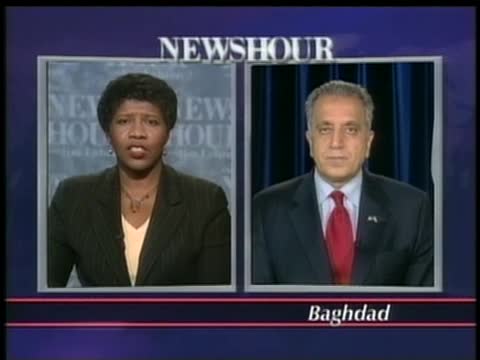
offered with Senator Clinton and others, that basically stands for the proposition that the ports of the United States should not be operated by any foreign government. And even though the President has said that he believes that he would veto such legislation, I believe Congress should put it on his desk and let the American people know where the President really stands. As I'm just thinking, in a pre-September 11th mindset, not a post-September 11th mindset on this issue. Senator, thank you very much. Thank you. And now Gwyn Eiffel has our newsmaker interview with the U.S. Ambassador to Iraq, Zalme Khalil Zad. She talked to him this afternoon from Baghdad. Mr. Ambassador, welcome. We want to start tonight by talking to you about the latest wave of violence. We're hearing and reading about roadside bombs, improvised devices, kidnappings, bombings. Does this impede what you've been trying to attempt as far as the political turnover
in Iraq? Well, this should incentivize the leaders to form a government of national unity as soon as possible, because much of the violence here is cross-sectarian. The fundamental problem of Iraq is that the various communities are polarized and are along ethnic and sectarian lines. That is producing some of the conflicts and attacks that you refer to. Iraq is voted, but they voted, unfortunately, along sectarian lines. And to deal with this problem, they need to form a national unity government, and that's what we're encouraging. We're talking about this national unity government. Secretary Rice today, traveling in Egypt, said Iraqis are struggling. And you yourself said yesterday in talking about this need for a unity government that the United States and your own words were not going to invest the resources of the American people to build forces run by people who are sectarian.
You seem to be making the link between the United States financial support and this need for a unity government. What I was saying was that what we do will be influenced by what the Iraqis decide. And we will do everything we can to help them make the right decision, a national unity government that has a good program to deal with Iraq's security challenges, the challenges of providing services for the Iraqi people, and ministers that are competent, particularly security ministers who are non-sectarian, who are not tied to militias, and will govern Iraq from the center. And if they don't make the right choices, then we in turn will look at what we do. And people can not assume that we'll continue to provide the support that we have financially and otherwise if they don't make the right choice.
It sounds like a threat, Mr. Ambassador. Well, it's stating the obvious that they have the right to make their own decisions. Iraq is a sovereign country and what I've said is not anything new. I have stated this before. Iraq needs the help of the international community, the help of the United States, the American taxpayers work very hard to pay their taxes, they expect their money to be used effectively and as far as the security forces are concerned, we are investing billions of dollars into the police program, into the building of the National Army. And if they are not run by people around non-sectarian, not tied to militias, not moderate, not broadly accepted, the forces would not be effective and therefore we're advising them to do the right thing and if they don't, we will take a look at what we do. So if the outcomes of the democratic elections that you pursue, we result in an outcome,
let's say a sectarian government that you do not prefer the United States withdraws its support. Well, I don't anticipate that that will happen. I think they will listen to our advice because what we are suggesting is in the interest of Iraq, that's what the Iraqi people want. I've seen multiple opinion surveys that show that. Iraq is one security, Iraq is one services, no single party or coalition has the majority. They need to come together across sectarian and ethnic lines and the sectarian tensions, as I said before, are the fundamental problem challenge of Iraq and the National Unity Government program that brings Iraqis together, that governs from the center is what is needed and I anticipate that that's what we will get. Prime Minister Al Jafri is response to you with kind of art.
He said, we do not need to be reminded, so if that's true, what's happening now that makes you feel that you must put such a point on this reminder? Well, I was glad to hear the Prime Minister say that, that he supports the idea of a National Unity Government, that he supports that these ministries be non-sectarian. I welcome that commitment and what I was stating and I'm stating again tonight is that these ministries have to be run by a non-sectarian, broadly acceptable, not tied to militia, moderate people who can serve the Iraqi people and that's what we seek. That's what we advise and that's what we will work for. You mentioned the Iraqi ministries, in particular the Iraqi Interior Ministry, there have been many reports lately that they may have had a hand in these death squads which have been accused of rounding up Sunnis, executing them and doing it under the cover of government approval.
Is that what has caused some of your concerns? Well, recently our forces did capture a few people from the transportation police, traffic police, four of whom are in our custody right now. They had a Sunni man with them and they've confessed that they were going to kill him. We are investigating that and I'm going to turn over that file of our investigation over to the Prime Minister in the next couple of days. There is a mid-May deadline for the formation of this government. Of course, we saw the elections a couple of months ago. Are we at a political deadlock stage right now? Well, no, I mean the certified results of the election came out only a few days ago right after the results were certified. The biggest block, the United Iraqi Alliance that Prime Minister Jafri is a member of,
nominated him for the post-op Prime Minister. That's what the Constitution calls for. Now there are discussions going on across parties and coalitions about the formation of a national unity government, who should be the constituent elements of a national unity government about the program, about the process and about people, all of which is important for Iraq's success. It will take a little bit of time to deal with all of these issues. I think we ought to be patient with them. The formation of this national unity government is the single most important issue. I cannot overemphasize it for affecting the future of Iraq, for bringing Iraqis together, for bridging the sectarian and ethnic gap that be doubles Iraq at the present time. And it will take time, but I think the issues that they are dealing with are very important.
And as I said before, we're prepared to help in any way we can. Let me ask you about Iran. Do you think that they are meddling in this process? Well, Iran is an important neighbor of Iraq. Iran has at least a two-track policy on the one hand in terms of state-to-state relations. Iran is supporting the government in Iraq and, on the other hand, parts of the Iranian government, some of its institutions, ought to provide assistance to extremist groups to militias and ought to be unhelpful to Iraq in this difficult transition that the country is going through. Last time we spoke on this program, you said that Secretary Rice had essentially authorized you to have some conversations with Iran to try to see if you could reach out and work out some sort of agreeable deal. Whatever became of those conversations.
All that, I did make that offer. The President and the Secretary did authorize that we could converse with the Iranians with regard to the situation in Iraq. I used to have those conversations with the Iranian ambassador when I was Ambassador to Afghanistan. And they offered still on the table. The Iranians have communicated some things with regard to it. We're going back and forth on that, and I would like to leave it at that at the present time. You have suggested and published interviews that you believe that Iran might be inserting itself in this process in Iraq in part to distract the international community from scrutinizing too closely Iran's nuclear ambitions. Could you expand on that? Well, yeah, a few days ago the Iranian Foreign Minister, surprisingly, while in Beirut, stated that the British troops should leave the Iraqi city of Basra.
I think that that intervention by Iran was uncalled for the issue of the presence of the coalition forces here is at the invitation of the Iraqi government, which has for the extension of the UN mandate for these forces. And I think Iran is coming under international pressure from the international community because of the nuclear issue, and it's getting itself involved in the issues such as Basra is not part of Iran, it's part of Iraq, and frankly, the presence of the British forces there is none of Iran's business. It sounds like you have several hurdles ahead of you, not only Iran's role in it, whether you can yourself engage them. Also what the British role is, obviously they're standing by you in Basra as this continues, but also what the Shiites are willing to accept or not accept, but the Sunnis are willing
to accept, not accept, but the Kurds are willing to accept it and not accept. Can you get to the bottom of any of this in time for this mid-May deadline? Well, I think so. When you do something as important as what we're trying to do in Iraq, taking authoritarian government, replacing it by a process for a democratic order, which involves state and nation building, which involves countering terror, and it is also in a very difficult neighbourhood. It's not easy, but then nothing very important is ever easy, and success in Iraq will have huge positive implications for the future of this region, and the future of this region is extremely important for the future of the world, for the security of the American people. So yes, this is difficult, yes, this is hard, there are big challenges, but I think we don't have a good alternative, but to do the best we can to succeed, and I am confident
that with patience, with flexibility, and agility, we can succeed in Iraq. U.S. Ambassador to Iraq, Zalme Khalilzad, thank you very much for joining us. Well, it's good to talk with you again. So to come on the news hour tonight, the new U.S. Supreme Court. The Supreme Court story and erase Juarez. The court today heard challenges to federal environmental laws and announced its decision to hear arguments on state abortion restrictions. All of that with just a Samuel Alito on the bench for the first time. One more on all of that, we turn to Marcia Khalil, Supreme Court reporter for the National Law Journal, and the joint arguments were Rapano's versus the United States, Caribel versus the U.S. Army, what was its stake? Really what's at stake is the future of wetlands in the United States. This case arose out of the plans of two separate property owners to fill in their wetlands
in order to develop, in one case, condominium complex, and in the other case, a shopping mall. Under the Federal Clean Air Act, I'm sorry, under the Federal Clean Water Act, you are prohibited from discharging pollutants, which could include fill material, dredging material, into navigable waters without a permit. They challenged whether the Clean Water Act actually applied to their land, their wetlands, because their wetlands do not abut navigable waters. In one case, the property owner says that the nearest navigable water is Lake Saint Claire in Michigan, and that's 20 miles away. So the battle is really over how far does the Clean Water Act reach in terms of regulating what is done on wetlands?
So the petitioners were arguing, basically, the Federal Government shouldn't have any say over whether I developed my land. What did the respondents on the core of engineer and the United States itself, I'm going to say? Well, the government said that the Act defines navigable waters only as waters of the United States, not exactly a very specific definition. But the Army Corps of Engineers has interpreted waters of the United States to mean not just wetlands that abut navigable waters, but wetlands that are adjacent to, for example, drainage ditches that may empty into tributaries that empty into navigable waters. As is the case with these properties in Michigan. And the government said that the Corps should give deference to the Corps's interpretation here, because it is consistent with the goals of the Clean Water Act, which is to preserve the purity of our waters. The petitioners counter that, well, there's nothing in the Act about tributaries.
So the Act just doesn't cover these waters. The government's theory, according to Justice Scalia, would allow regulation of mud puddles on land. And he said he thought it was very difficult to believe under anybody's concept that a storm drainage could actually be waters of the United States. But on the other hand, Justice Suter pointed out in terms of the favoring the government's argument and disfavoring what the property owners were saying here, the property owners which don't see regulation of tributaries and other kinds of waters that could flow into navigable waters would allow a polluter to go way upstream and pollute and get away with it. And Justice Suter pointed out, he found it hard to believe Congress intended to allow that kind of end-run around the Act. It sounds like the argument got to some pretty technical matters about how water moves
around the United States. But ultimately, at stake, is the enforceability of the Clean Water Act at stake? Yes. From the environmentalist point of view, really wetlands are at stake. Where the Supreme Court draws the line on the reach or the scope of the Clean Water Act? Well, the fine, how many wetlands can continue to exist as wetlands, whether developers can continue to fill them in without permits, without federal regulation, from the other side, from businesses point of view, where the Supreme Court draws the line can mean the difference in terms of rather substantial costs and burdens under the Clean Water Act, as well as sometimes criminal fines. It appeared to me after the arguments that the justices weren't pleased really with either side, because both sides kind of went to the extreme and didn't really tell the court
where they thought a reasonable line would be. Justice Kennedy pointed out in earlier cases, the court has said there has to be a substantial nexus between the wetland and the navigable water. Well, where is it here, he asked? And they really didn't get a clear view from either side as to a reasonable line. As was mentioned, this was just a Samuel Alito's first day on the bench's first public argument. Was he actively involved in the questioning? He was in the first case, the first argument. He asked one question in the second argument. He asked several questions. He appeared to me much as he appeared during his confirmation hearings. He has a rather inscrutable face, a slightly rumpled exterior. And he didn't seem entirely comfortable in his high-backed leather chair. But hey, it was his first day, and he probably knew the eyes of the court were on him. I imagine, I think, as with other new justices, it takes a little while before you get
into the very, very quick, given take of justices and lawyers during oral arguments. Now, during the confirmation hearings, it was mentioned quite a bit that Justice Alito would have a lot to say about several issues, abortion, executive power, free speech, rights of minorities. It looks like those prophecies are coming true. It does. In fact, even with the environmental cases, as we were leaving the courtroom, some of us were saying a month ago, we'd be leaving these arguments saying, well, it looks like Justice O'Connor, it's up to her. And leaving today's arguments, it looks as though it's up to Justice Alito, because the court appeared to be evenly divided. And as we learned today, there are issues coming up that Justice Alito is going to be key. On Friday, the court announced it was re-argument, a case that had been argued earlier involving First Amendment protection for public employees.
And indication they were split without Justice O'Connor, he'll be decisive. Also, the court has postponed the government's request to dismiss a challenge to the military tribunal system set up to try enemy combatants at Guantanamo Bay. And the court said it's going to consider whether it has jurisdiction, the power to hear that case. When it actually hears the case in late March, he will be critical there as well. Justice Roberts has to recuse himself from that case. Marcia Coyle, thanks a lot. And joining us now to discuss what effect Samuel Alito might have on the balance of the court for the foreseeable future. We're joined by Douglas Comeck, professor of constitutional law at Pepperdine University Law School, a friend and former colleague of Justice Alito, and Goodwin Lu, a constitutional law professor at the University of California Berkeley School of Law, Bolt Hall, Professor Lu testified against Samuel Alito during last month's confirmation hearing.
And Professor Comeck, let me start with you now that the new chief John Roberts and the new associate Samuel Alito were both seated, confirmed, sworn, the whole thing. How is this court different from the Renquist court? Well, Ray, I think they're off to a good start. I mean, this is a court that looks like it's very well administered, notwithstanding the disruption of confirmation proceedings and the need to fill two vacancies. They issued a number of opinions today. They took four cases, very important cases for the coming term. They disposed of a large number of cases by denying review effectively allowing the lower court judgment to stand. So first of all, I think you'd have to say that Chief Justice Roberts has this court humming in terms of its operations and administration. In terms of Justice Alito, I think Marcia put it very well.
What we saw at the confirmation proceeding is that he answers questions with a very precise, specific way, and the types of questions that he was asking today were very targeted statutory questions. What's the nature of the bodies of water of the United States? What does it mean to discharge waters in terms of the federal power laws, which all suggests to me, Ray, that he's trying to answer legal questions in the manner of a judge on statutory grounds whenever possible without reaching out for constitutional issues? I'd say a seamless transition. Professor Liu, you argued against the confirmation of Samuel Alito, now that he's seated along with the new chief. How is this court different in your view from the Renquist Court? Well, Ray, I think that there is now a consolidated five justice conservative majority on the Supreme Court.
Both Chief Justice Roberts and Justice Alito were appointed by President Bush. For the express purpose of consolidating the conservative trend of the Supreme Court's jurisprudence over the past 10 or 15 years. I think it's difficult to say how the court will rule in any given case that much is for sure. But I think that when you look at the long run of cases, I think the trend line of the law, which has bent, I think, in a generally conservative direction on a variety of issues ranging from environmental laws to civil rights to, I think, increasingly important, it will be executive power. That trend will continue for the indefinite future. And I think Justice Alito will be very central to it. Part of the reasons that I was concerned about Justice Alito, based on his record as a third circuit judge over the past to 15 years, is that he exhibited, I think, very tentative
exhibit comparatively minor concern for individual rights in the face of strong exertions of government power. And that is something that the case that Marcia talked about, the military tribunal's case, will put squarely before the center of the court this term, including the very issue of even whether Congress has the authority to deprive the federal courts of jurisdiction. And to hear challenges to detention and to the military tribunal process by an individual like Mr. Hamdan, the detainee in that case. So I think that, overall, we will see a continuation of the generally conservative trend of constitutional, law jurisprudence, and even maybe bending a slight bit more right word. Professor Kamek, you heard your colleague up in Berkeley talking about the consolidation of a five-vote conservative majority, but are there things that we don't know about new associate justices because they're so heavily bound if they were working in lower level
appellate courts by precedent, things that we don't know until they're on the high court about how they do their work? Well, of course. The Supreme Court is the Court of Last Resort, and it has a far greater freedom to reconsider its precedents. But both of these men, John Robertson, Samuel Elito, made some rather specific pledges, not to decide cases in a particular way, but to be particularly respectful of precedent. And again, while it is very early, Ray, to make specific statements about where they will fit in terms of the overall history of the court, thus far the theme of the Roberts Court is to handle questions very specifically, very incrementally. Take, for example, the first abortion case that they decided earlier, the Ayat case, they sent that back to the lower court with the instruction, is there a way to preserve as much of this statute as possible consistent with the constitutional right?
I think today's decision that Chief Justice Roberts wrote very directly, very elegantly, in the freedom of religion area, which protected the interest of a minority religion from really an over-broad application of the federal drug laws, would have been a decision that Justice O'Connor would have been very proud to write herself. And I dare say, had Justice Elito participated in it in that decision. His lower court decisions suggest he would have concurred as well. So we see some very careful writing, some very collegial work going on. And unlike Gordon, I tend to think we're going to see Roberts and Elito forming the center of the court making alliances with Justice Kennedy and Justice Breyer, depending upon the issue that's before them. In the time we have left, let me go back to Professor Liu to talk about the case that was granted cert today. That is a revisit of Pashsoco partial birth abortion, the late term
abortion that involves the partial delivery of a fetus before it is aborted. Why revisit this case when it's being used as precedent in lower courts? Is this an important step? It's a very important case, Ray. The court today granted cert to decide the constitutionality of the federal partial birth abortion ban, which was passed in 2003. Three years after the court had struck down a similar ban that was enacted in the state of Nebraska. The question in the case concerns whether Congress had any different basis to enact the ban that does not include any exception for the health of the mother. So in situations where the late term abortion procedure is medically indicated to preserve the health of the mother, the statute provides no exception for the use of the procedure in that circumstance.
This is an important case, I think, because it puts squarely into conflict, at least for someone like Justice Alito, two prongs, I think, of a dilemma. One is that he is on record in his 1985 memorandum seeking a job in the Reagan Justice Department saying that he doesn't think that the constitution protects a right to an abortion. This is a view that he did not disavow in the confirmation hearings, and I dare say it's something that many of his conservative supporters expect him to adhere to. And professing that was the subject of a lot of confrontation. During those hearings, I really have to go back to Professor Kamek for a very quick response on that partial birth abortion case. Professor before we go. Well I agree with Professor Lu, this is a very important case. I think the importance largely is related to the fact that when Justice O'Connor struck down the previous statute, she gave some instructions to Congress as to how to write a constitutional one. Congress thinks it followed those instructions and followed them to the letter and is somewhat frustrated
that the lower courts have disregarded their work. And the question is I think how deferential the Supreme Court will be to Congress's legislative findings. For Professor's, thank you both for joining us. Good to be with you. Thank you, right. Again, the major development of this day, President Bush warned he'd veto any attempt to block a deal, letting an Arab company run six U.S. ports, but Republican leaders of Congress join Democrats and saying they would do just that. We'll see you online and again here. After tomorrow evening, I'm Jim Lara. Thank you and good night. Sometimes, success needs to be nurtured. Sometimes it wants to be pushed. Sometimes
success takes everything we can give and then demands more. And sometimes all it takes is someone who sees what you see. At CIT, we're in the business of financing great ideas so you can take yours all the way to the top. And by the Archer Daniels Midland Company, this program was made possible by the Corporation for Public Broadcasting and by contributions to your PBS station from viewers like you. Thank you. And purchase video cassettes of the news hour with Jim Lara. Call 1-866-678-News.
Thank you.
Good evening, I'm Jim Lara. On the news hour tonight, the news of this Tuesday, then a look at the rising storm over an Arab-owned company running six major U.S. ports, a
newsmaker interview with the U.S. Ambassador to Iraq, Zalme Khalil Zad, and the new Roberts and Alito Supreme Court, with Marcia Coyle of the National Law Journal and Legal Scholars Douglas Kamek and Goodwin Lou. Major funding for the news hour with Jim Lara has been provided by. Somewhere west of Topeka, someone's getting out for a breath of fresh air, which is why a farmer is harvesting corn and why a train is transporting corn and why ADM is turning corn into ethanol, a renewable, cleaner burning fuel. Somewhere west of Topeka, someone's getting out for a breath of fresh air, and lots of us are helping make sure that fresh air is actually fresh, ADM, resourceful by nature. This program was made possible by the Corporation for Public Broadcasting, and by contributions to your PBS station from viewers like you.
Thank you. President Bush today defended a deal to let an Arab company run six U.S. ports. A company is a state-owned business of Dubai in the United Arab Emirates. The port stretch from New York to New Orleans. The deal faced growing opposition in Congress, but Mr. Bush insisted he veto any attempt to block it. If there was any chance that this transaction would jeopardize the security of the United States, it would not go forward. The company has been cooperating with the United States government. The company will not manage port security. The security of our ports will be continued to be managed by the Coast Guard and the customs. The company is from a country that has been co-operative in the war on terror. But Senate Majority Leader Frist urged the president to put the deal on hold. He said otherwise, he joined efforts to stop it.
House Speaker Hastert also a Republican made a similar statement. And in Miami, Republican Congresswoman Ili Anna Ross Layton said the Dubai connection is a problem. It's an ally, it's a friend, but on the other hand, there's a lot that should be questioned about this. And remember that two of the hijackers of 9-11 had Dubai connections came from that area and also some of the financing related to the 9-11 attacks went through the Dubai financial networks. We'll have more on this story right after the news summary. And Iraq today, Baghdad, was rocked by the worst car bombing in a month. Okay.
- Series
- The NewsHour with Jim Lehrer
- Episode
- February 21, 2006
- Producing Organization
- NewsHour Productions
- Contributing Organization
- NewsHour Productions (Washington, District of Columbia)
- AAPB ID
- cpb-aacip/507-cc0tq5rz9x
If you have more information about this item than what is given here, or if you have concerns about this record, we want to know! Contact us, indicating the AAPB ID (cpb-aacip/507-cc0tq5rz9x).
- Description
- Episode Description
- This episode of The NewsHour features segments including a look at the storm over an Arab-owned company running six US ports; an interview with US Ambassador to Iraq Zalmay Khalilzad; and a look at the Roberts and Alito Supreme Court with Marcia Coyle of the National Law Journal and legal scholars Douglas Kmiec and Goodwin Liu.
- Date
- 2006-02-21
- Asset type
- Episode
- Rights
- Copyright NewsHour Productions, LLC. Licensed under a Creative Commons Attribution-NonCommercial-NoDerivatives 4.0 International Public License (https://creativecommons.org/licenses/by-nc-nd/4.0/legalcode)
- Media type
- Moving Image
- Duration
- 01:04:42
- Credits
-
-
Producing Organization: NewsHour Productions
- AAPB Contributor Holdings
-
NewsHour Productions
Identifier: NH-8468 (NH Show Code)
Format: Betacam: SP
Generation: Preservation
Duration: 01:00:00;00
If you have a copy of this asset and would like us to add it to our catalog, please contact us.
- Citations
- Chicago: “The NewsHour with Jim Lehrer; February 21, 2006,” 2006-02-21, NewsHour Productions, American Archive of Public Broadcasting (GBH and the Library of Congress), Boston, MA and Washington, DC, accessed April 9, 2026, http://americanarchive.org/catalog/cpb-aacip-507-cc0tq5rz9x.
- MLA: “The NewsHour with Jim Lehrer; February 21, 2006.” 2006-02-21. NewsHour Productions, American Archive of Public Broadcasting (GBH and the Library of Congress), Boston, MA and Washington, DC. Web. April 9, 2026. <http://americanarchive.org/catalog/cpb-aacip-507-cc0tq5rz9x>.
- APA: The NewsHour with Jim Lehrer; February 21, 2006. Boston, MA: NewsHour Productions, American Archive of Public Broadcasting (GBH and the Library of Congress), Boston, MA and Washington, DC. Retrieved from http://americanarchive.org/catalog/cpb-aacip-507-cc0tq5rz9x