The NewsHour with Jim Lehrer; February 22, 2006
- Transcript
Good evening, I'm Jim Lara. On the news hour tonight, the news of this Wednesday, in the attack on a Shiite shrine in Iraq as reported by Ed Wang of the New York Times, the political storm over the port's deal as read by Mark Shields and David Brooks. A news hour report on religious tolerance at the U.S. Air Force Academy, and a look at what the going of Harvard's Larry Summers says about who's the boss. Major funding for the news hour with Jim Lara has been provided by Sometimes, success needs to be nurtured, sometimes it wants to be pushed, sometimes success takes everything we can give, and then demands more, and sometimes all it takes is someone who sees what you see at CIT, wearing the business a financing great ideas so you can take yours all the way to the top.
What does the future hold? Will you have the choices to make your world better? To live the life you dream of? At Pacific Life, planning for a better tomorrow is what we're all about. It's why for over 135 years Pacific Life has offered millions of people a world of financial solutions to help them live well now and plan well for the future. Pacific Life, the power to help you succeed, and by the Archer Daniels Midland Company. This program was made possible by the Corporation for Public Broadcasting, and by contributions to your PBS station from viewers like you. Thank you. Powerful bombs blasted a major Shiite shrine in Iraq today. There was no claim of responsibility, but the twin blast in Samara, North of Baghdad, sparked reprisals against Sunnis across the country.
At least 90 mosques were attacked, and three Sunni clerics were killed. We have a report narrated by Julian Mannion of Independent Television News. It's one of the holiest shrines of Shia Islam. Today it's in ruins after a bomb attack that has provoked outrage and fear throughout Iraq. Only this morning a small group of armed men dressed in police uniforms entered the Alaskaria shrine and set off two powerful explosions. The blast brought down the Great Golden Dome, which was one of the largest and most splendid in the Islamic world. Now only a blasted stump remains. The ornate gateway where generations of pilgrims prayed was today the scene of grief and anger as the people of Samara surveyed the damage. Inside the sacred enclosure which contains the tombs of two Shiite saints seems to be still standing amid the rubble. His massive provocation against the Shiite branch of Islam appears to be the work of Sunni
extremists, perhaps supporters of Al-Qaeda in Iraq. Shiites have reacted with fury, demonstrations erupted in Baghdad and a string of other cities, with many calling for revenge. Iraq's President Jalal Talabani spoke of the threat of civil war, and called on Iraqis to stay united. The Shiite spiritual leader, Grand Ayatollah Sistani, made a rare television appearance, urging protesters to behave with restraint. This devastating attack on a sacred shrine has caused more anger among Shiites than the murderous bombings they have long endured. The question now is whether it will finally propel Iraq into civil war. Late in the day, gunman and Iraqi police uniforms seized and killed 12 Sunnis at a prison in Basra, the victims were suspected insurgents. In Washington, President Bush condemned the shrine attack, in a written statement he called
it, and a front to people of faith throughout the world. We'll have more on this story right after the news summary. On the port security story today, White House officials said the president did not know an Arab company would take over operations at six U.S. ports until several days ago. They said he asked check with his cabinet secretaries and all of them still approved the sale. Yesterday, Mr. Bush warned he'd veto any move in Congress to block the deal, but lawmakers from both parties said today they will not be deterred. We'll have more on this later in the program. The chief U.N. war crimes prosecutor dismissed reports today that Ratko Maladich has been cornered. The former general has wanted for atrocities during the Bosnian war, including the massacre of 8,000 Muslims at Trebanisa. Reports yesterday said he'd been found near Belgrade, Serbia. But at the Hague today, U.N. prosecutor Carla Del Ponti said that's not so. There is no indication at all that negotiations about his surroundings are currently being
conducted. I was in contact with authorities in Belgrade yesterday evening, and I was assured that this is not true in all this. Maladich remains at large. The Serbian government also issued denials, but unnamed Serbian security officials insisted surrender talks are underway. One told the Associated Press the government cannot openly acknowledge it is negotiating with Maladich. The ousted president of Haiti, Jean-Baptron Aristide, is free to go home. That word came today from President-elect Renee Pravall, a one-time protege of Aristides. He said the former president has a legal right to return from exile in South Africa. Aristide was forced to flee two years ago after a violent rebellion.
The execution of a convicted killer in California was postponed indefinitely last night. Michael Morales was originally set to die early Tuesday. But for a second night, no doctor was willing to carry out the lethal injection. A federal judge had ordered prison officials to use a doctor to make sure the condemned man did not suffer. Pope Benedict named 15 new Roman Catholic Cardinals today, they included two Americans. One was Sean O'Malley, Archbishop of Boston. He was brought in there to deal with a sexual abuse scandal involving clergy. The other is William Leveda, former Archbishop of San Francisco. He's now head of the Vatican office on Catholic doctrine. Eight people in Lincoln, Nebraska became the country's newest millionaires today. They're co-workers at a meat processing plant. On Saturday, they won the largest lottery jackpot in U.S. history, $365 million. They shared the winning powerball ticket and agreed to split a lump sum payment.
Today, each was handed to check for just over $22 million. One of the winners, Michael Terpstra, said they always treated it as a lark. Did I really believe it? No, not really. This is something we did. It was kind of fun. It gave us something to talk about when a big jackpot would up. What did you get to do? Oh, I'm going to buy an island. You know, I'm going to buy an airplane, reality. See, not a fan of flying. Don't really like water. I have no idea what I'm going to do. At least three of the winners are immigrants from Vietnam and the Republic of Congo, and several worked in overnight shift at their plant before today's ceremony. After taxes, each will get about $15 and a half million. Inflation at the retail level, rose in January by the most in four months. The Commerce Department reported today the Consumer Price Index was up 7-10 of a percent. But not counting energy costs, the core rate was up just two-tenths.
That was in line with expectations. And on Wall Street, it eased fears of higher interest rates. The Dow Jones Industrial Average gained 68 points to close at 11,137. The Nasdaq rose 20 points to close at 22,83. And that's it for the news summary tonight. Now the explosion in Iraq. The ports uproar, faith at the Air Force Academy, and campus power. The Iraqi violence, we ever report from Edward Wong of the New York Times in Baghdad when I felt talked with him this evening. Welcome back, Ed. It seems like if there have been weeks now of escalating attacks in Iraq, and today's was certainly spectacular. The question is, how significant was it? I went. The tax today was fairly symbolic, and it basically had consequences across the entire country.
What you saw was you saw protesters streaming out into streets in cities all across Iraq, whether it was down in Basra, in the South, by the Gulf, or up in for Cook, in the North. A lot of them were calling for some sort of retaliation. Some of the protests were peaceful, but there were also attacks on dozens of mosques in retaliation. Many of the attacks were on Sunni mosques, and various political leaders had to come out, and basically call for restraint, call for calm. We saw Granitella Ali Al-Sustani, the Shiite cleric, come out and say that he wanted a period of mourning, but he did not want violent reprisals. We also saw some other Shiite leaders coming out and saying the same thing, and the top American general here and ambassador also came out to try and conciliate between the different parties. So basically, it was a huge deal among all the leaders here, all the politicians to religious leaders, all of them had to come out and try and calm people down. You made reference to the U.S. ambassador to Iraq's Al-May Khalilzad, who on this program
yesterday was talking repeatedly, it seemed, about the problems of sectarian political division, and now we see what appears to be sectarian violence. Is there generally considered to be a connection? The sectarian attacks have been going on for quite some time now in Iraq, basically for at least a year or more, we've had a low-level civil war here, even though many people don't want to call a civil war, but everyone, the ground here, undoubtedly thinks there is one. So far, as far as we can tell, we're not heading towards a large-scale civil war anytime in the coming days, but sectarianism, violence related to sectarianism, has been here. There have been bombings that have killed 130 people at various mosques, and those have been in some ways just as devastating as the attack today. So the fact that there is this sectarian-oriented attack isn't that new. It's just that they decided to attack one of the most significant shrines in the world of Shiite Islam.
In fact, Samara is one of the four holy cities in Iraq. So when the United States officials on the ground there watched this, do they fear that because of this symbolism, it may undermine the political process they've been trying to jumpstart? It's definitely created a lot of tension, and some of the Shiite leaders are even blaming that on the Americans seen that the Americans haven't been conciliatory enough in this process that the Americans have been upping the tension by using the wrong language by underscoring the divisions by calling for various quotas, for example, in the government. Americans have been trying to act as a middle person in this process, and now you have these groups that are still far apart in their talks, and that are also feeling alienated from the Americans and from each other. So this attack only serves to exacerbate that, and we're seeing groups calling for calm today, but we're not seeing them really moving close together yet.
We have over time talking to you, and others about the situation in Iraq had questions about the role of Mokhtada Al-Sater, who has quite a following and a connection as well to Iran. Have we heard any reaction at all from him or his followers? Well, Mokhtada's officials, his high-siranking officials in his organization came out in a press conference and basically also called for restraint, just like many of the other Shiite leaders did, including Ayatollah Sasqani, but in Satter city, what you saw was you saw members of Mokhtada Al-Sater's militia driving around with Kalashnikovs, driving around in cars, and there was a lot of anger there. A lot of it was directed at Americans. It was directed both at Sunnis and at terrorists or in surgeons, but a lot of them were also blaming the Americans for what had happened, and oftentimes you do hear this rhetoric. You do hear this talk at a lot of bomb sites, and Mokhtada's people have been especially
anti-American, and he's never backed down from that stand, so you do have a lot of angry young men out there with guns who are angry at not only Sunni Arabs, but also at Americans and at other occupying powers here. So does that mean that anytime something like this happens, even if it is clear, fairly clear that it is Iraqis, essentially attacking Iraqis, that Americans by their very presence there will also come under question or suspicion? The problem that the Americans face here in Iraq is that basically people in all sides believe that the hand of America is in everything. So I mean, I think that these see America's a superpower, and they know its presence in the world, and they know its presence here in the country. And so when there's an attack, when there's political happenings, whatever you call it, they'll believe that there is some element of American involvement in it. The other power that many people are starting to look towards is Iran, and you'll see a lot
of talk of people saying that Iranian involvement in attacks or in various sectarian killings, and that's something that various political leaders are trying to grapple with right now. President Talabani called this attack today, quote, a conspiracy against the Iraqi people to spark a war among brothers. What's he getting at there? Well, for a long time now, we've heard talk that there are certain guerrilla cells or terror cells who want to start a civil war, basically sparking a sectarian war between Sunnis and Shiites. I mean, the letter that Abu Musab al-Zarqawi, the Jordanian militant, sent to certain leaders, basically said that he wanted to spark a sectarian war, and we know that that's part of the strategy of certain militant Sunni Arabs, as well as other types of insurgents, maybe Iranian-backed insurgents were unsure about that.
But there is the strategy to do that, and basically Talabani and other leaders are trying to pull people back from that, they're trying to pull people away from their precipice. And Wong, thank you, as always. Great. Thanks a lot, Wayne. And to the continuing waves of protest over the big seaport deal, Nuzarqo responded Kwame Holman begins. President Bush made several public appearances today, but made no mention of the controversial sale of shipping operations at six U.S. seaports to a state-owned United Arab Emirates company. However, his spokesman Scott McClellan said the president still stands behind the deal, but admitted Mr. Bush knew nothing about it until the news recently was publicized. It was coming out last week, and he learned about it over the last several days. But McClellan also stressed the deal had been vetted carefully by officials at multiple cabinet agencies who determined it would not pose a national security threat.
There are no objections raised by any of the departments that are charged with being involved in this process, and that's why it didn't rise up to the presidential level. But even in spite of that, with all the attention that this transaction has received, the president felt it was very important to go back to each cabinet secretary who has responsibility for this process and ask them, are you comfortable with this transaction proceeding forward? And they all said yes. The $6.8 billion deal scheduled to become final next week would give Dubai ports world ownership of a British firm that currently manages shipping operations in New York, New Jersey, Philadelphia, Baltimore, Miami, and New Orleans. I am very worried about this proposed sale. The new arrangement continues to draw criticism from Republicans and Democrats alike, many of whom point to the fact that two of the 9-11 hijackers use the United Arab Emirates as an operational and financial base. Several governors of states with affected ports said the deal would raise the risk of terrorism.
New Jersey's John Corzine is a Democrat. It's just incomprehensible to those of us who are concerned for the safety and security of our community. That was echoed by Maryland's Republican governor Robert Ehrlich. Job 1 is public safety, paramount during a time of war, a terror war. According to the plan was even louder from members of Congress, New York Republican Congressman Peter King vowed to block the deal entirely. If we weren't anything, it's 9-11 as we can ever be too careful. In this case, we're actually being negligent and it almost approaches criminal negligence. New York Senator Chuck Schumer, a Democrat, said he would introduce legislation at least to suspend the transaction. Our legislation will go to the floor, House Senate next week, and it's going to pass like a hot knife through butter, I dare say. I can't imagine there being a single vote against it. And the opposition extends to Congress's top two Republicans, Senate Majority Leader Bill Frist and House Speaker Dennis Haster, both of whom also promised legislation to put
the deal on hold. But the president made it clear yesterday he would veto any such bill. I can understand why some in Congress have raised questions about whether or not our country will be less secures result of this transaction. What they need to know that our government has looked at this issue and looked at it carefully. Again, I repeat, if there is any question as to whether or not this country would be less safe as a result of the transaction, it wouldn't go forward. Meanwhile, the issue is dominating the news. The White House is forced into damage control, a rebellion from leaders in both political parties. And was the lead issue on many editorial pages this morning, hoping to amplify its side of the story, the administration sent out senior officials for televised interviews. The UAE is a strong partner in the war on terror. And lesser known cabinet officials involved in the initial review of the deal, such as Stuart Baker from the Homeland Security Department. We have never done a agreement of this kind in the context of ports before.
So in that sense, this is a new layer of controls. Tomorrow the Senate Armed Services Committee will get a briefing on the ports deal from administration officials. And how it all looks to shields and brooks, indicated columnist Mark Shields, New York Times columnist David Brooks. How do you explain this uproar, Mark? Well, I think the uproar is predictable, Jim. I mean, for one thing, it's political, the Republican Party was really, if you look at it, bereft of any advantage over the Democrats on the economy on health care, on the budget, on handling of Iraq, the one whole card they had, the one strong suit was the strength and the war against terrorism that they were making the country safe. The George Bush had won reelection in large part by a risk of verse nations and I'm going to keep you safe. And the other guys are a little reckless.
And quite frankly, Republicans see this being forfeited, that advantage through this. They see the president squandering, what was their advantage. His name will never again appear another ballot, every Republican in the House will be running a third of the Republicans to the Senate are going to be running this fall. And they're frankly nervous about it. What would you add to that, David? I think it's mass hysteria. I think the week ago, none of the people we just saw in that report knew a thing about port security or care, but thing about the port security. Including the president. Listen, this was a thing for experts, and I think what's happened, we've had some nativism, some isolationism, and just mass hysteria and a lot of political pandering. But the thing that gives me solace about this is I haven't read of a single expert who knows what they're talking about, who thinks there's anything to this story. There's not a single person that I've read who thinks that security will be changed. The Coast Guard and Customs will still be in charge of security. The American Longshoremen will still be there, the management will still be there. This is a globalized industry, and the transfer from one holding company or another, according to every expert I've read, doesn't think this will make a difference, so I happen to think
this will burn out. Yeah, it'll burn out. So you don't agree with Senator Schumer that when this goes to Congress next week, it'll pass like a hot knife through butter. It might, but this is all burst out of nowhere, and it could easily dissolve out of nowhere. I just see the tremendous weight of the evidence. There's no evidence, there's no serious sense that there's any real security threat. On the other hand, there's a tremendous sense that it's going to do tremendous harm to American interests, first in Dubai, a country that invests here, but second throughout the Arab world. I just came back from Doha, where you came across. Tell us where Doha is in Qatar, right? Stones are away from Dubai, and a lot of Muslim Democrats are the conference over there, and the one thing you heard from them again and again and again, there's this democratic wave sweeping across the whole region, but it's not warm and sunny. The democratic opportunity is being seized by Hamas and other Islamic fanatics, and their main argument is that the West is filled with racists who have one rule for themselves and another harsher rule for us Arabs, and what's happening on Capitol Hill reinforces
that it gives tremendous strength to bin Laden, Hamas, and all the Islamists, and it's just doing tremendous harm to America's reputation in the West. So sometimes, since it's going to come back. Since it's going to come back, I'll give Dave. I'll see David Doha perspective in this story. I'll talk about the political. Today, Jim, members of Congress reporting that neighbors were coming up to them. This is saying, what's going on? Explain this. Would you please, Jim? What you have to understand is the Bush administration has made the case that the war in Iraq has been a disaster. Every rationale for that war has been discredited from Saddam being part of 9-11 to having weapons to all of, to be in part of al-Qaeda, all the rest of it, the one argument that they used that had some sticking point and some coherence politically was, it's better to fight them over there than to fight them over here. Well, to a lot of people, it's bringing them over here. We know now that only two to five percent of all the boats, all the ships that come in the United States, are even inspected.
And the idea of turning it over, they've made the case, the administration has made the case, quite frankly, and the idea that the president wasn't involved, if Scott McCall in the stand-up there, how do you distance a president from his own administration? I mean, that to me is incomprehensible. David, what about that? Not only that, the president or the administration didn't talk to anybody in Congress, including their own Republican leadership. Right. I think they now understand that was a mistake. Well, I think what happened was that you have these technocrats who don't think like politicians go in through a process which was completely well-reported in the financial press. What much talked about is a big firm, it owns a lot of ports or operates, a lot of port management, and a lot of countries, none of whom are going through this native business area. And they thought, yeah, we do this all the time. We check it out, we have 12 agencies, check it out, technocratically, it all checks out, this firm's fine, Dubai's fine, so let it go through, so they're thinking like technocrats. And along, Ruth's really started and really got the biggest push from Michael Savage, who was a genius for our understanding what's going to support.
He's a very conservative radio, yeah. Oh, yeah. Beyond conservative radio. Okay. Whatever word you do. You use the word. I won't use the word. Okay. And so he had a sense, this is going to seem weird to people who don't know about it. And it does. UAE, Arabs, ports, ports are insecure, people have a sense of that's true. And it's exploded on left and right, but the point for politicians is, at some point you have to be a statesman, you've got to resist when you get this popular tide and nobody on Capitol Hill is doing that. Somebody on McCain. Except John McCain did say that he supports, he must have heard the evidence, but until he hears something to the contrary, you'll go with the commander. The president is going to go ahead. You think the president will actually veto this? This is Bitburg. I remember Bitburg when Ronald Reagan went to 40 years after the end of World War II and they scheduled appearance at a cemetery at the behest of Helmut Kohl, the German leader, and it turned out to be SS standpoint there, and they wanted to go through it. This is the same kind of tone-death approach. And you know, the Arab Emirates, it's not Athens, all right? There are only three countries in the entire world that diplomatically recognize the Taliban
government of Afghanistan, and the Arab Emirates was one of them. So I mean, this isn't exactly Iowa, we're talking about, a Vermont or some sort of a friend necessarily, friendly ally of ours in all of these struggles. Is it a business transaction? Is it going to hurt global economy, probably so. But George Bush promised that he'd be a United or not a divider. Tell me six years later, he has redeemed that promise. He has brought together the editorial page of The Washington Times, The editorial page of The New York Times. Hillary Clinton, Chuck Schumer, Newt Gingrich, Bill Bennett, Cal Thomas, you name it. I mean, it is overwhelming. But you think it's overwhelming, but you think it's going to go away, David, because you think it's nonsense. I mean, there are a whole series of editorial pages that The Washington Post was one of them, which have very persuasive articles. The Times quoted expert, after expert, of people saying it's illogical. This whole thing is illogical.
So there's just no there there. I mean, you can talk about, you know, the massive terror war. There's sort of this abstract rhetoric about that we're in threat. We're in danger. But when you get actually down to the deal, when you get down to the operation of the ports, there's no even an argument for why this is dangerous. But back to Mark's point, David, the tin-in-air argument, the AP ran a story this afternoon, in fact, said that why didn't somebody, he's asking the person who wrote the story, he's asking the question, why didn't somebody in this process, he were just talking about, wait a minute, United Arab Emirates, hey, Arab, this 9-11 say, we should maybe take a look at this and maybe jump it up to the wider. I think of the tunnel vision of a technocrat. The UAE is the first government in that region to agree to our contracts about how we secure containers and ships. The UAE has been a tremendous friend of the US in Iraq and around the region. It's a modernizing globalizing part of the world. They're in this little tunnel vision. They know UAE pretty well. They know the container industry pretty well. It seems normal to them.
Jim. Jim. Yes. Democrats lost in 2002, the clubbed over the head on. They weren't the party of national, they didn't understand national security, they didn't understand terror. They lost in 2004 when all the issues were going their way on the basis of terrorism and the culture. Now, Karl Rove, the genius, stands up there and says the Democrats have a pre-9-11 mentality. We have a post-9-11 mentality. Senator Menendez of New Jersey made this the opposite last night. I made that point last night on the end of the overview and I think it cannot blame Democrats politically for, say it, wait a minute, they've been saying this for so long and wait a minute. Who now has a post-9-11 mentality? We will pick up this conversation on Friday night unless they've had tried it and there's not going to be a story for you all the way. You said it's skeptical. You think it's critical? Hey, do you think this thing is going to go away now? No, I can't go away. It's not going to go away. No. We will see what happens between now and Friday. Sure, I'll be wrong.
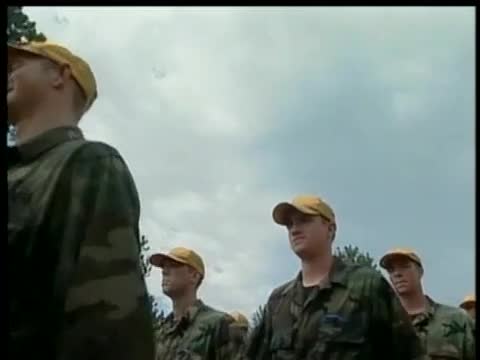
Okay. Still to come on the news hour tonight, religion at the Air Force Academy and the faculty versus the president. News hour correspondent Tom Bearden has our Air Force report. We'll start with exercise one. In this scenario, please imagine that you are the minority faith in your workplace. What things might you find sensitive or offensive? This is the latest attempt by the U.S. Air Force Academy to combat a perception of religious intolerance on campus. It's called the RSVP program, respecting the spiritual values of all people. The mandatory classes are designed to help students and faculty who are 80% Christian better understand people of other faiths. Junior Lindsay Temus is Jewish. She said she didn't have to imagine a scenario of religious insensitivity. She was confronted with one last year when a major training event was held on the first night of Passover.
Knowing when big holidays are not scheduling things during those times is really important. Knowing it's this time of worship for this person and scheduling a major event like that was just offensive to a lot of people. For the past eight months, the Academy has been under attack by several alumni, a former Air Force chaplain and others for allegedly permitting an environment that is hostile to non-Christians. I'm going to throw it really high this time, sir. Academy graduate Mikey Weinstein, who is Jewish, is leading the charge. One of his sons is also a graduate and another is still there. My kids have been told that all of their ancestors, all of their descendants, they themselves will burn eternally in the lake of fire for not accepting an evangelical biblical worldview of Christ. What do you got for me today? Christine Stein filed a federal lawsuit to halt what he called illegal proselytizing and evangelizing throughout the Air Force. There's been an attempt to have essentially an evangelical coup in the military. You have the vast majority of the chaplains core and laity, meaning anybody else who's not a chaplain, who now view the military as a missionary field.
And their goal is to see a spiritually transformed military with ambassadors of Christ in uniform. Weinstein says some evangelical Christians have used the authority of their rank to intimidate other service members, telling them that they need to be Christians if they're to succeed professionally in the Air Force. Reverend Melinda Morton is a Lutheran minister who was an Air Force officer for 13 years. The last three were spent at the Academy. I felt that that was a very important place to be in order to serve people that I had a great appreciation and felt that they had particular needs in the military. At her invitation, a delegation from the Yale Divinity School spent a week at the Academy with Cadetson faculty during basic training or freshmen in the summer of 2004. Their job was to assess and report on the climate at the Academy.
One of the matters that had kept coming up over that summer was the Yale team began to comment on what they saw was particularly overt and strident emphasis on Christian evangelical proselytation of the cadets in the field by chaplains and frankly by others in leadership positions. Specifically, the report said the cadets were encouraged to return to their tents, proselytize fellow cadets, and remind them that those not born again will burn in the fires of hell. Morton says her superiors at the Academy ignored the Yale report until it surfaced in the press. She says she was then asked to disavow it. I was simply being asked to disclaim that as were other chaplains by direct phone calls and other things to present a united front that the matters that we had reported in our document never occurred and that they were false.
You're asked to lie. Yes, I was. Morton resigned from the Air Force over the issue. Like Weinstein, she thinks evangelicals have targeted the military. The evangelical community viewed this as a mission field and promoted this as an opportunity to fulfill your obligation to be a missionizing agent in the world. Colonel Randy Robnett, chief chaplain at the Academy, arrived after Morton resigned but disagrees with her assessment. I've never seen evangelicals claiming the military as a mission field. We bring our faith with us and the military is a crosscut of our society and mostly America is Christian. But I don't see my chaplains anyway claiming the military as a mission field. They feel a call to a mission and that is to come in and care for military families, folks that are employing, helping folks understand this global world and terrorism, helping
them to find their faith, whatever that might be. The Pentagon eventually responded to the Yale Divinity School report by issuing interim guidelines for the entire Air Force in August of last year. Those guidelines said, prayers should not be included in official settings like staff meetings, classes, or sports events, but non-denominational prayers can be included in some ceremonies. Official communication, including email, should avoid the perception of endorsing religion. And authority figures have a greater responsibility to avoid expressing their religious beliefs to subordinates. We spoke to a number of cadets of various faiths about how they viewed the religious atmosphere on campus today. Natalie Shone is a Buddhist. Personally, I saw a change to the attitude at the end of last year, at the end of last academic year, so it's been relatively recent, but I think it's going and everyone's kind of realizing that everyone has different needs and we have to start accommodating them.
After a gall breath identifies himself as spiritual, but does not subscribe to any organized religion. Personally, if I see somebody who's a great leader, who credits some of their characteristics to their faith, I think that's a great thing. I think it's great that people have faith. Now, there is a very fine line between having your faith be known and imposing it, but what's not imposing to me may be imposing to somebody else, and that's where commanders and officers have to be very careful. Michael Lebevitz, who is Jewish, said he doesn't have a problem with most non-denominational prayers at military ceremonies. I think a lot of the prayers that we do are part of our military heritage. There have been times when I felt like the prayer was not all the way appropriate and I have not been afraid to approach a general officer and discuss it with him. What reaction did you get? Very open. In fact, they want to discuss it further and it was almost like an interview like we're having right now. I feel that if I'm in uniform, I should only have to pray or have any religious activity voluntarily.
If I'm an official dinner that's mandatory, I don't think I should have to pray or listen to anyone else pray. Christa Spurling is an agnostic. Have you ever felt pressured to affiliate with any religion? My Christian friends have taught me about their religion, but that's part of their religion and that's something that I need to respect to that part of their faith is to evangelize to others. I've never felt like if I did not accept their religion that that would ever be a problem, but of course they're going to talk to you about it, just like I talked to them about my reasons for not believing. I am an evangelical Christian and I would say that our faith is to live out what we believe and that doesn't mean to get in everybody's face and say, this is what I believe and you should believe that too because that's just, that's not how you love people, that's not how you interact with people. But some evangelical ministers and a group of 72 congressmen felt the guidelines the Air Force issued last summer were too restrictive.
They lobbied the Air Force and the White House to scale them back. Ted Haggard heads the National Association of Evangelicals and is the pastor of the 12,000 member New Life Church in Colorado Springs, which is just across the highway from the Academy. I just think it's a mistake to say the law now. The government needs to come in and tell chaplains how to be chaplains and tell cadets how they can talk to one another about religious issues and tell generals or anybody in the chain of command how they should handle their religious speech. If we start to do that with the law, it's going to squelch, religious expression completely and potentially eliminate it. He says he thinks Air Force leaders should be encouraged to talk about their faith, whatever it may be. We are woefully a mess if we go down the trail of saying under the banner of freedom of religion, it means we're protected from being exposed to anyone else's religion. That's not good, it's not right, it's not good for the world and it's certainly not good for America.
But instead, people need to be exposed to one another, it's good for an Islamic leader to try to persuade me and it's good for a Jewish rabbi to try to persuade me and it's good for me to try to persuade a Jewish rabbi and then we all go out and have a meal together, that's the spice of America. But the new leadership team at the Academy says it's not acceptable for Air Force officers to do that persuading while on the job. Major General Irving Halter is the Academy's vice superintendent. All we're trying to do is make sure that people have an awareness that when they speak, when I speak in this uniform, for instance, I'm a different person than somebody who may be in church speaking or in any other public than you speak. We are high profile people and so we have a responsibility to make sure that the folks that we're talking to don't somehow or another think that we're trying to push them into a particular faith view.
In early February, the Air Force revised the religious guidelines, shortening them by about half and easing the restrictions on public prayer so that chaplains may still pray in the name of Jesus. Pastor Haggard was pleased with the changes. Mikey Weinstein, however, says the new rules go exactly in the wrong direction. He plans to pursue his lawsuit. Like the first set of guidelines, the new directives are said to be interim. The Air Force says there is no timetable for making them permanent. Now the resignation of Harvard President Larry Summers and Power in Higher Education. Margaret Warner has our look. Students crammed into Harvard Yard yesterday to cheer their embattled president, Lawrence Summers. I look back on the last five years with a great sense of satisfaction and pride. Harvard's greatest days are in the future.
Hours earlier, Summers had posted a letter on the Harvard website saying he would leave the presidency at the end of this academic year. He wrote, I have reluctantly concluded that the rifts between me and segments of the Arts and Sciences faculty make it infeasible for me to advance the agenda of renewal that I see as crucial to Harvard's future. The former Treasury Secretary and Harvard professor returned to the Ivy League University in 2001 and quickly embarked on ambitious projects. Young them to make it easier for poor families to send their children to Harvard to expand the school's international focus, advance younger faculty, and boost scientific research. He earned support for many students who backed him three to one in a recent Harvard Crimson poll. He makes his voice heard and whether people agree with him or not, I think that it's an important quality to have. But Summers also sparked controversy and early dispute with prominent African American
professor Cornell West over great inflation and West outside activities led West to leave Harvard for Princeton. In another celebrated case, Summers suggested last year that innate gender differences may partly explain why few women reach top science posts. Many Harvard professors, especially women, were outraged. By then, Summers was on a collision course with the powerful faculty of the Harvard College of Arts and Sciences. They passed a no-confidence vote last March and had scheduled another one for next week. Yesterday, law professor Alan Dershowitz suggested the faculty did Summers in. This is the hard left flexing their muscles and saying, we don't like the way Larry Summers thinks.
We don't like what he says, we don't like what he does, and we're going to get rid of him. Former Harvard president Derek Bach will fill in temporarily after Summers leaves. And now for the larger implications of the Larry Summers story, we turn to Elizabeth Coleman, the president of Bennington College in Vermont, and Anne Marie May, an associate professor of economics at the University of Nebraska, Lincoln. She's a visiting professor this year at Middlebury College, also in Vermont. Welcome to you both, Professor Coleman, what is the Larry Summers story tell us more broadly about the relationship, about the balance of power between college presidents and faculty? Well, it certainly suggests that it's a critical issue, and the first thing I guess I'd say is that this balance shifts and changes from institution to institution, and from issue to issue. But what we've seen, I think, in the Harvard case is that when a president provokes faculty, even a small number of faculty, it's a matter, it raises critical problems for
their leadership, and unless that provocation ceases in some ways, and unless things move away from the focus being on the provocation itself, it becomes increasingly difficult to leave. So are you saying then that explain to people who aren't familiar with the academic world that a college president is not like the CEO of a company? Now, they are, in some respects, they are with respect to their responsibility for the totality of the institution and virtually every aspect of it. So that's the sense in which a president is the CEO. There is nothing that a president can say that's not my business. Nor is there anything that they can say they are not responsible for. That's different in higher education, typically, is their authority, and their authority does not extend in the ways that a CEO's does.
So that a president who seems to go too far in exercising their prerogatives and what they think of their prerogatives to set the course of an institution, to challenge certain kinds of things that are going on. The question of whether they have the authority to do so becomes immediately an issue. One of the things that was very striking about, from the very beginning, about almost every controversy with the exception of the women's issue, one got very little about matters of substance and a lot about matters of form. There has been an enormous emphasis here on really the manners almost of Larry Summers, the style of Larry Summers, and whether or not he had the right, actually, to say and do certain things rather than the substance of what he was saying and doing. Professor May, let me ask you about the power of the faculty, your faculty member yourself. Some have likened the position or authority of faculty to doctors in a hospital to maybe members of an orchestra that it is quite different from being an employee in a typical
company. Is that how you see it? Oh, I think that's certainly true. There's a level of professionalism and professional respect that faculty expect to receive from presidents. It is rather challenging because I think that the two groups have two different views of their relationship. Faculty see it as a collegial relationship where their views should be valued and weighed on serious issues that face the university, presidents, I think, oftentimes have a necessarily more hierarchical notion of that relationship. And so when you start out with two different sorts of visions of the relationship, the challenges in managing those visions and in coming to an agreement and in managing conflict. Let me ask you about one incident. I don't want to get an incident itself, but used to that as an example, and it was the one involving Cornell West, African-American studies professor, very eminent scholar in his field.
And there was a private conversation between Larry Summers early on and Professor West dealing with things like, did he give, where's grades too high or did he have too many outside activities? And it turned into a major, major incident. Is that kind of thing, properly the province or seen by faculty is properly the province of a president or does the faculty say, essentially, that's an academic matter, that's up to us. Well, I think the faculty do reserve the right and the prerogative to make those difficult decisions, but they also at the same time accept that there are procedural balances in place, so that it isn't just one faculty member who can reign over their students, but there are all kinds of procedures established so that you can redress grievances. What does strike me as inappropriate would be for a president to contact an individual
faculty member to ask them specifically about grades, just as it would be inappropriate for a trustee to do the same thing. And President Coleman, back to you on that in terms of who, really, in the end, has the power over the academic... I mean, we all take as a given that the college president goes out and raises money and it's the public face of the university, so I'm sure you know. But how about the academic direction of an institution? Yeah, well, of course there are differences. I mean, we have a tendency in these things to talk about both the faculty and presidents as kind of monolithic. So one of the points I'd like to make is that faculty differ their complex bodies and they think for themselves and independently and separately and they don't always think in a block and certainly presidents differ. Some presidents are more deeply involved in the academic life of the college than others. I would say that any person who heads and leads in academic institution has a responsibility
to be deeply committed to its academic mission and to do whatever they can to further that mission. The idea that presidents of colleges and universities should stay out of academic matters to me is a notion that is enormously dangerous and misses the nature of the principled work of educational institutions, which is to educate students as brilliantly as we possibly can and that involves in my judgment, that's where the collegiality, of course, comes from. Students in the shared mission, there are moments when we have different roles to play in that mission, but as far as I'm concerned, the idea that presidents should stay out of academic matters is extremely dangerous. So Professor May, when Larry Summers said in his letter that this rift with the faculty had made it impossible for him to pursue his quote, agenda for renewal. Just that say to you, or does it say anything to you, about the power of the president
of a large university like this or any university, to actually make a change in direction. If the faculty doesn't support it. Right. Well, that's the challenge of leadership is trying to garner support, and I think that is a challenge that is increasingly more difficult for presidents across the country. One thing we haven't talked about are the increased budgetary pressures that are encouraging presidents to have to be all things to all people. And they in turn will impose in some ways that perspective onto the faculty. It's a challenge to be able to react by trying to do the best that they can, but respond to those pressures as well. And I think that's part of the conflict that we see now that seems to be exasperated. It's increasingly difficult for presidents to have collegial relationships with their
faculty. Do you agree with the president? No, no, I don't. I think that the character of the relationship is not so abstract, and that's something that's born out of shared pressure, shared work, shared sweat, and some principles, some shared convictions about the urgency of our work. Can I, may I just interrupt you, so we just have a minute. I want to hear both of you, Professor, President Coleman, first briefly, and then to you, Professor. Do you think this incident in and of itself, Larry Summers' resignation, will make college presidents less willing to speak out publicly on controversial matters? I hope not. And I think you are touching on something that is a question, and that is what possibilities are there for both leadership. And I hope that people will not take this to me, that there's any less possibility for that kind of leadership.
And Professor May? Well, I think what it hopefully will encourage is for presidents to be very careful when they do speak, to have some kind of substantiation for the claims that they make. And I think part of that problem for President Summers was the venue in which he spoke. But hopefully it will lead to an important exchange about the issue. The issue was important. But it was the style in which the message was delivered, perhaps, and unsubstantiated as it was that led to a good deal of difficulty. And you're speaking, of course, about the women in science, where we have to leave it there and Professor and President, thank you both. Thank you. Thank you. Again, the major developments of this day, powerful bombs blasted a major Shiite shrine in Iraq, it sparked reprisals against Sunnis, and raised new fears of civil war. And White House officials said President Bush did not know an Arab company would take
over operations at six U.S. ports until several days ago. But they said the entire cabinet still approves of the deal. And again, to our honor roll of American Service personnel killed in Iraq and Afghanistan, we add them as their deaths are made official and photographs become available. Here in silence are ten more. perspective. We'll see you online and again here tomorrow evening. I'm Jim Lara. Thank you and good night
Major funding for the news hour with Jim Lara has been provided by Somewhere in Indiana a farmer is getting to work somewhere in California and Connecticut and everywhere in between others like him are getting to work which is why every morning Monday through Friday millions are able to work The American farmer is essential to the economy, and that's why we work to be a central to him ADM resourceful by nature and By CIT and Pacific life This program was made possible by the corporation for public broadcasting and by contributions to your PBS station from viewers like you Thank you You
You To purchase video cassettes of the news hour with Jim Lara Call one eight six six six six seven eight news We are PBS You
You You You
You You Good evening, I'm Jim Lara on the news hour tonight the news of this Wednesday in the attack on a Shiite shrine in Iraq as
Reported by Ed Wong of the New York Times The political storm over the porch deal as read by Mark Shields and David Brooks a New zauer report on religious tolerance at the US Air Force Academy and a look at what the going of Harvard's Larry Summer says about who's the boss Major funding for the news hour with Jim Lara has been provided by Sometimes success needs to be nurtured Sometimes it wants to be pushed Sometimes success takes everything we can give and then demands more And sometimes all it takes is someone who sees what you see At CIT we're in the business a financing great ideas so you can take yours all the way to the top What does the future hold?
Will you have the choices to make your world better to live the life you dream of at? Pacific life planning for a better tomorrow is what we're all about That's why for over one hundred thirty five years Pacific life has offered millions of people a world of financial solutions To help them live well now and plan well for the future Pacific life the power to help you succeed and by the Archer Daniels Midland Company This program was made possible by the Corporation for Public Broadcasting and By contributions to your PBS station from viewers like you. Thank you You Powerful bombs blasted a major Shiite shrine in Iraq today There was no claim of responsibility But the twin blast in Samara north of Baghdad sparked reprisals against Sunnis across the country at least 90 mosques were attacked And three Sunni clerics were killed. We have a report narrated by Julian Mannion of independent television news
It's one of the holiest shrines of Shia Islam today It's in ruins after a bomb attack that has provoked outrage and fear throughout Iraq Only this morning a small group of armed men dressed in police uniforms entered the Alaskaria shrine and set off two powerful Explosions the blast brought down the great golden dome which was one of the largest and most splendid in the Islamic world Now only a blasted stump remains the ornate gateway where generations of pilgrims prayed was today the scene of grief And anger as the people of Samara surveyed the damage Inside the sacred enclosure which contains the tombs of two Shiite saints seems to be still standing amid the rubble This massive provocation against the Shiite branch of Islam appears to be the work of Sunni extremists Perhaps supporters of al-Qaeda in Iraq
Shiites have reacted with fury demonstrations erupted in Baghdad and a string of other cities with many calling for revenge Iraq's president Jalal Talabani spoke of the threat of civil war and called on Iraqis to stay united The Shiite spiritual leader Grand Ayatollah Sistani made a rare television appearance Urging protesters to behave with restraint this devastating attack on a sacred shrine has caused more anger among Shiites than the murderous bombings They have long endured The question now is whether it will finally propel Iraq into civil war Late in the day gunmen in Iraqi police uniform seized and killed 12 Sunnis at a prison in Basra The victims were suspected insurgents and Washington President Bush condemned the shrine attack in a written statement He called it and a front to people of faith throughout the world will have more on the
- Series
- The NewsHour with Jim Lehrer
- Episode
- February 22, 2006
- Producing Organization
- NewsHour Productions
- Contributing Organization
- NewsHour Productions (Washington, District of Columbia)
- AAPB ID
- cpb-aacip/507-bn9x05xz3h
If you have more information about this item than what is given here, or if you have concerns about this record, we want to know! Contact us, indicating the AAPB ID (cpb-aacip/507-bn9x05xz3h).
- Description
- Episode Description
- This episode of The NewsHour features segments including a report on the attack on a Shia Shrine in Iraq with reporting by Edward Wong of the New York Times; analysis by Mark Shields and David Brooks; a report on religious tolerance at the Air Force Academy; and a look at Larry Summers' departure from Harvard.
- Date
- 2006-02-22
- Asset type
- Episode
- Rights
- Copyright NewsHour Productions, LLC. Licensed under a Creative Commons Attribution-NonCommercial-NoDerivatives 4.0 International Public License (https://creativecommons.org/licenses/by-nc-nd/4.0/legalcode)
- Media type
- Moving Image
- Duration
- 01:04:13
- Credits
-
-
Producing Organization:
NewsHour Productions
- AAPB Contributor Holdings
-
NewsHour Productions
Identifier: NH-8469 (NH Show Code)
Format: Betacam: SP
Generation: Preservation
Duration: 01:00:00;00
If you have a copy of this asset and would like us to add it to our catalog, please contact us.
- Citations
- Chicago: “The NewsHour with Jim Lehrer; February 22, 2006,” 2006-02-22, NewsHour Productions, American Archive of Public Broadcasting (GBH and the Library of Congress), Boston, MA and Washington, DC, accessed May 16, 2026, http://americanarchive.org/catalog/cpb-aacip-507-bn9x05xz3h.
- MLA: “The NewsHour with Jim Lehrer; February 22, 2006.” 2006-02-22. NewsHour Productions, American Archive of Public Broadcasting (GBH and the Library of Congress), Boston, MA and Washington, DC. Web. May 16, 2026. <http://americanarchive.org/catalog/cpb-aacip-507-bn9x05xz3h>.
- APA: The NewsHour with Jim Lehrer; February 22, 2006. Boston, MA: NewsHour Productions, American Archive of Public Broadcasting (GBH and the Library of Congress), Boston, MA and Washington, DC. Retrieved from http://americanarchive.org/catalog/cpb-aacip-507-bn9x05xz3h