The NewsHour with Jim Lehrer
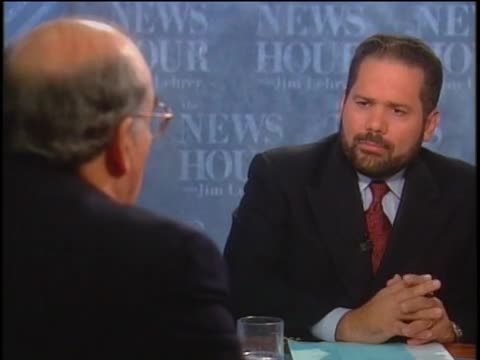
- Transcript
JIM LEHRER: Good evening, I'm Jim Lehrer. On the NewsHour tonight, the still unresolved election for President of the United States, we have the latest developments in Florida and elsewhere, plus full discussion and analysis of where it may be headed. The other news of this Friday will be at the end of the program tonight.
FLORIDA RECOUNT
JIM LEHRER: The recount of the presidential vote in Florida remained officially incomplete today. The Florida secretary of state said two counties had still not reported their totals. But an Associated Press tally of all 67 counties had Governor Bush leading Vice President Gore by 327 votes. That margin had been nearly 1,800 before the recount. In Tallahassee, former Secretary of State James Baker spoke for the Bush campaign. He said ballots from Floridians overseas are still to come in and be counted by next Friday. But he said the outcome is already clear.
JAMES BAKER: Let me begin by saying that the American people voted on November 7. Governor George W. Bush won 31 states with a total of 271 electoral votes. The vote here in Florida was very close, but when it was counted, Governor Bush was the winner. Now three days later, the vote in Florida has been recounted. Over two-thirds of the state election supervisors overseeing that recount are Democrats. At the end of this recount, Governor Bush is still the winner, subject only to counting the overseas ballots, which traditionally have favored the Republican candidates. No evidence of vote fraud, either in the original vote or in the recount, has been presented. Now the Gore campaign is calling for yet another recount. In selective and predominantly Democratic counties, where there were large unexplained vote swings in their favor in the recount, it appears that the Gore campaign is attempting to unduly prolong the country's national presidential election through endless challenges to the results of the vote here in Florida. Furthermore, the more often ballots are recounted, especially by hand, the more likely it is that human errors, like lost ballots and other risks, will be introduced. This frustrates the very reason why we have moved from hand counting to machine counting. Let me say a word specifically about the Palm Beach ballot. There's a rule of law to be followed in all elections. The state of Florida has established legal procedures to design, approve, publish and, if need be, to protest ballots before the election. The ballot was designed by a Democratic elections supervisor; she approved it. The Democratic Party did not question it before the election. This butterfly-type ballot was used in recent elections in the same county and under the same rules, and again the Democrats did not complain. The overwhelming majority of voters who used the ballot in this election understood it and they cast valid votes. Our lawyers have confirmed the legality of this ballot, and we have with us here today relevant copies... copies of the relevant Florida statutes if you would like to have them. The Gore campaign has also tried to make a lot of the fact that double-marked ballots are not counted. A key principle in American elections is one person-one vote. If we have ballots with two votes, of course we can't count them, and of course we can't guess about them. Ballots that are double marked can't be evidence of the voters' intent to vote one way or the other. No jurisdiction in the United States of America would accept such a ballot as a valid vote, and Florida law specifically does not. This happens in every precinct and in every election. And the procedure is very clear: Those ballots have to be disregarded. We understand, and let me say that I understand personally, because I've been involved in them, that it is frustrating to lose an election by a narrow margin. But it happens. And it happened to the Republican presidential candidates in 1960 and in 1976. Both Vice President Nixon and President Ford put the country's interest first. They accepted the vote for the good of the country. It is important, ladies and gentlemen, that there be some finality to the election process. What if we insisted on recounts in other states that today are very, very close; for example, in Wisconsin or in Iowa, or if we should happen to lose it in New Mexico? If we keep going down the path we're on, if we keep being put in the position of having to respond to recount after recount after recount of the same ballots, then we just can't sit on our hands, and we will be forced to do what might be in our best personal interest - but not -- it would not be in the best interest of our wonderful country. And what's happening now, if I may say so, is not in the best interest of our country. And there is a way to stop that. There's a way to bring this thing back before it spirals totally out of control.
JIM LEHRER: As Baker said, recounts were possible in other states. Republicans were exploring new counts in Iowa and Wisconsin. Resident Gore won both by a few thousand votes. He was also the projected winner in New Mexico, but his margins shrunk today to 118 votes, as counting continued in that state. There was still no winner in Oregon, where Gore had a narrow lead. State law there could require a recount as well. Top representatives of Vice President Gore's campaign said today the outcome in Florida was far from certain. Campaign manager William Daley, and former Secretary of State Warren Christopher spoke in Tallahassee.
WILLIAM DALEY: As you know, the automatic recount required by Florida law is continuing. To date, that count has shown a considerable narrowing of the margin between Vice President Gore and Governor Bush. When one considers the number of ballots yet to arrive from Americans overseas, and presumably mostly men and women in the military, it seems very clear that the outcome here in Florida remains in doubt, as it will for several more days. In addition, in the past 24 hours three counties have granted requests to have ballots counted - hand counted - at least on a sample basis. These requests were made because of oddities in the computer vote totals. I hope all Americans agree that the will of the people, not a computer glitch should select our next President. The wait to get these results is frustrating, frustrating to all of us in both campaigns, and to the American people obviously as well. But calls for a declaration of a victor before all the votes are accurately tabulated are inappropriate. Waiting is unpleasant for all of us, but suggesting that the outcome of a vote is known before all the ballots are properly counted is inappropriate. In addition, we continue to explore the questions of what can be done to remedy the unfairness of thousands of residents in Palm Beach County who believe they had were voting for Al Gore having those votes tabulated for Pat Buchanan or not tabulated at all. Our legal team has concluded that the ballot in Palm Beach County was unlawful, it was complained about on election day, a complaint implicitly acknowledged by the election supervisor who put out a flier on election day warning about the problems. In the end, as frustrating as this wait may be, what we are seeing here is democracy in action - a careful and lawful effort to ensure that the will of the people is done. Our other systems of government may work faster, curtailing voters' rights may get a right that is faster, but no system of government is more just or more enduring than ours. I hope that our friends in the Bush campaign will join us in our efforts to get the fairest and most accurate vote count in Florida. Respect for democratic principles and for the fundamental precept of our Constitution, that the people should decide, requires no less. I think as we move forward it is implicit for all of us and all those concerned that we carefully measure all of our words, recognizing the high stakes involved in these deliberations.
WARREN CHRISTOPHER: We are only three days away from the election itself. But our constitutional Fathers wisely provided a period of time after the election and before the electors meet. We're in the early part of that period. I don't see any threat to our Constitution. Indeed, what we're doing is a constitutional process. There is no constitutional crisis. We're proceeding in accordance with the Constitution of laws and will continue to do so. I don't see any threat at the moment to our standing overseas. We've always had this period of interregnum between the election and the installation of a new administration. I think we're proceeding in a very direct way. If there was an escalation of rhetoric on the other side in the last few hours, I just... I'm not inclined to join it. I'm inclined to try to stay on the path of being affirmative about it, trying to carry out our duties here.
REPORTER: Mr. Baker said two things. Mr. Baker said in West Palm Beach County, that they threw out 16,000 ballots in the last election; there is nothing new about this. Secondly, he said you say there is no urgency, however they have an urgency because they have a transition to plan and they want to get on with it.
WILLIAM DALEY: My understanding, and this is what I've been told. In 1996, there were a total of 15,000, both non-voted ballots and double punched ballots. This time there's double that amount. There's about 30,000 ballots that were either not voted or double punched. So it's twice as many. And the bottom line is that mistake, that problem may very well dictate who is the President of the United States, where four years ago, it was not an issue and contention in the state of the nation who was going to win. Oh, on the transition -- I'm sure Governor Bush and his team of very experienced people are well prepared to transition in. They have said that, and I think obviously a great number of Americans believe them as thief said that, and the Vice President is prepared as he has been prepared for eight years in the event of an emergency to transition into the presidency, so I don't see that as a big issue -
JIM LEHRER: Vice President Gore did not make any public statements today. But Governor Bush spoke to reporters at the Governor's Mansion in Austin, during a meeting with key advisers. For the record, that bandage you'll see on his face is to cover a boil.
GOV. GEORGE W. BUSH: Each candidate and each team has to do what they think is in the best interest of the country. I think in the best interest of the country, it is in our country's best interests that we plan in a responsible way, a possible administration. And there have been two votes, and... we're pleased with the results of the two votes.
REPORTER: Governor, since you seem so sure that will you win, have you given thought of resigning as Governor of Texas to give your full attention to the transition?
GOV. GEORGE W. BUSH: I am mindful that there are still votes to be counted, Tom. And we're... I believe, as does Secretary Cheney, that the responsible course of action is to prepare, and that's what we're doing here in Austin, Texas. We're taking our time in a very low-key manner preparing for a possible administration. I'm sure there are going to be some people disappointed that their man didn't get in, but there are also going to be a lot of people very happy. But our job will be to unite the country. And I'm confident that the Bush- Cheney administration will be able to do so, in a dignified way.
JIM LEHRER: Claims of irregularities in the Florida vote did continue today.
IRREGULARITIES
JIM LEHRER: Betty Ann Bowser reports from the middle of the storm - Palm Beach County.
SPOKESPERSON: Is this true and correct?
GENTLEMAN: Yes, it is.
BETTY ANN BOWSER: By early this morning, Palm Beach County Democrats had compiled more than 5,000 affidavits from voters. Some complained their votes weren't counted; some said they were unfairly turned away from the polls on Tuesday by precinct workers. But, overwhelmingly, they complained the presidential ballot was confusing.
WOMAN: I never saw anything so confusing.
WOMAN: I'm from New Jersey, and I never saw anything like this.
WOMAN: It's absolutely ridiculous.
WOMAN: It is.
BETTY ANN BOWSER: Bev Simon is an elementary school teacher who still isn't sure whether she voted for Vice President Gore or Reform Party candidate Pat Buchanan.
BEV SIMON: The fact of the matter is, that it is very confusing. You're talking about the presidency of the United States, and that needs to be handled by a popular vote.
BETTY ANN BOWSER: Do you want a chance to vote over again?
BEV SIMON: Oh, most definitely. And that's why I'm here today, because I feel that we have to be given the opportunity.
BETTY ANN BOWSER: And insurance executive Gerald Postin said he accidentally voted twice for President, which means his ballot was thrown out.
GERALD POSTIN: It is real confusing when you went to punch it and went to look at it. And I remember doing it and then I wanted to go back and there were so many people, I just said -- eh.
BETTY ANN BOWSER: What happened to you? You punched it twice?
GERALD POSTIN: Yeah. I knew I was going to go back and ask for another card, but there were so many people waiting in line, I said forget about it. Then when I got home, I started thinking about it. I said wait a minute. That means my vote didn't count, you know. Gee, I better do something.
BETTY ANN BOWSER: Palm Beach County Democratic officials say they expect they will have another 2,000 affidavits notarized by tomorrow as protests over irregularities in Tuesday's election grow.
CROWD SHOUTING: Revote, revote!
BETTY ANN BOWSER: Last night as hundreds of people gathered at a church in Riviera Beach, a Florida circuit court judge issued a temporary injunction. It prevents the county election board from releasing the ballots to the state before a court hearing is held next week.
SPOKESMAN: And in the sample ballot....
BETTY ANN BOWSER: In addition to 19,000 thrown out for being double punched, there were another 10,000 ballots disqualified because they showed no vote for President -- perhaps because of inadequate punches. Democratic Congressman Robert Wexler said an alarming number of those disqualified ballots were in African American voting precincts.
ROBERT WEXLER: 4.5% of the entire vote of Palm Beach County was literally put in the trash basket for President of the United States. And when we examined each individual precinct, what we found was the 4.5% number, as large as it is, as incredulous as it is, there are precincts that are predominantly African American where up to 15 and 16% of the vote was thrown away.
BETTY ANN BOWSER: At least three lawsuits have been filed challenging the results of Tuesday's election this, and this ballot is one of the things they're questioning. Attorneys for the Democratic Party say Florida law requires the voting preference hole to appear to the right of the presidential candidate's name.
BETTY ANN BOWSER: And you say without question that's illegal, that ballot is illegal?
SPOKESMAN: Yes. Florida state statute has mandatory requirements and it is in violation of the statute. You need to be able to count them correctly. There have been counting problems thus far. There has to be a correct total and ultimately we'll reach the correct total. And I think that the people of the nation are willing to wait to be satisfied that there is no taint to the election and that the candidate who received the most votes in Florida receives the electoral votes, and thereby goes on to become the President.
BETTY ANN BOWSER: Republican leaders say the ballot was legal under state statutes and they argue only a handful of voters were confused at the polls. Mary McCarty is a Palm Beach County commissioner.
MARY McCARTY: Suddenly because the Democrats don't like the outcome of the election, we now have to throw our whole democratic process in turmoil. It undermines the whole basis of our democratic system. That is not how democracy works. And, regardless of what people say about confusion or whatever, it is the voter's responsibility to go in and do the right thing. And 450,000 people were able to figure it out in Palm Beach County.
SPOKESMAN: Petition for a manual recount --
BETTY ANN BOWSER: Tomorrow, election officials will conduct another recount. This one will be a random sample of about 1% of the votes. The ballots in three precincts will be hand counted in their entirety. But Republicans aren't happy about this arrangement. Tucker Eskew is spokesman for the Bush campaign in the Palm Beach County.
TUCKER ESKEW: Not only did the process not allow for us to provide some sort of protest or objection before they agreed to request the manual recount, it's done in a county with strong Gore vote and Democrat control of the voting board. It is not coincidental that the manual recounts being conducted in other Florida counties are all counties controlled by Democrats with strong Gore votes and with voting boards governed by Democrats. That suggests a sharply partisan motive in this manual recount.
BETTY ANN BOWSER: Gore supporters deny they're politically motivated. Meanwhile, Tuesday is the earliest Palm Beach County officials can turn over their recounted votes to the state for verification.
FOCUS - HISTORY ON HOLD - DAY 3
JIM LEHRER: Now, some perspective on what's going on, beginning with an event last night that, through a coincidence of timing, had more going for it than originally planned. It was a celebration of presidential history and American democracy here in Washington. Ray Suarez reports.
RAY SUAREZ: With the next chief of state still unknown, President Clinton and three former Presidents gathered last night to celebrate the 200th anniversary of the White House. Governor George Bush's father and mother were there, so were former Presidents Carter and Ford, their wives and Ladybird Johnson. President Clinton toasted his predecessors.
PRESIDENT CLINTON: Good evening. In the short span of 200 years, those whom the wings of history have brought to this place have shaped not only their own times, but have also left behind a living legacy for our own. In ways both large and small, each and every one of you has cast your light upon this House, and left it and our country brighter for it.
RAY SUAREZ: But afterwards, the focus changed to this year's cliffhanger election and to the next resident at 1600 Pennsylvania Avenue.
PRESIDENT CLINTON: I think that all of us should remember that our system will prevail; that our nation is so great, so strong, and the tradition is so embedded in the consciousness of our leaders here, that we will survive this present uncertainty about the outcome of the election.
GEORGE BUSH: Whatever happens this time, my pride and Barbara's pride knows no bounds. Moreover, our democracy will go on as President Carter said, and the new President will become part of the continuum of service that sets our nation and this building apart.
PRESIDENT CLINTON: We know how proud President and Mrs. Bush must be of their son, and rightly so. And we Americans should take great pride in the fact that this contest was fought to a close conclusion. It is not a symbol of the division of our nation, but the vitality of our debate. And it will be resolved in a way consistent with the vitality of our enduring Constitution and laws.
RAY SUAREZ: Now, a longer view of today's election turmoil. We get the perspective of NewsHour regulars, Presidential historian Michael Beschloss, and journalist and author Haynes Johnson. Joining them tonight are Richard Epstein, a constitutional law professor at the University of Chicago Law School, and Roger Wilkins, professor of history and American culture at George Mason University. Michael Beschloss, let me start with you, since you were one of the honored guests at last night's glittering party at the White House. It must have been pretty surreal on some levels.
MICHAEL BESCHLOSS: You know, it was surreal, Ray. As you know, I've got two little boys and this was their idea of what it was like to have dinner at the White House, as I described it to them later on. You went in and sitting at this long head table you had these four Presidents, Ford, Carter, Bush and Clinton as will as Lady Bird Johnson, and their wives. They were all there in sort of a freeze; it looked almost like Mt. Rushmore. But the amazing thing is here was a night full of goodwill and unity -- exactly what we've not seen very much of this week. Two things really stand out: Number one, if you can believe it, at one point during the dinner, the marine band was playing "God Bless America" -- everyone got up - all those former Presidents and the current President, and their wives, and began clapping and singing "God Bless America" along with the audience on their feet, which was almost like a scene out of a musical. And the other thing was Gerald Ford, I thought, had the best words of the evening. He was telling about the fact that in other moments of crisis in American history, we have been able to come together and get over it, and he said the words, "the Constitution works." And it just sent a jolt through me because I just remembered that standing in exactly that same place in the East Room in 1974, just after Richard Nixon quit to avoid impeachment and conviction, that's exactly what he said to calm American nerves. He said the Constitution works. This is a government of laws and not of men.
RAY SUAREZ: We saw the formal speeches from the microphone, but apart from the formal times, during the more social times, was the election result sort of the elephant in the room and people were finding other things to talk about purposely, or did that really dominate the evening?
MICHAEL BESCHLOSS: They were trying but without much success, Ray. You know, this was something that everyone was obsessed by and the interesting thing was that, of the guests there, I would say half of them supported George W. Bush, about half of them supported Al Gore, and not only supported them -- there were a lot of people in that room who might be in a Gore cabinet, might be in a Bush cabinet, so deeply invested in the outcome. So there was a little bit of an uneasy effort to stay away from the elephant in the room. At the same time, the nice thing was that all these characters in the drama were able to get together in a wonderful evening that really, I think, spoke to the best of America.
RAY SUAREZ: Well we'll shift our gaze now from looking over our shoulders at the last 200 years and look forward. Roger Wilkins, what should Americans be thinking about? What would you want them to be looking at to come to some common wisdom about what has just happened?
ROGER WILKINS: Well, you know, I think that there really are only about two people who can get us out of this. Haynes and I were talking before. We were journalists together in Watergate; this is weirder than Watergate, because with Watergate you knew there were steps and you go down the road, you know what is going to happen. Here you don't. These are two campaigns where the people really don't like each other. And, because of that, it seems to me, this is pretty dangerous. You see Jim Baker down there spinning very, very hard for his side, but he's one of the wise men. And what I think has to happen is that somehow both of these candidates have to figure out that this thing is really bigger than either of them and that in some way, they have to put a process together where they assure the country that they will come together at some point in some process and the country will go on. I don't think that this continuation of the campaign by other means is helping anybody.
RAY SUAREZ: Richard Epstein, the same question to you. What would you want to spoke us --focus people's attention on in making some sense of this?
RICHARD EPSTEIN: Well, I think the first thing that I would try to insist upon is the importance of finality with respect to the decisions in question. One of the things that seems to be happening here is that the entire matter escalates. First, it turns out to be what the ballot looks like, then it turns out to be an issue of how it is that people were turned away from the polls -- then it's a question of other forms of invalidation in Palm Beach County, then in New Mexico, then elsewhere. And I would hope that what we could do is get ourselves to the point where we agree that a recount, which takes into account all the imperfections in the previous process and all the uncounted votes, would resolve the thing without further adjudication. I think it is a big mistake under these circumstances to listen to the protestations given individuals in one county and to act as though that the same problems don't exist everywhere else throughout the United States. If we overturn this rock and look at all the maggots underneath it, we'll see them everywhere else as well if we turn over other rocks. The sad truth, and I'll end with this point, is that an election process cannot be engineered to the point where it gets you to .01 percent efficiency. No matter which way the vote comes out, you are not within the confidence of error. The chances are that the guy who had the popular vote and maybe even the electoral vote were wrong and we just have to recognize the imperfections of the system and move on.
RAY SUAREZ: Well, when you talk about turning over other rocks, are you concerned by the spread of these skirmishes to other places in the country, New Mexico, possibly Iowa, Wisconsin?
RICHARD EPSTEIN: Sure. And elsewhere in Florida. I mean, people said they were turned away from the polls because they were too long lines. Other people say they were deterred from voting because of the early announcement that Gore had won. I regard all these charges as equally frivolous. They happen in every election, and I think even when the outcome is on the line, you have to stick with the standard principle of finality, which says that unless you can show that there was some degree of fraud associated with the creation of this particular electoral result, then it stands. And the irony, of course, is it was folks trying to help the old people who created the ballot mess. It was certainly not the Bush forces, and so I think in the end what we have to do is to bare our teeth -- grit our teeth, grit, and hope that we can get some healing situations. So, I would try to counsel moderation on both sides. Frankly, I don't know who will win the count in Florida. That's one of the reasons why I'm reasonably confident that this is the appropriate approach.
RAY SUAREZ: Haynes Johnson?
HAYNES JOHNSON: The remarkable thing, watching that lead-in about the White House last night, think about the symbolic fortuitousness of that event. 200 years of the White House, John Adams entered it as the first resident. Here you have, by just happenstance - it happens to be two days after this remarkable election, the four Presidents that we saw sitting there, each of them had gone through a trauma that is almost unimaginable. Three of them were defeated after one term, thrown out of office by... and bitterness, Jimmy Carter, Gerald Ford, George Bush, one-term Presidents. Now the President, Bill Clinton, who is the 41st man ever to occupy... that's all it is, 41 men in 213 years have occupied that position. He was the only elected President impeached. Here they are talking about the system was stronger than that -- that's the lesson the country has to have. And what I think what these political candidates have to take in mind, and I'm sure they will down the road because it can't last too long -- Roger is right -- the thing about the democracy is it's very, very powerful, but very fragile. And the only thing that really counts in this experiment, John Adams said when we became President, he didn't believe it was an experiment. He said no democracy has ever lasted. It always self-destructs and commits suicide. So it was an experiment and the experiment was based on something so elemental you had to have faith and trust in the system. You had to have faith in the electoral system and the ability that your vote really mattered. That's what's at stake now. The danger is the longer this goes on, the less legitimacy it has, and that is what cannot be allowed to stand. I take the example of those four men who knows what it is like to suffer ignominy, and hatred and passion and divisiveness and who stood together last night.
RAY SUAREZ: Well, Michael, let me talk to you a little bit about time, because the electoral college doesn't meet until December. The inauguration is in January. It used to be in March for much of the history of the country. Are we ringing the alarm bells too quickly?
MICHAEL BESCHLOSS: Well, it depends on what happens. I think in a way, Ray, the burden is going to be on the person who is the loser of the final vote in Florida after those absentee ballots come in, which will be ten days after election day, after the 17th of November That is the point where I think the loser is going to have to make the decision whether to escalate to broad scale litigation about irregularities. And if that happens, it is almost like nuclear war. The other side will probably strike back - sue in other states. And then you have got a legal situation that begins to get out of control almost like a general nuclear war, and the chance of a vote by the electors on the 18th of December begins to get very dim and we begin to have the possibility of this election thrown into the House of Representatives in January. So in a way, whoever loses that count on the 17th of November, and there is no way we can know who that is going to be tonight, is going to have to make a very tough decision, which is, is it worth it to pursue this? Do I feel so strongly about this that I'm going to risk possibly dividing the country, throwing a shadow over the next administration, whoever runs it, and also the possibility that there may not be a full-fledged President inaugurated on the 20th of January?
RAY SUAREZ: Richard Epstein, you wanted to jump in?
RICHARD EPSTEIN: Yeah. I think, in effect, one of the things we know about litigation is that there is no such thing as an easy case. I spent my life as a lawyer working on lots of cases that I thought were lead pipe cinches and find out that eight years later and God knows how many trips to the appellate court, that the thing is more murky as ever. You have to understand that the ingenuity that 70 lawyers on each side can bring to this thing simply surpasses the imagination of even the law professors who think that as instant experts on election law they know something or even everything. So I'm just frightened to death about this. And I agree with what Roger said. The key point to remember here is this is not a lock for either Bush or for Gore, and would I love both of them to make pledges today to say that they are not going to go beyond the recount issue to demand a reconsideration, a revote, or anything else. I regard that as so destructive that I am terrified in my sleep.
RAY SUAREZ: Roger Wilkins.
ROGER WILKINS: Well, it's a little terrifying this morning when you see Bob Dole, a very serious American, calling George W. Bush the President-elect. That's outrageous! Now things have been said on the Democratic side. We will take this litigation to its course. Instead of having the wisest men that they can find down there in Florida spinning the American public, they should call those guys back and say, you guys, with whatever wisdom you have working for us with the spirit that we saw in the White House last night, we have for to figure out how to prevent this nuclear war. These guys... One of them is going to is going to lose the White House. One of them may have to give it up. People have lost their lives fighting for this country so these guys ought to get big.
RAY SUAREZ: We have to end it there. Gentlemen, thank you all.
FOCUS - NEXT MOVE?
JIM LEHRER: Last night we spoke with Howard Baker about the severe personal pressures on Vice President Gore and Governor Bush to do the right and timely thing. Baker is the former Republican Senator from Tennessee and Republican leader of the Senate, and Reagan White House Chief of Staff. Tonight, the same conversation with a Democratic counterpart, Leon Panetta, White House Chief of Staff in the first Clinton term, and before that, a long-time Congressman from California. Mr. Panetta, welcome.
LEON PANETTA: Thank you, Jim, nice to be with you.
JIM LEHRER: Senator Baker said last night that Misters Gore and Bush had a choice to make, hang in there to the bitter end and possibly become President, or give it up and become a national hero today and in history. Do you see it as starkly as that?
LEON PANETTA: Well, there's no question that there is going to be a tough choice that has to be made by either one of these candidates at some point. My concern is that they're both facing their first test as to whether or not they can lead this nation and put the national interest first and try to begin to heal the deep divisions that we see in this election and in this country. And frankly, neither side is doing it very well right now. I think the Bush camp, by going through the transition, declaring victory, urging that Gore hang it up, I think they're on the wrong track; particularly when there is no final vote here in Florida. With regards to the Gore camp, their threat to carry on litigation and prolong this very difficult decision, I think is also on the wrong track. I think both need to back up, tell their principals to work together. They're going to have a recount in Florida, they're going to count the absentee ballots, whatever that final vote shows, whatever the secretary of state certifies as the final vote, both sides ought to accept.
JIM LEHRER: But just in personal terms, how difficult is that going to be for these two men when that time comes after all they've been through and as close as this election has been?
LEON PANETTA: Jim, this is the toughest decision that any individual who has run for President will face. It's tough for any politician. You're engaged in a campaign. You have been fighting for more than a year. You have all of your campaign workers who have been working in every state. They have been struggling and fighting. They have been pushing; they have been trying to ensure that their man would win, and suddenly it comes down to the election and they still don't have a winner. The candidates are being pressured from their campaign advisors to stick in there, fight it out -- they fought it this long -- continue to fight it out. But in the end, both candidates have to understand they're running for the presidency of United States, and that means that at some point they have to take into consideration what is in the national interest of this country. It's not an easy decision. It never is. But very frankly if they want to be President of the United States and work in the Oval Office, then they're going to have to understand that they will have to put the national interest first if they're going to be good Presidents.
JIM LEHRER: Senator Baker said last night, based on his knowledge of these two men specifically, that he thought both were capable in the final analysis of making this kind of wrenching decision. What is your reading of that?
LEON PANETTA: I feel the same way, I really do. I know Al Gore... I was elected with him in 1976 to the Congress -- and I think deep down in his guts, he will do what's right for this country. I think Governor Bush, by virtue of being part of a family that has been involved in politics and in a lot of tough decisions, and he's had to face some tough decisions as Governor as well, obviously will have to look at his own guts to determine what's in the interest of this country. But I really do believe, when it comes down to it, that they're going to make the right decision for this country.
JIM LEHRER: The words used in the prior discussion, you heard the same discussion all of us did, words like "frightened," "dangerous territory." Do you share some of those fears?
LEON PANETTA: The greatest strength of this country is our confidence in the stability of the United States of America. We trust in our Constitution. We trust in our process. We trust in ourselves. That's our great power abroad in the world, and it's our great strength here at home. When there is anything that threatens the stability of this nation, then that is of concern. And if we have a prolonged process here in arriving at who will be the President of the United States, then that could undermine the confidence we have in our stability, and I think that's of concern.
JIM LEHRER: What constitutes a prolonged process in your opinion from here on?
LEON PANETTA: I think if we arrive at a final vote and then there continues to be litigation pursued by either one of these two candidates, and we wind up going into court, I think what's going to happen is that that will open a door to all sides to engage in basically scorched earth litigation. They'll raise questions in Wisconsin, in Iowa, in New Mexico, as well as other states. And I think you then start having a very prolonged process with litigation that will keep this issue up in the air. I think both camps have to push back to the side and focus on the finalization of the vote count and rely on that, and whoever wins, accept those results.
JIM LEHRER: Is there a problem here that if the rhetoric continues to escalate and this process continues, that no matter how it turns out, the legitimacy of the eventual winner, whether it be Vice President Gore or Governor Bush, will be in severe question? In other words, the atmosphere will be so poisoned going in, that it will be difficult for this person to function as President of the United States?
LEON PANETTA: Whoever is elected President right now is walking into a situation in which you virtually have a dysfunctional Washington. You're going to have a President who, whoever it is, will have been elected by a very small margin. You have got a Congress in which while the Republicans may control it, their numbers are very small and at the margin as well. You've got almost six years of trench warfare here between the two parties and an awful lot of gridlock on a number of issues from the budget to education to health care. And now suddenly a President has been tortured through the election process as well. It is the perfect prescription for further gridlock and for trouble.
JIM LEHRER: You heard what was said earlier, that another problem here is you don't want to turn over too many rocks in this process, that the election process, the electoral process of the United States is a good and wonderful thing, but it isn't very exact. You have been through a lot of... how many times have you run for office, how many elections?
LEON PANETTA: Eight times.
JIM LEHRER: Eight times. And you have been involved in other people's elections, too. What would you say to the American people tonight about our electoral process and the sanctity of each vote, et cetera?
LEON PANETTA: The reality is that obviously all of us, as American citizens, enjoy a wonderful right in this country that our Forefathers gave us to exercise the freedom of elections, and the ability to vote is the most important right we can have in a democracy. But the reality is that there is no such thing as a perfect election. If people are looking for "the" perfect election where every ballot is counted, every individual has his or her vote, that's not what we have and it's what we haven't had for 200 years. Now ultimately our system does work to come to some finalization as to what the vote is. And we have to accept the imperfections of our election process in order to bring to closure to every election; that's the nature of our democracy. And that's the way it is now and that's the way it will be in the future.
JIM LEHRER: Leon Panetta, thank you very much.
LEON PANETTA: Thank you.
FOCUS - POLITICAL WRAP
JIM LEHRER: And finally tonight, to Margaret Warner for some closing words from Shields and Gigot.
MARGARET WARNER: That's syndicated columnist Mark Shields and "Wall Street Journal" columnist Paul Gigot. All right, Mark. Where are we in this process? We've heard a lot of talk tonight about "dangerous ground," "dangerous territory?"
MARK SHIELDS: Uncharted waters.
MARGARET WARNER: Uncharted waters. I mean, are we in danger of moving... of this really spinning out of control? Where do you think we are?
MARK SHIELDS: No, do I not. I mean I think, you know, it is a good time to pause. This is not a divided nation. It is equally divided politically, but it's not a polarized nation. This isn't 1968; it isn't 1974. It's 1955 -- it's Dwight Eisenhower's America. We just finished an election where there was no defining issue so the sense of urgency... I heard Jim Baker who has been missing for 17 months and is now re-earning his bones as a consigliore for the Bush family, saying the country is really hanging in the balance as he made this case. Talk about hyperbole. There are no tanks in the street. There are no people that are at razor's edge, are standing, ready to take each other on. With three days after the election, we're four weeks away from the electoral college meeting, I mean this is a process, Margaret, where in a state where 0.5% difference triggers an automatic recount; we are talking 0.01%, one-half of 0.01% -- 327 votes. Does that deserve a recount? Sure. Does it merit litigation under the process? It shouldn't at this point, and I don't think it will.
PAUL GIGOT: I respectfully disagree about the urgency of this. We are in a political crisis, Margaret. We're not in a constitutional crisis yet, but I think we could be there, and I say that because one of the sides - that is the Gore campaign -- has said, "no matter what the recount is, we are going to pursue litigation and talked about - Bill Daley did yesterday -- injustices unparalleled in our history. If the will of the people is to be heard, Al Gore will be the next President." That's basically saying no matter what the count is, we're going to pursue a legal case. And I think that that is... that's incendiary, and that really does create some political problems about trust in government and the legitimacy of whoever wins.
MARGARET WARNER: But today in Bill Daley's press conference, he didn't talk about litigation. How did you read that? In other words, how clear is it what their intentions are?
PAUL GIGOT: I don't think their intentions are certain right now. I thought yesterday that language was over the top. Today he had toned it down a little bit, and there was a little more ambiguity about where they might go. And I think that does reflect the fact that some cooler heads in the Gore campaign but also Democrats I've talked to privately and some have said it publicly, Bob Rice, the former cabinet member for President Clinton, Bob Torricelli, Senator from New Jersey, others have talked about the fact that, look, if the vote goes against the Vice President, we've got to get this decided. So I think there is some real tension in the Gore camp. But so far the Vice President seems to be sanctioning a litigation strategy.
MARGARET WARNER: How do you read the intentions of the Gore camp right now?
MARK SHIELDS: I read the I intentions of the Gore campaign to get a full definitive accounting, Margaret. I mean, I miss -- with all respect to Paul -- I miss this international looming crisis that went undebated in the last campaign. I mean, I missed it. I'm sorry. I didn't... I listen.
PAUL GIGOT: Not international, domestic.
MARK SHIELDS: I don't quite get it. I don't see that there are people in the streets concerned about this. Democracy is messy, it is time consuming, it is inefficient. Democracy must never be sacrificed to the timetable of some power grabbing, terminally ambitious politician. You talk about unseemly behavior. Unseemly behavior -- Bill Daley aside, forgotten -- how about conferring a transition meeting, trotting out Colin Powell who is the most convenient icon that George W. Bush has at any moment of crisis in his life. I mean it was just... this was... it was presumptuous and it was arrogant on Bush's part. So I think that there is tension in either... Leon Panetta said it best. Leon Panetta said, "if either of these men wants to be a leader, they're facing their first test." Right now, both have behaved pretty badly and I think that's fair to say. And I think threats of lawsuits or let's re-open Wisconsin or let's take another look at Iowa, which never crossed their minds until yesterday, as far as I can see in the Bush campaign, I think it all looks a little tit for tat.
PAUL GIGOT: Yesterday everything changed, Mark. I think that's the big difference. I agree with you about the transition point -- that Governor Bush should have put that all away and said, "look, until all the votes are counted, we're not going to move on here." But that's the cut-off date and I think that is the moment of decision... sorry. Go ahead.
MARGARET WARNER: I just wondered how should we read what Jim Baker said today? He not only... In fact he didn't talk much about litigation so much as recounts. He even said if these recounts continue to be requested, we're going to request recounts. What is the Bush camp saying there?
MARK SHIELDS: Well, I mean it was pretty obvious. It was a threat by Jim Baker that we'll keep this going. We are not going to be pushed around or whatever. I mean, I thought it was an empty threat in response to no threat to him. What we're faced with, Margaret, and to be blunt about it, is we have not had a full recount. I mean, understand the magnitude of this. Six million votes almost, 327 separating them. I mean this is really... this deserves time. This deserves an honest count, and a definitive count. That's all we're talking about.
MARGARET WARNER: Is the Bush camp objecting to a full recount or a hand recount?
PAUL GIGOT: They are objecting to a hand recount, not a full recount.
MARGARET WARNER: Warner: Why?
PAUL GIGOT: They are not objecting to a full recount. We've already had a machine recount. and presumably it will be sanctioned by the secretary of state next week. We had the unofficial results that the Associated Press kept track of, but we don't have the official results. What they don't want, and with some justice, I think, is that you are going to have a hand ballot recount in four predominantly Democratic counties of Florida. Why just let it be in those Democratic communities controlled presumably by Democratic officials? Let's have a recount in every county in Florida. While we're at it, let's have a recount in Wisconsin and Iowa and New Mexico. In other words, there is a Pandora's Box quality to this, that Leon Panetta and others talked about. If you are going to hand count them, hand count them all.
MARGARET WARNER: Do you two think there is any chance that these two men would do what almost everybody in Ray's discussion was suggesting but Professor Epstein really said, which is these two men right now should pledge they're going to abide by the full recount, the recount, whatever you want to call it, when it's done -- say that in advance and take the litigation thing off the table?
MARK SHIELDS: I don't think it will. It would it be nice if it happened, yes. But Margaret, coming back to Paul's point, counting your vote is a fairly elementary duty of democracy. I mean that's all we're talking about, whether in fact votes were counted. I mean that is not something that is rocket scientist. That's not neurosurgery. That's just simply validating. Are there mistakes made? No one is arguing malice here; no one's arguing deceit or treachery. All we're arguing is that there may have been honest mistakes made that could affect the outcome.
MARGARET WARNER: Same question to you and also, how long do you think this can go on and the question that Leon Panetta addressed without it undermining either Americans' faith in the whole process or the future President's ability to govern?
PAUL GIGOT: Right now it looks to me that November 17 is D-Day if you will because when those votes are sanctioned by the secretary of state of Florida, this is the result. Okay. I think up to that point while the votes are being counted either of the men can say, well, we're awaiting the outcome. But once it gets to that point, I think they begin to look like sore losers and they begin to look like they're putting the American public through something that it doesn't want to be put through, which is more of this wrangling. They want closure to this. I think beyond that, either man is going to face a real basic choice and my own guess is that despite all this rancor of this week, both of them would decide that they're going to go Richard Nixon's route and concede rather than go all the way to the Supreme Court and all the trauma that would involve.
MARGARET WARNER: Same question to you, mark. How long can this go on?
MARK SHIELDS: It can go on until there is a fully understood public recognition that there has been a full, fair count in Florida. And that's it.
MARGARET WARNER: Is that next Friday?
MARK SHIELDS: It may be next Friday, it may be the week after next Friday. There may be counties still being counted. I really enjoyed the lionization of Richard Nixon over the past 36 hours since the polls closed. Richard Nixon in 1960 lost Illinois and he didn't challenge. He didn't challenge. There were 27 electoral votes. It wouldn't have affected the outcome and Dwight Eisenhower opposed a recount.
MARGARET WARNER: This is going to affect the outcome of the show. We're going to have to cut it off there. Thank you both. To be continued.
NEWS SUMMARY
JIM LEHRER: In the other news of this day, there was a new wave of violence in the Middle East. Gun battles between Palestinians and Israeli troops broke out in the West Bank and Gaza. Five Palestinians and an Israeli soldier were killed. The new fighting followed the funeral for the leader of a Palestinian militia. He was killed yesterday by Israeli forces. Israeli Prime Minister Barak will meet with President Clinton Sunday in Washington. But he said today it would be far-fetched to expect a resumption of peace talks, until the violence ends. This was a bad day on Wall Street. The Dow Jones Industrial Average closed down 231 points, at 10,602. The NASDAQ Index fell 171 points or more than 5% to close at 3,028. That was its lowest close of the year.
RECAP
JIM LEHRER: We'll see you online, and again here Monday evening with the latest on the presidential election endgame and related matters. Have a nice weekend. I'm Jim Lehrer, thank you and good night.
- Series
- The NewsHour with Jim Lehrer
- Producing Organization
- NewsHour Productions
- Contributing Organization
- NewsHour Productions (Washington, District of Columbia)
- AAPB ID
- cpb-aacip/507-bk16m33r9r
If you have more information about this item than what is given here, or if you have concerns about this record, we want to know! Contact us, indicating the AAPB ID (cpb-aacip/507-bk16m33r9r).
- Description
- Episode Description
- This episode's headline: Irregularities; History on Hold; Next Move?; Political Wrap. ANCHOR: JIM LEHRER; GUESTS: MICHAEL BESCHLOSS; HAYNES JOHNSON; RICHARD EPSTEIN; ROGER WILKINS; LEON PANETTA; MARK SHIELDS; PAUL GIGOT; CORRESPONDENTS: FRED DE SAM LAZARO; BETTY ANN BOWSER; SUSAN DENTZER; RAY SUAREZ; SPENCER MICHELS; MARGARET WARNER; GWEN IFILL; TERENCE SMITH; KWAME HOLMAN
- Date
- 2000-11-10
- Asset type
- Episode
- Topics
- Politics and Government
- Rights
- Copyright NewsHour Productions, LLC. Licensed under a Creative Commons Attribution-NonCommercial-NoDerivatives 4.0 International Public License (https://creativecommons.org/licenses/by-nc-nd/4.0/legalcode)
- Media type
- Moving Image
- Duration
- 01:04:04
- Credits
-
-
Producing Organization:
NewsHour Productions
- AAPB Contributor Holdings
-
NewsHour Productions
Identifier: NH-6895 (NH Show Code)
Format: Betacam
Generation: Preservation
Duration: 01:00:00;00
If you have a copy of this asset and would like us to add it to our catalog, please contact us.
- Citations
- Chicago: “The NewsHour with Jim Lehrer,” 2000-11-10, NewsHour Productions, American Archive of Public Broadcasting (GBH and the Library of Congress), Boston, MA and Washington, DC, accessed July 3, 2026, http://americanarchive.org/catalog/cpb-aacip-507-bk16m33r9r.
- MLA: “The NewsHour with Jim Lehrer.” 2000-11-10. NewsHour Productions, American Archive of Public Broadcasting (GBH and the Library of Congress), Boston, MA and Washington, DC. Web. July 3, 2026. <http://americanarchive.org/catalog/cpb-aacip-507-bk16m33r9r>.
- APA: The NewsHour with Jim Lehrer. Boston, MA: NewsHour Productions, American Archive of Public Broadcasting (GBH and the Library of Congress), Boston, MA and Washington, DC. Retrieved from http://americanarchive.org/catalog/cpb-aacip-507-bk16m33r9r