The MacNeil/Lehrer NewsHour
- Transcript
MS. FARNSWORTH: Good evening. I'm Elizabeth Farnsworth in New York.
MR. LEHRER: And I'm Jim Lehrer in Washington. After our summary of the news this Thursday, we update the situation in Rwanda and its neighbor, Burundi, Jeffrey Kaye reports on the new knowledge about earthquakes, analysts look at the two new possibilities in the media merger world, Time Warner and NBC, Disney and CBS, and essayist Richard Rodriguez says good-bye to a church. NEWS SUMMARY
MS. FARNSWORTH: The U.S. and Cuba opened talks today on stemming the flood of refugees bound for the United States. The government of Fidel Castro had requested wide ranging negotiations but the Clinton administration restricted the discussions to the exodus. The U.S. delegation is led by a deputy assistant secretary of state, the Cuban by the president of the country's parliament. A State Department spokesman had this to say after today's session in the U.S. mission at the United Nations.
DAVID JOHNSON, State Department Spokesperson: They were serious, professional, and business-like. They continued in that manner through the afternoon. In the afternoon, however, we'd gotten beyond semantic presentations into the details of how the United States believes we could meet what we believe is a mutual objective, channeling the desire to immigrate into a legal, safe, orderly, predictable, and dependable process, and stemming the uncontrolled outflow.
MS. FARNSWORTH: The talks are expected to continue tomorrow. The current migration began in early August when Fidel Castro let it be known his government would no longer stop people who wanted to leave. Since then, more than 19,000 refugees have set sail in homemade rafts and boats. Yesterday, the U.S. Coast Guard picked up more than 2100 people. Seven hundred were rescued by mid-day today. Jim.
MR. LEHRER: State Department officials said today North Korea and the United States will begin discussing the possibility of diplomatic ties. A meeting is scheduled for September 10th in Pyongyang. White House Press Secretary Dee Dee Myers said the talks would deal with technical issues like phone and mail service in case the United States decided to open a liaison office. Separate talks will be held on North Korea's nuclear program. The government of Zaire said today it wants its 1.2 million Rwandan refugees to return home by the end of the month. Aid officials said many of the refugees fear reprisals by a rival tribe now in power in Rwanda. We'll have more on the story right after the News Summary.
MS. FARNSWORTH: NBC and CBS could soon have new owners. Published reports said today that Time-Warner is negotiating to buy NBC from General Electric for as much as $3 billion. But the deal may face regulatory hurdles. The Walt Disney Company, meanwhile, has reportedly approached both NBC and CBS. We'll have more on the story later in the program. Attorney General Janet Reno announced a settlement against the Avis Rental Car Company today for allegedly violating the Americans with Disabilities Act. Avis has agreed to install special hand controls at no extra charge for consumers who request them. The units cost between two hundred and five hundred dollars and take about ten minutes to install. Reno spoke at a Washington news conference.
JANET RENO, Attorney General: It is fitting that this agreement comes on the eve of a holiday when many Americans take to the road with family and friends. And it gives to so many people an opportunity now to expand their horizons. Under the ADA it is becoming possible for people with disabilities to not only have access to basic necessities but also to enjoy the travel and leisure opportunities that many of us take for granted.
MS. FARNSWORTH: The Justice Department is investigating complaints against 10 other rental car companies. A federal judge today granted final approval to a $4 1/4 billion settlement involving breast implants. The agreement involves nearly 60 companies and nearly 100,000 women. It's the largest product liability settlement in U.S. history.
MR. LEHRER: An earthquake shook Northern California this morning. It was centered in the Pacific Ocean about $90 miles southwest of Eureka, California. There was some damage but no reports of injuries. The Interior Department said today the Northern Spotted Owl will remain on the threatened species list in California. The timber industry had asked for it to be removed. The owl was added to the list in 1990 because the Fish and Wildlife Service said excessive logging was a threat to its survival.
MS. FARNSWORTH: That ends our summary of the day's news. Still ahead, an update on Rwanda, earthquake science, media mergers, and a Richard Rodriguez essay. UPDATE - SAFE TO RETURN?
MS. FARNSWORTH: First tonight, an update on the refugee crisis in Rwanda. It has faded from the front page, but more than 2 million people remain in camps in Southern Rwanda, Zaire, Burundi, and Tanzania. The mostly Hutu refugees are unwilling to return to or stay in their country, which is now controlled by the minority Tutsi tribe. Today, a Zaire official said his country wanted the refugees to leave by the end of the month, and the U.N. announced it is sending a special envoy to Central Africa next week to explore ways to keep the ethnic conflict from spreading. We begin our coverage with a recent report from Southern Rwanda on why the refugees aren't moving. The correspondent is Mark Austin of Independent Television News.
MARK AUSTIN, ITN: It's a mission to save a country that may just be beyond salvation. Under heavy guard, senior members of Rwanda's new Tutsi-led government are entering the Hutu-dominated protection zone in the Southwest. Surrounded by the security of U.N. guns, they come with a message of peace and reconciliation. But this is a frightened audience. These Hutus are petrified that the new government army, the RPF, will exact revenge for the massacre of hundreds of thousands of Tutsis by Hutu extremists. These ministers are trying to persuade them it's propaganda and that they'll be safe in Rwanda, a claim met with derision.
SETH SENDASHONGA, Interior Minister, Rwanda: Those who have been leading genocide in the massacres still have a free hand to come here and carry out that work for United Nations, so we've come to counter that propaganda, and we've come to give signs of goodwill and to give assurances to the people.
MARK AUSTIN: But today it seems those assurances aren't enough as thousands more Hutus head for the Zairian border, despite fears of another catastrophe like that in Goma.
SPOKESMAN: People prefer to die by diseases or by hunger, not to die killed by RPF.
MARK AUSTIN: In Rwanda, fear remains all pervasive. Holding this country together is proving almost impossible.
MS. FARNSWORTH: We now get an update on the situation on the ground in and around Rwanda. George Moose is Assistant Secretary of State for African Affairs. C. Payne Lucas is the president of Africare, a non-profit development organization working in Africa. He is co-chairman of a White House delegation just back from Rwanda, Burundi, and Zaire, and Jack Bode is the vice president of resources for the International Rescue Committee. He returned a week ago today from touring refugee camps in Zaire and Rwanda. Mr. Bode, let's start with you. You've come back so recently. What is the situation now in the camps?
MR. BODE: Well, the situation in the camps is much better today than it was three weeks ago or a month ago. There are still body pick-ups every morning, but intervention on the part of the humanitarian organizations has made a huge difference. Clean water, medicine, food, it's not, it's not a good situation. In Goma, the camp is about as difficult a place as you can imagine.
MS. FARNSWORTH: And let me go to Mr. Lucas now, who has also just recently, very recently, come back. Are you finding that people are not willing to go back, not willing to return to Rwanda?
MR. LUCAS: People in the camps continue to live in fear. Part of it grows out of the militia that came in from -- the Hutus who came in from Rwanda who are preaching to the -- to the people that if they go home, they will be slaughtered. This is compounded by Zairewa soldiers who are extracting all kinds of blackmail from the people in those camps. And until they are reassured that they can go home safely, the camps are going to be there. And we met frequently with the RFP leadership. They assure us that --
MS. FARNSWORTH: The Rwandan Patriotic Front, the leadership in the government.
MR. LUCAS: Yeah. They assure us that there will be no reprisals. They, in fact, have offered to let us bring our monitors in to look at in the interior to check their behavior and what not. So their receptivity on the part of the RPF is actually wonderful. But when you've slaughtered so many people, the young are afraid to go home. We have to find a way to get Zaire to come in and stop these soldiers. And we have to find a way to stop the militia, the Hutu militia, from intimidating the people in those camps. Do we have no hope? Those camps will exist forever.
MS. FARNSWORTH: Sec. Moose, is there any evidence that the government is behind any kind of retribution right now? I'd like to remind people that the government is basically a government of Tutsis and the Hutus had murdered 1/2 million -- I don't think anybody knows exactly how many Tutsis --but do you see any evidence that the government is, in fact, allowing or encouraging retribution?
SEC. MOOSE: We certainly don't have any evidence that this is a matter of government policy. And one of the things we have sought to do repeatedly in our meetings with government officials is to satisfy ourselves that the policies of the government are, in fact, aimed at ending the retribution and at creating a situation in which people can have reasonable confidence that they can return in safety and security. The other fact of the matter is, however, that this is -- this is a government that up until just a few weeks ago was only an army and that they have taken control of a country which in many respects has none of the normal instruments of government. There's no civil service. There's no judiciary. There are no police. And so its capacity to implement policies with the best of intent is limited. And I think that's, again, one of the areas where the international community is going to have to continue to play a role such as with the deployment of the U.N. troops which we have been working to expedite and the deployment of monitors. I think there are some encouraging signs from the government, their willingness to cooperate with UNIMER, the U.N. peacekeeping force, as well as their willingness to allow monitors, I think our task is to try to expedite the deployment of those troops and those monitors so that, in fact, they can do the job that is needed.
MS. FARNSWORTH: Tell me, what is the U.S. presence right now in the camps and in Rwanda?
SEC. MOOSE: The U.S. military presence is, indeed, winding down. Recall that the reason our military went was because they had the unique capacity to respond to this, this unprecedented humanitarian crisis. So they were able to set up the structures where nobody else is able to do that. Gradually, as the international human rights and humanitarian relief organizations have been able to take over that responsibility, we are drawing down. Our military has already left Goma. We expect within the next month that they will also be able to hand over their responsibilities in Kigali and in Entebbe. At the moment, we still have 1400 troops who are in the area, 800 or so in Entebbe and Uganda, about 100 in Kigali, and about 500 elsewhere in the region.
MS. FARNSWORTH: Mr. Bode, we've heard that there's still fear. People don't want to go back. The government doesn't have much of an infrastructure to lure people back, doesn't have any money, and yet, here's Zaire saying that one million or more than one million refugees have to be gone by the end of the month. What does this mean? What's going to happen at the end of the month?
MR. BODE: In this business of refugee work, humanitarian assistance, the one thing that you learn very quickly is that you can't predict what refugees are going to do. You can prepare, which we should prepare. You can pontificate, but you just don't know. Refugees go where they need to go from their perspective and when they need to go.
MS. FARNSWORTH: So no matter what Zaire says, they just may not go, no way to make 'em go?
MR. BODE: Looking at Kabumba Camp, which has anywhere between depending on who you believe two hundred thousand to sometimes as high as seven hundred thousandpeople, for them to move between now and October 1st, it's probably not going to happen.
MS. FARNSWORTH: And isn't there a history of some violence against Rwandans in Zaire? Is this anything you're worried about?
MR. BODE: No. We're worried about it, of course. It's violence against people. But I'm not sure there's a lot that humanitarian assistance organizations can do about it.
MS. FARNSWORTH: And, Mr. Lucas, the Associated Press reported today that the government in the -- the Rwandan government has invited Hutu refugee leaders back and said, come back, help us try to draw up plans to repatriate the refugees. Is this likely to happen?
MR. LUCAS: Well, I think we have every indication that the Hutu government in Rwanda is serious. They prosecuted a war in there, but they don't know how to run a country, and they're going to need all the leadership they can get. Moreover, it's not an attractive thing to help people put in electricity and telephone and water. Nothing is working in Rwanda. They are broke. And until the international community -- and I don't mean just the American government -- I mean, the Japanese, the Germans and everyone there must pitch in to give the RPF a chance of restoring this country. If we don't, then the magnificent response of the American people and the success of our military which was absolutely outstanding to see young American men and women respond to this crisis the way they have, they've stopped the dying. The body count in Goma now is down to two hundred and two hundred and fifty a day. That's a magnificent story.
MS. FARNSWORTH: Mr. Lucas, tell me right now, how is the government handling Hutus who do come back? Is there any kind of process for dealing with people who are suspected of having taken part in the massacres?
MR. LUCAS: Well, at the moment, there are none back that we know of, but Hutus who have been coming back who have not been associated with the massacre, they have made it a policy that they can go back to their homes. And if they find Tutsis in those homes, the Tutsis have to give those homes up for the Hutus.
MS. FARNSWORTH: Okay. And also one last question to you. You also went to Burundi, and you expressed some concern about what's happening in Burundi, which has a similar ethnic breakdown of about 85 percent Hutu and 15 percent Tutsi. Tell us about what's happening in Burundi.
MR. LUCAS: Well, our entire delegation, which was co-chaired by Congressman Donald Payne, we all came away from Burundi feeling that unless they elect in a democratic process soon a new president -- by the way, two presidents have been killed in the last year - - unless they elect a new president soon in which both parties will accept -- and you're going to have the same thing that took place in Burundi. Remember, 1993, seventy-five to a hundred thousand people were killed in Burundi, so the resources of our government, the diplomatic resources around the world must, in fact, impose very stiff requirements on that country to resolve its problems. One reason why this large delegation was so important, we, ourselves, reminded the government of Burundi that the world is watching and that we're not going to tolerate the type of genocide that went on in Rwanda, because if it does, we're going to have to pour millions and millions of dollars into Burundi.
MS. FARNSWORTH: Sec. Moose, what about Burundi, do you think that the same sort of thing that happened in Rwanda can be avoided in Burundi?
SEC. MOOSE: Well, I hope that it can, and I think we are obliged to try to make that effort, the effort that Mr. Lucas just referred to. One of the most important things we can do is the constant reminder to the political parties and leaders in Burundi that the international community is, indeed, watching and attentive to what they're doing. I do think that it's important -- if I can just return to Rwanda -- it is very important that we complete the process that we have begun in Rwanda. And part of that process is the accountability for the crimes that occurred in Rwanda. I think it's very important both for the process of reconciliation in Rwanda but also as a demonstration to others elsewhere, including those in Burundi who may have something similar in mind, that we demonstrate that there is going to be accountability. The people who are responsible for this will not be allowed to get away with it. That is a key element of this, and this for that reason --
MS. FARNSWORTH: Tell me how that can be done.
SEC. MOOSE: Well, the government in Rwanda has, itself, encouraged the creation of an international tribunal. They recognize the difficulty that they, themselves, face in trying to prosecute these people. We have been actively supporting that. There is now a commission in Rwanda, a commission of experts appointed by the United Nations to begin the process of investigation. We have Americans as part of that mission. They are expected to recommend within the matter of a few days the creation of an international tribunal that will be charged with prosecuting those suspected of complicity in these crimes. I think that's the important first step.
MS. FARNSWORTH: Mr. Bode, what do you think has been learned from Rwanda that can be used throughout Central Africa to avoid this in the future and in Burundi specifically? Now that we've had a little time to reflect on what happened in Rwanda, not much, it's not history yet, it's still current affairs, but what have we learned?
MR. BODE: Refugee emergencies are occurring on a much more frequent scale and a much larger scale than ever before. If you look at the statistics, in 1974, there were two and a half million refugees in the world. Today there are twenty-six, twenty-eight million refugees in the world. The size and the scope is just beyond belief. The international community, while it needs to work within these countries to prevent emergencies from happening and the slaughters that we've seen most recently in Rwanda, we're probably not going to be able to prevent them all, and the world needs to prepare for another Rwanda, and we can do that. We can pre-position materials.
MS. FARNSWORTH: You're saying we have to prepare for refugees and not worry about trying to stop killing?
MR. BODE: No. I think we have to do both. Many, many hundreds of thousands of refugees died in Rwanda. If we had gotten there quicker, if we had the materials, the personnel, the equipment, the vehicles to get there quicker and provide water, medicine, food for those, the refugees that arrived in camp in Kabumba quicker, many, many people would have been saved. That's going to happen in Burundi. If Burundi disintegrates, the same thing is going to happen. We should learn that lesson now and prepare for it.
MS. FARNSWORTH: Okay. Thank you so much, gentlemen, for being with us.
MR. LEHRER: Still to come on the NewsHour tonight, learning about earthquakes, two big media merger possibilities, and a Richard Rodriguez essay. FOCUS - EARTHSHAKING NEWS
MR. LEHRER: Now, the science of earthquakes as learned some six months after a 6.7 magnitude earthquake shook the Los Angeles Basin. Jeffrey Kaye of public station KCET-Los Angeles reports.
MR. KAYE: In the early morning of January 17th, residents of the LA Basin were rudely awakened by a thunderous roar. It was the sound of the primary wave of an earthquake. The primary or P wave such as this one reported during Alaska's 1964 earthquake is the broadcast signal of a quake, announcing to all that somewhere the earth is moving. The earthquake occurred here in Northrdige. Those who lived near the epicenter first heard the P wave and then were jolted by the quake's S or secondary wave. This wave is silent but carries with it the destructive, shearing, rocking motion that we all associate with earthquakes. In a matter of seconds, 58 lives were lost and over $20 billion in damage done to bridges, buildings, and homes. In the months since the Northridge quake, scientists of various disciplines have been busy interpreting the massive amounts of data resulting from the 6.7 magnitude quake, the largest in LA since 1971. Seismologist Ross Stein studies earthquakes with the U.S. Geological Survey.
ROSS STEIN, U.S. Geological Survey: Northridge revealed -- if we needed to have it revealed to us -- the extreme vulnerability of urban areas to large earthquakes. We knew this, but Northridge made it abundantly clear both how dangerous they are in populated areas and how much work we have to do to build stronger buildings and find the sites of future earthquakes.
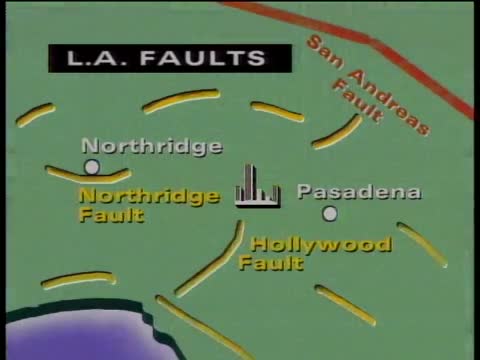
MR. KAYE: The Northridge quake, which occurred only a dozen miles from downtown LA, debunked the conventional wisdom that the fault Angelenos needed to fear most is the San Andreas Fault, California's largest, which is some 30 miles East of Los Angeles.
LUCY JONES, U.S. Geological Survey: The popular perception before the earthquake was let's worry about the San Andreas.
MR. KAYE: Lucy Jones is a seismologist with the U.S. Geological Survey.
LUCY JONES: It's quite clear that the faults we have in Los Angeles are long enough to give us even bigger earthquakes because pretty much the length of the fault gives you the size of the earthquake. The more area you have to produce energy, the more energy you produce. And we have faults long enough for probably a seven and a half in Los Angeles. The San Andreas is less than half the problem in Southern California. We have 300 faults that we know about, plus others, obviously, that we don't capable of at least magnitude sixes.
MR. KAYE: And we're seeing, what, how many earthquakes on this map over what period of time?
TOM HEATON, U.S. Geological Survey: Well, you're seeing probably over a hundred earthquakes in the last week.
MR. KAYE: Southern California's earthquakes are being closely monitored by Seismologist Tom Heaton of the U.S. Geological Survey.
TOM HEATON: The average year we recorded about 10,000 earthquakes in Southern California. The last several years it's been more like 30,000 earthquakes because of these large earthquakes. Last night, we had a magnitude 3.7 aftershock that showed up on my pager at 1 o'clock in the morning, woke me up.
MR. KAYE: But LA's earthquakes have not only increased in frequency; they've also grown in size.
LUCY JONES: In 1986, the rate at which we have earthquakes changed. And the one statistically significant part of the change is that the relative number of large to small earthquakes changed. We started having more big ones without having more small ones. We don't know exactly why but we came to the conclusion even if we don't know why, the fact is this has changed at a statistically significant level. We have to consider the new rate our rate. And the new rate implies that we have a 12 percent annual probability of magnitude sevens.
MR. KAYE: Scientists don't have to go far to examine the power of a magnitude seven earthquake. East of LA in the Mojave Desert, the Landers Fault bears the evidence of a 1992 quake which measured 7.3 on the Richter Scale Geologist Kerry Sieh of Cal-Tech has carefully studied the fault.
MR. KAYE: Where are you going up here?
KERRY SIEH, California Institute of Technology: We're going to go to the top of the scarp, which is a little cliff that formed at the time of the earthquake. So in a period of about one or two seconds, this piece of ground came from a place down about there to here building this cliff.
MR. KAYE: So if we had been standing next to each other at the time of the earthquake, we would have wound up like this after the earthquake.
KERRY SIEH: And you would have been down there about 13 feet away.
MR. KAYE: And I would be down here.
KERRY SIEH: Right.
MR. KAYE: So this is where -- this is the relationship that would have wound up after the earthquake had we been standing together.
KERRY SIEH: So if we had been face to face conducting an interview here before the earthquake, you would have in a matter of a second or two gone shooting off in that direction, and you would have dropped down about five feet.
MR. KAYE: The five feet uplift caused by the Landers earthquake is how mountains begin, a small upward movement from one earthquake, followed by hundreds of other quakes over millions of years. The numerous steep mountain ranges surrounding the LA Basin are vivid testimony to how seismically active this region is. The Landers earthquake also gave scientists an important piece of new information, one that could be troubling in terms of the LA Basin.
KERRY SIEH: We used to think, in California anyway, that if you have one fault, you then have a potential for one earthquake, the longer the fault, the more the potential for a greater earthquake. Okay. What we found in this earthquake is that not only did this fault move, this is a 25 kilometer long fault, but another fault next door, its neighbor, also moved, and another fault up on the other side of this fault also moved. So we had six major faults all about 20 kilometers long each all breaking in sequence in one big earthquake. So we found that sometimes faults link together to form a bigger earthquake.
MR. KAYE: The Landers Fault and the fault which lies underneath Northridge are related. They are both part of the San Andreas family of faults. As far as California is concerned, the San Andreas is the mother of all faults and marks the line where two of the earth's major plates which form the globe's crust come together. On the western edge of the fault is the Pacific Ocean plate. The North American plate is on the East. As these plates rub against each other, stress builds up. Every 130 years, the southern end of the San Andreas explodes in an earthquake of 8.0. Complicating the picture in Southern California is the fact that there is a severe bend in the San Andreas near Los Angeles.
LUCY JONES: Southern California has been pushed into the fault. It's been shattered, and we've got little pieces that are being shoved one by one around this corner, and it leads to the over 300 faults capable of damaging earthquakes that we have in Southern California, and it leads to a much messier situation than say what goes on in the Bay area, where you have just a few faults and you can see more clearly what's going on. Down here it's a mess.
MR. KAYE: Geologists are now hard at work trying to better understand LA's faults, digging into them to find out how often they move, like this fault near Hollywood. But some faults such as the Northridge Fault are extremely difficult to detect, because they do not come to the surface. The earthquake was the first sign there was a fault under Northridge.
ROSS STEIN: There are faults down there which we hadn't realized, and what we now have done is to look back around the world to other sites with similar conditions and see that earthquakes of magnitude seven to seven and a half occur on these blind thrust faults, and so they presumably occur here as well.
MR. KAYE: Geologists and seismologists are now seeking to share their growing knowledge about LA's faults and earthquake potential with engineers who design buildings to withstand earthquakes. A recent meeting in Pasadena brought engineers and scientists together to discuss what might happen if LA had a 7.0 earthquake. One of the frightening facts brought out of the conference, according to Tom Heaton, is that the effects of large earthquakes on buildings and other structures are not fully understood.
TOM HEATON: There's some perception that I've run into among the public that somehow we fully understand how the ground will move and how the building will respond to that. And, in fact, that's not the case. There is no such full understanding, and, in fact, I think in some cases, I think there's some misunderstanding between engineers and scientists that exists out there. And what the full implications are have yet to be determined.
MR. KAYE: What is known is that in a 7.5 earthquake the ground could move horizontally as much as 15 feet as it did in Landers, and the shaking could last 30 seconds or more. By contrast, Northridge lasted only 10 seconds with a horizontal ground movement of only two feet. But Northridge showed how destructive even a 6.7 earthquake can be when buildings are directly over an earthquake. That fact is amply demonstrated at ground zero, the campus of California's state university at Northridge. Charles Thiel is the engineer overseeing the inspection of the campus buildings damaged by the quake.
CHARLES THIEL, Cal State University: While we're on this site I want to remind you that this particular building is continuing to fall down now. Immediately after the earthquake, maybe 15 percent of it had collapsed. Now we're probably up around 50 percent or something of that order.
MR. KAYE: Was this built to code?
CHARLES THIEL: Yes. It was essentially built consistent with many of the professional practices for this type of structure.
MR. KAYE: Why did this structure suffer so greatly when others around here didn't seem to suffer this way? Was it because of the location?
CHARLES THIEL: No. It wasn't a location issue. It was not necessarily a workmanship issue. This particular style of construction has been demonstrated just not to be the equal of the kinds of ground motion, the code level of ground motions that we saw in this case.
MR. KAYE: While the sight of this collapsed garage is shocking to see, the damage did not surprise engineers. Concrete parking structures like this have long been suspect. But the Northridge quake brought to light an even larger and potentially more devastating revelation.
CHARLES THIEL: This earthquake has been really the first test in the United States of modern steel construction in a region of very strong shaking. And we've learned some things about it that indicate that steel does not perform as well, steel systems don't perform aswell as we had expected them to.
MR. KAYE: The compelling evidence for this can be found in this building, Cal State Northridge's Oviatt Library.
CHARLES THIEL: I thought this building was just fine and that we'd have to clean up the asbestos and take care of picking up the ocean of books that were on the floor and that we'd be able to re- enter it. As we discovered the condition of the building, that view has changed radically.
MR. KAYE: In the weeks following the quake and as aftershocks occurred, Thiel began to see small cracks, signs which told him there were deeper problems, structural problems. He removed interior walls, uncovering the steel beams that supported the building. What he found shocked him.
CHARLES THIEL: What we discovered was that many of the base plates were actually severed You can see that this is actually four inches of steel that has been essentially broke like the end of a paper clip. So essentially what's happened is with the crack that you see here --
MR. KAYE: Yes.
CHARLES THIEL: -- and you see exactly the same crack on the other one.
MR. KAYE: Right.
CHARLES THIEL: You essentially have severed this thing so it can rock. It'll just rock to its heart content. This is four-inch steel. And it's all high quality steel. This is not junk stuff.
MR. KAYE: The rocking of the building caused this huge bolt to bend and the concrete underneath to shred. In fact, 75 percent of the steel plates in the building failed in a major way, and the Oviatt Library was not alone. It's estimated that sixty to seven other steel-framed buildings suffered damage due to the Northridge quake. However, the extent of any damage in private buildings is unknown.
CHARLES THIEL: This is a public structure. It's owned by the public. Everything that we learn and everything that we have here is available for public examination, including by the professionals. That is not true for private structures. The only thing that's really available is what the owner chooses to allow to be discussed, and many owners would prefer not to have that information divulged.
MR. KAYE: John Hall, an engineering professor at Cal Tech, says that what happened in Northridge in a relatively small earthquake is a warning engineers should not ignore.
JOHN HALL, California Institute of Technology: In a seven plus earthquake we should -- we could see some collapses of our taller buildings. It may be one or two or maybe even three, something like that, but certainly a lot of them are going to be very severely damaged, even though they may not collapse.
MR. KAYE: What's causing this? The problem is that the welds which tie steel beams together simply are not holding up in the real world stresses of large earthquakes. This is new and disturbing information, and something that the laboratory testing of welding techniques never revealed.
CHARLES THIEL: And if there's one great message of this earthquake for the research community, it is quite simply that we have radically underinvested in research on the full scale performance of structures.
MR. KAYE: Typically, lab tests like this shake table test of a highway support are run on models which are at most 50 percent the size of the final structures. Another flaw is that the pressure applied to them usually takes place over a period much longer in duration than a real earthquake. This is because there's not enough money to do tests on full scale structures in a real life time frame. In fact, the federal government budgets only $13 million a year for earthquake lab tests.
JOHN HALL: If the government is willing to spend $10 million in - - $10 billion in relief, then it certainly makes sense to me to take a small percentage of that and devote it to research to the future earthquake.
MR. KAYE: While engineers are now hard at work trying to solve the problem of steel welds, the rebuilding effort goes on. The California Department of Transportation is almost finished rebuilding the bridges and highways damaged by the quake. It is also strengthening thousands of bridges throughout California in hopes they will be better able to withstand large earthquakes. And innovative approaches to buildings are being developed as well. LA's new emergency command center designed to organize rescue efforts during future big earthquakes is being built on large rubber pads to minimize any damage the building might experience in LA's next large earthquake hits. FOCUS - SWITCHING CHANNELS
MR. LEHRER: Now, another kind of shake-up. There were reports today that two of the nation's three major commercial television networks could be changing hands. Time-Warner is reportedly after NBC, while the Disney Company wants CBS. We have asked two reporter analysts to take us through the various possibilities. James Stewart is an editor at Smart Money Magazine and a writer for the New Yorker Magazine and of books about media and high finance. Marc Gunther covers television for the Detroit Free Press and is the author of a recent book on ABC News among other things. Let's go through these things one at a time beginning with Time-Warner. James Stewart, what would drive each of these parties to want to get together?
MR. STEWART: Well, there's no question that the entertainment industry is consolidating. We're now seeing a consolidation of the producers of programming and entertainment, the distributors, such as the networks, and then the hardware manufacturers who make the television sets. This has begun. Sony, for example, owns programmers, owns TV producers, and we're now beginning to see the distribution channels, which include cable TV and the networks, becoming a major focus of this consolidation.
MR. LEHRER: Now, Marc Gunther, that's only been possible in recent times, has it not? That used to be illegal.
MR. GUNTHER: That's right. I mean, it's a little like the old days of Hollywood when the studios at one time owned your neighborhood movie houses. The government broke that up back in the early 50's. And for really the last 20 years, the networks have been prohibited from owning much of the programming that they show. Here in Washington, the FCC has eased those rules. They're called the financial interest and syndication rules. And with the easing of those rules, for the first time it's now possible for networks and studios to combine. And that's what we're seeing.
MR. LEHRER: Now, Time-Warner, so why would Time-Warner want NBC, other than just to have a network? I mean, what's in it for them?
MR. GUNTHER: That's it. I mean, Time-Warner before this deal, or it's not really a deal yet, before these --
MR. LEHRER: Sure.
MR. GUNTHER: -- talks became known has spoken about starting its own fifth network, the Warner or WB network was going to start in network. That's a big uphill climb. They'd have to create their own distribution. They'd have to create their own programming. Here, by purchasing the NBC network, they instantly have a major platform to put all of Warner Brothers studio output onto television. The networks even in a 500-channel world that everybody sees coming are really the only way to create a hit show, to create a television star, and, therefore, they're very valuable to the studios.
MR. LEHRER: James Stewart, that's right, is it not? There have been predictions since the cable world came and the productions about 500 channels, et cetera, that the big, commercial networks' days were numbered. Not so.
MR. STEWART: Yeah. I think that's -- there clearly is going to be a continuing role for network distribution. Their share has eroded, obviously, but there is still going to be a mass market provider, and I think those will be the networks. And you see, Warner is a major producer of programming. They need every kind of outlet they can get. Cable gives them a certain percentage of the market, but to really get closed to total saturation coverage, they will need a network.
MR. LEHRER: Now, they're heavy into cable right now, are they not?
MR. STEWART: Yes. They're if not the largest one of the largest owners of cable distribution systems.
MR. LEHRER: All right, now, let's reverse it. Look at NBC. NBC is owned by General Electric. Why would they want to unload this wonderful thing called the NBC Television Network?
MR. STEWART: Well, just as you see the entertainment industry converging, you're seeing the old conglomerates divesting some of their entertainment properties. It really doesn't make sense anymore to own a stand-alone network which is trying to compete with the diversified, integrated entertainment giants. GE traditionally bought disparate industries that were leaders in their market. The market is no longer going to be networks. It's going to be larger entertainment companies, and NBC standing alone is not going to fit that definition. But it makes a lot of sense, I think, for General Electric to get rid of it.
MR. LEHRER: Do you agree with that, Marc?
MR. GUNTHER: I do, and the other thing is that GE has really not had a happy experience with its ownership of NBC. I mean, its entertainment programming was No. 1 when GE took over. It's now No. 3. There has been tremendous tumult in the NBC News division under GE's ownership. It's been a big headache for them and the network has really slid downhill since they bought it in 1986.
MR. LEHRER: All right. Are there any red lights that should be flashing for the general public on the possibility -- and that's all we're talking about at this point -- of Time-Warner buying NBC?
MR. GUNTHER: Yeah. I think there are a number of red lights. I mean, one of them is all the reasons that these companies want to get together which may make business sense may not make sense for the public.
MR. LEHRER: For instance.
MR. GUNTHER: Access to the network, which is what the studio wants. If you have a studio-network combination, all of a sudden the smaller, independent producers who want to create television programs worry that they won't be able to get their programs onto the network. Another potential problem is the opportunities that the owners seen for cross-promotion in the minds of viewers are really a potential for conflict of interest. Take the Warner movie "Natural Born Killers" that just came out. Hypothetically, had this merger taken place, it could have been reviewed by Entertainment Weekly, Oliver Stone could have gone on the Today Show. Woody Harrelson, the star, could go on the Tonight Show. It could move to HBO. It could eventually run on NBC. People Magazine could do a feature on one of the stars. All those would be owned by the same company, and that doesn't make for a kind of vigorous criticism in journalism.
MR. LEHRER: Do you agree, James Stewart?
MR. STEWART: Well, I think the danger here is a diminishment of competition. And that's going to need some scrutiny I think, probably by the regulatory --
MR. LEHRER: By whom? By whom?
MR. STEWART: By the Justice Department and Federal Trade Commission looking at the effect on competition. Now, I'm not saying it will go down.
MR. LEHRER: Sure.
MR. STEWART: The danger is that the programmers can force their product onto their own captive distribution channels, which means there won't be real competition to get it on there. Now, columnists will argue that that isn't necessarily going to happen. Let's say Disney produces The Lion King. Nobody in their right mind is not going to want to air a show of that quality. But what about the scores of other movies Disney makes that we've never heard of and that weren't particularly great successes? That's the kind of stuff that could then dominate a network or distribution channels that would be owned by Disney.
MR. LEHRER: Now, speaking of Disney, it's -- here again we're still talking about reports that haven't been confirmed by anybody but that Disney's interest not only in CBS but there's in a report today that they've even expressed an interest in going after NBC and possibly even ABC. Now, is it the same rules apply for Disney as they do for Time-Warner?
MR. STEWART: Yes, very similar. I mean, Disney is obviously a major -- at the moment almost exclusively a producer of programming. It is not now diversified the way Time-Warner is, and it has overtly said that it did not want to pursue this course. But there's certainly the thinking now, and it'll be years before that we really know if this is right, is that this strategy is not going to prevail in the entertainment industry. So for Disney, if they need a network, it doesn't really matter which one, they just want one of them, and it makes sense that they would see which one can they get at the best price.
MR. LEHRER: Sure. But, Marc, I thought Disney -- of course, Disney already has a Disney Channel, and they were thinking about starting their own cable network, or cable channel, were they not?
MR. GUNTHER: They have the Disney Channel, which runs on cable, local cable systems all across the country, but the problem is --
MR. LEHRER: Yeah, but I meant kind of a full service network in addition to the Disney Channel, that they were thinking about that.
MR. GUNTHER: I'm not aware that that would go forward, but Disney makes programs like Home Improvement, the No. 1 show on television. And the Disney Channel does not have the reach or the impact that can create a hit show. It can't make a star. A network is really the only place to do that. And the networks are really the outlets that give value to these programs. When Home Improvement or Roseanne or the Cosby Show are sold in syndication, reaping literally hundreds of millions of dollars of revenue, that's because they became so successful and so popular on the networks. And the studios want the chance to expose their product to those huge audiences.
MR. LEHRER: You see the same red lights for this deal as you would for the other?
MR. GUNTHER: You know, not so much because Disney is pretty much purely an entertainment company and they're buying an outlet for their programming. There is the issue of fair access to the network. But with Time-Warner and NBC, you're talking about companies that already blend, you know, huge journalistic organizations with big entertainment organizations. I could see with the pressure created by the -- the debt created by that merger a thinking at the top corporate levels achieved. Do we really need a Time person and an NBC person in Beijing? Do we really need them both in South Africa? Maybe we could consolidate there. I think with the journalistic organizations there's a bit more concern. Time also owns a big stake in CNN. So you really would see a lessening of journalistic competition.
MR. LEHRER: James Stewart, all three of us, in fact, are journalists, but what do you think about what these kinds of deals that they go through, does it -- is there anything that anybody should be concerned about as far as journalism?
MR. STEWART: It's very hard to say. I mean, I think journalism remains -- we live it every day -- a very competitive field in which people are racing to get the exclusive access. And journalism is not just TV. It's splintering into all kinds of electronic delivery, real time delivery, newspapers and print. I think there's still a lot of healthy competition there. One thing I said that could be good about this is that GE is, as I think was mentioned earlier, GE and Larry Tisch have not been great stewards of these networks. They've treated them as cash cows. They have not plowed a great deal of investment. GE has let NBC go from No. 1 to No. 3. If they're in the hands of vigorous, competitive entertainment companies, we might actually see some more competition and better management of these assets.
MR. LEHRER: What about those who say, wait a minute, this is going to mean that entertainment and news, the differences between entertainment and news are going to be more and more obscured?
MR. STEWART: Well, you know, let's face it. The lines between entertainment and news have been blurring for years now. I mean, they're already blurring on the networks under their current ownership, and we can all sit around and bemoan the loss of church and state there, but there's obviously a market and an appetite for that sort of thing.
MR. LEHRER: And there are, obviously, Marc, there is a market and an appetite for this very thing in terms of CBS, Disney, Time- Warner, and NBC. That is where it's going to go, right? I mean, these big companies are going to get together and do it all.
MR. GUNTHER: I think it's clear that whether or not these particular deals go through or not, and the statements out of NBC today, for example, were that, you know, some of the speculation is premature, that deals like these will go through, and really the model is Fox. Rupert Murdoch owns the Fox Network. He owns 20th Century Fox. They make TV programs. They make movies. He owns newspapers and magazines. And he really was the pioneer in this kind of vertical integration that we're seeing now.
MR. LEHRER: And that is -- that cannot be stopped and it doesn't, so we might as well not worry about it, right?
MR. GUNTHER: Well, I don't know if it can't be stopped, but it's certainly something I think that consumers of news and entertainment ought to keep an eye on, you know, who owns these big companies that are providing them with that information.
MR. LEHRER: Jim Stewart, do you agree that it's inevitable that this is going to happen, that one -- even if these deals don't go through, others like them will?
MR. STEWART: I do agree with that in the near-term, but in the long-term, you know, the jury is out on this. In the 60's, everybody thought conglomerates were a brilliant idea, and everybody moved, and we got a lot of conglomerates, and all the conglomerates have been undone now. I think it will remain to be seen whether vertical integration yields the profits and the quality that its opponents think that it will. There is a danger that if they start forcing bad programs onto the networks, they're going to be vulnerable, and some of these things will in years to come be undone.
MR. LEHRER: But don't they have -- who would have the ability to compete against them, Jim?
MR. STEWART: Well, they do have their other giant rivals who have rival networks, and as Fox has shown, if the networks become too fat and complacent, there is still the opportunity to forge new networks. It's difficult, but it's been proven it can be done.
MR. LEHRER: Okay. Jim Stewart, Marc Gunther, thank you very much. ESSAY - A SENSE OF GRACE
MS. FARNSWORTH: Finally tonight, essayist Richard Rodriguez, editor of the Pacific News Service, contemplates the closing of a church.
RICHARD RODRIGUEZ, Pacific News Service: For over a century, All Hallows Catholic Church has stood on its hill in San Francisco. Such a plain, old building it is, like thousands of 19th century churches all across America. Architectural historians call the style "Carpenter Gothic." Last year, the Catholic archbishop of San Francisco announced the closure of 11 churches all around the city. Reasons for the closing vary. According to Church officials, it was too expensive to make some churches earthquake safe, or it was a case of the grandchildren of the original immigrant founders moving off to the suburbs. One official claimed that All Hallows Church was no longer a viable parish. A few weeks ago, I received a letter from a woman who attended All Hallows Church. She wrote, "I would be extremely gratified if you would come to our last Sunday Mass." "The reason I am forced to write to you," she said, "is because we face a gaping need. We need to believe that we still matter." That last Sunday Mass at All Hallows is preserved now on homemade videotape. You can see what it was like: the crowded pews, that warm summer morning, the knowing faces of the old, the screaming babies. The entire parish had gathered one, last time for a Mass that went on with tears and much music for over two hours. All Hallows was constructed in 1886, with dollars earned by working class people. Generations tended this church, painted and repainted it, warmed it in winter, lit candles, and sang hymns, and took Communion, and found the meaning for their lives. Finally, however, legal title to the building belongs to the archbishop. It was his decision alone to lock the doors. All Hallows, perched on its hill, saw generations pass beneath it. The founding neighborhood was predominantly Irish. There are still white families on these blocks. The nearby shipyard brought African- Americans to this section of San Francisco during the war. Today there is a growing Hispanic population, mostly Central American. And increasing numbers of the neighbors are Samoans and Tongans - - "Pacific Islanders" they are called by government bureaucrats. People in universities go on and on about multiculturalism. People in neighborhoods like this one live multiculturalism. On that last Sunday, in this small church, white and black worshipped together. The singing was in Spanish and in Samoan. Huge Samoan men in ceremonial skirts sang like cherubs. Ideas about God do not create religion. Religion does not exist in the solitude of the theologian's mind or in the philosopher's high tower. Religion comes into being when people gather together, whether in a mosque or a temple or a church, when people gather together to share their beliefs and to worship. Religion creates community. Religion requires community. Religion is a public thing, a neighborhood event over time. In a neighborhood that many San Franciscans today regard as dangerous and violent, in a neighborhood recently famous as the growing up place of O.J. Simpson, All Hallows Church was a place where people met. Years ago, when I was an altar boy, I served at hundreds of Masses. I saw more weddings and funerals in a year than baseball games. I grew up with the ritual rhythms of sorrow and joy. At a Catholic funeral, there comes a moment just after the Communion, when the undertakers approach the altar. Suddenly, the Mass is coming to a close. Suddenly, mourners anticipate the journey to the cemetery. All the preparation, all that stands between life and death, the wake, the meals with visiting relatives, the funeral Mass, all that keeps mourners from bidding their last good-bye is over. At All Hallows that last Sunday, just after Communion, the altar servers started extinguishing the candles. The altar was stripped of its starched, white cloth. From the back of the church came an Irish bagpiper. He circled the congregation of Samoans and Nicaraguans, grandmothers and babies, all the while playing "Amazing Grace." A church exists to see us through the seasons of our lives. Babies are baptized. Children take their first Holy Communion. Teenagers are confirmed. Young people get married. The old are buried. Fall, spring, Christmas, Easter, we expect a church to last forever, to see us through our comings and goings. We do not expect to witness a funeral for a church. When the Mass was finally over at All Hallows, even before we left the building, the lights were extinguished. I'm Richard Rodriguez. RECAP
MR. LEHRER: Again, the major stories of this Thursday, U.S. and Cuban officials began talks about the Cuban refugees coming to the United States. Seven hundred more Cubans were rescued at sea today. And the government of Zaire said it wanted its 1.2 million Rwandan refugees to return home by the end of this month. Good night, Elizabeth.
MS. FARNSWORTH: Good night, Jim. That's the NewsHour for tonight. We'll be back tomorrow. I'm Elizabeth Farnsworth. Good night.
- Series
- The MacNeil/Lehrer NewsHour
- Producing Organization
- NewsHour Productions
- Contributing Organization
- NewsHour Productions (Washington, District of Columbia)
- AAPB ID
- cpb-aacip/507-bg2h708r0s
If you have more information about this item than what is given here, or if you have concerns about this record, we want to know! Contact us, indicating the AAPB ID (cpb-aacip/507-bg2h708r0s).
- Description
- Episode Description
- This episode's headline: Safe to Return?; Earthshaking News; Switching Channels; A Sense of Grace. The guests include JACK BODE, International Rescue Committee; C. PAYNE LUCAS, Africare; GEORGE MOOSE, Assistant Secretary of State; JAMES B. STEWART, The New Yorker; MARC GUNTHER, Detroit Free Press; CORRESPONDENTS: JEFFREY KAYE; RICHARD RODRIGUEZ. Byline: In New York: ELIZABETH FARNSWORTH; In Washington: JAMES LEHRER
- Date
- 1994-09-01
- Asset type
- Episode
- Rights
- Copyright NewsHour Productions, LLC. Licensed under a Creative Commons Attribution-NonCommercial-NoDerivatives 4.0 International Public License (https://creativecommons.org/licenses/by-nc-nd/4.0/legalcode)
- Media type
- Moving Image
- Duration
- 00:59:44
- Credits
-
-
Producing Organization:
NewsHour Productions
- AAPB Contributor Holdings
-
NewsHour Productions
Identifier: 5045 (Show Code)
Format: Betacam
Generation: Master
Duration: 1:00:00;00
If you have a copy of this asset and would like us to add it to our catalog, please contact us.
- Citations
- Chicago: “The MacNeil/Lehrer NewsHour,” 1994-09-01, NewsHour Productions, American Archive of Public Broadcasting (GBH and the Library of Congress), Boston, MA and Washington, DC, accessed May 15, 2026, http://americanarchive.org/catalog/cpb-aacip-507-bg2h708r0s.
- MLA: “The MacNeil/Lehrer NewsHour.” 1994-09-01. NewsHour Productions, American Archive of Public Broadcasting (GBH and the Library of Congress), Boston, MA and Washington, DC. Web. May 15, 2026. <http://americanarchive.org/catalog/cpb-aacip-507-bg2h708r0s>.
- APA: The MacNeil/Lehrer NewsHour. Boston, MA: NewsHour Productions, American Archive of Public Broadcasting (GBH and the Library of Congress), Boston, MA and Washington, DC. Retrieved from http://americanarchive.org/catalog/cpb-aacip-507-bg2h708r0s