The MacNeil/Lehrer NewsHour
- Transcript
MR. MacNeil: Good evening. Leading the news this Friday, President Bush deplores the persecution in China, but does not plan further sanctions. Some Iran-Contra charges against John Poindexter will be dropped. Consumer prices rose sharply in May. We'll have details in our News Summary in a moment. Jim.
MR. LEHRER: After the News Summary, we have excerpts from today's hearings on abuses in federal housing programs, our regular Friday night chat with David Gergen and Mark Shields is next, then a report on an enormous event in Hungary, recollections of the worst under Joseph Stalin, and an Amei Wallach essay about the art of a man named Goya. NEWS SUMMARY
MR. MacNeil: The White House said today that Pres. Bush deplores the persecution of Chinese democracy demonstrators in China, but has no plans for more sanctions. Spokesman Marlin Fitzwater said the President will continue to review the situation. He said the best hope for stability in China was dialogue and reform rather than arrests and show trials. In China, nearly 100 more people were arrested today for taking part in pro democracy contests and the government stepped up its propaganda campaign. We have a report from Beijing by Jeremy Thompson of Independent Television News.
JEREMY THOMPSON, ITN: Two weeks ago Tiananmen Square was filled with cries for freedom. Today this vast empty expanse echoed with the stamp of repression. It's been sealed to everyone but the army since the killings. Today they made an exception. Under martial law, foreign correspondents have been harassed, arrested and expelled for trying to report the truth. Today we were invited into the Great Hall of the People to meet the men who ordered that treatment. An array of army top brass warmly welcomed us, then immediately accused the foreign media of distorting the facts. The tone was set. Col. Li Juyung kindly informed us he would now explain the real truth about the army's actions in Tiananmen Square. Eye witnesses had described the ending of the student occupation as a massacre. Through his interpreter, Col. Li gave us a very different version.
COL. LI: [Through Interpreter] In the process of clearing up the Tiananmen Square, I can say we never beaten up to death of a student or a young man on spot. There is no such a thing as the bloodshed on the Tiananmen Square.
MR. THOMPSON: At first, Col. Li claimed the troops had only fired into the air to teach people a lesson. But as it became obvious that most correspondents had witnessed the events of June the 4th, Col. Li altered his story, admitting that soldiers had shot directly at Beijing citizens. Tiananmen is the country's symbolic heart, the centerpiece of Chinese Communism. Those in power are terrified of it becoming a memorial to martyrs who died fighting for democracy. Twelve days ago, the soldiers had come with tanks. Today they came with turf, replacing the gardens trampled and burned during the last moments of the student protest. They were cleaning up the square, scraping away the past, and sanitizing history.
MR. MacNeil: The U.S. embassy in Beijing advised American businessmen to stay out of China at present. While the Communist authorities saturated the media with assurances of stability, embassy officials said that with armed troops about, there was danger for foreigners of being caught in the wrong place. Wire services are reporting that more Chinese diplomats in the United States have defected, and others are seeking asylum in Canada, but neither government will release their names for fear of reprisals against their families in China. Jim.
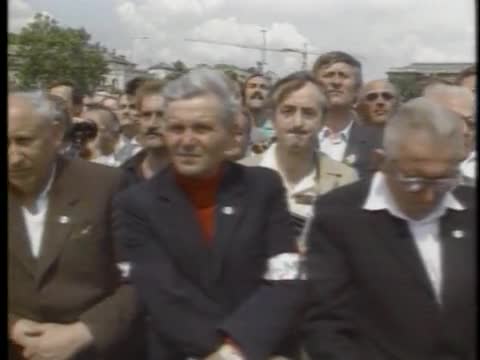
MR. LEHRER: The leader of the Hungarian Revolution was honored today in Budapest. Imre Nagy and four colleagues were praised in an ceremony at Heroes Square. An estimated 1/4 million people attended the event, which was seen as a major symbolic step of change for the Communist Government of Hungary. Nagy and the others were executed for their part in the 1956 uprising against the government. Their remains were dumped into unmarked graves. Today they were reburied in marked graves on the same spot.
MR. MacNeil: Lawyers said today they planned to subpoena Pres. Bush and former Pres. Reagan for the Iran-Contra trial of Adm. John Poindexter. Attorney Richard Beckler sid the former national security adviser had substantial contact with both individuals during the events outlined in the indictment. But special prosecutor Lawrence Walsh said he will abandon parts of the case to avoid the problems of access to secret documents that plagued the trial of Oliver North. And his assistant, Christian Mixler, said that after the charges are narrowed, there would be no reason to involve Bush or Reagan.
MR. LEHRER: There was more word today about the growing scandal at HUD, the Department of Housing and Urban Development. The HUD inspector general and a private escrow agent testified before a House of Representatives hearing. The agent, Marilyn Harrell, has admitted she kept as much as $5.5 million of HUD money. She admitted that was a sin, but said she donated most of it to help provide housing for the poor. Inspector Gen. Paul Adams said such theft was made possible by poor accountability systems at HUD.
PAUL ADAMS, HUD Inspector General: The best we can determine at this time is that the department or at least some of its offices had such poor record keeping systems that they either did not have a good inventory of the units assigned to a particular closing agent or had not performed a reconciliation which would detect the non-transmittal of the proceeds.
MR. LEHRER: We will have a longer excerpt from today's hearings after the News Summary.
MR. MacNeil: In economic news, consumer prices rose sharply in May by .6 percent, almost as steep as the .7 percent increase in April. That means that during the first five months of the year, inflation rose at an annual rate of 6.7 percent, compared with 4.4 percent the last two years. The White House called the May figures disappointing. The Commerce Department also reported that new housing construction fell 2.1 percent in May to the lowest monthly rate since the end of the last recession in 1982.
MR. LEHRER: There was a development today in the big Time Incorporated buyout story. Time announced it had rejected the offer of Paramount Communications for the company and, instead, Time was going ahead with its plan to buy out and thus merge with Warner Communications. Paramount said it would proceed with its unwanted offer anyhow and Time filed a lawsuit aimed at blocking Paramount from doing that. There are still many more rounds to go before this strike is finally settled.
MR. MacNeil: A coal miner's strike that began Monday spread today. Coal miners in Pennsylvania and Kentucky joined striking miners in West Virginia and Indiana, bringing the total number of strikers to more than 10,000. That amounts to about 7 percent of the work force. They're all striking to express sympathy with another group of coal miners who have been on strike since April against the Pittston Coal Group, which has coal mines in Virginia and West Virginia.
MR. LEHRER: And that's it for the News Summary. Now it's on to the HUD hearings, Gergen & Shields, a special day in Hungary, life under Stalin, and an Amei Wallach essay. FOCUS - BUILDING SCANDAL
MR. MacNeil: We turn first tonight to the widening money scandal at the Department of Housing & Urban Development. As we reported, the Department's inspector general told a House subcommittee that HUD did not have proper control over money from property sales and upwards of $20 million is unaccounted for. These revelations are the latest twists in an ongoing saga of allegations of abuse and wrongdoing at the Department during the Reagan years. Kwame Holman reports on today's hearings before a government operations subcommittee chaired by California Democrat Tom Lantos.
REP. TOM LANTOS, [D] California: It is not at all difficult to understand how this program should operate. When a homeowner defaults on an FHA insured loan, the bank forecloses and seeks payment from HUD for the outstanding mortgage balance. HUD pays off the bank and then HUD sells the property. A private escrow agent under contract with HUD is present at the closing and he or she is required to promptly send the proceeds from the sale together with the settlement papers to HUD.
KWAME HOLMAN: That was the way the sale of HUD foreclosed properties was supposed to work, but this afternoon, Marilyn Harrell, a former Maryland closing agent hired by HUD, repeated her public admission that she kept some $5 1/2 million of HUD funds, but turned much of it over charity.
MARILYN HARRELL, Former HUD Closing Agent: I kept a modest salary, which allowed me to pay past debts, meet my monthly obligations, and care for my son and those that came to live with us. What was spent over and above what we needed to run the company was directed legitimately to help the poor and homeless and assist those ministries that did the same. I in no way justify what I have done as being anything less than sin. I have come forward as one who loves the Lord in an attempt to confess to the world that I am a sinner and I'm sorry that I diverted government funds. I'm prepared to give everything that I have or will ever have to restore to the government that which was taken.
REP. LANTOS: Initially something must have given you the idea that HUD is so disorganized and is so unable to exercise proper controls that you undertook the first diversion of funds. What made you have such a very low opinion of controls at HUD?
MARILYN HARRELL: Well, for one thing the very lowest people on the employment spectrum were those that were in control of inputting the computer work that was actually the accounting process. These were clerical people that probably were the lowest paid there.
REP. LANTOS: And you felt that there were no controls of any kind that could have made this scheme obvious to higher ups at HUD?
MARILYN HARRELL: Not really.
REP. CHRISTOPHER SHAYS, [R] Connecticut: From the hearings that we've had, which you haven't necessarily been paying any attention to, it's very clear to me we were talking about political appointees and I was very comfortable in saying the career employees shouldn't take any wrap here. We're talking about political employees. And what's kind of sad about this for me is that there are going to be a number of career employees who clearly are going to lose their job and I don't know if they would end up going to jail or not, but you've brought a whole different focus. It's the career employees now that are going to be taken a look at.
REP. LANTOS: What was the first transaction that you recall where you diverted funds?
MARILYN HARRELL: Well, I had done a closing where no one had asked where the proceeds were and it had gone for a couple of months. In fact, I think it went over eight months before anyone asked where the proceeds were for this particular case, and I felt that the government isn't personal, if you'll forgive me for saying so, that if I have to hurt someone because of an error, I prefer that it be the government rather than a private individual, and at that point I accepted -- Mr Frank, I'm sorry, but I mean, these are people, these are real people, and I figured the government could far better afford it than an individual could, so, you know, perhaps it was poor judgment on my part, but I wasn't given an alternative.
REP. LANTOS: Well, you know it was poor judgment on your part, don't you?
MARILYN HARRELL: Of course.
REP. LANTOS: Of course you do.
REP. BARNEY FRANK, [D] Massachusetts: I want to ask you, how did HUD finally find out about this?
MARILYN HARRELL: Well, in late September there was a large --
REP. FRANK: Of 1988.
MARILYN HARRELL: 1988 -- there were a large number of properties that I could not account for the proceeds on, and as a consequence, they began to question.
REP. FRANK: So this began in 1986?
MARILYN HARRELL: '85.
REP. FRANK: And from July of '85 to September of 1988, nobody had noticed anything?
MARILYN HARRELL: That's correct.
REP. FRANK: And then in September of 1988, HUD was expecting some money and it wasn't forthcoming, and they then did what --
MARILYN HARRELL: Extended my contract for two months.
REP. FRANK: Oh, I see. Because you hadn't given them the money they expected, they extended your contract. Your eight amendment rights against cruel and unusual punishment may be in jeopardy here more than your fifth amendment rights. Having come down so hard on you with a two month extension of your contract -- that was a contract you had asked to terminate?
MARILYN HARRELL: That's correct.
REP. FRANK: So you said, I want my contract terminated. HUD said no, there's something fishy going on here, you'd better keep doing it for two more months. What then happened?
MARILYN HARRELL: Well, at the end of that time, right at the end of that time --
REP. FRANK: At the end of two months?
MARILYN HARRELL: Yes. At the end of the two months, the first part of December, obviously they knew that there was a problem.
REP. SCHUMER: Before you spoke, the inspector general said that at maximum, he thought $20 million was stolen in this way, and yet, the figure that's been bandied about for your theft is $5.5 million. So if others could steal more, and there are other people involved, we may really have a scandal that goes into the tens of millions and even hundreds of millions of dollars, is that --
MARILYN HARRELL: It's certainly feasible.
REP. FRANK: HUD inspector general Paul Adams brought this case and those of two other closing agents to the forefront, but Adams found himself being criticized by committee members for not moving faster to report the missing foreclosure funds. He also was under attack for an earlier contract steering investigation that failed to focus on former HUD Secretary Samuel Pierce and his executive assistant Deborah Gorr Dean.
REP. CHRISTOPHER SHAYS, [R] Connecticut: I would like to know the records of Sec. Samuel Pierce were not subpoenaed.
PAUL ADAMS, HUD Inspector General: As I mentioned earlier, Mr. Shays, that investigation we were doing was conducted with the guidance from the public integrity section of the Department of Justice. At no place during the course of the investigation did our auditors or investigators or the public integrity section ever suggest that was needed and so there was no subpoenaship for his records, sir. There was no evidence in any other records that we looked at that any moneys had passed to him or there was never any suggestion that money had passed to him and, therefore, we did not perceive a need to.
MR. HOLMAN: Meanwhile, the committee will continue its investigation while U.S. Attorney General Richard Thornburgh has ordered audits of all HUD property sales. FOCUS - GERGEN & SHIELDS
MR. LEHRER: Now, Gergen & Shields. Our regular Friday night analysis team of David Gergen, Editor at Large of U.S. News & World Report, Syndicated Columnist for the Washington Post. Mark, how big a deal is this HUD scandal?
MARK SHIELDS, Washington Post: Big. Big and it's going to get bigger and it hurts the Republics, quite frankly, in a way that they least can afford it. It's a combination of venality and incompetence that has emerged thus far, but what it appears to be, the Republicans have been troubled for a long time by the nagging public perception they had a party that's indifferent to the plight of ordinary people and in favor of the privileged few. What we have here is the re-emergence of James Watt, most Republicans like to forget, and the big payoffs at the expense of a program to help ordinary and poor people.
MR. LEHRER: That of course was not the issue on this particular hearing, but it was last week's hearing.
MR. SHIELDS: But I mean the HUD scandal. I'm talking about the HUD scandal.
MR. LEHRER: No. I'm just wondering, people may not be familiar with it.
MR. SHIELDS: This aspect of it I think is really a side show, not a side show, but it's a diversion. It's something to get public attention. It's an indication of the incompetence of it. The venality is the payoffs, at least in the defense contractors, people going to be consultants from the Defense Department. There was the perception they knew something about the program, Jim. In the case so far you've got Jim Watt who said he never saw a housing project, knew nothing about it, wasn't interested in it, had never gone to see it afterwards, and so you get the sense of it is a blatant bit of influence peddling.
MR. LEHRER: Certainly used himself, in fact. He said he was guilty of that.
MR. SHIELDS: Yeah.
MR. LEHRER: If he was accusing a Democrat, that's what he'd say it was. David, what's your view?
DAVID GERGEN, U.S. News & World Report: I have a somewhat different view. Jack Kemp has said -- he's the new Secretary at HUD, of course, that he's inherited the swamp. That's exactly what he's got. But I think we have to distinguish between the two kinds of actions we've been describing over the last two weeks. On one hand, we have what was described tonight which appears to be clear embezzlement and embezzlement is against the law, and I think that's the scandal. There are also apparently some sweetheart contracts. Whether they violated the law or not yet we don't know.
MR. LEHRER: There's nothing suggested on the -- let's make that very clear -- on the Jim Watt thing that he did anything illegal at all.
MR. GERGEN: That's exactly right. The violations of the law appear to be these "Robin HUDs", as they're called now, people, escrow agents, who took money and siphoned it off to their own means or to poor people or whatever, we don't know yet. That's what you had on tonight. That's what's illegal. Jim Watt and these Republican consultants, no one has accused them yet of violating the law, and I think it's very improper to say that's a scandal.
MR. SHIELDS: I don't think -- it's a political scandal. For eight years, Ronald Reagan was dedicated to the elimination, the curtailment of federal involvement of housing for the poor. This was a straight grab for fees and payoffs and sweetheart deals to those who had political connections, to people who had no interest in housing, no interest in poor people, and I think in that sense, it has all the makings of a political scandal. What you're also going to do is sacrifice potentially the most attractive and I think potentially popular cabinet officer, Jack Kemp. He's not going to be fighting for the homeless. Jack Kemp is going to be fighting to put out a scandal, correct a scandal, correct wrongdoing that's gone in the department before he got there.
MR. LEHRER: He didn't get points for doing that?
MR. SHIELDS: No, not publicly.
MR. GERGEN: I disagree with that. In the first place again, the facts are not in on Jim Watt yet. We haven't had a full investigation which everyone -- I don't think it's fair to the man or other Republicans at this point to label them, say this is a scandal and to slap them with the same brush, we've seen unclear violations of the law. That's point one. Secondly, what I do think, this is going to divert Jack Kemp's attention from a more positive program to do something, a conservative revolution to help the poor. I do think that if Jack Kemp and Dick Thornburgh, the Attorney General, can lead a very aggressive investigation, that can help Kemp and Thornburgh, and it also may soften the blow against Republicans. I don't think there's any doubt that because the Republican administration -- this happened during a Republican administration -- it's going to hurt the Republican party -- but I think if they move smoothly, aggressively, Thornburgh after all yesterday ordered all 94 U.S. Attorneys to investigate these possible embezzlements by escrow agents, and I think that's exactly the thing they need to do. They need to be tough as nails.
MR. LEHRER: Are they up a little bit of a creek though because it was the Reagan administration, how far they can go?
MR. GERGEN: I don't think there's any question it's going to hurt Republicans, but I think they can minimize the damage. I would also argue that -- I think it's very very doubtful that it will hurt the President in this case. I think there's no indication that he or any of his people had anything to do with it. I think it's a party problem. I also think the larger point is, it's going to deepen the suspicion we felt all year. People think Washington is so mismanaged, there's corruption, they can't manage the money and people are going to say why turn things over to this government. Everybody --
MR. LEHRER: In other words, everybody's got it?
MR. GERGEN: Everybody's at the trough.
MR. LEHRER: Yeah. Look, speaking of the President, clean air, his bill this week, how's that sailing, Mark? What do you think about that idea?
MR. SHIELDS: I think George Bush made a big positive move this week in correcting what has been a nagging problem for him. Of all the score cards that Pres. Bush has received, the one area where he has received consistently negative marks has been his handling of the environment. That's I think mostly traceable to the Exxon Valdez and the perceived slowness and lack of forcefulness with which the administration moved. This is a grab and a move that set daylight between himself and the Reagan years, which he did. I thought rather --
MR. LEHRER: On acid rain.
MR. SHIELDS: On acid rain and the whole area of clean air. Plus he did something that Republicans haven't done for a long time. He talked about government programs that have worked, he talked about the success of the clean air program, and I guess the third thing I would say is that this is a question whether George Bush is going to bring, as he did on the S&L thing last night in the House vote, whether he's going to bring his party with him, because it's an issue on which Democrats have enjoyed an edge with voters on being the party that's better to do it. George Bush --
MR. LEHRER: During the campaign, he kind of took that away from Dukakis.
MR. SHIELDS: He did, but Dukakis carried the environmental states, if you remember, Washington State --
MR. GERGEN: I'm glad you didn't have five points, but in any event, the environmental is the fastest growing movement in Western Europe, and I think it's rapidly growing in the United States. It could be the big issue of the 1990s. I think Bush very smartly now has moved in front of that curve. He could easily steal that because he's now got a Bush bill out there, we don't have a Mitchell bill, we don't have a Democratic bill; we have a Bush bill on clean air. I think that was smart politics and the bill itself is also very well crafted because he's got many of the environmental groups that think it's a good idea to pass it and yet industry also is willing to go along. That was a trick they had to do. They had to balance it so they didn't have industry totally opposed. They thought they couldn't get enough votes, including Democratic, if they didn't have industry go along.
MR. LEHRER: Mark mentioned savings & loan. That's a Bush bill too that's going through there.
MR. GERGEN: I would argue, you know, we went through weeks agreeing that Bush was in a hole and was off to a slow start. It seems to me in the last four weeks, particularly since he went to Europe, he's been on a roll, he's begun to find his bearings. I think he's become a stronger President. Somehow Europe almost liberated him to a degree from a cautious past.
MR. LEHRER: From the Gorbachev shadow?
MR. GERGEN: I think -- and from the Reagan shadow.
MR. LEHRER: The Reagan shadow.
MR. GERGEN: And he's had the NATO trip. He handled China rather well. He got points for that from the public. He's handled the environment rather well. He had a good week this week on the S&Ls. His Gallup poll rating now is up this week to 70 percent. It's up 14 points.
MR. LEHRER: Approval rating.
MR. GERGEN: Approval rating is up 14 points over what it was this year. Highest he's had this year.
MR. LEHRER: But yet he vetoed the minimum wage and it looks like he's going to get away with it, right, Mark?
MR. SHIELDS: I don't know if he will get away with it. I think that it happened at a week when the Democrats and the House were going through a change in command with elections for the new Majority Leader. I still think it's a marvelous issue to be joined with the attempt as put by Senate Majority Leader George Mitchell, that eliminating $12 a week increase, 30 cents an hour, $12 a week for the poor working Americans -- these aren't ne'er do wells, these aren't people who are sitting there collecting federal checks. These are people who are working 40 hours every week, and at the same time, over three years, and at the same time in the next year wanting to give $30,000 to the top 1 percent of Americans with the capital gains tax. In that contrast, and I think if it's joined that way, that could be a very tough issue for George Bush to handle.
MR. GERGEN: I agree with that, Mark. But it seems to me that the Democrats may back down a bit and may not push the issue as much as we thought they originally would. I agree, I thought it worked against Bush, but he vetoed it so swiftly and the Democrats are backing away from it, that it may not hurt him as much as I thought. What we're really seeing, Jim, in my view is a strengthened Bush presidency and Congress still reeling from the events in the past few weeks, the resignations and that sort -- not quite there yet, and a weaker Congress so that Bush is getting the upper hand in a lot of these fights.
MR. LEHRER: Whatabout the new Democratic leadership, what's your assessment of that as far as grade?
MR. GERGEN: I think they have first rate leadership now. I think it's going to be stronger than the leadership they had in the past. They're certainly going to be more united and they seem to want to get this group moving. Gephardt spoke very eloquently I thought about that point, let's get put the problems of the past behind us and let's get on with the country's business. I think a lot of Republicans would welcome that. I'm sure Bush would. I think with Foley, Tom Foley and Richard Gephardt, and Bill Gray, that's a very strong team.
MR. SHIELDS: I would agree with that. Last night on the floor when the House was debating the savings and loan, there was a air of good feeling. I'm not saying there was a bad feeling when Jim Wright was there, but there really as, there was joking, there was a joculary, kind of a good natured feeling among Democrats and across the oil. And I think that's Tom Foley, a reflection of Tom Foley.
MR. LEHRER: Who plays -- which one of those three Democrats plays the bad guy? Somebody's got to be a bad guy in this, don't they?
MR. SHIELDS: I think you're absolutely right. Whether it's a bad guy --
MR. LEHRER: You know what I mean.
MR. SHIELDS: But the guy who's going to provide the visceral --
MR. LEHRER: The Tony Coelho before.
MR. SHIELDS: Exactly. And I think it has to be even though he's an Eagle Scout by choice and inclination, it has to be Dick Gephardt, the Majority Leader from St. Louis who ran for President, who articulated I think some issues and understood them and advocated positions.
MR. GERGEN: Bill Gray wields a pretty good knife but I do agree it's Gephardt and Gephardt's a man with ideas too, and that's a very powerful force in the House.
MR. LEHRER: Gentlemen, thank you.
MR. MacNeil: Still to come on the Newshour a dramatic turn in Hungary, nightmares from Stalin's Russia, and the art of Goya. FOCUS - RESURRECTING THE PAST
MR. MacNeil: One of the most remarkable changes in the Communist world has been unfolding in Hungary. As we reported in two recent documentaries, Hungary's Communist government is permitting both political opposition and elements of a free market economy, but today there was a symbolic event that stirred the hearts of millions of Hungarians, the official rehabilitation of Imre Nagy; Nagy was the prime minister executed by hanging for his part in the 1956 uprising against the Soviet Union. Thirty years later he is a hero. Gaby Rado of Britain's Independent Television News reports on the extraordinary scenes in Budapest today.
GABY RADO, ITN: The show of public mourning couldn't have had a more grandiose setting, Budapest's monumental Heroes square dedicated to the nation's founding fathers. On the steps of an austere building to one side, lay six coffins, those of Imre Nagy and four of his closest colleagues and above them a symbolic empty coffin for the many thousands of others who died. Throughout the morning a non-stop procession of ordinary people placed flowers and wreaths beneath the coffins. Among those paying silent tribute was Imre Nagy's daughter and the widow of his young defense minister, Pal Malitar. At 12:30, bells rang throughout Hungary, followed by the voice of Imre Nagy, an excerpt from one of his last radio broadcasts. Later one of the speakers, an old freedom fighter, delivered the most stinging attack on the Soviet Union ever heard in Hungary.
SANDOR RACZ, President, 1956 Workers Council: [Through Interpreter] The heaviest burden we have to bear is the presence of Soviet troops on our soil. These coffins here today are the result of their actions. As is the continuing bitterness of our daily life.
GABY RADO, ITN: The mood here is more than that of a national day of mourning. There's a feeling that history today is being rewritten and that finally the truth can be spoken openly about the men who were officially branded traitors and about the events which led to their execution. 1956 still ranks in history as the most violent outburst of popular anger against a Communist regime. The rebels fought with captured weapons until sections of the Hungarian army came over to their side and for a few days they appeared to have won as the Soviet troops withdrew from the country. Imre Nagy was asked to lead the short-lived government. He declared Hungary's intention of leaving the Warsaw Pact and pointed Hungary towards an open form of Communism. But after the revolution was crushed, he and his colleagues were convicted of treason in what's now officially acknowledged as a show trial, Nagy's battered, crumpled figure shown in film only released this week. It's almost certain that he was held and executed in this prison on the outskirts of Budapest. His body, kept inside for three years, was then secretly carried to the neighboring cemetery, along with the bodies of his associates. Their grave, known only as Plot 301, was in a remort corner which the authorities tried to keep a secret, but the families and their supporters knew the truth.
ERZSEBET NAGY: [Through Interpreter] It is a great tragedy in my life, in the life of my family. This is something that you can't make up for. This cannot be regarded as not happened with a burial. You can't undo it with a legal or political rehabilitation.
MR. RADO: The plot has not been transformed into a national monument. Wooden funeral columns, an ancient Hungarian custom, stand where several hundred other revolutionaries lie. The speed with which this all happened is quite remarkable. At the beginning of the year, authorities wouldn't even admit Imre Nagy's body lay here. Within a few months, the remains had been identified, then came the process of political rehabilitation and now Imre Nagy is to receive a hero's reburial. It mirrors the speed with which Hungarian politics, itself, is changing. The new climate is such that the most senior living revolutionary, Gen. Bela Kiraly, has been allowed to return home from the USA for the first time in 33 years. Sentenced to death for his politics before 1956, he was liberated by the freedom fighters whom he went on to lead in the field.
GEN. BELA KIRALY, 1956 Revolutionary Council: If I ever want to define for myself a picture dramatizing dooms day, that was for Hungary the dooms day, this beautiful city in flames, Soviet tanks in the hundreds within, in the thousands nationwide, the extremely large troop concentrations, that was the dooms day.
MR. RADO: This man joined the crowd in front of the parliament on October 25, 1956. They had just called on Imre Nagy to speak when troops opened fire without warning from the surrounding buildings. It was the beginning of the blood letting.
HUNGARIAN RESIDENT: I lay down and was around me was a wounded lady and people. I've seen about six or seven deaths and about ten or fifteen wounded people, you know.
MR. RADO: Today's honoring of Imre Nagy, while helping to heal the scars of 1956, is one of the reasons for a serious rift in the Communist Party. A striking image this morning was that of Imre Posgai, a Politburo member, beside Nagy's coffin. Posgai has pushed the party to the frontiers of reform, clearly challenging Karoly Grosz, the Hungarian leader, who pointedly wasn't at today's ceremonies. This week Grosz has been looking uncomfortable at the first roundtable talks with opposition parties.
PROF. IVAN T. BEREND, Central Committee Member: It's still a question whether it will be a split or some other kind of transformation. The majority of the party wants to avoid a split. Now led by the reforming, with a new program, Europe socialist party can be emerged probably with a new name, Hungarian socialist party, for example, that's one of the suggestions, and the very conservative elements who cannot and will not accept it will remain outside, or establish a fundamental Communist Party or something like that.
MR. RADO: Hungary's growing opposition parties are watching the in-fighting among the Communists with glee and they accuse them of using the Nagy burial quite cynically.
DR. GEZA JESZENSZKY, Democratic Forum: It is an attempt to use Nagy as a symbol for renewal, for the Communist renewal, to save the reputation of the party itself, and they emphasize that Nagy was one of the founders or the founder of the Communist new Hungarian socialist workers party, so, in fact, Nagy is becoming kind of a banner.
MR. RADO: Late this afternoon, the bodies of the five men were returned to the cemetery for reburial. Their new more dignified graves will become a national shrine and Hungarians will be allowed to speak of Imre Nagy the way his old comrade, Gen. Kiraly, describes him.
GEN. KIRALY: He was a village man, he was a country man, he understood the basic problems of Hungary in general and every individual -- he was a man of great humility, a man of great humaneness, an absolutely lovely and respectable person. FOCUS - VOICES FROM THE GULAG
MR. MacNeil: The new freedom in the Communist world to discuss and reconsider the past flows from the policies of Mikhail Gorbachev and the Soviet Union. Our next report is about survivors of the network of Stalin's labor camps known as the gulag. Last fall a movie was being made about Stalin's reign of terror. The film maker wanted to run the movie's closing credits over the faces of Stalin's actual victims, so he broadcast an appeal asking anyone who survived a prison camp to show up in the film studio's courtyard in Leningrad. We've obtained some unusual video tape of what happened next. People began arriving well ahead of time. Most were carrying papers to prove they're no longer considered enemies of the people. They were exonerated after Stalin died. The film director asked them to gather in groups and remain silent while the cameraman walked among them, taking their pictures, but silence is hard to dictate in Mikhail Gorbachev's Soviet Union. One by one they began exchanging stories about what happened to them and why, then they realized there was another film maker in their midst, the man who recorded this video tape, a young Leningrad TV producer named Eugene Porotav. He pointed his camera at a man who was reciting some poetry written in prison and provoked this extraordinary demonstration of glasnost in action.
MR. VASATOVICH, Former Gulag Prisoner: [Through Interpreter] First the big house, then the Christi prison, and then over there the gray haired -- and you're lingering under the prison wall and waiting for me in vein. Is it true that I have committed heavy sins before my fatherland? Is it true that I have to pay with my freedom and my life for writing poems? I don't believe so because the law may be severe but the people's wrath will be even harsher when the spirit of freedom springs out of the bitter tears of children and wives, and perhaps, future generations will understand us, who are innocent, and when the due time comes, they will call out the sins of the great leaders. Whether it will happen or not, I wish I could live to see the retribution and bow my head at the Kremlin wall to its red stars, to come there not in secret but in bright daylight and to kneel at the remains of those who have been aroused by Lenin to fight oppressors, but today with impunity the evil has -- the evil has conspired with the forces of darkness, and the wings of black ravens have eclipsed the sun over Russia. Whom can you call, whom can you appeal to, whom can you tell at the time when your heart is broken that you are not an enemy, that you're not a Sikh held by guards at the big house, but in the meantime, you're a slave, you're an outcast, you're at fault for everything and with everybody and tomorrow at dawn you will be led out to a place unknown by the prison guard, but you, my love, you will again come in tears to the prison gate. You will come with your love for me. You will come cursing your destiny in your own country. Thank you very much. These are my poems. My name is Vasili Vasatovich. I have fought twice in the defense of Leningrad, first during the war with Finland, and then during the second war, so I am a participant in the defense of Leningrad.
SPOKESPERSON: Have you published your poems?
MR. VASATOVICH: No, they won't publish my poems. They tell me you are writing about yourself and you should now be writing about everybody.
SPOKESPERSON: But you're writing about all of us.
MR. VASATOVICH: How can you write about everybody when just about all are dead?
FORMER GULAG PRISONER: [Through Interpreter] Please, take this picture of my husband, who was shot by a firing squad. Please, be so kind. He was the second secretary of the Communist Party's Central Committee in Armenia.
FORMER GULAG PRISONER: [Through Interpreter] I had to do my time at White Sea Baltic Canal. I was 19 years old and I was arrested as a member of a convict's family. There was no charge. My father perished in the camps for nothing. He has been exonerated now. I too have been exonerated. By mistake, by accident, in January of 1943, the KGB set me free and sent me to the front. There I completed an officer's training course. I was wounded several times. At the present time, I am a war invalid, category two. We must fight Stalinism. Stalin is dead but that doesn't mean anything. There are still Stalin supporters around, singing his praises, but what is there to praise, if only they saw what was done, if only they saw how many people died at the White Sea Baltic Canal -- I'm a witness -- it came before winter -- we started out with 20,000 men. By spring there would be just 20, everybody else had starved to death, and then the Northern Gulag administration would fill up the camp again and again everybody would die, so I don't know how many thousand people. I'm the only survivor. It's just a matter of luck. We must fight against it. We must tell it to the next generations, to our grandchildren and great grandchildren, that here are people who suffered through no fault of their own.
FORMER PRISONER OF GULAG: [Speaking through Interpreter] Just a minute, my turn. On the 23rd of August, 1937, at noon, I was arrested in the street. My husband was already in jail. They took me to the KGB and that was the end of my life as I knew it. There was no end to interrogation. They beat me. They would put me in the middle of the room and when I fainted, they would splash cold water on me and we would go on sometimes for three days, would not let me go back to my cell. They beat me unmercifully. They ruined my hands. I used to be a pianist, but all my fingers were broken. My head was broken. For 10 years I was in the camp, inhuman terrible conditions. There was no bedding, no mattress, nothing, just bare. We all slept in a row, 10 years. In summer they never let us get enough sleep. Our job was to float timber down the river. The timber was going to the city. I forgot the name -- no, no -- Stalingrad -- we had to stand in the water like this deep and it was snowing already. We had to stand in cold water for eight, ten hours floating rafts down the river and the guards were taunting us. They kept saying, you were not brought to live, you were brought here to croak. And they hardly gave us food. There were occasions when there was a terrible frost and for weeks there were no supplies. In fact, they actually had to kill a horse and to give prisoners a piece of cooked meat. It was terrible. During all those 10 years I never once saw a piece of sugar, not to mention tasting one. The conditions were terrible and now I am suffering. I have a bad heart. I am a broken person. I am 82 years old. I live alone. I have a very small pension, just 70 rubles and how can you live on this money? But the conditions were terrible. Then I was exiled to Venice in Georgia. There they were giving me a very hard time. Nobody would give me a job or they wouldn't issue me internal passport. Only much later when I was exonerated as I was totally innocent, even my husband was exonerated and was posthumously restored to his party membership. It was only then that I got my passport, but before I couldn't move to any other place. They would pile dirt on you and trample you because who are you, this lonely woman, a jailbird. There was not a name for me. That is what I heard wherever I went. It was only in '75 that I my sister helped me and I was given a small room in Venice, and I could exchange this room for a space in Leningrad.
FORMER GULAG PRISONER: [Speaking through Interpreter] Would you like to immortalize? I was the youngest prisoner in all the Soviet camps. I was jailed at age nine.
REPORTER: Nine?
FORMER GULAG PRISONER: Yes, in 1937, I was nine years old.
REPORTER: So you were arrested as a family member of an enemy of the people?
FORMER GULAG PRISONER: Yes, sure. Later, I was given a sentence myself. In '37, they arrested my father. He was a party member from 1912. He was a professional revolutionary and had an underground party nickname, Comrade Andrev. He was one of those who made the revolution. In '37, my father was taken as an enemy of the people, never to come back. I was nine years old then, my brother was thirteen, and with my mother, we were all carted away into internal exile. They just threw us out in Negrav Province, in a place, in the sticks, in the middle of nowhere. They dumped us with no clothes, no shoes. We had no money, no food, nothing. My God, what was our guilt? I just ran away from there, from that place of exile. I took up the life of a street kid until 1941. In '41, they caught me and put into an orphanage, but not before they first classified me as a German spy. For a few days they held me at the KGB headquarters. They beat me with an electric cord. But what can you beat out of a 13 year old who has no idea what enemy intelligence means? Eventually upon the intervention of the district attorney of the town of Krapotkan where I was held, they let me out and put me back in the custody of the orphanage administration. This was the orphanage in the village of Krazansky, in Kresnar Dar Province. I stayed there for some time and then I ran away. On January 12, 1942, near Moscow, I went to serve in the red army. So you see, I'm an old veteran and a war invalid and on February 20, 1948, I was arrested on my own merits and given 10 years. At that time I was working at Lenin Camsumul Theater as a stagehand. On June 8th '49, the chairman of the Lenin city court, Mikhail Akada Vronin, after reading the verdict, asked me, defendant, do you understand, you have been sentenced to 10 years of imprisonment, and I was fool enough, I was young, I was just 20 years old, I said, excuse me what is it for. He also had a sense of humor, this Vronin, he said, well, after you have finished your first 10 years, you'll understand what it is for, and if you still don't understand, then I can help you. So this is how my life ran its course. My father was exonerated for his first case in 1956, after the 20th Congress of the Communist Party because I had fought to get him exonerated, then also for the 1930 case. In fact, I didn't know then, but it turned out that the first time he was arrested in 1930, he was expelled from the party. So after my second release from jail, I was raising this issue and finally got him exonerated in 1965 for his 1930 conviction. The formula was for lack of proof of the charge. The charge was that when he was a member of the Nokurate Province special security committee at the time when Stalin ordered the collectivization of forums, my father said to this colleagues, you know, my friends, I am a hereditary peasant. I am a peasant, I am a land tiller and I understand the peasants mentality. Don't you understand that if we drive him into collective forums with a gun at his back, the next day he will run out or won't work there at all, so he was sent to a concentration camp for four years because of his defeatist statements. This is his exoneration paper for 1937. That's my father's exoneration paper. That's the one from which he never returned. On his death certificate, on the line that gives the cause of death and the place of death, they just put a long dash.
SPOKESPERSON: That means that he was shot by a firing squad if there is a dash.
FORMER GULAG PRISONER: And that's his exoneration paper for the 1930 case. That's after I was let out of the big house. That was in 1966 that I managed to get this case cancelled and by the way, I did read the case, and it was completely slanderous; it was complete garbage.
FORMER GULAG PRISONER: [Through Interpreter] I was an honor student on Stalin's scholarship. I was arrested when I was in my third year in teacher's college. I was 20 years old then. In jail, I wrote this poem, this song. I am tired of wasting my soul in jail and to recover my cold so that I can talk at night to my little friend, tell her, with a gentle but contrite smile. Now the day's over and so much the better. It's okay that we are tired and tormented and that we are almost crazy here. Don't, don't cry my little friend. Don't you worry about a thing; things will change in our life. There will still be spring in our lives. I suffered for 16 years, 8 years in camps, then for eight years I was in internal exile. When I was arrested for the first time, I was 20 years old. But after they let me out I got married. When I was 29, I had a family. But three years later I was rearrested. I was separated from my little baby, from my mother, from my husband. They were not allowed to visit me in jail. Then I was sent back to Krasnayav Province. There I did time in 1954 when I was let out under general amnesty and in '56, I was exonerated. I have asthma, I suffer. This is what I got from my Stalin scholarship. ESSAY - ENLIGHTENED SPIRIT
MR. LEHRER: Finally tonight Essayist Amei Wallach, art critic for the newspaper Newsday, has some thoughts about the current U.S. exhibit of the work of the Spanish painter, Goya.
AMEI WALLACH: Goya is so popular that any rare major exhibit is cause for frenzied rejoicing. When this one opened at the Prada Museum in Madrid, crowds snaked along the sidewalks and the police had to be called on closing day to shut the gates against the advancing throng and yet this is a cool intellectual view of a painter we celebrate for his passion. It gives us Goya, the ambitious court painter to Carlos IV who nevertheless dared to portray the king and his queen as vein and vapid idiots. It gives us the Goya who cared about social justice and the dangerous ideals of the enlightenment that were sweeping Europe into revolution and the pioneer in painting the real world as he saw it, unclouded by high renaissance ideals. This was Goya as moralist. His great suite of prints, the capitis, turn aim at child abusers, asinine nobles, rapacious priests and prostitutes. The front piece tells the story. When reason sleeps, demons dance. And yet, even though the work on the Metropolitan's walls was chosen to hammer home the point of rationality out of the 500 paintings and thousands of prints and drawings that Goya made during his 82 years, some of those works also make the very opposite point. They give is the other Goya, the genius ahead of his time, the first modern artist to confront the abyss. Take the paintings on witchcraft. Their purpose was to teach the folly of superstition. The Witches Sabbath does just that. Every creature in it appears criminally misguided, particularly the women offering their babies for sacrifice. In Witches in the Air, we're right there and we're terrified. The draped figure at the bottom beckons and the victim, whose blood is being sucked, flails about in a no man's land of black space, that is the very stuff of nightmares and irrationality. When he paints the inside of a lunatic asylum, when he etches mutilated bodies draped on trees or shot down by a firing squad, it is clear that Goya was all too aware of irrational demons in himself and others. Goya attempted to control it with reason but he was too honest to pretend it did not exist. There was too much to prove otherwise in his own life and the world around him. An obscure disease left him deaf when he was 47. Napoleon's invasions incited guerrilla uprisings and the usual senseless brutality. Goya's response was the Disaster of War, and when the Spanish throne was restored with Ferdinand as king, things got even worse. Ferdinand, as Goya painted him, was stupid, treacherous and cruel. The Spanish enlightenment was in disarray. Goya turned it into a metaphor in his drawing Death Struggle in which two interlocked figures strain on a page devoid of anything but their shadows. He was 74 when his illness struck again. The self-portrait he made then was a turning point. He is decaying, weakly fighting the doctor who is nursing him but there is also Dr. Arieta, kind, intent, and capable. After his illness and self-imposed exile in Bordeaux, Goya painted other capable men and women, usually laborers. His last painting was of a milkmaid, glowing with good health and sexuality. His last note was hope. RECAP
MR. MacNeil: Once again the main stories of the day, the White House said Pres. Bush deplores the persecution of pro democracy demonstrators in China but plans no further sanctions, a number of Chinese diplomats defected in the U.S. and Canada, lawyers said they would subpoena Presidents Bush and Reagan for the Iran-Contra trial of Adm. John Poindexter, but the prosecution said it would drop some charges, making their appearance pointless. Consumer prices rose sharply in May, making an annual inflation rate of 6.7 percent. Good night, Jim.
MR. LEHRER: Good night, Robin. Have a nice weekend. We'll see you on Monday night. I'm Jim Lehrer. Thank you and good night.
- Series
- The MacNeil/Lehrer NewsHour
- Producing Organization
- NewsHour Productions
- Contributing Organization
- NewsHour Productions (Washington, District of Columbia)
- AAPB ID
- cpb-aacip/507-9w08w38r1m
If you have more information about this item than what is given here, or if you have concerns about this record, we want to know! Contact us, indicating the AAPB ID (cpb-aacip/507-9w08w38r1m).
- Description
- Episode Description
- This episode's headline: Building Scandal; Gergen & Shields; Resurrecting the Past; Voices from the Gulag; Englightened Spirit. The guests include MARILYN HARRELL, Former HUD Closing Agent; DAVID GERGEN, U.S. News & World Report; MARK SHIELDS, Washington Post; CORRESPONDENT: GABY RADO, ITN; ESSAYIST: AMEI WALLACH. Byline: In New York: ROBERT MacNeil; In Washington: JAMES LEHRER
- Date
- 1989-06-16
- Asset type
- Episode
- Topics
- Economics
- Social Issues
- Film and Television
- Military Forces and Armaments
- Politics and Government
- Rights
- Copyright NewsHour Productions, LLC. Licensed under a Creative Commons Attribution-NonCommercial-NoDerivatives 4.0 International Public License (https://creativecommons.org/licenses/by-nc-nd/4.0/legalcode)
- Media type
- Moving Image
- Duration
- 00:59:40
- Credits
-
-
Producing Organization:
NewsHour Productions
- AAPB Contributor Holdings
-
NewsHour Productions
Identifier: NH-1494 (NH Show Code)
Format: 1 inch videotape
Generation: Master
Duration: 01:00:00;00
-
NewsHour Productions
Identifier: NH-3455 (NH Show Code)
Format: U-matic
Generation: Preservation
Duration: 01:00:00;00
If you have a copy of this asset and would like us to add it to our catalog, please contact us.
- Citations
- Chicago: “The MacNeil/Lehrer NewsHour,” 1989-06-16, NewsHour Productions, American Archive of Public Broadcasting (GBH and the Library of Congress), Boston, MA and Washington, DC, accessed May 6, 2026, http://americanarchive.org/catalog/cpb-aacip-507-9w08w38r1m.
- MLA: “The MacNeil/Lehrer NewsHour.” 1989-06-16. NewsHour Productions, American Archive of Public Broadcasting (GBH and the Library of Congress), Boston, MA and Washington, DC. Web. May 6, 2026. <http://americanarchive.org/catalog/cpb-aacip-507-9w08w38r1m>.
- APA: The MacNeil/Lehrer NewsHour. Boston, MA: NewsHour Productions, American Archive of Public Broadcasting (GBH and the Library of Congress), Boston, MA and Washington, DC. Retrieved from http://americanarchive.org/catalog/cpb-aacip-507-9w08w38r1m