The NewsHour with Jim Lehrer
- Transcript
JIM LEHRER: Good evening. I'm Jim Lehrer, for a third night from the Fleet Center in Boston and the Democratic National Convention. On the NewsHour tonight: A report from Baghdad on today's car bombing that killed nearly 70 Iraqis, and how that and other Iraq issues look to delegates here in Boston; then, the emergence of the 9/11 Commission report as a force in the presidential race; and, on this John Edwards night at the convention, vice presidential history from Michael Beschloss, Richard Norton Smith, and Ellen Fitzpatrick; plus, some preview analysis by Mark Shields and David Brooks; and the other news of the day.
JIM LEHRER: There was a deadly car bombing in Iraq today. At least 68 Iraqis died in the suicide attack in Baquba; nearly 60 others were wounded. It was the worst attack since the transfer of power last month. To the south, Iraqi forces, with U.S. support, killed 35 militants in a raid. And in the West, insurgents attacked several U.S. Military bases and wounded ten U.S. soldiers. At least two coalition troops were killed in western Iraq today. Their nationalities were not announced. The U.S. Military also announced two American soldiers were killed in the last 24 hours. And late today, an Iraqi militant group told al Jazeera Television it had executed two Pakistani hostages. Earlier, Terence Smith spoke with Pamela Constable of the Washington Post in Baghdad.
TERENCE SMITH: Pamela, thank you for joining us. This suicide bombing today was one of the deadliest, really since the war. And yet the target today was Iraqis. Is that right?
PAMELA CONSTABLE: Yes, increasingly it's been happening that the kind of suicide bombings, roadside bombs and other attacks that once were aimed almost exclusively at coalition forces, facilities, or convoys are now more and more being targeted at Iraqis themselves. It used to be thought that this was primarily the work of resistance fighters loyal to Saddam Hussein. Now it appears more and more that we're talking about Islamic extremists, possibly Iraqis or possibly foreigners, with a very different motive, which is to undermine the Iraqi authorities and the security forces that are now largely responsible or increasingly responsible for protecting Iraq.
TERENCE SMITH: Is there any evidence that this was connected to or meant to mark the one-month anniversary of the handover, which is today?
PAMELA CONSTABLE: I doubt that. Of course, it's significant for that reason, and also because you have this upcoming national conference in a few days in which 1,000 delegates are to meet and create a sort of legislative council. So that's also a very important event politically that's coming up. But, you know, there's been a rash of these car bombings and kidnappings and hostage-takings and a number of other assassinations, attempted assassinations over the past two and a half, three weeks. So I see this as a pattern rather than as a chosen date.
TERENCE SMITH: And a pattern that is continuing or even increasing?
PAMELA CONSTABLE: It seems to be. I would certainly say that it's happening with great regularity. Every two to three days we see another major attack of one kind or another, or one of these kidnappings of foreigners, which included an Egyptian diplomat, a number of foreign drivers and other kinds of foreigners who are being taken hostage and the threats to behead them, the threats to kill them unless foreign organizations and governments pull out; those are increasing.
TERENCE SMITH: And, of course, there were attacks elsewhere around the country today. Jim Lehrer mentioned several of them. Do these appear to be coordinated?
PAMELA CONSTABLE: We couldn't say that necessarily, but certainly they're coming from similar sources. In many cases... in the cases of several of the other attacks you mentioned, there is belief that people are coming over the borders, from the Syrian border, from the Iranian border. It's widely believed that Islamic militants and others have been slipping across these borders, which have not been very well patrolled at all over the past year since the disbanding of the Iraqi border forces. But no, we can't say there is any outward or apparent coordination, but certainly a similarity of goals.
TERENCE SMITH: Pamela, U.S. sources were quoted today as saying that nearly a thousand Iraqi civilians and security forces have been killed since the handover.I wonder if any discernible backlash is developing among the Iraqi people against these insurgent attacks.
PAMELA CONSTABLE: Yes, I would say the atmosphere now among the public is much different than in my previous visit. This is my fourth tour of the duty in Iraq, and in previous visits, I found a great deal of resentment against the international forces, against the Americans. People, they might not outwardly sympathize with... with attacks against a loss of life against foreigners. But there was a great deal of public resentment. Now I do think that's turning. Obviously the international presence is fading away a bit, the Iraqi authority presence is growing, and the source of the attacks is changing. More and more when you interview people, for example, our Iraqi correspondent went to Baquba today, the site of the car bombing, and he interviewed many witnesses and victims who said there is no way this could have been done by Iraqis. This had to have been done by foreigners, by foreign Islamic militants, because it's such a devastating loss of Iraqi life.
TERENCE SMITH: Do the targets appear to be construed as Iraqis who are cooperating with the U.S. or cooperating with the new Iraqi government?
PAMELA CONSTABLE: I would say a little of both. It's really more -- the common thread would be that these are part of the establishment, particularly part of the security establishment. The terrorists appear to be trying very hard to dissuade young Iraqis from becoming part of the security establishment and from joining the security forces, and to some extent they've been successful. They have deterred... there has been a fairly high rate of desertion in some of the units of the various security forces and after today's bombing, our correspondent was interviewing victims in the hospital and some of the young men said, you know, "we're more determined than ever to protect our country." And others said, "forget it, I don't want to lose my life. I'm going back home."
TERENCE SMITH: So one purpose could be just to make it that much harder to enlist and recruit and train these forces?
PAMELA CONSTABLE: Absolutely. A number of the recent attacks has been against either police stations or particularly police stations or other facilities where Iraqis have come to sign up for jobs, either in the security forces or in other kinds of official jobs.
TERENCE SMITH: Pamela, you mentioned the national conference that's coming up this weekend. Is there great concern about the security around that conference?
PAMELA CONSTABLE: I'm sure there is. It's being held under extremely tight security. The U.S. Military is issuing special press passes requiring much more documentation than usual for anyone who is going to it. We are all going on our own. We're not allowed to take our local translators, so only foreign journalists or accredited Iraqi journalists are allowed. The location is still secret, which is hard to do when you are talking about a meeting for 1,000 people. It has not been announced. Even the names of those who will be attending have not been announced, although in some cases, that's because they haven't made the final determination yet. But yes, this is an event that would be a very likely and high- profile target for terrorists.
TERENCE SMITH: Pamela Constable of the Washington Post, thank you very much for bringing us up to date.
PAMELA CONSTABLE: Delighted to help.
CONVENTION
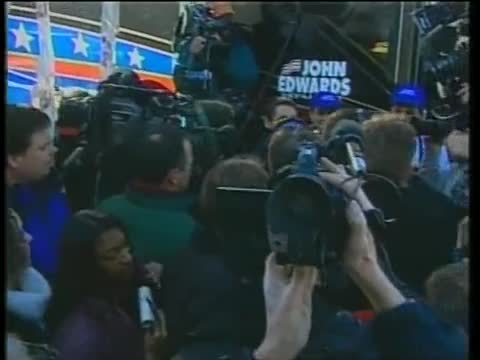
JIM LEHRER: Meanwhile, here in Boston, this is night three at the Democratic Convention, and it's John Edwards' turn in the spotlight. He'll addressthe delegates a night before he's formally nominated for vice president. Edwards inspected the podium and the convention hall late last night. Later, Elizabeth Edwards said her husband's speech will strike a note of optimism about the future. Also tonight, the Democrats will formally nominate John Kerry to be their presidential standard bearer this year. He addresses the convention tomorrow night. Kerry made his formal entrance into Boston today. That followed a six-day campaign trip that covered 3,500 miles through a number of states expected to be battlegrounds in the fall campaign. Kerry arrived by plane. Then he crossed Boston Harbor by water taxi with men who served with him aboard navy "swift boats" during the Vietnam War. He said the campaign had been "an amazing journey" and a "privilege."
SEN. JOHN KERRY: This is a gift, but most importantly, it's a responsibility and a challenge. And it's not one that I bear. It's one that we, all of us together, bear as the privileged citizens of the freest, greatest democracy on the face of this planet.
JIM LEHRER: Kerry was endorsed on Tuesday by 12 retired generals and admirals. The convention will hear from some of them tonight, including retired Army Gen. John Shalikashvili, the former chairman of the Joint Chiefs of Staff.
JIM LEHRER: It was already here, of course, but today's bombing in Baquba raised the Iraq issue even more to the delegates of this Democratic Convention. Gwen Ifill, from the floor, spoke to some of them about it.
GWEN IFILL: [No audio] -- our question for the delegate tonight became what would John Kerry do differently?
GWEN IFILL: Today there were yet more casualties in Iraq which kind of raises question about what John Kerry might do that would be different.
KIM COHEN, Colorado: I think John Kerry would be a different voice in Iraq; he would actually listen to people as opposed to saying its my way or the highway; I think that he would kind of question our whole credibility in this. We got into Iraq for the wrong reasons. We have to stay course because we can't leave Iraq as a failed state, but I think that he would be willing to kind of work within the system. I think that he would, as a new voice in the debate, be able to ask and get other people, other countries to participate. Kerry is smart enough to know that there are subtle nuances that I don't think Bush understands. Bush looks at things in black and white. I think Kerry would see that you have to kind of look at all sides of the situation.
BOB TUKE, Tennessee: John Kerry is a combat veteran. So am I. I got to know John Kerry because he and I are both Vietnam veterans. We didn't serve together. Im a marine and he is a navy man. He is a brown water navy man. He knows what it is like to be in combat. He is decorated. He has been wounded. I'll tell what you he would have done differently. He would have ensured the military had a proper plan for the end of the war, not just the beginning of the war. The reason that all these casualties are happening is because we did not have a good plan for end of the war, to make sure that we didn't get into the kind of insurgency that we are in right now. Secondly, what will he do now
because he is going to inherit what we have. What he is going to do is first internationalize this effort, which should have been done, again, in the beginning but it is not too late. What we need to do is bring other troops in, other allies, hopefully even Muslims, so that we have people from that culture helping to quell this, because we believe that most of the people inIraq would prefer to have a democratic, free, quiet, peaceful country.
GWEN IFILL: Yet, being president means you have to cope with unpredictability. The fact is , the U.S. is already in there. What difference does it make who's president -- how you handle what's next?
BOB TUKE: Your point is well made. You have to be flexible and you have to be intelligent and you have to be able to make decisions just as Kerry did in combat in Vietnam and with his 20 years of experience in the Foreign Relations Committee and personal knowledge of world leaders, he will be able to persuade countries to join with us. And he also will be able to engage the American people in this effort in a way that will not require that 40 percent of all the service people that are over there right now are reserves and national guard. That's patently unfair.
GWEN IFILL: All the polls show that people think of George W. Bush as being more strong on issues of war and national security than John Kerry. How do you convince Americans that what you see is a correct choice?
LOU ELLINGSON, Minnesota: That's... would I say there is nothing further from the truth than that. John is very strong for the military. He's strong for national defense; he will do what is necessary, but he won't send troops into combat for an optional type of war. He will only go into war if it's needed. John has experienced the devastation of war and what that is like.
GWEN IFILL: You served on a swift boat in Vietnam as well. Why is that significant, John Kerry's experience?
LOU ELLINGSON: Well, I think it's important that you have that type of experience. In his case, it showed determination, it showed courage; it showed strength, it showed the ability to react quickly when there was a crisis.
GWEN IFILL: As a veteran and as a delegate to this the Democratic Convention, and on a day when so many more casualties piled up in Iraq, how important do you think it is that next president be able to handle what's happening there right now?
JUAN ORTEGA, Texas: It is very important that a president at least have a better feel and have some kind of war record because that's the way you can have a better feel for what those individuals are going through, the sons and daughters of the current moms. That way you can be more sympathetic to what they're actually doing.
GWEN IFILL: What does John Kerry have to say to undecided voters to convince them that he can handle the war in Iraq?
JUAN ORTEGA: Well, I guess what he has to tell them, that it's not what party you're on, but it's the man. It doesn't take a Republican to be a war hog. If you have to be a that way, a Democrat can be that just as easily if you have to do that job or make that decision.
GWEN IFILL: Tonight on the podium, Jim, we'll hear from military leaders who will probably echo those same sentiments and hear from the likely vice presidential nominee, definite vice presidential nominee, John Edwards.
FOCUS THE POLITICS OF 9/11
JIM LEHRER: Now, how the 9/11 Commission's report and recommendations have rocketed into the presidential election dialogue. Spencer Michels begins.
SPENCER MICHELS: When the 9/11 Commission issued its report last Thursday, it first looked like its recommendations would be on the shelf for a while, as the president and Congress headed off the next day to vacations and the Democratic National Convention. But Democratic presidential candidate John Kerry, on the campaign trail in Detroit, Michigan, endorsed the recommendations and pressed for quick action.
SEN. JOHN KERRY: The bottom line is that this is not time for bickering. This is not a time for politics. When it comes to protecting our security and the homeland, there are no Democrats, there are no Republicans; there are just Americans, and there is America, and there is the American interest. And there are imperatives that we must move on rapidly.
SPENCER MICHELS: At first, members of the Bush administration said they wanted time to study the report. National security adviser Condoleezza Rice said this on the NewsHour last week.
CONDOLEEZZA RICE: This is not going to be easy, and it won't... won't happen overnight. Institutional change doesn't happen overnight.
SPENCER MICHELS: But by the end of the week, both Houses of Congress announced they'd hold hearings. The Senate's first will be Friday. In Texas, President Bush convened his national security advisors, and officials told reporters some recommendations might be adopted by executive order. On Monday, at a fundraiser in Kennewick, Washington, Vice President Cheney praised the commission's work, quoted from the report, and portrayed its findings as reasons to reelect President Bush.
VICE PRESIDENT DICK CHENEY: This is not an enemy you can reason with or negotiate with or appease. This is, to put it simply, an enemy that must be vanquished. And under the determined leadership of President George W. Bush, that is exactly what we will do.
SPENCER MICHELS: But in Norfolk, Virginia, yesterday, Sen. Kerry upped the ante. He said the Commission's tenure should be extended.
SEN. JOHN KERRY: If I were president today, if I'd been president last week, I would have immediately said to the Commission, "Yes, we're going to implement those recommendations and we want you to stay on the job for at least another 18 months in order to make sure we do the job." (Cheers and applause)
SPENCER MICHELS: These comments put the Commission report back on the front page today, as Kerry arrived in Boston to accept his party's nomination.
JIM LEHRER: And to Margaret Warner.
MARGARET WARNER: For more on why the 9/11 Commission's work has become such a hot issue in the presidential campaign, we're joined by Congresswoman Jane Harman-- she's the ranking Democrat on the House Intelligence Committee and assisted John Kerry in developing his position on the 9/11 recommendations; and Republican Mitch McConnell of Kentucky, the Senate's majority whip. He joins us from right here in the studio. Were glad you could be here in the studio and not downtown Boston.
Welcome to you both. Congresswoman Harman, why has suddenly the 9/11 Commission Report suddenly become this big political issue in this campaign?
REP. JANE HARMAN: Well, let me first of all welcome my friend Sen. McConnell to the Democratic Convention.
SEN. MITCH McCONNELL: Glad to be here. Hope to get out of here alive.
REP. JANE HARMAN: And how proud I am of my friend Sen. Diane Feinstein who just put John Kerry's name into nomination. Why has it become a big deal? It has always been a big deal. Lets remember the history here. This administration opposed adding the creation of a commission to the intelligence authorization bill a few years ago. It was in the middle of the night when the voice of the families couldn't be drowned out that finally there was agreement to set up the commission. And they have been there every step of the way in the hearing rooms pushing the Commission to be honest and bold, and they've succeeded and they're right around us now. That is why it is such a big deal.
MARGARET WARNER: But you do have this almost like a bidding war between Sen. Kerry and at least the Bush White House about what to do with these recommendations in just less than a week.
SEN. MITCH McCONNELL: Well, first of all, this Commission report has a lot of credibility because it was unanimous; there were no minority views. And as a result of their ability to cross party lines and produce a product that has been widely praised by both sides, I think quick action is what... is in order. Both the House and the Senate are having hearings here in the August recess. I heard my good friend Condi Rice with whom I normally agree suggest that this would take a long time. My view is the enemy of reform is delay -- that the more time that passes after the 9/11 Commission is out the less likely we are to reform particularly if it requires Congress itself to change the way we do business. And that was a major part of their recommendations.
MARGARET WARNER: But let me ask you just to follow up on something the congresswoman says because the Kerry campaign has also said this, which is essentially President Bush has flip-flopped on this. He opposed the commission initially. Then he seemed kind of cool about the recommendation. Now he says he is going to move quickly.
SEN. MITCH McCONNELL: Well, I think whether he was enthusiastic about this inquiry two and a half years ago is irrelevant. The question is we have got a solid product, a bipartisan product. We ought to act quickly. Congress itself is a big part of this, not the administration, although there are administrative changes too and hopefully the president will do what he can by executive order. But we need to tackle the changes that we need to make in Congress because we are part of the problem as well.
MARGARET WARNER: Now explain, Congresswoman Harman, this recommendation that Sen. Kerry has made to actually extend this Commission which is supposed to come to an end I think its either today or tomorrow, extend its life by 18 months. What is the rationale?
REP. JANE HARMAN: Well, I think his point is that that will keep our feet to the fire, it will keep us moving forward and it will measure how much we've done. I think even without extending the life of the Commission, the commissioners will do that and the families will keep the whole thing in the public eye.
Let me say something about the recommendations. I agree with Sen. McConnell that they're excellent and they're bipartisan and they build on a long history of other recommendations. The Senate Intelligence Committee on a bipartisan basis had recommendations recently, the joint inquiry and so forth. But let me say this: If we are coming back in August, and I believe we are, I want to us move on these recommendations. I was very disappointed today to be told that the Senate... that the House Intelligence Committee is going to hold one hearing a week during the month of August on fairly general topics, not one of those hearings is to mark up legislation which is already pending in our committee which would implement a major part of the Commission's recommendation.
MARGARET WARNER: Well, I think the Republican leadership actually now has announced an accelerated schedule. But I'd like to get back to the Bush-Kerry battle if I could here rather than -- even though you are both members -- do you think President Bush should endorse Sen. Kerry's idea to keep the Commission going as a sort of watchdog, or as she said to hold their feet to the fire?
REP. MITCH McCONNELL: I think I heard Jane suggest that maybe that's not a good idea. The Commission has finished its job. They did a great job. Now it's our turn. We need to implement the recommendations so I dont think we -- with all due respect to Sen. Kerry, I don't think we need the Commission for 18 more months. They did their job, they reported. Now the ball is in our court and we should act.
MARGARET WARNER: So if a viewer or voter... I hope we have viewers... if voters were watching this and say what is the difference between Sen. Kerry and President Bush and what to do with 9/11 Commission recommendations, listening to the two of you, wouldn't sound like a lot. What is the difference?
REP. JANE HARMAN: President Bush isnt sitting at this table. I heard Sen. McConnell say that Congress needs to act. I totally and enthusiastically agree with that, but what are we acting on? There are some good bills pending. Sen. Feinstein has one in the Senate. The one nine of us have offered in the House is virtually identical to the 9/11 Commission recommendations. No hearings have been scheduled that I'm aware of to mark up the bills.
MARGARET WARNER: But is it not the case that Sen. Kerry has, in fact, also endorsed the central recommendations of the Commission in terms of creating this national intelligence director and a counter terror task force?
That's right. And President Bush has not yet endorsed those recommendations and there are still some comments about it will take time. It won't take time. These issues have been thoroughly explored. I know that I explained in detail one of these concepts at a conference a few months ago that Sen. McConnell and the vice president intended. I'm just saying I may not be perfect but I am telling you there is a huge body of history over a number of years about how our intelligence architecture developed in 1947 is outmoded.
MARGARET WARNER: What would you say to a voter about the difference between Sen. Kerry and President Bush on what to do with the 9/11 Commission?
SEN. MITCH McCONNELL: I think Sen. Kerry's biggest problem going into the fall election is the perceived stature gap on this issue. And he, understandably, is trying to make that up, make up that gap by coming up with some creative recommendation. I don't blame him for trying, but the point is the job is finished. It's time for us to act. What I'm hoping is that the president will do... will take a number of the steps that were recommended for the executive branch that he can take without legislation. I agree with Jane. I think we ought to tackle this in both the House and the Senate in September and use this report as leverage to get the kind of reforms that are not likely to be achieved if we wait.
MARGARET WARNER: All right, but do you think the White House should endorse this rather sweeping concept of creating a national intelligence director that would have authority over the 15 disparate intelligence agencies?
SEN. MITCH McCONNELL: Look, I don't think I should give the president advice about what he ought to do. My suspicion is that he is going to endorse most of the recommendations. I would be surprised if he didn't, but I think he can speak for himself and I think we are going to hear from him shortly on this issue.
MARGARET WARNER: How much can he do by executive order because that's what they're telling reporters covering him down in Texas that what they're looking at first is what they can do by executive order.
SEN. MITCH McCONNELL: I think we are all examining the report to see what can be done by executive order.
REP. JANE HARMAN: A great deal of it can be done with executive order or even without executive order. For example, we've identified the problems with the collection of intelligence and the analysis of intelligence by the CIA. The president can reform that by directive, not even an executive order. He can ask the agency to change its practices right now. He can also integrate the more than 12 watch lists that that we have so that we have one watch list so that we can stop hijackers from getting on airplanes when we've identified that they're potential terrorists which is not our capability yet even now three years later. I think as far as Congress goes, in this central idea of one commander, unified commander over the intelligence agencies, we've learned from the way we do this in the military, the Goldwater-Nichols Act which is recommended by the 9/11 Commission, that it works. All four services work together. We have 20 years of history. Most of the military thinks it is a great idea. That's what we are talking about here, not a new bureaucracy and not a tsar.
MARGARET WARNER: All right, a final, quick political question, Senator, beginning with you. How does this question of what to do with this 9/11 Commission report play to or affect this political issue, which is the gap between, and you alluded to it earlier, the president and Sen. Kerry among the public on who would best manage the war on terror?
SEN. MITCH McCONNELL: Well, the president's strongest asset is his leadership in the war on terror. And I think Sen. Kerry you could expect to try to make advances on that issue. And he will use the 9/11 report in whatever way he thinks benefits him politically. The president is president, has responsibility to be responsible and I think he will be in following whatever recommendations he can as soon as he can.
REP. JANE HARMAN: The 9/11 Commission recommendations are bipartisan recommendations building on a long bipartisan history. They are the right thing to do. The issue now is whether this White House will step up and recommend the right thing to do and whether Congress will act. I suggest that if this administration doesn't step up, it should step aside and John Kerry has been very clear in endorsing these recommendations. He is a member of the Senate. And I'm sure he will support a strong bipartisan package as I will and I would hope that Sen. McConnell will, too.
MARGARET WARNER: Congresswoman Jane Harman and Sen. Mitch McConnell, thank you both.
FOCUS THE RUNNING MATE
JIM LEHRER: Now, on to the business of the convention this evening. It's mostly about John Edwards, John Kerry's choice of running mate. Kwame Holman begins.
KWAME HOLMAN: John Edwards' path to the podium in Boston to address the delegates tonight began in South Carolina, where Edwards was born 51 years ago. He grew up across the border in Tiny Robbins, North Carolina. Both parents worked at a local mill, and Edwards would become the first in his family to attend college. He graduated from North Carolina State University in 1974 and later from the University of North Carolina Law School. There, he met Elizabeth Anania. They married in 1977. Son, Wade, was born three years later; daughter, Catherine, in 1982. Edwards set up shop as a plaintiff's attorney in North Carolina, specializing in personal injury cases, and quickly earned a reputation as a gifted courtroom orator.
JOHN EDWARDS: Oh, I'd wanted to be a lawyer as a dream at least since I was young. I think a lot of it was just driven by my... either from television and from reading, my perception that lawyers could stand up for people who needed someone to fight for them or stand up for them.
KWAME HOLMAN: Standing up also paid off: Edwards won court judgments that made his clients, and soon him, millionaires. In 1996, tragedy struck, when 16-year-old Wade was killed in an auto accident. Following his son's death, Edwards and his wife decided to have two more children. Emma Claire was born in 1998, and Jack in 2000. Edwards also decided to choose a course Wade had hoped he would: The pursuit of political office. Running for public office for the first time in 1998, Edwards won a U.S. Senate seat from North Carolina, defeating Republican incumbent Lauch Faircloth. In the Senate, Edwards took a lead role in defending President Clinton during the impeachment proceedings. Edwards also used his courtroom skills on the Senate floor to advocate for the right of patients to sue their health maintenance organizations. Then, in January 2003, Edwards announced that he would make a run for the White House.
SEN. JOHN EDWARDS: My job will be to present the American people with a clear choice, a different choice, an alternative vision for America. My vision for America will be routed in my perspective of championing the cause of regular people.
SEN. JOHN EDWARDS: You think we could get some more people in this room? ( Laughter ) this is exciting!
KWAME HOLMAN: Edwards would prove to be a crowd-pleaser in the early going in Iowa and New Hampshire. He crept up in Democratic polls, using a rousing stump speech that hinged on a populist pitch.
SEN. JOHN EDWARDS: We have so much work to do this country. We still live in an America that in so many ways is two different Americas: One for all those folks who are in positions of privilege and power, who get everything they need whenever they need it, and then, the other America. You and I can change that. We can build one America where we don't have two health care systems-- one for families that can afford the best health care money can buy in a country that's got it, and one for everybody else.
KWAME HOLMAN: Edwards finished a surprising second to John Kerry in the Iowa caucuses and tied for third in New Hampshire. But his lone victory was the South Carolina primary. And Kerry's near-perfect winning record on Super Tuesday ended Edwards' presidential campaign.
SEN. JOHN EDWARDS: We have been the little engine that could, and I am proud of what we've done together, you and I. ( Cheers and applause )
KWAME HOLMAN: Edwards, who even as the primaries were ending was being mentioned as a vice presidential pick, praised the presumptive nominee.
SEN. JOHN EDWARDS: The truth of the matter is that John Kerry has what it takes right here to be president of the United States and I for one intend to do everything in my power to make him the next president of the United States. And I ask you to join me in this cause for our country, for our America.... ( cheers and applause )
KWAME HOLMAN: On July 6, John Kerry let his choice be known.
SEN. JOHN KERRY: I am pleased to announce that with your help, the next vice president of the United States of America will be Sen. John Edwards from North Carolina.
KWAME HOLMAN: The next day, the Democratic ticket posed for pictures with their families on Teresa Heinz Kerry's farm outside Pittsburgh.
SEN. JOHN EDWARDS: People are desperate to believe again that tomorrow will be better than today. That's what John Kerry represents for American people. He represents hope.
KWAME HOLMAN: But tonight, it's all about John Edwards, as he makes the most anticipated speech of his life.
JIM LEHRER: Some vice presidential candidate history now, and to Ray Suarez.
RAY SUAREZ: Helping us look back tonight, as they've been doing all week, are NewsHour regulars Michael Beschloss and Richard Norton Smith. They're joined by Ellen Fitzpatrick, professor of American History at the University of New Hampshire. Now earlier this afternoon, convention man Governor Bill Richardson gaveled the convention to order and said any last minute vice presidential nominating petitions are still being accepted until 9:00 tomorrow morning. Now have we ever... when is the last time we got this far into a convention without really knowing who the vice presidential nominee was going to be, Richard?
RICHARD NORTON SMITH: That's a bit of a trick question because we went into the 1988 Republican Convention without knowing who the first George Bush's running mate was going to be. Bush wanted to inject some excitement, some suspense, he wanted to hype the ratings, get the country watching. And they paid a price for spontaneity arguably because they announced Dan Quayle, 41 year old senator from Indiana, not well known nationally and many thought not properly vetted. A firestorm erupt that afternoon over allegations concerning whether or not Quayle had improperly used his family's influence to get into the National Guard rather than serve in Vietnam. Quayle actually gave a decent acceptance speech and when he finally did meet with the press, did just fine. By that time he had already been stamped in some ways and it could be argued that he really never got over it.
RAY SUAREZ: Has that vetting sort of become institutionalized now, what Richard refers to as the vetting?
ELLEN FITZPATRICK: I think so. I think the really the last Democratic Convention where this was really up for grabs -- in 1976, the choice was not announced until the very end of the convention. But in 1972, McGovern really didn't have anyone when the convention was over. There was a move afoot to draft Ted Kennedy. There was discussion about that and Kennedy declined. And then McGovern said that he would go to the party elders and ask for advice. Well, we know the outcome of that was not good, and the choice of Eagleton and the subsequent problems that developed has led, I think over time, to a very careful attempt ahead of time to make sure there are no major problems, and to do this well in advance of the convention itself.
RAY SUAREZ: Michael, walk us through how it happened that the parties pretty much stopped picking and candidates started picking their own running mates.
MICHAEL BESCHLOSS: Well, you know, at the beginning of American History, of course, the vice president would be the second person, the person who got the second largest amount of votes. But in recent times, people realized that vice presidents are important parts of tickets and increasingly important people, so it has been a tradition that the nominee chooses someone that he likes with one exception. 1956 Adlai Stevenson was nominated the second time in Chicago, and he thought the convention was really boring and people were not watching enough, something that we sometimes think is only said about recent conventions. And so he thought the way to live this up is lets just throw it open to the delegates and so he said I'm just going to let the delegates on the floor choose a vice president. Came down after a number of ballots between John Kennedy of Massachusetts, Estes Keefeover of Tennessee. Keefeover won and so the result was that Stevenson was saddled with someone he really did not like and was not a very good choice.
RAY SUAREZ: What about the conventions themselves? Have they served as an opportunity for really a coming out for a vice presidential candidate, an anointing as a national figure?
RICHARD NORTON SMITH: Yeah. One very good example is in 68, you had the Democratic Convention that tore itself apart on national television and then Hubert Humphrey announced Ed Musky this, calm, soothing, Lincolnesque figure from the state of Maine who again very few Americans knew about at the time. He was an instant success. By contrast, you could go back to 1964. Barry Goldwater picked a deservedly obscure congressman from Buffalo named William E. Miller for one reason, he said because he said he drove Lyndon Johnson nuts.
MICHAEL BESCHLOSS: Which he later did.
RICHARD NORTON SMITH: Miller didn't flop so much as he lived down to his expectations.
RAY SUAREZ: Has this been a choice that is something that lifts a ticket? Do we even know whether it makes that much difference to presidents and their running mates?
ELLEN FITZPATRICK: I think it makes a difference in many ways. Certainly from the point of view of political strategy it makes a difference. In 1960, of course, John Kennedy's choice of Lyndon Johnson led to, you know, headlines in the New York Times that this was explicitly a calculated political decision in picking Johnson in an attempt to strengthen Kennedy's appeal to the South. And by the same token, people questioned the choice of Al Gore by Bill Clinton thinking well here's a southerner, someone from Arkansas, why would he pick someone from Tennessee; but I think it does provide an opportunity to strengthen the ticket. It is obviously a very important decision. And it has, however, as you pointed out, increasingly become a decision of the candidate, a political and a personal decision who do I feel comfortable with, who will make a good partner for me in this long journey that lies ahead.
RAY SUAREZ: In the last three weeks there has been a lot of talk about John Edwards campaigning skills. Have any running mates really proven their value during the fall campaign by sort of living beyond their billing? Turning out to be formidable campaigners?
MICHAEL BESCHLOSS: Lyndon Johnson knew his forte was not, you know, giving a stump speech. He looked like a cigar store Indian. The result was that he chose Hubert Humphrey who was famous for doing this, would give these great speeches, all Americans believe in Social Security and all these other things but not Sen. Goldwater. And he was able to bring to Johnson what he did not have, make the case in a way that Johnson couldn't, and we may be seeing history repeat itself tonight.
ELLEN FITZPATRICK: There was one political speech that we are not likely to see given tonight. In 1900, the New York delegation nominated one of their own to be vice president, and there was a tremendous outpouring, a 12-minute ovation on the floor of the convention. And the nominee, David Hill, stood up and gave what was described as an indignant denunciation of his own nomination and said under no circumstances would he serve. Now that's... that would have been an incredibly refreshing see to see but we are not going to see that.
RICHARD NORTON SMITH: Mention a self aware politician. Beyond the hustings or traditional hustings are the electronic hustings and the debate, now a recent development of vice presidential debates. We have one every four years. I would argue at least that you could look at Walter Mondale in '76, Lloyd Bentsen in 88 and arguably Dick Cheney in 96, all of whom won their debates; it is hard to see what that contributed to election day either to the defeat or to the victoryof the ticket.
RAY SUAREZ: Well, we'll talk some more later. Thanks a lot.
FOCUS SHIELDS & BROOKS
JIM LEHRER: And that brings us to Shields and Brooks: Syndicated columnist Mark Shields, New York Times columnist David Brooks.
JIM LEHRER: David, what should we expect from John Edwards tonight? What is his mission? What is his job?
DAVID BROOKS: Well, I think he will do a couple things. First he will talk about two Americas. Obama talked yesterday about one America Edwards two Americas. Sources inside the Kerry campaign told me there are three Americas. So theyve got to straighten that out. So, no, he will talk about the four -- the divisions within this country. The second thing he has got to do is show strength of his own, to show that he passes the commander in chief test just in case John Kerry is elected and something happens to him. So there has got to be that strength element to the speech. Then I think the third final thing he is going to do is play on his optimistic good nature and relay the theme which has been running through this convention which is there are these nasty, evil people who are dividing America, were uniting America, and then they attack the Republicans for dividing America in a very divisive way. But those are the three main tasks I think hell set himself up
JIM LEHRER: Youre adding any others to those three?
MARK SHIELDS: Yeah. I think its the first two nights of the convention have been the Democrats telling us what Democrats believe, who they are, the type of battles theyve won. Its been a celebration of the party and what holds the party, what the party holds dear about itself, and what holds the party together. I think that this convention has to start moving into the future because American elections are about the future. Yes, its referendum on George W. Bush. But weve got to start hearing about what a Kerry-Edwards administration intends to do and what this election is going to be all about beyond George W. Bush. I mean, weve established that George W. Bush is the least popular American not incarcerated in this building.
JIM LEHRER: I notice, and I'm sure you did, too, the delegates that Gwen interviewed at the top of the program about what John Kerry would do differently about Iraq from this point on got kind of vague answers.
MARK SHIELDS: That's right.
JIM LEHRER: If his own delegates can't answer the question. ....
MARK SHIELDS: That's right.
DAVID BROOKS: Yeah. I asked about that I ran into a Kerry aide and said are we going to get some issues? The four things he wants to do in next four years? I got sort of a vague answer about that. Then they go on to talk about, we got to show strength. We got to pass that commander in chief test. And it could be they only have one goal for this convention, showing he can be a tough commander in chief, which, to me is not enough. They have got to do a little more than that.
JIM LEHRER: But you think, Mark, that John Edwards has got to start that tonight, right?
MARK SHIELDS: Hes got to start moving to the future. Obviously you want to dance with the girl who brung you and John Edwards truly is. He was the star of the 2004 race; he emerged as the best spokesman for the Democratic vision, the country economically. He lit up crowds. There is no two ways about it. But I really think, Jim, that he has got to start making the case. He is not going to be... the vice presidential candidate, the cheerleaders or their attack dogs. You've got Agnew or you've got Hubert Humphrey. And he is not an attack dog. That is not what John Edwards does. So he's got to make the case for John Kerry into the future.
JIM LEHRER: David, you mentioned commander in chief. If there was ever... we don't need a reminder but we certainly had one today. You've said it many times on the NewsHour, this election could be decided by events. We had this terrible bombing, terrible suicide bombing in Iraq. That certainly reminds us what this is all about, does it not?
DAVID BROOKS: That's right. This bombing will not shake up the campaign the way a bombing in October would because the people who really decide this election don't care about politics; theyll tune in the last two weeks. So any event in those two weeks will affect people who are not paying that close attention to world affairs. It will have a disproportionate value so a bombing like today at the end of the October could swing election one way or the other, let alone something that happens here, let alone any world event. This election -- I guarantee you some weird thing will happen in late October and suddenly there will be a big shift one way or the other.
JIM LEHRER: Do you read it the same way?
MARK SHIELDS: I don't, Jim. I think that it's fair to say that any day that Iraq is on the front page of the newspaper is bad day for the administration. Dwight Eisenhower... administration running for reelection in the middle of wars, unpopular wars do not do well. Dwight Eisenhower won with in 1952 not with a plan but saying Ill go to Korea. Richard Nixon won in 1968 in the middle of Vietnam by saying I have a plan, its still undisclosed. I think because he is not George Bush, John Kerry has an advantage. I still think he has to be more specific than he has been, but I really do think sadly, tragically that the deaths there in a political sense translate into a disadvantage for the president.
DAVID BROOKS: I would disagree a little. Nixon won again in 72 in the middle of a pretty unpopular war, the opposing candidate has to show they have something to do; they have an idea what to do with the enemy. There is this insurgency out there. Who are they? Has Zarqawi been mentioned at this convention no -- or the insurgency been mentioned during this convention? No. Is there a strategy for dealing with the insurgency, no. There has just been a void.
JIM LEHRER: So taking this very day as an example, 68 Iraqis killed by a suicide bombing in Baquba, it is not enough just to say that. Youve got to say youre saying that Kerry has got to say and if you elect me president, I'm going to do this about that?
DAVID BROOKS: I would even settle for "here's the problem" addressing the fact that there is this guy Zarqawi out there. What motivates him? Who is he? What is the insurgency? It has just been a void. When you talk about Democratic foreign policy, very often, we should have more allies; well, that's the process. Allies for what? Theres no strategy.
MARK SHIELDS: -- not for invading other countries. David is absolutely wrong in his history. 1972 was not about Vietnam, David. I'm sorry, it wasn't. The draft was over; there were no more draft calls as of 1972. The resistance -- the country had been fractured and fragmented in 1968 over the War in Vietnam. That was no longer the case in 1972. It was not the dominant issue of that campaign. So I don't think that it was... the war was not nearly as unpopular in 1972 as it was in 1968 because Richard Nixon had already started his plan with withdrawal.
JIM LEHRER: Quickly Mark, beginning with you, back to Margaret's discussion about how the 9/11 Commission report has suddenly become an issue here. What do you think the impact of that could be?
MARK SHIELDS: Well, I think the impact -- what's fascinating, I did discover in my own reporting is the unanimity....
JIM LEHRER: Mitchell McConnell and Jane Harman demonstrated that.
MARK SHIELDS: Demonstrated and lauded it on the part of the commission. They came in, as you know, unanimously and Lee Hamilton the Democrat and Tom Kean, the chairman, the Republican, deserve great credit for it, Jim. The other person who deserves credit according to people on the Commission is John Ashcroft, the attorney general. When John Ashcroft went after Jane Gorelick, the commissioner, the Commission itself bonded.
JIM LEHRER: Shes one of ten members.
MARK SHIELDS: One of Ten members and Jim Thompson, the Republican governor of Illinois and Slate Gordon Republican senator from Washington said we are not going to play this cheap partisan game. Were not going to be divided, and they agreed right then and there to come in unanimously. The fact that they came in unanimously demands the Congress, demands the administration, demands the nation pay attention to their recommendations.
JIM LEHRER: So, as a result, what, no issue? Everybody is going to go and in hand to the rescue.
DAVID BROOKS: There are two stages in this debate. The first stage is let's all embrace the Commission. The second stage is the candidates actually read the report because there is actually stuff in that report that they should be uncomfortable with both for different reasons. John Kerry may be uncomfortable with the embracement of preemption. Both would be uncomfortable with the idea that we should be getting incredibly tough with the Saudis, the Egyptians, all these autocratic regimes in the Middle East; theres a whole series of steps in that report. This is not namby pamby stuff, let alone the reorganization of the intelligence community. That should raise problems for members of each party. 7There is stuff in the commission which violates a lot of stuff the candidates have been saying for the past year.
JIM LEHRER: Like what?
DAVID BROOKS: The big thing is preemption.
JIM LEHRER: You mean in terms of Democrats
DAVID BROOKS: The Democratic Party has been generally opposed to...
JIM LEHRER: But what about the thing that is the nut of it, which is the reform in the intelligence community and national intelligence director and national counterterrorism center?
DAVID BROOKS: That I think -- I'm not sure Kerry and Bush have specific ideas about that. They will study them and I think the ideas it may not be a logical issue but the Commission report feels very different than say in this convention. The description of the Wahabi intellectual influence around the world the madrassahs, the fragility of the regimes in Saudi Arabia and Pakistan, a much higher priority issues that are just not being talked about.
JIM LEHRER: Okay. Well, we'll continue to talk about this and other things during the convention later this evening. Thank you all very much.
NEWS SUMMARY
JIM LEHRER: And in the non-convention news of the day, an explosion at a mosque in Afghanistan's Ghazi Province killed at least two people. Most were there to register to vote in Octobers election. And the relief organization Doctors without Borders announced it would leave the country because of security fears. Five of the group's workers were killed last month. The U.N. Security Council began final talks today on a resolution on Sudan. The United States is pressing for sanctions against Sudan if the government fails to disarm Arab militias. Gunmen in the Darfur region have killed at least 30,000 civilians, most of them black. A million others have fled. Speaking in Cairo, Egypt, today, Secretary of State Powell said U.N. action would help end the crisis.
COLIN POWELL: Nobody wishes to make the situation any worse with respect to the imposition of sanctions but at the same time, pressure must be kept on the Sudanese government to make sure that access is allow and that security is improved
JIM LEHRER: The Security Council will most likely vote on the resolution by the end of this week. There were new questions today about the voting process in South Florida. Miami-Dade County confirmed a computer malfunction had erased records from touch-screen voting machines used there in 2002. The erasure was made public when a watchdog group asked for the data. The touch-screen machines were put into use after the furor over paper ballots in the 2000 presidential vote. The price of crude oil closed at a new high in New York trading today. At one point, oil futures traded above $43 a barrel. They finished at $42.90, up more than a dollar from Tuesdays close. Prices spiked when the giant Russian oil firm Yukos said it might halt production. It's in a court fight over back taxes. The U.S. Federal Reserve reported today the economy cooled somewhat in June and July. A survey of regional activity found slower growth in much of the country. In a separate report, the Commerce Department said orders for durable goods rose 0.7 percent in June, after two months of decline. On Wall Street, the Dow Jones Industrial Average gained nearly 32 points to close at 10,117. The NASDAQ fell more than ten points to close at 1858. And again, the other major news of the day was in Iraq. A suicide car bombing killed at least 68 people in Baquba. And the U.S. Military announced at least two U.S. soldiers were killed, ten wounded in the last 24 hours.
RECAP
JIM LEHRER: We'll see you again at 8:00 P.M. Eastern Time with our live coverage of the Democratic Convention here in Boston, then again here at our regular NewsHour time tomorrow evening. We also have further convention coverage online. For now, I'm Jim Lehrer. Thank you and good night.
- Series
- The NewsHour with Jim Lehrer
- Producing Organization
- NewsHour Productions
- Contributing Organization
- NewsHour Productions (Washington, District of Columbia)
- AAPB ID
- cpb-aacip/507-8g8ff3mk40
If you have more information about this item than what is given here, or if you have concerns about this record, we want to know! Contact us, indicating the AAPB ID (cpb-aacip/507-8g8ff3mk40).
- Description
- Description
- The recording of this episode is incomplete, and most likely the beginning and/or the end is missing.
- Date
- 2004-07-28
- Asset type
- Episode
- Rights
- Copyright NewsHour Productions, LLC. Licensed under a Creative Commons Attribution-NonCommercial-NoDerivatives 4.0 International Public License (https://creativecommons.org/licenses/by-nc-nd/4.0/legalcode)
- Media type
- Moving Image
- Duration
- 01:04:14
- Credits
-
-
Producing Organization:
NewsHour Productions
- AAPB Contributor Holdings
-
NewsHour Productions
Identifier: NH-8020 (NH Show Code)
Format: Betacam: SP
Generation: Preservation
Duration: 01:00:00;00
If you have a copy of this asset and would like us to add it to our catalog, please contact us.
- Citations
- Chicago: “The NewsHour with Jim Lehrer,” 2004-07-28, NewsHour Productions, American Archive of Public Broadcasting (GBH and the Library of Congress), Boston, MA and Washington, DC, accessed June 22, 2026, http://americanarchive.org/catalog/cpb-aacip-507-8g8ff3mk40.
- MLA: “The NewsHour with Jim Lehrer.” 2004-07-28. NewsHour Productions, American Archive of Public Broadcasting (GBH and the Library of Congress), Boston, MA and Washington, DC. Web. June 22, 2026. <http://americanarchive.org/catalog/cpb-aacip-507-8g8ff3mk40>.
- APA: The NewsHour with Jim Lehrer. Boston, MA: NewsHour Productions, American Archive of Public Broadcasting (GBH and the Library of Congress), Boston, MA and Washington, DC. Retrieved from http://americanarchive.org/catalog/cpb-aacip-507-8g8ff3mk40