The MacNeil/Lehrer Report; The Return of St. Stephen's Crown
- Transcript
ROBERT MacNEIL: Good evening. A curious chapter of the Cold War finally ended today when the United States formally returned the Crown of St. Stephen to Hungary. This 1,000-year-old symbol of Hungarian nationhood had been kept by the United States ever since World War II to prevent it falling into communist hands. But today Secretary of State Cyrus Vance, on behalf of President Carter, personally turned the relic over, together with its associated regalia, to Hungary`s communist government in a ceremony in the parliament in Budapest. The crown`s return aroused the bitterest opposition in this country. Tonight, what was the fuss about, and what does the crown`s return mean for U.S.-Hungarian relations? Jim?
JIM LEHRER: Robin, President Carter`s decision to return the crown was clearly a symbol; the disagreement is over what kind of symbol it is. The administration says giving it back symbolizes better relations between the United States and communist Hungary, and could lead to even more cooperation, particularly in the economic and cultural exchange areas. Those opposed to the crown`s return see other symbols. They say the crown stands for the Christian freedom that existed in Hungary before the communists took over, and to return it to Hungary`s communist government is a betrayal of the crown`s real symbolic meaning. The opponents went to federal court in an unsuccessful attempt to keep it here. There were also anti-return resolutions introduced in Congress; they failed to go anywhere, either. And the crown is now in Hungary. Robin?
MacNEIL: Janos Kadar, the Communist Party leader, was not present at the ceremony in parliament, apparently in deference to U.S. wishes that the crown be delivered to representatives of the people, not the communist government. Mr.. Kadar`s sensitivity to such matters is one of the slight signs of a new direction in Hungary in recent years. Here`s an excerpt from a BBC report which we broadcast on the twentieth anniversary of the uprising against Soviet domination.
MICHAEL COCKERELL, Correspondent: Janos Kadar and the Kremlin are joint architects of Hungary`s road to communism. As he sets off for a regular visit to Moscow, he`s careful to shake hands with every member of his politburo, for he knows there are many hard-line comrades who`d be happy for his delicate balancing act of the past twenty years to collapse. Behind the earthy exterior, Kadar is the most supple of politicians. Unlike the pre-1956 leaders, he`s deliberately built up a cult of non-personality -- no official portraits, no television interviews. But he`s gained considerable freedom of action in domestic affairs from the Soviet Union. At Lenin`s tomb in Moscow, Kadar arrives to lay the inevitable wreath. Hungary is still a client state, almost totally dependent on Soviet raw materials, and forming a buffer from the West. But Kadar has been allowed to develop his own brand of communism in exchange for one thing: total loyalty to Russia on foreign policy. Kadar never forgets what happened to Mr. Dubcek, the East European who strayed too far off the Moscow road. For all his obeisance to Moscow, Kadar is becoming increasingly dependent on the West. Hungary now owes Western creditors more than`L1,000 million; and exactly opposite the Party headquarters there`s a new building going up on the fashionable side of the Danube. In the heart of the most historic and sacred part of Budapest they`ve demolished a fourteenth century convent. In its place they`re building the Iron Curtain`s first Hilton Hotel.
Andras Bolgar is manager of the Hilton project, and like only five percent of Hungarians, he`s been accepted as a member of the Communist Party. Bolgar told me he was born to be a director. He`s part of the new Western- oriented management elite growing up in Hungary. Unlike other East European countries, Hungary has reintroduced the profit motive, and Andras Bolgar finds no inherent contradiction in serving at the same time the ideals of Karl Marx and Conrad N. Hilton.
ANDRAS BOLGAR: It`s quite the same, whether this business is coming from a capitalist firm or a capitalist idea; if the business is good, it`s good for us from the capitalist countries, too.
COCKERELL: I wonder what makes you a communist.
BOLGAR: Well, I think now, here in Hungary, to be a communist means that to work a little bit harder than everybody for this country, to build up new hotels, to build up new buildings and to work efficient for the country.
COCKERELL: One of the things that strikes me is that you look, and almost sound and dress, like a Western business man. I just wondered if you thought that without 1956 you, doing the job that you do now, would exist.
BOLGAR: In my opinion, anyhow, this change should happen without `56, because as I told, this progression had to come anyhow, and it`s not the reason of `56.
COCKERELL: The greatly improved living standards of peasants and workers date from 1956 and the massive injections of Russian money into Hungary. Twenty years ago many coal miners were political prisoners and criminals, sentenced to work down the pit; and when the uprising came the miners were in the forefront. As a result, the miners these days are paid four times as much as a doctor, though they only produce half as much as an equivalent English mine. Szoke Gabor is a coal-face worker. He earned 10,000 forints last month -- about x,50 a week. Like everyone else in Hungary, Gabor pays no income tax.
COCKERELL: Do you think it`s right that you should be paid four times as much as a doctor?
SZ6KE GABOR: Well, I`d say we were both doing a different job. And don`t forget that I`m doing physical work for that money. But in any case I wish he`d earn more as well.
COCKERELL: Szoke Gabor has his own private vineyard that he bought from the state mining company. Before 1956 the landowners were dispossessed. Today, nearly half Hungary`s food and drink is produced on private plots. Gabor and his daughter Eva claim their lives are now less restrictive. They can now apply for visas to travel to the West once every three years, and Gabor now feels he`s doing well under the communist system.
GABOR: Yes, but I`m not really satisfied. I want more and more, and so I always work to get more.
COCKERELL: Are you a communist?
GABOR: No.
COCKERELL: Why not?
GABOR: I don`t know, I don`t know. I`m just not a communist. I think I`m better than some communists, because I work with my hands. Perhaps the truth is, you know, you just have to be somebody worthy to be accepted into the Communist Party.
COCKERELL: Gypsy violin music was banned before 1956 as anti-Communist. Now, it`s allowed. Filming is a real test of freedom in Hungary today. Zoltan Varkonyi is Hungary`s richest and most successful film director. We had asked to interview one of Hungary`s young, avant-garde filmmakers. Permission at first granted was then withdrawn. In recent years there have been many controversial films made in Hungary, very different from the chauvinist box-office successes of Zoltan Varkonyi; but they`ve never been shown to the public. As dean of the Film Academy, Varkonyi not only makes his own films, he helps unmake other people`s.
ZOLTAN VARKONYI: My job is to educate people toward socialist culture. If somebody`s making an animate film and wants to disturb the socialism, that film shouldn`t be shown.
COCKERELL: Why is that?
VARKONYI: ...and that film is going not in the studio. Why not? Why we, other artists, we are defending our culture against the enemies, you know? And an enemy, if he wants to make against the socialism a film, can go outside the border, and there he can make it; here, not.
COCKERELL: For those creative artists who`ve been prepared to stay and work within Hungary, the system has brought its own rewards. Zoltan Varkonyi, the filmmaker, has a maid and two houses. His country house is set in its own grounds in the fashionable hills outside Budapest. With his film- actress wife, the Varkonyis are part of a new, privileged class growing up in Hungary. They share a taste for luxury items like Scotch whiskey and American cigarettes, only available for Western currency or on the black market. Varkonyi was the first Hungarian to order his own helicopter, and owns many icons and inflation-proof paintings.
Not included among life`s comforts is the right of political opposition. Parliament meets a few days each year; the communists win 99.6 percent of the votes. In the streets of Budapest that still bear the scars of 1956, one question kept going through my mind: is Janos Kadar right in believing he can buy off the people with cars, washing machines and a certain limited freedom? As they drive past the Hotel Astoria, that twenty years ago was the headquarters of the Russians, do Hungarians believe the costs of 1956 match the benefits of today? When the Russians came back into Budapest they put down the revolution with unparalleled savagery.30,000 Hungarians died in the uprising, and many more were imprisoned in Siberia. They`d fought to end economic subjugation and the rule of terror. They demanded the withdrawal of Soviet tanks from Budapest and all Russian troops from Hungary. They wanted the right to live and speak freely that was theirs when they took over the radio station. Twenty years later, the regime has its licensed free speakers, like Pal Ipper, the news commentator.
PAL IPPER: I wouldn`t say that never happened, that somebody called me from upstairs, but you know, that happens once in a year, let`s say, when there is some special interest of the Hungarian government. You have to know that our television is owned and run by the government, so it`s a government TV, though I always try -- and I do my best -- to represent my, own views within a certain framework, which cannot be just contrary of the government`s views. But it really very rarely happens that somebody tells me what to say and how to say it.
COCKERELL: Is that because you are effectively self-censoring -- you know exactly what the limits are?
IPPER: Yes, sure. Self-censorship is sometimes stronger than an official one.
COCKERELL: In the town that twenty years ago was called Stalinvarosch, the military band rehearses the "International" for the grand parade. "We peasants, artisans and others, enrolled among the sons of toil, let`s claim the earth henceforth for brothers and drive the indolent from the soil."
In Hungary today, the general sentiment is less lofty. Self-censorship is a way of life. A man like Solzhenitsyn couldn`t exist here, one diplomat told me. Hungarians have realism genes passed on at birth.
MacNEIL: A look at Hungary just over a year ago by BBC reporter Michael Cockerell. In today`s ceremony in Budapest the speaker of the Hungarian parliament, Antal Apro, spoke to the many Hungarians in the United States. He said the people of Hungary address with esteem the thousands compelled by the "vicissitudes of history," as he put it, to take to the road and to have become citizens of the United States but have always preserved respect and attachment for their ancient homeland. The principle "vicissitude of history," of course, was the revolution of 1956.
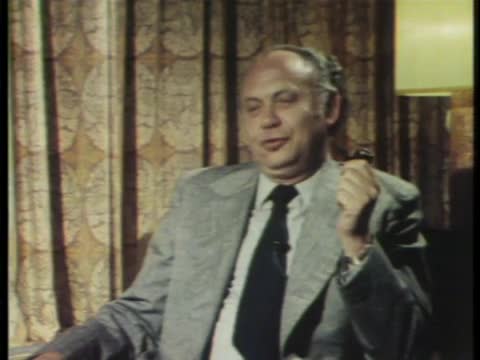
One of those who fought in it as Commander-in-Chief of the National Guard, or Freedom Fighters, was Bela Kiraly, now Professor of History at Brooklyn College. Mr. Kiraly, are you in favor of sending the crown back?
BELA KIRALY: I am absolutely in favor of sending the crown back.
MacNEIL: Do you not .fear, as some say, that it would strengthen the communist regime of Mr. Kadar, of which we`ve just seen a few bits?
KIRALY: Well, of course I expect that they will do all in their power in literature and the media to explain this act as an addition to the recognition of the regime, the legal regime of Hungary.
MacNEIL: As a victory for Hungarian communism.
KIRALY: No question about it. And they know how to do it. But on the other hand, I believe that so many symbolism`s are involved here that in the long range it will not strengthen the communist regime but maintain thoughts and sentiments which are the antipoles of communism.
MacNEIL: The opposite of communism.
KIRALY: The opposite.
MacNEIL: Will the symbolism of its return have any practical effect in Hungarian life, do you think?
KIRALY: Oh, definitely. Well, what is practical life really? I don`t believe that tomorrow the Hungarians will be able to buy more bread or will have a greater freedom, but I consider it also as a sign of time, you know, that Kadar was so eager to receive the crown back. It is definitely a symbol of Kadar kind of tolerance. And I was very much impressed today with the radio report that during the ceremonies, when the crown was handed over -- I would not emphasize to the communist regime like you did, I would emphasize to the Hungarian people -there was not a single red flag hoisted on the parliament, it was full with Hungarian national flag. What I think was the most important part of it, it definitely strengthened a trend, that you have to talk about the crown. If you talk about the crown you talk about Hungarian identity. If you talk about the crown, you talk about a thousand-year-old history of a nation, not by communists, not by Brezhnev; you don`t talk about the Soviet Union, you talk about the Hungarian past. The practical, immediate effect of it is a strengthening of Hungarian consciousness; in the long range it is more important than many other things.
MacNEIL: And could in fact encourage thereby Hungarian sense of independence, and through it some new identity.
KIRALY: The greatest part of this whole crown is that when it was awarded in 1001 by the Pope, at that time that was an act in which Stephen, not yet saint at that time of course, elevated his nation into statehood. Statehood in the tenth, eleventh century in Europe was monarchy; and all the other monarchs -- kings, dukes, princes -- received the insignia and the sovereignty from one person, the superpower -- I am using this modern term...
MacNEIL: The Pope.
KIRALY: No, from the emperor. And the price of it was swearing fealty to that emperor, which meant that all the other countries were vassals of the emperor; St. Stephen was not. He received the crown from the Pope without strings attached. He did not have to swear really to anyone, and the crown therefore represents this thousand-year-long concept of Hungarian independent state. That is also a meaning which vis-...-vis the Soviet colony of power today, in long range is a very effective thought.
MacNEIL: Thank you. Jim?
LEHRER: Other Hungarian-Americans were displeased about the return of the crown and view it as a slap in the face for the Hungarian independence movement. The spokesman for this few is the Reverend Julian Nagy, of the First Hungarian Reformed Church in New York City. Reverend Nagy, you disagree with Mr. Kiraly. Tell us why.
Rev. JULIAN NAGY: Yes, certainly. Let me tell you first of all I find this slap-in-the-face expression a bit strong; I wouldn`t use it as a theologian. I am not a politician and I do not represent any group or association here, even not my own church. I am a private person, a preacher of the Word of God. But let me tell you that I felt very disappointed when I heard about President Carter`s decision to return the crown, first of all because he`s the first evangelical minded President in the United States and he is bound by some evangelical principles, first of all that he`s not supposed to be a cause for stumbling for people -- that`s a very important evangelical rule; and I`m afraid he may hurt the spiritual feelings of the Hungarians all over the world. Because we don`t consider -- and I do not consider as a Protestant pastor -- the crown as a sacred object, but it has a certain spiritual value, a spiritual meaning, and the thing is that a thousand years ago the Hungarian people said a very definite yes to the West European Christian way of thinking. And the step of our President disrupted this idea, this conception, and I am afraid that more or less he Balkanized Hungary and East Europe with this arrangement.
LEHRER: Do you feel it will strengthen the communist regime in Hungary, the fact of giving them the crown?
NAGY: Yes, to a certain extent, because they know -- and they are very clever people -- they know quite exactly that the crown has a symbolic value as the symbol of our independence, and as long as it has been kept here abroad in the free world it was a constant threat to the Hungarian government. And now it has become a piece of exhibition and nothing else.
LEHRER: You then reject. Mr. Kiraly`s point that in the long run this could enhance the feeling of nationalism and the feeling of independence on the part of the Hungarians.
NAGY: I`m sorry to say, if you studied the history of the Communist Party all over the world and the Soviet Union, there is no long run in that history. There are a lot of ups and downs, ups and downs; and for the time being there is a more or less liberally minded government in Hungary, but I am quite sure that what Mr. Kadar promises now, his successor won`t keep it.
LEHRER: What about the point that`s been made that this return was actually to the people of Hungary and that the people of Hungary have a right to see their crown regardless of what the government is. Do you agree with that?
NAGY: Not at all, because the whole distinction between government and people is completely false. Let me tell you that I left Hungary much later than the revolution, in `64. And out of the twenty years I spent there in the communism I was an industrial worker for more than ten years. And it means that I belonged to the revolutionary troop -you know, to the working class; and in those ten years I can`t remember one instance when we were asked about anything, when we were asked for our opinion on certain things. We were tools. We were means, you know, for producing more and more and more and more and -- that`s all. So there is no distinction between people and government. The people have no right to say one word in this whole problem.
LEHRER: Mr. Kiraly, what about that -- no distinction between people and government?
KIRALY: I would certainly oppose this whole idea that we should not make a distinction between the government and the people; that is exactly my point, that we must make that distinction. If the people can`t open their mouths opposing clearly the Soviet Union, Marxism, or the Kadar regime, it`s a fact of life. But that is what no one can change from today to tomorrow. I`m looking therefore to a long distance ahead, I`m looking for the survival of Hungarian nation, and the survival is not primarily a democratic issue. It is also that, but it is whether the Hungarian culture will survive during I don`t know how many decades of Soviet colonial rule over Hungary. Who knows how long it will...? Now, I have now definite example what I would like to bring up, which definitely is absolutely contrary to what the Reverend says. On November 9 I was in Washington in this hearing in the Congress. There was a telephone call from Budapest; that was the day when in Moscow there was the sixtieth anniversary of the Bolshevik Revolution, Brezhnev`s big speech which was printed all over the world, of course in the communist world it was headline in the papers. And what did this gentleman report from Budapest? They reported -- that was exactly the day when it was known in East Central Europe and other parts of the world that the crown will go back to Hungary. There was not a word in Hungary about Brezhnev`s speech, there was not a word about the sixtieth anniversary of the Bolshevik Revolution; everybody talked about the holy crown of Hungary. That is what I`m saying, they will talk about the crown for decades and decades and decades and it will not strengthen Bolshevism, it will strengthen national consciousness, and that is the issue.
LEHRER: Reverend, you disagree.
NAGY: Oh, yes, I`m sorry to say; again and again. Because this way, by returning the crown, America carried the dream of a small people. And let me tell you that I was quite surprised to listen to our President speaking in Warsaw when he said, if you will remember, that "I cherish" -- or "We cherish the desire and commitment of the majority of the Polish people not to be dominated." Not to be dominated, you know?
LEHRER: All right. Robin?
MacNEIL: I`m awfully sorry, but that`s the end of our time for tonight. Thank you very much. Good night, Jim.
LEHRER: Good night, Robin.
MacNEIL: That`s all for tonight. Jim Lehrer and I will be back on Monday night. I`m Robert MacNeil. Good night.
- Series
- The MacNeil/Lehrer Report
- Producing Organization
- NewsHour Productions
- Contributing Organization
- National Records and Archives Administration (Washington, District of Columbia)
- AAPB ID
- cpb-aacip/507-804xg9fw3x
If you have more information about this item than what is given here, or if you have concerns about this record, we want to know! Contact us, indicating the AAPB ID (cpb-aacip/507-804xg9fw3x).
- Description
- Episode Description
- This episode features a discussion on The Return of St. Stephen's Crown. The guests are Bela Kiraly, Julian Nagy, Patricia Ellis. Byline: Robert MacNeil, Jim Lehrer
- Date
- 1978-01-06
- Asset type
- Episode
- Rights
- Copyright NewsHour Productions, LLC. Licensed under a Creative Commons Attribution-NonCommercial-NoDerivatives 4.0 International Public License (https://creativecommons.org/licenses/by-nc-nd/4.0/legalcode)
- Media type
- Moving Image
- Duration
- 00:30:24
- Credits
-
-
Producing Organization:
NewsHour Productions
- AAPB Contributor Holdings
-
National Records and Archives Administration
Identifier: NHNARA18 (AAPB Inventory ID)
Format: 2 inch videotape
If you have a copy of this asset and would like us to add it to our catalog, please contact us.
- Citations
- Chicago: “The MacNeil/Lehrer Report; The Return of St. Stephen's Crown,” 1978-01-06, National Records and Archives Administration, American Archive of Public Broadcasting (GBH and the Library of Congress), Boston, MA and Washington, DC, accessed June 8, 2026, http://americanarchive.org/catalog/cpb-aacip-507-804xg9fw3x.
- MLA: “The MacNeil/Lehrer Report; The Return of St. Stephen's Crown.” 1978-01-06. National Records and Archives Administration, American Archive of Public Broadcasting (GBH and the Library of Congress), Boston, MA and Washington, DC. Web. June 8, 2026. <http://americanarchive.org/catalog/cpb-aacip-507-804xg9fw3x>.
- APA: The MacNeil/Lehrer Report; The Return of St. Stephen's Crown. Boston, MA: National Records and Archives Administration, American Archive of Public Broadcasting (GBH and the Library of Congress), Boston, MA and Washington, DC. Retrieved from http://americanarchive.org/catalog/cpb-aacip-507-804xg9fw3x