The MacNeil/Lehrer NewsHour
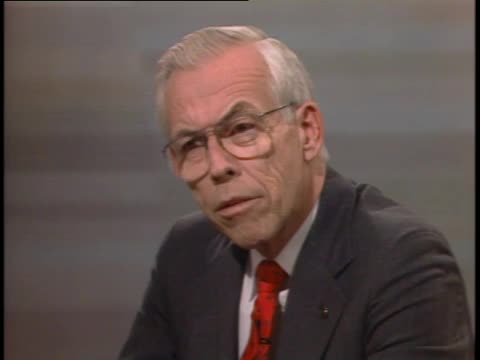
- Transcript
MR. LEHRER: Good evening. Leading the news this Wednesday, the Soviet parliament nominated Mikhail Gorbachev for a new and more powerful Presidency, and German reunification talks got underway in Bonn. We'll have the details in our News Summary in a moment. Judy Woodruff is in Washington tonight. Judy.
MS. WOODRUFF: After the News Summary, we turn [FOCUS - ON THE STAND] to the trial of Reagan National Security Adviser John Adviser John Poindexter. Oliver North had an emotional last day on the witness stand and law correspondent Nina Totenberg will be here to describe it. Then the health insurance crisis facing the United States [FOCUS - POOR HEALTH]. We'll get four perspectives from two members of Congress with different views about a recent report on the subject, Sen. Jay Rockefeller and Congressman Bill Gradison, and from the head of a corporate and labor coalition just starting to look for solutions, Dr. Henry Simmons, and from a top official of the American Medical Association, Dr. James Todd. Finally we'll look at the hidden health problems facing college athletes underscored by the sudden death of basketball [FOCUS - DEATH OF AN ATHLETE] star Hank Gathers.NEWS SUMMARY
MR. LEHRER: Mikhail Gorbachev won another big one today. The Soviet parliament nominated him to a four year term as president under the new terms of a strong presidency adopted yesterday. They were expected to make the election formal later tonight or tomorrow. Gorbachev had asked for more power to manage the nation's worsening economic and ethnic problems. Tom Brown of Worldwide Television News has our report.
MR. BROWN: It was another successful day for Mikhail Gorbachev. The congress of people's deputies once again voted his way, once again deciding by a slim margin that they, not the Soviet people, will elect the nation's new, more powerful president. Gorbachev, himself, nominated by the Central Committee is the only candidate whose name will appear on the ballot. The final vote gave Gorbachev a 2/3 majority. It was his closest vote yet in Congress. If he'd lost, he'd have had to face a disgruntled public in a national election campaign, but the voting came after an appeal from Historian Dimitri Kilichev who warned delegates of civil war if the country had to go through its first presidential election now. The balloting for president was delayed until later in the day, with results expected the following morning. Gorbachev needs only a simple majority to win.
MR. LEHRER: The new powers will allow Gorbachev to propose and veto laws, negotiate treaties and declare war in consultation with the parliament. Judy.
MS. WOODRUFF: The six countries involved in deciding the future of a reunified Germany decided today to include Poland in future border discussions. That word came from the so-called two plus four talks which took place in Bonn, West Germany. Representatives of the two Germanies and the four victorious World War II allies met for one day to discuss procedures and agendas for future talks. More substantive talks will begin after East Germany elects a new government on Sunday. The Polish government had asked to be included in discussions about the German-Polish border. Also today Romania's parliament passed a law giving its people the right to free elections and representative government for the first time in more than 50 years. The elections are scheduled for May 20th. The law provides a mechanism to exclude any candidate who was associated with the regime of the late dictator, Nicolae Ceausescu.
MR. LEHRER: There were weather extremes throughout this country today. Thunderstorms brought flood warnings in Oklahoma, Texas, Illinois, Iowa, and Wisconsin. There were snow blizzards in Wyoming. At least two tornadoes touched down in Central Texas. They came one day after a series of tornadoes caused widespread damage in the plain states. Two people were killed, twenty-nine injured. Some of the word destruction was in Hesston, Kansas, where more than 75 homes were hit. And a heat wave on the East Coast this week brought record high temperatures as far North as New York City. It also brought the earliest ever bloom of Washington's cherry blossoms.
MS. WOODRUFF: A $140 million communications satellite was launched from Cape Canaveral this morning, but scientists said it failed to separate from its rocket booster. Using computer commands from the ground, they were finally able to separate them, but the satellite remained in a low and useless orbit. Officials are now considering their options, which include a rescue of the satellite by a future shuttle mission.
MR. LEHRER: There will be a run-off in the hot, brutal Democratic race for governor of Texas. State Treasurer Ann Richards and Attorney General Jim Mattox will be in it as a result of their one- two finish in yesterday's primary. The campaign has been one of vicious personal attack and counterattack. It is expected to get even worse between now and April 10th, the date of the run-off. The winner will face Republican oilman rancher Clayton Williams in the November general election. He won the GOP primary yesterday with 61 percent of the vote.
MS. WOODRUFF: There was a call today for increased government spending on child care. A report, financed by the Federal Department of Health & Human Services, in conjunction with private interests, urged federal state and local governments to spend an additional 5 to 10 billion dollars a year to improve America's day care system. Speaking at a Washington press conference, panel chairman John Palmer said the problem was most urgent among the nation's poor.
JOHN PALMER, Syracuse University: Consequently, we'd recommend that the federal government in partnership with the states expand subsidies to low income families to enhance their choices and ability to pay for the services and arrangements that best meet their need. We further recommend that the federal government initiate a process to develop national standards for child care and that it mandate unpaid job protected leave with continuation of health benefits for employed parents of infants of up to one year of age.
MS. WOODRUFF: The report estimated that by the year 2000 nearly 70 percent of all preschool children will have mothers who work outside the home.
MR. LEHRER: Bruno Bettelheim is dead. The 86 year old child psychologist died yesterday in a Silver Springs, Maryland, nursing home. He committed suicide. Bettelheim was a pioneer in the treatment of emotionally disturbed children. He was born in Vienna, studied under Freud, he survived two years in Nazi concentration camps. It was an experience that later influenced his writings and his theories of treatment.
MS. WOODRUFF: That's it for our News Summary. Just ahead on the Newshour, Oliver North's last day of testimony in the Poindexter trial, the role of the federal government in paying for health care and questions raised by the death of basketball star Hank Gathers. FOCUS - ON THE STAND
MR. LEHRER: Oliver North is first tonight. This was his fourth and final day as a witness in the Iran Contra trial of John Poindexter. He spoke again about what he told his former White House boss Poindexter about his activities on behalf of the Nicaraguan Contras and his false statements to Congress. Nina Totenberg of National Public Radio is here with us. Nina first there were emotional moments for Oliver North today describe them for us could you please?
MS. TOTENBERG: Well I would say today was the worst day that Oliver North has ever had on any witness stand and it all happened with in the space of an hour at the hands of Prosecutor Dan Webb who executed what only could be termed a virtuoso performance of redirected examination, In fact more like cross examination of his own witness, And at one point Oliver North seemed almost on the verge of breaking down.
MR. LEHRER: What happened. What was Webb asking and what did North say?
MS. TOTENBERG: Let me weave the picture for you a little bit. The defense lawyer had brought out on his cross examination of North that many people in the Government knew what Oliver North was doing to aid the Contras at the time Congress had banned military and intelligence aid to the Contras. So when Prosecutor Webb stood up he acknowledged there were lots of people in the Government who new what North was doing but he said there were certain things that you and Admiral Poindexter the defendant in this case kept just between the two of you and when North demure on that the Prosecutor snapped. When you appeared before Congress and lied through your teeth, did you tell that to Ronald Reagan, did you tell that to George Bush, did you tell that to generals that you had worked with. Did you tell any one that you lied. And Colonel North answered I don't believe I told any one that I lied. Then later on a few minutes later in the testimony. I am going to read it for you to be most accurate. Prosector Webb says, Poindexter and MacFarland, he was the one who proceeded Poindexter. Poindexter and MacFarland on two different occasions decided it was a better idea to lie to Congress and you knew that it was a crime. Colonel North, no. Prosecutor Webb his dripping with incredulity it was not a crime. You thought that you could go before those twelve Congressmen and lie and lie and lie. North his voice was cracking I was not under oath this was an informal meeting in the White House situation room. Prosecutor Webb his voice rising Did you think this was a tea party? North's voice rising I knew it wasn't a tea party. Webb, this was a solemn occasion in which these twelve Congressman were trying to find out what happened. North I did not attach any solemnity to the occasion. Prosecutor Webb, you thought it was important enough for you to go to Admiral Poindexter and say that it was not a good idea. You are not going to change you testimony that you gave just two days ago to help your former boss are you and then he pulled out North testimony of two days ago and shoved it at him and in that testimony North had acknowledged words to this effect I said to Poindexter it is not a very good idea and Admiral Poindexter said to me you can take care of it. You did you lied. Answer yes, Prosecutor Webb, and you expected Admiral Poindexter to be happy. You carried the Admirals water and lied to Congress. You had done well hadn't you referring to Admiral Poindexter's memo afterwards to North saying well done. Did you feel good. North his voice now almost a whisper. I have told the World. The judge at this point interrupted and said that we can't hear you speak up and he said I told the World and I don't feel good about it.
MR. LEHRER: Just from a substance point of view and remembering that a man is on trial and could go to prison what was the impact of it from that point of view on the guilt or innocence of John Poindexter?
MS. TOTENBERG: Well all through his testimony although be it reluctantly he drew Poindexter into the picture tying him to concealing the diversion by getting permission from Poindexter. Assuring Poindexter that he had destroyed the diversion memos by tying Poindexter to essentially orders to lie to this congressional committee because North said he wanted to refuse to answer the questions and Poindexter told him you ca handle it. Every piece of the way North tied Poindexter portraying him as the Swengali behind the scenes calling the shots. Although North never used those words there is reasonable question, of course, sometimes you have to wonder who is on trial here. Is it Oliver North or John Poindexter.
MR. LEHRER: And it was very much a combative situation was it not through these four days of testimony between Webb the Prosecutor and Oliver North?
MS. TOTENBERG: It was and it even was for Defense Attorney Richard Beckler. There was a moment today when North said that he couldn't remember shredding documents on those faithful November days when disclosure was imminent in the Contra affair. Now that is something that he has testified vividly in a number of forms and today he told the defense lawyer ..
MR. LEHRER: He did it on television before the Select Committee.
MS. TOTENBERG: Absolutely and today he said that was something that he could not remember when the defense lawyer was asking him about it and the defense lawyer was pounding on him about his previous testimony.
MR. LEHRER: Quick question. Is there any way to read the impact of this on the jury?
MS. TOTENBERG: Quick answer. No.
MR. LEHRER: I know but I had to ask. We don't know it is there and we will see. What is next?
MS. TOTENBERG: Well we heard from Fawn Hall this afternoon. She was a brief witness. It is not clear who the next witness is. I have to go back and check this evening. It was supposed to be Retired General Secord but he was dismissed as a witness today so I am not sure where the prosecution is going next.
MR. LEHRER: Okay Nina Totenberg thank you.
MS. TOTENBERG: Thank you Jim. FOCUS - POOR HEALTH
MS. WOODRUFF: Our next focus tonight is health care and how to make it more accessible to all Americans. More than 30 million of us have no health insurance and may businesses are grappling with the high cost of providing health insurance for their employees. Recently the problem has been the subject of many studies including one released earlier this month by a Commission named after former Congressman Claude Pepper. The Sharply divided panel called for 23 billion dollars in federal money and private money to insure the uninsured. The Chairman of the Pepper Commission Senator Jay Rockefeller, Democrat of West Virginia is with us tonight as is its Vice Chairman Congressman Bill Gradison of Ohio who dissented from some of the final proposals. Also with us is Dr. James Todd, Executive Vice President for the American medical Association. The AMA came out with its own set of recommendations last week and joining us from Miami Dr. Henry Simmons President of the National Coalition for Health Care Reform a business and labor group who is also studying the problem. Gentleman let's first try to define the problem that we are talking about. It is cost, is it lack of access Senator Rockefeller you begin.
SEN. ROCKEFELLER: It is both. I mean American families are being crushed by the cost of health care. Small businesses can't afford it and big business is pulling away from health care and of course now you are talking about a 150 billion dollars of health care expenditure is going to cost the federal government the whole health care crisis. And of course as you said 8 million children no health care insurance and 31 million Americans no health insurance, and pregnant women lots of them no health insurance. It is just wrong in a country called America.
MS. WOODRUFF: Congressman Gradison do disagree with that definition?
REP. GRADISON: No not at all. I think that a very large of the health uninsured it going to cause a break down in our health care system. I believe that there is a crisis. I believe that it is showing itself already in the narrow operating margins of many of our hospitals. many hospitals closing, emergency rooms being eliminated in many institutions. I think there is a need for action and soon.
MS. WOODRUFF: Dr. Todd.
DR. TODD: Absolutely a need for action. Part of the Problem has been that no one anticipated the tremendous gains that we would be able to bring to patients with the new technology today. We are doing things today that could never be done before. The problem is that nobody really wants to get together and address what is a basic level of health care to which every American ought to have access. Once you define that then you can begin to talk about it. Part of the problem with the Pepper Commission is that everybody talked about the dollar figure. You have to make some very basic decisions before you can talk money.
MS. WOODRUFF: Dr. Simmons let me bring you in. What about the definition of the problem. Any disagreement with what you have heard so far?
DR. SIMMONS: Yes I do disagree the definition given to this point is incomplete. We have a serious cost problem costs are under control. We certainly have an access problem which is growing worse but in addition we have extremely serious problems in the quality, appropriateness of medical care, of the efficiency of the delivery system and a crisis in mal practice and all four of those problems are inter related and systemic and we won't be able to solve them unless we address them all instead of just focusing on cost and access.
MS. WOODRUFF: When we look at the problem and say who is responsible it sounds like there are a lot of different parties responsible. Senator Rockefeller.
SEN. ROCKEFELLER: Yes. The problem is as a nation we have to give health insurance universally to all our people. There is no other country in the world that is industrialized except with the exception of South Africa that doesn't have universal access to health insurance.
MS. WOODRUFF: So that is the bottom line here?
SEN. ROCKEFELLER: As far as the Pepper Commission is concerned it is. The Pepper Commission put forward a plan and the first year of that plan would cost 3.4 billion dollars and it would start insurance reform and give pregnant women and children access to coverage.
MS. WOODRUFF: Does any body here disagree with the notion that we are talking about Universal coverage.
DR. TODD: Universal access absolutely essential. The things that Dr. Simmons has talked about is all part of the problem. The can all be handled evolutionary with out having to scrape a system that at its best is really very very good and at its worst is fixable without a whole new program. We do need to do something about the mal practice and the rest of that. We do need to improve the effectiveness and quality of care but we need to do that in cooperation with all players.
MS. WOODRUFF: Congressman Gradison, no disagreement that we're talking about universal access, I mean, that's the goal?
REP. BILL GRADISON, [R] Ohio: I think the goal is to assure every American access to health-care. This does not, in my view, require that there be a national health insurance program, and I think those are two entirely different goals. Canada, for example, which has a much acclaimed program, does not have a universal health insurance program. Each province, just like states in our country, has its own plan, and over a 25 year period or so, each province has developed a plan to cover its population, but not all in the same way.
MS. WOODRUFF: But we're talking about universal access.
REP. GRADISON: Absolutely.
MS. WOODRUFF: And some sort of floor?
REP. GRADISON: Absolutely.
MS. WOODRUFF: Adequate coverage.
SEN. JAY ROCKEFELLER, [D] West Virginia: And, Judy, I'd go farther than that. I would say that every American ought to have, not just access, but ought to have health insurance. And I think in terms of employment, it ought to go along with the job you have. And that's what the Pepper Commission tries to do, is to give through the job-based system access to health insurance, in fact, health insurance for every American.
DR. JAMES TODD, American Medical Association: Health insurance really ought to come from a variety of sources. The role of the federal government traditionally has been to help those who cannot do for themselves and they certainly need to do that. But if we don't develop a sense of individual responsibility in this country that says that business and others assume the responsibility to care for their employees, it isn't going to get done.
MS. WOODRUFF: All right. Well, let's talk about responsibility. Sen. Rockefeller, the Pepper Commission came out with a report, part of it dealt with care for the elderly and the disabled, but a big chunk of it, $40 billion, half of that would come from the federal government, the other half from employers. Why did you decide on that split, that particular 50/50 split?
SEN. ROCKEFELLER: Well, on long-term care, we try to do -- the present system, you've got to understand, the present system for long-term care if you want to get into a nursing home, you've got to spend yourself down into poverty, literally into poverty before you qualify for Medicaid, which in turn provides nursing home care. Now I don't think that nursing home care is necessarily needed for all people. In fact, the Pepper Commission said what we really ought to be doing is putting the concentration on home-based care, which is much more inexpensive, we can provide the services there, and it's what people want, so that's why we went after a home-based system. Yes, we have a, you know, we have social insurance for home-based care, we have social insurance for the first three months in a nursing home if you have to be there and after that, we protect assets and savings up to $60,000, so that people again don't go broke through twenty-five to thirty-five thousand dollars a year for nursing home care.
MS. WOODRUFF: But for the health insurance aspect, again, it was what, 20 billion, 23 billion to come from the federal government?
SEN. ROCKEFELLER: Forty-two.
MS. WOODRUFF: Go ahead.
SEN. ROCKEFELLER: The long-term care program is 40 billion overall.
MS. WOODRUFF: That's right. We're talking about two different things. One is long-term care. The other is a health insurance program, is that correct?
SEN. ROCKEFELLER: That's correct.
DR. TODD: But they're all continuity of the same thing, and what we really are talking about is a public-private partnership that gets the job done. The program the American Medical Association announced last night does exactly this. It covers all of the areas, including long-term care, catastrophic care, doing something to make sure that the Medicare program stays solvent over the years, and it's got to be a partnership between all of the people. The Pepper Commission has done a magnificent job to bring together some very diverse views and come out with a credible report. And we want to work with them and build on that.
MS. WOODRUFF: And that's what I'm trying to focus on here. Congressman Gradison, you had a problem with the way the report dealt with health insurance. Why?
REP. GRADISON: Well, absolutely. First of all this commission recommended $66 billion a year of new federal spending, a number which I happen to think is understated, without any suggestion as to how it could be raised. That's $870 for every federal income tax paying household in America, and I think it's just a classic example of a wish list without any means of paying for it. And just to give you an example, the long-term care proposal would make available free to every American, regardless of their ability to pay, the first three months in the nursing home. That sounds great, but my taxpayers, my constituents would just as leave that if God forbid Donald Trump needed three months in a nursing home he pay for it himself. This plan would have the government step in, using taxpayer funds to make that kind of a payment. Furthermore, with regard to the access question, the commission basically mandates after a phase-in period that all businesses provide health insurance whether they can afford to pay for it or not. During the early years, there's a little help for them, but that phases out. I think that most of the businesses that aren't providing this today aren't doing it because they're anti-social. It's because it's so expensive. And the commission said very little that's useful in my view about how to reduce the cost of health care.
MS. WOODRUFF: Let's go now to Dr. Simmons in Florida. You looked at what the Pepper Commission came out with. What's your reaction to what you just heard described here?
DR. HENRY SIMMONS, President, Health Care Coalition: Well, Judy, first of all, I think the Pepper Commission has done a substantial public service. I think what remains to be done, however, is recognition of the fact by the people of the United States that unless health care costs are controlled, these costs are already the highest in the world and will double in only six years, unless we can control those costs, no American's access to health care can be assured.
MS. WOODRUFF: Well, the commission --
DR. SIMMONS: So I think the point, the point that really needs to be made is that we cannot just focus on access. We've got to fix this system that's just not working well in the American people's behalf. That means addressing --
MS. WOODRUFF: Sen. Rockefeller.
DR. SIMMONS: -- the quality problem, the malpractice problem, and the cost problem.
MS. WOODRUFF: Sen. Rockefeller, why didn't you address those other things?
SEN. ROCKEFELLER: We did. I mean, the malpractice, we did it last year in physician payment reform, we're doing it in the Pepper Commission. We recognize that medical liability is a major problem. Why? Because it causes doctors to practice defensive medicine. And that's why the Rand Corporation and others say that perhaps up to 30 percent of medical procedures in this country are not medically necessary. They're done maybe because of defensive reasons, because doctors feel they're going to get sued, and, indeed, they are being sued. That's why cost containment is so important. We have another I think very important approach in the Pepper Commission, our philosophy is that everybody ought to participate in their own health care costs. In other words, if you're getting all your health care costs for free and you're not paying any of the burden yourself, you're much more likely to overuse the health care system, and that's why we have a system of co-payments and co-insurance where people basically are paying.
MS. WOODRUFF: Dr. Todd, how basically does the AMA set of proposals differ from what came from out of the Pepper Commission? What's the basic difference?
DR. TODD: We differ in several ways, not terribly different philosophically, perhaps more in the specifics of it. We believe the first thing you have to do is decide what level of health care should be, all Americans should have access to. Once you do that, then you decide how to pay for it.
MS. WOODRUFF: Is that a difficult thing to decide?
DR. TODD: Very difficult, because what is a basic insurance package to one person is inadequate, has to be floating, because the need of the pediatric age group is different from the elderly group, it is very difficult to do, a lot of interest involved, the proper use of technology. Once you do that, then you begin to develop a pluralistic method of paying for it. Dr. Simmons is absolutely correct. We have to address the appropriateness. I won't buy 30 percent of the care in this country is unnecessary because that study was done retrospectively, but I don't think there's any question that some unnecessary care is being given because of the professional liability, patient demand. Patients walk into doctors offices, every time this program hypes another technological advance, patients want it. It has, everybody has to be involved in it. There's no magic solution and the magic of the Pepper Commission was they really got them talking seriously.
MS. WOODRUFF: Dr. Simmons, you also looked at the AMA proposals. What was your reaction there?
DR. SIMMONS: Well, I think it's the same as I've already said. There is absolutely no substantial cost containment strategy in that proposal. And unless, until that gets fixed, none of the proposals will be adequate to the task. That's why our National Leadership Coalition for Health Care Reform was formed so that this system could build on what's been done by a variety of good groups, but really come up with a comprehensive plan that will meet this nation's needs for the years ahead. We don't have it yet.
MS. WOODRUFF: Sen. Rockefeller.
SEN. ROCKEFELLER: Because we argued that at the beginning of the Pepper Commission and some people said no we should do cost containment and we should do cost containment alone until we have that under control, and my view and the majority of the view was you cannot hold 8 million children, 31 million Americans hostage, until you get this incredible cost control system under control; you've got to do both. And so that's what we do is we have cost containment, not as strong, frankly, as I would like to see it in some areas, but you don't win everything. But what we do is we provide access to health insurance for all Americans, and it's a workable plan and we are risk in this country if we do not make it happen.
MS. WOODRUFF: But your commission and the time you put into it ended up being very split right down the middle on some of the most critical recommendations.
SEN. ROCKEFELLER: But that's, you know, 8 to 7, 11 to 4. So what? It's a controversial subject and the White House was trying to intervene at the end to get people to vote "no". I was satisfied.
MS. WOODRUFF: Is that what happened, Congressman Gradison?
REP. GRADISON: No. I think that the issues were much more fundamental than that. The opposition as well as the support was bipartisan on the issue of access. The House members voted 3 to 3 in favor and the Senate members 3 to 3. I think though the commission has served a useful purpose. To me they have set out, we now have the issue framed, the current law at this end which is not acceptable and the Pepper Commission which in my view is the other extreme, and I think from here on as further studies take place, they are likely to fall between these two polls.
MS. WOODRUFF: Dr. Todd, do you see it that way?
DR. TODD: Yeah, I do. And I take exception to Dr. Simmons. I think theprofession is interested in cost control. We supported the resource-based relative value schedule for reimbursing physicians on a legitimate basis, and we are talking about developing practice parameters so that physicians will practice only the highest quality of care. Cost containment is built into this and we haven't even talked about the insurance industry yet. That can help a great deal as well.
MS. WOODRUFF: Sen. Rockefeller.
SEN. ROCKEFELLER: I'd agree with that. Obviously, the basic thing we have to do is reform the insurance industry so they cannot turn people down for medical problems and they have to give coverage and that's clear. I don't agree with Bill in one respect. I think the other extreme is national health insurance and what I think most of us agree with is if we don't get some plan in effect in this country, and I think the Pepper plan is the place to start, we are, in fact, eight or ten years from now going to have national health insurance and it's going to cost $250 billion to put in place of your money.
MS. WOODRUFF: But some people think it's inevitable anyway, that it's coming and it's just a matter of time before we reach that point.
REP. GRADISON: I don't agree with that. Maybe if we were starting all over again, that would be the way to go, but 85 percent of the American people have health insurance. It may not be perfect. They have reason to worry about cost inflation. The political problem, which the Pepper Commission regrettably never faced, is how to get that 85 percent of the haves, those who have health insurance, who have higher than average incomes, to pay a sufficient amount of taxes to take care of the 15 percent that are the have nots.
MS. WOODRUFF: You're saying it's going to have to come out of taxes, is that what you're saying?
REP. GRADISON: Absolutely. Where else, the tooth fairy?
MS. WOODRUFF: Does anybody --
DR. TODD: Not entirely out of taxes. Some of it's going to have to come out of taxes obviously, but some of it ought to be paid for by the people who can afford to pay for it. There should be some sliding scales in this so that there's not a single source funding and the individual responsibility gets returned.
MS. WOODRUFF: Dr. Simmons, where do you come down on that?
DR. SIMMONS: Judy, first, Jay Rockefeller has done a remarkable public service with the Pepper Commission. However, what still hasn't happened is the American people have not yet completely understood the problem and the private sector is not waiting on the issue. That is the major opportunity and thing that needs done now. That is beginning to happen through our coalition and others. I think until that happens, we really cannot create this public- private partnership that will be critical to the final success and build us an American solution that we all want.
MS. WOODRUFF: Does anybody disagree with that, Sen. Rockefeller?
SEN. ROCKEFELLER: No, I don't. I agree with it, but I just think just saying no doesn't work. We've got to deal with something. The Pepper Commission put out a plan. It's workable, it's doable. It builds upon the system that we currently have. If we improve it, we can do the first year of it without raising any taxes, just $3.4 billion. We just take away a few B-2 bombers that the President has in his budget and we've paid for it. But we can start and we've got to start on it. That's where you're going to build the coalition, when people start seeing results.
MS. WOODRUFF: Congressman Gradison, $3.4 billion the first year.
REP. GRADISON: That isn't the figure. The actual figure for the first year implementation of the Pepper Commission recommendations is over $10 billion because there were two elements, the access part which is the low number we just heard, and then the long-term care part. In this present environment where we can't even afford to pay for the health programs we have on the books, including Medicaid, which is inadequate, almost the entire country, to come along and say we're going to add two major new health care programs, we're going to start with 10 billion, but when it's all, in effect, the amount of taxes, yes, taxes that the federal government would have to collect is $65 billion a year, it's just blue sky and mirrors. I regret to say that, but I think it's true.
MS. WOODRUFF: And Dr. Simmons, your group is going to go off after all these other studies have been done and you're going to solve it once and for all, is that right?
DR. SIMMONS: Well, Judy, I can say this. We don't whether we're going to solve it. We're going to give it one heck of a try and it probably has never been as broad and potentially powerful a group come together to work on it. That's extremely encouraging and I believe we have an opportunity to work with Sen. Rockefeller, with Congressman Gradison, and organized medicine. That's what's encouraging about what's going on.
MS. WOODRUFF: All right, gentlemen. I have a feeling this is one we will be coming back to time and again. We appreciate you all being with us, Dr. Simmons in Florida, Dr. Todd, Sen. Rockefeller, Congressman Gradison, thank you. Jim.
MR. LEHRER: Still to come on the Newshour tonight the sudden death of Hank Gathers. But first this is pledge week on public television. We are taking a short break now so your public television station can ask for your support. That support helps keep programs like this on the air. PLEDGE BREAK SEGMENT - REUNIFICATION TALKS IN BONN
MR. LEHRER: For those stations not taking a pledge break, the Newshour continues now with a report on today's diplomatic talks in Bonn on the reunification of Germany. The correspondent is Gaby Rado of Independent Television News.
MR. RADO: The two sat down together with the four for the first today. Admittedly, there were high ranking civil servants from the various foreign ministries here to discuss procedural matters before the politicians took over, but it was still a piece of history in the making, the two parts of Germany and the victorious wartime allies were now meeting as equals. At lunchtime, the West German foreign minister Hans Diedrich Genscher met with delegation heads. Yesterday he shifted his government's policy in conceding that Poland could join in the talks later. But it's the question of military alliances which will give the two plus four participants the most difficult, in particular of how a new united Germany can stay part of NATO and face an opposition from the Soviet Union. At present the two parts of Germany bristle with military bases. In the disarmament process following the transformation of Europe, the Soviet Union wants guarantees built in about its security.
YEVGENY GULKIN, Bonn Correspondent, Tass: The Soviet Union is ready to minimize its military presence in Europe together with the United States and we have already started with the withdrawal of our troops from Hungary, so it's quite natural that the Soviet people don't appreciate the idea of including the whole united Germany into the NATO.
MR. RADO: The British foreign secretary, Douglas Hurd, on a visit to Chancellor Kohl in Bonn this week confirmed that the role of Germany in NATO was going to be a main concern in months to come. The West German government is sure the Soviet Union will relent.
JURGEN SUDHOFF, West German Junior Foreign Minister: My feeling is that the Soviets will be very careful in analyzing their own interests and I think their own interest is that a united Germany should not be a free floating entity within the geographical center of Europe. I think that the Soviets in the end would prefer to see a united Germany as partner, as a responsible and reliable and proven entity alliance, which is NATO.
MR. RADO: The presence of nearly 400,000 Soviet troops in East Germany is another difficult area. Their numbers will be cut, but there will still be many of them on German soil when the country is unified, creating problems about their status and about their exact function. In the longer-term, after unification and the conclusion of disarmament talks, the German people face calls for neutrality from left wing and green parties inside the country, but it looks at present as if those views will stay in the minority.
DR. EBERHARD SCHULTZ, Institute for Foreign Affairs: There are too many troops right now in Germany. There are unnecessary exercises, for instance, the low altitude flights which are nonsense in modern warfare. All this might be discontinued and if a sensible military presence is there, I think nobody would have objected.
MR. RADO: For the wartime victors, their two plus four talks will result in the ending of their special rights and responsibilities in Germany, most visibly maintained in the four power administration of Berlin.
JURGEN SUDHOFF, West German Junior Foreign Minister: Sixty-three million Germans in the Federal Republic have proven through forty years that they're democratic, that they're Europeans, and now we are being joined by another sixty million who voted for freedom and for democracy. The post war era is over and that is equivalent to ending also four power responsibilities.
MR. RADO: The talks ended this evening with a statement confirming that Poland would be invited to join in when the border issues were raised and setting the date of the next meeting after a new government has been formed in East Germany. Today's former launching of the two plus four process is helping to concentrate minds on the timetable for German unification. After the earlier wild optimism which spoke of the two Germanies becoming one by the end of this year, more and more politicians here are now saying that with complex external and internal problems still to be resolved, it's all going to take a great deal longer.
MR. LEHRER: Future unity talks will alternate between sites in West and East Germany. FOCUS - DEATH OF AN ATHLETE
MR. LEHRER: Now a look at the death of basketball star Hank Gathers. He played for Loyola Marymount University in Los Angeles, despite being diagnosed with a heart condition. He collapsed and died during a game March 4th. Correspondent Jeffrey Kaye of public station KCET-Los Angeles has our report.
MR. KAYE: Hank Gathers went into his final game knowing that like 3 million other Americans he suffered from arrhythmia, an irregular heartbeat. Gathers was diagnosed in December after his first collapse. Doctors prescribed heart medication which made him sluggish, but after the dosage was reduced, he said he was in top form for the March 4th game against the University of Portland. After his collapse during that game, Gathers was taken off court on a stretcher. The team's trainer carried a defibrillator, a machine designed to jump start a failing heart. Outside the pavilion, a team doctor administered CPR, cardiopulmonary resuscitation, to no avail. Paramedics used a defibrillator, then rushed him to a nearby hospital, where he was pronounced dead. Within days that a shocked campus mourned a hero's death, troubling questions were raised about the medical treatment and advice Gathers received. The questions remain unanswered because Gathers' doctors refuse to comment publicly about his case. A lawyer for his family, Bruce Fagel, has promised a lawsuit. He charges that in the critical minutes after Gathers' collapse, he received no medical treatment.
DR. BRUCE FAGEL, Gathers Family Lawyer: The family's first question was why did those doctors not do anything, why was -- I'm not sure if they were aware of the defibrillator or not, but they were certainly aware that nobody was doing CPR on him. They knew that Hank had a medical condition to the extent that they could understand it, they knew, their first thought when Hank went down, it's his heart.
MR. KAYE: Medical personnel have said they didn't use CPR on the court because Gathers had a pulse. Attorney Fagel, who is also a physician, says CPR should have been administered anyway and the defibrillator used. Fagel also suggested that Gathers' medication had been cut back because unnamed university officials complained his game had been adversely affected. Coach Paul Westhead denied that charge. Did you ever ask doctors to reduce Hank's medication?
MR. WESTHEAD: No, no.
MR. KAYE: Did anyone on the staff here ask doctors to reduce Hank's medication?
MR. WESTHEAD: No, not to my knowledge.
MR. KAYE: But Westhead said the staff was concerned about the medication's effect on Gathers.
PAUL WESTHEAD, Basketball Coach, Loyola Marymount University: There were times when we would have conversation with the doctors about what was happening to him. And I think that also is very very understandable and very very expected. I do know that the doctors told us that this young man was released to play basketball. I mean, I know that.
MR. KAYE: Exactly what the doctors said is also a matter of dispute. Cardiologist Michael Brodsky at the University of California at Irvine says heart experts have issued guidelines on how to handle athletes with arrhythmia. They say if athletes black out, as Gathers did in December, players should be monitored for six months, and then told only to participate in low intensity sports. Would basketball or football be one of those sports?
DR.
MICHAEL BRODSKY, Cardiologist: Well, according to the American College of Cardiology, the low intensity sports that they're referring to include bowling and golf and sports like that. They consider sports like basketball to be a high intensity sport.
MR. KAYE: So you question, the thing about the Gathers case, whether or not he should have been playing at all?
DR. BRODSKY: That's a difficult issue.
MR. KAYE: So what advice should doctors offer athletes with heart conditions, and what precautions should be taken if those players participate in strenuous sports? At the college and high school levels, the pressure to perform can also be intense, particularly if future careers are at stake. Athletes, their parents and doctors, must decide whether the medical risks of competition outweigh the benefits. Roger Roadstrom plays inside linebacker for the University of New Mexico Lobos. The sophomore football player willingly accepts the punishment of a rigorous workout even though he has also been diagnosed with arrhythmia. When you heard about the Gathers death, Hank Gathers, what went through your mind?
ROGER ROADSTROM: It kind of scared me at first.
MR. KAYE: Has it made you, has his death made you reconsider your playing?
ROGER ROADSTROM: No, it hasn't. I mean, his might have been a little more serious than mine, or I don't know, but I just feel, I feel great. I mean, he said that he felt great and things like that too, but I mean, I'm taking medicine, you know. I don't stop taking it.
MR. KAYE: Caroline Maxwell also has arrhythmia. She's on the Capastrano Valley High School swim team in Orange County, California. Her father, Michael Maxwell, says his daughter was shaken by Gathers' death.
MICHAEL MAXWELL: After it kind of sunk in, I could see the look in her eye and she came up to me pretty wide eyed and she's 17 years old, she's a big girl, but she looked at me, she says, dad, am I going to die? I said, no. Her condition is different and -- but it was a tough moment there for her and I think she's handling it very well.
MR. KAYE: Did hearing about him make you want to stop swimming?
CAROLINE MAXWELL: No, not at all. I heard that he didn't take his medicine and that he didn't do things right and I said, well, you know, that's sort of stupid that he didn't do things right, but I'm not going to make the same mistake he made, you know, because I love swimming and I love the way I am now and I don't want to change that, you know. And so I'm just going to take medicine and do what I can do.
MR. KAYE: Maxwell and Roadstrom might find comfort in the thought that they take their medicine and Gathers didn't, but the attorney for Gathers' family insist that even though doctors greatly reduced the athlete's dosage, Hank Gathers took the prescribed medication up until the day he died. Caroline Maxwell and Roger Roadstrom are following the advice of Dr. Michael Brodsky who specializes in arrhythmias. Brodsky believes that with close medical supervision athletes like Roger Roadstrom who have moderate heart conditions can compete.
DR. BRODSKY: Prior to me signing off on him being allowed to play, I evaluated him with medications and showed that he had no more arrhythmia on this therapy. I discussed this with the team coach, with the patient's parents, and the patient, himself, and we agreed to allow him to participate, and even then, I was still concerned, so I continued to follow him closely. I went to every game. I monitored him thoroughly during the season.
MR. KAYE: Brodsky has monitored Roadstrom since the young man's high school football days in Southern California. For two years, Roadstrom has been No. 38 with the Lobos. Assistant Coach Marvin Lewis looks out for the athlete.
MARVIN LEWIS, Assistant Football Coach: If Roger would have any type of problem out there on the field where he felt weak or faint or light-headed or something, we know, you know, right now to get him over to the trainers and let them go from there.
MR. KAYE: Lobos' trainers and team doctor decided to re-evaluate their policies when Roger Roadstrom joined the football team.
DR. EDWARD LIBBY, Team Physician: Partly because of that, we changed some of our procedures and made sure that we had good ambulance access, et cetera, here at the program. We reviewed our policies when Roger came.
MR. KAYE: What else did you change?
DR. LIBBY: Well, we simply discussed what would need to be done if someone suffered an arrhythmia like that and was everyone certified, was everyone prepared to deliver CPR.
MR. KAYE: Do you have a defibrillator?
DR. LIBBY: Yes, we do. His drug levels are carefully monitored. We keep extra portions of his drug on hand in case we went on a trip and he said, gee, I forgot. So we leave very little up to him in terms of finding ourselves in another city without his drug. We check up ourselves with his cardiologist to be sure that he's getting all the appropriate follow-up.
TRAINER: [Talking to Caroline Maxwell in Water] Good job, Kerry. Why don't you go ahead and take your pulse.
MR. KAYE: As for Kerry Maxwell, her coaches have training in CPR, but her team has no defibrillator. Coach Bob Skelley says he goes easy on the swimmer.
BOB SKELLEY, Swim Coach: I tend not to get on her about her times and try to encourage her just to do her best effort and she's the best judge of when she's going too hard or not doing what she should be doing.
MR. KAYE: Do you have any questions, any doubts as to whether or not she should be on the team?
MR. SKELLEY: I think that's up to the parents.
MR. KAYE: Did you try and talk her out of swimming?
MR. MAXWELL: I sure would have been more comfortable if she wouldn't have, and we talked about it a little bit and she just wouldn't have any of it. She just, she wanted to swim. She said, dad, I've just got to swim. I think the thing that distressed me the most or really made everything vivid to me was when her cardiologist took us aside, my wife and myself and my younger daughter, and suggested, not suggested but insisted that we all learn CPR, and then when I'm learning CPR, the nurses are saying now, if this happens to Kerry, I mean the dummy that I was working they named Kerry, I mean, almost, and I just, that was pretty, pretty frightening stuff.
DR.
MICHAEL BRODKSY, Cardiologist: I think there's a direct correlation between the initiation of CPR and patient recovery following a collapse. So it's not just for Kerry Maxwell and Roger Roadstrom that people should know CPR, but it's for society, and I think in particular that her teammates and her coach should know CPR. I think defibrillators should be available in all public spots. Dr. Bernard Loun stated this years ago and I think that America's slow to take his advice.
MR. KAYE: What would be your advice then to other people in your position, to other teams?
BRIAN QUINN, Athletic Director, Loyola Marymount University: To other teams?
MR. KAYE: Who have athletes or may have athletes with arrhythmia.
MR. QUINN: Make sure that they have the very best medical advice possible and follow the advice of those very very good medical people. That's the advice I would give and I would hope that no one ever has to go through it again. I would say to any athletic director, anyone involved in it, it is a nightmare, because it's, there's such great sadness out there. I mean, I just can't tell you the sadness. I mean, I've never felt like this in my life. It's every day. I can't get it out. It's there every day and until that's over -- I don't know when that passes, I don't know when that passes, but we're a very caring institution and that's, we did what was right, and I have to keep saying that. We did in every capacity what was good practice. [FUNERAL SERVICE FOR GATHERS]
MR. KAYE: Hank Gathers was buried in his hometown of Philadelphia on Monday. The controversy over his death was eclipsed by grief. Eventually, it may be up to a jury to decide whether Gathers ignored medical warnings in pursuit of a dream or whether he died knowing the risks, despite diligently following doctor's orders. RECAP
MS. WOODRUFF: Once again, the main stories of this Wednesday, The Soviet parliament nominated Mikhail Gorbachev for the new, more powerful Presidency. And this evening, President Bush said that the U.S. was checking out reports of a fire at a Libyan chemical factory. Last week, White House Spokesman Marlin Fitzwater accused Libya of making chemical weapons there. At the time, he refused to rule out military action against the plant. But tonight, Pres. Bush told reporters there was absolutely no U.S. involvement in the fire. Good night, Jim.
MR. LEHRER: Good night, Judy. We'll see you tomorrow night. I'm Jim Lehrer. Thank you and good night.
- Series
- The MacNeil/Lehrer NewsHour
- Producing Organization
- NewsHour Productions
- Contributing Organization
- NewsHour Productions (Washington, District of Columbia)
- AAPB ID
- cpb-aacip/507-804xg9ft1r
If you have more information about this item than what is given here, or if you have concerns about this record, we want to know! Contact us, indicating the AAPB ID (cpb-aacip/507-804xg9ft1r).
- Description
- Episode Description
- This episode's headline: On the Stand; Poor Health; Pledge Break Segment; Death of an Athlete. The guests include SEN. JAY ROCKEFELLER, [D] West Virginia; REP. BILL GRADISON, [R] Ohio; DR. JAMES TODD, American Medical Association; DR. HENRY SIMMONS, President, Health Care Coalition; NINA TOTENBERG, National Public Radio; CORRESPONDENTS: GABY RADO; JEFFREY KAYE. Byline: In Washington: JAMES LEHRER; In New York: JUDY WOODRUFF
- Date
- 1990-03-14
- Asset type
- Episode
- Rights
- Copyright NewsHour Productions, LLC. Licensed under a Creative Commons Attribution-NonCommercial-NoDerivatives 4.0 International Public License (https://creativecommons.org/licenses/by-nc-nd/4.0/legalcode)
- Media type
- Moving Image
- Duration
- 00:55:48
- Credits
-
-
Producing Organization: NewsHour Productions
- AAPB Contributor Holdings
-
NewsHour Productions
Identifier: NH-19900314 (NH Air Date)
Format: 1 inch videotape
Generation: Master
Duration: 01:00:00;00
If you have a copy of this asset and would like us to add it to our catalog, please contact us.
- Citations
- Chicago: “The MacNeil/Lehrer NewsHour,” 1990-03-14, NewsHour Productions, American Archive of Public Broadcasting (GBH and the Library of Congress), Boston, MA and Washington, DC, accessed April 2, 2026, http://americanarchive.org/catalog/cpb-aacip-507-804xg9ft1r.
- MLA: “The MacNeil/Lehrer NewsHour.” 1990-03-14. NewsHour Productions, American Archive of Public Broadcasting (GBH and the Library of Congress), Boston, MA and Washington, DC. Web. April 2, 2026. <http://americanarchive.org/catalog/cpb-aacip-507-804xg9ft1r>.
- APA: The MacNeil/Lehrer NewsHour. Boston, MA: NewsHour Productions, American Archive of Public Broadcasting (GBH and the Library of Congress), Boston, MA and Washington, DC. Retrieved from http://americanarchive.org/catalog/cpb-aacip-507-804xg9ft1r