The NewsHour with Jim Lehrer
- Transcript
JIM LEHRER: Good evening. I'm Jim Lehrer. On the NewsHour tonight, a summary of the news, and then emphasis on two of the day's major stories. First, the Senate hearings on the threat from Iraq: We'll have excerpts, a debate on taking military action, and some historical perspective on such intervention by the United States. Second, Congress's failure to agree on providing prescription drugs for the elderly; Susan Dentzer explains.
NEWS SUMMARY
JIM LEHRER: A bomb exploded at a university in Israel today, killing at least seven people, including one American. More than 80 others were wounded. We have a report from Harry Smith of Independent Television News.
HARRY SMITH: Once again, Israel rushes to the aid of its bomb victims. Amid the chaos, it's difficult to imagine that just a few minutes before, this was regarded as one of the most peaceful corners of Jerusalem; a center of learning for students from around the world. It was lunchtime when the bomb went off. Many of the students were gathered here, in the most popular cafeteria on the campus. Tables and chairs were sent flying, windows blown out. What was left, a scene of carnage with reminders still visible of the normality of which had gone before. Police initially thought this was another suicide bombing, but now believe the explosive was left in a bag. Troops immediately set up roadblocks, checking the identities of all Arabs in the area. What many students are now struggling to understand is why they were a target. This is a university where Jews study alongside Arabs. This Arab student said, "This is not the way to fight wars." Palestinian leader Yasser Arafat condemned the attack, but blamed Israel for the cycle of terror. The Islamic militant group Hamas said it carried out the attack in revenge for Israel's killing of its leader in Gaza last week. The Israeli government has already said it will retaliate.
JIM LEHRER: In Washington, President Bush said again the Palestinians must replace its officials who haven't delivered in the war on terror. The U.S. Senate opened major hearings today on possible military action against Iraq. The witnesses included Richard Butler, a former top UN weapons inspector. He said Saddam Hussein is working on chemical, biological, and nuclear weapons. But he said there's no evidence the Iraqi leader would share them with terror groups. President Bush has called repeatedly for ousting Saddam by any means. This is our lead story after the news summary, and we'll have much more on it in a moment. The Senate today rejected another plan to pay for prescription drugs under Medicare. Most Democrats were in favor, while most Republicans were opposed. They want a drug benefit administered through private insurance. Later, the Senate did pass a bill designed to make generic drugs more available. It now goes to the House. We'll have more on this story later in the program. The Senate Ethics Committee "severely admonished" Senator Robert Torricelli last night. The panel said the New Jersey Democrat breached ethics rules by failing to disclose expensive gifts from a campaign contributor. Torricelli then apologized on the floor of the Senate.
SEN. ROBERT TORRICELLI: I want my colleagues in the Senate to know that I agree with the committee's conclusions, fully accept their findings, and take full personal responsibility. It is always been my contention that I believe that at no time did I accept any gift or violate any Senate rules. The committee has concluded otherwise in several circumstances.
JIM LEHRER: The Ethics Committee could have recommended the full Senate censure or even expel Torricelli. The Justice Department had investigated the allegations for three years, but decided not to file charges against the Senator. The U.S. Justice Department is now investigating accounting practices at AOL/Time Warner. The media giant confirmed the inquiry today, but gave no details. It was already under the scrutiny of the Securities and Exchange Commission. The SEC has been looking into deals that led to higher revenues in the America online internet service. On Wall Street today, the Dow Jones Industrial Average closed up 56 points at 8,736. The NASDAQ was down 15 points at 1328. In other economic news, the Commerce Department reported slower growth in the second quarter. The nation's Gross Domestic Product increased at an annual rate of 1.1% from April through June. The growth rate was 5% from January through March. An alleged Russian crime boss was accused today of trying to fix ice skating events at the winter Olympics in Salt Lake City. The suspect was arrested in northern Italy, on U.S. charges. A federal prosecutor in New York said the man schemed to get Russian and French judges to trade votes in the pairs figure skating and ice dancing.
JIM COMEY, U.S. Attorney: Essentially, the Russian organized crime figure, the defendant, is alleged to have wanted to help this young woman who is a member of the French pairs team, dancing team, and also help himself. And so to do that, he arranged a classic quid pro quo, we'll line up support, you line up support for the Russian support, we'll line up support for the French pair and everybody will go away with the gold, and perhaps there will be a little gold for me, the Russian organized crime figure.
JIM LEHRER: And the French did win the ice dancing, and the Russian couple won the pairs figure skating, as the suspect wanted. Later, a Canadian couple was also given a gold medal in the pairs competition after a French judge said she had been pressured. Pope John Paul II canonized the Catholic Church's first Indian saint today in Mexico City. More than one million people lined the streets and watched on outdoor TV screens as the Pope honored Juan Diego. According to tradition, the Virgin Mary appeared to him in 1531. The vision helped convert millions of Indians to Catholicism. That's it for the News Summary tonight. Now it's on to attacking Iraq, intervention history, and the stalemate on prescription drugs.
FOCUS THE THREAT
JIM LEHRER: The Senate hearings on taking action against Iraq. Kwame Holman begins.
KWAME HOLMAN: Senator Joseph Biden said he hoped two days of open hearings before the Senate Foreign Relations Committee would begin a national dialogue on Iraq. The committee's goal, he said, was to determine Iraq's biological, chemical, and nuclear capabilities, the threat they pose, and what the U.S. response to that threat should be.
SEN. JOSEPH BIDEN: One thing is clear. These weapons must be dislodged from Saddam Hussein or Saddam Hussein must be dislodged from power.
KWAME HOLMAN: It's been widely reported for months that the Bush Administration is seriously considering a military strike against Iraq, but Congress for the most part has been left out of those discussions.
SEN. RICHARD LUGAR: If President Bush decides that large scale offensive military action is necessary against Iraq, I hope that he will follow the lead established by the previous Bush Administration and seek Congressional authorization. The Administration must be assured of the commitment of the American people in pursuing policies and actions in Iraq after focused and vigorous discussion and debate.
KWAME HOLMAN: Among the witnesses today was Richard Butler, the former head of the United Nations weapons inspection program in Iraq. The UN weapons inspectors left in 1998, charging the Iraqis prevented them from doing their work. Butler told the committee Saddam Hussein has been free to step up Iraq's development of weapons of mass destruction ever since.
RICHARD BUTLER, Former Chairman, UNSCOM: Mr. Chairman, members of this committee, Iraq's stated position is that it has no weapons of mass destruction. As recently as last week, two senior Iraqi officials-- the deputy prime minister and the foreign minister-- reiterated this claim. It's more than interesting that in his public statements, Saddam Hussein never claims to be disarmed. On the contrary, he threatens a degree of destruction of his enemies, which implies his possession of mighty weapons. It is essential to recognize that the claim made by Saddam's representatives that Iraq has no weapons of mass destruction is false. Everyone concerned, from Iraq's neighbors to the UN Security Council to the Secretary General of the UN-- with whom Iraq is currently negotiating on the issue-- everyone simply, Mr. Chairman, is being lied to.
KWAME HOLMAN: Butler said up until the time his inspectors were removed, they had determined Saddam planned an aggressive program to develop chemical and biological weapons, and he suspects that continues today. Butler then turned to Saddam's nuclear capability.
RICHARD BUTLER: The key question now is: Has Iraq acquired the essential fissionable material, either by enriching indigenous sources or by obtaining it from external sources? And I don't know the answer. It is possible that intelligence authorities in the West and Russia-- and you all know why I mention Russia in particular-- may know the answer to that question. But what there is now is evidence that Saddam has reinvigorated his nuclear weapons program in the inspection-free years. And over two years ago, the IAEA estimate was that if he started work again on a nuclear weapon, he could build one in about two years.
KWAME HOLMAN: Dr. Khidir Hamza was Saddam Hussein's top nuclear engineer before he defected in 1994.
KHIDHIR HAMZA: With more than ten tons of uranium and one ton of slightly enriched uranium-- according to German intelligence-- in its possession, Iraq has enough to generate the needed bomb-grade uranium for three nuclear weapons by 2005. Iraq is using corporations in India and other countries to import the needed equipment for its programs, then channel them through countries like Malaysia for shipment to Iraq.
KWAME HOLMAN: Questions then focused on how the United States should respond to the threat. Anthony Cordesman, a military analyst, reminded members of the committee that Iraq remains the strongest military power in the Persian Gulf. He detailed the kind of assistance the United States would need and could expect in order to conduct a military operation against Iraq.
ANTHONY CORDESMAN, Center for Strategic & International Studies: I think we will have the support of the British government. Most of our NATO allies will, at best, be reluctant and seek, if anything, to delay it, to use the UN. But we had some of those problems during the gulf war. You are going to need Turkish air basing far more, because the center of power is a lot further north. If you cannot get Saudi airspace, that will be critical. So would Saudi bases, if possible. There were really 23 airfields and air bases at the time of the Gulf War. We used every single one of them to capacity, put Marine Corps aircraft into unimproved strips because there were no areas left, and 11 of those bases were in Saudi Arabia. If we are going to fight this one, you, at a minimum, are going to need all of the capacity of Qatar, of Bahrain, and Kuwait. You're going to need to be able to stage through Oman. You probably are going to have to use most of your carrier assets, at least initially, because of a lack of basing, unless you can get Saudi Arabia. So any assessment of relative capability and scenarios is based, determined not so much by what our European allies do, but what we can actually get by way of support in the region.
KWAME HOLMAN: Harder to gauge, said Cordesman, is the kind of assistance the United States could expect to receive from within Iraq.
ANTHONY CORDESMAN: It is easy to talk about the unpopularity of the regime and to assert that units are not reliable. People did that throughout the Iran-Iraq war, and they were wrong virtually every time. We did not see mass defections in the Gulf War until Iraqi forces came under intense pressure. The Republican Guard s units and the heavy divisions were treated in good order. We talk about tyranny, and repression, violence is part of this regime. But so are incentives in bribery. It is impossible to know who will take these bribes and incentives seriously. Saddam has been in power during the entire life of some 80% of the Iraqi people. To say that he has had no impact, that he does not have loyalty, that there are factions that will not follow him, is reckless and dangerous. Uprisings can be meaningful in some areas. But uprisings are very unlikely in the core areas of Saddam's strength-- Baghdad, Tikrit, and the cities in the center-- and urban warfare is a dangerous and uncertain structure.
KWAME HOLMAN: Senators returned to the key question of how to respond to the threat from Saddam, short of going to war.
SEN. CHRISTOPHER DODD: Is there any sense or any scenario, which you can conjure up which would cause Saddam Hussein to... and his government, to take a different view towards inspections?
RICHARD BUTLER: Well, Mr. Dodd, my... Senator, my answer, I'm afraid, will be a pessimistic one. It is essential that we have Iraq brought into conformity with the law, which is that it must cooperate with a full scale international effort to, a, take away the weapons that it made in the past and which already exist, and b, institute a system of long term monitoring, a Hamza referred to, for example, to en sure that those weapons will not be constituted in the future. Are they likely to do it? No, they're not. Does it mean that we should, therefore, now stop trying to get that restored? No. I think we've got to go a littlefurther way, if for no other reason than to make clear to the world that we went the full distance to get the law obeyed and arms control restored before taking other measures.
SEN. CHUCK HAGEL: Is it each of your opinion that the policy of containment is now exhausted, and we now must face the reality that it does not work?
KHIDHIR HAMZA: Containment did keep Iraq from accelerating its production, limited its... what is available to it, destroyed most of its weapon depository. But in the end, it's not the answer, for the simple reason: Iraq restructured its science and technology base around the containment policy. So it created a new international network for purchasing, redistributed its scientists and engineers so that they will not be very visible to air strikes and to possible inspectors if they go in. So in the end, Iraq is working to defeat containment, and in the end, it will achieve its purpose.
KWAME HOLMAN: The Foreign Relations Committee listened to panels of witnesses throughout the day and will resume hearings tomorrow.
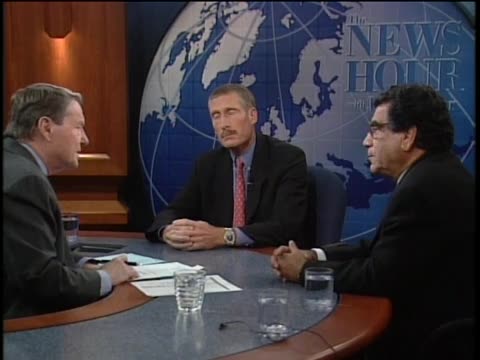
JIM LEHRER: To continue the discussion we get four views now; three from people who testified at today s hearings: Khidhir Hamza, he s the former director of the Iraqi nuclear weapons development program -- he defected in 1994, authored an autobiography called Saddam s Bomb Maker; Morton Halperin is a senior fellow at the Council on Foreign Relations in Washington he served as the director of policy planning at the State Department during the Clinton Administration; Charles Duelfer is a visiting resident scholar at the Center for Strategic & International Studies in Washington he was the deputy executive chairman of the original UN inspections regime of 1993 until its termination in the year 2000; and we hope to be joined in a moment Edmund Ghareeb, an adjunct professor of international service at American University -- he's written extensively about the Middle East.
Mr. Halperin, first, do you agree with what Mr. Hamza just said about containment that eventually Saddam Hussein will defeat it?
MORTON HALPERIN: No, I don't think so. I think that we need to tighten the containment. I talked in my testimony about containment plus, which is to implement the new Security Council resolution, which provides a basis for trying to cut off the illegal flow of material into Iraq and the illegal oil sales from Iraq, so that we deny that regime materials that would contribute to weapons of mass destruction and money to buy such things by a more effective embargo of the country. And I think that is possible if we focus on that rather than on an invasion.
JIM LEHRER: What makes you think that's possible?
MORTON HALPERIN: Well, the Administration worked very hard under the leadership of Secretary Powell to change the UN embargo, so as to let in a great many more materials to allow the Iraqis to repair their oil fields and to sell oil. And the exchange for that was that there would be tighter controls over things that actually directly contributed to weapons of mass destructions or conventional military power. The problem is that countries surrounding Iraq get a great deal of economic benefit from this illegal trade. And what I think we need to do and can do is to offer them financial compensation for foregoing that trade, which would be a lot cheaper than mounting a military operation and pressuring them to agree to that in exchange for delaying any attempt to launch a military operation. I think if we put our energy into that proposal, that there's a real chance that we could get cooperation in the region, precisely because people do not want us to start military operations.
JIM LEHRER: Mr. Duelfer, what's your view of this, of containment?
CHARLES DUELFER: I think there's a distinction you have to make between the things which are smuggled into Iraq that have to do with weapons of mass destruction, and other things. What Mr. Halperin is describing is some way of creating a hermetically sealed environment around Iraq. Unfortunately, inspectors, all the border people in the world cannot stop the limited number of things related to weapons of mass destruction, which could go into Iraq. They can get whatever they need. And what's worse, with respect to chemical and biological weapons, they can make the materials, they can make the production equipment indigenously. They don t need anything from outside. So with respect to containing the WMD, the weapons of mass destruction problem, containment doesn't really help you.
JIM LEHRER: Why not? What about his points that it would help the coalition, it would help the other countries in the neighborhood support what we were doing, in other words as a first step, to take that, take it further than we've taken it thus far?
CHARLES DUELFER: The issue Mr. Halperin is raising is it costs the border states to cut down their trade with Iraq. Most of the trade with a Iraq, even if it's illegal, is illegal in the sense that Iraq is getting things not permitted by the UN; that is a much larger amount of trade, the specific items, which may be related to chemical weapons, biological weapons, nuclear weapons and long range missiles. So containing Iraq for those purposes is a limited set of problems. And it's much harder.
JIM LEHRER: All right. Mr. Halperin, your response?
MORTON HALPERIN: Well, I think that clearly some things they can do indigenously, but for nuclear weapon asks missiles, I think an embargo can be effective. It would also serve to prevent the Iraqis from increasing their conventional capability and therefore, will put greater pressure on them if we at the same time press them very hard on the resumption of the inspections, which are called for by the UN Security Council resolutions, and also to press further on this no-fly zone within Iraq, so that we begin to put increased pressure on the regime and build up support for military operations if they become necessary.
JIM LEHRER: Mr. Hamza, do you believe, you've already said you don't believe containment is going to work, that Saddam Hussein will defeat that? So what are the options then? Military action, that's the only thing left on the table?
KHIDHIR HAMZA: Well, that was the diagnosis of the Administration. And they made that diagnosis long ago under the Iraq Immigration Act. The only way to get around all this hassle, you have to police the world effectively to really restrict Saddam from what he's doing Saddam supporting for Indian corporations to Malaysia, to Singapore, to all the over the world, through Germany previously, most of Europe. So what do you do, police the whole word to contain Saddam? Police his neighbors? Not all of his neighbors can be enticed by money. And, in Syria, obviously cannot be enticed easily by money from the US; you have Jordan, which has inter links with Iraq on many levels and it is impossible for Jordan with a little bit of money to drop Iraq. Iraq is vital to Jordan. So it is really very simplistic to say that if we do this and that Saddam can be prevented from acquiring nuclear weapons, Saddam already has most of the components he needs for nuclear weapons. He needs a few things here and there and he can get them. So he is acting now as a conduit for other types of weapons as mentioned today in the hearings, mortars for tanks and other equipment, and airplane parts. So what you have, you have to embark on a massive operation of running and chasing just about everybody around the globe to stop Saddam from getting what he wants. And it's impossible in the long range. How long can you keep this up, ten years? Already it's been eleven years. How long can the US keep this up and not getting on everybody's nerves with it?
JIM LEHRER: More difficult than a military action?
KHIDHIR HAMZA: I think military action is surgical, is sooner, and it addresses the basic problem, which is this is a regime that has to be -- remember South Africa. South Africa was embargoed by the world, and they got nuclear weapons. The only way they gave them up was when there was a regime change. These types of regime when they made a decision to go in that direction, they know it is vital for their survival and they are not going to back down.
JIM LEHRER: Mr. Halperin, it's two against one because Mr. Ghareeb is caught in traffic here in Washington. So I'm going back to you. How do you respond to Mr. Hamza's point?
MORTON HALPERIN: One has to ask the question what the alternative is. First of all, I am extremely dubious at the notion that there can be a surgical military operation. And I think it would be extraordinarily irresponsible to count on that, that is to start an operation, to ask people in Iraq to cooperate with us as they did after the Gulf War, and then to have them destroyed again because there is not sufficient American military power. If we are going to go into Iraq, we need to put sufficient forces in the region to win a ground combat operation, and we have to assume that it will take a long period of time, that there will be extensive casualties not only of American troops but of civilians in the region. And I think anything short of that is simply irresponsible and is counting on a collapse, which conceivably could happen but would be irresponsible to rely on. Second, I think we have to ask the question, as was asked at the hearing, what would be the new regime? Will the new regime give up nuclear weapons? I would argue that almost any Iraqi regime confronted with the Iranian nuclear program, the Israeli nuclear program, with the Pakistani nuclear program, the Russian nuclear program, will not give up the option to get nuclear weapons. This is not something that is in the mind of the single diabolical person.
JIM LEHRER: We'll come back to the new regime question in a moment. Mr. Duelfer, how do you respond to Mr. Halperin, what is your position on the question of military action? Do you agree with him that it would take a massive action for forget it?
CHARLES DUELFER: I think we have to be thoroughly prepared to deploy a large number of American forces. But bear I mind ultimately what we're talking about is a political action, not a military one. Changing a regime is fundamentally a political act. It may require the willingness and indeed the act of the military forces. But what we're seeking to do is create the conditions in Iraq where the Iraqi people can change their own government. To do that, they need to be convinced that the present manager in Baghdad, Saddam Hussein, is going to be gone. But if we can create that sense, in audiences in Iraq, in regional countries, in Europe, in US, when they start to think about their relationship with the next government, I think they'll see there's an advantage. Saddamwill see himself very lonely. And Iraqi people may be convinced that now is the time to act, and it's in their interest and the interest of their institutions and everyone else to do something. But again, it's uncertain, a lot of uncertainty. But one thing which is certain, all other things being equal, Saddam at some point will get a nuclear weapon.
JIM LEHRER: You agree with that Mr. Hamza, but that's not an issue that Saddam Hussein will get a nuclear weapon at some time?
KHIDHIR HAMZA: Look at the size of his programs, you have something like four or 500 people working in the biological program, a thousand in the chemical, including delivery people. And you have by now 12,000 working in the nuclear. So the sizes tell you where the money is and what's the most important.
JIM LEHRER: What's your best guess as to what he will do with these weapons? Why does he want them, how will he use them? What's the threat from these weapons?
KHIDHIR HAMZA: Nuclear weapons are not going to be used, they ever never were used except in World War II context. The idea of nuclear weapons is to provide his regime with the security he needs to have a free hand in the region. He could go into terrorism with impunity if he has nuclear weapons, nobody is going to go seriously after a regime change when he has it. This is the security here he needs. Saddam is a very insecure person, if you remember, the attack on Iran was out of insecurity against the Khomeini regime. Kuwait the same and security and economically -- Saddam was accusing Kuwait of trying to destroy his regime by selling oil too cheaply. So what you have is a man who needs this, to at least safeguard whatever he got and then go after the region. You see after he gets it, is a much harder and much less manageable Middle East.
JIM LEHRER: Mr. Halperin, how would you describe the three?
MORTON HALPERIN: Even if he got nuclear weapons, as I say I continue to be skeptical that we mow and that he can get them quickly, but we contained the Soviet Union, the same things were said about the Soviet Union. There are other countries in the world that have developed nuclear weapons. The North Koreans have two nuclear weapons. We are quite capable of containing the Iraqis, and the important point is that Saddam is not going to initiate the use of those weapons. He will use them to try to gain a freer hand in the region. But as we demonstrated with the North Koreans, as we demonstrated with the Soviet Union, we can contain a country, prevent it from pressuring its neighbors, whether or not it has nuclear weapons. And I don't think the problem of containing Saddam Hussein is appreciably different whether or not he has a few nuclear weapons.
JIM LEHRER: What about chemical and biological weapons, Mr. Halperin?
MORTON HALPERIN: Well, those weapons he has, and he had chemical weapons at the time of the Gulf War and made a decision not to use them, presumably because he concluded that our retaliation would be greater. But his primary motive is to survive. And he is not going to use nuclear weapons or use chemical or biological weapons unless he believes his existence is threatened. The most likely situation in which he will use those weapons is if we launch an attack, which is clearly designed to remove him from power. He knows he cannot win a conventional war, and therefore his only hope at that point would be to use chemical weapons or biological weapons and hope that the western public and the American public would be so concerned about this that it would demand that the war stop and that we sue for peace. So if our goal is to prevent them from using those weapons, then a strategy of containment is much more likely to succeed than launching the very attack, which gives him the greatest incentive to use these weapons.
JIM LEHRER: Mr. Duelfer, how do you see that?
CHARLES DUELFER: I think it's sort of a backwards view on deterrence. In essence we find ourselves being deterred by Saddam Hussein. And if it starts at that point -- what other steps will he take against our interests, against our friends in the region, and then we will subsequently be deterred from backing up our friends and interests in the region. So I think to turn this argument around and say that the best way of causing Saddam to not use the weapons which he has is to not bother him, don't disturb him, don't threaten his regime, I think that's turning it on its head, --
MORTON HALPERIN: That isn t what I said.
CHARLES DUELFER: -- because then you will have a, he will have achieved his objective, he will have contained the United States and we will be limited in what we re able to do to protect our interests in the region.
JIM LEHRER: All right. We have to leave it there. As Senator Biden said, he hoped the national debate is beginning. We will see. We started it here tonight and we will continue. Thank you all very much.
FOCUS INTERVENTION HISTORY
JIM LEHRER: Now some historical perspectives on all this. Margaret Warner has that.
MARGARET WARNER: And for those perspectives, we're joined by two men who've written extensively on American diplomacy and the use of American power. James Chace, a professor of government at Bard College in New York. And Philip Zelikow, professor of history at the University of Virginia and director of the Miller Center of Public Affairs. And joining them is one of our regulars, Presidential historian Richard Norton Smith, director of the Dole Institute at the University of Kansas. Welcome to you all, and Richard beginning with you, has the United States taken this kind of action before -- that is a preemptive military assault, to force a change of regime, in a country that has not attacked us?
RICHARD NORTON SMITH: We have, although, you know, we were rather late for this whole business of empire. Remember we were more of an isolationist than an interventionist country. It was the Spanish American War at the end of the 19th century that ushered us somewhat reluctantly onto the world stage; even as it was going on, there was an enormous debate which involved President McKinley at the White House among others as to whether the United States would be a liberating or an occupying power. And in the end it was decided that we would keep the Philippines, we would not liberate them, in fact until 1946. Repeatedly in the first half of the 20th century, American Presidents of both parties sent Marines throughout the western hemisphere in particular, usually for economic interests. It was sometimes hard to tell whether American foreign policy was being made at the State Department or the United Fruit Company, which you know as the Octopus by Latinos. All of that began to change, intervention in fact was redefined with the advent of the Cold War, the creation of the CIA, instead of the Marines storming the beaches we had covert operations, Guatemala in 1953, in Iran we put the shah back on the Peecock throne. So I think when we're talking about intervention, we want to be very careful not to limit it to traditional military operations.
MARGARET WARNER: Professor Chace, given that we have a long and rich history of intervention,but what about really military invasion as opposed to covert operations, would you say there's a long history, even if you define it by the military, as a military assault?
JAMES CHACE: Of course there have been direct military assaults as well with the aim of changing regime. For example, Wilson sent in 1914, I believe, troops into Mexico to change the regime. He failed to do so, by the way, but he certainly tried to. Regime changes were made a number of times, in order to, by sending troops in, sending Marines in, in order to try to make a regime responsive to economic needs, to be, in other words, stable. More recently, however, of course, we have sent troops into Panama, roughly 30,000 troops out in the Panama Canal zone in to Panama itself to arrest Noriega, which we succeeded in doing and therefore to change the regime. We of course sent troops into Haiti, also to change the regime. And we might very well have kept troops in Somalia, also to change the regime. So we have used military action in order to do so. In fact, we also sent troops during the Gulf War under President Bush's father. And the aim really was to change the regime in Iraq -- to get Saddam Hussein out. However, we were unsuccessful in doing so.
MARGARET WARNER: Professor Zelikow, what would you add to that, first of all do you share that assessment that there is a real long history here, and what would you add to it?
PHILIP ZELIKOW: There is a long history here. What's different this time is that the reasons for considering American intervention are dramatically different. In the past, we've intervened for regional stability, for reasons of human rights, because we thought there might be an indirect threat of the United States. Here the rationale is that if we don't intervene, a country may develop weapons of mass destruction that might be used directly against America or one of its friends. Now, that's different. The only precedent I can think of that's directly on point is an invasion that didn't happen. It was President Kennedy's decision to invade Cuba if diplomacy failed to get Soviet missiles off that island. And he was quite prepared to first launch a major air strike and then if necessary invade that island rather than let America tolerate the threat he thought would be posed by weapons of mass destruction there. And in a way that's more analogous to the kind of threat that's motivating consideration of this possible intervention against Iraq. I'll add, differing with Professor Chace, President Bush in 1991, did not have the objective of overthrowing the Iraqi regime, they deliberately considered whether to make that one their objectives, and whether you disagree with it or not, they made a very considered decision not to make that one of their objectives.
MARGARET WARNER: Professor Chace?
JAMES CHACE: Well, I would say it was an implied objective. They were not certainly willing to go into Baghdad in order to get rid of Saddam Hussein. But I do believe that they would certainly have preferred Saddam Hussein to have abandoned the regime. And I think that the Administration at that time very much hoped that would happen. But it's also true, as Professor Zelikow points out, that President Bush at that time was very much worried about instability in the region. So it was a delicate balance that went on. And you can argue on either side, whether President Bush senior was actually successful in what he was trying to do.
MARGARET WARNER: Richard Smith, pick up on the point Phil Zelikow made about how different these rationale is, that is, it's to anticipate and head off a future threat, one that involves the nature of weaponry, rather than the litany of some of the other reasons, economic interests, ideological confrontation and so on?
RICHARD NORTON SMITH: Sure. Well, you know, we don't want to be prisoners of history. We want whatever perspective it affords, but there are unprecedented situations. And I think Professor Zelikow is quite right in his interpretation of this. I would add that the whole nature of intervention, as I said earlier, as it has evolved, and the weapons available to various Presidents have evolved, so has the justification. Interestingly enough, there has always been a Wilsonian strange of American foreign policy, an idealistic belief in self determination, and in some ways it was suppressed during the Cold War because everything was seen through the prism of US/Soviet rivalry, including intervention. Since the end of the Cold War, look what happened in Bosnia, for example. There was an enormous intervention by a coalition of western forces to try to remove a genocidal dictator, Slobodan Milosevic; earlier during the Cold War almost certainly that would not happened, because it would not have been defined as being in America's immediate national interest. So these unprecedented situations do arise; intervention is redefined in some ways as the threats are redefined.
MARGARET WARNER: Professor Chace, would you agree with that, that the reasons change as our definition of our national interest changes?
JAMES CHACE: Well absolutely. It's a question of how we see threat. There have not been military threats against the United States, except at that point, which Professor Zelikow referred to in Cuba when Soviet missiles were in place. But we do interpret threats differently. There is the question of what we perceive as an ideological threat. Are interventions covert especially in the western hemisphere against Guatemala, directed against Chile as well, and certainly against Castro in 1961 at the Bay of Pigs. These are essentially ideological threats. Our fear that communism would spread in the western hemisphere and ultimately perhaps undermine certain institutions in the United States, so it s the nature of threat that has changed over time. Now it is a question of possible military threat to the United States -- military in the sense that, in the case of Iraq, that we may be talking about the possession of nuclear weapons or other weapons of mass destruction. So we redefine the threat differently. Once again going back to the Gulf War of President Bush, Sr., the real reason that the United States went into that war was to assure the flow of oil and reasonable prices and that no country such as Iraq would have large control over the region. That was not what was usually given as the reason -- except when the Secretary of State James Baker, when asked why we went into Iraq at that time, said the reason was jobs, jobs, jobs. That was as close as he came to really speaking openly about the notion that a vital resource could be denied the United States.
MARGARET WARNER: Phil Zelikow, you began this colloquy about the nature of the threat and how different this was, except for the Cuban Missile Crisis. What are your thoughts on how that has evolved through history, in other words, why it evolves, why it changes?
PHILIP ZELIKOW: Well, it's changed with the nature of threats themselves. In an era where nations are battling for trade routes or colonies or commerce, and those are their most important interests, naturally conflicts are fought around that. In an era where the greatest threat to our country s safety is the weapons of mass destruction that confer the powers that used to belong to armies and fleets, to small groups of people, well, then our military defenses against those threats also must change. And Margaret, let me add that another big difference between the Iraqi case and some of the historical cases is that we're already in a state of open hostilities against Iraq. We've been in an open state of hostilities against Iraq for years. Now, they don't get on the front page very much, but the President knows because he has to prove them, we're engaged in military combat operations over Iraq almost every day. We're maintaining with our military power a protected zone of, in northern Iraq, where the Kurds are allowed to have a nation defended by the constant use of American force or threat of force. We are policing Iraq right now with planes flying patrols every day. So we're already in a state of low level war with Iraq at the moment. So if there's a transition, it won't be a transition from a nation with which we're at peace to a nation that suddenly we attack. This is a nation that is already in open hostilities against us, it's tried to kill President Bush, it's tried to do other things against Americans, and we're in operations against them every day.
MARGARET WARNER: Would you also say that a corollary difference or parallel difference is the open nature of this debate? Senator Biden and the Senate is now starting this huge open debate which they hope to continue. Is that unusual?
PHILIP ZELIKOW: Yes. There is almost a deliberate theatrical quality to the way this issue is being ramped up for national attention that also seems unusual historically. And maybe that's an artifact of our media age. In part it's an artifact of how much power America has, that we have the luxury to deliberate in a careful way about what may be an acute threat to the United States without being impelled to act on the force of events.
MARGARET WARNER: Richard Smith, your thoughts on that, the unusualness of this public debate?
RICHARD NORTON SMITH: Well, only in a democracy. I mean, that's a great irony is democratic values in the end that we and our allies are sworn to defend. And I said to someone earlier today, the only thing this week that's getting more publicity than our prospective invasion of Iraq is Bruce Springsteen. I think there goes our tactical surprise.
MARGARET WARNER: All right. And there goes our time. Thank you, gentlemen, very much.
UPDATE RX DRUG BENEFITS
JIM LEHRER: And finally tonight, Gwen Ifill has our prescription drugs update.
GWEN IFILL: The Senate today rejected a compromise Medicare prescription drug plan that would have given full drug coverage, minus a $2 co-payment, to seniors who earn less than about $17,000 a year. The plan was the third major prescription drug benefit proposal to fail in two weeks. But other less sweeping measures did make it out of the Senate. Here to describe those proposals, which must now win house approval, is Susan Dentzer of our health unit, a partnership with the Henry J. Kaiser Family Foundation. It seems that we do spend a lot of time focusing on what didn't happen. Let's talk about what did happen. First, this notion of generic drug coverage being part of what the Senate could have found a way to agree on, I guess.
SUSAN DENTZER: Yes. In fact, what the Senate did was enact a bill that would speed the access of generic medications to the market. Essentially what is the case now is that brand manufacturers... once a generic manufacturer applies to bring out a generic version of a drug, the brand manufacturers have the ability through several legal maneuvers to delay that. They do that, in some instances, keeping the generic products off the market for a number of years. This bill that was enacted today by the Senate or at least passed by the Senate would in fact remove some of those legal maneuvers, the ability of companies to do that. And in effect, generic products would therefore probably in some instances get on the market faster. And in fact, some of the savings that are estimated to American consumers by virtue of being able to get cheaper generic products range on the order of $60 billion over a ten-year period. So it could be quite substantial.
GWEN IFILL: So what the Senate did today was essentially close loopholes?
SUSAN DENTZER: Close loopholes, basically eliminate the maneuvers that are complicated and technical. But it essentially was a series of legal ploys that manufacturers could engage in to kind of stack up delays, for these products to be okayed by the FDA..
GWEN IFILL: Really about patent law?
SUSAN DENTZER: It was really about patent law and playing games, in effect, with the patent law. And the one common, the drug Paxil, is certified now, is going to be free of generic competition for five and a half years beyond its normal patent life because the manufacturer was able to engage in these procedures and keep the generic drugs over the market at a cost of perhaps as much as two and a half billion dollars over that five-year period to American consumers and held plans and employers and everybody else who pays the bill.
GWEN IFILL: Brand name pharmaceutical companies responded by saying it slowed their ability to develop new drugs. Was that just rejected out of hand by the Senate?
SUSAN DENTZER: By most of the Senators, because the bill did pass 78-21. Yes, I think most people feel that there's still ample patent protection. In effect, brand manufacturers will still be able to get a 30- month stay for the FDA once a generic manufacturer applies to bring out a generic drug, the brand manufacturer can sue and stop it for 30 months. So you'll still have 30 months to go through all the normal legal procedures to make sure that the generic product... that the generic manufacturer really has a right to bring it out. So there will still be a reasonable amount of patent production. It just will be that manufacturers won't have the ability to drag that out for a period of multiple, multiple years and use it as an anti-competitive device.
GWEN IFILL: There was another thing the Senate agreed to, the term is re-importation, but you've done stories about this. It's a phenomenon where people cross the Canadian border looking for cheaper drug, the same drug in Canada they could get here in the United States, and the Senate tried to address that today.
SUSAN DENTZER: Yes. In fact, because the Canadian government negotiates prices with drug manufacturers, drug prices generally in Canada are as much as 50% lower than drug prices in the United States for brand name drugs. Health plans, pharmacies, others have said, "why couldn't we just go over to Canada, buy the drugs there at these 50% discounts, bring them back, re-import them back into the United States and save a bunch of money for our consumers?" Well, that sounded fairly persuasive, obviously, to the Senate today. So under this bill, for drugs in Canada only-- it doesn't apply to other countries-- not only would health plans and pharmacies be able to go and purchase those drugs in Canada and bring them back into the United States, also individuals would be able for a three-month prescription to order drugs on line from Canada, mail order drugs from Canada, and reap savings as well. So the notion is to basically save as much money, and together with the generics provision, it is argued now American consumers will be able to save perhaps billions of dollars s year.
GWEN IFILL: Let's talk a little bit about what the Senate did not do. You've covered extensively a series of prescription drug Medicare benefit bills, which never quite rose to that 60 vote magic number. What were the policy differences that were at stake here, really?
SUSAN DENTZER: Almost everything was the subject of debate and discussion. Number one, the money; Medicare beneficiaries, people 65 and over, it's estimated, will spend $2 trillion on prescription drugs other the next ten years. So the question was if you're going to help at all with Medicare, how much of that $2 trillion are you going to pick up? At the low end, there are proposals to pick up $160 billion over ten years. At the high end, Senate Democrats were pushing proposals that would have cost $600 billion over a 10-year period.
GWEN IFILL: Did that make a difference in the amount of benefits they were talking about?
SUSAN DENTZER: Absolutely, because the amount of money you're willing to spend will drive not only what kind of benefit you can provide, can you pick up half of the cost of the drugs, can you pick up a third of the cost of the drugs -- what are the deductibles, what are the co- payments required, and most important, who gets those benefits? The proposal that went down to defeat today was targeted not just at low-income individuals, but also at individuals who have what's referred to as catastrophic drug cost, who spend a total of more than $4,000 a year or so out-of- pocket on their drugs. So do you address the low-income? Do you address the catastrophic, or do you address, as many of the Senate Democrats insisted, including people who refused to vote for the proposal today -- wait a minute. Medicare is a universal program. We've got to give it some help to everybody. So all of that was wrapped up in the debate over how big the package was going to be, who was going to be helped.
GWEN IFILL: There is obviously a big emphasis on low-income Medicare recipients and trying to give them some relief. Did anything in these bills speak to middle class Medicare recipients?
SUSAN DENTZER: The broadest Democratic proposal would very much have done that. That's part of the reason it costs $600 billion over ten years. In addition, there was a big debate over the delivery mechanism, who actually delivers the benefits to you. The Senate Democrats have been pushing a plan, very much akin to what most Americans in private health insurance have today. Somebody pays the overall bills, but when you go to get your drugs, you're dealing with something called a pharmaceutical benefits management firm or Medco, Express Scrips, what have you. You mail order the drugs from them, they check your drug interactions, et cetera. The Democrats wanted that to be the delivery mechanism. That wasn't private enough for the Republicans. They very much wanted the government out of the picture altogether, and perhaps even have private health insurance plans deliver these benefits.
GWEN IFILL: A very classic kind of party division about ideology as much as about policy.
SUSAN DENTZER: Absolutely right. And then there were perfect mutations in between. So on all of these issues there reallywas no sufficient meeting of the minds to get to the 60 votes. But this is an important point that all of the Senators on all sides made today. Almost every proposal garnered at least 50 votes in this vote.
GWEN IFILL: Does that mean that when people say this is dead for the year, that it's truly dead, or this conversation continues?
SUSAN DENTZER: The conversation continues, and again, almost everybody in every party said that that would probably be the case over August, that there would be an attempt to resurrect each of these bills to again forge a real compromise, and there's a great push to get this back into the Senate Finance Committee, which is where in theory it should have originated in the first place in the view of many. In fact, that didn't happen because the Senate Finance Committee was unable to get its act together to get a bill together. And so this generics bill was brought onto the floor several weeks ago as a vehicle to pass everything else. So there's an effort now to go back and start the process all over again. And there will be an effort over the next few weeks to see whether that can be achieved.
GWEN IFILL: As always, thank you very much, Susan.
RECAP
JIM LEHRER: And again, the other major developments of this day: A bomb exploded at a university in Israel, killing at least seven people, including at least three Americans. And the U.S. Senate opened major hearings on possible military action against Iraq. A correction: A graphic in the News Summary showed the NASDAQ Index was up today. But it was down 15 points. We'll see you online, and again here tomorrow evening, with continuing coverage of the Iraq hearings and debate. I'm Jim Lehrer. Thank you and good night.
- Series
- The NewsHour with Jim Lehrer
- Producing Organization
- NewsHour Productions
- Contributing Organization
- NewsHour Productions (Washington, District of Columbia)
- AAPB ID
- cpb-aacip/507-707wm14b6f
If you have more information about this item than what is given here, or if you have concerns about this record, we want to know! Contact us, indicating the AAPB ID (cpb-aacip/507-707wm14b6f).
- Description
- Episode Description
- This episode's headline: The Threat; Intervention History; RX Drug Benefits. ANCHOR: JIM LEHRER; GUESTS: JAMES CHACE; PHILIP ZELIKOW; RICHARD NORTON SMITH;CORRESPONDENTS: KWAME HOLMAN; RAY SUAREZ; SPENCER MICHELS; MARGARET WARNER; GWEN IFILL; TERENCE SMITH; KWAME HOLMAN
- Date
- 2002-07-31
- Asset type
- Episode
- Topics
- Education
- History
- War and Conflict
- Health
- Religion
- Military Forces and Armaments
- Politics and Government
- Rights
- Copyright NewsHour Productions, LLC. Licensed under a Creative Commons Attribution-NonCommercial-NoDerivatives 4.0 International Public License (https://creativecommons.org/licenses/by-nc-nd/4.0/legalcode)
- Media type
- Moving Image
- Duration
- 01:02:49
- Credits
-
-
Producing Organization:
NewsHour Productions
- AAPB Contributor Holdings
-
NewsHour Productions
Identifier: NH-7386 (NH Show Code)
Format: Betacam: SP
Generation: Preservation
Duration: 01:00:00;00
If you have a copy of this asset and would like us to add it to our catalog, please contact us.
- Citations
- Chicago: “The NewsHour with Jim Lehrer,” 2002-07-31, NewsHour Productions, American Archive of Public Broadcasting (GBH and the Library of Congress), Boston, MA and Washington, DC, accessed May 9, 2026, http://americanarchive.org/catalog/cpb-aacip-507-707wm14b6f.
- MLA: “The NewsHour with Jim Lehrer.” 2002-07-31. NewsHour Productions, American Archive of Public Broadcasting (GBH and the Library of Congress), Boston, MA and Washington, DC. Web. May 9, 2026. <http://americanarchive.org/catalog/cpb-aacip-507-707wm14b6f>.
- APA: The NewsHour with Jim Lehrer. Boston, MA: NewsHour Productions, American Archive of Public Broadcasting (GBH and the Library of Congress), Boston, MA and Washington, DC. Retrieved from http://americanarchive.org/catalog/cpb-aacip-507-707wm14b6f