The MacNeil/Lehrer Report; Iran - What's Next?
- Transcript
ROBERT MacNEIL: Good evening. There were continued demonstrations, strikes and violence in Iran today despite efforts to form a new civilian government and reduce the Shah`s role. Reuters reports fifty to sixty people killed in clashes between police and demonstrators in the town of Qazvin. Today the violence spread to this country; some 200 demonstrators described as Iranian students stormed the house of the Shah`s sister in Beverly Hills. The Shah`s ailing ninety-year-old mother has been staying there. The demonstrators set fire to brush, and flames reached to within twenty feet of the house. The students were beaten off by police with tear gas and fire hoses. There were fresh demonstrations in Tehran. Airport workers shut down Tehran Airport, creating huge jams of American and other civilians waiting to flee. But troops took over the airport, and some planes took off. Oil production remained below Iran`s own needs, adding to the economic dislocation.
In the middle of all this turmoil, Shahpur Bakhtiar, the liberal opposition figure chosen by the Shah to be prime minister, was reported to nearly ready with a new civilian cabinet, and is expected to present it to parliament and the Shah later this week. General Gholam Riza Azhari, who has led a military government for the past six weeks, has resigned to make way for the civilian replacement. But Bakhtiar has not so far picked up support from the National Front or the religious leaders behind the opposition campaign. And the Shah, whose removal they insist on, has not yet left.
Tonight, is a new government the key to peace in Iran or the key for further chaos? -- a question of vital importance to Washington. Jim?
JIM LEHRER: Robin, once again there are people going to a small village outside Paris for answers to this latest set of questions about Iran`s future. They go to the villa of the exiled Iranian Moslem leader, Ayatollah Ruhollah Khomeini. It has been increasingly clear in recent weeks that the seventy-eight-year-old Khomeini has major thumbs-up, thumbs-down power on what solution is or isn`t acceptable to the Shah`s opponents. This includes this latest proposal for a new civilian government.
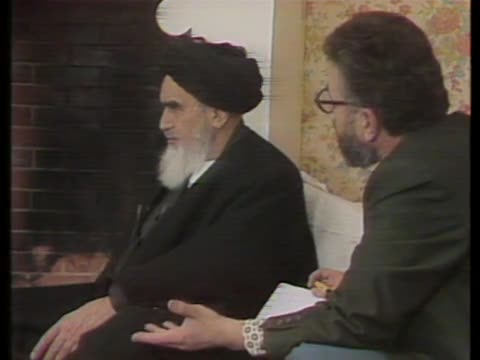
Last month Robert MacNeil, through an interpreter, interviewed Khomeini in France. That was before this latest round of demonstrations and violence began, but much of that conversation is relevant to what`s happening now, particularly his views about the United States.
(December 1, 1978. Ponchartrain, France.)
MacNEIL: How would relations with the United States change if the government you want came to power in Iran?
Ayatollah KHOMEINI: We don`t want to do any wrongdoing or oppression against the Americans, neither will we tolerate any oppression. We will not tolerate what they have done to us, but however, Persian nations with all nations will be friendly; if they treat us with respect, we will treat them with respect.
MacNEIL: What have the Americans done to you, that you object to?
KHOMEINI: The American government, they have committed the biggest crime by imposing on our people the Pahlavi dynasty. Through this support they have plundered our natural resources, and instead in return they have given us things that do not help our people in any way. They have dominated our army in order to support their cause, to stand against our people. They have made bases in our countries, which are contrary to our independence. With this Shah we don`t have any life in our countries, and this is the American government who support the Shah. The President of the United States, time and over, has called our people names, dirty names, the people that they have raised to achieve their human rights -- he has called us names. Is this Mr. Carter`s logic? The American people, they have put pressure on their president to stop this support. We are a nation under the oppression and the despotic regime of the Shah; all our people, they are crying for freedom, and this freedom has been denied from them. We don`t have the true independence, we are suffering, and through these mass murders and massacre they have overcome. So these are the issues that we have raised, and these are the issues that our people, they are fighting. We want the liberty of our people, we want to have independence of our country. Is this something that Mr. President Carter should call is dirty? The American people should seriously question their officials, because we don`t like that the whole Moslem nations throughout the world have some wrong notions concerning the American people and come and make a conclusion that not only the American government but the American people also are the opporessors. If the American people support the cause of the Iranian people for their liberty, we will also be grateful to them.
MacNEIL: There are some $20 billion in American military contracts outstanding in Iran. If your government comes to power, will you cancel those contracts?
KHOMEINI: These contracts are against the national interest of our country. One of the crimes that the Shah has created is to accept these kinds of contracts, which does not have any benefit to our poor people. All these contracts which are against the national interest will not be acknowledged. However, those contracts that are useful to our cause, we will keep them.
MacNEIL: Which ones are useful, and which ones are not?
KHOMEINI: This is not something that I can tell you right away. Some of these contracts, like the using the oil revenues, exporting the oil and using the revenue of that and buying the armaments that does not have any use for our people, these are definitely harmful against our national interest. Some of the useful contracts can be like the one which will help our agriculture, which will help our industrialization. Definitely they will be useful. But however, those that do not have any benefit we will not accept.
MacNEIL: You mentioned bases. Would you ask American bases to leave Iran?
KHOMEINI: These bases, basically speaking, are against our national interest. However, later on our expertise should come and review and tell us exactly what they are, what we should do.
MacNEIL: Has anyone in the American government or representing the American government been in touch with you recently?
KHOMEINI: Not at all
MacNEIL: Is the American government ignoring you?
KHOMEINI : I don`t know.
MacNEIL: It is reported that -- we have been told that you personally have chosen the person who should be nominated as the leader of the next government. Is that so?
KHOMEINI: There are people in my views; I have considered them.
MacNEIL: It is several people, not one?
KHOMEINI: Several people.
MacNEIL: Several.
MacNEIL: That interview took place a month ago. How does the Ayatollah view the present situation in Iran, and will he accept the efforts to form a civilian government? Khomeini`s closest associate now in the United States is Shahriar Rouhani, a member of the Young Moslems Organization and currently a Ph.D. candidate at Yale University. Mr. Rouhani is with us tonight in the studios of Public Television Station KERA in Dallas. Mr. Rouhani, will Ayatollah Khomeini back a government headed by Shahpur Bakhtiar?
SHAHRIAR ROUHANI: Not by any means. Any government in presence of Shah of Iran while he is in power is completely rejected by the movement and Ayatollah Khomeini, indeed.
MacNEIL: Can I ask you what your authority is for saying that? Have you been in touch with Khomeini recently?
ROUHANI: Yes; I know so.
MacNEIL: Since Mr. Bakhtiar was named by the Shah.
ROUHANI: Since then, and actually as far as I know, by this afternoon.
MacNEIL: As late as this afternoon. Would one assume that Mr. Bakhtiar was not on the list of people chosen by the Ayatollah as potential leaders?
ROUHANI: Since I do not know the list and I did not know then, I can`t tell you that. But certainly Mr. Bakhtiar was not and will not be.
MacNEIL: Why would the Ayatollah, as the principal religious leader of your country, not grasp this opportunity to stop the bloodshed and economic chaos, represented by Mr. Bakhtiar`s efforts to form a civilian government?
ROUHANI: We do not understand that the government of Mr. Bakhtiar is genuine at all, the government that he proposes, because so long as the Shah is present in his throne he is trying to buy the time to recreate the army, and the psychology that we are waging against the army to destroy the army, to stop that and recreate his position and enforce his position, you know, into the Iranian government.
MacNEIL: But the Shah has agreed, apparently, when the time is right to leave on an indefinite vacation, as he put it. Does that not represent symbolically a decision to quit?
ROUHANI: We cannot count on that. We want him out. We do not want any action, any government with his presence. We have tried it several times in the course of history. From 1906 we established the revolution from the constitutional monarchy; repeatedly we`ve been betrayed. We can no longer accept any presence of Shah or monarchy as a whole.
MaCNEIL: Even if he agreed to stop being an absolute monarch and to become a constitutional monarch, reducing his powers, that would still not be acceptable to the Moslem movement?
ROUHANI: No, it cannot be. Because we`ve tried it in the course of history, and it has not worked. Apart from the theoretical problems that we do disagree with him, we cannot accept him even on the practical basis.
MacNEIL: What will happen after Mr. Bakhtiar announces his government, assuming the parliament approves it in the next few days?
ROUHANI: A government which has been made by Shah of Iran is of no value. You know, most of those people have been approved by the Savak agents, anyway...
MacNEIL: The secret police.
ROUHANI: What will happen is this, that we shall continue our struggle against any form of government that Shah produces, which in turn enforces and establishes an interpower in a period which comes afterwards.
MacNEIL: As you know, President Carter has made it pretty clear that he intends to go on supporting the Shah and that he supports a compromise solution such as the Bakhtiar one might represent. Where does that put the United States now, in your view?
ROUHANI: Mr. Carter cannot go against the total history, Mr. MacNeil. Iranian people are determined to gain the freedom and independence and to be friends with American people on equal standing and standards. So a nation so conceived and so dedicated to the cause of liberty, freedom and establishment of Islamic government cannot be destroyed. And this, soon, the American government will realize, with the backing of American people that we have.
MacNEIL: I see; we`ll come back. Jim?
LEHRER: All right, some journalistic perspective now from the syndicated columnist Joseph Kraft. Mr. Kraft has been following the Iranian crisis closely, both on the ground in Iran and back here in Washington.
Joe, is this new civilian Bakhtiar government going to work without Khomeini`s okay?
JOSEPH KRAFT: I think Khomeini has important veto powers, and it seems to me not at all clear that it can work without his support. I should also add, because I think it`s an element that most of us tend to miss, that the army plays an important and I think not altogether unindependent role, and it`s not at all clear to me that Mr. Bakhtiar is going to have the backing of the military. Indeed, when he first announced that he was taking over and that the military would report to him rather than to the Shah, it was very, very clear that he didn`t have their backing. So I would say the Bakhtiar government is an extremely iffy and dicey proposition.
LEHRER: How important --with Mr. Rouhani listening in Dallas let me just ask you -- how important is Khomeini to what`s going on in Iran, from your reading of it?
KRAFT: Look, I am not an expert on Iran, I`ve been there about a dozen times or so, but I really don`t know the country, for example, nearly as well as Mr. Rouhani does. It did seem to me that there were several elements in the picture that he didn`t mention and that most of us tend to overlook. I think that the Ayatollah Khomeini has formidable negative powers, and it`s not clear to me that any solution that he vehemently opposes can get by. But it is also not clear to me that he has a lot of positive powers; it`s not clear to me, for example, that he can even organize a consensus for something positive that embraces the other religious leaders. His relations with the military are certainly very, very unclear to me, and I would think that it`s at least a possibility that the likelihood of his early return might precipitate a military coup. Robin mentioned one thing earlier that it seems to me we ought to be focusing on much more intently.
LEHRER: The Shah`s decision to leave the country, or willingness to leave the country?
KRAFT: Exactly. It seems to me that that, particularly in the light of what Mr. Rouhani was saying about no acceptance of a government while the Shah is there, and in view of what we`ve seen of the Shah -- we`ve seen him on television; he looked to me when I saw him six or eight weeks ago...
LEHRER: This was in person when you saw him.
KRAFT: Yeah; I interviewed him about two months ago -- and at that point I was struck at how he almost seemed like a basket case then; he certainly looks much worse now, so I would think that it`s not clear how long the Shah can hang on. I think he`s in bad shape. So it seems to me that one of the really critical things, in view of the fact that a minimal condition for Ayatollah Khomeini`s approving any government is that the Shah get out, and in view of the fact that the Shah himself looks as though he`s not altogether capable of handing down decisive orders -- and in view of the fact that he had a meeting with the American press the other day where the one thing he said was that he was prepared to take a vacation -- it seems to me that his disposition to leave, to go on leave, to take a vacation, is something that clearly is a new element in this situation, that`s a key to this situation that clearly ought to be picked up; and my sense is that that`s the heart of the debate going on now in Washington.
LEHRER: Picked up by whom? What should the United States do? Let`s say the Shah has given the world a signal, "Look, give me a way out and the way out is let me go on vacation." Then what should the United States do?
KRAFT: If the next step is the Shah`s taking a leave, it seems to me that that leave is a very, very delicate thing to arrange. It seems to me not at all clear that it can be done only by the Iranians themselves. It seems to me that they do need help from friendly people whom they trust, and the United States is peculiarly well-positioned to do that. We have a lot of people whom the Shah trusts, we know the relationship between the Shah and the army, we know the army people well; our military people have close relations with their military people. If you`re going to get the Shah to move, you have to do something about when and under what conditions the Ayatollah Khomeini is going to come back; we can do that. You have to say something to the Russians, because they are, you know, it seems to me very edgy; we can do that. So it seems to me that one of the things that`s up for grabs, although you can`t see it here in Washington, is the notion of sending a presidential mission out to Iran to help -- to play a part in the transition. We`ve been hanging back so far.
LEHRER: Well, let`s ask Mr. Rouhani about that idea. Do you think that`s a feasible solution or a step toward a solution?
ROUHANI: Mr. Lehrer. I should talk more about Mr. Joseph Kraft, that he says he`s not an expert; nonetheless he comes and says that the Iranian people cannot take care of their own affairs. The only solution will be as following: upon leave of Shah, upon his toppling, overthrow, whatever you may call it, we shall create an interim council. The interim council, which is by the approval and endorsement of Ayatollah Khomeini and the movement in Iran, will immediately establish or start the national election to create the general assembly in Iran. The general assembly will determine the totality of the government of the Islamic republic which has to be established. This will take place with the presence of all the representatives of the Iranian people.
LEHRER: Well, let me ask you this specific question, though, Mr. Rouhani: that Joe Kraft`s suggestion that there might be a role for the United States to play to bring the elements representing the Shah, the elements representing you and the Ayatollah, plus being able to fend off the Russians at the same time might be able to just put it all together and make it work. You do not see that as a legitimate role for the U.S. right now?
ROUHANI: Well, the United States can send a delegation to take all the CIA agents, all the military advisers and all of the puppets of the government out of the country. And we assure you that we have no intention of becoming too close with the Russian government at all. We establish our own government. So the positive role that the American government can play is to give us technical assistance in agriculture, in the civil services, in the educational levels, medicine, et cetera -- and we desperately need it; after all, you know, Iran has been on the verge of a revolution -- and then we can establish good, excellent relations with the United States of America.
LEHRER: Joe?
KRAFT: Mr. Rouhani, I really meant it when I said I wasn`t an expert on the map, but there is a question that I would like to ask you in view of that rather complicated and elaborate scenario you laid out: what makes you think that the army is going to sit still for that? Aren`t they going to resist that? You talked about the disintegration of the army. You think the military chiefs in Iran are just going sit still and do nothing?
ROUHANI: Yes, sir. I mean, anytime in the course of history that the figure of a dictator has been pierced and has been attacked and cracked, suddenly the army which has followed it completely cracked and was destroyed. This has been repeatedly shown in the course of the history.
KRAFT: I would deny that. I would say that the history is when a monarch gets forced out the military take over.
ROUHANI: On the contrary, the military does not have the power it has shown it to.
LEHRER: We have the power to go, I`m sorry. Robin?
MacNEIL: Yes. I think we`re going to be watching this situation a lot more in the future, so we`ll have a chance to go over these things again. Thank you, Mr. Rouhani in Dallas, for joining us this evening. Thanks, Joe Kraft in Washington. Good night, Jim.
LEH RER: Good night, Robin.
MacNEIL: That`s all for tonight. We`ll be back tomorrow night. I`m Robert MacNeil. Good night.
- Series
- The MacNeil/Lehrer Report
- Episode
- Iran - What's Next?
- Producing Organization
- NewsHour Productions
- Contributing Organization
- National Records and Archives Administration (Washington, District of Columbia)
- AAPB ID
- cpb-aacip/507-6h4cn6zm7k
If you have more information about this item than what is given here, or if you have concerns about this record, we want to know! Contact us, indicating the AAPB ID (cpb-aacip/507-6h4cn6zm7k).
- Description
- Episode Description
- The main topic of this episode is Iran - What's Next?. The guests are Joseph Kraft, Shahriar Rouhani. Byline: Robert MacNeil, Jim Lehrer
- Created Date
- 1979-01-02
- Topics
- Global Affairs
- War and Conflict
- Religion
- Transportation
- Military Forces and Armaments
- Politics and Government
- Rights
- Copyright NewsHour Productions, LLC. Licensed under a Creative Commons Attribution-NonCommercial-NoDerivatives 4.0 International Public License (https://creativecommons.org/licenses/by-nc-nd/4.0/legalcode)
- Media type
- Moving Image
- Duration
- 00:31:08
- Credits
-
-
Producing Organization: NewsHour Productions
- AAPB Contributor Holdings
-
National Records and Archives Administration
Identifier: 96769 (NARA catalog identifier)
Format: 2 inch videotape
If you have a copy of this asset and would like us to add it to our catalog, please contact us.
- Citations
- Chicago: “The MacNeil/Lehrer Report; Iran - What's Next?,” 1979-01-02, National Records and Archives Administration, American Archive of Public Broadcasting (GBH and the Library of Congress), Boston, MA and Washington, DC, accessed April 2, 2026, http://americanarchive.org/catalog/cpb-aacip-507-6h4cn6zm7k.
- MLA: “The MacNeil/Lehrer Report; Iran - What's Next?.” 1979-01-02. National Records and Archives Administration, American Archive of Public Broadcasting (GBH and the Library of Congress), Boston, MA and Washington, DC. Web. April 2, 2026. <http://americanarchive.org/catalog/cpb-aacip-507-6h4cn6zm7k>.
- APA: The MacNeil/Lehrer Report; Iran - What's Next?. Boston, MA: National Records and Archives Administration, American Archive of Public Broadcasting (GBH and the Library of Congress), Boston, MA and Washington, DC. Retrieved from http://americanarchive.org/catalog/cpb-aacip-507-6h4cn6zm7k