The MacNeil/Lehrer NewsHour
- Transcript
MR. MAC NEIL: Good evening. I'm Robert MacNeil in New York.
MR. LEHRER: And I'm Jim Lehrer in Washington. After our summary of the news this Monday, we have a report on the election eve tensions in South Africa, an update from Gorazde in Bosnia, a profile of Jim Leach of Iowa, the Republican point man on Whitewater, and some thoughts about the passing of Richard Nixon by former New York Times columnist Tom Wicker. NEWS SUMMARY
MR. LEHRER: There were two more bombings in South Africa today. At least two people were killed and dozens injured in a blast at a tavern in Pretoria. Earlier in the day, a huge car bomb exploded in a Johannesburg suburb, killing 10 people. More than 20 have been killed in a wave of terrorist attacks over the past two days. They coincide with the country's first all race elections which begin tomorrow. Charlayne Hunter-Gault reports from Johannesburg.
MS. HUNTER-GAULT: The bloody campaign of terror continued today when a 220-pound bomb ripped through a crowded taxi stand in the Johannesburg suburb of Germantown at a quarter of 9 in the morning. The blast mangled commuter vans, heavily damaging buildings in the working class area. In addition to the ten killed, dozens of others were injured by flying metal and glass. It followed a similar blast yesterday which killed nine people. Late today, the terror spread to a Pretoria suburb when yet another explosion killed at least two people and wounded dozens at a tavern frequented by blacks. While there has been no claim of responsibility, white extremists opposed to black majority rule have threatened violence to disrupt the elections which begin tomorrow and run for three days. In Cape Town at the least session of the white-dominated parliament, President F.W. DeKlerk said a group of desperate people had declared war on South African society, and he vowed to punish those responsible for the carnage.
PRESIDENT F. W. DeKLERK, South Africa: If these people were real men, they would come out into the open and discuss their concerns and proposals and not kill and maim innocent men, women, and children. We will not rest until they've been tracked down, convicted, and punished as they deserve.
MS. HUNTER-GAULT: African National Congress President Nelson Mandela, who is expected to win theelections and become South Africa's first black president, visited some of the victims of yesterday's bombing. He vowed that terrorists would not stop the election.
NELSON MANDELA, African National Congress: The mad men who are now slaughtering innocent people because they fear democracy.
MS. HUNTER-GAULT: Mandela called for unity of all South Africans and urged them not to be afraid to cast their ballots.
MR. LEHRER: We'll have an extended report from Charlayne right after this News Summary. Commerce Sec. Ron Brown said today the United States would increase its economic commitment to South Africa when the post-apartheid government takes office. He said the level of assistance would increase from about $70 million to $140 million over the next three years. He spoke in Washington.
RON BROWN, Secretary of Commerce: Although America already contributes substantially more in overseas aid to South Africa than any other single nation, we all know that much more is needed. The administration is committed to at a minimum doubling the present assistant levels to South Africa. President Clinton is committed to support real social reconstruction in South Africa, housing and commerce and education and health care. We seek to support the process of democratization and to establish a strong commercial relationship with South Africa.
MR. LEHRER: International aid organizations have begun removing their workers from the African nation of Rwanda. The French organization, Doctors Without Borders, left one Southern town after 170 patients were massacred in their hospital. The International Red Cross has also pulled back its staff. A spokesman said people were being executed right in front of Red Cross workers. Heavy shelling was also reported today in the capital of Kigali. The fighting between two tribal troops began April 6th, after the presidents of Rwanda and neighboring Burundi died in a suspicious airplane crash. An estimated 100,000 people have been killed since.
MR. MAC NEIL: Bosnian Serb forces continued to withdraw from Gorazde today under a NATO ultimatum. Tanks and artillery were seen rolling away from the Muslim enclave. The Serbs must remove all heavy weapons from a 12-mile area around the town by early Wednesday or face the threat of allied air strikes. The UN called off an attempt to get food into Gorazde today after Serbs blocked a convoy, but it was able to evacuate 79 seriously wounded or sick people this morning after flying out a similar number yesterday. The UN first got access to the town Sunday after a three-week Serb assault which killed 700 people and wounded nearly 2,000 others. In Washington, President Clinton said he was encouraged by the cease-fire.
PRESIDENT CLINTON: It appears that the, the pressure brought to bear by NATO and the UN has worked, that the cease-fire is holding, that the withdrawal is continuing. We will continue to monitor the situation very closely as the next day unfolds. I do want to say it's now clearly time to get the diplomatic initiative going again, while we maintain our vigilance. But I am pleased by the progress of the last 48 hours.
MR. MAC NEIL: Sec. of State Christopher flew to London today for talks with Britain and France on a new diplomatic initiative to end the war. He flies to Geneva tomorrow to meet with Russia's foreign minister. Human rights groups reported today that soldiers in Haiti massacred at least 23 people. The victims were shot on Saturday in a neighborhood loyal to the deposed President Jean-Bertrand Aristide.
MR. LEHRER: President Clinton spoke at a memorial service today for 15 Americans killed by friendly fire over Iraq. They were riding in two helicopters mistakenly shot down by two U.S. fighter jets two weeks ago. The Americans were part of Operation Provide Comfort, an international effort to protect the Kurds in Northern Iraq. Today's ceremony was held at Ft. Myer, Virginia, just outside Washington. It was attended by the nation's military leaders and family members of those killed.
PRESIDENT CLINTON: The Americans we honor today represented the best in our country, and the tragic irony, all who were involved in this accident, including the pilots of the two jets, were there on a common mission, to save the lives of innocent people. We know that just as we are all proud of their ability and their bravery, their readiness for any challenge, their devotion to their families, we all understand that they like we, none of us are immune from error, from tragic circumstance.
MR. LEHRER: Twenty-six people died aboard the helicopters. In addition to the fifteen Americans, there were six military officers from Turkey, Britain, and France, and five Kurdish civilians.
MR. MAC NEIL: Japan's parliament today easily confirmed Tsutomu Hata as the new prime minister, but soon afterwards, the largest party in his ruling coalition, the Socialists, announced they were pulling out in a political dispute with the other parties. The move stripped the coalition of its parliamentary majority, and it was not clear whether Hata's government could survive. In El Salvador, the ruling right wing Arena Party won a clear victory in the country's first presidential election after 12 years of civil war. The new president will be Armando Calderon Sol. His party defeated a coalition by former commanders of Salvador's left wing rebels.
MR. LEHRER: President Clinton called again today for Congress to pass a ban on assault weapons. He did so during a Rose Garden ceremony honoring Americans who assist victims of violent crimes. On Capitol Hill, a House Committee held hearings on whether to ban assault weapons. They heard different opinions from a woman whose parents were killed by a man using an assault weapon and a man whose wife was killed with one last year.
STEVE SPOSATO: Can any of you advise me how to tell a one- year-old that mommy is dead? Perhaps the manufacturer of the Intertech DC-9 assault weapon should publish this information in the instruction manual of its murderous product? The most important reason why I'm here today is because I feel sorry for the hundreds of thousands of people in this country that will feel my pain. The people who are next don't know who they are, or when their tragedy will occur, but it will.
SUZANNA GRATIA: About one month ago, I was in Kansas speaking and they also had a couple of gang members there, died-in-the-wool, tatoo-wearing gang members, and someone -- it had nothing to do with gun control -- but someone asked one of the gang members, "How do you feel about gun control?" He laughed, and he said, "Honey, you can make any laws about guns you want. The fact is it doesn't make 'em any tougher to get; it only makes 'em a little more expensive to get. And that means I got to go down the road and rob you to get the money to get it."
MR. LEHRER: And that's it for the News Summary tonight. Now it's on to the South Africa elections, a Bosnia update, Jim Leach of Iowa, and Wicker on Nixon. FOCUS - WARRING FACTIONS
MR. MAC NEIL: First tonight, our continuing look at South Africa during its historic transition to a multiracial democracy. Bomb explosions over the weekend and today killed 21 people. In addition, the bloody rivalry between the African National Congress and the Inkatha Freedom Party took the lives of three ANC election campaigners in Ulundi, the capital of the Zulu homeland. Against this backdrop of continuing violence, Charlayne Hunter-Gault looks at one of South Africa's major challenges, the violent collision of politics and ethnicity.
MS. HUNTER-GAULT: The latest violence in South Africa, two rounds of car bombings in Johannesburg and the possibility they were carried out by radical, white right-wingers, has focused attention anew on the divide between this country's black majority and its white minority. But until this week, the violence associated with the election campaign also involved another layer of conflict, possibly fed by radical whites but mostly between blacks. This was the image of the Zulu beamed all over the world, a warrior clan pressing its modern day political case in the traditional spirit of its much revered ancestors. The violence is down now that the mainly Zulu Inkatha Freedom Party has ended its boycott of the election. But the bitter conflict between followers of Inkatha and the African National Congress has been deadly, some 20,000 men, women, and children murdered in the last ten years, have of them in the Zulu-dominated Natal Kwazulu area of South Africa. And the issue of the Zulus and their place in a new South Africa is still unsettled, not least because there are constitutional problems that are still to be negotiated after the election and because despite perceptions outside the country, South Africa's Zulus are deeply divided in their political loyalties. It was King Shaka's often brutal campaign against other clans in the early 1800's that established the Zulu nation as the most powerful black nation in subsaharan Africa. Under later rulers, Zulus vanquished both the British and the Boors until their defeat at Ulundi, the capital of Kwazulu today. There are now some seven million Zulus in all of South Africa, making them the largest ethnic group in the country and some say the most nationalistic. Zulus are proud of their history and traditions, and they maintain them in symbols and in ceremony. The leopard skin chest and head pieces indicate the wearer's royal blood. The Zulu monarchy is the only one remaining among more than one dozen tribes of South Africa. The king, 46- year-old Goodwill Zwelatini, holds no political power. That is exercised by his cousin, Mangosuthu Buthelezi, chief minister of Kwazulu and head of the Inkatha Freedom Party. It was only after some accommodation was made for his demands for constitutional protection of that monarchy for more powerful regions like Kwazulu that Buthelezi finally decided to enter Inkatha in the elections. Like most of the homelands blacks were forced into by the apartheid government, Kwazulu sits on the most barren land, with few resources. Farming jobs in the former British colony of Natal are not enough to sustain the population. Although many Zulus remain in rural areas, many others have migrated to urban centers like Johannesburg, where they have found work in the mines and industry around the White areas. It is here that we find the Zulus, despite their traditions, are not monolithic and, in fact, are often on opposite ends of the political spectrum. In a suburb near the Soweto township where he was born, we find Sipho Mathobela, a 26- year-old Zulu who is planning to attend law school next year. He works as an administrator in a Johannesburg law firm, managing the office and filing cases in court. He earns about $500 a week but is the sole supporter of his family, including six younger siblings. Mathobela is a Zulu and a member of the Inkatha Party, active in the Youth Brigade. This was the day of the announcement last week that Buthelezi and Inkatha would contest the election, and the mood was far more upbeat than it had been in months. Andrew Mzobe is a 27-year-old foreman at a pipe and steel manufacturing company. He's worked here for seven years while studying by correspondence to complete his education. He earns about $113 a week and is also the sole supporter of his family, his mother, and two nephews. He lives in the black township of Tmbisa, population about 350,000. There is calm in the area now, although last summer it because a flash point for ethnic violence when 200 men living in the hostel, single-sex resident for mine workers and others working or seeking work from the rural areas, attacked and killed people from the township believed to be aligned with the ANC. Like most of the people in this Tmbisa area, Andrew Mzobe is a Zulu who supports the African National Congress. At different times, we talked with both these young men about what it means to be a Zulu in this political environment and how they thought it would affect his future and the future of their nation in this historic an delicate period of transition.
ANDREW MZOBE, African National Congress: I'm proud of being called Zulu. It's like others have went to an extent of hiding themselves to be Zulus because of the political situation in our country. If you are a Zulu-speaking person, other people consider you to be an enemy.
MS. HUNTER-GAULT: How does being a Zulu today affect your life?
ANDREW MZOBE: We don't look at each other as one tribe, so most of the issues are being analyzed in terms of politics, you know. So Zulus are now divided across political lines or across the political parties, so there is no more this issue of Zulus considering themself as a tribe.
SIPHO MATHOBELA, Inkatha Freedom Party: I was born a Zulu, and I'll die being a Zulu. Whether I like it or not, I'll die being a Zulu. My mother is a Zulu. My father is a Zulu. That makes me a Zulu. We speak Zulu in my family. And we exercise Zulu traditions. We exercise Zulu customs, and we even worship our ancestors.
MS. HUNTER-GAULT: But unlike Mzobe, Sipho Mathobela identifies strongly with the Inkatha Freedom Party.
SIPHO MATHOBELA: I did not join the IFP because I'm a Zulu. I totally and fully subscribe to its policies. That's all. In fact, I liked the principles of the IFP because they embraced democracy in its totality, and in its -- I mean, the -- in the IFP, within the structures of the IFP, I have learned that an individual has the right to voice out his opinion.
MS. HUNTER-GAULT: Both these young men's lives have been deeply affected by politics. Mzobe was thrown in jail for a year for his ANC activities. He resents the suggestion that all Zulus are members of the Inkatha Freedom Party.
ANDREW MZOBE: To me, it is unacceptable for say IFP in their activities to use the weight of Zulus.
MS. HUNTER-GAULT: The impression is often given that all Zulus are pro-Inkatha, and everybody else is ANC. Do you know many Zulus who also support the ANC?
ANDREW MZOBE: Yeah, it's true. I mean what is happening is the majority of the Zulus are for ANC. Most of the Zulu people have joined IFP just for security reasons, so not that most of them joined IFP willingly, and there are those who joined because of their fear. Others, they stay in hostels, as I have said, and dominantly in hostels IFP is dominant.
MS. HUNTER-GAULT: Mathobela says Inkatha is not the only party to blame for the people's insecurity and fears of violence.
SIPHO MATHOBELA: You know, it is very much unfortunate, very, very unfortunate that in our country there is a culture which set our townships. That is the culture of political intolerance. The IFP is not an exception to that. It is not an exception to that, but one has to look at this issue, at a broader context of it, you see. No party should carry this blame alone.
MS. HUNTER-GAULT: Have you ever been confronted physically?
SIPHO MATHOBELA: There were some of the ANC youth leaders who told me that whenever they can get hold of me, I'll be killed and so on. I've lost many friends in that violence. And by saying friends, I do not mean that my IFP friends. You know, I've lost brothers, because it was a black brother facing a black brother, fighting a black brother, you see. And I couldn't stand it.
MS. HUNTER-GAULT: Mzobe is also distressed by the violence, but argues that it was caused by Inkatha's taking advantage of the ANC's suspension of the arms struggle in 1990.
ANDREW MZOBE: Zulu people are not per se warriors fighting against other people. The people, the culture of Zulu people is to unify people and immediately ask that the African National Congress suspended the arms struggle, the violence that had been. Before the ANC suspended the arms struggle, there was no sort of violence of this nature.
MS. HUNTER-GAULT: What about the king, how do you feel about the Zulu king, Zwelatini?
ANDREW MZOBE: To be honest, I'm having a problem with the king, especially in the present days, okay, because if you talk of -- if you take the demand of the zulu king, you know, there has just been a demand from last month, so it's surprising now on the eve of the election the king could come up with such a demand of the Zulu kingdom.
MS. HUNTER-GAULT: Do you care that there is -- whether there is or is not a Zulu kingdom?
ANDREW MZOBE: I'm totally against the issue of Kwazulu kingdom.
MS. HUNTER-GAULT: Why?
ANDREW MZOBE: Because it takes us back to the state of which we call feudalism, where the kings were considered as the dominant people in the society. And if you take feudalism, it was anti- progress. And in this present stage, we feel that democracy is the base in which the society can be established, not on Zulu kingdom.
MS. HUNTER-GAULT: Mathobela strongly defends the idea of a Zulu kingdom.
SIPHO MATHOBELA: To a king, I'm a subject. That is why when I talk about him, I say, his majesty. I respect him. I respect that man, because I see him as the person who upholds, who keeps my culture and so on, you see. In fact, he is Zulu No. 1 to me.
MS. HUNTER-GAULT: Despite their differences, both these young Zulu men are hopeful about the future.
ANDREW MZOBE: Really, I'm feeling great, you know, because even if I wasn't a prominent figure, but I know that my contributions have assisted in bringing his process of democratization of our country.
MS. HUNTER-GAULT: Is being a Zulu going to have a place in a new South Africa?
ANDREW MZOBE: My thinking is that the Zulu people must consider themselves as part and parcel of South Africa. Okay. And they should not consider themselves as separate entity or as separate tribe from the whole of South Africa.
SIPHO MATHOBELA: One has to be optimistic about the future. You know, what I can say concerning this, in regard to this violence in our country is that, one, let us not rely most on the political leaders. Let usnot react violently when they make inflammatory statements. Let us not listen to leaders who do not have vision when it comes to our country's future.
MR. LEHRER: Charlayne will be reporting from South Africa all this week. Still to come on the NewsHour tonight, the Whitewater man from Iowa, and Tom Wicker on Richard Nixon. UPDATE - END IN SIGHT?
MR. LEHRER: But first now an update on the siege of Gorazde, the Bosnian town that has become the latest symbol of the horrors of war in that part of the world. Peter Morgan of Independent Television News reports.
PETER MORGAN, ITN: Hooting their horns in defiance, the Bosnian Serbs remind the UN that they're pulling back from Gorazde on their own terms. After three weeks of fighting, the Bosnian Serb soldiers have shrunk the Muslim enclave from thirty miles to just three. More than 700 people have died during the offensive. Muslim snipers fired at the Serbs as they withdrew. The Serbs responded by blowing up Gorazde's water pumping station and setting fire to outlying villages. UN troops from Ukraine, France, and Russia arrived in the Serbs' wake. Some 480 UN soldiers are now around Gorazde, spreading out along the front lines. They'll try and ensure the Serbs observe the next step of the NATO ultimatum to pull all their heavy weapons out of a 12-mile zone around Gorazde by early Wednesday. Peace of a sort has allowed the UN to start evacuating the casualties of war. Sarajevo's Kosovo Stadium where the Olympic Games were launched 10 years ago has been turned into a landing strip. The UN aims to fly 600 people out of Gorazde over the next week. Their passage though is delayed by the Bosnian Serbs, who insist on checking each flight. After the hell of Gorazde, Sarajevo offers some comfort and safety. Children like nine-year-old Emina Dezhdarovic have become orphans, her left eye lost after a mortar explosion, a child's world destroyed.
EMINA DEZHDAROVIC, Little Girl: [speaking through interpreter] I was with my mother, brother, and aunt. We were sitting there, and then suddenly I don't remember anything afterwards.
MR. MORGAN: In Sarajevo's relative silence, parents still with their children recall the scene.
UNIDENTIFIED MOTHER: [speaking through interpreter] Everything burning, they slaughter everyone, destroying everything. It can't be a worst slaughter. They destroyed whole families. It was hell
MR. MORGAN: UN doctors were also caught up in Gorazde's fighting.
DR. MARY McLOUGHLIN, United Nations High Commission for Refugees: The conditions in the last 10 days in Gorazde were absolutely horrendous. There is -- at times there were shells falling in the inner city and in the hospital area every few seconds. There was constant sniper fire. People's houses were shelled, and if any of the survivors managed to get out in the street, they risked being shot down by snipers.
MR. MORGAN: In London, John Major played host as Russia's special envoy put forward his new ideas on Bosnia. The Russian Defense Ministry opposes the use of air strikes, so Mr. Churkin put the emphasis on diplomatic initiatives over the next few weeks.
VITALY CHURKIN, Russian Envoy: For my part, I made a rather strong pitch for a comprehensive cessation of hostilities agreement between the Serbs and the Bosnian government. We have been working for that agreement for quite a while now. Essentially, it is a document which is almost prepared, and we believe that given political will on both sides, it could be something which could be signed very quickly.
MR. MORGAN: Later, Warren Christopher and Douglas Hurd went in, followed by the French. Russia wants an international conference on Bosnia. The contact group proposed today effectively puts that idea on hold.
WARREN CHRISTOPHER, US Secretary of State: The contact group, I think, is a way to begin this, to try to regain the momentum that existed prior to the situation in Gorazde, to try to carry forward, to build on some tentative agreements that were reached in Geneva.
MR. MORGAN: Latest pictures from Gorazde tonight showed the UN setting up base in a devastated town. It's not clear when, if at all, the UN can reverse the Serb gains here. FOCUS - AT THE VORTEX
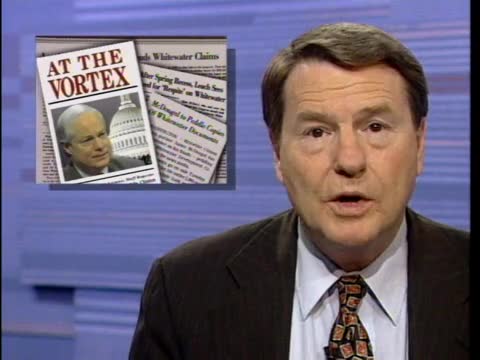
MR. LEHRER: Now the Republicans' chief messenger on the so-called Whitewater affair. He's the once obscure Congressman from Iowa, Jim Leach. Kwame Holman profiles the man and the issue he won't let go.
MR. HOLMAN: Since last December, Rep. Jim Leach has been everywhere, preaching his gospel that the Whitewater controversy involves at least unethical actions by the Clintons.
REP. JIM LEACH, [R] Iowa: I do not think, for example, this is of Watergate proportions. I've said that from the very beginning, and I maintain it now. This is a breach of public ethics, in my judgment, that occurred prior to the President taking office.
MR. HOLMAN: In his quiet manner, the senior Republican on the House Banking Committee, has hammered away, insisting the Clintons disclose all details of their 1978 investment in the company called Whitewater that sold vacation homes in Arkansas. Leach says during the 1980s some of the Clintons' debts were paid with funds taken from Madison Guaranty, the now-defunct Little Rock savings & loan. In making his charges, Leach has battled the President's defenders.
REP. JIM LEACH: [CNN Segment] That is a small issue. Let me go to the larger issue.
CORRESPONDENT: That's another lie, America.
REP. JIM LEACH: Where is the lie?
CORRESPONDENT: That's a misstatement.
REP. JIM LEACH: That's your rhetoric.
REP. JIM LEACH: [MacNeil/Lehrer Segment] What we have here is a candidate who ran as a man of the people but appears to be putting himself above the people on personal ethics and appears to be putting himself above the Congress on financial disclosure.
REP. BARNEY FRANK, [D] Massachusetts: With no specific allegations whatsoever to justify that, Jim.
MR. MAC NEIL: Okay, Congressman Frank.
REP. JIM LEACH: The press has been attacked. Allegers have been attacked. People in public life have been attacked. But the message has not been responded to, and until it is, there's going to be a kind of a little bit of a cloud hanging over this White House.
MR. HOLMAN: Democratic Congressman Barney Frank of Massachusetts says Leach has thrust himself out on a limb by stoking the Whitewater controversy.
REP. BARNEY FRANK: It's also, I think, just what happens sometimes when you get into a fight -- I think Jim found himself in a fight frankly with less than he thought was there, and he can't back down. To some extent, he's got a tiger by the tail. He has pumped this up into something that far exceeds what it is.
MR. HOLMAN: Jim Leach's move into the national spotlight has its roots here in Southeastern Iowa, where citizens in and around Davenport on the banks of the Mississippi have elected Leach to the House of Representatives nine straight times. Many people here see Leach as something of a local hero, and when the softspoken Congressman speaks, plenty of Iowans listen. Leach grew up in Davenport, and here his pursuit of Whitewater goes virtually unchallenged, as at the Kiwanis Club luncheon during the recent Easter congressional break.
SPOKESMAN: Few people can transcend political lines. Although Jim Leach is a Republican, his message goes beyond partisanship. I believe the reason for this can be summed up in one word, integrity. You never have to question his motives. You only appreciate his knowledge, forthrightness, and his sincere quest for the truth. I am proud to introduce to you our Congressman from the First District, Jim Leach.
REP. JIM LEACH: Well, thank you very much. Let me just say how honored I am to be here at home, and it's been a little controversial time for me, and so I appreciate being with friends.
MR. HOLMAN: More and more in recent weeks, Leach has cast himself as the reluctant leader of the Republican charge on Whitewater.
REP. JIM LEACH: I probably felt stronger than almost anyone I know about the difficulties it is when you take on some part of the background of the most powerful person in the world, which is the President of the United States of America. What began as a reasonably legitimate real estate endeavor came to be infused with resources from a federally insured S&L. Those resources led to conflicts of interest that I think are of a black and white variety. It's the responsibility of all minority parties and all western democracies to shine the spotlight of embarrassment upon a governing or ruling party when there is a stretching of public ethics. But I will tell you, I hope it's soon over. Thank you very much.
MR. HOLMAN: Many in this audience have observed Leach over the years and see his prominence on the Whitewater issue as a sharp contrast to his non-confrontational reputation. That say that adds credibility to his charges.
SANDY ARMSTRONG: He does not have a reputation for crying "wolf" when there isn't something to get excited about, and I guess that's what made me sit up and take notice, is I knew that he would not bring it to our attention unless it was worthwhile.
JUDITH WILLIAMSON: I just feel like it's kind of gotten out of his hands. He'd like to see it done. He wants a good job. He wants a thorough investigation, but I think that there's been a little more media attention than even he expected or appreciated.
MR. HOLMAN: Over at the Quad City Times, Davenport's daily newspaper, editors have heard their readers' complaints about the press's recent preoccupation with Whitewater. But editor Dan Hayes says the complaints stop short of including Jim Leach, himself.
DAN HAYES, Quad City Times: I think most people just looking at Whitewater, itself, wonder, look, this happened a long time ago, I don't fully grasp how today affects it, but that doesn't detract from their feeling that Jim Leach is doing a good job on this issue. And they're glad that Jim Leach is doing a good job on this issue. And I think people are glad that Jim Leach understands it, because they don't.
MR. HOLMAN: And Hayes says those favorable opinions of Leach cross party lines among the independent-minded voters of his district.
DAN HAYES: More and more people are voting for the individual and not the party. And Jim Leach is an individual.
MR. HOLMAN: Jim Leach's tenacity on the Whitewater issue may come easily to a man who was a statewide wrestling champion in high school. Later, Leach quietly resigned his job as a rising young foreign service officer to protest Richard Nixon's 1973 firing of Archibald Cox, the special prosecutor in the Watergate case. In 1990, Leach's district was redrawn to include more Democrats. Still, he won with 68 percent of the vote, matching hisbest showing ever.
ERIC TABOR, Chairman, Iowa Democratic Party: Democrats for years said Jim Leach is not so bad, he's almost like a Democrat, I'm going to support him because he's a pretty good Congressman. Democrats have changed their views dramatically towards him.
MR. HOLMAN: Eric Tabor heads the Iowa Democratic Party.
ERIC TABOR: This is serious business. This is the President of the United States and a member of the Congress standing up, making accusations. You've got to have your facts straight. And on a number of things he simply did not have his facts straight, and you can't just say, well, it's no big deal. It is a big deal. This is a President of the United States. The American people have got to have faith in the President. Where is the substance of these allegations?
UNIDENTIFIED SPOKESPERSON: Before the gentleman begins, may we please have the House in order.
MR. HOLMAN: Last month, Leach went to the House floor to detail findings of his ongoing look into Whitewater. Some of his allegations later were called into question by journalists. But Leach stands by his central assertion. Leach says that during the 1980s, James MacDougal, the principal owner of the Whitewater Company, paid off some of Bill and Hillary Clintons' personal loans. Leach says MacDougal got the money to do that from deposits in the savings & loan he also owned. The federally insured savings & loan, Madison Guaranty, ultimately went bankrupt, costing the government $60 million.
REP. JIM LEACH: I have no doubt whatsoever that funds were infused into Whitewater from the savings & loan directly or indirectly from other MacDougal-related investments, and that some of these funds were used to pay off personal liabilities of the then Governor of Arkansas.
MR. HOLMAN: What is your sense of what the Clintons knew about those obligations, whether they knew they were being paid by -- you believe -- by MacDougal and what their response to that may have been?
REP. JIM LEACH: Well, here is -- I mean, the great question of, of the whole Whitewater episode. If one has a view of a very distanced governor and First Lady who weren't involved in any of the economics of the state, one might suggest that they had no idea. From the other hand, if one has a view that they were more intricately involved, one would reach a more skeptical conclusion.
MR. HOLMAN: We asked Congressman Leach whether he believes MacDougal received anything in return from then Arkansas Gov. Bill Clinton.
REP. JIM LEACH: Well, the question of quid pro quos is certainly a central question, and here again, one has to make some judgments about what matters and doesn't matter. I mean, there are minor quid pro quos in one sense. This institution was allowed to continue for an extended period of time, despite being insolvent. Mr. MacDougal's suggestions in who should be on a state regulatory commission seemed to be accepted. There are a series of other minor quid pro quos. Whether they're serious, that's a matter that others can assess.
MR. HOLMAN: An investigator for the Resolution Trust Corporation, the federal agency charged with bailing out bankrupt savings & loans like Madison, suggested MacDougal also may have made mortgage payments for the Clintons, using funds from bad checks MacDougal wrote. According to the New York Times, the investigator said in a memorandum, "If you know your mortgages are being paid, wouldn't you question the source of the funds being used to your benefit?"
REP. JIM LEACH: One of the memos from a government criminal investigator is that normally peopleknow when some else is paying off their liabilities. On the other hand, these are two very active people in the political process who had a lot of other things on their mind, and so maybe they didn't.
REP. BARNEY FRANK: The argument, well, the Clintons benefited from it, they may well have benefited from it, but did they know that they were benefiting from it? Should they have known? Did they cause it to happen? All those things remain unanswered.
MR. HOLMAN: Congressman Frank, Jim Leach's colleague on the Banking Committee, says all those questions should be left to Whitewater special counsel Robert Fiske.
REP. BARNEY FRANK: Fiske's going to answer them, but even if they're true, the worst argument is, oh, well, they benefited from money that this guy spent and he shouldn't have spent in this way, we don't know whether they knew it or not nine years ago. How does that become a major issue of the presidency?
MR. HOLMAN: At her surprise news conference last Friday, Mrs. Clinton said she knew nothing about any payments MacDougal may have made on the Clintons' behalf.
REPORTER: Are you convinced that no moneys from Mr. MacDougal or any of his related companies paid any obligations of yours or your husband's?
HILLARY RODHAM CLINTON: I know of nothing to support that, and I think we should wait and see what all the facts are, because, you know, I just want to reiterate that we didn't even see any documents until late in the 1980s, probably late '88 or '89, and so I just don't have any way of telling you want went from '78 to '88 or '89.
MR. HOLMAN: As for Congressman Leach, throughout his pursuit of Whitewater, he has been accused by some Democrats of pushing the issue at the urging of his party's conservative wing. Leach says he made his own decision and may have to live with some unhappy consequences if he's wrong about Whitewater.
REP. JIM LEACH: How the public comes to sort this out is something that, you know, could well have more liabilities than anything for me. I have assumed that from the very beginning.
MR. HOLMAN: The Whitewater special counsel is expected to release his full report within a few months. CONVERSATION - RN - 1913-1994
MR. MAC NEIL: We close tonight with some thoughts on Richard Nixon, who died on Friday at the age of 81. For an assessment of the former President's personal and political legacy, we talk to a reporter and writer who covered him for many years. Tom Wicker, a former White House correspondent and columnist for the New York Times, also wrote a history of Nixon's political life entitled One of Us. Tom Wicker, thanks for joining us.
MR. WICKER: Glad to be here.
MR. MAC NEIL: Many -- Nixon's death is forcing many other commentators to do now what you sat down and did three years ago, which was to take a fresh and objective look at the man. Has his death made you reconsider again in any way?
MR. WICKER: No, I don't think so. I went through that to the extent that I did reconsider sometime ago. I didn't reconsider entirely. I don't say that Mr. Nixon is a blameless figure, anything of the sort. What I did come to the conclusion -- the conclusion I did come to was that before Watergate, before Watergate, he was quite a substantial figure, both as president and in our politics generally. And I think that Watergate is like a wall, particularly in front of young people. They can't see past that wall to these other things. So I tried to rectify that, and I think that you do it.
MR. MAC NEIL: Some of the reviewers of your book three years ago found it intriguing that a liberal columnist, as they labeled you - -
MR. WICKER: Yes.
MR. MAC NEIL: -- would find so much to admire in Nixon. Now, there are some interesting assumptions there.
MR. WICKER: Well, in the first place I accept that label gladly. But in the second place, you know, Mr. Nixon as president was the first president to impose wage and price controls in peacetime. He created the opening to China. He made the first significant arms limitation treaty with the Soviet Union. And even though each of those things one might be able to criticize in detail, nonetheless, those are not things one connects with conservative Republican Presidents. And they are things that most liberal columnists in general agree with.
MR. MAC NEIL: Just on the liberal and columnist side of this for a moment, nothing was more obvious and central to Nixon's public life than how he and the press saw each other. Would you agree with that?
MR. WICKER: Oh, absolutely true. And he almost from the beginning of his career, he had an adversarial relationship at the very least with the press. I say almost from the beginning, because in the first years of Mr. Nixon's career, the Alger Hiss case for example, he had a reasonably good relationship with the press. I mean, most of the press at that time was supporting what he was going. The relationship turned sour in 1952 during his campaign for the vice presidency, on the Eisenhower ticket, when he was accused of having a secret slush for disposal in politics. And the accusation really wasn't accurate, it wasn't secret, and it wasn'a a slush fund in the sense that we knew it. But a great deal of fuss was made about it. It appeared for a while as if Eisenhower might drop him for the ticket, which was the beginning of a fairly bad relationship there. So from that point on, Nixon and the press were -- I'd say -- at dagger's points.
MR. MAC NEIL: That's one of the interesting things to me is how hostile Dwight Eisenhower was to Richard Nixon and how he tried in two campaigns or for two presidential elections to dump him, did he not?
MR. WICKER: Yes, he did. After all, President Eisenhower had had his own heart attack before he ran again in 1956, so he very wisely knew that the public was going to be looking very strongly at the vice presidential nominee, because a man who'd had a heart attack might conceivably have another one. And he apparently felt and said certain things that would lead one to believe that he didn't feel Mr. Nixon was really up to the job and even more important, he didn't think the public thought that. So he would be a drag --
MR. MAC NEIL: Do you know why he didn't think Nixon was up to the job?
MR. WICKER: I don't know. I don't know, and I suppose since -- particularly since President Eisenhower and Mr. Nixon were reconciled later on, I don't know why that was, but I do know that during the first term in particular, the first Eisenhower term and the second term, Nixon was relegated largely to political tasks. He was regarded as a politician. As we know later, he regarded himself much more seriously than that, as an expert on many things. And I think he resented quite deeply that he was not allowed into the inner policy circles of the Eisenhower administration.
MR. MAC NEIL: Or, as you point out in your book, ever upstairs in the living quarters of the White House in the entire time as vice president.
MR. WICKER: Well, I think that's right, yes.
MR. MAC NEIL: Did you find him difficult to cover?
MR. WICKER: Well, after all, you start out by describing --
MR. MAC NEIL: I guess what I mean it's difficult to be fair to as a reporter -- did his style as it did for so many people get in the way of being fair to Richard Nixon?
MR. WICKER: Oh, yes, it did, and I think there is absolutely no doubt that when Watergate came along -- and I'm not here saying that Mr. Nixon wasn't guilty of those things -- I think there's absolutely no doubt that both on the part of the press and on the part of many Democratic politicians and no doubt some liberal Republican politicians, there was a almost a salivation, here's the chance to get Nixon, and they wanted to do it. And I think that that was not really out of line in a way because they felt that he'd often felt the same way about them. And so the partisanship both on the part of politicians and the press I think was very, very much in evidence then.
MR. MAC NEIL: What legacy have the Nixon years left in the way the national press corps, particularly the White House Press Corps, which you used to belong to, treats Presidents now?
MR. WICKER: I think quite a serious legacy. Mr. Nixon, of course, was deeply involved in Vietnam and in Watergate, and both Vietnam and Watergate coming on the heels of each other, so to speak, really changed the attitude, in my judgment, of the Washington press. Up until perhaps the midway of the Johnson administration when the public really turned against Vietnam, I would characterize the press -- and I was part of it -- and I'm not accusing colleagues of anything that I wasn't guilty of -- I think the press was fundamentally a kind of a tame, hand out press. We accepted what the President said without much -- and leading members of Congress -- without much question. After that, when it became obvious that Presidents could and would and did lie to you, then I think the press's attitude changed. And the first President to really suffer that -- the consequences was President Carter. The press really went for him in many ways I think. Interestingly enough, they didn't do that for President Reagan. I think the reason for that was that President Reagan in a sense intimidated the press. I don't mean by threatening him or anything of that sort, but most of us didn't expect Ronald Reagan to get elected in 1980, and he did, and became immensely popular. And I think the press concluded that he knew something about the country that we didn't, and I suspect that's true.
MR. MAC NEIL: I was in Washington over the weekend, and I heard a number of people, not in one group, but several different places, say, ask, why should there be a day of national mourning for Richard Nixon, which made me wonder whether there wasn't some rancor left, some echo of rancor left in the public mind that they would ask this question about a dead President.
MR. WICKER: Oh, I think there is, and I think that's particularly true on the part of people who were deeply devoted, and many people were, to President Kennedy. The feeling somehow, I don't think they've ever lost it, there was a feeling of rancor developing out of the 1960 election, I think, not so much between the two men, themselves, as between the people who were, who were devoted to each of them. So -- and I think also many people genuinely deployed Watergate, and what it did to our country, and the stain it left on us. And even though I think President Nixon could feel that in the last 20 years he had regained some stature as a leader and as President Clinton said an adviser on foreign policy, an analyst, a commentator, still he never wiped out the stain of Watergate, and I don't doubt if it ever will be.
MR. MAC NEIL: Do you find itinteresting that in a way President Clinton has been more gracious and generous to him in public than some Republican leaders have been in recent times?
MR. WICKER: Well, it is, but then someone who was commenting on this over the weekend said that there's a kind of an ex-President's club, you know, a Presidents club, and I think that's true. After all, there are, what is it, only 41 men have held that office. There are only four of them alive now. So, so it's not unusual I think.
MR. MAC NEIL: I read a commentary in the Washington Post over the weekend by a former Saturday Evening Post editor, Kurt Smith, who also wrote some speeches for Nixon, and he said, he said, Peoria understood Nixon. Washington never got why middle America loved him. Certainly there seem to be a lot of people still who feel that Washington and the national press overplayed his sins and underplayed his virtues. Wouldn't you say that?
MR. WICKER: Well, that could certainly be argued, and if it's true, and I think to some extent in certain cases it was, it's because there was such an intense partisan conflict between Nixon and the Democrats and the press, and it's true on both sides. Mr. Nixon was not a man to, to forgive lightly or to overlook slights. He, he had his own -- he had his own resentments, deep resentments in many cases, and if that's the case, then there are likely to be people who have those same feelings about you, and I think they did. I would say that in the years that I've covered politics, which goes back a long way, that Richard Nixon and Lyndon Johnson aroused the most, the most contradictory feelings, I mean, the most people both for him and against him. President Kennedy not so much. He didn't have the capacity quite to make enemies the way they did.
MR. MAC NEIL: You are a prolific novelist as well as a journalist. If you -- thinking of Richard Nixon as a man who might be the subject of a piece of fiction, what do you make of the way his character and his fate played out together just as the way character became -- if it did -- the sort of predictor of his fate?
MR. WICKER: Yes. I think Mr. Nixon probably -- and I don't want to overstate this -- but in literary terms, he's the nearest thing to a tragic figure I've seen in our politics. Lyndon Johnson may be very much the same way. Men -- I think it was Elliott Richardson who said of Richard Nixon that he had within his grasp the capacity to be the greatest post war President. And I think in many ways that's true, and yet, there was something within his character. He hated to much. He resented too much. He was too uncertain. He was too secretive. All of these things made up some great flaw in his character that I can't quite put a hand on to describe it in one word, and that flaw as in, as in other tragic heroes, was his ultimate downfall.
MR. MAC NEIL: Do you -- do you feel, whether as novelist or journalist, you really understood his character?
MR. WICKER: Oh, no. No, no. I spent five years working on a book about Richard Nixon, and one of the things that I remember most clearly is I interviewed Dr. Arthur Burns, who was -- Nixon had appointed the Federal Reserve, and I said something about I hoped to understand Mr. Nixon, and he looked at me, and he said, you will never do that, and I never did.
MR. MAC NEIL: You -- I think it was in your book that you quote Kissinger -- a very poignant Kissinger line about Nixon, about being, if he had been loved. Do you remember that line exactly?
MR. WICKER: Yes, I did quote that, but that was actually Hugh Siedy in Time Magazine. Kissinger said that to him. He said that, I'm sure not referring to Nixon's family or daughters, he said he would have been a great man if someone had only loved him, and I think the meaning was that if he had had a friend or teacher or someone, a confidante, someone that he could trust and would have trusted, then that inability that he had to trust anybody would have been dissipated and perhaps other people would have trusted him. I think that at least I take to be the meaning of what Kissinger said.
MR. MAC NEIL: You called your book One of Us, and it's been marked a number of times by various people, Gary Wills and others, that Nixon was America looking itself in the mirror in a way that, the dark, the better angels of our nature, and the dark angels. Do you, do you believe that? Do you believe that he was in some ways a sort of exemplar?
MR. WICKER: Yes, I rather do. Norman Mailer it was I think who said that John Kennedy was a romantic ideal of ourselves. And I think Nixon was a -- and I have written this -- I think Nixon was a kind of a darker reality within ourselves, and he, himself had said somewhere along the line that you really had to understand the dark side of the American people in order to deal with 'em, to lead them, and I think he did to a certain degree, but by seeing that dark side within himself. And I think there is a, there is -- as each of us individually we have our, our good side and our bad side. I think the American people have a light side and a dark side. And I think Nixon understood that, and he was one of us.
MR. MAC NEIL: Tom Wicker, thank you. RECAP
MR. LEHRER: Again, the major stories of this Monday, there were two more bombings in South Africa, bringing the two-day death toll from terrorist bomb attacks to more than 20. The country's first all race elections begin tomorrow. And Bosnian Serb forces continued to withdraw from Gorazde under a NATO ultimatum. President Clinton said it appeared NATO and UN pressure was working. Good night, Robin.
MR. MAC NEIL: Good night, Jim. That's the NewsHour for tonight. We'll see you again tomorrow night. I'm Robert MacNeil. Good night.
- Series
- The MacNeil/Lehrer NewsHour
- Producing Organization
- NewsHour Productions
- Contributing Organization
- NewsHour Productions (Washington, District of Columbia)
- AAPB ID
- cpb-aacip/507-610vq2sw98
If you have more information about this item than what is given here, or if you have concerns about this record, we want to know! Contact us, indicating the AAPB ID (cpb-aacip/507-610vq2sw98).
- Description
- Episode Description
- This episode's headline: Warring Factions; End in Sight?; At the Vortex; Conversation - RN - 1913-1994. The guests include SIPHO MATHOEBELA, Inkatha Freedom Party; ANDREW MZOBE, African National Congress; TOM WICKER, Author; CORRESPONDENTS: CHARLAYNE HUNTER-GAULT; PETER MORGAN; KWAME HOLMAN. Byline: In New York: ROBERT MAC NEIL; In Washington: JAMES LEHRER
- Date
- 1994-04-25
- Asset type
- Episode
- Rights
- Copyright NewsHour Productions, LLC. Licensed under a Creative Commons Attribution-NonCommercial-NoDerivatives 4.0 International Public License (https://creativecommons.org/licenses/by-nc-nd/4.0/legalcode)
- Media type
- Moving Image
- Duration
- 00:59:18
- Credits
-
-
Producing Organization: NewsHour Productions
- AAPB Contributor Holdings
-
NewsHour Productions
Identifier: 4913 (Show Code)
Format: Betacam
Generation: Master
Duration: 1:00:00;00
If you have a copy of this asset and would like us to add it to our catalog, please contact us.
- Citations
- Chicago: “The MacNeil/Lehrer NewsHour,” 1994-04-25, NewsHour Productions, American Archive of Public Broadcasting (GBH and the Library of Congress), Boston, MA and Washington, DC, accessed January 9, 2026, http://americanarchive.org/catalog/cpb-aacip-507-610vq2sw98.
- MLA: “The MacNeil/Lehrer NewsHour.” 1994-04-25. NewsHour Productions, American Archive of Public Broadcasting (GBH and the Library of Congress), Boston, MA and Washington, DC. Web. January 9, 2026. <http://americanarchive.org/catalog/cpb-aacip-507-610vq2sw98>.
- APA: The MacNeil/Lehrer NewsHour. Boston, MA: NewsHour Productions, American Archive of Public Broadcasting (GBH and the Library of Congress), Boston, MA and Washington, DC. Retrieved from http://americanarchive.org/catalog/cpb-aacip-507-610vq2sw98