The NewsHour with Jim Lehrer
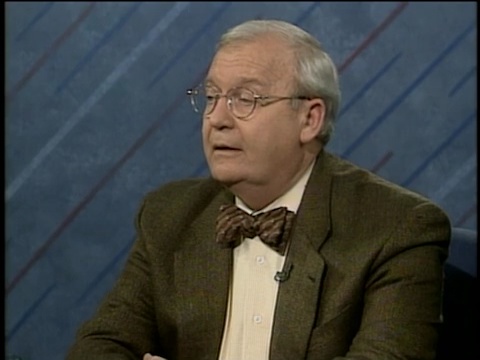
- Transcript
JIM LEHRER: Good evening. I'm Jim Lehrer. On the NewsHour tonight, the news of this Friday; then, a look at the coming of the end for the Terri Schiavo case; the latest on the revolution in the former Soviet Republic of Kyrgystan; and the analysis of Mark Shields and David Brooks.
NEWS SUMMARY
JIM LEHRER: The parents of Terri Schiavo appealed to an Atlanta federal appeals court today for the third time in four days. It came hours after a federal judge in Florida ruled for a second time not to put Schiavo back on a feeding tube. And late this afternoon, the parents went back to seek help from a Florida state judge who already has ruled against them several times. In the latest federal appeal, the parents said their daughter's due process and religious rights were being violated. Earlier this week, the 11th Circuit Court denied a similar appeal. The brain-damaged woman was removed from a feeding tube one week ago. Outside Schiavo's Florida hospice today, advocates for keeping her alive continued their vigil. Her father said her time is limited.
BOB SCHINDLER: Terri is weakening. She's down to her last hours. So something has to be done and it has to be done quick.
JIM LEHRER: We'll have more on this story later in the program. The U.S. has agreed to sell Pakistan about two dozen sophisticated fighter jets. Sales of F-16s were halted in the 1990s as part of U.S. sanctions over Pakistan's nuclear program. More recently Pakistan has been a U.S. ally in the war on terror and today hailed the renewed sales as a "good gesture." But its neighbor and nuclear rival, India, called it a "great disappointment." In Washington, State Department Spokesman Adam Ereli denied the sales would change the region's military balance of power.
ADAM ERELI: Relations between India and Pakistan have never been better. That's point one. Point two, stability comes from a sense of security, and to the extent that we can contribute to Pakistan's sense of security and India's sense of security, that will contribute to regional stability.
JIM LEHRER: The U.S. said it will allow American defense companies to enter the bidding to build new fighter aircraft for India, which plans to make purchases in the near future. In Iraq today, insurgents launched two major attacks. The largest happened to the West in Ramadi; 11 policemen died in a suicide car bombing at a checkpoint. At least 14 others were wounded, including two U.S. Soldiers. In Baghdad, gunmen killed five Iraqi women working as translators for the U.S. Military. Insurgents also assassinated the commander of an Iraqi national guard unit in southern Iraq. Opposition leaders in Kyrgyzstan struggled to restore order today, one day after a popular uprising brought down the government. Widespread looting broke out in the capital overnight, with at least one person reported killed. Thirty-one police officers were wounded. Parliament reconvened and named an interim president, who then appointed several acting ministers. The whereabouts of ousted President Askar Akayev remained unknown. He is thought to have fled the country yesterday. Today an e-mail statement attributed to him called opposition leaders "irresponsible adventurers and conspirators." We'll have more on this story later in the program. The FBI ruled out terrorism in Wednesday's explosion at a Texas oil refinery. The blast at the BP facility outside Houston killed 15 people and injured more than 100. Agents also said they'd found no evidence of foul play. Investigators said it could take months to determine the exact cause. Today, Good Friday, marked the beginning of Easter Weekend. Thousands of Christians from around the world gathered in Jerusalem to walk the way of the cross. It's believed to be the path Jesus took that led to his crucifixion. At the Vatican in Rome, Pope John Paul was unable to attend traditional Good Friday ceremonies because of failing heath. However, he was seen by the crowds by way of a video link. The pontiff was sitting alone in his chapel watching the ceremonies on a large television. A senior cardinal said Pope John Paul was lucid despite his poor physical condition. Back in the United States, financial markets were closed today in observance of Good Friday. And that's it for the news Summary tonight. Now it's on to: Moving toward the end of the Terri Schiavo case; the Kyrgystan upheaval; and Shields and Brooks.
FOCUS - LIFE AND DEATH
JIM LEHRER: Jeffrey Brown handles our Schiavo discussion tonight.
JEFFREY BROWN: One extraordinary week after the feeding tube was removed from Terri Schiavo, she remains in a hospice in Pinellas Park, Florida. Doctors have said she would likely die within a week or two after the tube's removal. Much about her case continues to raise important and difficult questions. And tonight we look at the situation through two different lenses. Dr. Russell Portenoy is a neurologist and chairman of the Department of Pain Medicine and Palliative Care at Beth Israel Medical Center in New York. Robert George is a member of the President's Council of Bioethics and a professor of jurisprudence at Princeton University. And welcome to both of you.
Starting with you, Dr. Portenoy, a week after the removal of the feeding tube, what would a patient such as Terri Schiavo be experiencing?
DR. RUSSELL PORTENOY: Well, typically patients who are toward the end of life and do not have access to nutrition or hydration slowly get quieter and sleepier; they lapse into coma. The coma gradually deepens and then finally they die.
JEFFREY BROWN: Now in this case, Terri Schiavo is in a persistent vegetative state. We've been hearing about that all week. Can you tell us as neurologist what exactly does that mean?
DR. RUSSELL PORTENOY: Well, neurologists typically define consciousness into the level of consciousness and the content of consciousness. The level of consciousness means how awake a person is. And the content of consciousness means things like thinking, emotion, memory. A patient in a persistent vegetative state can appear to have a normal level of consciousness with alertness and with normal sleep cycle but they have no content of consciousness. They don't experience emotion. They can't think. They can't interact with the environment. They have no memory. So the persistentvegetative state is actually a very difficult condition for caregivers because the patient can look as if he or she is awake and interactive but there's really no... nothing left of that person there.
JEFFREY BROWN: So is removing a tube from someone in that state different from removing a tube from someone in a conscious state?
DR. RUSSELL PORTENOY: Oh, absolutely. Patients in a persistent vegetative state give no sign of experiencing pain and suffering in any way that we can relate to. Patients who have the tube removed... if a normal person or a person who was conscious and interactive might experience some period of thirst or hunger, the patient in the persistent vegetative state would not.
JEFFREY BROWN: You say they give no sign of it. Is there a way of knowing whether they're experiencing pain?
DR. RUSSELL PORTENOY: Well, neurologists will evaluate a patient in a persistent vegetative state in a variety of different ways seeking any indication at all that there is functioning higher cortical interaction with the environment. They'll try to get the patient to interact, to speak. They'll try to get the patient to follow commands. They'll try to get the patient to react to sounds or pictures. A patient in a persistent vegetative state doesn't do any of these things. And also there's often ancillary evidence that the brain damage has been extreme. For example, in the... in this case, the CAT Scan has demonstrated that there has been massive injury to the brain and the EEG, which measures the electrical activity of the brain, from what the media reports say, is essentially flat showing that there's no cortical functioning.
JEFFREY BROWN: And in a typical case, what kind of care would be given right now in terms of preventing any discomfort?
DR. RUSSELL PORTENOY: Well, there's no discomfort in patients with a persistent vegetative state and yet, as a person in a persistent vegetative state dies, medical professionals have the obligation to treat that person with dignity in the same way that you would treat a person who was conscious and interactive. So I'm sure that in the hospice program within which she resides she is being cared for carefully; she's being protected. When she's turned, her skin is being protected. So there's no sense here that there is suffering. And yet the care would reflect a high level of concern as it would for any human being.
JEFFREY BROWN: Professor George, let me bring you into this. You come from a very different perspective. What concerns do you have about the process that's under way?
ROBERT GEORGE: Well, of course, my first concern is that Miss Schiavo is being deprived of nutrition and hydration on the basis of a judgment that she probably wouldn't have wanted nutrition and hydration to be given to her in this state. But I think that judgment is based on evidence that's at the very best questionable. I think it's very unlikely that Terri Schiavo ever contemplated the circumstance that she's in and contemplated the deprivation of nutrition and hydration as being what would be available to her in something that she would want. So my fundamental concern is with depriving a woman of food and water with the objective of bringing about her death.
JEFFREY BROWN: Well, some people have been using the term "starvation" for what's happening now. Do you see that? Do you see this as a cruel process?
ROBERT GEORGE: Well, we don't know whether it's cruel. Dr. Portenoy has just given one opinion about whether a person in Terri Schiavo's condition would be feeling pain and therefore there would be cruelty involved. Over the course of the past week I've been reading a lot of conflicting accounts by medical people, physicians, nurses, people who are on the spot, people who've looked at the data. And they're just conflicting opinions about that. So I can't say whether, in fact, there's cruelty here, but there's at least some experts who do believe that she's experiencing pain as a result of starvation, of being deprived of nutrition and hydration. But I don't think anyone can really know for sure. There's a good deal of ambiguity and uncertainty.
JEFFREY BROWN: Well, how much ambiguity? If there are a few experts on one side and if Dr. Portenoy is expressing a view of the majority, let's say, of neurologists out there, what kind of balance do you give it?
ROBERT GEORGE: Well, I don't know how to make the call myself because I'm not a neurologist, but I do know that there are responsible and respected people who are on both sides of that particular issue. There may be a preponderance on one side, but there are responsible people on the other. If I recall years ago, the famous case of Karen Ann Quinlan, when she was... when people at the hospital were contemplating removing her from a respirator, as they eventually did, medical opinion was unanimous that she would die, or almost unanimous that she would die when removed from the respirator. One expert, Professor Robinson from Georgetown, said she wouldn't die and it turned out that one expert was right and she lived on for another, for a decade, as a matter of fact. So we're working in an area here of some uncertainty.
JEFFREY BROWN: To the extent that there is this uncertainty, how far would you... how far would you take the argument? I suppose this kind of thing must hit many people in our audience or will hit it, these kinds of end-of-life decisions. If there's always a question of some doubt, when is there finality?
ROBERT GEORGE: Well, my judgment is that where there's any doubt at all, of course, we should err on the side of life. And the courts have decided the other way in this particular case and that, I think, is what's responsible for the controversy.
JEFFREY BROWN: Dr. Portenoy, would you like to respond to some of what you've just heard?
DR. RUSSELL PORTENOY: I think most palliative medicine specialists like myself very much want the expressed wishes of the patient not to be lost in the... in all the attention being paid to this case. This case has been adjudicated in the courts for a long time and the judges involved have felt that there has been evidence that this patient expressed the desire not to live in a persistent vegetative state if there was no reasonable hope that she would ever get better. It's important to realize that the goals of advanced directives, meaning to say the attempt in our society to make sure that every patient gives a healthcare proxy to someone or writes a living will so that his or her decisions about the kind of care that they would receive if they can't make decisions for themselves later on, that whole approach developed because of concerns about a paternalistic attitude in the healthcare field such that patients who would not have wanted to end up in a persistent vegetative state were kept alive in that state, or patients who had no desire to go into an intensive care unit were placed in an intensive care unit. So I think the concern here is not to forget the express wishes of this patient. If there is some disagreement about whether those wishes were truly expressed, all that I can say is that this was in the courts for a long time and the courts were satisfied that those wishes were expressed. So that's a decision to remove the tube in essence, is the patient's decision, not the decisions of those around her.
JEFFREY BROWN: Dr. Portenoy, to what extent are these kinds of doubts or uncertainties that Professor George has raised, is that a common thing in cases that you have to deal with?
DR. RUSSELL PORTENOY: The doubt that a patient is in a persistent vegetative state is actually very small. There's no question that recently science has identified a group of patients who have what's called a minimally conscious state. And there's no question that there are isolated cases in the medical literature of people who were in a minimally conscious state or perhaps a persistent vegetative state who improved over many years, never to become independent but at least to become more interactive. But in this particular case, she has been examined by multiple physicians over many years, more than a decade. And the objective evidence of brain damage on the CT Scan and the EEG as it's been reported in the media suggests that the higher functioning of her brain has been irreversibly damaged by really massive brain injury. So I think one can say there's always a possibility that the... that the unforeseen can happen, but in this particular case over a loft examined by competent people and with objective evidence of massive brain injury the likelihood of reversibility is nil.
JEFFREY BROWN: Well, Professor George, how do you respond there, because that is -- if the preponderance of the evidence is that there is little or no chance -- I should say no chance really of improvement, except for the possibility that the doctor just raised, the slim possibility, how long does this go on?
ROBERT GEORGE: Well, there is a slim possibility, that's true. But the question is not a question of reversibility. There are really two questions here and I think we have to be clear about them. First is whether Terri Schiavo is in a persistent vegetative state or is in a minimally conscious state. And that has been disputed and that has been disputed by competent experts. The second question is whether she did, in fact, make an express or express a wish to die if she was in a vegetative state. As I've examined the record, I see no evidence whatsoever that she contemplated being in a persistent vegetative state or envisaged herself in such a condition and then made a conscious choice and expressed the choice to be starved to death in that condition. That's just not in the record. We're going here as if she had written something out or said something very clearly envisaging a particular state of consciousness, a persistent vegetative state. But the fact is, she didn't.
JEFFREY BROWN: Dr. Portenoy, a final medical question. When Miss Schiavo does die, what will she die of?
DR. RUSSELL PORTENOY: Well, parents who have hydration and nutrition develop biochemical changes in the blood. These biochemical changes progress and at a certain level of abnormality they are associated with abnormal heart beat, arrhythmias of the heart. And so ultimately she will die when her heart stops.
JEFFREY BROWN: All right. Dr. Russell Portenoy and Professor Robert George, thank you very much.
FOCUS - UPRISING
JIM LEHRER: The Kyrgyzstan revolution. Ray Suarez has our story, beginning with the update he got a short time ago from Los Angeles Times reporter David Holley, who is in Bishkek, the Kyrgyzstan capital.
RAY SUAREZ: David Holley, welcome. Has order been restored to the Kyrgyz capital?
DAVID HOLLEY: Well, I wouldn't stay that order has been restored. Things were pretty calm here in the day today, but even in the daytime there were groups of... well, a total of several thousand mostly young men, some of them drinking, who were kind of edgy and going from building to building and acting like they might protest or whatever. And I think some of those people tonight have been out thinking of doing some more looting, and the police and some ad hoc security forces have been trying to prevent that. So there's a fair degree of tension, but overall in the big picture I think things are headed toward calming down.
RAY SUAREZ: Is there any sense either among those looters and protesters on the streets or among the police or other security forces who's in charge in Kyrgyzstan?
DAVID HOLLEY: Well, yes. I think that's pretty clear. The former opposition is in charge now, and they met in the parliament building today, the old parliament met. The key opposition leaders were there, and one of the key opposition leaders, Kurmanbek Bakiyev, was named the acting president and acting prime minister and he went ahead and appointed various cabinet acting ministers today also. And those people seemed to have authority over the police and the military as well now. So the new authorities are in charge now.
RAY SUAREZ: Did this all go according to a Kyrgyz constitution or were people making it up as they went along?
DAVID HOLLEY: Well, I'd say to a large degree it was made up as it went along, but in a place where the constitution isn't tightly followed and laws aren't always fully honored, it's a little hard to say. So it began with this flawed election and probably there was significant impropriety in how the election was done. So they do have a constitutional court decision on Thursday saying that the elections were invalid, which means the former parliament should be in charge and it's the former parliament that's approved Bakiyev coming out on top now. So there is a certain legal procedure that they can point to to try to say that they're trying to keep it within the bounds of legality.
RAY SUAREZ: And has it become clear where the former leader, Askar Akayev, is?
DAVID HOLLEY: Well, it's not clear. He was believed pretty widely to have gone to Kazakhstan and there's a Russian news agency report tonight saying that he did, indeed, go to Kazakhstan and that he flew out again from there today. And they're quoting an anonymous source that they say is well informed saying that they think he went to Russia. But none of that is clear or confirmed.
RAY SUAREZ: Well, this is a former part of the Soviet Union. It's also a neighbor of China. Have those two big countries weighed in on what they make of the state of play in Kyrgyzstan?
DAVID HOLLEY: I'm not aware of anything that China has said about it, but President Putin has expressed hope for the new authorities to restore order and stability quickly and he has made some comments that sound fairly sympathetic to the former opposition leaders who are now the new authorities in terms of that they can be expected to maintain perfectly okay relations with Russia. Many of the former opposition people are ones who even earlier were part of the government here and have dealt with Russia before and he noted that Russia has dealt with some of these people before and the dealings were perfectly okay.
RAY SUAREZ: What about some of Kyrgyzstan's own neighbors, the Uzbeks, the Kazakhs, have they had an interest in how this settles out?
DAVID HOLLEY: I think it's safe to say the governments in Uzbekistan and Kazakhstan are the ones most nervous about all of this because President Akayev here actually was seen as a more open leader and more of a democrat and more of a liberal than the presidents in Uzbekistan and Kazakhstan. So when they see someone like Akayev having this type of popular revolt by his opposition getting thrown out of office, they, of course, fear something worse in their countries. And on the other hand, they keep a tighter lid on the opposition which may make it harder for something like this to happen but could also make it worse if it did happen.
RAY SUAREZ: David Holley from the Los Angeles Times, thanks for being with us.
DAVID HOLLEY: You're welcome.
RAY SUAREZ: And for more on the situation in Kyrgyzstan we get two views. Charles William Maynes is president of the Eurasia Foundation, an organization which promotes the advancement of democratic institutions and private enterprise in 12 Eurasian countries. And Eric Rudenshiold is director of the Europe and Eurasia Division at the International Foundation for Election Systems, a democracy development NGO. He lived in the region in the early 1990s.
Bill Maynes, this government fell really fast. Were these forces that were building up inside Kyrgyzstan for a while before exploding on to the street?
CHARLES WILLIAM MAYNES: I think you have to understand what's happened in Kyrgyzstan. It was one of the parts of the Soviet Union that was subsidized by Moscow and they lost the subsidy, and there is no one else who's willing to pick it up. They have borrowed heavily from the World Bank and the IMF. They have very few resources. The American base there is one of their biggest sources of foreign exchange. Now they've got a Russian base. This is a country that basically depends on one gold mine and two bases in order to provide it with hard currency. And the country is also geographically positioned in a way that it is really one section is cut off from the other in wintertime, and the Uzbeks, who sit in the middle of these two wings of the country, have made it very difficult for the country to communicate, one part to communicate with the other. So you've had massive poverty. 50 percent of the country is below the poverty line. And they look at those who are more successful in the system, and in this case I think... in contrast to Georgia and Ukraine where the opposition was organized, this was a more spontaneous revolt of those people who were really upset by the deterioration in their quality of life.
RAY SUAREZ: Eric Rudenshiold, you heard Bill Maynes paint a pretty dire picture of conditions of Kyrgyzstan since the fall of the Soviet Union. But wasn't this country also portrayed as sort of a star pupil among the central Asian republics, both politically and economically?
ERIC RUDENSHIOLD: No. Absolutely. This was the country that we all called the little Switzerland of the former Soviet Union. This was led by a seemingly liberal president who tolerated opposition; he tolerated a moderately free press. Many of the traditional democratic principles that we had hoped to see being fostered in post-soviet countries really were taking off in Kyrgyzstan for a number of the early years. It's only later on, in the last five or six years that we started to see things shut down and that openness really start to close off.
RAY SUAREZ: Well, what happened? Was there a turning point where just things didn't work and started to go South?
ERIC RUDENSHIOLD: Well, I think you have a number of problems that took place. Privatization was left in the hands of government and, frankly, there was an awful lot of corruption that took place in this country. It's really far, far to the east and left to its own devices, it really, I'm afraid, suffered from too much corruption, too much clanic politics, which basically put friends, relatives and neighbors into positions of power in a number of places and siphoned off the wealth.
RAY SUAREZ: Bill Maynes, you mentioned Georgia and Ukraine, two recent Soviet republics that have had this kind of popular uprising. In the Ukraine, Vladimir Putin was seen as not backing the right horse. What did he do this time when things changed in Kyrgyzstan?
CHARLES WILLIAM MAYNES: Well, I think they learned. They learned their lesson. They took a diplomatic black eye in Ukraine because they bet so heavily on the wrong side and they were very careful not to do it this time. And actually the Russian role there has been very similar to ours, which is we would like this settled peacefully, we would like the two sides to sit down and work out some kind of compromise that will lead to a government that can... that has the support of the people.
RAY SUAREZ: Is there any place in the world that has both a Russian and an American base on its soil?
CHARLES WILLIAM MAYNES: No place. No place. Not only that, but actually when you talk to people from Kyrgyzstan, they say they're really... there are really three groups in Kyrgyzstan: Pro- American, pro-Russian and pro- Chinese because the Chinese have moved in massively in an economic way in Kyrgyzstan.
RAY SUAREZ: How did the United States, Eric Rudenshiold, get a base on Kyrgyz soil?
ERIC RUDENSHIOLD: Well, President Akayev has been one of the few leaders who's been very active in reaching out to the West and staying very active in the CIS, the Commonwealth of Independent States. He's been an adept politician at reaching out to both sides and really playing both sides off against each other to a degree. And as such, when the opportunity arose to open an air base when the U.S. approached the Kyrgyz, he accepted. What's interesting is, of course, the Russians then followed up wanting to have their own air base and he accepted that as well. So it's sort of been a dueling compromise, but Akayev was a very skillful politician.
RAY SUAREZ: Was, by all consent. He's out of the country now. But are there strengths on the ground in Kyrgyzstan that mean that maybe they have a shot now, a civil society, a core of leadership, democratic opposition?
ERIC RUDENSHIOLD: Well, this was a... this is a different revolution than what we saw in Ukraine and Georgia. Those revolutions were led by organized oppositions. This is a very disorganized and very heavily fractioned opposition movement, if you can call it one movement. And these forces need now to coalesce and it appears that they're making the right moves. They're following the same procedures that Georgia followed; the constitutional court overturned the parliamentary elections. The old parliament then became seated again. That parliament has now appointed an acting president, an acting prime minister, and starting to appoint cabinet. So you have a court structure, a legislature, and an executive. Russia has said that these are illegal processes but that they respect and will do business with the results of these processes. So it's a mixed bag. They have to maintain order. Civil society has certainly reached out. And, frankly, the power from the south that we've seen, these young people, these disenfranchised hungry, frustrated people that have taken to the streets, they're the ones who have to be quelled and they're the ones who have to learn to listen to these new voices, and accept them as a ruling class.
RAY SUAREZ: For all the speed in coalescing, bringing new stability about, Bill Maynes, is there also a chance of pretty bad things, civil war?
CHARLES WILLIAM MAYNES: Well, there's one difference that hasn't been mentioned yet between Georgia and Ukraine on the one hand and Kyrgyzstan on the other and that is that the leader who has lost has not yet given up. Both in Georgia and Ukraine the leader who lost stepped back. And we're not clear that that's going to happen yet. If it doesn't happen, then it could be very serious. It would all depend on how... whether Akayev still has strengths in the society. And it would also depend on whether Kazakhstan in particular supported Akayev in any kind of bid for regaining power.
RAY SUAREZ: In the poorest places in this region, radical Islam has had some appeal. Is that something to be at least watched in Kyrgyzstan, Eric Rudenshiold?
ERIC RUDENSHIOLD: Well, certainly we've seen a rise of Islam throughout that Fergana Valley southern regions particularly, and I think this is related to the rise of Islam throughout that valley southern region. I don't think anyone anticipated that this... the veneer on the leadership was going to be so thin, so when civil society pushed back that it would crack and crumble so quickly. Will Islamic forces be able to rise up quickly and organize and be able to gain credibility and put forward a leader at a time when it's needed? I'm not sure they're that organized, either. Certainly Islam is a conduit for political expression in this region. But I think it already difficulty articulating any concerns in this time.
RAY SUAREZ: And finally, Bill Maynes, do authoritarians in the old Soviet Union have to worry now? Today in Minsk there were demonstrators who were carrying signs praising the Kyrgyz uprising and demonstrating against President Lukashenko. Is this something that could send shock waves throughout the area?
CHARLES WILLIAM MAYNES: Well, it certainly has sent a message across the former Soviet Union; I'm afraid it will be interpreted in the wrong way. The countries that have not experienced change may see this as a reason to suppress civil society. I would suggest that what this really shows is that if you have a leadership that is very thinly based in terms of its reaching actually deep into society, it can be easily overthrown. And the answer to that is not to suppress everything below the government but to make efforts to try to reach out to civil society and establish real roots in the society. And I'm hoping that over the longer run that will be the lesson. Because, yes, governments that are not well-connected with their society are vulnerable. There's no question about it.
RAY SUAREZ: Bill Maynes, Eric Rudenshiold, thank you very much.
JIM LEHRER: Still to come on the NewsHour tonight, surviving the tsunami, and Shields and Brooks.
FOCUS - SURVIVORS
JIM LEHRER: Now two reports from Aceh, Indonesia. They're on how people are coping three months after the tsunami. Dan Rivers of Independent Television News reports.
DAN RIVERS: The surreal landscape of Aceh: Ships impossibly stranded miles from the sea; an incomprehensible wasteland. I found it just as moving, just as depressing as my last visit here ten weeks ago; the haunting coast road crippled and still. At first glance it appeared nothing had changed. This was once a village of 10,000 people -- reduced to a collection of tents. Everywhere pitifulscenes: A man scavenging for scrap metal, his blind son helpless nearby. The aid agencies say they now have enough money. I was amazed. The need still seemed enormous. But Oxfam told me the cash had successfully averted starvation, allowing them to work on long- term projects.
BRENDAN COX, Oxfam: You haven't had the second wave of death that we were really concerned about from cholera, from other airborne diseases-- it could have happened. That's what the aid agencies working with local people have done so far, but of course, this, as you look around, it's going to take years and years or take decades to fix all this. And I think, as you look around you now, things are beginning to improve in some areas; people are moving out of tents into more permanent structures; people are beginning to lay foundations for new houses. But, as you say, this certainly will take years.
DAN RIVERS: And it's true. They showed me a foundation stone being laid for the first new house in the village of Lampia. Nearby, an opening ceremony for a new tool store providing equipment to enable villagers to start reconstruction. (Applause) Some are being paid to rebuild. These men earn two pounds fifty a day; among them, this man. He's working as a foreman. He thanks everyone who donated money, but says they still lack basic equipment. In his village there are only 22 stoves between 100 households. As we leave, he is overcome. Our interpreter is an old childhood friend. Zil lost 50 relatives, including his 17-year-old daughter. Most survivors are living in camps like this one. This family's situation is typical: eleven adults and four children crammed into one tent. They're given two liters of cooking fuel a week, but say they need that a day. But they do have clean water and basic food. Thanks to the money donated, disease and starvation have been averted. But in some places the aid is patchy. I met people in the village of Luknar who say they've had no help at all, preparing to rebuild completely on their own. What I've seen over the last few days has been at once inspiring and depressing. Yes, the aid agencies are involved in some very worthwhile projects. But then you come to somewhere like this. These extraordinary scenes remind you of just the sheer scale of what there is still left to do. Only the strongest could possibly have survived this onslaught. Too often it was the women, the elderly, the children who were unable to struggle free. When I met a group of survivors from Aceh Island, what struck me was not who was there, but who was missing. All these men are now without their wives. All are now trying to adapt to a community where the gender balance has been dramatically altered. It means work traditionally reserved for women is now being carried out by men. They're forced to learn new skills. Under normal circumstances, this would be progress. But here it's the legacy of a catastrophe. The sociological impact of the tsunami will last for generations. In some villages the men outnumber the women by ten to one. It could have profound effects on the way Acehnese society functions in the future. The village chief tells me there are now 280 men for 112 women. But in other communities that difference is even more pronounced. He admits they're all having to adapt. It's not just the women who are in the minority. Many elderly people also perished. Those that remain are often relying on the men to care for them. Perhaps the oldest survivor of the whole tsunami is Chatagunmuntun; she's 105 years old, in remarkably good health for her age. She was plucked to safety by her 70-year-old son. Her daughter's dead. He's now the one looking after her. The young women who have survived are now in the minority, but all have remarkable stories, none more so than Petri. We brought her back to the remains of her family home for the first time, now little more than a concrete foundation. She was six months pregnant when she was swept away by the tsunami. Her husband was killed, but she survived, afloat for ten hours before being rescued miles out to sea. Incredibly, Petri's baby is due any day, but with such an imbalanced society, life may be very different for the next generation.
FOCUS - SHIELDS & BROOKS
JIM LEHRER: Finally tonight, the analysis of Shields and Brooks: Syndicated columnist Mark Shields, New York Times columnist David Brooks.
The Schiavo case, Mark. How do you read the politics of this right now?
MARK SHIELDS: I don't think it's all fallout, Jim. I think that the acts of the Congress have been greeted by voters with an enormous sense of skepticism -- that they felt it was done... motives are always scrutinized and always open to consideration but I've never seen such overwhelming negative reaction on the part of the public. I think if there's a fallout politically they may have strengthened the president's own relationship with the religious and cultural conservative wing of his party who were given great credit and deservedly so, I think, for the turnout in the last election for their support of him but since that election had been given very short shrift in the Bush's second term agenda which has been bankruptcy, Social Security, tort limitation, liability and nothing on same-sex marriage and so forth. This time the president showed that he would stand with them on an issue that at minimal cost to himself, I think, quite frankly.
JIM LEHRER: Is that what this is all about, David?
DAVID BROOKS: Well, actually I think there's a lot of sincere belief here. I mean, one interviews these guys and they believe -- they are pro-lifers, they believe in a certain definition of life, that all life has intrinsic worth. The life of comatose people, of Terri Schiavo has the same worth as our life. And I think they believe that sincerely. Is there an element of politics in here? Obviously. But that's democracy. You're allowed to play to certain opinions. I think they saw it's unpopular. I think a lot of people see them grandstanding but they were going to go ahead with it anyway partly for that sincere reason and part because it does... you know, the Republican Party has... 20 years ago was a party in the deep minority. As the social wing of that party, the religious conservatives have become more important, it has become a majority party. If there's any evidence that this wing of the party is hurting the Republicans, it doesn't exist because the party has risen as the social conservatives have risen.
JIM LEHRER: Do you think in this case the president and the Republican leadership misread the politics of it, or do you think they didn't - what do you think -- how did it play?
DAVID BROOKS: I find that hard. I don't think it's settled out. I think some of the polls, when you read the questions, they're dubious. The polls lead you in one direction. I think, you know, any time a president shows sincere belief, whether it's majority or not, there's some set of respect for that. Whether there's grandstanding or whether Bill Frist and Tom Delay come out enhanced, I doubt it. But when sincere belief is expressed, I think that's fine. The one thing I'd say about the Democrats is that afterthey lose elections they're always saying, you know, we have got to talk more about faith and values. This was a week when they really could have talked more about faith and values. You don't have to side with Bill Frist or whatever but you have to talk that way. And when I look at the whole structure of the debate, what I saw was social conservatives making a moral case about the sanctity of life and social liberals making a legislative case about where this should be decided, so it was social conservatives talking morality and social liberals talking process. And I think that was an opportunity the Democrats missed.
JIM LEHRER: First DeLay and Frist and we'll get to the liberals and the Democrats. Have they been hurt by this?
MARK SHIELDS: Just one point, Jim. I'm not questioning sincerity but I am saying this is a truly radical premise which was laid down, that there's an absolute commitment on the part of the United States Government and the United States society to the prolongation negotiation of human life. Okay? That's really... that's what underlies this. If that commitment is a serious one, it's not only radical, I mean the commitment and the terms of resources, human, emotional, financial that you're talking about for that policy's implementation, you can forget all about tax cuts. You can forget about cutting Medicaid ever. And you're really talking about...
JIM LEHRER: You're suggesting that what the Congress and the president did was say well, look, this is no longer a decision for individuals and the courts, it's a decision for the executive branch?
MARK SHIELDS: It's no longer a decision for the state of Texas in the Futile Treatment Act George Bush signed an governor which enabled a hospital to terminate... as it did last week, to a five and a half-month-old infant with a fatal disease over his mother's objections to terminate treatment and to take... end his life.
JIM LEHRER: David, do you see it in the those big terms?
DAVID BROOKS: I see it halfway. I don't think the president or anybody else said the government is going to take over this. But I do agree with Mark and I go with Mark to the emphasis that this was not about legislative shifting. This was not about judiciary stuff. This was about a fundamental division of values and the social conservatives said all life has intrinsic value. The social liberals said that quality of life is really important and that life exists on a continuum. Some people have the full capacity of life and some people tragically do not and that they can be... one can envision a circumstance where their death has more dignity than their life. And so you had two entirely different ways of looking at the world. Whether they thought... each side has thought through the implications of their basic beliefs, I doubt.
JIM LEHRER: Okay. Bill Frist and Tom DeLay, how do they come out of this?
MARK SHIELDS: Bill Frist I think was damaged, whether permanently we'll find out. How? But how was he damaged? Bill Frist had the reputation of being-- which he is-- a physician, a world-class heart surgeon who takes off on his own and goes to the third world on Senate breaks to perform surgery pro bono. And if anything, that was going to be a great credential. It was going to be a doctor running for president rather than a politician. This week he looked like a politician. He gave a diagnosis based upon a videotape. Then his office scurried back to say it wasn't a diagnosis. He looked political. It was not helpful. Tom DeLay, Tom DeLay demonstrated once again the infinite capacity of some office holders when they're under siege and under attack to make themselves, elevate themselves to be martyrs. He said to a meeting of the Family Research Council, he didn't know it was being taped, that in fact God had sent the Terri Schiavo tragedy at this time to draw attention to the fact that the conservative movement and he were under attack by enemies. So, you know... DeLay welcomed it as a chance... I mean, does he have a long record in that field, yes? Had he been active in this cause? No. When you get a memo circulating on the floor of the House that says - Republicans -- it's important moral issue and our pro-life base will be excited that the Senate is debating this important issue, they condemned it -- did the Republican leadership -- they never denied it and they never disavowed it.
JIM LEHRER: What do you think, David? Frist and DeLay.
DAVID BROOKS: Frist and DeLay, I don't disagree with anything Mark said about Frist and DeLay. I think they're... Frist is a sincere man and in many ways a wonderfully admirable man who sometimes doesn't let his true self come out because he's running for president. I basically think that's the situation. And DeLay I think much less highly of and what Mark described is just grandiosity which afflicts some politicians.
JIM LEHRER: The memo. Now you want to talk about the memo.
DAVID BROOKS: The memo is true and untrue. Listen, I think the Republican Party is a socially conservative party. They are deeply morally offended by what's happening to Terri Schiavo. And so to discern the politics from the sincerity I think is just impossible to do. Politicians rightly identify the same. They're the same. And so most people one meets on the social conservative side are totally sincere about this and would do it even knowing how unpopular it may turn out to be.
JIM LEHRER: Now the liberal Democrats have been whopped by the liberal columnists, pundits, for remaining silent and on the sidelines during this major debate. Did they deserve to be whopped?
MARK SHIELDS: They sure did. James Carville and Stan Greenberg, who are the architects of Bill Clinton's '92 race, run a think called the Democracy Corps, which conducts national surveys. They said of their last survey, "Democrats appear to lack direction, conviction, values, advocacy or a larger public purpose." They certainly did nothing to rebut that presumption this week with the handful of exceptions, I mean, people like Barney Frank and Debbie Wasserman-Shultz of Florida and Jim Moran of Virginia. Most of them just headed for the hills, people who'd die to get -- would knock over their grandmother to get in front of a microphone haven't been seen. They went - Peter the Hermit somewhere. So, no, I mean, Democrats, you know, were nowhere to be found and they were missing in action.
JIM LEHRER: Sincere views on their part?
DAVID BROOKS: In part I think that's half an indication that the politics of this are much trickier than they seemed from the first pass, which I think is certainly true. The second thing I'd say there were many Democrats, members of the Black Caucus, Sen. Harkin, many others who more or less sided with the majority. And I think they did so...
JIM LEHRER: With the Republican to pass the bill?
DAVID BROOKS: --on the grounds... Robert George who was on this program before didn't get to talk about philosophy but he's a philosopher. And one of the things he emphasizes is that if we start making distinctions between different sorts of people and who can be moved toward death and who can't it's the helpless and the weak who are going to suffer. And I think what Sen. Harkin and a lot of the other Democrats and Republicans are active on this, I think it's because they have that exact fear.
MARK SHIELDS: I think that's a very good point. But what we're talking about, we mentioned last week, if we're really serious about this, let's have a public policy on it. Let's have a major debate. This was a bill that was for one... it wasn't a real piece of legislation, they knew it wasn't a real piece of legislation, all it did was celebrate this one case, this tragic woman who will probably be dead a week... by the time we get together next Friday and, you know, but is that it? I mean, is it just then going to be sort of a direct mail piece?
DAVID BROOKS: That's how a debate always works. There's one case, everybody can see it on TV, there's like a soap opera element but it sparks a real debate. I actually think there's been quite a good week. We've had the trashiness but we've had a good debate as well on top of that.
JIM LEHRER: And you think it will continue after she goes?
DAVID BROOKS: Listen -- there are millions of people who are going to find themselves facing issues like this. It's certain to.
JIM LEHRER: One other just crass political question. The conventional wisdom is that Jeb Bush, the governor of Florida, has been helped by this, if, in fact, he decides he wants to run and take his brother's place in 2008, do you agree?
MARK SHIELDS: I don't think the American people are ready for a dynasty that three out of four presidents would come for from the same family.
JIM LEHRER: That aside?
MARK SHIELDS: I think Bush has always been known in the political community as the authentic Bush conservative. There were always some skepticism or doubts about George W. --
JIM LEHRER: And his father.
MARK SHIELDS: Certainly about his dad and certainly about his mother. But Jeb has been the true believer and he's certainly acted in that way.
JIM LEHRER: What do you think?
DAVID BROOKS: I always believed for the rest of our lives the presidents would be Bush/Clinton, Bush/Clinton, Bush/Clinton forever. As for Jeb Bush, I have been told that he has told people with as firm a view as you can that he's not running for president in '08. And I believe that to be the case partly because people don't want another Bush. So I don't think his presidential prospects are helped. I think he was, again, motivated by sincere belief as much as a politician can be.
JIM LEHRER: Just a few seconds left. Any big change on Social Security since we talked about it last -- last week?
MARK SHIELDS: Support not hemorrhaging is eroding. Today Chuck Grassley, the important chairman of the Senate Finance Committee whose bill has to come before committee said he is not confident that they'll be able to pass it.
JIM LEHRER: I saw that. He said he didn't think there would be one this year. What do you think?
DAVID BROOKS: I sort of agree with that, though I think we're moving -- we've seen proposals aggressively reduce benefits, reduce Social Security benefits but protecting the poor; we've seen Sen. Bennett, we've seen Democrats, if we do get to a point where we have one vote on personal accounts and one vote on the solvency issue, I think we're coming to a consensus on the solvency issue. So there's some subterranean movement on. Again, I'm not sure we'll ever get to that point, but it's most likely we'll have "no" votes.
JIM LEHRER: Do you think separating the two would be helpful to the debate at least?
MARK SHIELDS: I think there's just a fundamental flaw inthe logic which is there's a problem of solvency, there really is. 2041, 2042 -- be able to pay 75 percent of the benefits. That's a serious problem. We have to address it. My answer is we've got to have personal accounts. Wait a minute, no, that's not going to have anything to do with it. I think unless and until the president really has to lead on this. He put the issue on the agenda and I think he has to come up with a proposal.
JIM LEHRER: Okay. And we are out of time. Thank you both very much.
RECAP
JIM LEHRER: Again, the major developments of this day: The parents of Terri Schiavo appealed to an Atlanta federal appeals court after a federal judge in Florida ruled not to reinsert her feeding tube. The U.S. agreed to sell Pakistan about two dozen F-16 fighter jets. And opposition leaders in Kyrgyzstan struggled to restore order following a popular uprising that brought down the government. Washington Week can be seen on most PBS stations later this evening. We'll see you online and again here Monday evening. Have a nice weekend. I'm Jim Lehrer. Thank you and good night.
- Series
- The NewsHour with Jim Lehrer
- Producing Organization
- NewsHour Productions
- Contributing Organization
- NewsHour Productions (Washington, District of Columbia)
- AAPB ID
- cpb-aacip/507-4746q1t23z
If you have more information about this item than what is given here, or if you have concerns about this record, we want to know! Contact us, indicating the AAPB ID (cpb-aacip/507-4746q1t23z).
- Description
- Episode Description
- This episode's headline: Life and Death; Uprising; Survivors; Shields & Brooks. ANCHOR: JIM LEHRER; GUESTS: DR. RUSSELL PORTENOY; ROBERT GEORGE; DAVID HOLLEY; CHARLES WILLIAM MAYNES; ERIC RUDENSHIOLD; MARK SHIELDS; DAVID BROOKS; CORRESPONDENTS: KWAME HOLMAN; RAY SUAREZ; SPENCER MICHELS; MARGARET WARNER; GWEN IFILL; TERENCE SMITH; KWAME HOLMAN
- Date
- 2005-03-25
- Asset type
- Episode
- Rights
- Copyright NewsHour Productions, LLC. Licensed under a Creative Commons Attribution-NonCommercial-NoDerivatives 4.0 International Public License (https://creativecommons.org/licenses/by-nc-nd/4.0/legalcode)
- Media type
- Moving Image
- Duration
- 01:03:59
- Credits
-
-
Producing Organization:
NewsHour Productions
- AAPB Contributor Holdings
-
NewsHour Productions
Identifier: NH-8192 (NH Show Code)
Format: Betacam: SP
Generation: Preservation
Duration: 01:00:00;00
If you have a copy of this asset and would like us to add it to our catalog, please contact us.
- Citations
- Chicago: “The NewsHour with Jim Lehrer,” 2005-03-25, NewsHour Productions, American Archive of Public Broadcasting (GBH and the Library of Congress), Boston, MA and Washington, DC, accessed May 9, 2026, http://americanarchive.org/catalog/cpb-aacip-507-4746q1t23z.
- MLA: “The NewsHour with Jim Lehrer.” 2005-03-25. NewsHour Productions, American Archive of Public Broadcasting (GBH and the Library of Congress), Boston, MA and Washington, DC. Web. May 9, 2026. <http://americanarchive.org/catalog/cpb-aacip-507-4746q1t23z>.
- APA: The NewsHour with Jim Lehrer. Boston, MA: NewsHour Productions, American Archive of Public Broadcasting (GBH and the Library of Congress), Boston, MA and Washington, DC. Retrieved from http://americanarchive.org/catalog/cpb-aacip-507-4746q1t23z