The MacNeil/Lehrer NewsHour
- Transcript
Intro
JIM LEHRER: Good evening. In the headlines this Friday, South Africa announced a new crackdown on anti-apartheid organizations, President Reagan hailed outer space as a new center for free enterprise business and industry, and new government figures show good news coming on the economy. Robin?
ROBERT MacNEIL: After the news summary on tonight's NewsHour, four focus sections. The South African ambassador and a representative of the African National Congress look at the rising tension in their country. We have a documentary report on new acid rain threats to the American West. Correspondent Charles Krause describes what's at stake in El Salvador's weekend elections. And art critic Robert Hughes evaluates the work of Marc Chagall, who died yesterday.News Summary
MacNEIL: The white minority government of South Africa today banned for three months all meetings by 29 anti-apartheid organizations after weeks of black rioting that left many dead. The order bans indoor as well as outdoor meetings of the largest anti-apartheid group, the United Democratic Front, and 28 other organizations. Apartheid is the South African system of racial separation or apartness which denies many political rights to the nation's 22 million blacks who are ruled by five million whites. The minister of law and order, Louis LeGrange, said the ban was imposed to maintain public order. The order applies to parts of eastern South Africa and followed more rioting in some of the black townships in the eastern part of Cape Province. Here's a report from Graham Leach of the BBC.
GRAHAM LEACH, BBC [voice-over]: The rioting of the past 24 hours has been among the worst to have occurred in recent days. This was one of five schools set on fire in the black township of New Brighton. Other targets included the homes of black policemen. On two occasions, the police opened fire on the attackers. The cost of the damage inflicted on government buildings and private homes is now running into hundreds of thousands of pounds. These were the clothes and belongings of a local black councillor. He himself managed to escape, unlike many of his colleagues, who have been killed, with their bodies then being set alight.
MacNEIL: In Washington the Reagan administration said South Africa was trying to silence peaceful opposition to apartheid. State Department spokesman Edward Djerejian said such measures were not the way to solve the country's problem. In our first focus section after this news summary we hear from both the South African ambassador and the banned African National Congress. Jim?
LEHRER: President Reagan's major subject of the day was space, both the military and civilian uses of it. In a Washington speech he said space should be turned into a center of attention for entrepreneurs and businessmen, and he announced a 14-member commission to look for ways to do it. The members include astronaut Kathryn Sullivan, former astronaut Neil Armstrong, the first man to walk on the moon, and outgoing U.N. Ambassador Jeane Kirkpatrick. Speaking to the National Space Club, Mr. Reagan also made a pitch for his strategic defense initiative, otherwise known as Star Wars.
Pres. RONALD REAGAN: We seek to render obsolete the balance of terror, or "mutually assured destruction," as it's called, and replace it with a system incapable of initiating armed conflict or causing mass destruction, yet effective in preventing war. Now, this is not and should never be misconstrued as just another method of protecting missile silos. The strategic defense initiative has been labeled Star Wars, but it isn't about war; it's about peace. It isn't about retaliation; it's about prevention. It isn't about fear; it's about hope. And in that struggle, if you'll pardon my stealing a film line, "the force is with us." Once our adversaries fully understand the goal of our research program, it will add new incentives to both sides in Geneva to actually reduce the number of nuclear weapons threatening mankind. By making missiles less effective we make these weapons more negotiable. If we're successful, the arms spiral will be a downward spiral, hopefully to the elimination of them.
LEHRER: The body of Major Arthur Nicholson was returned to the United States today. The Army intelligence officer was shot and killed by a Soviet sentry in East Germany last Sunday. The Soviets claim he was in an unauthorized area taking pictures; the U.S., which has strongly protested the killing, says Nicholson was on a routine information-gathering mission in an authorized zone. Nicholson's body was flown from Germany to Andrews Air Force Base outside Washington. Vice President Bush was among those on hand for the arrival ceremony. Also at Andrews was the entire detachment of liaison officers who served with Major Nicholson in Germany. Nicholson was 37 years old. He will be buried with full military honors Saturday at Arlington National Cemetery in Washington.
MacNEIL: In economic news the government's index of leading economic indicators rose 0.7 in February, compared to double that in January. Private economists said the figures showed that the U.S. economy was moving ahead at a slow but steady pace.
In Brussels the European Economic Community announced that Spain and Portugal would become members next January. Their joining would bring the number of European countries forming a common market to 12. But Greek Prime Minister Andreas Papandreou insisted that the community approve a package of aid to Greece's poorer regions as the price for his support for the new entries. Greece gave the community until June to reach a decision.
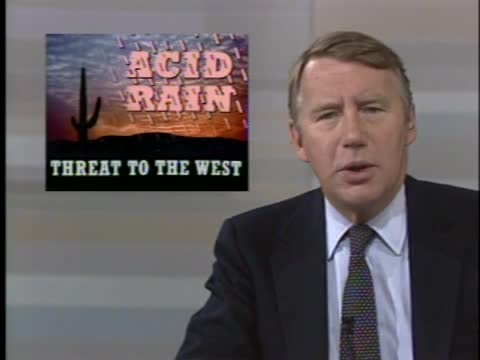
LEHRER: A private environmental group said today acid rain is threatening national parks, forests and wilderness areas in the western states. The claims are in a 50-page research report released by the World Resources Institute at a Washington news conference.
GUS SPETH, World Resources Institute: Acid rain can no longer be thought of merely as an Eastern issue. It has to be thought of in national terms. It's a national issue. It's hitting both east and West. Indeed, another thing the report makes clear is that we have an acid rain problem on our southern border in some ways similar to the one we have on our northern border with Canada. There are plans in Mexico for a large expansion of smelter capacity. If this expansion does occur as planned without the pollution control as planned, then the Mexicans will be exporting their acidity into the United States much as we're exporting our acidity into Canada today.
LEHRER: We will have more on acid rain in the West later in the program.
And there was good news on a cancer vaccine today. Researchers in New York City said a vaccine made of live tumor cells has shown it can significantly reduce the severity and recurrence of colon and rectal cancer, the second leading cancer killer. The scientists say, however, it will take another four or five years of study to be certain the vaccine is helpful.
MacNEIL: In Honduras the army was placed on alert today during a political showdown between the president and the legislature involving the naming of judges to the Supreme Court. Riot police surrounded the court building and the president's house amid rumors of a coup. Honduras is a close ally of the United States in Central America, and the State Department suggested it wants the dispute settled in a peaceful and democratic way.
In Lebanon there was factional fighting from north to south in all three major cities, Beirut, Tripoli and Sidon. At least seven people were killed and more than 25 were wounded. Crisis on the Cape
MacNEIL: South Africa and the growing tension between the minority white government and the majority black population leads our focus segments tonight. A little more than a month ago the story in South Africa seemed to be one of change, of small but potentially significant signals that President P.W. Botha and his Afrikaner government might ease some of the legal underpinnings of apartheid, South Africa's system of racial separation. But South Africa's blacks, given a new international voice by Nobel prizewinner Bishop Desmond Tutu, rejected Botha's tentative offer to give them limited political rights and the possibility of owning property. Black opponents of apartheid turned against those blacks participating in government-sanctioned councils. Since last September, 109 councillors were assaulted, 147 forced to resign, and four killed. The violence flared even higher eight days ago on the 25th anniversary of a massacre at Sharpeville. On this March 21st, 19 blacks were killed by police gunfire in another township. Since then 18 more have died, for a total of 37. Each episode has bred more protest and more incidents. In Capetown, 239 demonstrators were arrested when they tried to march toward Parliament after a memorial service for the 19 who died on March 21st. A day later President Piet Botha made his intentions clear in a speech to Parliament.
PIETER BOTHA, President of South Africa: I'm committed to maintaining law, order and stability in our country. I have already given instructions for appropriate steps to be taken to restore and maintain law and order.
MacNEIL: As part of the effort to restore law and order the South African in government, as we've said, today banned 29 anti-apartheid groups from meeting for the next three months. One of the major South African anti-apartheid organizations is the African National Congress, which has been officially outlawed in South Africa since 1960. For a black African perspective on events in South Africa we turn to the ANC's representative here at the United Nations, Johnstone Makatini.
Mr. Makatini, first of all, what's your reaction to the order today banning indoor meetings by these organizations?
JOHNSTONE MAKATINI: I think it just shows that the regime is really in serious trouble and it's acting out of desperation. And it can only fuel the militancy of the people.
MacNEIL: You don't think it will bring a halt to anti-apartheid activity?
Mr. MAKATINI: Oh, definitely not. Definitely not.
MacNEIL: How will people be able to act peacefully if they can't meet, even indoors?
Mr. MAKATINI: Well, the people will just go underground. Because what this means is that the position reached by the ANC in 1961 will now be reached by other millions of people who can only find this to be meaning that once again all the peaceful avenues are being closed.
MacNEIL: The position reached by the African National Congress in 1961 was that force was necessary?
Mr. MAKATINI: Exactly. It was that inasmuch as nonviolence could not have worked against Nazi Germany, after 49 years of nonviolence, we came to the conclusion that nonviolence could not work against the apartheid regime.
MacNEIL: The responsible minister who announced this policy today said it was necessary to maintain public peace because of all the recent violence.
Mr. MAKATINI: Well, public peace can only be restored if the regime allows the free political expression leading to the exercise of universal adult suffrage and the establishment of majority rule.
MacNEIL: I just said in that bit of background that the story a few weeks ago in South Africa to us appeared to be some chinks of light, that there were some gestures towards peaceful change. In that context, how do you explain the violence of the last few weeks?
Mr. MAKATINI: Well, it's because it was clear to our people that all these were maneuvers aimed at the further entrenchment of the system in fact. And, you know, they could not take it no more. They cannot take it no longer. They see the whole continent of Africa being free and they see the regime tottering. It's just a military power walking on clay feet. It is vulnerable; they have detected its vulnerability. The workers have discovered their power, and they see the ANC, you know, growing and, you know, developing its capacity to bring that regime to its knees.
MacNEIL: What is your explanation for the violence by black militants against blacks who have been cooperating with or working for the South African government? Are blacks now divided against themselves in South Africa?
Mr. MAKATINI: Oh, the regime has always tried to do that. I know that in the past few days the regime is singing that song because it is trying in fact to prepare the stage for what it has always worked for; in other words, dividing -- I mean, arresting the process of detribalization in order to use one tribal ethnic group against the other at the opportune moment. But, coming to what has happened so far, it's just proof that, you know, we are truly non-racial. Anybody who collaborates with the regime, whether it's black or white, becomes the enemy, and anybody who identifies with the movement and with the lofty objectives of the ANC becomes an ally, whether he's white or black.
MacNEIL: So you consider that such violence against blacks who have cooperated with the regime in any way will probably continue? Is that it?
Mr. MAKATINI: Yes. Yes, inasmuch as there will also be at some stage violence against whites who are -- who man the state structures of oppression.
MacNEIL: The government has said this week that much of this violence is a result of Soviet-directed efforts in South Africa.
Mr. MAKATINI: That's an old song. I mean, this is a song that we have heard all over, wherever the black people or people of the Third World have dared to fight for their liberation, whether it was Kenya -- Kenyatta was called the leader of death and darkness. Even in this country at one stage Martin Luther King was called such names. You know, that's nonsense. And, in any case, the South African regime even considers the United Nations as under the Soviet influence because, as far as they're concerned, communism is anything that, you know, is for social -- in the direction of social, political or economic change. We don't take that seriously. And, in any case, the Soviet Union is one of the -- is part of the international community that is committed to the support of the struggle as reflected in the resolutions of the United Nations in fighting against the system that is condemned as a crime against humanity, and we see nothing wrong in the repetition of what happened in the fight against Nazi Germany, when all nations of the world made common cause against fascism. We see nothing wrong at all. But the Soviet Union is not alone. Sweden is one of the countries, Canada is one of the countries and a lot of others in other countries that support our cause.
MacNEIL: Do you see the United States committed to change in southern Africa?
Mr. MAKATINI: We see the United States in a different light now after the takeover by the Reagan administration, but committed to the perpetuation of that system through the policy of constructive engagement.
MacNEIL: But the State Department today condemned the order banning meetings by those organizations.
Mr. MAKATINI: Crocodile tears. I mean, because the Reagan administration has done everything to embolden the South African regime to engage in much more brazen acts of repression.
MacNEIL: How have they done that?
Mr. MAKATINI: By, you know, these statements and acts of solidarity, you know, even saying that they will never leave South Africa on the ledge and providing diplomatic protection to the South African regime at the United Nations whenever effective action is proposed. The way they vote, and even intimidating or blackmailing other countries to vote, you know, in favor of South Africa.
MacNEIL: Some people looking back at Sharpeville 25 years ago -- 30 years ago -- see the circle having been turned, and here we are 30 years later at white police killing black demonstrators in South Africa. Is it the circle that's turned, or have we entered a totally new phase in the South African --
Mr. MAKATINI: It's both. It's a totally new phase. At that time, you know, at the Sharpeville time, we were isolated. In other words, the countries neighboring South Africa were under colonial domination themselves, and therefore were used as buffer zones for the preservation of apartheid, but today they are potential rear bases, and nothing can stop that revolution. Nothing.
MacNEIL: So do you see any alternative now to violent revolution in South Africa?
Mr. MAKATINI: The only possibility we see is if there could be effective international action in the form of the imposition of comprehensive and mandatory sanctions against South Africa. That would help to shorten the duration of the inevitable armed conflict. It would help to lessen the loss of human lives. But nothing can stop, you know, the bloodshed now because, I mean, we've been bleeding for the past 300 years, and it's soon that, you know, that the bleeding soon -- the bleeding has to be on both sides.
MacNEIL: Mr. Makatini, thank you.
Mr. MAKATINI: Thank you. Jim?
LEHRER: The other side now in a separate interview with Bernardus Fourie, South Africa's ambassador to the United States. Mr. Ambassador, is there anything that can stop the bloodshed now?
BERNARDUS FOURIE: Certainly. Certainly. The road on which the government is embarked, the road of political evolution, the road of bringing people into the social-economic field, of getting greater political participation -- you know, a reference has just been made here before to the statement of President Botha, State President Botha, that he was going to maintain law and order. But the paramount thing that's forgotten, and I'm just going to read a little bit of his speech that reflects the other side. He said, "Whether I agree with the various political demands that have been made by various interest groups is not the issue. I am committed to a program of reform designed to broaden democracy and to improve the living conditions of all South Africans, regardless of race, color or creed." That, I think, is the road, and not the road of declaring war or declaring war by blacks on other blacks. I mean, Mr. Makatini indicated here very clearly that he and his organization has declared war on everybody whom he says have been cooperating with the South African government. No. It is people who are ready to proceed in a way of taking part in a democratic process, of developing democracy, and this -- taking forward this evolutionary stage where we'll get to the point where we have greater harmony, where there will be participation on a wider level by the black people of South Africa in the government of South Africa.
LEHRER: How does that jibe with banning peaceful meetings by 29 anti-government organizations?
Amb. FOURIE: When you say peaceful meetings, here you've got a situation -- you know, the shots you showed here before the program started I think reveal the picture. And I think for once I was gratified that you showed those shots to show how houses were being burned, to show how people were being killed, and not by police, by black people, killing others, killing them regardless of whatever they had done. And Mr. Makatini gave the indication here -- he declared war on every black man who doesn't go along with ANC. And the ANC, in spite of what has been said, started in the '50s. It was inspired, its leaders all came from Moscow's trained cadres, communist-inspired. There are today people in the ANC who are not communists, but the leadership, extensively, is still very much under the influence of communism.
LEHRER: How does banning 29 political organizations fit what you just read, the intentions of the president?
Amb. FOURIE: It's not banning these organizations. It's in fact, in certain areas indicated in these trouble spots, that for three months there would not be the public meetings.
LEHRER: Now, why? Why?
Amb. FOURIE: Now, I humbly put you -- ask you this question and I give you a reason. The choice is, must those innocent black people, must they be murdered, must, day after day, their houses be burned, their schools being burned, or should something be done to stop this, to get to a position of tranquility and then to proceed with our effort to build a constitution, to bring about greater political development so that all can participate in it?
LEHRER: And banning public meetings feeds that purpose now?
Amb. FOURIE: Banning public meetings, meetings -- the type of meeting, like some of those with a purpose of burning, of raping, of killing people, you can't have any political process development in that atmosphere. So you've got to stop that. We've seen it in all parts of the world. What part of the world, when this sort of thing goes on, can you have discussions and development? You must first try to tranquilize the situation and to stop that kind of law-breaking.
LEHRER: What is behind the violence?
Amb. FOURIE: Behind the violence is exactly, exactly what Mr. Makatini said. He said they believe in violence, they believe it's the only way of reaching their aims, and they're going to continue with it. Andevery man, black, white or coloured, whatever he is, who doesn't agree with him is an enemy and should be killed. That is behind the violence as far as the ANC is concerned.
LEHRER: Is that the position of the government, that that's what's causing the violence? That the people have no legitimate complaints?
Amb. FOURIE: No, certainly, certainly. The government has never said it. You know, in this recent statement before Parliament, getting to political issues, you know, there have been great changes in South Africa. There was a time when coloured -- people of color didn't get the same wages, they couldn't do the same jobs, they couldn't join trade unionism. Those things have all been changed. They've all been changed. And in the political field, the first great development was in municipal, city government. People were given full rights of government in their own cities and their own municipalities. That in itself was also going to be a training ground, a proving ground, a way of fostering democracy, from there to proceed further. But what is happening by people who are fostering violence? They say, "Kill those people. Kill them, eliminate them. Burn them." And whereas the government, on its part, has publicly stated that the black people, the people in the cities, in spite of the city governments, in spite of their participation in national government, they have the right as political entities to play a part in taking the responsibility in South Africa and in the decision-making at the highest levels, which in essence is an invitation, is an indication as far as the government is concerned the road is clear for political development. But you can't do it by killing people.
LEHRER: But doesn't that look like what's going to happen, Mr. Ambassador? Doesn't it look like there's going to be more violence and more death?
Amb. FOURIE: Well, as far as the ANC is concerned, they've thrived on that. They've done it now for a quarter of a century, and they will continue with it. But the government will not allow it and, when I say the government, the people, the black people of South Africa -- you know, the ANC hasn't got the support of the black people. If you talk about black people --
LEHRER: Well, let's don't talk about the ANC. Let's talk about the fact that 19 people died last week. They were blacks and they were shot by the police. What I'm saying, are more people going to die in the next --
Amb. FOURIE: We regret -- we regret the loss of life, and as far as that incident's concerned, the government immediately appointed a legal commission to investigate, to find what else going on. But, do you realize how many people have been killed since and are being killed daily, not by police but by black militants? And if the police don't intervene, two times, three times, five times as many would be killed daily.
LEHRER: Okay, all right. That's my point. Do you see any solution -- no matter who's doing the killing, people are going to die?
Amb. FOURIE: Yes, we see a solution.
LEHRER: Now, what is it?
Amb. FOURIE: We see a solution and that is for peaceful development, for reform, for the leaders to get together, instead of talking about bloodbaths, instead of threatening other people, to come and sit down round the table and say, "Here it is. Here's the possibility for constitutional development in an orderly fashion. Let us join hands there, let us proceed on that road. Let us work for the benefit of ourselves, our children and the country as a whole."
LEHRER: What does President Botha mean when he says law and order will be maintained at all costs? Does he mean military means?
Amb. FOURIE: Well, what he means by that is no government can govern, no country, no society can exist in an orderly fashion if mob violence takes over. In other words, mob violence has got to be stopped, and mob violence has caused the South African government's concern. Of course, one tries to stop it if possible without the loss of life. But -- sorry?
LEHRER: No, I was just going to say, how do you respond to the State Department's statement today condemning today's banning, saying that it squelches peaceful protest?
Amb. FOURIE: I haven't seen the exact wording of that statement. Of course, we -- the State Department is free to express its views, but I would like to know, and I'm quite sure the State Department would not agree with Mr. Makatini and say let's declare war, let's continue. They would like to see peaceful conditions restored, but as far as the way to do it, the South African government has the responsibility. We've got to bear the results of it. And therefore I think the people on the spot has a certain, not only duty but also the right to take the necessary steps.
LEHRER: And also, a point that Mr. Makatini made about the Reagan administration. Is it your position that the Reagan administration supports your government and the policy of apartheid?
Amb. FOURIE: Certainly not. Certainly not. It is the first time I've ever heard of it. But it's not for me to speak here on behalf of the Reagan administration, but you know the United States' policies. You know what's been said and what is being said daily. So that to me was a completely, completely new one. And I fear it's something just grabbed from the air..
LEHRER: Mr. Ambassador, thank you.
LEHRER: Robin?
MacNEIL: Still to come on the NewsHour tonight, a report on the dangers of acid rain in the American West. Correspondent Charles Krause previews El Salvador's upcoming elections. Art critic Robert Hughes discusses the work of Marc Chagall, who died yesterday. And we close with the week's political cartoons. Acid Rain: Threat to the West
MacNEIL: Next tonight, we focus on acid rain -- not the familiar kind there's been all the fuss about in the eastern United States and Canada, but in the American West. A new study released today warns of an ecological disaster there, and recommends controversial measures against pollution. Spencer Michels of public station KQED-San Francisco reports.
SPENCER MICHELS, KQED [voice-over]: The rain that falls in the West is less acidic than rain that comes down over the eastern U.S. and Canada, but it is acidic and the mountains, rivers and lakes it falls on are more vulnerable to ecological damage from acid than areas in the East. That's because the slopes are steeper, the soil is thinner and because there is less natural alkalinity to neutralize the sulphuric and nitric acid. Here at the University of California at Berkeley researchers say that serious damage will occur in the West just as it has in Scandinavia and eastern North America unless sources of the airborne acid are curtailed.
JOHN HARTE, University of California: The first signs of damage will probably be to aquatic life, to salamanders and trout, plankton, grasses and aquatic insects. Subsequent to that you're likely to see damage occurring to terrestrial organisms, to trees, shrubs and so forth.
MICHELS [voice-over]: For six years Professor John Harte has been studying acid rain and acid snow. In his laboratory he can simulate conditions, like a snow melt in a western mountain lake, and can experiment with the chemical and biological consequences of abnormally high acidity. Thus far, scientists have not found any proof of biological damage as a result of acid rain, but Harte says that some western lakes have shown sharp increases in acidity in the last two years, but only for a week or two. Should the period become longer, he says, damage to living creatures could result.
Prof. HARTE: We don't know if it's over the next few years or 10 or 20 years or perhaps 60 or 80 years, but over the next years there will be a continuing change in the chemical quality of our lakes and streams and soils, leading eventually to biological damage.
MICHELS [voice-over]: The new study, financed by the Washington-based World Resources Institute, blames man made pollution as the sources of acid rain, and especially mentions pollution from the automobile, so prevalent in the West. Large smelters in the Southwest, like the Phelps-Dodge copper smelter in Arizona, are singled out for contributing to the acid rain over the Rocky Mountains. These metal ore cookers, upwind from the mountains, are now exempt from provisions of the federal Clean Air Act. The report authors want that exemption eliminated. They would also like the U.S. to negotiate with Mexico to reduce emissions from Mexican smelters near the border. The study also names coal-burning power plants in the Southwest as major sources of acid rain, and oil refineries as well.
[on camera] Researchers expect and actually desire a strong reaction to their report as a way of waking up the West. An oil company official downplayed the immediate threat and said that emission controls already in place will serve to mitigate the danger.
[voice-over] In California the single most important source of acid rain is the automobile. The amount of nitrous oxide emitted by cars here far surpasses the amount in the East. That gas turns to nitric acid when it gets wet, and that constitutes acid rain.
JOHN HOLMES, California Air Resources Board: We already have the toughest standards for automobiles in the country, in the world, in fact. Our control program for nitrogen oxides, for example, which is the precursor of nitric acid, will, I think, over the years ahead provide a substantial reduction in nitric acid in the atmosphere.
MICHELS [voice-over]: John Holmes heads the research division of California's Air Resources Board, which has just funded research into the health hazards posed by acid rain and acid fog.
Mr. HOLMES: But with our research program we're placing great emphasis on the possible health effects of acid in the air. The federal program is not giving us much help there, I'm afraid, so we're on our own with health.
MICHELS [voice-over]: Among the things the state wants to find out is how acid rain and fog affect people with asthma, a group that makes up five to 10 percent of the population. University physicians are setting up experiments to explore how it is that acid rain or fog triggers asthmatic attacks.
Dr. DEAN SHEPERD, University of California: Well, previous studies have shown that sulphuric acid mist, which is one of the prominent acids that's found in the atmosphere, especially in the Northeast and central United States, causes asthma attacks in people with asthma. And sulphur dioxide, which is a precursor of some of the acid aerosols in the atmosphere, is also a potent cause of asthma attacks.
MICHELS [voice-over]: Should scientists find adverse affects on human health, the battle to control acid rain and its sources in the West and in the East is likely to become more intense. For now, environmentalists have already seized upon the new report as justification for a hard-line approach to even more stringent pollution controls.
CARL POPE, Sierra Club: If we had not cleaned up automobiles, if we had not cleaned up nitrogen oxides in California, which California did when the federal government backed off, we might now be facing the kind of problem in California they have in West Germany where their forests are already irreversibly dying. But at the same time we haven't done enough. So we need to clearly remember that five, six years ago, we were being told by industry, "No, no. You don't need this much cleanup," now it's clear that we needed not only that amount of cleanup but we need additional levels. So we still have a chance, I think, here in the West to catch the problem before it becomes critical and before we start paying the kind of price they're already paying in the Northeast. The question now is, will we take advantage of that opportunity?
MICHELS [voice-over]: Industry hasn't had a chance to see the new report, but some spokesmen acknowledge the threat of acid rain is real, but advise more study before Congress imposes new and constly controls. Salvador Elections: The Stakes
LEHRER: There's an election in El Salvador Sunday. It's not as momentus as last year's presidential contest with American TV anchormen, PR men and pollwatchers on the scene, but for President Jose Napoleon Duarte, much is at stake. Here's a focus report from El Salvador by our special correspondent, Charles Krause.
CHARLES KRAUSE [voice-over]: Sunday's election could be compared to an off-year congressional election in the United States. El Salvador's voters will elect mayors, city councilmen and 60 members of their congress, called the National Assembly. President Duarte has asked the voters to give his moderate Christian Democratic Party a majority. Like a U.S. president, Duarte says he needs control of the legislature to carry out his programs, but there similarities with the United States end; El Salvador is at war.
This week, as the election approached, El Salvador's armed forces and guerrillas battling Duarte's government were engaged in heavy combat throughout much of the country. The guerrillas refused to take part in the election. They've destroyed a dozen municipal buildings and attacked a vital communications tower, part of their campaign against the election. And, last weekend, they killed a retired general in broad daylight. Meanwhile, President Duarte's attempt to negotiate an end to the fighting, begun last October in La Palma, is stalled. Both the guerrillas and El Salvador's extreme right have taken hard-line positions. They've made it politically impossible for Duarte to continue the dialogue for peace during the election campaign. Duarte's economic policies and management of the government are also under attack. El Salvador's nationalized banks have little money to lend. Unemployment is estimated at 40 . Duarte's opponents on the right say he's failed to deal effectively with the country's war-shattered economy.
[interviewing] Is it correct for us to look at this election as a kind of referendum on the first 10 months of President Duarte's government?
THOMAS PICKERING, U.S. Ambassador to El Salvador: I think yes. You also should look at it as the close of the first phase in the democratic process here in El Salvador. And as well, I think, a pointer for the future. Where do the people of El Salvador see themselves going, in terms of party platformsand positions and in terms of personalities, with respect to formng a government for the next three years?
KRAUSE [voice-over]: With no more elections scheduled until 1988, the right views this year's election as crucial. It must win enough votes to keep control of the Assembly or lose veto power over what it considers to be Duarte's dangerously liberal political agenda. Once again the right has put its money on Roberto D'Aubuisson. He's a charismatic former Army intelligence officer with alleged ties to El Salvador's death squads. If the right loses on Sunday, D'Aubuisson will lose his post as president of the Assembly. On the campaign trail, Major D'Aubuisson has largely ignored the guerrillas. Instead, he's trained his heaviest fire on Duarte, who defeated D'Aubuisson in last year's presidential election. This year D'Aubuisson has accused Duarte of being a coward and a traitor.
ROBERTO D'AUBUISSON, ARENA Party: La prepotencia de un Loco Napoleon queriendo hacer todo --
KRAUSE [voice-over]: D'Aubuisson contends that the president, whom he refers to as "El Loco Duarte," plans to turn El Salvador over to the communist guerrillas if the Christian Democrats win Sunday's election. It's sheer demagoguery but Duarte's supporters worry that D'Aubuisson's rhetoric could be effective. Jose Morales Ehrlich is the Christian Democrat's candidate for mayor of San Salvador and one of Duarte's closest political confidants. He says that El Salvador faces three years of political paralysis if D'Aubuisson's ARENA-PCN coalition retains its majority control of the Assembly.
JOSE MORALES EHRLICH, Christian Democratic Party [through interpreter]: It would be a disaster because they wouldn't let the president govern. We'd have three years of sterile fighting that would undermine the democratic process. The problem in El Salvador is that only the Christian Democrats believe in democracy. ARENA is anti-democratic. PCN is anti-democratic. They don't understand the democratic process.
KRAUSE [voice-over]: We asked Ambassador Pickering if he shares the view that a victory by D'Aubuisson's coalition on Sunday will create a political deadlock in El Salvador.
Amb. PICKERING: For reasons well known to you, we are not going to take views here in the embassy about electoral outcomes, because we are the largest aid donor, a very significant presence in this country, and what we'd have to say about outcomes gets transmuted immediately and automatically into embassy preferences. I look at the post-election period, from what people are telling me now, as almost as important as the pre-election period in determining what happens in the future of the country and how the governments are guided and how they operate.
KRAUSE [voice-over]: No matter how important the Assembly election may be for El Salvador's political future, the country's voters appear apathetic. D'Aubuisson, for one, has attracted far smaller crowds this year than he did last year. The Reagan administration is reportedly concerned that if D'Aubuisson and his right-wing allies lose again, they will opt out of the political process. The fear is they could decide to use their guns and their influence within El Salvador's powerful army to destabilize Duarte's government. To prevent that, the U.S. has reportedly provided covert aid to the National Conciliation Party, the junior and more moderate part of D'Aubuisson's right-wing coalition. We asked Ambassador Pickering about those reports.
Amb. PICKERING: It was, I think, absolutely wrong-headed and stupid for the press to go out on that kind of limb. And I have tried at every turn, obviously, to express the clear, simple view of the embassy that that ain't so.
KRAUSE: However, I must recall that last year before the elections you expressed similar views, and then shortly after the election Senator Helms in fact charged that the United States had covertly supported the Christian Democrats last year. And so the same question remains of whether this year the covert support is going to ARENA and the PCN.
Amb. PICKERING: Sure. As you know, with respect to covert intelligence activities, we make no comments. With respect to the policy of the United States government, fully expressing that policy, I say again to you that we are not supporting, do not intend to support or oppose any of the parties competing in the Salvadoran elections in 1985.
KRAUSE [voice-over]: Whether or not the right has received U.S. support, the National Conciliation Party, or PCN, is expected to play a key role after Sunday's vote. PCN leaders have said they will break with D'Aubuisson after the election and might be open to an alliance with Duarte's Christian Democrats. That would keep the moderate right in the government and reduce the likelihood of a political deadlock that could only benefit the guerrillas. Last Sunday at San Salvador's cathedral there was a poignant reminder of the country's tragic history and just how much remains to be done. Thousands of Salvadorans marched and then attended a memorial mass marking the fifth anniversary of Monsignor Oscar Romero's assassination. Those responsible for the archbishop's murder have never been found or tried. Romero has become a symbol of the tens of thousands killed here, victims of El Salvador's continuing political violence. In his homily the current archbishop, Arturo Rivera y Damas, called for peaceful and clean elections. But in the view of many Salvadorans, this year's campaign did little to inspire faith in the country's political leaders. Instead, the name-calling and mud-slinging seemed to trivialize the only real issue the voters care about -- how to end the war that is tearing El Salvador apart.
LEHRER: That report by Charles Krause, who is here with me now. Charles, obviously there are no polls or anything. Is there any way to tell at this point how this election is liable to go on Sunday?
KRAUSE: There are no polls, and the best guess is what the embassy is predicting and what the parties themselves are predicting. It seems that none of the parties, neither D'Aubuisson's coalition nor Duarte's Christian Democrats, will get a majority, an outright majority of the Assembly. It appears that they're going to have to look for coalition partners, and there will be a period of probably a month or more of intense negotiations before this all gets sorted out.
LEHRER: The scenarios you outlined in your piece, neither one looked particularly attractive. Even if Duarte wins, the right-wing might turn even more violent. Obviously, if he loses there are serious ramifications. Take me down both roads.
KRAUSE: Well, it does not look as if he's going to win an outright majority. The logic of some sort of coalition with the PCN is that the right would continue to feel that it had some role in the government. That might be --
LEHRER: Would that be without D'Aubuisson or with D'Aubuisson?
KRAUSE: Well, it would be without D'Aubuisson because the PCN is a separate party. It's gone into a pre-election alliance with D'Aubuisson, but it's already said that as of Sunday night the alliance is over, and we interviewed several of the PCN leaders while we were there this last week, and they're hinting very broadly that they're willing to negotiate with Duarte and go into some sort of coalition.
LEHRER: Then what does D'Aubuisson do?
KRAUSE: D'Aubuisson -- this may be his last hurrah. There are indications that even in his own party there are splits. Five of the deputies belonging to his party, which is called ARENA, split with him last weekend publicly and said they were supporting another conservative party. So, in a sense, unless D'Aubuisson wins very big, his days as a significant factor in El Salvador may be coming to an end. But El Salvador is a country where you predict at your peril, because probably anything could happen.
LEHRER: Well, Charles Krause, thank you very much. We'll see what happens on Sunday. Thank you. Master of Fine Art: Marc Chagall
MacNEIL: Long before he died yesterday at the age of 97, Marc Chagall had won a place in history as one of the most important artists of the century and his distinctive style known around the world. Chagall will probably be best remembered for the fanciful, dreamlike paintings that were inspired by his early life in a Russian ghetto. He was born in a small Russian town in 1887, one of 10 children in a religious Jewish family. He studied briefly in St. Petersburg and left for Paris in his early '20s. It was there that he spent most of his life, living and painting. Some of his most prominent works, his murals and stained glass windows, are almost as famous as the buildings that house them, like the United Nations headquarters in New York. Twice married, Chagall spent most of his later years at his villa in St. Paul de Vence on the French Riveria, where he died yesterday.
To tell us more about Marc Chagall and his work is Robert Hughes, art critic for Time magazine.
Chagall seems to be the painter everyone liked, all over the world. What made him so accessible when so many other painters of this century have been so difficult for people?
ROBERT HUGHES: Because his paintings are about memory and about personal romance. He took experiences which are, you know, actually common to a lot of people, such as deracination, leaving the loved home, finding a loved wife, and he turned them into, you know, a continuous stream of imagery that was very legible. I mean, he wasn't an abstract painter. He wasn't a painter who expressed ever, you know, very much despair or unfulfilled longing. His paintings are about satisfaction. People love paintings that are about satisfaction.
MacNEIL: I mentioned, as the obituaries have done, that he came from a very religious family and religious symbols are in a lot of the paintings. How important was that?
Mr. HUGHES: I think it was immensely important to his audience. As far as I know, Chagall was not an orthodox Jew. He wasn't a very closely practicing Jew. And there is actually, later in his life, you know, when he becomes the kind of official painter who gets the commission to commemorate everything from the opening of a bank to the Holocaust, he becomes a kind of practitioner of a sort of rather routine and diffuse religious symbolism. There's no -- I mean, I wouldn't call him a remarkably pious painter. It's a kind of vaguely corporate religious symbolism, if you wish. There's no doubt about his sincerity in doing so, but all the time, of course, you do have the religious emblems occurring in his paintings, but significantly more in the late paintings, I think, than in the early ones. And it's the early ones that interest me most.
MacNEIL: Well, I was going toask you that. Looking over a man's work who was painting for eight decades, almost, it's incredible. Where do you go to choose what's really important?
Mr. HUGHES: Oh, my goodness! Well, you see, I mean, there is this enormous oeuvre. I mean, he painted, etched, drew incessantly. And the size of his output -- I don't think its intensity or its variety -- but in size it rivals Picasso's. And so naturally there's a lot of good ones and there's an awful lot of not-so-good ones.
MacNEIL: When were the best ones done?
Mr. HUGHES: I think that, well, the Chagalls that really interest me are at the time when he comes to Paris, when he's come out of the relative provinciality of Russia, although, of course, St. Petersburg is not a provincial place. But when, as a fairly raw, excited, highly sensitized, romantic youth, he arrives in Paris and there he encounters Cubism. He encounters the milieu of Picasso, of the Ballets Russe, of course, which had come to Paris at about this time, Delauney, and of all the painters who constituted the School of Paris at this amazing point in history.
MacNEIL: You chose one as an example of the characteristics of this early period. Let's look at it and have you tell us. It's called "Paris Through the Window."
Mr. HUGHES: "Paris Through the Window," yes. It's in the collection of the Guggenheim Museum, and this actually is a very good example of, you know, that kind of excited state of disciplined modernism that he was in in 1913. I mean, the tourist elements of Paris are there, not because they're tourist elements -- the Eiffel Tower is there -- but because they represent modernity. The man in the parachute up on the right there, that little train chuffing along upside down that you can see through the window, that glorious, prismatic kind of light, which of course you can't see on the television screen but which is there in the painting, with the rays and shafts and break-up and the glitter of light. All of this is, you know, an excited, romantic response to, you know, the then-infinitely fascinating city. And then, at the same time, you know, there's grafted into it those folkloric elements, those elements of fantasy that come out of his childhood memories, that wonderful cat with the human face, caterwauling amorously on the sill there and the bouquet of flowers on the chair. And then, down in the righthand corner, I guess a two-faced self-portrait, with the, you know, one side of Chagall looking back to Russia at his childhood and the other side looking out to the experiences of the specifically modern world that Europe represented. And in his hand, I don't think you can see it on the picture, engraved on the center of the palm of his hand there's a little heart, which is, I guess, Bella, his childhood sweetheart. It's that kind of mixture that I think, and the discipline of shape, that makes these pictures --
MacNEIL: And no image there that is difficult to recognize.
Mr. HUGHES: I wouldn't have thought that they're all that difficult to read. They become much easier to read later on.
MacNEIL: Now, later on. Why do you admire the work of all those decades since less?
Mr. HUGHES: Because the work of the teens and '20s isn't a bit sentimental and a lot of sentimentality begins to come in, I would say, after the 1930s. He still produces beautiful lyric images. But there is this kind of rather -- I mean, actually I would say slightly sugary kind of quality that begins to intrude later on.
MacNEIL: Where does he rank among the greats of this century?
Mr. HUGHES: Well, I don't put it, averse as I amto drawing up definitive lists for the Parnassus sweepstakes. I mean, I don't think he's as great a painter as Picasso. He's not as great a painter as Miro. I don't know that I would put him among the top 10 of the 20th century, but he's certainly among the top 20. But it's just that, you know, it's not a consistent career. But it's a tremendously impressive long one.
MacNEIL: Well, among professional critics, does it diminish him as an artist that so many millions of people understood him and liked him, that he was so popular?
Mr. HUGHES: Well, I guess it does among some critics, but I can only say that it doesn't with me, because it's possible to be a great painter and a very popular one at the same time. It was his good fortune to be popular. I don't think that diminishes the work at all. If the work's good, it's because of other reasons, and if it's bad it's also because of other reasons. But I think it's wonderful that a painter can have a wide audience, and certainly he did, although a lot of the wide audience was, I think, came with a certain amount of kitsch. But the great work, I think, is always going to survive, and it will always have that kind of audience.
MacNEIL: Well, Robert Hughes, thank you very much indeed.
Mr. HUGHES: Thank you.
MacNEIL: Jim?
LEHRER: Again, the major stories this Friday. South Africa announced a 90-day ban on meetings by 29 anti-apartheid organizations. President Reagan said space should become a commercial center for businessmen and entrepreneurs, and the government's leading economic indicators show the promise of good growth in the economy over the next few weeks. Robin?
MacNEIL: We close tonight with our Friday look back at newspaper cartoonists from around the nation. One of their preoccupations this week was a lighthearted remark by President Reagan about farmers, that he'd rather export them and keep the wheat. Poking Fun
Pres. REAGAN, being chased by tractor with bumper sticker reading, "Keep the missiles and launch the President" [Toles cartoon, The Buffalo News, United Press Syndicate]: Heh, heh. I think we should keep the grain, heh, heh, and export the farmers. Uh, I didn't mean it! Well, I didn't say it. No, wait! I didn't understand it!
Pres. REAGAN, being boxed up for export to U.S.S.R. by farmers [Dana Summers cartoon, Orlando Sentinel, Washington Post Writers Group]: Uh, there once was a farmer from Nantucket. Stop me if you've heard this. Ohhh.
SOVIET FARMER, behind mule pulling hand plow [Wells cartoon, The Augusta Chronicle]: Olga, one hears of many difficulties in America. The farmers cannot make the payments on their air-conditioned tractors.
OLGA, farmer's wife: Nikolai, tell me, what is this tractor? What is air-conditioned? Also, payment?
BLACK SOUTH AFRICAN [Dana Summers cartoon]: The problem here in South Africa is clearly black and white. [looks at fat white labeled "apartheid"] But mostly white.
UNCLE SAM, Soviet bear with smoking gun in East Germany [Benson cartoon, The Arizona Republic, Tribune Media Services]: Ummm,
SOVIET BEAR: Aren't you supposed to be in Geneva?
Pres. REAGAN, at arms talks [Benson cartoon]: I'd like you to meet the newest member of our team. [MX launches from under the negotiating table]
CONGRESSMAN, taking punches from Pres. Reagan [Bassett cartoon, Atlanta Journal]: Oh! :! NO! UMMPH! NO! NO! Aaaggh! YES!
Pres. REAGAN: Thank you, Congressman, for saving the MX.
MacNEIL: Good night, Jim.
LEHRER: Good night, Robin. Have a nice weekend. We'll see you on Monday night. I'm Jim Lehrer. Thank you and good night.
- Series
- The MacNeil/Lehrer NewsHour
- Producing Organization
- NewsHour Productions
- Contributing Organization
- NewsHour Productions (Washington, District of Columbia)
- AAPB ID
- cpb-aacip/507-445h98zw8m
If you have more information about this item than what is given here, or if you have concerns about this record, we want to know! Contact us, indicating the AAPB ID (cpb-aacip/507-445h98zw8m).
- Description
- Episode Description
- This episode's headline: Crisis on the Cape; Acid Rain: Threat to the West; Salvador Elections: The Stakes; Master of Fine Art: Marc Chagall; Poking Fun. The guests include In New York: JOHNSTONE MAKATINI, African National Congress; ROBERT HUGHES, Art Critic; In Washington: BERNARDUS FOURIE, South African Ambassador to U.S.; Reports from NewsHour Correspondents: GRAHAM LEACH, in South Africa; SPENCER MICHELS (KQED), in San Francisco. Byline: In New York: ROBERT MacNEIL, Executive Editor; In Washington: JIM LEHRER, Associate Editor; CHARLES KRAUSE, Correspondent
- Date
- 1985-03-29
- Asset type
- Episode
- Rights
- Copyright NewsHour Productions, LLC. Licensed under a Creative Commons Attribution-NonCommercial-NoDerivatives 4.0 International Public License (https://creativecommons.org/licenses/by-nc-nd/4.0/legalcode)
- Media type
- Moving Image
- Duration
- 00:59:53
- Credits
-
-
Producing Organization:
NewsHour Productions
- AAPB Contributor Holdings
-
NewsHour Productions
Identifier: NH-0399 (NH Show Code)
Format: 1 inch videotape
Generation: Master
Duration: 01:00:00;00
-
NewsHour Productions
Identifier: NH-19850329 (NH Air Date)
Format: U-matic
Generation: Preservation
Duration: 01:00:00;00
If you have a copy of this asset and would like us to add it to our catalog, please contact us.
- Citations
- Chicago: “The MacNeil/Lehrer NewsHour,” 1985-03-29, NewsHour Productions, American Archive of Public Broadcasting (GBH and the Library of Congress), Boston, MA and Washington, DC, accessed September 28, 2026, http://americanarchive.org/catalog/cpb-aacip-507-445h98zw8m.
- MLA: “The MacNeil/Lehrer NewsHour.” 1985-03-29. NewsHour Productions, American Archive of Public Broadcasting (GBH and the Library of Congress), Boston, MA and Washington, DC. Web. September 28, 2026. <http://americanarchive.org/catalog/cpb-aacip-507-445h98zw8m>.
- APA: The MacNeil/Lehrer NewsHour. Boston, MA: NewsHour Productions, American Archive of Public Broadcasting (GBH and the Library of Congress), Boston, MA and Washington, DC. Retrieved from http://americanarchive.org/catalog/cpb-aacip-507-445h98zw8m