The NewsHour with Jim Lehrer; September 21, 2006
- Transcript
A I'm Jim Lara, today's news, Democratic Leader Pelosi, U.N. Ambassador Bolton, Foreign Aid, and the Los Angeles Times, all tonight on the news hour. Good evening, I'm Jim Lara.
On the news hour tonight, the news of this Thursday. Then, two newsmaker interviews. We'll talk about terrorism, Congress and politics, with House Democratic Leader Nancy Pelosi, and about Iran and Darfur with John Bolton, the U.S. Ambassador to the United Nations. Also, Paul Sommen reports on whether foreign aid to stem poverty really works, while our media unit looks at troubled times at the Los Angeles Times. Major funding for the news hour with Jim Lara is provided by... Somewhere in the Heartland, a child is sitting down to breakfast, which is why a farmer
is rising for a 15-hour day, and a trucker is beginning a five-day journey. An 8AM is turning corn and wheat, soy and cocoa beans into your favorite foods. Somewhere in the Heartland, a child is sitting down to breakfast, which is why so many work so long, and take their job to heart. ADM, resourceful by nature. At CIT, we provide the financing to keep health care strong and healthy. We help energy companies find new resources. We work with communications companies to make the world smaller and life bigger. We offer financial aid to make college possible for more students. At CIT, we help finance the future, because that's the place to be. See it with CIT. And by Pacific Life, BP, the Atlantic Philanthropies, and with the continuing support of these institutions and foundations. And this program was made possible by the Corporation for Public Broadcasting, and by contributions to your PBS station from viewers like you.
Thank you. President Bush and Senate Republicans reached a compromise today on handling terror suspects. The administration wanted to give CIA interrogators greater latitude and legal protections. Several key senators wanted guarantees against torture. The two sides said they'd reached an agreement after a meeting at the U.S. Capitol. We have a framework which will allow the CIA to go forward with its program. We also address the issue of military commissions to get a legislative framework that would allow terrorists to be brought to justice in a way that was consistent with our values. And we also believe we have a way ahead to do that as well. There's always, in this business, people say, who's the winners and who's the losers? There's none.
We're all winners because we've been able to come to an agreement through a process of negotiation and consensus. We still have the House of Representatives to go along with this agreement, but I'm very proud of what we've accomplished today. The chairman of the House Armed Services Committee, Republican Duncan Hunter, stops short of endorsing the deal. He said there are still issues to be resolved, especially on evidence rules for military tribunals. Our work in the House is not over yet. I think we're very close. We still have a – we are concerned most strongly with the utilization of classified information and the utilization of that information to obtain convictions in this new type of war against a new type of enemy. Details of the agreement on interrogations were sketchy, but later President Bush said it will help save American lives. He urged Congress to pass the Compromise legislation before going home next week. The House moved ahead today on a series of border security bills.
They called for cracking down on tunnels among other things, and they passed easily. Republicans turned to bringing up border issues one at a time after comprehensive immigration reform bogged down. Democrats complained today it was mostly about scoring political points. They said it was unclear the Senate would even consider the bills. We'll talk to House Minority Leader Pelosi right after this news summary. The Department of Homeland Security awarded Boeing a contract today for a virtual fence on part of the Mexican border. It will use cameras, sensors, and unmanned planes to monitor a 28-mile stretch in Arizona. A contract is worth $67 million. The President of Iran insisted today his country's nuclear program is peaceful. Mahmoud Ahmadinejad claimed Iranian nuclear sites are wide open for outside viewing. He spoke at a news conference at the United Nations and he said he's at a loss on how to prove Iran isn't hiding anything. The bottom line is we do not need a bomb, unlike what others think.
And regretfully, some believe that the nuclear bomb can be effective in international relations. They're wrong because the time for nuclear bombs has ended. We know that these nuclear arsenals will not benefit anyone. The Iranian leader said his country will negotiate halting its nuclear work under fair and just conditions. And he called for the United States to show good faith by destroying its own nuclear arsenal. Later, U.S. Ambassador John Bolton told the news hour that's not believable. He said the Iranian President is dissembling. We'll have that interviewed later in the program tonight. In Iraq today, at least 18 people were killed and attacks across the country. Another 38 bodies were found around Baghdad. And U.S. commanders reported two more American soldiers killed. The UN reported today nearly 6,600 Iraqi civilians died in violence in July and August. That's far higher than initial estimates.
A UN special investigator also said torture in Iraq may be worse now than under Saddam Hussein. He cited allegations of abuse in Iraqi jails, and he said private militias are even more brutal. Also today, Italy handed over security for a southern province to Iraqi forces. Prime Minister Abmaliki was on hand in Nasaria for the ceremony. It's the second of 18 provinces to have power transferred. Italy's 1600 troops are set to withdraw entirely by the end of the year. Military rulers in Thailand took over the duties of parliament today. They also banned all meetings of political parties. The moves came two days after the army ousted the elected government in a bloodless coup. The deposed prime minister was in London today visiting his daughter. He said he would take a deserved rest, and he urged new elections. The British billionaire Richard Branson pledged $3 billion today to fight global warming. Branson heads the Virgin companies.
He announced his 10-year plan in New York as part of former President Clinton's global initiative. Our generation has the knowledge, it has the financial resources, and, as importantly, it has the willpower to do so. And we're very pleased today to be making a commitment to invest 100% of all future proceeds to the Virgin Group from our transportation interests, both our train businesses and airline businesses, into tackling global warming. The money would go into finding renewable energy sources to move away from oil and coal. The Centers for Disease Control recommended today that all Americans, between 13 and 64, be tested for HIV. The new guidelines called for patients to be tested as part of routine physicals, but only high risk groups, such as gay men and intravenous drug users, would need to be tested annually. There would be no separate consent form, but patients could decline to have the tests.
The CDC said the guidelines would fight the spread of AIDS, and it would save lives. Walmart will start selling nearly 300 generic prescription drugs at sharply lower prices. The world's largest retailer said today the medicines will sell for $4 for a month's supply. They include widely used drugs for allergies, heart disease, and other ailments. The company said the program will begin in Florida and expand to other states next year. Space shuttle Atlantis returned safely to Earth today after 12 days in orbit. The landing had kept Canaveral Florida when smoothly. It was delayed a day by concerns about debris near the shuttle. The astronauts did the first construction on the International Space Station since 2003, when Columbia was destroyed. On Wall Street today, stocks fell on fresh concerns about economic growth. The Dow Jones Industrial Average lost nearly 80 points to close at 11,533. The Nasdaq fell 15 points to close at 2,237.
And that's it for the news summary tonight. Now Democratic Leader Pelosi, Ambassador Bolton, poverty, and foreign aid, and tough times at eight times. Our newsmaker interview with the House Minority Leader, Nancy Pelosi, Democrat of California. We have also extended an invitation for a matching interview with House Republican Majority Leader John Boehner. Congresswoman Pelosi, welcome. I'd pleasure to be here. Today's deal. It was announced late today between the White House and the Senate on military tribunals and interrogation rules for terrorists. What do you think of that? Well, I haven't seen the particulars of it, but the principles that we have heard in the news reports sound very much like legislation proposed by the Democrats last week in the House Armed Services Committee, which was an approach that would enable us to get the most reliable intelligence to protect the American people that will enable us
to prosecute those responsible for 9, 11 and bring them to justice. And we'll do so in a manner that was consistent with the Geneva Conventions, so as to protect our American soldiers should they come under questioning. So, that was rejected in the House Committee. So, I'm not surprised that Chairman Hunter is a Duncan Hunter, is not holding back, is a approval. Well, he, do you expect him to finally give in on this, or do you know? I don't know. He's not fond of deals that are made between the Senate and the White House without the House to participate. But just based on just the rough knowledge that we all have of this, it looks to you at least as if the President and the White House blinked on this? Yes, indeed. I think that the authority that Senators Warner and Senator McCain and Lindsey Graham and others, and certainly Secretary Powell, for obtaining reliable intelligence to protect the American people as they said to bring those responsible for 9, 11 to justice and do so in a way that protects our troops as finally they impress that upon the President and persuaded
him. And so unless Duncan Hunter and others who feel the way he does, rise up in some way, you think this will be enacted into law by the, before you all adjourn next week? I don't know. It may come to the floor of the House and Senate, but it has time to go to conference and back. I don't know if that can be done before the election. But, again, we haven't seen the particulars of this, and as you know, the details are very important. What else do you expect the Congress to do before you all adjourn next week? Well, they haven't done much. This is really a do-nothing rubber stamp Congress for the President. In a few days, we'll reach the end of the fiscal year, and this Congress is still not passed a budget. Democrats are proposing our 6-4-06. We think that we could pass before we leave here the nine initiatives to make America safer, for example, to pass the 9-11 Commission recommendations to make our economy fairer by passing an increase in the minimum wage to make college more affordable as students are going back to school now by making tuition tax-deductible to move toward energy independence.
All of this are simple discrete bills that are in the hopper to guarantee a dignified retirement and, of course, to make a health care more affordable by giving the administration the power to negotiate. But no, that's going to be an act in a law between now and next week, isn't it? Well, it could be, but instead we are doing bits and pieces of an immigration bill without approaching it in a comprehensive bipartisan way, which is necessary in order to manage the immigration issue. Again, we haven't passed a budget. We haven't even passed all of our appropriation bills, so there's much unfinished business. Were you surprised by the lead story in the New York Times this morning about their new poll, which said that only 25 percent of the Americans, they polled at least, had approved of the job the Congress of the United States was doing? No, I would be among those who would not approve. I was pleased that that same poll said that its election were held today that 50 percent of the American people would vote for a Democrat and only 5 percent.
35 percent would vote for a Republican, a 15-point spread, but that's today and today is not election day. So all the problems of the Congress or the Republicans fall? Well, I think that the Republicans have taken very pride in saying that they control everything. They have the mandate, the House, the Senate, and the White House. We're proposing a new direction, a new direction, but there are six for 06 that I told you about, but also that starts with integrity, where you cut off the link between special interest and legislation, and are there really for the people, where you have civility by partisan administration of the House, where the voices of the minority are heard no matter who was in charge, and fiscal discipline. We haven't had that. If we have it, then we can move quickly into the people's business, and we are after all the people's house. Are you serious about this? Yes. If the Democrats win control of the House in November, that you will bring the Republicans in and operate in a bipartisan way?
Absolutely. And we put it in writing in our new direction for America. It's in writing in here, and it's available at HouseDemocrat.gov. But what would you be your motivation? The Republicans have... You're claiming that the Republicans have not involved the Democrats in our leadership. Now, why would... What would be your motivation for allowing them in? A new direction. It's what our founding fathers had, is their vision. It's what our soldiers sacrificed their lives for. The aspiration of our children are about. Whatever we do, we should do in a way that is very democratic. It doesn't mean we have to agree on all issues. We won't. We'll try to find our common ground. We owe that to the American people, but where we don't have it, we stand our ground, have the debate on the ideas, have the transparency and the openness, and let the people decide. Do you want to be a speaker of the House? I want to have a Democratic speaker. Yes, and I think that coming in with, again, integrity, civility, and fiscal discipline, we cannot do what the American people want in their interest. As you just said a moment ago, the election day isn't, this isn't election day.
What do you see when you look ahead to election day? Are you optimistic at all about the Democratic control of the House? I'm optimistic one day at a time. I evaluate one day, one week at a time. In 17 days, we'll begin the absentee balloting, the early voting, and in, of course, 47 days, we will have the election. I'm optimistic because of our issues of a safer America, fairer economy that I mentioned. I'm optimistic because of the caliber of the candidates that they have. They're talented. They have law enforcement, national security, fiscal discipline credentials, and they care about the future of our country. All the polls show that Iraq is the major issue going into this election. First of all, do you think it should be? And what is the choice between Republicans and Democrats on Iraq? Well, the Republicans are proposing, stay the course. And since we went into this war on a false premise, a wrong premise, we went in with the expectation that would be received differently, wrong again,
that the reconstruction would be paid for by the Iraqis and soon wrong again. And we roll on every score, and the President says, stay the course wrong again. Stay the course. No, we're proposing a new direction, where we want to work with the President in a bipartisan way to urge the Iraqi government to disarm the, disarm the militia, to amend their constitution, to involve people and some of the civil strife, to engage their neighbors in diplomatic initiatives, and to begin the responsible redeployment of our troops out of Iraq, beginning no later at the end of this year. That's different from the course that the President is on. But he's still going to be President, whether you're the Speaker of the House, whether the Democrats are controlling the House or not. No, but I think he'll have to answer for the, since it's half a trillion dollars have been appropriated for this war, much of it unaccounted for. As many of our troops without the equipment that they need, without an end in sight, we've been in Iraq longer than we were in Europe and World War II.
The President still doesn't have an exit strategy. It's just not right. We need a new direction. An exit strategy is what the President needs and you as the Democratic majority and the House could come up with an exit strategy and force him to accept it? Well, no, what I'm saying is we should be working together. It's very unusual that the President has taken this very one approach to it that he is conducting this war without the involvement. Quite different from what has happened in the past when we have been a nation at war. And we have to change direction, too, because this is the wrong war. This isn't the war on terror. This is diverting our attention and our resources away from the real target. We should never have left Afghanistan in the manner that we did. Our troops have done a magnificent job in Iraq. It's time for a diplomatic and political remedy there. But at the same time, being there has taken its toll on our military readiness. Don't take it from me.
Experts on the subject have said we don't have one combat in the U.S. to be deployed in case of another threat to our national security. The target is of Afghanistan. They harbored the terrorist. We took our attention away from there and we should return the focus there. Hunt down Osama bin Laden, bring those responsible for 9-11 to justice, defeat the terrorist. And the war in Iraq is deterring us from doing that. Finally, as you know, I'm sure you know the Republicans running in these congressional races in November. You're a target of a lot of us speaking of focus. And they say, do you really want to turn the House of Representatives over to a liberal Democrat from San Francisco? How do you respond to that sort? The Catholic mother of five, Grandmother of five, going on six, the focus is the president of the United States. It's him and his policies and that of this rubber stamp Republican Congress that are the issue. I think targeting me, most people don't even know who I am, is an act of desperation
on the part of the Republicans. We're going to keep the focus in a very optimistic way on our new direction. We know it's possible if elected for us to achieve these things, and in the spirit of the optimism and hope and confidence of the American people build a better future for our children. But just in shorthand terms, it is correct to say, isn't it? That if the Democrats do take control of the House, whether you're a speaker or not, it's going to be a more liberal House of Representatives than there is now, correct? It's going to be a more bipartisan Congress. It's going to be a more productive Congress. It's going to be a Congress that is about the future. And yes, that will be a new direction. And for instance, to be specific, for instance, if the Democrats were in charge of the House of Representatives, the chairman of the House Armed Services Committee would be a Democrat, and he would not be seen probably what Duncan Hunter said today about this new deal, correct? They would be Ike Skeleton, who's a very conservative Democrat from Missouri, who has impeccable national security credentials, has the respect of members of Congress on both sides of the aisle,
and in fact, the administration. He's revered. I've visited him at Whiteman Air Force Base in Missouri and at Fort Leonard Wood, and he has the respect of the military community, that's at home, and in Washington, D.C. He would be a great chair of the Armed Services Committee, because our national security shouldn't be about partisanship, it should be about working together to make America as safe as we can be, with a military second to none, with diplomatic alliances based on that strength to stop terrorism, to stop the proliferation of weapons of mass destruction, to have real homeland security that doesn't get D's and F's, and then completes from the 9-11 Commission, but A's, which honors our responsibility to our veterans when they come home. All right. Later Pelosi, thank you very much. Thank you very much. New direction. Got it. Coming up, a foreign aid debate and the Los Angeles Times problems.
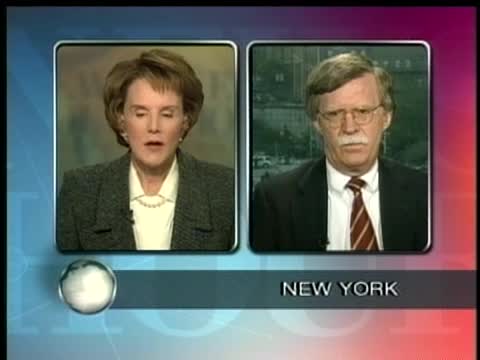
They come after an interview with the U.S. Ambassador to the United Nations, John Bolton, Margaret Warner, talk with him earlier this evening. Ambassador Bolton, welcome. Thanks for joining us. Glad to be here. At the Iranian President, Ahmadinejad said today at the UN that Iran was, he said, we are not seeking a nuclear bomb, we do not need a bomb. Do you believe him? I don't think that that's a credible statement. I believe for 20 years that Iran has been seeking to acquire nuclear weapons capability. There's no other explanation for all of the activity they have underway across the entire nuclear fuel cycle. This isn't the first time that they've denied their seeking nuclear weapons, and it's not the first time they've been decently. And does the United States have good intelligence, hard intelligence, that what you're saying is the case that they are pursuing nuclear weapons capability? Well, we certainly have a lot of information, but I want to stress that the information that has been made public by the International Atomic Energy Agency over the years shows the full extent of what the IAEA knows about Iran's activities.
And that information alone is inexplicable unless Iran is seeking a nuclear weapon. Not only that, but we also know and is public about their ballistic missile program demonstrates that they're pursuing a capability to deliver the nuclear weapons once they create them. He also said that Iran would be willing to negotiate a suspension of its uranium enrichment activity under what he called, quote, fair and just conditions. Do you see an opening here for a deal on getting these talks started? I think that's just trying to throw sand in our eyes again. And the International Community has made it clear through a resolution adopted by the IAEA Board of Governors overwhelmingly by a 14-to-one vote of the Security Council by the terms of the European nations that have been negotiating with Iran that they can have negotiations that lead to a constructive solution if Iran suspends its uranium enrichment activity. That's not only a condition of the United States, that's the International Community's condition.
Iran knows what the condition is. They so far have not been willing to accept that condition. And the reason is very clear. They have used the negotiations of the last three years to perfect many aspects of their work on the nuclear fuel cycle. Time is on their side in that sense. So every day that goes by where they continue their enrichment activities, they get closer to a completely indigenous capability to produce nuclear weapons. Is there any flexibility in the U.S. position? French President Shirak suggested this week that perhaps three things could happen simultaneously as a face-saving deal here. Suspension of the enrichment talks starting and the UN dropping this sanctions threat is that doable? Is that acceptable to the United States? Well, the Security Council Resolution 1696 that we adopted made it plain that sanctions would follow in the Security Council if Iran did not suspend its uranium enrichment activity. So what we're waiting for is for Iran to comply with Resolution 1696.
And if they do, then obviously we're not going to pursue sanctions in the Security Council. But let's be clear, the ball is in Iran's court. It's their obligation to suspend uranium enrichment activity. Now, three weeks, however, have elapsed since the August 31st deadline when the Security Council said suspend enrichment or face-global sanctions. Nothing has happened on the sanctions front. Is it fair for us to conclude at this point? I mean, we who aren't involved that you simply don't have the European allies on board for sanctions at this point. Well, I think it's accurate to say that there's been no activity in the Security Council on sanctions. And I think what this demonstrates very clearly is President Bush affirming yet again what he has said repeatedly that he seeks a peaceful and diplomatic solution to the problem posed by Iran's pursuit of nuclear weapons. We've gone the extra mile. You could say we've gone several extra miles in order to give the European space to pursue these discussions with Iran. But the foreign ministers of the five permanent members, I think, made it clear here this week that that time is not indefinite.
Moreover, we have undertaken a number of other steps in conjunction with other countries in terms of other aspects of Iran's dealings with the rest of the world and the area of financial transaction suspect exchanges of funds through terrorist fronts and cutouts. And we've also increased our activity under the President's proliferation security initiative to try to interdict the international trafficking and weapons and materials of mass destruction. So while it's fair to say that we've been quiet in the Security Council since the passing of the August 31 deadline, we have not been in active elsewhere. Now, how many more miles as you put it is the U.S. willing to grant these talks about talks between Iran and the EU. For instance, is it true the reports that at that same meeting you refer to of the foreign ministers, Secretary of Rights agreed with everyone else to give it least until sometime in early October, which is at least another 10 days? Well, the circumstances we're in now include the fact that the Iranian negotiator has repeatedly scheduled meetings and then canceled them.
We expected him here in New York last weekend and then this week. He has a visa, there are no restrictions on his travel, but he never showed up. So Javier Solana has the task of finding the Iranian negotiator wherever he may be and continuing the negotiations. We want to give that a chance to play out, but the time is not unlimited, that's clear. Now, President up my dinner shop had a very high profile in New York this week. He now only gave a speech. He went to the Council on Foreign Relations yesterday and he, of course, had his long press conference today. My question is after watching him in action, does he strike you as somebody, do you conclude that he's a man that the West and the U.S. can do business with? Well, we can do business with somebody who abides by their word and in this particular case who complies with security counsel resolutions, you know, respecting the United Nations. We're waiting for the President to do that.
He certainly said a lot of other things that don't lead one to sanguine conclusions about our ability to do business with him, including speculating on the world without the United States and Israel, not a very comforting thought. Tuesday, the Sudanese President but share used his U.N. speech to I'm switching to Darfur now to completely reject once again a U.N. force for Darfur. My question is, should the U.N. at this point move to put a force in there anyway? I think it's important to recognize that the next day the African Union heads of state made it very clear that they're going to extend the mandate of the existing African Union force in the Darfur region. Setting up the ability of the U.N. to take over from the African Union in the very near future. We just had a meeting today with the foreign ministers of the five permanent members and Secretary General Anand where 90% of the discussion was about Darfur. Secretary Rice and the Danish Foreign Minister will chair a meeting tomorrow of about 20 to 25 foreign ministers also to discuss how to take things forward on Darfur.
The fact is the African Union has agreed to this transition. It's critical to the implementation of the Darfur Peace Agreement, which the Government of Sudan has agreed to. It's time for the Government of Sudan to acknowledge the inevitable and help in the transition here for the protection of its own citizens in the Darfur region. But this African Union force, which is there now, has been criticized by almost everyone concerned as perhaps that it's well-intentioned, but it's outgunned outman, and it doesn't have the mandate to actually go in and in a proactive sense protect civilians. Is this extended African Union force going to have the same limitations? I mean, is there any reasonable expectation that extending the force is going to do anything to quell the violence? Well, I don't want to paint an excessively optimistic picture, but what we're going to do in the interim until there is a full transition to the United Nations is we're going to try and enhance the existing AU force. But this is a race against time. Make no bones about it. The genocide continues. I think most estimates of the humanitarian situation are that they're getting worse.
So we don't view the extension of the mandate as more than a holding action at best. What we really need to do is ramp up our efforts to accomplish the transition, strengthening the African Union force while we can, to try to get a complete transfer to a UN force just as soon as possible. Ambassador Bolton, you've been at the UN over a year, and this humanitarian crisis has been raging for that entire time. The U.S. has been saying things such as you're saying right now, but what needs to be done. What is your conclusion about why the world community and the U.S. has been basically impotent in this situation? I think there's been substantial opposition in the Security Council from China and other countries, too. The efforts we've been trying to undertake, and that is a problem inherent in multilateral diplomacy in the Security Council. In fact, the last resolution on Sudan that the Council adopted was by a 12-0 vote with three abstentions, China, Russia, and Qatar.
So the performance has not been, as we would have liked, that not through lack of effort by ourselves, by the British, by the French, by the African members of the Council. But because of the opposition of those that don't want this peacekeeping force to come into being. Now, I think we're all urging the Government of Sudan, even those that didn't vote for the resolution, to accept the inevitable here. But that's a delay, which is tragic and unfortunate, is a consequence of diplomacy at the UN. Ambassador John Bolton, thanks for being with us. Thank you. Now, I report on foreign aid and reducing poverty. It's a subject that's on the international stage this week at the United Nations and elsewhere. The NewsHour's economics correspondent Paul Somman has also been exploring the subject.
What do all these have in common? The IMF and World Bank, the UN, billionaires Bill Gates, Warren Buffett, and George Soros, superstars Bono and Angelina Jolie, many of the world's highest profile politicians. The link, a public commitment to end world poverty and disease through foreign aid. Regardless of size or scope, our problems will yield to concerted action and innovative partnerships of individuals, NGOs, businesses, and governments. But one skeptic claims that the more than $2 trillion spent on foreign aid over the past 50 years or so has been a tragic waste, failing to deliver even the cheapest of fixings. Like, rehydration kits for babies dying of diarrhea, cost 10 cents. And yet, still last year, 2 million babies died because they didn't get these. The skeptic is William Easterly. Former self-described left-wing do-gooder.
He grew up in Ghana, the son of a missionary. Former World Bank staffer for 16 years, now a hard-nosed economist at New York University. Malaria medicine, he says, can save a life for 12 cents, and yet, there are 1-3 million deaths from malaria last year. It's true of so many simple interventions that aid money could pay for over and over again. The existing aid money, without even increasing aid, and yet somehow the aid is not actually reaching the poor people. So much aid, so little attention to where it winds up. That's the nub of Easterly's argument, spelled out in a new book, White Man's Burden, which blasts foreign aid agencies, the UN, even sacred cow do-gooders like Irish Rockstar Bono. When people like Tony Blair and Bono say, it's up to us to save Africa, it sounds to me exactly like the White Man's Burden. That is, Englishmen Rudyard Kipling's 19th-century colonialist, some would say racist poem, White Man's Burden.
Take up the White Man's Burden, the savage wars of peace, fill full the mouth of famine, and bid the sickness cease. And what does he mean? He means that it's up to the whites, the White Man, to go in and cure the sick in Africa, to feed the hungry in Africa. And that's pretty much the mindset of aid officials today. Also part of the mindset, a belief that poverty can be solved scientifically by experts, what Easterly calls the planners. The total misconception there is that poverty is a technical scientific problem. That you just need to come up with a lot of scientific interventions like bed nets to protect people against getting malaria and improve fertilizer to improve agriculture. You know, about 400 other things like this. But it doesn't work to have a bunch of experts parachute in because you're trying to solve a microcosm, what's a part of a much larger problem of a society that's not working because free markets and democracy are not working.
Skeptical of Easterly is aid expert and activist Jeffrey Sachs. We see so many successes of foreign aid. We ought to learn from them, the green revolution, the health revolution, and so many parts of the world, disease control, eradication of smallpox, near eradication of polio, children in school, spreading literacy, declining fertility rates, so many successes that we should learn from those successes and apply them to the problems that we have. The problems that our world faces in the 21st century. To Sachs, Easterly's white man's burden indictment is provocative and if true, important. But Sachs speaks for much of the foreign aid establishment in treating this as a slander and out-of-date author of his own book, The End of Poverty, a friend of, among others, Bono, who wrote the introduction to this book, Sachs is also a target at Easterly's critique because he's an unapologetic planner.
By contrast, Easterly supports what he calls searchers, social entrepreneurs and non-governmental organizations trying to achieve modest goals one at a time, like making micro loans to village entrepreneurs or distributing mosquito nets to eliminate malaria in the African country. The African country of Malawi. The percentage of children and mothers actually sleeping in the bed nets dramatically went up. After the searchers in Malawi stumbled upon the solution of giving pregnant mothers subsidized price for bed nets and clinics. And they actually sold the net to the pregnant mothers so you know that the mother placed some value on the net and would actually use it. You know, whereas the planners approach to malaria would be, you know, we know the scientific solution to malaria is to, for everyone to sleep under a bed net. So we just drive trucks around throwing nets off the back of trucks and the nets, you know, want get wind up being used as fishing nets or wedding veils or diverted to the black market and they don't really reach the poor people. The fact of the matter is that when you try to sell bed nets to people that have no money, it takes years and years and years to achieve what you can achieve in a few weeks by a mass distribution campaign.
This idea that somehow you go slowly or on a small scale because that's the right thing to do while millions of people are dying because they don't have access to the most basic things that they need makes no sense. And then some how they just take it for granted that these will all be implemented by human agents. And that completely ignores the economic and political problems that make poor countries poor governments and poor countries are, it's sad to say it, but we have to face reality they're very corrupt. Even when they're not corrupt, the bureaucracies are very unmotivated and dysfunctional. So, you know, when you try to channel the money through governments and poor countries, the money just doesn't reach the poor. But Jeffrey Sachs's point is that these days some big plans actually work, like the effort to get drugs to HIV positive patients in Africa, for example.
And to make sure they follow the regiments. That was able to get antiretroviral medicines. Now there are hundreds of thousands of people staying alive. And the latest evidence is, oh, the skeptics were wrong. The people really do follow through the protocols. The spread of resistance, which was so much feared, no, that hasn't happened specifically. We have the president of the United States and his plan behind these concepts in a big way now. Now you have a new presidential malaria initiative because there are proven things that can be done to save millions of lives. That's what counts. Well, we're at the end of this debate. And you may think you've just heard yet another typical dueling books on the one hand, on the other hand, standoff, where you can't possibly know who's right. So let's finish with a point of commonality. Because both these men actually agree as to what works in foreign aid, proven practicality. And that means what's needed is accountability, which is so often been lacking in the past.
And accountability, which means we demand that aid agencies really do get evaluated for whether their dollars reach the poor, for whether the medicines reach dying babies in time to save their lives. We demand that these evaluations be totally independent. And if you know that you're going to be judged in that way, then you are going to be a lot more motivated to make sure that those babies get 10 cent oral rehydration kits so they don't die from dehydration. Which Jeffrey Sachs says, absolutely. And it's now beginning to happen. Foreign aid has always been most successful when it's been most practical. Straight forward things that can be done on a large scale, and the world is moving in that direction, fortunately, finally. The questions remain, of course.
Has foreign aid really begun to become accountable, and if it has, will it continue to change in the right direction? Finally tonight, news of a struggle within the newspaper industry. Jeffrey Brown has our media unit report. With 13 Pulitzer Prizes in just the last five years, the papers top editor and its publisher have resisted the latest demands of its corporate parent, the Tribune company, to make further significant cuts from the newsroom, which now numbers 940. Over the last six years, the Times has lost 200 editorial jobs all in service of one goal, maximizing the paper's profitability. Dean Bakke, the editor in a story last week in his own paper, said, I am not averse to making cuts, but you can go too far, and I don't plan to do that. I just have a difference of opinion with the owners of Tribune about what the size of the staff should be, to make substantial reductions, would significantly damage the quality of the paper.
The Tribune company has owned the LA Times for six years, among its other marquee newspapers are the Chicago Tribune, the Baltimore Sun, and the Hartford Current. In addition, the company owns television stations, internet properties like careerbuilder.com, and baseball's Chicago Cups. Despite the breadth and quality of its holdings, Tribune's stock price has been in a five-year slump, and its board of directors met today in Chicago to discuss the company's situation. And now two people who know the Los Angeles and industry situations well, John Carroll is a former editor of the Los Angeles Times. He left the paper last year. A longtime reporter and editor, including at the Baltimore Sun, he's now the night visiting lecturer at the Shorenstein Center on the press, politics, and public policy at Harvard University. Charles Boybrinskoy is vice chairman of Ariel Capital Management, among its many media related holdings. Ariel currently has 6% of the Tribune company's stock, roughly 15 million shares, excuse me, in its portfolio.
John Carroll starting with you, how unusual is it to see an editor and publisher lead a kind of mutiny at a major paper like this? I don't recall ever seeing it before, it's very unusual. So what's going on? Well, I think every good editor has a point which he has to define for himself, at which he must quit or resist rather than damage the paper further. And that's where I believe my friend, Dean Bake, is at this moment. I hope it can be worked out, but he wants to be editor of a first-rate paper. And I think he's afraid that that dream is being dashed. You gave a speech earlier this year called, what will become of newspapers in which you addressed, quote, the conflict between those who served the reader and those who served the shareholder.
Now, is that what you see going on in Los Angeles? It is. You know, there used to be a unity of purpose on the part of people who own newspapers. They served several masters, they served the counting house, making money was important. But it was also important to serve the community that gave roots to the paper, and also to serve journalism to uphold high standards. It seems to me, and I've been in the business a lot of years, that in this era of publicly owned newspaper chains, the money part has overshadowed all else. And obligations to journalism obligations to the community have fallen by the wayside to a considerable extent. And that is really the tension that's causing this problem.
All right, let me bring in Mr. Brinskoy. How do you see it? You want the value of this company to rise? How do you see what's going on in Los Angeles and in Chicago? We don't think it's as unusual as maybe others have suggested. It's very common for a boss to ask a division manager to cut costs and to have to take people out. It's very common for that division manager to push back. I ran a division of city group for 10 years, and I'd get a call about every other year asking me to cut people, and I always push back. That's part of the nature of business. What's unusual here is this has gotten into the press. And that's unfortunate because it has called into question almost an insubordinate role of the editors in Los Angeles. At this point, the Board of the Tribune may be questioning whether it makes sense to stay public and have all of this dirty laundry aired. What is the problem at the Tribune and in the industry in general? What do you see? Why is the value down?
The market has been very positive about newspapers for a long, long time. The markets always love the strong cash flow, the lack of new competitors. The market's gotten very concerned about the threat of internet. And in our judgment has overreacted the stocks of all newspaper companies have declined for about five years. In our estimation, the market is not properly evaluating the internet growth that the newspapers have. Most of these companies have internet growth of 20% plus a year, but the market's focused on concerns about declining circulation. And it's often pointed out that the LA Times itself makes about 20% a year in operating profits. Now in many industries, that would be pretty darn good. Right, it's not the profit margin accounts, it's the direction of profits. And right now, those profits have been flat. A lot of people think they've been declining, they actually haven't been. They've been flat, not growing the way we as shareholders would like them to. But they've been, the cash flow has been very good and the profits have been stable.
What people are concerned about is the future. Will the internet take away readers and produce pressure on earnings in the future? Now, Mr. Carroll, does all of this suggest to you that the publicly owned corporate ownership model in some ways conflicts with the public interest role that you were talking about for newspapers? It does. And if I could add to something that Cheryl said, we are in a difficult position with the internet and vastly increase rivalries for advertising. So the business has some clouds over it. Yet it is remaining at a 20% profit margin, which is a very handsome margin by the standards of most industry. I can tell you from my experience at the Los Angeles Times that you cannot sustain a 20% margin at that paper without diminishing its quality year after year. If I could wave a magic wand and change the circumstances under which our corporate leaders operate, I would try to see if they could get away with reducing the profit margin to 10%.
I can almost promise you that if they could cut it to 10%, the circulation would stop dropping. It would probably start gaining. And we would be able to invest very heavily in the web, which is crucial to the paper's future. At a 20% margin, I feel strongly that we are cashing in the paper's future in favor of current earnings. So Mr. Burbrinskoy, there you hear it. I mean, if the people at the paper and Mr. Carroll speaking along the lines, they speak, if they say the quality is hurt to try to keep up those profit margins, how much consideration is that due for shareholders? You can imagine we're not going to be enthusiastic about cutting the profitability of the LA Times in half. In fact, the 20% margin is actually below industry averages and below where the LA Times used to earn during times when it won't, many pure surprises and had a very good reputation for journalistic excellence,
which it still has. By the way, I'd point out the LA Times has more reporters than the Washington Post. So the bottom line here is we think there can be a wonderful, happy medium where everybody gets along. The quality of the LA Times can remain strong, the profits can be strong with growing internet traffic. What may change is how the LA Times is owned. All of the Tribune may become a private company where the company doesn't have to worry about these quarterly fluctuations in earnings. Well, what do you think about that, Mr. Carroll? Because you know, there is talk in Los Angeles of several prominent wealthy citizens who might want to buy it. We did a story ourselves in Philadelphia recently where that happened. Is that a new model and would that be a good one? Taking it private would be something new for this company. And it might or might not be a good thing, depending on who's running it. Taking it to local owners, again, might or might not be good.
We've had local owners in the past. Some of them are superior, and some of them are mediocre and some are awful. So it's kind of a crap shoot. But I feel that the way the paper is going under its current structure and under its current leadership is almost certain to take it down. And by down, the first step of down is that we'll fall from the top tier of American papers, which in my judgment consists of four papers, Los Angeles Times, New York Times, Washington Post, and Wall Street Journal. It cannot stay at that level. And for the second largest metropolitan area in the country, which Los Angeles is, it should aspire to be not only at that level, but toward the top of that level. Mr. Brinsky, we just have 30 seconds or so. Do you see a back to Los Angeles here? There is speculation about the editor and publisher being fired. Do you think that will happen?
I really don't. Again, as I emphasized up front, it's very common for somebody who runs a business to push back on his boss, who's calling for job cuts. That happens at every business every week. What's unusual is the scrutiny that this has gotten. We think this will be worked out, and we think the Board of the Companies take a hard look at all of these issues right now. We've got every confidence that they're going to come to a good conclusion. All right, Charles Brinsky and John Carroll. Thank you both very much. Pleasure to be here. Again, the major developments of this day, President Bush and Senate Republicans reached a compromise on interrogating terrorist aspects. The President said it will help save American lives. And the President of Iran insisted, again, his country's nuclear program is peaceful. And again, to our honor roll of American Service personnel killed in Iraq and Afghanistan. We add them as their deaths are made official, and photographs become available here in silence are 12 more.
Thank you. We'll see you online and again here. Tomorrow evening with Mark Shields and David Brooks, among others, I'm Jim Lara. Thank you and good night.
Major funding for the new hour with Jim Lara is provided by. In navigating towards retirement, there are many courses you can take, and Pacific Life can help you reach your goals. With over 135 years of experience, Pacific Life offers a wide range of financial solutions. Approach the future with confidence. Pacific Life, the power to help you succeed. And by BP, the Archer Daniels Midland Company, CIT, the Atlantic Philanthropies, and with the continuing support of these institutions and foundations. And this program was made possible by the Corporation for Public Broadcasting, and by contributions to your PBS station from viewers like you. Thank you. To purchase video cassettes of the news hour with Jim Lara,
call 1-866-678-News. I'm PBS. Thank you.
Thank you. Thank you. Thank you.
Thank you. Thank you. Good evening, I'm Jim Lara. On the news hour tonight, the news of this Thursday.
Then, two newsmaker interviews. We'll talk about terrorism, Congress, and politics with House Democratic Leader Nancy Pelosi. And about Iran and Darfur with John Bolton, the U.S. Ambassador to the United Nations. Also, Paul Salmon reports on whether foreign aid to stem poverty really works, while our media unit looks at troubled times at the Los Angeles Times.
- Series
- The NewsHour with Jim Lehrer
- Episode
- September 21, 2006
- Producing Organization
- NewsHour Productions
- Contributing Organization
- NewsHour Productions (Washington, District of Columbia)
- AAPB ID
- cpb-aacip/507-3t9d50gf5q
If you have more information about this item than what is given here, or if you have concerns about this record, we want to know! Contact us, indicating the AAPB ID (cpb-aacip/507-3t9d50gf5q).
- Description
- Episode Description
- This episode features segments including an interview on politics and elections with Nancy Pelosi, an interview on national security with John Bolton, a report on the effect of foreign aid, and a report on the troubles at the Los Angeles Times.
- Date
- 2006-09-21
- Asset type
- Episode
- Rights
- Copyright NewsHour Productions, LLC. Licensed under a Creative Commons Attribution-NonCommercial-NoDerivatives 4.0 International Public License (https://creativecommons.org/licenses/by-nc-nd/4.0/legalcode)
- Media type
- Moving Image
- Duration
- 01:04:06
- Credits
-
-
Producing Organization:
NewsHour Productions
- AAPB Contributor Holdings
-
NewsHour Productions
Identifier: NH-8620 (NH Show Code)
Format: Betacam: SP
Generation: Preservation
Duration: 01:00:00;00
If you have a copy of this asset and would like us to add it to our catalog, please contact us.
- Citations
- Chicago: “The NewsHour with Jim Lehrer; September 21, 2006,” 2006-09-21, NewsHour Productions, American Archive of Public Broadcasting (GBH and the Library of Congress), Boston, MA and Washington, DC, accessed September 13, 2026, http://americanarchive.org/catalog/cpb-aacip-507-3t9d50gf5q.
- MLA: “The NewsHour with Jim Lehrer; September 21, 2006.” 2006-09-21. NewsHour Productions, American Archive of Public Broadcasting (GBH and the Library of Congress), Boston, MA and Washington, DC. Web. September 13, 2026. <http://americanarchive.org/catalog/cpb-aacip-507-3t9d50gf5q>.
- APA: The NewsHour with Jim Lehrer; September 21, 2006. Boston, MA: NewsHour Productions, American Archive of Public Broadcasting (GBH and the Library of Congress), Boston, MA and Washington, DC. Retrieved from http://americanarchive.org/catalog/cpb-aacip-507-3t9d50gf5q