The NewsHour with Jim Lehrer
- Transcript
JIM LEHRER: Good evening. I'm Jim Lehrer. On the NewsHour tonight Elizabeth Farnsworth updates the Swissair tragedy off the coast of Nova Scotia; Susan Dentzer reports on the new drugs aimed at preventing breast cancer; Terence Smith with Jody Powell and Helen Thomas examines how the press brought the Lewinsky story to the Moscowsummit; and former Senators Nunn, Rudman, and Danforth, and Senator Bumpers discussion presidential resignation. It all follows our summary of the news this Thursday.% ? NEWS SUMMARY
JIM LEHRER: One hundred and thirty-seven Americans were among two hundred and twenty-nine people killed in last night's Swissair jetliner crash. The McDonnell-Douglas MD-11 fell into the Atlantic Ocean six miles off the coast of Nova Scotia some 20 miles southwest of Halifax. The plane was en route from New York's JFK Airport to Geneva, Switzerland. Canadian officials said at least 36 bodies had been recovered by rescue ships and fishing vessels. Some wore life vests, indicating they had prepared for an emergency landing. Swissair said the cause of the crash was not known. At least seven victims worked for various UN agencies in Geneva. We'll have more on this story right after the News Summary. Hurricane Earl was blamed for one death in South Carolina today. It spawned tornadoes as it moved northeast into the Carolinas from the Florida Panhandle. It was downgraded to a tropical storm and is centered now near Macon, Georgia. It caused flooding in Panama City, Florida, after it pushed to shore overnight with 80 mile an hour winds and some 23 inches of rain. Florida Governor Lawton Chiles said most of the damage was caused by an 11-foot storm surge, not by the winds. On Wall Street today the Dow Jones Industrial Average closed down 100 points at 7682.22. The NASDAQ Index of smaller and high-tech companies closed down also nearly 21 points at 1571.86. World markets had a bad day. Most of them had rebounded Wednesday from earlier losses. Indexes in London, Frankfurt, Paris, Stockholm, and Oslo were all down again today. Most Asian stocks also were lower, pulled down by a drop in Tokyo. In Russia today the ruble sank to a new low, officially 13.5 to the U.S. dollar. The Russian currency now has lost more than half its value since last month. The political turmoil also continued. The Communist leaders of the lower house of parliament, the Duma, again vowed to reject President Yeltsin's choice for prime minister, Victor Chernomyrdin. The nomination is to come up for a vote tomorrow. If Chernomyrdin is voted down, Yeltsin is allowed under the constitution to put him forward one more time. President Clinton was in Northern Ireland today. He addressed the recently-elected Belfast Assembly, telling its members to force rival Protestant and Catholic factions to give up stockpiled weapons. He said the United States would try to help.
PRESIDENT CLINTON: Of course, for all we can and will do, the future still is up to you. You have agreed to bury the violence of the past. Now you have to build a peaceful and prosperous future. To the members of the assembly, you owe it to your country to nurture the best in your people by showing them the best in yourselves. Difficult, sometimes wrenching, decisions lie ahead. But they must be made. And because you have agreed to share responsibility, whenever possible, you must try to act in concert, not conflict.
JIM LEHRER: Later, Mr. Clinton went to Omagh. He laid flowers at the marketplace where 28 people died in a terrorist bombing there last month. Mr. Clinton met with relatives of the victims and offered his condolences. Back in this country today the Justice Department confirmed it's conducting another view of 1996 Clinton-Gore re-election spending. Attorney General Reno offered no details when questioned by reporters at her weekly briefing. But a department spokesman said she would try to determine if the campaign evaded spending limits. The review could lead to a 90-day preliminary investigation, followed by a request for an independent counsel. Also in Washington today, a leading Democratic senator criticized President Clinton for immoral behavior in the Monica Lewinsky matter. Joseph Lieberman of Connecticut said the President undercut the trust of the American people and reduced his moral authority. He said the transgressions were too consequential to be overlooked. He said they warranted a measure of public rebuke and accountability. But he said talk of impeachment and resignation was unjust and unwise at this time.
SEN. JOSEPH LIEBERMAN, [D] Connecticut: While the legal process moves forward, I believe it is important that we provide the President with the time and space and support he needs to carry out his most important duties and protect our national interest and security. That time and space may also give the President additional opportunities to accept personal responsibility for his behavior, to rebuild public trust in his leadership, to recommit himself to the values of opportunity, responsibility, and community that brought him to office, and to act to heal the wounds in our national character.
JIM LEHRER: Lieberman's sentiments were echoed by two other Democrats who followed him to the Senate floor, Bob Kerrey of Nebraska and Daniel Patrick Moynihan of New York. We'll talk more about the issues involved later in the program. FBI Director Louis Freeh testified before the Senate Judiciary Committee today. The subject was terrorism. He said Saudi exile Osama bin Laden remained a menace, despite U.S. missile strikes on his operations in Sudan and Afghanistan.
LOUIS FREEH, FBI Director: This is an organization of great resources, as I mentioned, active in many countries. It is a unique organization in the sense that you have a multi-national following. You have individuals literally all over the world who are followers of bin Laden. So, I think there should be no illusions about the fact that when bin Laden as recently as May of this year declares war on Americans and issues a fatwah to kill American civilians anywhere they may be found is about as serious and imminent a threat as I can imagine.
JIM LEHRER: Senators asked Freeh about the legality of assassinating suspected terrorists. He said federal law bans killing heads of state, but he would study whether it applied to others. Former UN Weapons Inspector Scott Ritter testified before two Senate committees meeting in joint session today. He said senior diplomats in the U.S. and the U.N. undermined inspectors by urging them not to conduct surprise visits that would force a showdown with Iraqi President Saddam Hussein. Ritter quit last week in protest. He had this to say.
WILLIAM SCOTT RITTER: The United States has undermined UNSCOM's efforts through interference and manipulation, usually coming from the highest levels of the administration's national security team, to include the secretary of state, herself. Iraq today is not disarmed. It remains an ugly threat to its neighbors and to world peace.
JIM LEHRER: And that's it for the News Summary tonight. Now it's on to the Swissair crash, a breast cancer update, media coverage of the Moscow summit, and the resignation question.% ? FOCUS - SWISSAIR CRASH
JIM LEHRER: The Swiss Air tragedy. David Smith of Independent Television News begins our coverage.
DAVID SMITH: This morning as navy and coast guard scoured the Atlantic off the very picturesque Peggy's Cove, Nova Scotia, brining back everything from personal effects to plane wreckage. The Canadian authorities were still calling it a search and rescue mission. But, in reality, they'd given up any hope of finding survivors overnight. The magnitude of the disaster of Swissair Flight 111 mirrored by the human tragedy. Two hundred and twenty-nine passengers and crew, mainly American, but also French, Swiss, British, Saudi, Russian, twelve of them staff of the United Nations going back to base in Geneva.
JIM BUCKLEY, Search Boat Captain: Pieces of wood, pieces of foam, pieces of seat, and then you'd see-a terrible smell of aviation fuel. It was very concentrated in one area. And then you'd see bodies and parts of bodies.
DAVID SMITH: Tonight it's clear that 90 minutes out of New York the pilot reported smoke in the cockpit, started dumping fuel as fast as he could, and radioed that he would make an emergency landing in Halifax. He crashed 20 miles short, nose-diving into rather stormy waters just south of Nova Scotia's provincial capital.
FRANK SKIDMORE, Canadian Investigator: Well, we'll want all the bodies recovered, and we'll want all the aircraft recovered, as much as possible, so that's - we'll continue to investigate with every avenue explored as far as we can take it.
DAVID SMITH: Because of the passenger list, this is a disaster that echoes across the world. In Northern Ireland, President Clinton.
PRESIDENT CLINTON: We hope for the best, and we are deeply grieved that this has occurred.
DAVID SMITH: In Switzerland, where relatives of victims gathered at Geneva Airport.
GEORGE SCHORDERET, Swissair: Our main task in the next few hours is to keep the utmost support to the members of the families, because that's the most important for us.
DAVID SMITH: And, of course, in New York, where at the United Nations they ordered flags at half mast. At this stage, obviously, more questions than answers. Swissair has a fine safety record, its last major crash 19 years ago. The plane, an MD-11, the world's only modern wide cabin airliner powered by three engines, and an overhaul a year ago, the airline is saying. The cargo version of the plane did crash in New Jersey last year, but everyone board escaped safely. But significantly from Washington the Americans dispatched a team of investigators overnight, and the Clinton administration even at this early stage seems to be ruling out terrorism.
JANET RENO, Attorney General: My understanding is that all initial information indicates that it was an accident.
ROY BEARS, Canadian Investigator: My information suggests that it was smoke in the cockpit that was reported.
REPORTER: What does that tell you --
ROY BEARS: Basically nothing. There could be a large number of reasons causing smoke --
DAVID SMITH: Ahead now days, if not weeks and months of searching for clues, investigators already reporting one large piece of fuselage has been in shallow water, helpful that as they tried to rebuild the plane and a picture of what went wrong. The human cost, though, is already very clear. Among the victims, Dr. Jonathan Mann, a pioneer in the battle against AIDS, who was the first chief of the World Health Organization's special AIDS unit -- on his way to a major health conference in Geneva - one name on a passenger list that now represents the worst airplane disaster in North America since the crash of TWA Flight 800 off Long Island in the summer of 1996.
JIM LEHRER: This afternoon a Canadian transportation official was asked about reports the pilot considered landing in Boston instead of Halifax.
VIC GERDEN, Canadian Transportation Safety Board: The diversion to Halifax, instead of Boston, is, to my understanding was because Halifax was closer, so it would be normal for an air traffic controller to suggest the closest airport.
REPORTER: In the initial request for a diversion, was it not the case that the Swissair pilot asked to go to Boston and initially started to turn to Boston and then was routed to Halifax as the event progressed?
VIC GERDEN: That's my understanding. That is correct, that the pilot initially asked to be diverted to Boston, and after the diversion started, the air traffic controller indicated that Halifax was closer, and evidently the pilot must have chosen to divert to Halifax, instead of Boston.
REPORTER: What's the time here from the initial call saying smoke, to wasting time turning to go to Boston, and then turning back to Halifax? What are we talking about here, three, four minutes, six minutes?
VIC GERDEN: We haven't looked at the tapes in detail at this point, so that will be part of the investigation, to determine that the timings of the entire flight from takeoff to the crash.
REPORTER: But do we have the right order of magnitude?
VIC GERDEN: I don't know.
JIM LEHRER: Elizabeth Farnsworth in San Francisco has more.
ELIZABETH FARNSWORTH: And we turn now to Michael Goldfarb, former chief of staff of the Federal Aviation Administration. He's now an aviation consultant.Mr. Goldfarb, I want to go through this story as much as is known and get you to explain some things for us. As far as we know, the first sign of trouble was smoke in the cockpit. What could cause that smoke?
MICHAEL GOLDFARB, Former Chief of Staff, FAA: Well, first of all, Elizabeth, today is a tragedy truly of global aviation and transportation proportions. And the first priority clearly is search and rescue. We've always cautioned about speculation. Speculation not only invariably turns out to be wrong, it also can divert very precious investigative resources to the wrong kinds of issues. So with that caveat, we don't know. We have only questions and not answers. I think, as the report said, smoke can be caused from a multitude of factors, simple things from an air conditioning duct to electrical wiring, to an internal explosion or an external explosion, to cargo hold. We're all familiar with the ValuJet crash several years back where we had oxygen and generators in the cargo hold. That has since been prohibited from being transported in or out of the United States. So it is just so early that smoke in and of itself. You know, crashes thankfully are so rare, and they're so tragic because numbers of things come together simultaneously. It's never one thing. It's a series of things. And already in this report you're hearing smoke in the cockpit, landing in Boston. What was the nature of the emergency? Was it a mayday emergency, or was it a request to land? And, in that case, Boston could have said, well, you know, perhaps given traffic flows, you may want to consider going elsewhere. So we know that it wasn't a catastrophic emergency until the end. And all these questions will have to be answered. Unfortunately, the public need to know the answers don't always coincide with the investigation, itself - the timetable.
ELIZABETH FARNSWORTH: As we just heard, the investigators seem to have ruled out terrorism. How can they rule it out, or seem to rule it out this early?
MICHAEL GOLDFARB: Well, I really couldn't comment on that, and I know that we ruled in a bomb on TWA 800 and spent a long time chasing that factor and turned out, in fact, to be mechanical failure - we believe, the center fuel tank. So it's so premature to rule in or rule out anything, but I guess from the behavior of the aircraft, the fact that the crew had smoke in the cockpit. They dumped fuel, which is normal procedures. They sought an alternative airport to land, which is normal procedures. And then something at 10,000 feet happened and went wrong. And that's all we know. And we don't know why. Having victims with life preserves on kind of indicates it wasn't sudden and catastrophic, that they knew they were in an emergency situation so we just don't know.
ELIZABETH FARNSWORTH: I understand that you can't speculate. Somebody on the ground said that the engine was "making the worst sounding deep groan I've ever heard." Does that tell you anything?
MICHAEL GOLDFARB: Not necessarily. I mean, it - oftentimes there are sounds that, you know, sound strange in normal conditions, if you're not used to those kind of sounds -- I mean, whether the - it's engine failure. What the Canadian board is going to do, the investigators, with the help of the US NTSB, is going to break it into pieces, and they're going to say, okay, let's look at the weather. Well, we know Hurricane Danielle was offshore, was that a factor, probably not, but that needs to be examined. Let's look at structure. We know the aircraft had a major overhaul, literally taking it apart, putting it back together, looking at wires, looking at structure, looking at systems, only a year ago. It's a new aircraft. But they'll look at structural issues; they'll look at human factors. Was there something happening in the cockpit that might have diverted the attention of the crew? Was smoke a factor in judgment made about how to handle emergency procedure? And they'll look at air traffic control. Unlike TWA of two years ago, we may be more fortunate in two ways. One, we have tape between ground control and the cockpit, which should be very useful to finding a potential cause, and certainly the so-called "black boxes." The MD-11, a newer version, has a very modern black box. And that simply means it gets lots of information, unlike older aircraft, whether it be TWA or ValuJet. And that information is going to tell you everything going on in that aircraft, if they can find it. So we're hopeful that between those kinds of things we won't have that protracted period where we spend month dredging the ocean floor, with no real clues.
ELIZABETH FARNSWORTH: Are they likely to find the black box? It's apparently between seventy-five and a hundred and fifty feet deep in the water - under the water.
MICHAEL GOLDFARB: It's pretty amazing what they've been able to do. I mean, literally both ValuJet, which when you look at the picture, was under the swamp, and this crash too, most of the wreckage is down deep, the rescue capabilities and the use of sonar are pretty remarkable, and literally bringing up the plane and piecing it together, we're hopeful that they will find those boxes, and they're key to the investigation.
ELIZABETH FARNSWORTH: Mr. Goldfarb, have there been advances in the investigatory techniques and the various elements that you use to make investigations just because of the most recent crashes?
MICHAEL GOLDFARB: I can't answer that specifically. I would imagine that what we saw in TWA 800 was that the navy was using state of the art technology in the search on the ocean floor. The NTSB and, I believe, the Canadians as well have very sophisticated equipment in their labs to look at this. And remember now they're going to be calling in the manufacturer, Boeing, which now owns McDonnell-Douglas, as well as the Swiss authorities. It will truly be a global search until we find out what brought down the aircraft.
ELIZABETH FARNSWORTH: And what about the - what's been learned from the recent crashes in how to deal with families, how to help families cope with this? Has there been something learned in that?
MICHAEL GOLDFARB: Difficult lessons learned, and we go back to the Lockerbie situation. It's a double -- one can only imagine the pain and grief of the accident, itself, and then running into bureaucracy, or people not knowing how to inform people about things. That has been one of the lessons learned, both from the Lockerbie crash, from TWA, and from ValuJet, that you can bet that the authorities, both of the airline industry and of the investigative bodies, their first thoughts are - right now are the families and making sure that their needs are taken care of.
ELIZABETH FARNSWORTH: Swissair has had a rather good safety record, hasn't it?
MICHAEL GOLDFARB: Yes. It's puzzling. I mean, Swissair is a good air carrier, a very strong safety, maintenance. The airline - the aircraft is a good aircraft. No particular government notices called air worthiness directives that would indicate these kind of problems. And the crew was experienced crew, with lots of flight time, so it's truly - it is puzzling, and it really from an aviation standpoint is a huge aviation tragedy, to have this kind of thing happen.
ELIZABETH FARNSWORTH: The plane has advanced automatic system controls that significantly reduce pilot error, according to some of the information put out. Tell us about that.
MICHAEL GOLDFARB: Well, you know, it's interesting, with all the automation that we have in the cockpit, we're going in two directions. One is we have lots of technology that's making -- literally helping pilots see and handle aircraft in bad weather or when terrain is upon them and they don't have landing aids. That's the good news. That bad news is that there's nothing - there's nothing like piloting skills. And so technology is not alone going to handle this. And what we're finding is that crews need to actually have the experience of handling an aircraft. Many of today's pilots have never had an engine out in their entire careers. And so we need to go both ways, not just on the technology but on the training of the pilots, and make sure that they expect the unexpected. And it truly is unexpected. It's exceedingly rare. It's safe to fly, and it is very rare to have something happen precisely because it is so many things coming together into a unique set of circumstances into a crash.
ELIZABETH FARNSWORTH: Well, Michael Goldfarb, thanks very much for being with us.
MICHAEL GOLDFARB: Thank you.
JIM LEHRER: Still to come on the NewsHour tonight, a breast cancer drugs update, the Lewinsky story goes to Moscow, and the resignation question.% ? UPDATE - CANCER WARS
JIM LEHRER: The breast cancer story reported by Susan Dentzer of our health care unit, a partnership with the Henry J. Kaiser Family Foundation.
SUSAN DENTZER: There may soon be two promising new weapons in the war on breast cancer-- an illness that affects roughly 1.6 million women in the U.S. and kills nearly 44,000 each year.
SPOKESPERSON: It would appear from the preliminary research -
SUSAN DENTZER: Yesterday an advisory board of the federal Food and Drug Administration recommended that the FDA approve a revolutionary new drug, Herceptin. The drug shrinks breast cancer tumors and slows progression of an especially deadly form of the disease. The green light for Herceptin heralds a new era. Conventional treatments for breast cancer include three basic techniques: surgery to remove a tumor or diseased breast, and radiation and chemotherapy that can kill both cancerous and healthy cells alike. These blunt approaches are sometimes described as "slash, burn and poison." But Herceptin, developed by researchers at the biotechnology company Genentech, takes a radically different approach-- zeroing directly in on breast cancer's most basic roots.
DR. SUSAN D. HELLMANN, Genentech: It's a breakthrough treatment because this is the first time that we've really had a cancer therapy that specifically targets a genetic problem at the level of the cancer cell.
SUSAN DENTZER: Nearly a third of women with breast cancer have tumor cells that contain too many copies of a gene called Her-2. In a healthy cell, Her-2 produces a protein that prompts normal cell growth. But in cells with too much Her-2, breast cells reproduce out of control and spread throughout the body. Physician Dennis Slamon played a key role in Her-2 research.
DR. DENNIS SLAMON: It turns out that women who had this alteration had a more aggressive form of the disease, and a shorter disease-free survival, in other words they relapsed more quickly, and unfortunately, they had a shorter overall survival; despite equivalent therapy, they died more quickly.
SUSAN DENTZER: Genentech's scientists found a way to block excess Her-2 with antibodies cloned from mice. The result was Herceptin. A major study has shown that the drug can slow or stop tumor growth -- sometimes in women for whom all other anti-cancer drugs have failed. Herceptin doesn't cure breast cancer but, in combination with chemotherapy, it slows or stops tumor growth in far more patients than in those who use just chemotherapy alone. Although expected to be very costly, the drug is likely to be the first of a wave of new medications.
DR. SUSAN D. HELLMANN: In the future, I think that you'll see more approaches where we look at the actual molecular biology, the genetic makeup of the tumor and think about and create new ways of treating patients with cancer by looking at the genetic abnormality.
SUSAN DENTZER: For the first time yesterday, the board also recommended that the FDA allow the use of a drug to prevent or at least delay the onset of breast cancer. It said that some women at high risk for the disease could use the longstanding anti-breast-cancer drug Tamoxifen in hope of keeping tumors from developing in the first place. Taken in pill form at a cost of about $100 a month, Tamoxifen has been used in breast cancer treatment for more than 20 years. It counteracts the effects of estrogen, the female hormone, in promoting the growth of breast cancer cells. One major study showed that Tamoxifen may have reduced the risk of developing breast cancer by nearly 45 percent in women who had a high risk of developing the disease. But other studies have suggested that the drug's effectiveness in preventing cancer is much less -- or even nonexistent. What's more, Tamoxifen can cause fatal blood clots and cancer of the uterine lining. The FDA panel's recommendation was controversial. Since little is know about the effects of long-term use of Tamoxifen, the panel recommended only short-term use. It also said it did not know which high-risk women should use the drug for prevention. Some patients and advocates were concerned.
MARILYN McGREGOR, Cancer Survivor: Tamoxifen is a known carcinogen; it's not as if it's a benign thing; it's not Bayer aspirin. It's a carcinogen. It causes other kinds of cancers, in addition to a whole other range of issues. And so, as many of the people who criticized the trials said, well, is the benefit sufficient for those women to take the risk of taking the disease? It's not as if it's bland. It is a risk.
FRAN VISCO, President, National Breast Cancer Coalition: It's going to be difficult for women to make these decisions. And our concern is that doctors who don't understand and don't have the time to get all of this information to impart to their patients will simply prescribe it as a preventative for breast cancer.
SUSAN DENTZER: Despite the concerns, the FDA is expected to follow the advisory board's recommendations and approve use of both drugs.% ? FOCUS - THE PRESIDENT AND THE PRESS
JIM LEHRER: Press coverage of the President in Moscow and to our media correspondent, Terence Smith.
ANCHOR: Two politically wounded world leaders side by side, the President of the United States and President of Russia, One answering private questions about a sexual affair the other the survival of a nation.
ANCHOR: The President in Russia, far from Washington, but nowhere to hide. He wants to talk about democracy, but he's asked questions about Monica.
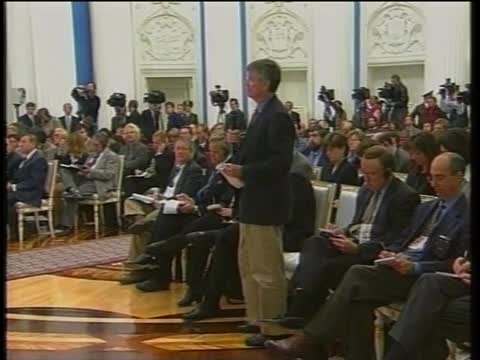
TERENCE SMITH: On network evening news broadcasts last night, coverage of the meeting of two world leaders in the midst of a Russian economic and political crisis was dominated by Monica Lewinsky , two of three questions American reporters were allowed to ask at the joint news conference dealt with the scandal in the White House.
REPORTER: In retrospect now, with some distance, do you have any feeling that perhaps the tone of your speech was something that didn't quite convey the feelings that you had?
PRESIDENT CLINTON: I thought it was clear that I was expressing my profound regret to all who were hurt and to all who were involved.
TERENCE SMITH: The CBS Evening News led the broadcast with the Lewinsky questions.
ANCHOR: The fight for his presidency is only beginning.
TERENCE SMITH: Followed by a piece on the Russian political crisis. NBC and ABC gave precedence to new developments in breast cancer but quickly followed with the Lewinsky matter. And on broadcasts that have the luxury of more time -
ANCHOR: CNN's Betsy Aron reports on how the economic crisis is weighing on Russia's entrepreneurs.
TERENCE SMITH: The summit coverage included more than just Monica. On the NewsHour with Jim Lehrer the President's comments on Lewinsky were reported in the News Summary and followed by a discussion on Russia's economic and political crisis. Later, historians discussed how presidents function in the face of a preoccupying scandal. Today's newspapers varied in their coverage. Some, like the San Francisco Chronicle, the Oakland Tribune, and the Denver Post put the Monica story inside. But the New York Times headlined "Clinton Defends His TV Admission on Lewinsky Case." The Washington Post reported "President stands pat on Lewinsky's speech."
TERENCE SMITH: For more on the President and the press we turn to two veterans of the White House. Helen Thomas, UPI's White House bureau chief, has covered every administration since that of John F. Kennedy. She's been with the wire service since 1943. Jody Powell served as press secretary to Jimmy Carter. He's the author of "The Other Side of the Story," an account of his own battles for the White House press corps. He's now chief executive of Powell Tate, a public relations and strategy firm. Welcome to you both.Jody, let me begin by asking you, what your reaction was when you watched the news conference in Moscow? It was an obviously awkward situation or moment for reporters to raise questions about Monica Lewinsky. Obviously they thought they had to do it.
JODY POWELL, Former Carter Press Secretary: I suspect it was the same reaction as anybody who served any president in the last 50 years. We've all seen this before. There are times, Terry, when the White House press corps goes into a pout. And when it does, it basically refuses to cover anything other than whatever it is they think the President ought to be talking about, and the people ought to be listening. But this support, I think, at least in my mind, was the gravity of the situation, that the President was trying to deal with, and that the country, indeed, is trying to deal with, with regard to the former Soviet Union and Russia. And in that sense I thought it was particularly egregious to pretend that nothing of importance that we needed to know about that trip, basically other than Lewinsky.
TERENCE SMITH: Helen Thomas, is the White House press corps in a pout?
HELEN THOMAS, UPI: Absolutely not. The questions were very legitimate. You talk about the graveness of the crisis in Russia while it's very grave for President Clinton. His political survival is on the line, and you can listen to the senators that you put on earlier today. I mean, it's not a question that's going to go away. It is a global village. They expected the question. He has not been questioned since his testimony. We have a President who is under a federal investigation. It is very critical.
JODY POWELL: Let me make clear that I'm not arguing that it wasn't a legitimate question. The question had to be asked. My concern is what was done with the coverage afterwards, and that basically there was a decision by certainly CBS and to a less extent the other two networks that we're not going to tell the American people anything else that the President said, virtually anything else that he did, except about this issue, and maybe it won't play out - as other things that I remember - and Helen was there too and Terry, you were around. I remember during the hostage crisis - that wasn't quite a scandal, but we went for months where it was impossible for the President or for me as a press secretary to get any coverage of about anything else that was going on in America, except for the hostage crisis, and that was - that was a decision -
HELEN THOMAS: Again, the drumbeat is fantastic. That's true.
JODY POWELL: Helen makes a good point. Clearly this is going to go on for a while. And I don't see an end to it. And, you know, the President, his staff, the Congress, the other parts of the executive - they're going to have to try to figure out how we - how the government deals with a lot of other important things while this - while this plays out.
HELEN THOMAS: Well, Jody, he was covered every inch of the way on his trip to Russia. Many many statements - so I don't think that the coverage was denied in terms of the Russian economy.
TERENCE SMITH: Well, Helen, your argument, I take it, is that the lack of access to the President -
HELEN THOMAS: Exactly.
TERENCE SMITH: -- is what necessitated a question like that -
HELEN THOMAS: And they knew the question was coming. He was prepared for it. They set themselves up for it, in fact, but we are -
TERENCE SMITH: What do you mean, set themselves up for it?
HELEN THOMAS: Well, I mean, they could have had a news conference before Moscow, and we were always asking for one. We threw many questions at the President and he ignored them. So it was - I mean, it was fair game, but it's more than that. It's the - the point is that he has to answer these questions. This is the speculation of the day. Trent Lott gave him a farewell - I mean, politics is supposed to end at the water's edge. He made a strong statement against the President before he left and Lieberman today and so forth, on it goes. You cannot ignore the story.
JODY POWELL: I think Helen and I would disagree on this, but I don't think there is anything the President could have possibly done, no matter what he said, no matter how many questions he answered, no matter how long he's been with the press. He would -the next time he was available to the press he would get the same treatment. As Helen said -
HELEN THOMAS: He would be asked a question, you're right.
JODY POWELL: If it -
HELEN THOMAS: But I think -
JODY POWELL: If it wasn't about the apology, it would be about the rumor of the day or the leak of the day, or whatever it is - and you just - we got to figure a way to allow a president in the midst of something like this to communicate with the American people about something else in addition to this. A degree of maturity and responsibility on the part of journalists would help, but I don't expect that to happen.
TERENCE SMITH: All right. Helen, let me put the question to you this way.
HELEN THOMAS: All I'm saying is that all the speculation since he made his original statement was that more was needed, and this was what we put to him.
TERENCE SMITH: Indeed, that's been the call from Congress as well.
HELEN THOMAS: Right.
TERENCE SMITH: But let me put the question to you this way. How much is too much for the press? At what point - if any - does the press say we accept the President's statements at face value and move on?
HELEN THOMAS: Well, I think that there's so much more in this situation that, yes, we - I think the statement has to be accepted now, but there are so many ramifications. Other shoes keep falling, and it's not a story that's - you know, has an end yet. All the speculation, all the senators jumping in and so forth, I just don't see how you can lay off, but I do have to admit that when you have 24-hour cable and they're hitting it 24 hours a day and four or five major programs are directed from that situation alone every day, then, I mean, it's impossible, intolerable, I'm sure, for the President.
TERENCE SMITH: Well, so at least that much is too much. Jody, let me ask you this. Has it reached the point, in your opinion, where the press and the reporting on the story is getting in the way of the president and his ability to do his job and communicate with -
JODY POWELL: I think in terms of the President's ability to have a dialogue with the American people over virtually anything else, yes, and I think it has been that way to a significant degree for quite some time. And I want to emphasize, this is not peculiar to President Clinton. It has happened to every - at one time or other -sometimes more than one time - to every president that I can recall during - and interesting I think - this clearly, however it turns out, will have done damage to the presidency in a lot of ways, certainly the legal precedents set here are troublesome. I think, though, a year from now, however this comes out, in terms of the presidency as an institution, it will survive and it will recover, and it will go forward. I think the more lasting damage will be done - will have been done to the reputation and the credibility of American journalism with the American people. And that's not an insignificant loss either, because American journalism has an important role to play.
TERENCE SMITH: Helen.
HELEN THOMAS: I don't agree with you at all. I think we will prevail, survive, and we're doing the job that we have to do.
TERENCE SMITH: Well, Jody, what would you counsel the President if he were to do so now as he goes forward to a period which will include a report from Kenneth Starr and whatever action eventually is taken in Congress? Would you urge him to say more about his relationship with Monica Lewinsky, or not?
JODY POWELL: Well, unlike apparently a lot of people in this town, I don't really think it's proper to offer a President advice on national television, so I'll refrain from commenting on that. I think that the awkward part of it is that so much of this is out of the President's hands. There probably are some things he could do, but, as you point out, the report's going to be there. Apparently, parts of the report continue to be dribbled out, or things that people think are in the report. Members of Congress are going to continue to feel compelled to unburden themselves and offer the President advice of one sort or the other in public and I suppose those of us who appear on these shows every now and then will pop up with our own contribution to it, and what - I think this is about as delicate a time in terms of what's going on globally as we've had in a long time. And I really do think our President, our Congress, institutions are capable of dealing with this, but we really do need a bit more responsibility and maturity on the part of journalists to allow a dialogue to take place.
TERENCE SMITH: Helen, in a few seconds, can you tell us what you'd like to see the press do, as this story plays itself out.
HELEN THOMAS: I think that we should cover this story and cover it very fairly, legitimately. I think that we should let the President have his day. I don't think that there should be a constant, constant repetition, 24 hours a day, when you don't have news. But it's very legitimate news when something is breaking and it's a story that will - you know, it's going to go on, and I think the President knows that. I think it takes a terrible toll. Jody's right. We should be concentrating on these other things, but this is the most human story, and I don't - I don't think anyone's going to really refrain from it till it has an ending.
TERENCE SMITH: Okay. Thank you both.% ? FOCUS - SHOULD HE RESIGN?
JIM LEHRER: And that brings us finally tonight to the resignation question. Last month, Former Sen. Sam Nunn of Georgia became the first prominent Democrat to raise the question in a very public way. In an opinion piece for the Washington Post he questioned whether President Clinton could continue to govern effectively and provide the necessary leadership on domestic and international affairs, and he said, "This will require personal sacrifice and may even require his resignation, but it would fulfill the President's most important oath, to preserve and protect our nation." Sen. Nunn is with us tonight, along with three former colleagues, Democratic Senator Dale Bumpers of Arkansas and former Republican Senators John Danforth of Missouri and Warren Rudman of New Hampshire.Sen. Nunn, do you still believe the President may have to resign?
FORMER SEN. SAM NUNN, [D] Georgia: Jim, I think the President for the last seven months has not put the country's interest first. That's been very apparent. If he had, he would have corrected whatever mis-statements or inaccuracies or false statements had been made in the deposition months ago, and he would have apologized to the country. So he did not and has not put the country's interest first, and I think that is the duty of the President. That's the point I was making. At this stage I cannot say precisely what his duty demands that he do in terms of putting the country's interest first, but certainly dealing with any alleged acts of illegality and being frank and candid and voluntarily giving this information to the independent counsel, as well as, I think, to the Congress and the American people, is essential. Whether he will need to consider resignation seriously is a matter that he can determine better than anyone else, because he knows whether the news is going to get worse. I do not. I hope this President can be an effective president when he concludes his term. I hope that resignation is not required. But certainly that is a possibility that the President owes the nation, because he does know what acts have been committed here, and the rest of us do not.
JIM LEHRER: He owes it to the nation to at least consider it, is that what you're saying?
FORMER SEN. SAM NUNN: Depending on the facts, depending on whether the - he knows more about what's going to be in the Starr report than anyone else. He knows more about his own actions than anyone else, so he has an obligation here to put the nation's interest first and to determine whether, indeed, acts have been committed that could require his resignation in all good conscience. The damage that has been done to the country is considerable. We've had a lowering of moral discourse in the country. We've had a negative role model for our children when family deterioration is one of our principal social problems in this country, leading to many more. We've had a weakening of the office of the presidency, and we have diverted national attention from far more significant long-term matters for the nation, including both economic and foreign policy matters. So all of this has taken its toll, and it's my hope that we will not continue down this path for an indefinite time in the future.
JIM LEHRER: Sen. Rudman, where do you come down on the question of whether or not President Clinton has an obligation to consider resignation at least?
FORMER SEN. WARREN RUDMAN, [R] New Hampshire: Well, of course, I agree with Sam that there could come a point we would have that obligation. But I think one has to consider the resignation of a president in this country is a seismic event. It has many unintended consequences. It just cannot be taken lightly, and certainly no one is suggesting that it should be. We don't know if these facts are right. But we do have a process. It's called impeachment. And if, in fact, the Congress felt that there high crimes and misdemeanors, it certainly would proceed. Now, if, in fact, there are other facts that none of us know and it now comes out in a month or two or several weeks that there are other things that have happened which are essentially very serious in terms of criminal law, then I think he would have an obligation to resign, but let me give you my bottom line on this. My bottom line is that the process that the Constitution sets forth, I believe in that process. I guess I'm a traditionalist. Richard Nixon only resigned when it became apparent that the country was becoming essentially immobilized by his presidency. And if Bill Clinton were to be shown to have done things which none of us know about, except him, of course, and the special prosecutor, then at that point I think Sam Nunn is correct, that maybe you short-circuit the process and consider resignation, but not lightly, not lightly. It's a bad precedent to set.
JIM LEHRER: Should it even be discussed the way we're doing it? Should Senator Nunn have written his piece? Should we be talking about it?
FORMER SEN. WARREN RUDMAN: Oh, I think he should, and I'm glad that he did, because I thought a Democrat as prominent as Sam Nunn had some obligation to speak for the party, because not too many other people were. Let me say that the piece was provocative, but it was very thoughtful, and what Sam essentially was saying to us and also I think to President Clinton is you ought to consider this at some time. Sam did not say you should do it now. And let me say that, you know, this is a very disturbing thing to all of us who love the country, who love the institutions that this country has, but the American people, more than anyone else, look at the situation and I think they recognize that they are stronger than their government in many ways, and thank God they are, and they always have been. If the American people start to turn, if other evidence comes forth, then I think what Sam wrote is very appropriate, and I think we have to sit back and wait.
JIM LEHRER: Sit back and wait, Senator Danforth?
FORMER SEN. JOHN DANFORTH, [R] Missouri: Jim, I don't think so. I mean, it seems to me that the issue here is really very straightforward, and that is, can we have, as a President of the United States someone who has sex with an intern and then lies to the American people? And I think that the answer to that question is that we cannot have such a president. I don't think that this hangs on, you know, what more is in the independent counsel's report. The two things that we - I guess - know and this would be confirmed in the report - has to do with sex with an intern and has to do with lying. And the simple question before the American people now through the Congress is, does this meet the minimum standards that we have as a people, as a country? I think that the behavior of the President, assuming sex with an intern and assuming lying, is so far below any standards that we have as a country that the President cannot stay around. And I think that Congress should proceed with impeachment. Whether the President decides to resign or not is purely a personal decision on his part, but it seems to me that the Congress has to vindicate some very basic standards here. No corporation that I know of would permit this of a corporate officer. We know that the military wouldn't permit it. Educational institutions wouldn't either. So what are we saying to all of these institutions, and what are we saying to our children if we say we are willing to keep in office somebody who does these things? I think this is a very, very serious matter.
JIM LEHRER: But what about the process point that Sen. Rudman raised, that democracy has a way of working and the process with that in case - if you, in fact, are right, the process will take care of that before resignation - how do you feel about that?
FORMER SEN. JOHN DANFORTH: Well, the process is impeachment, and that is exactly what I think should go forward. I mean, impeachment is not like a trial. The trial happens in the Senate. The House of Representatives would impeach, meaning would act similarly to a grand jury and decide that there's sufficient evidence to take it to a trial. I think that that is exactly the process.
JIM LEHRER: So you don't think that the President -
FORMER SEN. JOHN DANFORTH: I think that the importance of the Congress doing this is that the American people really have to speak on it, and what is troubling is the public opinion polls, if it is true, that the American people say that they don't care about it, or it doesn't matter to them, or that the business of being a president is just the business of a technician, let him go on with the technical work of the presidency - that really is troubling, because the presidency is very symbolic. The President of the United States is a leader, and this person is attacking existing standards in this country, and if we decide to keep him in office, we would have been accomplices to that.
JIM LEHRER: That's quite an indictment, Senator Bumpers.SEN. DALE BUMPERS, [D] Arkansas: You know, Jim, first of all, we have to remember that presidents are human beings, just like the rest of us. And we have a saying that you've heard since you were a child about to err is human, to forgive is divine. But having said that, let me say, I totally agree with something Sen. Rudman said, and that is we're treating this much too cavalierly in this country. We - the words resignation and impeachment roll off our lips very easily. And that's a terrible, terrible consequence of this. It is for the nation. Let me also say that the American people are way ahead of the politicians on this one. The American people have said we know what the President did; there isn't anybody in this country that has to have all the salacious details that are going to be in the Starr report to know that the President had a sexual relationship with Monica Lewinsky. Everybody - Democrats and Republicans alike - condemn his conduct. I won't say it's unforgivable, but it is certainly regrettable. And, having said that, let me also say Bill Clinton and I have been good friends for 25 years. And I know him better than most. And nobody is more remorseful about this lapse in judgment than he is. And I promise you - and I think - I think that he will spend the rest of his life trying to merit his wife and daughter's forgiveness, as well as the forgiveness of the American people. But the American people are saying, by margins of 70 to 75 percent, we know what the President did, we do not need all the salacious details, and we do not want him to resign, and we do not want him impeached, and the reason we don't is because it isn't just that the sin, for example, doesn't warrant some dramatic action against the President. They do not want to put the country through the trauma of it. And I think so far they're right. I'm like everybody else; I'm reserving judgment till the report comes in. But having said that, let me add one other little caveat that I hope the American people remember. When you get the report from Kenneth Starr, you should bear in mind there's going to be wholesale hearsay testimony that would never have been admissible in a court of law. I don't think Ken Starr, when he got damning testimony from a witness, I don't think he spent very much time going out trying to find out a witness to refute that. And that report, in my opinion, based on being a trial lawyer myself once upon a time, that report is not going to be - is not going to be very evenhanded. I hope it is. But I can tell you - it's going to have a lot of hearsay testimony in it too. So I would plead with people, don't come to a hasty judgment on this.
FORMER SEN. WARREN RUDMAN: Just one point on Jack Danforth's excellent point, and I don't disagree with much that he said, but, you know, one of the things that concerns me, if the President were to come back from Ireland tomorrow or the day after and resign, would the American people, for better or for worse, thinking he's been a good president and approving his job approval - and I dare say the unintended consequence would be a backlash against media, against the Congress - whereas, if you let the system work, which is what I am proposing, then people have a better chance to judge for themselves. And that's the point that I'm making.
JIM LEHRER: Let the system work, Sen. Nunn?
FORMER SEN. SAM NUNN: Yes. I think the system ought to work. I think that impeachment is in the Constitution of the United States. The politicians will decide this question, although the public opinion will have a huge influence on it. And that's appropriate and proper. But there are some things that need to be done in the interim. We've got a lot at stake with the world economy. The world economy now is probably more fragile than it's been in the last 20/30 years, maybe longer. The United States is the leader of the world in this regard. We have a lot at stake in Iraq. We have soldiers' lives at stake in Bosnia and in Korea. We have a lot of danger spots in the Middle East and Southwest Asia, with nuclear proliferation. All of these things require American leadership. American leadership requires trust, and that trust requires credibility and a degree of moral authority. And I think the Congress has a duty here in these difficult circumstances also, and that is to understand that it's very important to the Congress and the President and the key cabinet officials to be in contact. We're about to have in about three weeks about three months of recess and a political campaign. The world doesn't sit back and wait while that goes on. The world perceives we have a weakened president. That makes the situation more dangerous everywhere, both economically and national security-wise. I think Congress ought to appoint a few people to represent the leadership and being in communication with the President and other cabinet officials that have to lead in foreign policy so that Congress can basically respond in a timely fashion to any presidential request during this period, because let's don't fool ourselves. We're in a more dangerous period now because of America's preoccupation with this scandal.
JIM LEHRER: Sen. Bumpers, do you feel that the President has been weakened severely in his ability to function as President of the United States along the lines Sen. Nunn just laid out?SEN. DALE BUMPERS: I think the President may be weakened slightly. But I don't think it's severely. I don't think his relationship with the leaders of the world has really been crippled, and I think the - I don't think the Russians, for example, in this trip sat back. Russia is not interested in Monica Lewinsky; Russia is interested in the fact that they can't buy food; their economy is collapsing. And I don't think the President's strength in the world has anything to do with that. And I think - I want to say one other thing, Jim. I hear a lot about moral authority. You know, I admire Mark McGwire. I've watched that - I watch it every night. I'm just in awe of this guy, but I don't look to him for moral authority. I don't look - I look to the President to be a leader, but I don't look to the President to be a moral authority. I go to church and I have a pastor and I look to them for moral leadership, but I don't look to the President. I look for him to be a leader. I look for him to be intelligent. I look for him to do things that make us a stronger nation. And I think that the President - I'm not sure how this is going to come out - and I'm not prejudging it for myself. I'm not telling you right now what I might do. I'm just simply saying - I'm pleading with people - you know, wait and see. And the American people - I want to reiterate - Sam Nunn has just said - and he said correctly - politics will play a role in this. That means the American people are going to be influencing how their senators and congressmen conduct themselves on this, and the American people, as I said a moment ago, they're wait out in front on this. They may change; they may turn. I think Sen. Nunn made that point awhile ago. But I'm just saying if there ever was a time for people to be patient in their judgments, this is it.
JIM LEHRER: Okay. I wish we could go on, but we have to end it there. Thank you all four Senators very much.% ? RECAP
JIM LEHRER: Again, the major stories of this Thursday 137 Americans were among 229 people killed when a Swissair jetliner crashed into the Atlantic Ocean near the coast of Nova Scotia last night. And Hurricane Earl was blamed for one death in South Carolina, where it spawned tornadoes. And on that baseball homerun race, Mark McGwire of the St. Louis Cardinals hit two more last night. He now has fifty-nine, only two more to go before he matches Roger Maris's record of sixty-one. Sammy Sosa of the Chicago Cubs also remains in the chase with 56 as of tonight. We'll see you on-line and again here tomorrow evening with Shields & Gigot, among others. I'm Jim Lehrer. Thank you and good night.
- Series
- The NewsHour with Jim Lehrer
- Producing Organization
- NewsHour Productions
- Contributing Organization
- NewsHour Productions (Washington, District of Columbia)
- AAPB ID
- cpb-aacip/507-251fj29v9b
If you have more information about this item than what is given here, or if you have concerns about this record, we want to know! Contact us, indicating the AAPB ID (cpb-aacip/507-251fj29v9b).
- Description
- Episode Description
- This episode's headline: Staying the Course; Swissair Crash; Cancer War The President and the Press; Should He Resign?. ANCHOR: JIM LEHRER; GUESTS: MICHAEL GOLDFARB, Former Chief of Staff, FAA; FORMER SEN. SAM NUNN, [D] Georgia; FORMER SEN. WARREN RUDMAN, [R] New Hampshire; FORMER SEN. JOHN DANFORTH, [R] Missouri; SEN. DALE BUMPERS, [D] Arkansas; HELEN THOMAS, UPI; JODY POWELL, Former Carter Press Secretary; CORRESPONDENTS: DAVID SMITH; SUSAN DENTZER; ELIZABETH FARNSWORTH; TERENCE SMITH
- Date
- 1998-09-03
- Asset type
- Episode
- Rights
- Copyright NewsHour Productions, LLC. Licensed under a Creative Commons Attribution-NonCommercial-NoDerivatives 4.0 International Public License (https://creativecommons.org/licenses/by-nc-nd/4.0/legalcode)
- Media type
- Moving Image
- Duration
- 00:58:15
- Credits
-
-
Producing Organization: NewsHour Productions
- AAPB Contributor Holdings
-
NewsHour Productions
Identifier: NH-6247 (NH Show Code)
Format: Betacam
Generation: Preservation
Duration: 01:00:00;00
If you have a copy of this asset and would like us to add it to our catalog, please contact us.
- Citations
- Chicago: “The NewsHour with Jim Lehrer,” 1998-09-03, NewsHour Productions, American Archive of Public Broadcasting (GBH and the Library of Congress), Boston, MA and Washington, DC, accessed April 2, 2026, http://americanarchive.org/catalog/cpb-aacip-507-251fj29v9b.
- MLA: “The NewsHour with Jim Lehrer.” 1998-09-03. NewsHour Productions, American Archive of Public Broadcasting (GBH and the Library of Congress), Boston, MA and Washington, DC. Web. April 2, 2026. <http://americanarchive.org/catalog/cpb-aacip-507-251fj29v9b>.
- APA: The NewsHour with Jim Lehrer. Boston, MA: NewsHour Productions, American Archive of Public Broadcasting (GBH and the Library of Congress), Boston, MA and Washington, DC. Retrieved from http://americanarchive.org/catalog/cpb-aacip-507-251fj29v9b