The NewsHour with Jim Lehrer
- Transcript
JIM LEHRER: Good evening. I=m Jim Lehrer. On the NewsHour tonight Margaret Warner runs a discussion about Pakistan's nuclear dilemma; Charles Krause reports on the poor in Chile, South America's free market success story; and Paul Solman examines why so many large companies have the urge to merge. It all follows our summary of the news this Tuesday. % ? NEWS SUMMARY
JIM LEHRER: President Clinton today announced a projected $39 billion budget surplus for 1998. He did so at a Rose Garden event. It will be the largest in U.S. history and the first in forty years. He also said he would consider tax cuts next year but only after Congress fixes Social Security.
PRESIDENT CLINTON: I will oppose any budget that fails to set aside the surpluses till we have strengthened Social Security for the 21st century. That does not mean that in the future there could never be a tax cut. It simply means that we need to know how we're going to pay for the challenges of reforming Social Security. Once we know that-and we should know that sometime next year-then we can have a debate about what ought to be done if there are funds that still are unaccounted for and unobligated.
JIM LEHRER: In economic news today the New York-based Conference Board said its measure of consumer confidence in the economy dropped in May but was still stronger than expected. Home resales in April slid 2.5 percent from a record level in March. And on Wall Street the Dow Jones Industrial Average was off nearly 151 points, closing at 8963.73. The U.S. Supreme Court made several decisions today. It ruled police in a high speed pursuit cannot be sued under federal civil rights laws by anyone harmed in the process. Sovereign immunity of Indian tribes extends to business deals outside tribal lands. South Carolina may prosecute pregnant women under child endangerment laws if they use crack cocaine, and most of Ellis Island belongs to the state of New Jersey. New York can claim only a small portion of it. The court refused to hear challenges to federal and state laws assuring free access to abortion clinics. Also in Washington today the World Bank postponed three large loans to India worth $855 million. A statement said the delay was at the request of the bank's executive directors. There was no mention of India's nuclear tests two weeks ago. India today reported more clashes with Pakistan along their disputed border with Kashmir. Tensions between the two countries have risen since India's underground tests. We'll have more on Pakistan's reaction right after this News Summary. Police swept suspected Muslim guerrilla networks in five European countries today. In Paris 53 people were detained. The operation was aimed at preventing terrorist attacks during the upcoming World Cup soccer championship in France. Nearly 30 other suspects were rounded up in Italy, Belgium, Germany, and Switzerland. World Cup competition begins in two weeks. A fire continued to burn in a national forest in Northern Florida today. Flames scorched 1200 acres of oak and pine forests. And the U.S. Forest Service said smoke clouds were threatening Tallahassee 20 miles Northeast of the fires in the Apachacola National Forest. Firefighters said 15 percent of the fire has been contained, but they expected more fire activity over the next two days because of drought conditions. There has been no word on what set off the fires. And that's it for the News Summary tonight. Now it's on to Pakistan's nuclear dilemma, the poor of Chile, and merger mania. % ? FOCUS - PRESSURE POINT
JIM LEHRER: The pressures on Pakistan to conduct its own nuclear tests and to Margaret Warner.
MARGARET WARNER: There have been celebrations across India ever since the country detonated five nuclear explosions earlier this month. But the underground blasts--India's first nuclear tests since 1974-were fiercely denounced by Pakistan, India's neighbor and archenemy.
AYUB KHAN, Foreign Minister, Pakistan: The leadership, as I say, seems to have gone berserk in India. And it is drawing Pakistan and has drawn Pakistan into a headlong arms race.
MARGARET WARNER: Pakistan has never formally admitted having nuclear weapons. But--along with India and Israel--it has refused to sign the 1968 nuclear nonproliferation treaty. As a "non-signer," Pakistan has no obligation to open its nuclear facilities for international inspection. Still, the world has long suspected that Pakistan was developing nuclear weapons. Since 1990, the U.S. Congress has embargoed sales of high tech combat aircraft to Pakistan, because the president could not certify that Pakistan did not have a nuclear device. Now, in the wake of India's nuclear tests, the Pakistani government is threatening to respond in kind.
GOHAR AYUB KHAN, Pakistan Foreign Minister: On this issue Pakistan is one. There is no one voice against it. And such threats will be matched.
MARGARET WARNER: Former Prime Minister Benazir Bhutto, a leader of the opposition party, is saying Pakistan must act.
BENAZIR BHUTTO, Former Prime Minister, Pakistan: I believe it is very likely that within the next 30 days, Pakistan will respond with a detonation itself. However, I have said that since India has forced Pakistan's hand, Pakistan must also signal to the world community that it is not a rogue state.
MARGARET WARNER: Pakistan was formed in 1947 to create a separate homeland for millions of India's Muslims. Since then, the two countries have gone to war three times. In 1990, they came close to a fourth armed conflict over the disputed territory of Kashmir. Reflecting this tension, South Asia is one of the world's more heavily and lethally armed regions. Even now, both Pakistan and India continue to buy and develop aircraft and missiles capable of attacking deep into the other's territory. After the Indian tests, President Clinton imposed U.S. sanctions against India.
PRESIDENT CLINTON: The nuclear tests conducted by India against the backdrop of 149 nations signing the nuclear non-proliferation treaty demand an unambiguous response by the United States. It is important that we make clear our categorical opposition.
MARGARET WARNER: The Clinton administration has threatened that additional sanctions will be imposed on Pakistan if it conducts nuclear tests too. Ten days ago, the administration dispatched two officials to the Pakistan capital of Islamabad to urge Pakistan not to take that step.
STROBE TALBOTT, U.S. Deputy Secretary of State: We came to consult with a very good friend. It's particularly important that good friends like the United States and Pakistan stay in the closest possible touch and understand each other's views at difficult times. This is a difficult time, we've had a good meeting, and we're looking forward to more good meetings. And that's it. Thank you very much.
MARGARET WARNER: The U.S. call for international sanctions against India received support from Japan and Canada, but there was little enthusiasm elsewhere--as was evident at the recent G-8 summit of industrialized nations in Britain. Some Pakistani officials said the weak response showed Pakistan could not count on the western world for its security if it refrained from matching India's nuclear tests.
ZAMIR AKRAM, Deputy Chief of Mission, Embassy of Pakistan: I know that there will be sanctions if we test, and I know that these sanctions are going to cause economic hardships on Pakistan. But from a country that has already been under sanctions for several years these are not very grave consequences when compared to the kind of consequences we would face if we do not take the necessary measures for our national security.
MARGARET WARNER: The Clinton administration and some members of Congress are discussing a possible package of U.S. economic and military security assistance for Pakistan, hoping to persuade it not to follow India's path. A delegation of Pakistani officials is expected to arrive in Washington tonight.
MARGARET WARNER: Now, some perspective from two men who know Pakistan well. Jamsheed Marker was a Pakistani Foreign Service officer for 30 years, serving as ambassador to Washington from 1986 to 1989, and ambassador to the United Nations from 1990 to 1995. He is now an adviser to U.N. Secretary-General Kofi Annan. Robert Oakley was an American Foreign Service officer for 34 years and was ambassador to Pakistan from 1989 to 1991. He's now a visiting fellow at National Defense University. Welcome, gentlemen, both. Ambassador Marker, when India detonated these nuclear tests, the expectation was that Pakistan was going to follow suit very quickly. Yet, it hasn't. Why not?
JAMSHEED MARKER, Former Ambassador, Pakistan: Well, the answer, Margaret, is quite clear; that as the prime minister of Pakistan has said, we're not in for the knee-jerk reaction. It's a responsible government, and we're examining the whole situation very carefully. Having said that, let me also say that the first and primary objective is, of course, national security. And you said that the Indians exploded five nuclear devices. And we just need to think of that. There are five different types of nuclear devices exploded within sixty miles of our border. It is something not to be taken lightly. We're not talking Christmas crackers here, and we-it's clear that the government of Pakistan has to take the most serious view, and the most sober consideration of how to react to this.
MARGARET WARNER: Explain-staying with you, Amb. Marker, for a minute, for people who don't know the subcontinent well, what exactly is it that Pakistan fears from what India did? Do they think India is going to actually use weapons against it? What is the basis of the fear or concern?
JAMSHEED MARKER: Well, put quite simply, India has used conventional weapons against Pakistan on four occasions, three to four occasions. And now they are armed with a nuclear capability. What's to stop them using nuclear weapons? The whole-the whole situation-what they've done really is they have sort of driven the Trojan horses through the whole nonproliferation process, and although Pakistan is primarily concerned with this, I venture to submit that this is something of a matter of the utmost concern for the rest of the world, because we are now in a whole new situation, a whole new setup. It's not just Pakistan that needs to be concerned. Obviously, it is, but I think it's a matter of grave concern for the rest of the world.
MARGARET WARNER: Amb. Oakley, you know the Pakistanis well. Given these concerns, why do you think two weeks have gone by and the Pakistanis haven't responded yet?
ROBERT OAKLEY, Former U.S. Ambassador, Pakistan: Well, as Amb. Marker said, you have a government in Islamabad that's acting very responsibly. You have the chief of army staff, Enraul Pindi, he's also acting very responsibly. And looking at their overall security, which includes their economic situation, they're less well able to withstand the sanctions which the United States has in mind than the Indians are, but, more than that, they believe, I think, that with the proper sort of reassurances from the rest of the world, they might not have to test. But, as it is, they're afraid not only of the nuclear testing by India, but also what comes after it. Indian home ministers already said, well, now you see how strong we are, thanks to our nuclear tests. We believe that we may just take back that part of Kashmir, which is inside Pakistan. That's very unsettling.
MARGARET WARNER: So you're saying that the fact India has a nuclear weapon, even if it never used it, there's essentially geopolitical blackmail potential here and Pakistan's concerned about that.
ROBERT OAKLEY: They are, and this is what the Indians are saying and they'd like to see some response to that, not merely to focus upon whether Pakistan tests or not but what goes beyond it in terms of salvation and security. And I think that we need to focus upon-as Amb. Marker said-the area-the era of traditional nonproliferation is over. And a colleague of mine, Judge Schneider, and I wrote two years ago at the Institute for National Strategic Studies that this wasn't going to work in South Asia, that it was a different sort of an animal, and one needed to take a different approach to nonproliferation in South Asia, recognizing the special status of India and Pakistan, providing reassurances and coming up with a new approach. No one's been willing to do that. And so now the chickens are coming home to roost.
MARGARET WARNER: Amb. Marker, I want to get what the world can do, but let me first ask you one more question just about Pakistan and its calculations. Since the U.S. already has sanctions of some sort against Pakistan, explain why the threat of additional ones is so-of such concern. In other words, how would they differ from the current sanctions? And does Pakistan have more to fear from economic sanctions say than India? Is it more vulnerable to that threat?
JAMSHEED MARKER: I think probably Pakistan is more vulnerable from that point of view. In fact, I'm pretty sure it is for a variety of reasons. I don't have to go into that, but I don't think that that will be the major consideration, that-is Pakistan more vulnerable than India to economic sanctions. The point is that in terms of Pakistan's security, national security, which includes both military security, as well as economic security, and as you've said, or as Jim Lehrer said at the beginning of the show, it is the dilemma. It is a terrible dilemma for Pakistan. And Pakistan has, I think, responded so far admirably in terms of the measured response, in terms of the careful full consultations with the United States, with China, with a number of other countries. I think that's very important. But I must say that I personally and we're deeply disappointed with the frankly pusillanimous response by the group of eight. I mean, they ought to have been much more concerned about this because, as I said, this is a worldwide problem. It's not going to end with just Pakistan.
MARGARET WARNER: So what do you think Pakistan is looking for in a concrete sense from the rest of the world and from the U.S. to continue refraining from testing?
JAMSHEED MARKER: Well, one more than verbal assurances, that, you know, you be good and everything will be okay. Two, certainly not threats that if you do explode, we're going to do this, that, and the other. What we want is a serious political discussion, taking into account all the factors that are there. Now, you can ask-I have a number of ideas on this. I'm not with the government and I'm not, so to speak, in the loop of what's happening, but obviously, I mean, for a start, why don't you transfer some of these-some of the credits that have been stuck to India straight away to Pakistan?
MARGARET WARNER: Economic ones.
JAMSHEED MARKER: That's right.
MARGARET WARNER: Amb. Oakley, what about-what do you think it will take?
ROBERT OAKLEY: I think it will take several things. It'll take some positive actions by the United States, not merely negative actions, sanctions, threats of sanctions. All Pakistan has seen from the United States for eight years is sanctions. The Indians have taken a very firm stand against sanctions, saying we'll go it alone without assistance from the world community, if we have to. This is a losing approach.
MARGARET WARNER: Why doesn't Pakistan say that?
ROBERT OAKLEY: What?
MARGARET WARNER: That we'll go ahead, never mind the sanctions?
ROBERT OAKLEY: They may, if it comes to that. If it's a question of their national security versus sanctions, they will choose their national security. They're a people of pride; they have to look after their own country. It's absolutely essential. We need to turn this thing around and think about some positive approaches. In the first instance we need to get rid of Pressler, which for eight years has not only caused Pakistan-
MARGARET WARNER: That's the current sanctions?
ROBERT OAKLEY: That's the current sanction against Pakistan, which was imposed eight years ago because we, including Pakistan, had the capability of testing a weapon or producing a nuclear device. The Indians have had the same capability all this time. They've now exploded a weapon. So we're now talking about sanctions against India. We need to get rid of the sanctions we've already taken against Pakistan for merely having a capability. That would certainly be an inducement, but I think not an adequate inducement, for them not to test. You then need to get the world rallied around to maybe the five permanent members of the Security Council, maybe plus the Germans and the Japanese, to look at the whole security, economic and political, military security of South Asia, and say, what can we do to put this on a new basis to contain the situation, to make sure that India doesn't use this new power to invade Pakistan, for example, as some Indians are talking about doing? Other Indians are saying, now we want to have peaceful relations with China and Pakistan. Well, which is the true India?
MARGARET WARNER: Amb. Marker, let me ask you very specifically about the kind of security guarantees that Pakistan might be pleased to get. Does Pakistan want something so specific, such as if India either used or threatened to use nuclear weapons against Pakistan that the United States would essentially stand behind Pakistan with its-the United States's-nuclear arsenal?
JAMSHEED MARKER: I think that would be very helpful.
MARGARET WARNER: Do you think that's in the cards, Amb. Oakley?
ROBERT OAKLEY: I think it would be very helpful, but I rather doubt it.
MARGARET WARNER: You doubt it would happen, or-
ROBERT OAKLEY: I doubt that it would happen.
MARGARET WARNER: Why not?
ROBERT OAKLEY: Well, I doubt that the executive branch and the congress are going to be able to get together and come up with that kind of a statement, and really in order to be binding and to be meaningful, you have to have both, I think. I'm just not sure it will happen, and I think that something short of such a categoric assurance might work, if it was given by all five permanent members of the Security Council to make sure there isn't any fighting between India and Pakistan of a conventional or non-conventional nature.
MARGARET WARNER: Amb. Marker, is there something short of that kind of overall nuclear guarantee that you could foresee or envision?
JAMSHEED MARKER: As I say, I think one would need to look at it, and one would need to look at it in terms basically of Pakistan's security and the situation on the ground, the political situation, as it exists. It's-one can talk about these things in theory, but it-you can only get an answer or a settlement after a serious political discussion. I mean, what's happening now in Kashmir-there's this increase in the fighting. It's most disturbing.
MARGARET WARNER: This is the disputed area between India and Pakistan, just to explain.
JAMSHEED MARKER: Yes, that's right, and has been for 50 years. There are U.N. resolutions which have not been implemented. I don't want to go into all of that again, but that is an essential element in the overall settlement.
MARGARET WARNER: Amb. Marker, let me ask you this. Do you think that Pakistan actually is enjoying a certain advantage right now and might continue to by keeping both India and the rest of the world guessing and trying to-in other words-keeping India off balance and at the same time trying to get a little more in the way of both security and economic guarantees from the rest of the world? You're smiling.
JAMSHEED MARKER: Margaret, I hardly think that living in the shadow of five nuclear explosions two days ago-or two weeks ago-a week ago-is an advantage. There are more advantageous situations in which countries can find themselves. But I think the important thing for Pakistan is not only the verbal assurances of security but a credible belief in them and put quite frankly, the most credible belief in Pakistan's security at the moment is to have a nuclear explosion, which would give credibility to its-Pakistan's capability of defending itself. But that, again, has other consequences, which we are talking about.
MARGARET WARNER: Your prediction, briefly, Amb. Oakley.
ROBERT OAKLEY: It depends upon what the United States, in the first place, and the other leading members of the international community do. If they take tangible actions to reassure Pakistan, as well as give them some verbal assurances, and Pakistan feels confident that it's going to be supported, then I think Pakistan might be able to forego a test. But the most dangerous thing would be if Pakistan and India go on to start producing nuclear weapons, putting nuclear warheads on missiles, and deploying the missiles. If that happens, we're all in serious trouble, and that's the one thing that must be avoided.
MARGARET WARNER: All right. Amb. Oakley and Amb. Marker, thank you both very much.
JIM LEHRER: Still to come on the NewsHour tonight, a report from South America on Chile and merger mania. % ? FOCUS - MODEL ECONOMY?
JIM LEHRER: The free market economic of Chile and its poor. Charles Krause reports.
CHARLES KRAUSE: For well over a decade, Chile's free market economic model has produced the equivalent of an economic miracle: 7 percent growth rates, low inflation, low unemployment, and growing exports. Wedged between the Andes and the Pacific Ocean, Chile is far from its principal markets. Yet, foreign investment is pouring in, while Chile's fruit, wine and other high quality export products are being shipped, and sold, around the world. New buildings, new cars and new shopping centers provide ample evidence that, for the wealthy at least, Chile's new economic system is a resounding success. There's also evidence of a new middle class. Central planning and government-owned industries are out. Instead, it's privatization that's brought prosperity, and, as a result, virtually every developing country in the world, except North Korea and Cuba, has adopted at least some variation of Chile's free market economic model. Last month, the leaders of all 34 Western Hemisphere nations, except Cuba, met in Santiago to pay tribute to the Chilean model and to reaffirm their commitment to free trade and free markets throughout the hemisphere. But as President Clinton reminded the assembled heads of government, there's still one dark cloud on the horizon.
PRESIDENT CLINTON: Poverty throughout the hemisphere is still too high; income disparity is too great; civil society too fragile; justice systems too weak; too many people still lack the education and skills necessary to succeed in the new economy. In short, too few feel change working for them.
CHARLES KRAUSE: The president's message was clear: the U.S. supports the free market system but fears it won't be sustainable over the long term unless there's clear evidence that capitalism and free markets reduce poverty. In Chile, there's no question that the rich have gotten richer and are better off than ever before since the free market system took effect. But for years, there was little evidence that the new wealth was trickling down to the poor. That began to change in 1990, when 17 years of military dictatorship came to end. The new democratic government, now led by President Eduardo Frei, began tweaking the free market model it inherited from the military. The goal was to reduce poverty without reducing the incentives that helped produce Chile's high 7 percent growth rate. Among other things, the new government increased the minimum wage and raised pension payments. Today, there are still terrible slums in Chile. But according to the most reliable statistics, since 1990, the number of Chileans living below the poverty line has been cut nearly in half. Guillermo Perry is the World Bank's chief economist for Latin America.
GUILLERMO PERRY, World Bank: There is no doubt that there has been an impressive improvement. 20 per cent of the population that was poor has gotten out of the poverty level, so that's a very impressive achievement. And, in general terms, real wages have been improving very substantially in the last years.
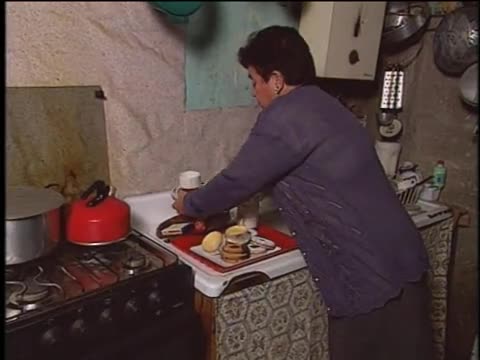
CHARLES KRAUSE: Those facts are now evident even in some of Chile's poorest slums, places like La Victoria in Santiago. At first glance, it's hard to imagine the situation here has improved. But, in fact, La Victoria is far more prosperous today than it was just a few years ago. Food is more affordable and more plentiful. There's electricity, running water, and the dirt streets are now paved. Perhaps even more important, an old classroom in the neighborhood school has been fitted with new computers. They're a priority because education is viewed as the key to eradicating poverty--here in La Victoria, elsewhere in Chile, and increasingly throughout the hemisphere. Maria Clara Aramburu is the school's principal. We asked her what changes she's seen in La Victoria since she came to work here 34 years ago. "Many changes," she told us. "The houses are much better. The children have better clothes, and their health is better, too." La Victoria was founded more than 40 years ago, in 1957, when several hundred homeless families invaded what was then a rural estate and seized land to build their homes. Among those original settlers were Heriberto Lagos and his wife, Sonia. Today, they're still in La Victoria--having raised five children here, two of them still at home. The others visit often; bringing their children to play on the concrete floor of the house the Lagos' rebuilt just five years ago. Late at night or early in the morning, Heriberto Lagos leaves his family to work a ten-hour shift in a steel mill, where he earns about $3 an hour. It's hard work and each week, the shifts change. One week, Heriberto works all day--the next week, all night. Still, he says he's lucky to have his job because to remain competitive, the owners of the steel mill have invested heavily in new machinery--laying off half their work force over the past few years. For the workers who remain, however, real wages have increased along with their productivity. As a result, Heriberto takes home about $170 a week with overtime--a good wage in Chile and enough to begin to lift the Lagos family out of poverty. Back in La Victoria, the family now has own computer, a telephone, and three television sets. A meal in a restaurant is still out of the question, as is a night at the movies. But the family was able to take a vacation this year to the South of Chile.
SONIA LAGOS: (speaking through interpreter) We took the two unmarried kids, just the four of us. It was wonderful. We truly deserved it; it had been so long since we'd gone anywhere.
HERIBERTO LAGOS: (speaking through interpreter)You see, I would always tell my kids about how lucky I was, many years ago, when I was still single, to travel around quite a bit. I would often tell my kids about how beautiful it was, but I'd never been able to show them myself. This time I was able to do that. And I took them in my own car, too. Our dream now is to see our children get a degree and become professionals. The whole point is for them to have a better life than we did, and that they, in turn, be able to give their own children a better life-a life without the deprivation all of us have known.
CHARLES KRAUSE: A generation ago, it would have been unthinkable for a child from La Victoria to aspire to study much beyond grade school. But for the Lagos family, and many others in La Victoria, the dream of an education for their children is now coming true. Patricio Lagos, 14, is in high school, while his older brother, David, 19, attends a private university. He's studying to become an industrial engineer. Every month, fully one third of the family's income goes to pay for David's tuition. It's an enormous financial sacrifice--one which Heriberto and Sonia are willing to make-but which they say believe demonstrates that Chile's new economic system is unfair.
HERIBERTO LAGOS: (speaking through interpreter) I think there are many benefits, and much has been accomplished. But the most serious problem is that too few rake in too much of the national income. Too few have too much, and too many have too little. We have to start reducing inequality, and when that's done, then we might say that the pie-that's a saying we have here--is being split fairly.
CHARLES KRAUSE: Heriberto Lagos is by no means alone. Many of La Victoria's walls are covered with murals attacking the perceived inequities of Chile's free market system. The left calls it "injusticia"--injustice. Economists and politicians call it the "equity debate." Here in La Victoria-and throughout Latin America-the left remains strong, so the debate over equity has an important corollary: Will the free market model be sustainable politically if it appears to favor the rich, to be exploitative and unfair? o far, in La Victoria, there's been enough economic progress so that resentment toward the new system has not yet translated into protests or political demonstrations. That's significant because La Victoria has long been a stronghold of Chile's Socialist and Communist parties. Today there's a monument to those from La Victoria who were either executed, or who simply disappeared, after Chile's 1973 military coup. That coup was led by Gen. Augusto Pinochet, a fervent anti-Communist who introduced the new free market system. He also wiped out a generation of Chilean leftists, including those from La Victoria and others, including Orlando Letelier. A socialist and former Chilean foreign minister, in 1976, Letelier was assassinated when his car was blown up in Washington. Today, his son, Juan Pablo Letelier, is a socialist member of Chile's Chamber of Deputies. His district includes many poor people like those in La Victoria. A critic of the current economic model, Letelier says that many of the tax and labor laws inherited from the military are so pro-business that they're undermining support for the free market system among the working class and the poor.
JUAN PABLO LETELIER: As long as there's one person who doesn't have a stake in the growth, there's something that's wrong. That has to do with values and principles, not with economic numbers. The model in Chile, or better yet the economy, grows because the Chilean people are a very special type of people, a working people, with great effort, but they have the right to participate in the fruits that they produce. Or otherwise we end up with great frustrations which accumulate and which I think ethically are not acceptable.
CHARLES KRAUSE: Jose Pinera was one of the economists who helped Pinochet design and implement the current system. Today, he says the fairness issue is nothing more than a political tactic invented by the left.
JOSE PINERA: You must accept in a free society that someone with exceptional talents like Bill Gates or Michael Bell can have more income and can get rich, as long as you also know that the working people are going up. And that's happening also in Chile. Of course, those very talented entrepreneurs that are finding new opportunities in the export sector, are creating a new software, have discovered a new way to produce at a given factor, of course their income goes up. That is life. But the important thing, again, is that their income doesn't go up because a minister gives them a privilege or because of corruption and they get demanding to the public treasury. But they are getting rich because they are creating wealth for everyone. Chile is a very stable political society. So of course there may always be some people somewhere saying that this will be, it will create a problem. That has not been the case. Look at Chile. Where is the instability?
CHARLES KRAUSE: But Letelier says that in a democracy, labor laws that limit the rights of unions and tax laws that favor the rich are going to create real problems.
JUAN PABLO LETELIER: I would tell people like Pinera that the time will come that changes will take place. And if one wants to have a future of stability, it's better to come up quicker with the changes than to postpone them.
CHARLES KRAUSE: Letelier's view that if the free market system is to continue, the gap between rich and poor must be narrowed is generally shared by most development economists and by most elected politicians throughout the hemisphere. Jose Antonio O'Campo is executive secretary of the U.N. Economic Commission for Latin America and the Caribbean headquartered in Santiago.
JOSE ANTONIO O'CAMPO: We are a very inequitable society. And, second, the forces which lie behind a wrong distribution of income a wrong distribution of assets in society have, if anything, increased or become stronger in recent decades. If those forces, which are tending to generate a bad distribution of income in society, are not addressed, we'll be back into significant social conflicts, which were an unfortunate fissure of this society's not long ago.
CHARLES KRAUSE: So far, Chile has avoided a return to conflict because even though the rich are doing extraordinarily well, there's also evidence of economic and social mobility. Formerly working class areas like La Florida are now booming. Vast new subdivisions house a new generation of secretaries, computer technicians, and middle managers. There are also new shopping centers and new supermarkets. And it's this new middle class that many economists and politicians believe holds the key to the future of the free market system, not only here in Chile but throughout the developing world. It's thought that if there's enough social and economic mobility for at least some of the poor to become middle class, then there's less danger of a political backlash, and it's more likely that support for the free market system will continue. % ? FOCUS - MEGER MANIA
JIM LEHRER: Finally tonight, what's driving the mania for mergers. Phil Ponce begins.
PHIL PONCE: So far, 1998 is shaping up as a record year for mergers and acquisitions. Since January, four of the five largest mergers in corporate history have been proposed. In the world of high finance, Citicorp teamed up with Travelers Group in an $83 billion deal. The goal: to offer consumers one-stop shopping for all their banking, investing, insurance and other financial needs. NationsBank and BankAmerica announced plans for a $60 billion merger, creating what they hope will be the first truly coast-to-coast bank. In the auto industry, one of America's big three has gone global. Chrysler is being bought by German powerhouse Daimler-Benz in a deal with more than $40 billion, the largest takeover in automotive history. In communications, the so-called Baby Bells are growing in size but shrinking in number, most recently with the purchase of Ameritech by SBC in a $62 billion stock deal. For the businessmen involved opportunity calls.
SPOKESMAN: When we looked at this together, there's a perfect fit.
REED, Citicorp: The business opportunities seem to be quite fantastic for our shareholders.
EATON, Chairman, Chrysler: We are leading a new trend that we believe will change the future and the face of this industry.
PHIL PONCE: The recent merger activity continues a broad trend of the last several years--one that's hit industries as diverse as entertainment and media, health care and pharmaceuticals, defense, insurance and retail. In the last year alone, a record $1 trillion in mergers took place, all amid a strong economy and booming stock market. Today's merger boom is just the latest in American economic history. Industrial takeovers of the early 1900s gave birth to giant oil, steel, and auto companies. General Motors, for example, was created by the merger of more than a dozen car companies. Both the 1920's and 1960's saw bursts of merger activity and the creation of new conglomerates in a host of industries.
COMMERCIAL SPOKESMAN: The crowning jewel in R. J. Reynolds Tobacco Company's bid to be the lowest cost producer of the highest quality cigarettes in America.
PHIL PONCE: More recently, in the 1980's, hostile takeovers and leveraged buyouts like the one that produced RJR Nabisco fueled another merger frenzy. But mergers within just the last three years have outstripped the entire decade of the 1980's. And business watchers inmany industries predict more are on the way.
JIM LEHRER: Our business correspondent, Paul Solman, of WGBH-Boston continues. His discussion was taped last week.
PAUL SOLMAN: Now, four views--two from Wall Street. Bruce Wasserstein is an investment banker who's been involved in many larger mergers. He's author of a new book, "A Big Deal, The Battle for Control of America's Leading Corporations." Jim Grant is an economic writer and editor of a newsletter Grant's Interest Rate Observer. And we have two economics professors with us: Fred Weston teaches mergers and acquisitions at the Anderson School of Management at the University of California in Los Angeles, UCLA. And Walter Adams is past president of Michigan's State University and author of "A Dangerous Pursuits, Mergers & Acquisitions in the Age of Wall Street." Gentlemen, welcome to you all. Professor Adams, from a business point of view, does this recent spurt of mergers make sense to you?
WALTER ADAMS, Michigan State University: Well, it really doesn't because mergers do not create new wealth. They don't build new factories. They don't create new products. They don't provide new technology. They do not increase efficiency. Nor do they--in and of themselves--stimulate international competitiveness. They represent merely a rearrangement of existing assets--the trading of ownership shares on the floor of the New York Stock Exchange. You might call it rearranging the deck chairs on the Titanic.
PAUL SOLMAN: So, Mr. Wasserstein, are you engaged--you and your colleagues, that is--engaged in a wasteful activity here?
BRUCE WASSERSTEIN, Investment Banker: Well, I very much enjoyed the professor's comments, because they summarize really an outdated and very, I believe, simplistic point of view. This is a complex phenomenon, but the one thing we can all agree on is that it did happen and continues to happen. There have to be reasons why this is a recurring fundamental force in our economic markets. The fact that the takeout of a merger or acquisition is fundamental to companies starting up, to venture capital markets, is obviously another factor in the growth of the stock market. But the big factors that are new, I think, at this point in time are the deregulation of industry and the changes in technology. The confluence of these two factors with the nature of the financial markets at this time have led to this explosion of activity.
PAUL SOLMAN: Jim Grant, economic fundamentals, human psychology, which do you think is driving this more, and do you agree with Professor Adams or Mr. Wasserstein?
JIM GRANT, Economics Writer: I agree with all my panelists in advance. It seems to me that of the two fundamentals of psychology the benefit of the doubt must go to psychology. These merger waves are recurring; they are not unique. And the explanations advanced for them at the time are strikingly similar. But inasmuch as technology changes and structures change and the explanations can't be the same, right--there has to be something else. It is no accident, I think, that these merger waves have tended to occur at moments of the greatest optimism and the highest valuation of financial markets. A hundred years ago there was talk of a new era. Similarly, in the 1920s and the 1960's, and now again in the 1990's, the higher the stock market, the more intense the optimism, the greater the tendency towards consolidation. Contrariwise, at the bottom of things we find an unsticking. These are cyclical features of markets.
PAUL SOLMAN: Unsticking, I'm sorry, I didn't follow.
JIM GRANT: Well, things come unstuck at the bottom. There are divestitures, spin-offs, breakups.
PAUL SOLMAN: You mean, the mergers of yesteryear become today's--
JIM GRANT: Sure. And by the way, as a matter of scholarship, it seems to me--I've never read a study that did not contend that five years or so after the merger, that the owners of the acquiring company were better off. On the contrary, those owners tend to be worse off.
PAUL SOLMAN: Well, let's stay with the larger issue of whether or not it's good for the economy before we get to how successful they are--whether it's not, it's good for the companies involved. Professor Weston, we haven't gotten you in here. Psychology do you think is driving it more than fundamental factors?
FRED WESTON, UCLA: What has changed is the globalization of competition. This, in part, came about from technology. But the technology produced lower transportation costs. So now we have one world market. In addition, the boundaries of industries are blurring. There's competition among firms in different industries. I would disagree that there are no studies that show shareholders are better off five years later. Some show they do and some not. But what's most significant is that even if the mergers, on balance, were failures, their great impact is the four other firms not involved in mergers to be efficient. It's the threat of being taken over that has made the whole economy more efficient. Since 1980, when this merger activity increased, there has been an increase in the number of jobs in the economy from 99 million to 119 million. That's 20 million jobs in 10 years. That's 2 million jobs a year. When a merger is announced, it is said that--often it's reported 2,000 laid off, 300,000 laid off. But this is moving resources. Fundamentally what mergers do, contrary to what Prof. Adams says--mergers and the threat of mergers move resources to their highest and best and most economic uses.
PAUL SOLMAN: Prof. Adams, isn't that true? I mean, we're talking about the economy as a whole now, not just for business or businesses. I mean, isn't there a real efficiency factor and you're always afraid your company is going to get taken over and, therefore, you squeeze the most out of the assets?
WALTER ADAMS: Well, that really is not borne out by the facts. If you take a look at the major acquisitions that have taken place during the 1980's, 2/3 of those mergers have been failures. When you talk to a management guru like Peter Drucker, he says one out of five mergers is a success. Two mergers neither live nor die, and two are outright failures. Now, one out of five, that isn't a very good batting average. It seems to me when you look at an AT&T, which buys an NCR computer, they pay $7 2 billion for that acquisition. A few years later they sell it for half that amount. Kodak buys Winthrop Chemical, sells it off at a great loss to itself. The market itself has demonstrated that these giant mergers do not work because the mythology that size guarantees efficiency, technological progressiveness, international competitiveness, that just isn't borne out by the facts.
PAUL SOLMAN: Mr. Wasserstein, the facts. You've certainly been in on a lot of the deals that took place.
BRUCE WASSERSTEIN: Sure. This is at the level of being fairly silly at this point. Fortunately, we have hindsight of the way the markets have performed. There's no doubt that there are changes in technology. There's no doubt there is a globalization. There's no doubt there is convergence. The advantage of America in the world market today, in comparison to other countries, has been, indeed, our flexibility to have a viscosity of assets. The reply I'd make to all of the professor's anecdotal information is, so what? The point is some deals work; some deals don't work. The statistics I completely would disagree with, but the fact that this company sold off this division doesn't mean that it's now not better focused on the future. We all have to adapt. After all, if you were a buggy whip company and you stayed that way; you wouldn't be in very good shape today.
PAUL SOLMAN: Mr. Grant, isn't that true? Isn't what Mr. Wasserstein says true? After all, Japan doesn't have as many mergers. Neither does Germany. And it looks like the United States has moved ahead of these countries in part because of the dynamism of our market--getting bigger, getting smaller.
JIM GRANT: I think he's right in two very important ways. One, the dynamism of American markets and finance is wonderful. And, in the absence of it, you get situations, such as the one you have in Japan, in which there is an ossification of markets and companies. And it's not very good. He also said something that I think bears repeating, that is, that at a price, the purchase of assets works. Well, it seems to me that what we have now is a very high price. And, furthermore, it's not coincidental that merger waves have occurred in eras of very high prices. If the studies I've read are valid, that, on balance, the acquiring companies tend not to do very well, perhaps it is because they've overpaid, perhaps because they got the courage to buy when everyone else had the courage to buy. It's no--again it's no--it is a paradox, but it's no secret that merger activity is quiescent when assets are cheap. Why is that? Well, there's no courage to lend; there's no courage to borrow; there's no courage to imagine great things. These things take place; they tend to take place at peaks.
PAUL SOLMAN: Professor Weston, I want to get in the question of people losing their jobs, which is a frequent complaint made about mergers and hostile acquisitions. There's this thing called synergy. One and one is great and equals three--you get more out of the combined companies than you would if they were operating separately, But as far as I can tell, synergy often means just cutting back people who were doing the same thing in the two companies, therefore, a loss of jobs.
FRED WESTON: Now, if you read the case, that is, where massive restructuring has taken place--it's more than just laying off people. It's changing top management. It's changing product selection. It's changing product quality. It's changing manufacturing processes. It's supplying new information systems. The difference between the mergers that fail and the mergers that succeed are that the mergers that succeed really make a fundamental change in the efficiency of the companies. And then they do succeed, and then they do contribute to the excellent performance of the economy during the last 17 years.
PAUL SOLMAN: So, last question to you, Professor Adams, do you see no merit to the argument that these mergers, hostile acquisitions, all the rest of it, much as they may not even work out in themselves, contribute to the overall efficiency of the economy by disciplining managements who otherwise wouldn't be disciplined?
WALTER ADAMS: There I have not seen persuasive evidence to that effect. It seems to me, you asked the question earlier about motivation behind mergers. The people who profit most from mergers are the marriage brokers on Wall Street who put these mergers together in the first place, and then five or ten years later, these same people preside over the divorce of these companies, and they get a commission at either end.
PAUL SOLMAN: Well, I have to allow Mr. Wasserstein a last word on that, since he is one of these so-called brokers. Mr. Wasserstein, you'll get the last word.
BRUCE WASSERSTEIN: You know theories of this international conspiracy are interesting but really underline my point of the paucity of depth to thee arguments. Look, we have--
PAUL SOLMAN: You are paid on commission, are you not?
BRUCE WASSERSTEIN: It all depends, actually. But basically, if you don't give good advice, you're not going to be giving advice in the future. You have to think in our business, the people who are in it long-term are the people who give good advice. Mergers are a very imperfect process. They allow the economy to adjust to all sorts of changes, regulation, technology, globalization. A lot of them don't work. It is imperfect. The statistics, pro and con, are really at such an elementary level of distortion, one way or the other, that they really can't be trusted. For example, a lot of the numbers on jobs lost include companies, divisions that are sold by the acquiring company, so the jobs, in fact, aren't lost. And if you look at the unemployment rate in America today, at the height of the merger trend, it's quite clear that you can't argue that mergers by themselves create that high rate. In fact, if one were to summarize the boom level, at least on a correlation basis, we're having the highest rate of mergers in the U.S. We're also having the highest rate of growth and lowest unemployment in the western economies.
WALTER ADAMS: A spurious correlation, that spurious correlation-they know that, Mr. Wasserstein.
PAUL SOLMAN: Gentlemen, a spurious correlation is surely not a concept we'll wind up getting into tonight. Thank you all very much. We've run out of time. Appreciate your being here. % ? RECAP
JIM LEHRER: Again, the major stories of this Tuesday, President Clinton announced the first federal budget surplus in 29 years, not 40, as I reported in the News Summary. He said he will consider tax cuts next year but only after Congress fixes Social Security. And the U.S. Supreme Court ruled police in high-speed pursuits cannot be sued by someone harmed in the process. A follow-up before we go tonight: Last May, we had a report about student athletes with learning disabilities who wanted to play college sports but couldn't meet the academic requirements of the NCAA. Well, today the NCAA agreed to revise the way it assesses academic performance for those students. We'll see you on-line and again here tomorrow evening. I'm Jim Lehrer. Thank you and good night.
- Series
- The NewsHour with Jim Lehrer
- Producing Organization
- NewsHour Productions
- Contributing Organization
- NewsHour Productions (Washington, District of Columbia)
- AAPB ID
- cpb-aacip/507-222r49gr7m
If you have more information about this item than what is given here, or if you have concerns about this record, we want to know! Contact us, indicating the AAPB ID (cpb-aacip/507-222r49gr7m).
- Description
- Episode Description
- This episode's headline: Pressure Point; Model Economy; Merger Mania. ANCHOR: JIM LEHRER; GUESTS: JAMSHEED MARKER, Former Ambassador, Pakistan; ROBERT OAKLEY, Former U.S. Ambassador, Pakistan; JIM GRANT, Economics Writer; FRED WESTON, UCLA; WALTER ADAMS, Michigan State University; BRUCE WASSERSTEIN, Investment Banker; CORRESPONDENTS: CHARLES KRAUSE; PHIL PONCE; ELIZABETH FARNSWORTH; MARGARET WARNER; PAUL SOLMAN; KWAME HOLMAN
- Date
- 1998-05-26
- Asset type
- Episode
- Topics
- Economics
- Social Issues
- Women
- History
- Global Affairs
- Business
- Sports
- Race and Ethnicity
- War and Conflict
- Health
- Religion
- Consumer Affairs and Advocacy
- Military Forces and Armaments
- Politics and Government
- Rights
- Copyright NewsHour Productions, LLC. Licensed under a Creative Commons Attribution-NonCommercial-NoDerivatives 4.0 International Public License (https://creativecommons.org/licenses/by-nc-nd/4.0/legalcode)
- Media type
- Moving Image
- Duration
- 01:01:43
- Credits
-
-
Producing Organization: NewsHour Productions
- AAPB Contributor Holdings
-
NewsHour Productions
Identifier: NH-6136 (NH Show Code)
Format: Betacam
Generation: Preservation
Duration: 01:00:00;00
If you have a copy of this asset and would like us to add it to our catalog, please contact us.
- Citations
- Chicago: “The NewsHour with Jim Lehrer,” 1998-05-26, NewsHour Productions, American Archive of Public Broadcasting (GBH and the Library of Congress), Boston, MA and Washington, DC, accessed April 2, 2026, http://americanarchive.org/catalog/cpb-aacip-507-222r49gr7m.
- MLA: “The NewsHour with Jim Lehrer.” 1998-05-26. NewsHour Productions, American Archive of Public Broadcasting (GBH and the Library of Congress), Boston, MA and Washington, DC. Web. April 2, 2026. <http://americanarchive.org/catalog/cpb-aacip-507-222r49gr7m>.
- APA: The NewsHour with Jim Lehrer. Boston, MA: NewsHour Productions, American Archive of Public Broadcasting (GBH and the Library of Congress), Boston, MA and Washington, DC. Retrieved from http://americanarchive.org/catalog/cpb-aacip-507-222r49gr7m