The NewsHour with Jim Lehrer
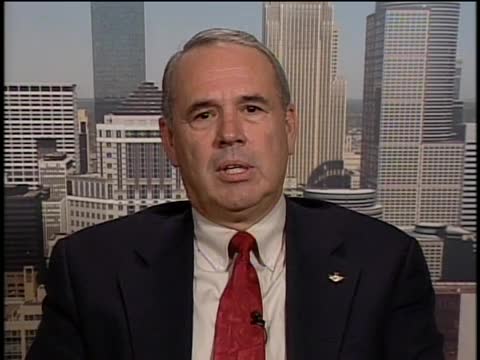
- Transcript
RAY SUAREZ: Good evening. I'm Ray Suarez. Jim Lehrer has the day off. On the NewsHour tonight: A summary of today's news; a look at the new economic numbers; a Betty Ann Bowser report on how well welfare reform has worked; should airline pilots be armed; and the weekly analysis of Mark Shields and David Brooks.
NEWS SUMMARY
RAY SUAREZ: U.S. unemployment rose in April to its highest level in almost eight years. The Labor Department reported today the rate was 6%, up 0.3 from March. The upturn occurred even though companies actually added 43,000 positions to their payrolls last month. On Wall Street, the jobless numbers helped send stocks lower. The Dow Jones Industrial Average fell 85 points to close at 10,006. The NASDAQ Index lost 31 points to finish at 1,613. It has not been that low since October. We'll have more on the economy in just a moment. In the Middle East today, Israeli and Palestinian officials reacted cautiously to holding an international peace conference this summer. Secretary of State Powell announced it Thursday. Foreign ministers would lead the discussions. Today, an Israeli spokesman said his government needed more details, while Palestinian leader Yasser Arafat welcomed the idea, but said he had to consult other Arab leaders. At the White House, Spokesman Ari Fleischer said it remains to be seen if Arafat needs to attend the conference. He also said President Bush believes the Palestinian people "deserve better."
ARI FLEISCHER: The President does have concerns about the Palestinian authority and making certain that the Palestinian people have a government that is worthy of them and is not in any way inhibited in its ability to serve the people as a result of lack of transparency or lack of rule of law or the presence of corruption. Again, Yasser Arafat, on the question of fighting terrorism and also on the questions of corruption and rule of law, has not earned the President's trust. And these are all issues that the President will watch and monitor.
RAY SUAREZ: Late Thursday, the Israeli government said it had proof Arafat directly approved funding for terrorist attacks. It said the information came from a top Palestinian leader, now under arrest. Palestinian officials had no immediate response. On the ground today, Israeli forces raided a hideout of the militant group Hamas in Nablus. A Hamas member and an Israeli soldier were killed. The president of Kosovo came face-to-face today with Slobodan Milosevic at the Milosevic war crimes trial. Ibrahim Rugova testified at The Hague in the Netherlands. He said the former Yugoslav president led a campaign of ethnic cleansing to rid Kosovo of Albanian separatists in 1999. The violence provoked NATO air strikes in Serbia. Milosevic, in turn, accused the ethnic Albanians of horrible crimes against Serbs, committed under NATO protection. A retired Catholic priest agreed today to return to Massachusetts to face charges of child rape. Reverend Paul Shanley waived his right to fight extradition at a hearing in San Diego where he now lives. He's accused of repeatedly attacking a young boy in the Boston area during the 1980s. Shanley has become a central figure in the sex abuse scandal involving Catholic priests. Church documents show allegations against him going back to 1967. The archdiocese of Boston today abandoned the settlement with 86 victims of former priest John Geoghan. Geoghan was sentenced to six years in prison in February for sexually abusing one boy in 1991. The Finance Council of the archdiocese rejected the settlement as too costly. It was reportedly worth as much as $30 million. Cardinal Bernard Law supported the deal. He has come under fire for transferring Geoghan from parish to parish. At least eight pipe bombs exploded in rural mailboxes across Illinois and Iowa today. Authorities said five people were hurt, but none seriously. A Postal Service official said there were anti-government notes with the bombs. The notes also said in part, "If the government controls what you want to do, they control what you can do." The notes also said more "attention getters" were on the way. Hawaii is set to be the first set to regulate the price of gasoline. The state legislature adopted that policy Thursday. Hawaii voted to cap gas prices based on West Coast averages, and cap profit margins for dealers at 16 cents per gallon by July, 2004. The governor has indicated he will sign the bill. Gas prices in the state are among the highest in the nation, at 20 to 50 cents above the national average. That's it for the News Summary tonight. Now it's on to new economic numbers, revisiting welfare, guns in the cockpit, and Shields and Brooks.
UPDATE - ECONOMIC DIRECTIONS
RAY SUAREZ: Now, making sense of the numbers. The unemployment rate is up, the stock market is down for the year, and yet signs of economic recovery abound. So what should we make of all this conflicting economic news? We put that question to two long-time economy watchers. Gretchen Morgenson is a financial writer and columnist for the "New York Times." And Ed Montgomery is a professor of economics at the University of Maryland. He served as Deputy Labor Secretary in the Clinton Administration. Well, Professor, is 3/10 of 1% a sizable jump for one month?
EDWARD MONTGOMERY: Well, it is a significant jump and more than I think people were expecting. But I think if we step back, if you remember not more than two months ago, Alan Greenspan predicted that over the course of this recession, the unemployment rate would get up to 6%. That's exactly what we see now. So it is not all a surprise to us, but nonetheless, it was a big jump for one month.
RAY SUAREZ: But there have been a lot of countervailing evidence that things were improving, as well: Improved manufacturing numbers, good durable goods orders-- not necessarily last month, but over the last several months -- housing starts numbers were good; the weather had been mild. So there might have been an expectation that it wouldn't have been as big?
EDWARD MONTGOMERY: Well, I think part of what's going on in the manufacturing picture continues to improve now. While employment and manufacturing fell another 19,000, that's a much smaller drop than we had been seeing previously in the year, where we were averaging about 100,000 to 150,000 jobs lost each month. So in terms of that, there's some improvement. The two parts of manufacturing that have been really hard hit-- industrial equipment, electrical equipment production -- both were stable last month. So that's some positive news, although, again, we haven't seen employment start to climb yet in manufacturing.
RAY SUAREZ: And just to be clear, the economy is making new jobs, isn't it?
EDWARD MONTGOMERY: It is, indeed.
RAY SUAREZ: Just not enough?
EDWARD MONTGOMERY: It is. It actually added 43,000 jobs last year... last month, I'm sorry. In the service sector we added over 100,000 jobs. Health supply was growing, health services were growing; engineering services were growing. Growing. So a number of sectors were growing. The economy picked up a little bit. I think the large declines have seemed to have gone away. And so that's a positive trend, but I would expect to see some softness in the labor market still going out in the next month or two.
RAY SUAREZ: Are there regional hot spots, either places that haven't been as severely affected, or places that have been hit harder?
EDWARD MONTGOMERY: Well, this is a very traditional recession -- much like the 1981 recession where most of the job loss was in manufacturing, in this recession, over 70% of the job losses have also occurred in manufacturing. Again, in the rust belt states, those are the states, which have been disproportionately hit this time around.
RAY SUAREZ: So the Great Lakes and...
EDWARD MONTGOMERY: So the Great Lakes -- Michigan, Ohio, Illinois, Wisconsin, those kinds of states. Where there's textile in North Carolina, South Carolina, those states have been severely hit. Unlike the '91 recession, this really hasn't been a white collar recession. So we've seen growth in finance still. We've seen growth in the service sector throughout this recession. So, again, it's a very traditional recession in the sense that it's been disproportionately in the manufacturing regions of the country.
RAY SUAREZ: Now, last week came the news, the annualized rate, the Gross Domestic Product, had leapt 5.8%. If it moderates, that kind of growth, as the federal people who watch these numbers predict it will, will 3.5% or so be enough to keep job growth steady enough to sop up some of this new unemployment?
EDWARD MONTGOMERY: Well, if we go back to something like 3%, 2.5%, 3.5%, what we get is a fairly weak recovery. I think it would start adding jobs. It wouldn't return us to the kinds of days we saw in the late 1990s where the economy was growing at 4%, 4.5% a year. We were adding 200,000 jobs a month. I don't think we would necessarily get back to that kind of picture unless we get a substantial pickup in economic growth.
RAY SUAREZ: Now, Gretchen Morgenson, there has been news ample to make the pessimists and the optimists happy over the last couple of weeks. But no matter what happens, it seems, whether it's good news or bad, the market continues to decline. Why?
GRETCHEN MORGENSON: Well, I think that it's because the numbers, even if they look good from the top line number, that they're not really indicating a strong economic recovery. For instance, the 5.8% GDP growth in the first quarter was really largely a function of government spending and an increase in inventory buildup at corporations. Now, that's not a bad thing, but it's not as good as corporate earnings. Final sales to consumers or customers of these companies, that's what the market wants to see. And they're not seeing it yet. Now, as far as the employment figures, the problem with the increase to 6%, which was announced today, is that there is a fear that the consumer will be heard, that consumer spending, which has really driven the economy recently, as corporate capital expenditures have declined, that the consumer will start to cut back on the spending, and that will be bad.
RAY SUAREZ: Well, if we're waiting for corporations to start investing, to really start turning things over, where in the cycle does that typically happen? Do businesses have to see these other numbers trending higher before they jump in and start investing in new plant, new equipment, new employees?
GRETCHEN MORGENSON: The difficult thing about this cycle is that we had such a prolonged boom for so long, and the excesses in certain areas of, say, telecommunications, other technology spending, it might take an extraordinarily long or unusually long period to work out those excesses, to work down the inventories. At the same time, because this is technological goods that we're worrying about, we do have an issue of these obsolescence in goods, which is a problem for technology concerns. It is a real problem right now, because technology has really driven the capital expenditure part of the cycle, and that is really sort of dead in the water.
RAY SUAREZ: The Dow Jones Industrial Average is down about 15% for the year, the NASDAQ even more. Is there still a sense, among people who buy and sell stocks, that they are still too expensive?
GRETCHEN MORGENSON: Yes, definitely. Particularly when you look at the earnings. The markets are still overvalued by many measures. And since investors have had two years of down markets, it's almost as though they think they're owed an up market; that nowhere is it written that they have to take three years of pain. But the fact of the matter is, if earnings don't come back, the stock market is going to really, I don't know, be lackluster certainly.
RAY SUAREZ: And Professor, how does the stock market fit into other parts of this cycle? Will people feel more confident about their own spending? Will businesses feel more confident about their own spending once people at the top of the corporation see that their own share prices are higher?
EDWARD MONTGOMERY: Well, I think one of the things we have to keep in mind, over the course of the 1990s, there has been a dramatic increase in ownership of stock by average Americans. And so one has to wonder, until share prices start to rise, until workers and the average American starts getting some increase in wealth, whether you're going to see bigger increases in consumer spending. Consumers have stayed fairly confident during this recession. They've propped up the economy. Whether you'll get big booms until the stock market turns around, I'm suspicious.
RAY SUAREZ: Does low inflation, Gretchen Morgenson, and then outlook for low inflation down the road and no new interest rate increases help in the mix?
GRETCHEN MORGENSON: Well, certainly, low interest rates always help stock prices. Now, the current fear that is gathering some steam is the weakness in the dollar, which could be inflationary over the longer term. If it is allowed to weaken and fall even lower, you could have some inflationary pressures.
RAY SUAREZ: Gretchen Morgenson, Professor Ed Montgomery, thank you both.
FOCUS - REVISITING WELFARE
RAY SUAREZ: The welfare reform law is up for reauthorization later this year for the first time since it was implemented in 1997. So its impact in states like Connecticut is being closely watched. Betty Ann Bowser reports.
BETTY ANN BOWSER: Three years ago, Nicole Drury was barely hanging on. She had no job skills, she lived with a man who abused her, she was a new mother, and back then, economic survival came in the form of a monthly welfare check.
NICOLE DRURY: Where was I then? Struggling in a home that was so unhealthy for my daughter. We just were robbed three times, it was just so unsafe. It was unbelievable.
BETTY ANN BOWSER: But today, Drury has a full-time job as a receptionist at a Bridgeport, Connecticut Economic Council. The abusive boyfriend is history. So is welfare.
NICOLE DRURY: I am able to make ends meet. I was able to purchase a car, my very first car. I was able to purchase a wonderful condo in a beautiful neighborhood that I just love living in. And it's just so wonderful, and a lot more healthy for my daughter.
BETTY ANN BOWSER: Since welfare reform was implemented five years ago, more than 34,000 people in Connecticut like Drury have come off the welfare rolls-- a 60% drop in caseload. Reformers say that's dramatic evidence that the 1996 welfare reform law is working. In Connecticut, the state's reformed welfare program is called Jobs First.
SPOKESPERSON: That if you did decide to go on to nursing or something more advanced in the medical career, you've already gotten a foundation.
BETTY ANN BOWSER: Almost everyone who goes on welfare in the state has to take part in a program designed to help them learn a skill, then to move them into a paying job. When they go to work, they can keep their new paycheck, along with theirwelfare checks, for about two years. Connecticut also has the toughest time limit in the country, 21 months. Even though more than half of recipients get some kind of an extension, when those are up, welfare is cut off for good. Teisha Ford says the time limit was a powerful motivator.
TESHA FORD: It makes you move. It makes you get going. You know, you don't sit around. You know you have until this time, and you do whatever you have to do to make sure you meet that, you know, that deadline, because when it's done, it's done.
BETTY ANN BOWSER: But the debate over whether welfare reform is working is far from over. Success stories like Ford's and Drury's are just one part of it. Critics say Connecticut's robust economy deserves a lot of the credit for creating all the new jobs for welfare clients. And they say that many who got those jobs who left welfare for work aren't that much better off economically. As proof, they point to the first and only study done of any state's welfare population. It was paid for by the state of Connecticut, and was conducted by the Manpower Development Research Corporation of New York City. It put welfare recipients into two groups: A control group that got conventional welfare and the jobs first people.
DAN BLOOM, Manpower Development Research Corp.: Well, what happened is we compared the two groups to one another. And the group that was subject to the welfare reform, in terms of their income, it's not that much different than the group that was not subject to the welfare reform. They're more likely to be working and they were less likely to be on welfare, but they didn't especially have more money, no.
BETTY ANN BOWSER: And what does that say to you?
DAN BLOOM: Well, it says that when people go to work and get fairly low-wage jobs, and their welfare benefits ultimately are reduced because of the fact that they went to work, they may not end up with that much more... that much more income.
BETTY ANN BOWSER: In other words, people like Cherie Mazzoni. She's not economically better off than she was on welfare. Her 30-hour-a-week job pays just above the minimum wage. She's still living in poverty, just one step away from disaster. Recently this single mother of two lost her childcare supplement because the school wouldn't accept her school-age daughter.
CHERIE MAZZONI: I was caught in a catch-22. I'm not eligible for the money because she's school-aged, but the school that... this school, you know, like the West Haven Board of Education School, said she can't come because she's going to get left back. She's not ready. So now I have to pay $100 a week, and I have to do this and then I have to sit there and wonder, where's my food coming from? You know, how am I paying my rent? What am I going to do?
BETTY ANN BOWSER: Twice a month, Mazzoni shares her frustrations with other members of Mothers for Justice, a new haven group of current and former welfare moms. All of these women have gone to work in the past few years, but like Mazzoni, they are living on the edge, with complicated everyday life problems. And they don't think the reality of Jobs First lives up to its official promise. Michelle Caldwell tried to get a job as a bus driver.
MICHELLE CALDWELL: The training at most of these places is unpaid. So you're going for training. I'm hearing that I can get child care, but I'm not really working because I'm not getting the paycheck, and they don't want to give me child care unless I really have a job. But I have a job, it's just not paying me. Then it's not a job. But no, if I walk away from it then I don't have a job. Well, it's not a job. So what do I do?
BETTY ANN BOWSER: Connecticut's top welfare reform official admits getting off welfare can be complicated, but believes reform has done what it set out to do.
PATRICIA WILSON-COKER, Commissioner, Conn. Department of Social Services: I think that the MDRC survey said to me said that we were on the right track in many regards with welfare reform; that the goals of the program that we established were largely met, we did succeed in replacing welfare checks with paychecks, and that people were not hurt in the process.
BETTY ANN BOWSER: The debate over welfare reform has heated up because time has started to run out for hundreds of Connecticut families, when job opportunities are shrinking because Connecticut's unemployment has risen to 8%. Since families have started losing benefits, New Haven's Christian Community Action Organization has seen a big increase in the number of people coming to its shelters and food pantry. Executive Director Bonita Grubbs says she's getting four or five calls a day from families needing emergency shelter, the most she's experienced in 13 years with the organization.
REV. BONITA GRUBBS, Director, Christian Community Action: What we've seen is just an increase in the number of individuals with no income, whose problems are much more complicated, whose situations are much more difficult to deal with, and not only that, but the individuals who are coming to us have increased in the last couple of months. So we're seeing an increase in homelessness. It seems to be in direct relationship to people being cut off the system completely.
BETTY ANN BOWSER: Shelley Geballe is co-president of Connecticut Voices for Children, whose organization studied the case files of 94 New Haven families with 270 kids who were cut off welfare last October.
SHELLEY GEBALLE, President, Conn. Voices for Children: And they had nearly 270 kids, more than three kids on average. What was striking was that three out of four had no job at all. And the ones who were employed, the one in four that were employed, were working on average 25 hours a week at eight dollars an hour. So that's about $10,000 a year of annual income. So basically, on October 1, we created 270 kids where there was no income coming into the household in any meaningful way in a city like New Haven where the cost of living is exceedingly high. And since then, statewide there are about 40 to 50 families losing cash assistance every month who face similar circumstances.
BETTY ANN BOWSER: Geballe says Jo-ann Ndiaye is typical. A single parent with five children, she was cut off on February 25. Ndiaye is currently living in one of Grubb's emergency housing apartments because she is also homeless.
WOMAN: That is the most outrageous thing I ever heard of.
BETTY ANN BOWSER: Ndiaye worked for a year, but lost her job when her daughter's baby sitter quit. Then she took a course to get to get a child development associate degree, but lost her apartment just a month before taking the state licensing exam.
JO-ANN NDIAYE: This is one of the most scariest times for me of my life, you know. This is... I try not to be afraid, you know, because I'm a person of faith and stuff. I try to believe that God brought us this far, He's not going to see me and my children out on the street. So I try and not be afraid, but it can really get scary sometimes. You wonder what's going to happen next. You know, being off welfare, being cut off from the cash assistance and not having a job, you know -- not having day care, not being able to get day care because I don't have a job. That's a catch-22.
BETTY ANN BOWSER: The Bush Administration's top welfare reform official says nationwide, most of people who've left welfare are not in Ndiaye's desperate circumstances.
WADE HORN, Assistant Secretary, HHS: First, the Administration believes that welfare reform has been a tremendous success. We have seen caseloads drop over half. We've seen increased earnings for single-headed households. And we've seen a substantial drop in child poverty. About two-thirds of them are working, are working in $7-$8- an-hour jobs. If they're working full time, they are with income combination with the Earned Income Tax Credit, food stamps, and transitional medical benefits; are substantially better off than they were on the old system.
JO-ANN NDIAYE: I suggest that we keep a daily correspondence so I can let you know how he does in class, and you can let me know how things are at home.
BETTY ANN BOWSER: Congress begins writing a new law later this year, with both sides ready to do battle over the question of whether elimination of poverty should be a stated goal of welfare reform.
JO-ANN NDIAYE: Let you know when something's going on and you're not completing your work in class, right?
RAY SUAREZ: Still to come on the NewsHour tonight: Guns in the cockpit, and shields and Brooks.
FOCUS - ARMING PILOTS?
RAY SUAREZ: The debate over guns in the cockpit. Kwame Holman begins our coverage.
KWAME HOLMAN: After September 11, heightened airport security began at the curb. Police kept traffic moving, and quickly towed unattended vehicles. Curbside check-in was prohibited for a time. National Guardsmen patrolled the concourses of many of the nation's largest airports, overseeing stepped-up passenger screening. Last Fall, Congress passed new legislation creating a federalized force of security employees. Some of them began work this week at Baltimore-Washington Airport. That same law also required checked bags be matched with passengers on board each flight. Undercover, armed air marshals also were assigned to fly many flights, especially those using Washington, D.C.-area airports. The Federal Transportation Department hopes to hire air marshals sufficient in number to have one aboard every commercial flight. Also on board, the doors that separate the cabin from cockpit must be reinforced and allow access only by flight crews. The union that represents commercial pilots lobbied hard last fall for a provision that would allow pilots to have weapons, including handguns, in the cockpit. But the final aviation security law left a decision on guns in the cockpit to the Transportation Department.
SPOKESMAN: The subject of today's hearing is arming flight crews against terrorism.
KWAME HOLMAN: Yesterday, at a House Aviation Subcommittee hearing, a pilots' union official called on Congress to legislate weapons in the cockpit.
CAPT. STEPHEN LUCKEY, Air Line Pilots Association: The reason I'm really here today is because you know on 9/11, eight pilots were unable to survive an assault attack by 19 terrorists on four aircraft. Had they the tools, the training, and the tactical knowledge to meet this challenge effectively, I think history would reveal a different outcome. We'd have the World Trade Centers and we wouldn't have an industry that's hemorrhaging profusely at this particular time.
KWAME HOLMAN: Flight attendants did not testify at the hearing, but many of them, concerned about hijacking, have taken self-defense courses on their own. Their union says arming only the pilots could leave everyone else in the cabin isolated and vulnerable in a crisis. Transportation Secretary Norman Mineta and Homeland Security Advisor Tom Ridge both oppose allowing pilots to have cockpit firearms. A formal decision on the issue by the Transportation Department is expected next week.
RAY SUAREZ: Elizabeth Farnsworth takes the story from there.
ELIZABETH FARNSWORTH: For more on this issue, I'm joined by: Captain issue, I'm joined by: Captain Stephen Luckey, who, as we just saw, testified before Congress yesterday. He's chairman of the National Security Committee of the Air Line Pilots Association; Patricia Friend, president of the Association of Flight Attendants; and Michael Goldfarb, former chief of staff at the Federal Aviation Administration. He now runs an aviation consulting firm.
Captain Luckey, run through us your proposal for arming some airline pilots. Who would be armed with what training and in what part of the plane?
CAPT. STEPHEN LUCKEY, Air Line Pilots Association: Well, first of all, anyone who participates in the program would be a completely voluntary participant. He would be carefully screened according to their adaptability and their suitability for the job at hand. Then they would be going through an extensive selection process as a result of an interview, subject to the same standards, strict standards that most federal law enforcement officers are submitted to. Following that, they would receive extensive training probably a week in length, some 48 hours, with many, many subjects. And basically they would get the same training that a federal law enforcement officer would, with the exception of investigatory stuff and driving skills, et cetera. But they would be more than ready to... readily prepared to defend the cockpit. And that's what we really want to do. We want to get the airplane on the ground.
ELIZABETH FARNSWORTH: Captain, the cockpit would only be defended under this scenario, right? You would keep the doors locked. Even if something is happening in the main body of the airplane you would stay in the cockpit?
CAPT. STEPHEN LUCKEY: That's true. And this is an unfortunate choice dictated by the circumstance. Prior to 9/11, the policy was to cooperate with the hijackers, get the aircraft on the ground, but as was very graphically illustrated, the tragedies resulting from that particular modus operandi is no longer acceptable. We've had to-- and this is with the concurrence of the flight attendants unions-- we've had to go to what we call an encapsulated concept, where we don't open the door under any circumstances in order to manage risk. This is an acceptable risk business and unfortunately we have to make untenable choices to survive and minimize the liability and the risk to the passengers and crew.
ELIZABETH FARNSWORTH: Michael Goldfarb, what is wrong with Captain Luckey's proposal?
MICHAEL GOLDFARB, Former FAA Chief of Staff: Well, it is certainly the line of last resort in the cockpit. I think that we need to focus on security on the ground. It's quite a statement that I think 20,000 pilots all signed the petition. That concerns me that so many of the flight crews today still feel that there's that kind of concern to have it. You know...
ELIZABETH FARNSWORTH: Okay. Let's assume for a minute as much as can be done is done on the ground. What is wrong with arming pilots?
MICHAEL GOLDFARB: Well, there's plenty wrong with -- first of all, I would almost think the flight attendants, there should be a chief flight attendant armed at the cockpit door. Remember, all the doors are going to be reinforced. They will be impenetrable. That will be done in relatively near order. But I think that the crew needs to focus on flying the aircraft. It's the shady, it's the vagueness situation where, in fact, it's unclear. We had an incident of a passenger on the flight from Miami to South America who attempted to get in a cockpit. If we had a stun gun, perhaps it would have disarmed the person. If they had a gun, when do you make the choice to use the firearm? If we are going to start having civil aviation become law enforcement function, I think we have a problem in this country about the ability to allow planes and passengers to fly without having an armed kind of situation.
ELIZABETH FARNSWORTH: Captain Luckey, what about the concern that you wouldn't necessarily be trained to recognize who is really a threat and who is just perhaps mentally unstable in some way?
CAPT. STEPHEN LUCKEY: Well, force continuum reaction capabilities in training would be an integral part of our federal preparation for arming the pilots. You know, the most defendable place in the aircraft is the cockpit itself. The perpetrator is faced to a channelized, predictable narrow avenue area of approach where only one person can come through at a time. We know the status of the resources in the cockpit. We don't know about that in the cabin. Anyone who is armed outside of the confines of the cockpit would require much more extensive training, probably in the neighborhood of ten times the amount of training in order to adequately respond in the environment, in the passenger cabin. The cockpit represents a situation of surgical precision, as far as the application of lethal force at a very, very close range. It would eliminate the proximity or probability of collateral damage from an errant round hitting something or somebody we don't want to necessarily target.
ELIZABETH FARNSWORTH: And loss of pressure wouldn't be a problem if the bullet hit the fuselage?
CAPT. STEPHEN LUCKEY: No. The aircraft is literally full of holes. We control the pressurization through outlet valves, which are fairly significant size valves -- holes. These outflow valves would compensate even if an entire window were to be blown out of the aircraft, it could be accommodated through the closing of the outlet valves.
ELIZABETH FARNSWORTH: Patricia Friend, tell us how the attendants feel about this. Your organization is on record as saying that you oppose guns being put in the cockpit if pilots are the only ones given the means to defend themselves basically, and that you want the means to defend passengers and attendants. Is that a proper statement of your position?
PATRICIA FRIEND, Association of Flight Attendants: That's correct. We're very distressed that the only conversation going on right now about putting defensive capabilities onboard the aircraft is about putting that defense behind a barricaded cockpit door. There is no discussion about any defensive capabilities in the cabin, no personal defense training for flight attendants. We have called for non-lethal weapons, access to them in the cabin. We've called for something as simple as a personal emergency notification device so that we can immediately notify the pilots if there is a serious situation in the cabin. And that is not even being discussed. Instead, we're talking about putting guns behind a barricaded door and leaving the occupants of the aircraft cabin completely exposed.
ELIZABETH FARNSWORTH: So would it be fair to say you really have two concerns here? One is that you want a certain number of... you need some safety factors yourselves. And you're always worried about... are you worried about them having guns if you get everything else you need?
PATRICIA FRIEND: No. We're worried about putting some defense in the cabin. We don't believe that either passengers or flight attendants should have to be sacrificed, and that the only defensive capability is in the cockpit. So we will oppose that kind of a situation.
ELIZABETH FARNSWORTH: And Ms. Friend, what is it you wanted? What is it you need?
PATRICIA FRIEND: We want personal defense training for flight attendants so that we have some understanding of how to deal with a violent situation, and can protect ourselves and live to protect our passengers. We want access to non-lethal defensive weapons in the cabin, and we want an emergency means of notification for each flight attendant.
ELIZABETH FARNSWORTH: And if pilots could leave the cockpit and come help you out, would you support them having guns?
PATRICIA FRIEND: We would certainly be more willing to talk about it if they were going to use it to defend the occupants of the cabin.
ELIZABETH FARNSWORTH: All right. Now let's get this clear. You may have made this clear and I just missed it. If you get everything else you want, a non-lethal means of defense, this way of informing them quickly, then would you support them having guns?
PATRICIA FRIEND: We've never been actually opposed to it. Captain Luckey is correct. We understood the reason for barricading the cockpit door and not having the pilots come into the cabin. But we said we would accept that additional responsibility only if we got defensive capabilities in the cabin. That's not even part of the conversation today.
ELIZABETH FARNSWORTH: Captain Luckey, please respond to ms. Friend and expand this a little bit to tell us how you think you can best make airplanes safe. Remember, we're out here. We're the everyday passengers. We want to know what you think should happen and how it can be done quickly.
CAPT. STEPHEN LUCKEY: Well, actually, I agree with Ms. Friend's analysis of the threat. It's very real, and I'm personally, along with my organization, very actively lobbying for the very things that she has recommended. Unfortunately, pilots are faced with an untenable position and decision that has been forced upon us by the results of 9/11. You know, I spent 33 years in the cockpit of a commercial aircraft and never hurt a passenger or a flight attendant. I'm very proud of that. It is very unfortunate that we have to make this decision of isolating ourselves from them, and at the same time we have to protect the aircraft, the passengers, and the crew to the best of our ability through resource management in an acceptable risk situation. In order to do this, we have to be faced with an untenable position of being shot down or maintaining the absolute control of that aircraft in order to get it on the ground. And that can take hours or minutes. You know, the minimum time from altitude to the ground is about 20 minutes. We could be out over the water. And if the cabin is compromised and the perpetrators are trying to get into the cockpit, we have no means to stop them. They could have three or four hours to perpetrate an attack on the cockpit. And the only thing that we have that separates us and the catastrophic loss of the aircraft, the passengers and the crew, including all the flight attendants is the ability to defend ourselves as a last line of defense before the 15s and 16s come up and shoot us down.
ELIZABETH FARNSWORTH: Patricia Friend, respond to that.
PATRICIA FRIEND: Aviation security today has to be an integrated process. It has to start on the ground, and you have to be prepared at every step to try to prevent terrorism on board the aircraft. Captain Luckey is right. The cockpit should be considered the absolute line of defense. And until we have done everything that is necessary, everything we can possibly do at every step, from the ground to the cabin of the aircraft, I think it's premature to be talking about arming the last line of defense when we haven't sufficiently strengthened all of the other lines of defense.
ELIZABETH FARNSWORTH: And, Michael Goldfarb, come in here and summarize this for us and tell us what you really hope happens.
MICHAEL GOLDFARB: Well, I think Patricia really hit on it when she said that we have to focus on the 98% of aviation security on the ground. We have to move quickly. We don't yet have an integrated system in this country. If we have to rely on the last round of defense in the cockpit, I think we're not going to have a system that the public will have confidence in to allow air travel to return in this country. It has to occur at the airports. It isn't happening fast enough. We're not there yet. Those changes, the explosive detection systems need to get in there and the baggage screening needs to be more robust. And the idea of asking our flight crews to become law enforcement officials worries a lot of people in aviation safety because it's always the unexpected thing that occurs that creates accidents. It won't be a 9/11 the next unfortunate incident. It will take a different form. And to train for all those things when the main function is aviation safety and flying the plane, I think diverts the attention of civil aviation certainly.
ELIZABETH FARNSWORTH: Captain Luckey, look forward for us here. There is legislation and a chance you'll get a decision from the Transportation Security Administration. What are the prospects? Are you optimistic you'll get to carry guns? By the way, you used to carry a gun, didn't you, when you were a pilot?
CAPT. STEPHEN LUCKEY: Yes. I did. In 1961, the FAA amended the federal air regulations to have a provision for arming pilots in concurrence with the carrier. In the '70s I was recruited to do that, and trained by the FBI to do that, and carried a gun for several years on the aircraft. This was a confidential program; it wasn't a deterrent type program that we're talking about now. It is a very well defined program. Unfortunately, all of the things that have just been mentioned, all of the remedial efforts and the things that we call layers, we're trying to back them up as far as we can from the cockpit. Remember the reason that 9/11 happened is because eight pilots died, they lost their lives. They were unable to accurately repel the 19 suicidal terrorists. We need to make sure that doesn't happen. And, you know, as many layers as we put into place, they're only as good as their weakest point. I don't believe that we can make a system, including the barrier itself, that can't be defeated by a dedicated, motivated individual that's willing to pay the ultimate price. We're facing suicidal people who are highly trained, professional, well-financed and determined. They're intoxicated with fear, and this is something that... they're very addicted to fanaticism. We're faced with that challenge. We have to go to the ultimate means to ensure everything is available and everything is in place. The last thing, if it all fails, we have to be able to get that aircraft on the ground andprotect our passengers and crew.
ELIZABETH FARNSWORTH: Thank you all three very much.
FOCUS - POLITICAL WRAP
RAY SUAREZ: Finally tonight, our weekly analysis with Shields and Brooks, and to Terence Smith.
TERENCE SMITH: That's syndicated columnist Mark Shields and the "Weekly Standard's" David Brooks. Gentlemen, welcome.
Mark, initially the Bush Administration was reluctant to get deeply involved in the Middle East. And yet now, just this week, we have a proposal that the U.S. will help arrange an ambitious international peace conference on the Middle East to try to finally solve the differences between Israel and the Palestinians. Does that raise the stakes for President Bush?
MARK SHIELDS: There's no question about it. I mean, the political capital invested now is considerable. And the presence and dominant role - central role of the United States in organizing if not hosting the conference, I think raises stakes, and more importantly, raises the prospects of a resolution, because there is greater political stake involved, I think there is a greater chance of success.
TERENCE SMITH: David, what is your view of that?
DAVID BROOKS: I do agree. I have been sitting in on briefings all day about this thing - I've got talk of parameters and modalities coming out of my ears. What strikes me is how divorced it is from the reality on the grounds that they're still in this long process of creating the parameters for this process that will lead to a conference, talk and yet it has nothing to do with the passions we see every night in the Middle East on both sides. And it doesn't ask the fundamental question of why Arafat walked out last time. So I really have begun to get pessimistic that there really is a possibility that you'll get the EU, the Soviet Union, or Russia as we now call it, the Saudis, the UN, all on the table with Bush and the Israelis and they'll ask Sharon to make a compromise he doesn't feel he can make; then they'll tell Bush, okay make him. And then Bush will have to say, do I make him or do I bust up this conference that I've convened?
TERENCE SMITH: Those are the high stakes.
DAVID BROOKS: Yes, and it's incredibly high stakes, and if he busts it up, then our whole war on terrorism becomes much more difficult.
TERENCE SMITH: Given that reality, given the reality of the situation on the ground that David is talking about, what are the realistic goals for a conference like this?
MARK SHIELDS: Well, obviously David is right. There is an agreement on the outcome. That's the one thing we have. I mean there is agreement that Israel has to live free and safe with secure borders and in its own safety and integrity -- that there will be a Palestinian state that will be free and autonomous. I mean that's -- it isn't like we're trying to come to a conclusion. It's all about getting there. I don't mean to minimize the problems but I do think that the President is now committed. And I think that's important. And I think it's pretty obvious that the United States is key, indispensable to any resolution. I think that is seen by all the parties. And I remain, you know, hopeful that we can do it.
TERENCE SMITH: Is this an Administration that was dragged into it, in your view, by circumstances, by the reality?
DAVID BROOKS: I think by the reality of being the world's superpower, that you have to do something. You can't do nothing. That's never an option. And so I think they were dragged into it and I think as Mark says we all know what the solution is going to be. It is going to be something like the 1967 borders. The problem is that - the reality -- you can't have peace with a piece of paper and 12 guys in expensive suits sitting around a table. The reality on the ground matters. And the other thing that I think we're really missing these next few months and will be missing is that we have a golden opportunity to reform the Palestinian Authority because it's been destroyed. And so there really is an effort to set in so that the Palestinian Authority is not just a bunch of competing militias competing to out terrorize the other, so it's not corrupt, so you really have something pseudo democratic that really can be conducive to some sort of final agreement. And all the effort -- from what I can see -- is on this process rather than the reality on the ground, and that there are no carrots and sticks for Arafat to not do terror, to hold people back and stop the checks to the terrorists.
TERENCE SMITH: The Israeli Prime Minister, Mark, Ariel Sharon, is due in Washington next week, will be meeting with President Bush. This week the House and Senate passed non-binding resolutions supporting, basically Israel's position, its activity in the West Bank. And what does that do to the situation both in terms of President Bush's ability to put any pressure on Prime Minister Sharon and on politics?
MARK SHIELDS: It doesn't strengthen the President's dealings with the Israeli Prime Minister. I mean, the Congress of the United States -- unqualified political solidarity, out of belief, out of affection, out of affinity, and the Democrats side, out of a political reality that they, the Jewish vote in this country has been dependently Democratic. George Bush the first got 15% of the Jewish vote in 1992. George Bush the second got 19% in the year 2000 when he beat Al Gore. And Democrats felt I think a little bit on the defensive that because President Bush has been so strong and so supportive of Israel. There won't be anybody from the Congress at the conference table. They don't have a seat at it. But this was a vote, to nobody's surprise, I don't think politically, that the Administration has said without attribution that it is not helpful. It isn't helpful to their negotiating because it certainly strengthens the resistance or adamants of Mr. Sharon when he does come here.
TERENCE SMITH: No surprise, but what about the timing?
DAVID BROOKS: The timing is appropriate, I think. I think if you read those resolutions and I really ask people to go on line and read them, everything in them is true. They call terrorists "terrorists," and I think the truth is never not helpful. One of the things we've had in the last few weeks is sort of this weird moral inversion where the UN wants to investigate a massacre that never happened but is totally uncurious about Arafat's role in the massacres that we know did happen, the Passover Seders and things like that. There are murderers in the Church in Bethlehem. We know who they are; we know what terrorists acts they committed, and yet somehow the world is sympathetic to the murderers who are holed up in that church. What the Congress did -- Democrats and Republicans - is tell the truth. I think in this time of moral fog and double standards, it is useful to do that.
MARK SHIELDS: I would just add that I think if the United States is going to play an even handed role in this, I don't think the resolution was particularly helpful. It didn't-- there was nothing in it. It was just incomplete. It was incomplete in the sense there was nothing about the Palestinians and that the United States was committed as well to their freedom, to their identity and their independence. I mean it was essentially a cheerleading resolution, which is fine, but it's not really a statement of foreign policy.
TERENCE SMITH: Let's turn our attention here at home. The House passed a big ticket farm bill -- big numbers on it and a different policy. David.
DAVID BROOKS: A complete reversal of the policy we just had. We are learning from our successes not to repeat them. I think when we talk about foreign policy, we have to acknowledge that people are really hurting on the farms. Sometimes when us big city types talk about it, we don't acknowledge that fact. That is a true reality wherever you go in rural America. On the other hand, this bill to my mind is as bad a bill that has come down our purview in the last year surpassing the House stimulus package, which I thought was unsurpassable in its awfulness.
TERENCE SMITH: Bad -
DAVID BROOKS: Bad in that it leads to over production; it will cost American families a lot of money - about $4,000 over ten years in higher food bills and higher taxes. It will lower prices because we are going to be growing all this stuff we don't need. It subsidizes things like mohair, reintroduces all these old things, and then it funds all this money not to family farms but to the politically connected. I mean, it's just corporate pork on the soil.
TERENCE SMITH: Mark.
MARK SHIELDS: It is corporate pork but I think it's a political statement as well. We've had three elections in a row, Terry, in this country where the winning presidential candidate did not get a majority, where the majority party in the House of Representatives did not get a majority of the vote. And we have a Senate 50/50. This is public financing for the Senate campaigns of the year 2002. If you look at the battleground states, they are South Dakota, they are Minnesota, they are Missouri, they are Iowa, they're Arkansas, they're all along the -- and toss in Georgia with peanut farms as well with Max Cleland and basically what you have are Senators in tough races, Republicans and Democrats, mostly Democrats, whoever captures a majority of those farm belt seats will probably have the next majority in the Senate. It also signals the end of the Republican Revolution because David is right. The Republicans did come to power, vowing to break the dependency to wean American farmers from this federal largesse and that's gone. Two-thirds of all the benefits go to 3% of the farmers.
TERENCE SMITH: The big farmers.
MARK SHIELDS: Just to reinforce David's--.
DAVID BROOKS: A TV station in Houston went around to the neighborhoods to mansions pointing out who was getting all the money. Ken Lay gets farm subsidies. All these big Texas guys are at their ranches -
MARK SHIELDS: The city of Houston is the biggest beneficiary of any political subdivision.
TERENCE SMITH: Also here at home, it's 30 months to the presidential election and there should be a law against discussing it this early but a news magazine had it on the cover this week and we read about Al Gore and Joe Lieberman -- would Gore run? What would that do to Lieberman? What would it do? How do you read that?
MARK SHIELDS: Well, I mean, Al Gore is -- two things have to be said on behalf of Al Gore. First of all, in the 33 elections when the Democrats have run against the Republicans there have been 66 presidential candidates. Al Gore gets up and brushes his teeth in the morning and looks in the mirror and says I got more votes than anyone who has ever run except Ronald Reagan. I got more votes than Bill Clinton; I got more votes than either of the Bushes, all those guys are President and I'm not. So the idea that he doesn't want to run, that there isn't something in him saying you've got to run, is just, I think, foolish. It is understandable, it's legitimate. And as Mo Udall, the great Democratic Congressman from Arizona said the only known cure for the Presidential virus is embalming fluid. I think that's it. I guess the other thing about Al Gore is that he looks at George W. Bush and says, my God Almighty, he is at 75%. I would have been just as good. I would have been just as good as he is. I think it is awfully tough. The problem is you detect, at least in my travels, I detect precious little enthusiasm for his running again. There is a sense the guy has a right to run again but I don't get a groundswell of natural enthusiasm.
TERENCE SMITH: What do you hear, David?
DAVID BROOKS: Well, I hear he is going to run. There are rumors all around town that Joe talked to Mary who talked to Gore and Gore told here he was going to run and Mary is telling you and telling Joe. Nobody is telling Joe Lieberman, though, who is sitting, waiting around, who is not going to run. I do detect more enthusiasm for him out in the country than here in Washington. In Washington there is precious little but fortunately the Washington Democrats can be bought and when Gore gets the nomination, they'll be enthusiastic.
TERENCE SMITH: All right. Very briefly and finally, is President Clinton going to be the next Oprah, a talk show?
MARK SHIELDS: Well, you know, we've never figured out what to do with ex-Presidents and now we find out ex-Presidents haven't figured out what to do with ex-Presidents, the fact that he's thinking about it. Our old friend David Gergen once said every President once he leaves office decides if he was a failed President or a successful President and his post-Presidency is defined by that. Jimmy Carter, Richard Nixon, Herbert Hoover devoted enormous amounts of time, effort and energy to rehabilitate what they perceived to be their failed Presidencies. I didn't know where Bill Clinton figured himself to be, but this sure as hell ain't Habitat for Humanity.
DAVID BROOKS: I think it is all because Gore is getting good press and Clinton -- when Gore gets good press, Clinton feels the urge to emerge as the Ghost of Christmas Past and just to ruin Al Gore's life. And I think he is going to do it, though I don't doubt that he was born to do this. I think he will be fantastic at it, if he does it. I mean, just the reaction shots alone.
MARK SHIELDS: I think it will be a terrible mistake. I think Maury Povich who has a show said, please don't do it, Mr. President. I mean there is something unelevating about it.
TERENCE SMITH: All right. And for us, thanks both very much.
RECAP
RAY SUAREZ: Again, the major developments of this day: The Labor Department reported U.S. unemployment rose in April to 6%, the highest in almost eight years. And the Boston archdiocese abandoned a settlement with 86 sexual abuse victims of a former priest, saying the settlement was too costly. A reminder that "Washington Week" can be seen on most PBS stations later this evening. We'll see you online, and again here Monday evening. Have a great weekend. I'm Ray Suarez. Thanks and good night.
- Series
- The NewsHour with Jim Lehrer
- Producing Organization
- NewsHour Productions
- Contributing Organization
- NewsHour Productions (Washington, District of Columbia)
- AAPB ID
- cpb-aacip/507-1j97659z2m
If you have more information about this item than what is given here, or if you have concerns about this record, we want to know! Contact us, indicating the AAPB ID (cpb-aacip/507-1j97659z2m).
- Description
- Episode Description
- This episode's headline: Economic Directions; Revisiting Welfare; Arming Pilots; Political Wrap. ANCHOR: JIM LEHRER; GUESTS: EDWARD MONTGOMERY; GRETCHEN MORGENSON; STEPHEN LUCKEY, Air Line Pilots Association; MICHAEL GOLDFARB, Former FAA Chief of Staff; PATRICIA FRIEND, Association of Flight Attendants; MARK SHIELDS; DAVID BROOKS;CORRESPONDENTS: KWAME HOLMAN; RAY SUAREZ; SPENCER MICHELS; MARGARET WARNER; GWEN IFILL; TERENCE SMITH; KWAME HOLMAN
- Date
- 2002-05-03
- Asset type
- Episode
- Topics
- Economics
- Social Issues
- Global Affairs
- Race and Ethnicity
- War and Conflict
- Health
- Religion
- Employment
- Transportation
- Politics and Government
- Rights
- Copyright NewsHour Productions, LLC. Licensed under a Creative Commons Attribution-NonCommercial-NoDerivatives 4.0 International Public License (https://creativecommons.org/licenses/by-nc-nd/4.0/legalcode)
- Media type
- Moving Image
- Duration
- 01:03:26
- Credits
-
-
Producing Organization: NewsHour Productions
- AAPB Contributor Holdings
-
NewsHour Productions
Identifier: NH-7323 (NH Show Code)
Format: Betacam: SP
Generation: Preservation
Duration: 01:00:00;00
If you have a copy of this asset and would like us to add it to our catalog, please contact us.
- Citations
- Chicago: “The NewsHour with Jim Lehrer,” 2002-05-03, NewsHour Productions, American Archive of Public Broadcasting (GBH and the Library of Congress), Boston, MA and Washington, DC, accessed April 2, 2026, http://americanarchive.org/catalog/cpb-aacip-507-1j97659z2m.
- MLA: “The NewsHour with Jim Lehrer.” 2002-05-03. NewsHour Productions, American Archive of Public Broadcasting (GBH and the Library of Congress), Boston, MA and Washington, DC. Web. April 2, 2026. <http://americanarchive.org/catalog/cpb-aacip-507-1j97659z2m>.
- APA: The NewsHour with Jim Lehrer. Boston, MA: NewsHour Productions, American Archive of Public Broadcasting (GBH and the Library of Congress), Boston, MA and Washington, DC. Retrieved from http://americanarchive.org/catalog/cpb-aacip-507-1j97659z2m