The MacNeil/Lehrer Report; South African Foreign Minister
- Transcript
. . . This program is made possible in part by grants from public television stations, the Corporation for Public Broadcasting, Exxon Corporation, and the Ford Foundation.
Good evening. Robert McNeil is away tonight. Violence erupted again today in the Black South African Township of Swayto outside Johannesburg. Three persons are dead, one shot by police, and several others were injured or wounded.
The trouble grew out of student demonstrations demanding the police release student leaders detained last week on the anniversary of the bloody 1976 riots. Thirteen persons died last week, 618 died last year. The Associated Press said today's actions by thousands of black youths was the largest anti-government demonstration ever stage in Swayto. It comes at a time when the white ruling government of South Africa is already locked in diplomatic combat with the international community, particularly the United States, over its racial and political policies. The U.S. South African conflict came to a head in May in Vienna when Vice President Mondale and South African Prime Minister Vorster met and disagreed. Mondale told Vorster that the U.S. cannot accept governments that refuse full human rights, economic opportunities, and political participation to its citizens, meaning South Africa. Asked at a press conference if he was asking South Africa to accept a one-man, one-vote political system, Mondale said, quote, It's the same thing. Every citizen should have the right to vote, and every vote should be equally weighted, in quote.
Vorster and other white leaders of South Africa have been angrily reacting to and rejecting that idea ever since. Leading the government's negative comments has been roll-off, both the South African Foreign Minister who was formally, the South Africa's ambassador to the U.S. and the UN. Mr. Bota is now in the United States. He is met with Secretary of State Cyrus Vance and members of Congress, and has made a series of speeches and public appearances to further explain his government's hostility to the American position, and Mr. Bota is here with me now. Good evening, Mr. Ford, Minister, and welcome, sir. You've said repeatedly now, since Vienna, that South Africa is not going to negotiate its own suicide. What do you mean by suicide? Well, just exactly that. If you demand one-man, one-vote from us in one political entity, then you are in effect asking us to negotiate our own destruction. Because numerically, it is a well-known fact that we are in the minority, and we would have no hope, therefore, if you insist on a one-man, one-vote system.
We are in agreement that there should be full participation, enjoyment of political rights by everybody. But then we believe that can be achieved in a dispensation, where there is a division of power, territorial-wise, and otherwise. Let's get back to the word suicide. Do you mean literally that the whites of South Africa will be killed if one-man, one-vote comes? Well, perhaps not in that sense, of course. I didn't mean it, but in the sense that we would have lost the sovereignty. We've enjoyed over ourselves for 325 years, as long as you have enjoyed sovereignty over yourselves. The patent all over Africa is, as you know, an authoritarian one. There is no system anymore in Africa, except one or two irrelevant exceptions. Well, what I'm getting is, governments can be changed democratically, and you know it. But what I'm getting at is, physically, what is going to happen if something like one-man, one-vote should happen. Are you assuming that they would vote your government out of office if the blacks had the vote?
Not only that, you are going also to start a new strife and conflict amongst the black nations themselves. It's going further than merely a polarization between black and white. It is also a question of diverse black peoples who would not be able to combine and amalgamate. Maybe I'm being simple-minded about this, but let me try again here. If one-man, one-vote came to South Africa, it is your position that the blacks would vote as a block and vote the white government that you are now a member of out of office. Is that correct? That is correct, basically, is, but it will not end there. All right, then, once in power, then, what would they then do to the white minority? That... Well, you're going to ask the minister. Your guess is as good as mine. The point is that, I think that's a theoretical point, because it will not come to that. The whites will not abdicate their authority they got over themselves, but we want to divest ourselves of the power to rule blacks. We don't want to rule that.
We are ready and prepared to divest ourselves of that power, and this is not understood in the United States. Our position is presented here all the time as if we lord over black people, dominate them, denigrate them. Does regard their human dignity, and we object to this. This is not the true reflection of South Africans inside all. We want to have every person to enjoy full political rights. But we say that each one enjoy that within his own group, he's own nation, so that you avoid the striving and the conflict, which will be brought about by a system of one man, one vote in one political entity. But what if the blacks do not want to adopt that system? What if they want to participate with the whites and the government of a false South Africa? Well, then you are faced with a dilemma, but there are black leaders who have opted to take independence separately from the rest of the country, and there may be more who will go that way. And we believe in the long run that you will have a number of states in southern Africa, where you have removed the fear of political domination from the one to the other, and that in that way you can then economically cooperate to the fullest extent. Let me ask the question another way. Do you feel that the blacks should not be involved in making that decision as to how the future should go for them?
I think you don't understand South African history. I'm trying, I'm trying. Yes, just bear with me for a second. When we came to South Africa around about the same time you came to this country. There were no blacks in the southern portion of Africa, the Cape of Google. We only met the first black people's 150 years after arriving there. We met them some 500 miles north of Cape Town. It isn't as if we and they got there together suddenly and started to integrate suddenly. What happened was that throughout the centuries virtually the black nations and the white nations occupied separate areas, practiced their own institutions on a parallel basis. With the discovery of gold and the new industrialization process that took place only a few decades ago, blacks then started to come to the cities. They were mostly unskilled as was the case historically not as a result of policy.
As a result of this process, new problems rose as to their political rights in the urban areas and elsewhere. But the black people still basically live in the areas they settled themselves a century or two ago. There's a basic historic fact that he's not on the street in this country. Yes, but again, my question is, should the blacks, are you saying the blacks should not be involved through a vote or any other mechanism in the decision as to what the future of South Africa? Never share power. Never in our history. Try to picture yourself in a position where you have never shared power, say, with a red Indian population of 1 billion to the north of you or to the west of you. Then if it's then ask of you whether you are now prepared to introduce a one man, one vote system, what would be your answer if your value system, your own cultural life, your own national life would be placed in jeopardy vis-a-vis, say the Indian culture. But you've opened up and I come us, come back to my back, quite my first question. What's the jeopardy to you as an individual and the other white citizens of South Africa through a one man, one vote system?
I still don't know how many I've heard it. It would be the end of us and you know it. Well, I mean, the end of you and what, wayser, I mean, that's what, you know, what does that mean, end of you? May I put it bluntly to you? Yes, sir. Are you prepared to accept any of the present day African governmental systems for America? That, let's, I'm not, I'm not one man asking the question. Yes, but we're talking about Africa, are we not? We're talking about Africa and we live in Africa and we are white Africans. And the point is, if I might put it bluntly then to you and be frank with you. Now we're in Africa that you have the democratic system any longer. You don't have a chance to change your government peacefully. You don't have freedom of the press. You don't have freedom of expression. You don't have an independent judiciary. Now I don't say this is bad or good. I don't say this is superior or inferior. I understand why it is the case in a developing continent like Africa. And the reason why we can't risk this is that we believe inevitably one man, one vote in our part of the world
will lead to exactly the same result as you've got in the rest of Africa. And we are not prepared to accept that system and we are honest about it and we are frank about it. We're meaning the white portion of South Africa, yes, the white nation of us. And again, you don't care what the blacks think of this particular issue. It's not a question of not carrying what they think. It's a question of us having achieved through history and nationhood, living in what we consider to be our part of the country. This is the basic issue. As far as the black people are concerned, naturally we would wish them to develop into full independence, enjoyment of full human rights and dignity. Surely that is the case. The point is the moment you try to enforce the one upon the other you're going to have for punctually can war. And there will be no human rights then and no dignity then and no development. These are the basic facts. You may be giving them one man, one vote, what caused war. It will cause war, not only that, but you in home.
Well, between white and black and also between black and black in the long run as you've had in other parts of Africa as he's proved. Of course, the US position has been that by not doing away with the racial thing that you would cause war. Just the opposite. Is that not correct? That is the United States attitude. We do not agree with it for the simple reason. Even if you could remove every white man from the face of South Africa tomorrow, which is not possible because they will not be moved. But even for argument sake, if you could do that, then you would be no nearer one man, one vote. You would be no nearer peace because the individual black nations, they're not just an homogeneous group of people. The individual black nations will immediately start vying for power. And you would be back to one long struggle. The struggle will never end until the dominant group gains victory either on its own or with outside help. And you're no into the blood in the conflict. And you're sure of that and there's no question about that. That's what would happen. We're not only sure of it.
Contemporary history proves it and African history proves it at this moment. Did you pass all this on to Secretary Vance and your conversations with him yesterday? By the day before yesterday. I can't say whether I discussed it in exactly the same terms as you and me are discussing it now. But I think the gist of this was conveyed to him by me, yes. What are you saying? Well, you know, it will be very difficult for me to disclose conversations of that nature. All right, let me, without going to any quotes, did you come away from that conversation, feeling that you had made your point to Secretary Vance that he understood what you were saying, that he was sympathetic to what you were saying, or that he was saying nasty break, Mr. Farnnost. Whether Secretary of State Vance agreed with me, I can't say. He didn't say that. But he didn't listen very attentively to what I had to say. But to what extent he agreed, that's for him to say. He made the United States point of view also clear to me, let me say, in all fairness to him, which was a very great extent that some of the views implied by your remarks this evening. And we had a good chat, we had a long talk of out and a half.
And I'll say this, I got away there with a feeling that he gave me a fair hearing. All right, another thing that Vice President Mondale said in Vienna, he said essentially this, that without progress in political participation and ending discrimination, then quote, the press of international events would require us, meaning the United States, to take actions based on our policy. What kind of actions is the Vice President talking about? Well, you better ask him. I don't know what kind of actions he's talking about. He did not tell Prime Minister Vorister. Not in the talks we had with him. But before the press conference, he never mentioned one man, one word. Yeah. What about your conversations with Secretary Vance? Did he give you any clues as to what kind of actions the United States might take if this loggerhead position? No, he did not. No, he did not give me any indication. But quite frankly, we have reached the stage where we, in my opinion, must accept the worst perhaps, and that is that you would take punitive actions against,
like an economic boycott. Maybe you might be prepared to take that, in that case we will be prepared to resist it. What would be the effect of an economic boycott on South Africa? The immediate effect would be that millions of black people would be out of work and would suffer immensely. That would be the immediate effect as it is the case in your country and many other countries. There are double as many black youths out of work in this country than whites. What would be the long standing effect of an economic boycott? To your government. We believe we can survive it. No question that you can. We believe we can survive it. We are on the African continent. Our trade with Africa has increased. We can sell our goods. We have goods that we can sell and that the world will need, not only that, we can survive. Are you concerned enough about it to make any kind of concessions for the United States position in order to prevent that kind of thing? Of course I am concerned as far and many as to one must heed advice from quarters which come to you and which is well-manned.
Certainly it is only a fool who would not heed advice. But I have got a problem. The United States come to me and say, look, we don't think it is fair that there is wage discrimination based on color. Then I can listen because within ourselves also our own concept of fairness must encourage us from within to change methods like that. And move away from discrimination based purely on color. Surely there is. There is. There is that discrimination now. Is there any discrimination? There are many other forms of discrimination based on color. And where we can, we will move away from it. We will move away from it in order to be fashioned and so on. Usually if you measure not to disrupt the country's economy but my problem is deeper than that. You don't come to us now and say you want to talk about that. You come to me and say, in effect that you want us to accept a system which will mean our destruction, our suicide as I said in the beginning, which will not bring peace, not for the black man, not for the white man.
And this makes it far more difficult than for us to talk with you if I may put it like that. All right, you've also said that if there is a quote from you that if the Americans don't want to destroy us, there is a point beyond which we cannot go. Where is that point? That point is that point where you demand from us to advocate our right to govern ourselves, to survive as a nation, to practice our value system, where others can then come and decide for us that we've got to accept their value system. No elections, no freedom, no independent judiciary and nationalize everything we possess. In other words, the point where we cannot be pushed beyond is that one where we lose control over our own affairs. I repeat, we want to divest ourselves of the power to rule over others. And I would hope that the United States can see this. Once they can see this and believe it, I believe we can have fruitful cooperation, not only in our interest, but particularly in the interest of the black people and the states north of us.
You can remove sanctions in addition and that kind of thing, less in the tensions. Then you can move in and you can assist all the nations of Southern Africa agriculturally, improve the protein diet of the people, move along better education, eliminating animal and human diseases, make the people more healthy, bring new hope to them. This is the way we want to move, but you cannot move that way if you come to us and say to us, look, abdicate, one man, one vote, and that's the interview. The blacks in your own countries are reported at the top are now demonstrating, and of course the associated process is the largest, as I said, this kind of demonstration that's ever happened in Swayto. And you may not agree with this simplification, but most of not all of the rest of the world seems to be against you at this point. How long can you realistically keep saying, no, I'm very adamant about that. What it depends, it depends to what do we say no. We don't say no to the enjoyment of human dignity and human rights to all the people in our country.
That is not a no from us. But we must say no to anybody demanding that we abdicate our right to existence, survive, and govern ourselves. You mentioned the Swayto unrest and demonstrations. I don't know whether you realize that the demonstrations went beyond the limits of a peaceful demonstration. The demonstrations started to overturn buses, set fire to cars, loot shops. The lives and property of innocent people were placed in jeopardy. The police acted through the past few weeks with great diligence, with great restraint, and they ought to be commended for the way in which they handled this. I don't want to minimize the significance of this unrest, but it is distorted. It was the main news in this country today. Why don't you ask yourself how many people died yesterday in some other part of the world where you don't even hear about it? Because there is no free press. You don't seem to understand these matters.
You don't put matters in perspective. Why don't you make it main news that so many thousands and thousands of people are detained in the rest of Africa, Asia, Soviet Russia? Let's get down to the truth then, but let's not be selective in the morality that we tried to meet others. In other words, what I was saying to you people who live in white houses shouldn't throw little rocks. Do you ever see a time when a majority rule will come to South Africa? The majority rule in South Africa can come. In this sense that each nation will have it, yes. In that sense, it can come and will come. All right, is it your position that the blacks now on South Africa are happy with their situation now? No, most probably they are not. I cannot state that yet today, but that is a question of consultation between them and us. We have in constant consultation with it. There are legitimate grievances. Let me say it frankly to you. And we must eat that and we must look at that and we will consider that. Our Minister of Justice has said exactly this. There are channels of communication which are open.
For us to talk about our differences and not to shoot it out. You said the other day that in reference to a line about the United States and the Civil Rights Movement, that the blacks in South Africa are not slaves. I don't know if you've seen the news today that are you in ambassador Andrew Young said in a TV interview that he has. That means yours. Blacks are still slaves and they know it. And it is not what he thinks of them. It is what they think of themselves. That might be sure, but I don't agree with him at all. He might have said that black South Africans have a large structure in the Johannesburg area, which is 80% higher than that of Ghana, which is the highest in Africa. We have more black children at school per capita than any other country of Africa. More graduates, better medical services. And the big problem is this if I may just say to you, you equate your black American with our black. It is a total fallacy. It is incomparable. Well, sir, I would think that most people are not equating black Americans with black and South. Aren't they really equating black South Africans with white South Africans?
How does that, isn't that really the most relevant comparison? And at the point, the mistake that you're making, you're taking your experience, particularly in the South. And you think that must apply to all other situations which appear to you on the surface to be the same. The black people in this country came here as slaves. That's what I said. And they suffered immensely in this country. And it took you centuries and decades to give them full liberty rights. Although they never threatened your value system at all, they were a minority. And it's a surprise to me that it took you so long to give the small minority full rights. In our country, it's exactly the opposite. We met black people as nations, living, talking their languages, practicing their cultures on the African continent within their value systems. And this you don't seem to understand. Your black man was divested of his African personality. Your optimum of it needs to become part of your value system. He doesn't threaten you at all. But my point was that in the South African context, that the comparison between the life and the situation of a black South African compared with the life and the situation of a white South African.
Isn't that irrelevant comparison to make? No, I don't think it's a relative comparison to make because you are on the African continent. When we came to Africa, we dared different standards of living and different stages of development. Just as when you came here, you were at a different stage of development compared with the Indian. There's no question about it. And no one could blame you that you came from Europe, wearing clothes and practicing a certain culture in the Indian deep knot. Now, this is the situation in Africa. So up in each of, from the start, there was certain differences in stages in development and differences in the value systems of the people's concern. You don't appreciate the work Andrew Young is doing in Africa, you're not so you're a bit critical of him in the past. Why is it that you think he's become so popular in black Africa? I wouldn't like to comment on that in this program. I'm in your country, which is a citizen of this country, and I do feel that I would prefer not to comment on that at all. We fundamentally disagree in each note on quite a number of issues.
He has been a prominent civil rights movement man, and I think he's making a mistake in equating his situation. And he's fight with that of the black African as a matter of fact. Mr. Young would not last a few days in any African country today, if he say of the government of that country, what are you saying freely here? Why not? Why not? Simply because it's not allowed to cook the size African governments when you're living inside them. And that's affecting you knowing. Is he doing more harm than good from your point of view? I wouldn't like to answer it. I have my own views in it. He has certainly not assisted in being about a better feeling between black and white. All right. You talk about sharing the responsibility or sharing power with blacks through what you call, I think the term is separate development. Is that right? Is that the emphasis, of course, on separate? That is a historical fact, of course. That's what apartheid means, right? Well, we can talk for hours.
What apartheid means so much nonsense has been written about. Right. It was service understood. Historically speaking, it's simply meant that immigrants from Europe came to Africa 300 years ago as you came here and started to live according to the norms they brought with them just as you brought your norms here. And if there is today an incompatibility or a difference between the way your red Indians live and you yourself live, then that is also apartheid. Well, how do you want to share the power with the blacks if you do, if they cannot share in the political process? What power then do you then share with them? Well, already the trans guys become independent. Of course, where black people have one man, one word. I mean, that's a fact. The trans guy, of course, is not up to this point, not been accepted, as an independent guy. Well, that doesn't mean that it doesn't exist. And if you apply the norms for acceptance and recognition, it can comply with the better than 30, 40 countries of the United Nations. So the mere fact that people are not honest and truthful and apply the same morality to the same circumstances,
doesn't mean that you're not dealing with the truth or the reality. Right now, this is another case where you've mentioned here, finally. Why if you have, if you feel obviously very clear tonight, you feel very strongly about your position. You feel very strongly that it's a right position, that it's a righteous position. Why is it? But wouldn't you? Why is it that it's falling on deaf ears around the world? Why are you not being able to make your mind? Because you're dealing with an international situation, a big power struggle. Because you're dealing with politics, the world all over. Many of your policy makers, the whole world, many of your policy makers will agree with their alone. That there's no justice in two-thirds of the nations of the world. No human rights, no human dignity. Millions of people never even have a decent meal to eat once in their life before they die from birth. These are basic facts, but you know as well as you, as I do, that you're applying selective morality to us. That we have become a problem since the end of the Second World War.
When you and the Russians started the Cold War and we've become into that mainstream of this big battle. That is a fact because if you really know the sincerity with which we want to approach our problems, then most Americans could agree with us. They couldn't agree with the individual or particular details of our policies and the application that I can't expect from America. But I do believe that the overwhelming majority of Americans would, if they know our sincerity, if they know the healthy debate with which we approach our problems, agree that we also have a right to exist. That we also have a right to be a nation on our own, practicing our value systems, talking our languages without lowering it over other people. But why doesn't anybody seem to believe you, Mr. Foreign Minister? I think you will be surprised as to how many people know the facts, but for political reasons, not being a position to a political public. All right. Mr. Foreign Minister, thank you very much for being with us. All right.
Another news permitting I'll be back tomorrow night with a look at what's happening with solar energy. I'm Jim Lara. Thank you, and good night. For transcript, send $1 to the McNeal Lair Report, box 345, New York, New York, 10019. The McNeal Lair Report was produced by WNET and WETA. They are solely responsible for its content. The program was made possible in part by grants from public television stations, the Corporation for Public Broadcasting, Exxon Corporation, and the Ford Foundation. What's happening with solar energy is the one story we'll examine next on the McNeal Lair Report.
One story in detail is the McNeal Lair Report. Join us.
- Series
- The MacNeil/Lehrer Report
- Episode
- South African Foreign Minister
- Producing Organization
- NewsHour Productions
- AAPB ID
- cpb-aacip-507-0c4sj1b68v
If you have more information about this item than what is given here, or if you have concerns about this record, we want to know! Contact us, indicating the AAPB ID (cpb-aacip-507-0c4sj1b68v).
- Description
- Episode Description
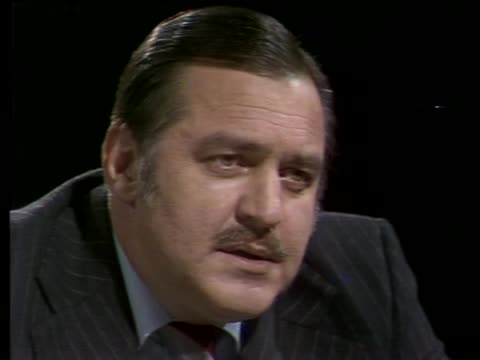
- Jim Lehrer hosts a discussion with South African Foreign Minister Roelof Botha about the current political state of South Africa for The MacNeil/Lehrer Report. Recent attempts by foreign powers to force South Africa to adopt a "one man, one vote" policy nationwide have caused concern from the white minority who currently hold power. Botha claims that the "one man, one vote" policy would lead to the current, white dominated, government of South Africa to be overthrown, which he believes would lead to immediate war within South Africa between the various African nations who inhabit the country. Discussion includes the question of civil liberties and the current apartheid government.
- Created Date
- 1977-06-23
- Asset type
- Episode
- Genres
- Interview
- News Report
- Rights
- Copyright NewsHour Productions, LLC. Licensed under a Creative Commons Attribution-NonCommercial-NoDerivatives 4.0 International Public License (https://creativecommons.org/licenses/by-nc-nd/4.0/legalcode)
- Media type
- Moving Image
- Duration
- 00:31:11
- Credits
-
-
Director: Struck, Duke
Executive Producer: Vecchione, Al
Host: Lehrer, Jim
Producer: Winslow, Linda
Producing Organization: NewsHour Productions
- AAPB Contributor Holdings
If you have a copy of this asset and would like us to add it to our catalog, please contact us.
- Citations
- Chicago: “The MacNeil/Lehrer Report; South African Foreign Minister,” 1977-06-23, American Archive of Public Broadcasting (GBH and the Library of Congress), Boston, MA and Washington, DC, accessed April 2, 2026, http://americanarchive.org/catalog/cpb-aacip-507-0c4sj1b68v.
- MLA: “The MacNeil/Lehrer Report; South African Foreign Minister.” 1977-06-23. American Archive of Public Broadcasting (GBH and the Library of Congress), Boston, MA and Washington, DC. Web. April 2, 2026. <http://americanarchive.org/catalog/cpb-aacip-507-0c4sj1b68v>.
- APA: The MacNeil/Lehrer Report; South African Foreign Minister. Boston, MA: American Archive of Public Broadcasting (GBH and the Library of Congress), Boston, MA and Washington, DC. Retrieved from http://americanarchive.org/catalog/cpb-aacip-507-0c4sj1b68v