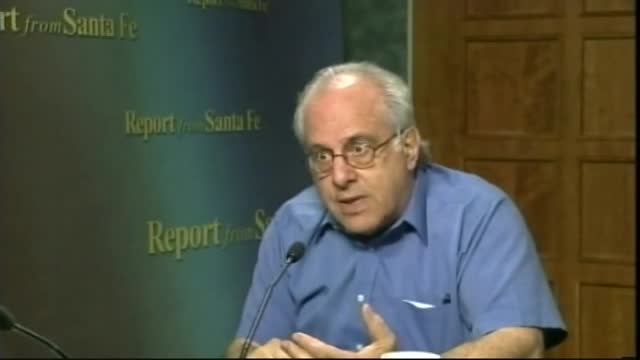
Report from Santa Fe; Richard Wolff, Part 2
- Transcript
The National Education Association of New Mexico, an organization of professionals who believe that investing in public education is an investment in our state's economic future. And by a grant from the Healy Foundation, Tau's New Mexico. Hello, I'm Lorraine Mills and welcome to report from Santa Fe. Our guest today is esteemed economist Richard D. Wolff. Thank you for joining us. Thank you for inviting me, Lorraine. Well, I want to talk a little about your background, your professor of economics emeritus at UMass in Amherst. You are the visiting professor in the graduate program of International Affairs at the New School University in New York. You have been on television shows, radio, you're a bit of a celebrity, but you've been on with Charlie Rose, Amy Goodman, Bill Marr, and Bill Moyers. And you talk about our economy and people think, the economy, why should I learn about this? Why do people need to know what's happening to them as a result of the economy?
Well, the answer is that our economy is in a period of extraordinary change. It's not just the crisis since 2007, bad as that one is, but it's a longer term change to at least 30, 40 years old that is producing ripples that nobody can escape. Let me give you a few examples. This is the first generation of modern college students that is emerging from school carrying tens of thousands of dollars in debt. I went to school a little bit earlier, and I didn't come out of school with anything like that kind of debt. Many of my college classmates didn't. Now, I know from the students that come into my office that tens of thousands of debt is the new normal for college students. But it's so diabolical because student loans are the only debt that you cannot discharge through bankruptcy and it's doubly diabolical because there are no jobs. So what you're doing is you're saying to students, go to college, work real hard because the job market is poor and this is your
leg up on the competition for the job. So you borrow tons of money, why? Because the recession means your folks are less able to help you than they might have been in an earlier time. So you borrow way up high and they come out of school and discover either there isn't a job for you or there will be a job, but the level of income will put you in debt pionage, we call it, for years and years to come. I can't tell you about the number of students that come to see me in my office at the university, crying men and women because they can't get married to the someone they love because the finances are impossible. They can't think of having a child. I always find it amusing that those who claim to be in great supporters of family values then do nothing to help this generation of college students cope with the debts and the job situation that is literally making them choose not to have a family, not to have children. So that's
one index. Here's another one. We have millions of people for close, thrown out of their homes. We have a country now that has millions of people without a home and millions of homes without people in them. We have the homes, we have the people, but we have an economy that can't put these two things together. These are signs of fundamental breakdown, dysfunctionality of an economic system, and I think it's making people ask the kinds of questions we haven't heard in 50 years. Well, it's very important to ask them because we have a lot of decisions to make. We have a lot of choices to make and if we're not informed, but no one ever questioned capitalism before. No, it lived under a kind of pass. We Americans are pretty good. We question our education system. We've been in a debate the last few years about our medical insurance system. We question our energy systems. We do that and we
do it with the presumption that you debate the goods and beds about a system within your society so that you can identify what's wrong and make it better. Well, that applies to the economy just like it applies to schooling or medical care or anything else. If we don't criticize our economy and we haven't for 50 years, then we don't identify its flaws and we don't make it better. We're now living the sad consequences of not having questioned our system, given it a kind of free pass so it could indulge all of its worst tendencies, for example, to make a few people very rich at the expense of an awful lot of other people. And we now live with the consequences and I think we're finally waking up and deciding, hey, let's have that conversation that we didn't have as a nation for 50 years before more damage is done. And it's part of Yankee ingenuity in the American way. Can't we do better than this? How can we improve
this? So we put that in science and technology and all these things but not into this underlying economic infrastructure that like a fish in water, we don't notice that that's what we're working in. Yeah, most of my teachers in the university just kept telling us that capitalism is the greatest thing since sliced bread and therefore any question about it or any criticism about it is somehow at best inappropriate, at worst, a sign that you're ignorant or really at worst that somehow you're evil and have some other purpose. And that's kind of childish. We ought to grow up and say, okay, our economic system like everything else has its strengths, has its weaknesses, lets identify the weaknesses and do better because as you put it, whether it's Yankee ingenuity or Southwestern ingenuity, whatever it is, we're better off if we can allow the critical perspective to have its chance to make its case. So your new book is called Democracy at Work and that works on so
many levels. It's Democracy in the workplace and Democracy working for all of us, but talk about the lack of democracy in most of our workplaces. Well, I think it's very stark and for me it's one of the strongest points that I try to make in that book. Democracy for me means, and I think it has meant this in the history of the United States, that if you're affected by a decision, you have the right to participate in making it. We hold our political leaders from the mayor to the president and everything in between, to account. We all get to choose in at least that modest way of a vote who is going to make the decisions because we have to live with those decisions. And yet, the place we spend the most time as adults is at work. Five out of seven days, most of us, Monday to Friday, go to work for the best hours of those five days. When you head that up across a lifetime,
that's the most important place where you spend time. Is that a place where democracy rules? And the answer is not even a little. When you go to work, when you cross that threshold, pass the doorway into the office, the store, the factory. You're in a place where a tiny group of people, the major shareholders in the company and the board of directors they select, they decide what you produce, how you produce, where the production takes place and what's done with the profits your labor helps to create. They decide you live with the results, but you don't participate in the decision. You have absolutely no say in what is done. Even though if they move the office, you lose your job. If they have economic decisions that don't go well, they'll cut your salary or take your benefits or take your job. All of these decisions which transform your life are made by people over whom you exercise no control. That's autocracy. That's not democracy.
So for me, it has always been, wow, a country that commits itself to democracy, that even claims it goes to war around the world to bring democracy is doing something very peculiar. It's keeping democracy out of the place where most adults spend most of their time. That's why I called the book Democracy at Work because the argument I make is we would have a much better economy, working much better for most of us if the workplace was run democratically, which we ought to be in favor of in principle, rather than in the capitalist way, which gives such a tiny group of people at the top such a wildly unrestrained power. Well, there is a new movement called Worker's Self -Directed Enterprises. So some and some instances, some companies have done this. For example, if your furniture plant in North Carolina is going to be outsourced, maybe the garment industry is better to China, if those workers can step up and make whatever
accommodations they need as a group to make it profitable to keep the jobs there, then this seems to me this should be encouraged. Absolutely. Our argument is precisely that. Imagine the following kind of dramatic scene. A factory owner comes to clothing workers in North Carolina or furniture workers in Arizona or cattle dairy producers in Wisconsin. It really doesn't matter. And says, well, I'm thinking of packing it in, closing this enterprise. And I'm going to go to China where I can pay wages a small fraction of what I pay all of you and make a lot more money. And that's what I'm in business to do. And at this point in America, the workers cringe and give back as much as this employer wants in the hope that he doesn't leave. They're in the position of begging. You can put nice words around it, but that's what they're doing. Now, imagine a dramatic new scene. The workers say to the
company, okay, go. Have a nice day. Have a nice trip. See you later. What do I mean? The workers will say, you leave. You go to China. You do your thing. We're staying here, but we're not going home and getting drunk because we're bad, feeling bad about this. We're going to stay here and we're going to keep this enterprise going. This office, this factory, this store. We're going to collectively do it as a workers co -op. We're going to be not just the people who work here, but the people who run this enterprise. It's going to be workers self -directing themselves in this enterprise. And we got a little message for you, Mr. Employer, who's thinking of leaving. When you produce in China and you bring this stuff all the way back to America to sell, we're going to be looking right over your shoulder and we're going to be going to the American people and say, you got a choice, Mr. and Mrs. American buyer. You can buy the goods from China, from the company that abandoned America, abandoned the workers, abandoned the communities. And let's remember many of the
factories that leave and many of the offices that leave, appealed for and got subsidies, tax breaks, and all kinds of things for decades before. None of which they ever paid back and now their payback is to say, goodbye, we're leaving. Okay, we're going to tell your story and we're going to say, you, Mr. and Mrs. America, have the alternative. You can buy the products that the workers who stayed here, who are committed to building here, have produced. And let's see whether the companies will be leaving as quickly as they did before. Now, nobody pushes back against them. A workers co -op is a way to push back that would preserve jobs and fiscal stability for the towns in which these jobs are preserved. And here's a little footnote. Imagine this happening and the workers wanting to take over the factory needing some money to make the transition. They go to the local politicians, the mayor, the representative, the governors, and they say, give us
some public money to help keep these jobs, to help keep these tax revenues. If the politician says no, then the workers go to the community and say, this politician chose not to do what would have kept the jobs, kept the tax revenue, preserved our communities. He decided not to help so that the company could leave, and there would be no consequences. You want that on your record, Mr. politician, Mrs. politician? I don't think so. So I think that the politicians would be falling all over themselves to help the workers do that. It would open up a whole new chapter of American economic history. Well, you're here on behalf of a symposium called Banking on New Mexico. And it's about public banks. And I think the basic one was the Bank of North Dakota that was set up in what, 19, I believe it was 1960, but very close
to it. So it's 100 years old. Right, right. And so we're looking at something like that in New Mexico. New Mexico is in a little poverty phase right now. We're not doing too well in the national rankings. But how would having a public bank benefit our economy here? And just let me remind our audience we're speaking today with Richard Wolf, renowned economists who brings a really fresh, to me, very provocative point of view on these things. So talk to me a little about public banking. Well, the idea, excuse me, the idea in North Dakota, which is a wonderful story because people don't imagine that North Dakota might be progressive in particularly this way. They created a state bank. That is the state of North Dakota owns and operates the bank. It is not a private bank is not owned by shareholders the way banks in America usually are. Republicans and Democrats have for years been under pressure from banking institutions and lobbyists to get rid of this. And Republicans and
Democrats alike have preserved this. And they've preserved it because it's a wildly popular bank in North Dakota. So anyone who says that you couldn't have public enterprises in America because the people wouldn't support it North Dakota is a perfect counter example. So what does it do? Here's the idea very simply. Every state of the 50 states in the United States takes in a ton of money, all the sales taxes, all the income taxes, many or all of the property taxes, the fees for your driver's license, for your dog license, for your fishing license, and on and on. Hundreds of millions and in the bigger states billions of dollars come in. So now ask yourself this question, what does the state do with it? The answer is it deposits it in private banks and it pays those private banks huge fees of all kinds for holding the money and managing the money. Then periodically when state functions need some money they have to go to the bank to get
the credit to build a road or expand the school or whatever it is. And again there are fees and interest. The idea of North Dakota is a simple logical straightforward idea. Why don't we have a state bank so that the state takes all the money poured into it in taxes and fees but deposits it in its own bank and says the money in the bank that's deposited will be made available for loans which is what everybody does but we because with a state bank of New Mexico if you had one will be particularly concerned to build up New Mexico. We will lend money to people based on how good it is for New Mexico to have this business here or this school there or this hospital over there. And the logic is simply the extension of the logic of the state in the first place. The point of the state taxing us was to use money for the benefit of all of us. That's what taxes are for. And
if you're going to use the money then don't waste it on paying credit and interest and fees to huge banks mostly from the biggest cities in America who will take the money thank you from North Dakota and lend it to China to help build up the infrastructure of China that will suck more businesses out of the United States. So it's a kind of an appeal to say look private banking is making use of our money in the ways that are good for it. We want our money the taxes we pay the fees we pay to be used instead for what's good for us who have put the money in there. It's a very different notion but it's one that whose time has come and I think public banks would also be much more likely to find merit in helping businesses transition from top -down hierarchical capitalist type enterprises to these new kinds of co -ops that
are developing because they are more locally based more locally responsible and I think more consistent with the kind of economic development that states would prefer. Well in our own New Mexico legislature we've had some lawmakers like Brian Egoff and Tim Keller who put in public banking bills and it's an idea that people are just you know it may take some time but as you say the time has come you also have mentioned that the time for co -ops may actually be tell me a little about what's happening with the co -op movement what is a co -op? Well a cooperative is an idea very old in some ways thousands of years old and it has been part of the United States from before we were an independent country when we're still a colony. The co -op is the idea that there's an alternative way to do business not an individual or a group of individuals who own a business and then hire everybody else telling that person or the other hired people what to do and when to do so that the end of the day
the worker who actually makes all the stuff goes home and leaves behind what he or she used their brains and muscles to produce a co -op says no the way to organize an enterprise is all the people who help to produce whatever it makes goods or services should together have some collective authority power control that's at least what a worker co -op means there are other kinds of co -op consumer co -op that's quite popular in many parts of the United States today that's basically what a group of consumers get together and they realize if we each go to the store to buy a box of cereal for example we will pay X but if we got together 100 families and bought a huge quantity of that cereal and then parcel it out amongst ourselves the cost of the equivalent box would be much less it's simply the discount you get from buying quantity so there are benefits
like that from cooperating in economic affairs and what I'm interested in is that as the capitalist way the corporation with the tiny group of shareholders and board of directors at the top and all the mass of the rest of us as workers basically being drones and as I make jokes working hard so that the first two hours at the end of the day after we finished our job shift we go to a bar and we have what are called happy hour because it's the first hours that are happy in the day what it says about us but to deal with that by saying look let's change the workplace let's make it not unhappy let's make it a creative place where what's called upon from each of us is not just the task we're assigned but to be part of deciding the big questions how this enterprise grows how it organizes itself who shares what authority over whom and what kind of rotational way so that we develop all of our capacities we don't have to live in an economy where the only compensation for a horror of work
is the ability to go to the mall and shop we ought to have a society that says look you spend the best part of your life working that ought to be an exciting interesting place where you develop yourself as a person not place where you only serve the profits of a few and I think that movement is growing in America and given the problems of our capitalist system I don't think it's surprising nor do I think it's a short term phenomena well and in New Mexico in particular there are threads of this through our culture we have the Asakia system which is a distribution of water and there's not much water so it has to be managed well and it's a community effort the mayor domo it makes sure that everyone gets enough water and there have also been other agricultural cooperatives where people work together it's a long long long history you know there's a town that got famous a couple weeks ago because I also have a radio program and I talked about on the radio program it's in Kentucky I believe the name of the town is Somerset Kentucky and the mayor there a
staunch Republican by the way was got a lot of attention when he was approached by people in his community who were sick and tired of paying very high prices for the gasoline to fuel their cars so the mayor this Republican bought a storage facility for gasoline and bought a huge quantity of you know 100 ,000 gallons or something put it in the thing and had little pumps and everybody who wanted to come could get their gas at the town gas pump where the price was many many cents lower per gallon than in any commercial station and of course the commercial stations went bananas and the big oil companies went bananas but he he was staunch they said you're a Republican you should be against it he said it's the job of the government to help small businesses against big businesses and to help people and if I can provide cheaper gasoline not just for the people of the town but for all the small
businesses and have to gas up their trucks and their vans and then I'm gonna do it and he wouldn't budge and I think that a Republican could think this way could understand his jobs as an elected official that way that's a very powerful sign of where things are going people need help and if the government as we construct it doesn't do it then the government is gonna have to change or get out of the way well this symposium banking on New Mexico symposium was it said it was dedicated to those in our community who do not have access to a just economy and this mayor was inspired to make the the provision of gasoline to make it a much more just economy and simply to use the mass power buying in bulk to do that so in a way it's at that point where left and right merge with simple common sense absolutely and having the goal that we are here
that if we can make the lives of the vast vast majority of our little businesses and of our citizens better and it hurts a few we should take care of those few it's not a question of ignoring them but we have to make the decisions as we see the lay of the land and providing public gasoline at a cheaper price clearly falls into what we ought to be doing then we can sit down and see how we can help the few get private gas stations that are hurt by this the trouble is of course if you think about this and if you find this reasonable where are we gonna go next the same logic applies to food the same logic applies to clothing to medicine all the basics of our lives why don't we have a government a collective supermarket right next to the others let's see how the competition works if we buy in bulk and distribute to our to our citizens these are the questions that have been swept under the rug made taboo for 50 years but you can't bottle
them up forever and they're now coming out we only have a minute left but you've warned that that we can't make this about the poor America was based on the middle class the American dream was the middle class and so what you're saying is it's now time to minister not to the extremes the one percent or the the very poor but let's revive our middle class and the American dream tell us how to do it well before I do I want to congratulate someone I very rarely congratulate namely USA today the newspaper a few months ago they ran a front page story where they asked your question what's happened to the American dream and they did a research good research I'm telling you is an economics professor and basically here's what they found in order to have the American dream at a modest level of that dream it takes a family of four about a hundred and thirty thousand dollars of income per year in the United States and by that calculation only one out of eight
American families is in a position to afford it for seven eighths of our people the American dream is unavailable anymore okay whether you agree on the exact numbers all the other studies come up with roughly similar stories that the American dream is no longer within reach of the vast majority of our people that is a crisis for a society that has thought of itself as middle class a society which has thought of itself of everybody having an equal chance to make it in society if one eighth of the people have all the money and seven eighths don't we're not starting from an equal point we're not getting an equal chance we're in a fundamentally unequal society and in a country like ours that has prided itself on not being that way that grates on everybody's nerves and is a very unsustainable I would even go further explosive situation to to live through and that's what's happening in this country and we're going to have to leave it there now when our audience thinks about going to work I want them to think about democracy
at work your new book and the classic that I just love capitalism hits the fan our guest today is Richard Wolf thank you so much for spending time with us today thank you Lorena let me put in a word of appreciation for you're having the courage to take these issues and put them on the air and do your part to break a taboo that was never good for this country in the first place thank you very much and I am Lorena males I'd like to thank your audience for being with us today on report from Santa Fe we'll see you next week past archival programs of report from Santa Fe are available at the website report from Santa Fe dot com if you have questions or comments please email info at report from Santa Fe dot com report from Santa Fe is made possible in part by grants from the members of the National Education Association of New Mexico an organization of
professionals who believe that investing in public education is an investment in our state's economic future and by a grant from the Healey Foundation Tells New Mexico
- Series
- Report from Santa Fe
- Episode
- Richard Wolff, Part 2
- Producing Organization
- KENW-TV, Eastern New Mexico University, Portales, New Mexico
- Contributing Organization
- KENW-TV (Portales, New Mexico)
- AAPB ID
- cpb-aacip-4f3780e8544
If you have more information about this item than what is given here, or if you have concerns about this record, we want to know! Contact us, indicating the AAPB ID (cpb-aacip-4f3780e8544).
- Description
- Episode Description
- This week's guest on "Report from Santa Fe" features a new interview with the popular and internationally renowned economist Richard D. Wolff. Wolff is a professor of Economics Emeritus at the University of Massachusetts, Amherst, and the author of many books including his latest, ”Democracy at Work: A Cure for Capitalism.”Economists who manage to engage both scholars and laymen are few and far between. Wolff is that rare exception. On this week’s edition of “Report from Santa Fe,” host Lorene Mills and her guest Richard Wolff tackle such challenging topics as privatizing banking, cooperatives as an alternative business model, the eroding middle class, and the elusive American Dream. Wolff is notorious for his ability to identify problems and offer ways to effect solutions. Whether he is talking about the repercussions of a new generation of college graduates saddled with unprecedented student loan debt or our economic system, the point he makes is that everyone affected by a decision has the right to participate in making that decision. Wolff discusses the provocative economic ideas that turned his books "Capitalism Hits the Fan" and "Occupy the Economy" into national bestsellers. Wolff can be heard on national radio weekly as the host of “Economic Update” and has been a frequent TV guest on shows such as Bill Maher, Charlie Rose, and Bill Moyers. In his new book “Democracy at Work,”, Wolff explores avoiding economic crisis with workers’ self-directed enterprise, alternatives to capitalism and the merits of privatizing banks. Guests: Lorene Mills (Host), Richard Wolff.
- Broadcast Date
- 2014-11-15
- Asset type
- Episode
- Genres
- Talk Show
- Media type
- Moving Image
- Duration
- 00:28:55.367
- Credits
-
-
Producer: Ryan, Duane W.
Producing Organization: KENW-TV, Eastern New Mexico University, Portales, New Mexico
- AAPB Contributor Holdings
-
KENW-TV
Identifier: cpb-aacip-2917afd7887 (Filename)
Format: DVD
If you have a copy of this asset and would like us to add it to our catalog, please contact us.
- Citations
- Chicago: “Report from Santa Fe; Richard Wolff, Part 2,” 2014-11-15, KENW-TV, American Archive of Public Broadcasting (GBH and the Library of Congress), Boston, MA and Washington, DC, accessed April 4, 2026, http://americanarchive.org/catalog/cpb-aacip-4f3780e8544.
- MLA: “Report from Santa Fe; Richard Wolff, Part 2.” 2014-11-15. KENW-TV, American Archive of Public Broadcasting (GBH and the Library of Congress), Boston, MA and Washington, DC. Web. April 4, 2026. <http://americanarchive.org/catalog/cpb-aacip-4f3780e8544>.
- APA: Report from Santa Fe; Richard Wolff, Part 2. Boston, MA: KENW-TV, American Archive of Public Broadcasting (GBH and the Library of Congress), Boston, MA and Washington, DC. Retrieved from http://americanarchive.org/catalog/cpb-aacip-4f3780e8544