Artisode; Duke City Street Art
- Transcript
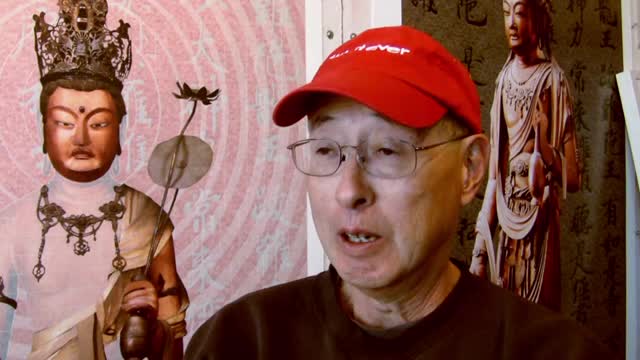
Photography re -represents things and maybe I don't even exist and what you're seeing right now, you know, this is all just camera stuff. I mean, my greatest audience seemed to be right brain thinking women, multi -taskers, women that are able to put aside how the pictures were made, what F -stop did you use, what type of film did you use, you know, all that technical stuff, and just get into like the idea of it, like the dream, to live the dream with me. I worked with a friend painter named Andre Tracy, and we constructed these elaborate sets of exploding light bulbs, cafes exploding, downtown LA being hit with a nuclear bomb, working in a way as a tablo photographer, which I've always been arranging for the camera in a directorial mode, in a sense. So I moved out to New Mexico, the
contemporary and historical issues of New Mexico's marriage to the nuclear culture in a way. It's all here. The mining issues, the issues involving the national labs, contaminated areas like Morton Dead Canyon at Los Alamos, the development of nuclear weapon technology at that time and currently. I didn't say I'm an activist, I'm going to make this particular statement. In fact, it was more an aesthetic statement than I wanted to make based upon these particular issues. One of my interests has always been who writes history, who creates history, and our understanding of that. So all of that became entwined in Rihichi Nagatani, Slash Nagatani excavation work, which was about my linking up with an archaeologist named Rihichi
and finding out this kind of like story about finding these maps from Native American shamans and going around the world to every continent, following these maps. And what they found was luxury cars buried in various sacred sites in the world. All of the images in this Rihichi Nagatani excavation work are photographs. There are no real artifacts or representations of artifacts, which is also interesting to me about how photography re -represents things and how we take them, those representations as the truth. I had started reading about healing and growth with using color -colored light. And so I thought, oh, it probably would be the Chinese, you know, the Japanese who embraced this rather ancient Egyptian idea. On 2005, I found out I had colorectal cancer,
and this idea of healing became even more poignant to me. And one of the images is about a month after my surgery, and it shows both the photographer, the patient, the cancer survivor receiving chromotherapy. One of my theories is that I can't think about time or I probably never do these. When you just tear pieces of masking tape and you put them down over and over and over and think less about time and about completion of anything, you end up being in this nose -thought zone. My life as a tapest has been guided by the process more than any other work that I've ever
done. And I don't mean just the materials, but the kind of spiritual process of making the work. Dreaming the story and I try to apply that as long as they keep evolving and each piece doesn't become redundant, then I think I'll just continue to be a tapest.
- Series
- Artisode
- Episode
- Duke City Street Art
- Producing Organization
- KNME-TV (Television station : Albuquerque, N.M.)
- Contributing Organization
- New Mexico PBS (Albuquerque, New Mexico)
- AAPB ID
- cpb-aacip-4bc38f94a66
If you have more information about this item than what is given here, or if you have concerns about this record, we want to know! Contact us, indicating the AAPB ID (cpb-aacip-4bc38f94a66).
- Description
- Series Description
- This segment takes a look at street art in Albuquerque, New Mexico. Street art is defined, the meaning and appreciation of street art are discussed, and citizens of Albuquerque discuss their opinions of street art.
- Asset type
- Episode
- Genres
- Miniseries
- Media type
- Moving Image
- Duration
- 00:05:20.487
- Credits
-
-
Producer: Kowalski, Kelly
Producing Organization: KNME-TV (Television station : Albuquerque, N.M.)
- AAPB Contributor Holdings
-
KNME
Identifier: cpb-aacip-f750b557563 (Filename)
Format: XDCAM
If you have a copy of this asset and would like us to add it to our catalog, please contact us.
- Citations
- Chicago: “Artisode; Duke City Street Art,” New Mexico PBS, American Archive of Public Broadcasting (GBH and the Library of Congress), Boston, MA and Washington, DC, accessed March 13, 2026, http://americanarchive.org/catalog/cpb-aacip-4bc38f94a66.
- MLA: “Artisode; Duke City Street Art.” New Mexico PBS, American Archive of Public Broadcasting (GBH and the Library of Congress), Boston, MA and Washington, DC. Web. March 13, 2026. <http://americanarchive.org/catalog/cpb-aacip-4bc38f94a66>.
- APA: Artisode; Duke City Street Art. Boston, MA: New Mexico PBS, American Archive of Public Broadcasting (GBH and the Library of Congress), Boston, MA and Washington, DC. Retrieved from http://americanarchive.org/catalog/cpb-aacip-4bc38f94a66