Bill Moyers Journal: International Report; 113; A Conversation with Clark Clifford - Vietnam and Its Aftermath
- Transcript
The report originally scheduled for tonight, dealing with international women's year, will be seen next week at this same time. Stay tuned for the following special Bill Moyer's journal. This program was made possible by grants from the German Marshall Fund of the United States, the Corporation for Public Broadcasting, the Ford Foundation, International Business Machines Corporation and the Rockefeller Foundation. We must understand that peace is indivisible. The United States cannot pursue a policy of selective reliability. We cannot abandon friends in one part of the world without jeopardizing the security
of friends everywhere. I am convinced that this country is going to continue its leadership. We will stand by our allies and I specifically warn any adversaries. They should not under any circumstances feel that the tragedy of Vietnam is an indication that the American people have lost their will or their desire to stand up for freedom any place in the world. One policy in Indochina has failed. Cambodia's in ruins, South Vietnam is besieged and crumbling. In Reckissing during Gerald Ford say the failure of our policy there has seriously undermined our credibility with other nations. And events in Indochina have not been the only bad news for American policy in the last few weeks. A series of disappointments has led to a hard look at American power and influence in world affairs.
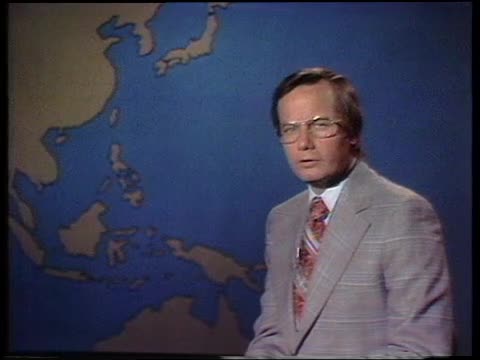
I will be talking about these issues tonight with Clark Clifford, advisor to President since 1946 and Secretary of Defense in 1968 at a critical turn of our involvement in Vietnam. I am Bill Moyers. There seems little doubt we are watching the final throws of the Vietnam War. It did not fade away quietly for Americans as some imagined it would after our troops withdrew and the POWs came home. Rather it is ending as it always was, a nightmare of horror and human suffering as terrified and weary refugees flee along with the collapsing South Vietnamese army.
Americans are tired and frustrated by our long involvement in Vietnam. They have not as a whole responded with renewed debate over past arguments, but have been engulfed by compassion or stricken by guilt. Few people questioned the argument that the Vietnam experience was a blow to American power and prestige. We invested billions of dollars in thousands of lives and encouraged and tolerated immense suffering on the part of these people in an effort to prevent what is now happening. Now, questions are being asked about our future commitments and the impact the defeat of South Vietnam will have on American allies and the future of American foreign policy. The two most prominent forces raising the question of American reliability are President Ford and Secretary Kissinger. The problem we face in Indochina today is an elementary question of what kind of a people we are.
For 15 years we have been involved in encouraging the people of Vietnam to defend themselves against what we conceived as external danger. I am saying that as a people we should not destroy our allies. And that once we start on that course, it will have very serious consequences for us in the world. I believe that there is a great deal of credibility to the dominoe theory. I hope it does not happen. I hope that other countries in Southeast Asia, Thailand, the Philippines do not misread the will of the American people in the leadership of this country to believe that we are going to abandon our position in Southeast Asia. We are not.
Let me say to our Western European allies, we are going to stand behind our commitments to NATO and we are going to stand behind our commitments to other allies around the world. The administration's argument is in fact a resurrection of the dominoe theory, the notion that the loss of Vietnam would make other nearby countries vulnerable to subversion and aggression, causing them to be toppled one by one. Nor is it in the mind of Ford and Kissinger only a question for Southeast Asia. The Secretary of State cited American reverses in Vietnam as one of his problems in persuading the Israelis to agree to a treaty with Egypt. He suggested the Israelis doubted the credibility of our willingness to help them after Vietnam in the event of another war with the Arabs. Kissinger said peace is indivisible. The statement suggests that in his mind foreign policy is a seamless web unadorned by distinctions. That view is certainly open to challenge, but what is obvious is that on several fronts American diplomacy has met some reverses. Those reverses and the general drift of events have led to images of the United States as
a helpless giant of diminishing influence. They have also led to serious questions in some places about our ability any longer to control or shape affairs. The British News Magazine, the economist, summed up the predicament this week with a cover headline, The Fading of America. The series of events precipitating the doubts was crystallized by Secretary of State Kissinger's recent failure in the Middle East and the possibility of renewed warfare. Shuddling back and forth between Cairo and Jerusalem for 17 days, Kissinger was unable to get the Israelis to give up the strategic passes and oil fields or Egypt to make public statements of non-belidurancy toward Israel. It was personally a diplomatic failure for the increasingly troubled Secretary of State who probably would not have attempted the mission in the first place had he not thought there was a reasonable chance of success. Kissinger told Newsman, traveling with him, that the crisis in Indochina and the questions of America's long-term commitments may have stiffened his Israel's intransigence.
As Washington reassesses its Middle East policy, the troubling question is this, if America cannot persuade Israel into some kind of accommodation, is there any other hope to avoid war and another embargo of oil? The Middle East was complicated by the assassination of King Faisal of Saudi Arabia. He had been a friend of the United States and admirer of Kissinger and a force for moderation among Arab nations. As heads of state gathered for Faisal's funeral, the Saudi cabinet selected Faisal's brother to be King. For the moment, Faisal's policies continued, but for America, the familiar has been replaced by the unknown. Another unexpected development is the triumph of left-wing forces in Portugal and the possibility of the first communist-dominated nation in Western Europe. Following an unsuccessful coup attempt by moderates, leftist military officers consolidated their
control of the government with the help of a well-organized communist party. Communists may soon dominate Portugal, with serious effects on the Atlantic alliance. Their success in Lisbon could also encourage Communist Party efforts in other Western European states. Across the Mediterranean, Cyprus has become another thorn for U.S. policy. Secretary Kissinger interrupted his Middle East mediation for a hurried visit to initiate a compromise between Greece and Turkey. Both have been allies and both are unhappy with our policy towards Cyprus. The Greeks are mad because the United States long supported the now-deposed right-wing hunter and did not act to stop the Turkish invasion on Cyprus. The Turks are angry because the United States cut off military aid after they invaded Cyprus. Somehow in Cyprus, we've managed to hit two friends with one stone. Now we face the possible closing of military bases in both countries just as the Soviet Union has become a major naval power in the Mediterranean.
No one of those smiles have since disappeared from the face of Henry Kissinger. No troubles mount, but do they represent impending disaster or the pain of simply inevitable adjustment? Despite the errors of judgment, the tactical mistakes, the fizzling of Kissinger's miracles and the frowns of some of our allies, the United States still has friends in the world and a role to play, an important role. We still have enormous power and influence, although we have learned there are limits to our power and our influence does not guarantee things will always go our way. It's a dangerous world, of course, and it runs on self-interest, not benevolence. Surely we've learned that in recent years. What the United States has been given is a chance not to retreat like an ostrich from the world, but to assess and knew what it can do in the world, what it ought to do, and the difference. Above all, we have a chance now to begin to make distinctions between what is truly a danger and what is only a nuisance.
These are the issues I want to discuss with my guest this evening. His name is Clark Clifford, and he's been close to power in Washington for almost 30 years now. He's been called the most powerful private citizen in the nation's capital since Bernard Baruch. A native of Missouri, Clark Clifford came to the White House in the 1940s as a naval aid to Harry Truman. In 1946, he became special counsel to the president and was a principal agent in shaping American foreign policy from within the White House and in unifying the armed forces into an integrated command under the Department of Defense. In the Eisenhower years, Clifford was a highly successful lawyer in Washington. Then President-elect Kennedy asked him to serve as liaison to the outgoing administration during the transition following the 1960 election. Then Mr. Kennedy named him chairman of the Foreign Intelligence Advisory Board. A close friend of Lyndon Johnson, he was an intimate behind-the-scenes adviser to LBJ, own domestic and foreign affairs. Lyndon Johnson named him secretary of defense when Robert McNamara resigned in early 1968,
and it was Clifford, according to most participants, who played the key role within government in the tumultuous weeks that spring when Lyndon Johnson began to reverse himself on the war in Vietnam. Clifford's role led some to describe him as the man in power who started stopping the Vietnam War, and his critics to call him an SOB who walked out on the president. One fact is indisputable, like much of the nation, he involved from a hard-liner toward containing communism to believing that America had to withdraw from Vietnam. He's an old friend of mine and a former colleague. Clark, we were both part of those years when the Vietnam build-up really intensified and I'll come back to that later, but I'd like to ask you in the beginning, have you been surprised by what's happening now in Vietnam? Yes, I've been surprised by the haste with which the end has come in these past few weeks. We had been led to believe these last five or six years that the program of Vietnamization
was succeeding and that the South Vietnamese would be able to take care of themselves when the test came and the South Vietnamese forces retreated in many instances without even fighting. I think it was a surprise and even shocked to most knowledgeable Americans and was very definitely a startling development to our own military. How do you count for it? What do you think happened? I think when the final test came that the will to defend the two government was lacking in these men, they had everything they needed. Even so far as equipment was concerned, but when you're faced with the question of defending the land in which you live and the question is, are you devoted enough to that government to sacrifice yourself for it?
Is that an absence of patriotism? I think it's an absence of fidelity to the government that you have at that time. One might state it sharply by saying these men had everything to fight with, but really nothing to fight for. What about the fear of communism and the fear of the North that has always seemed to be at least a part of the outlook of the people in the South? Wasn't that something to fight for? Well, the fact is that it's not sufficient now for them. They are not willing to fight and die to keep communism from becoming part of their part of South Vietnam. The fact is the two government has been a dictatorial and very repressive government. You will see from time to time, the people have no rights. You're placed in jail if you're Mr. Tood decides you should. The newspapers are closed.
There have been thousands of political prisoners there, so there was no feeling of being part of the government, no feeling of being part of South Vietnam that would want making the sacrifice that troops have to make. Wasn't the regime in the North, isn't the regime in the North also dictatorial and repressive? I'm wondering how that affects the relationship between the forces. Is it something more than that? This has been one of the age-old problems since the world has been troubled with communism. What is the sense of dedication that impels ordinary people to invade other countries, perhaps, as distinguished from defending the fatherland? I'm sure I don't know the answer. I don't know that anybody does. But there is a discipline that is inculcated in these forces, and they have fought well. They went through those years and years of the terrible bombing to which we subjected
them. They got down to where the very young boys were part of the military service. There was still a sense of dedication. One of those reasons is that this war has been Vietnamese against Vietnamese. The South Vietnamese were fighting to stay separate. The North Vietnamese were fighting to unify their country. And it's entirely possible that that was a motivating factor that led them to make the sacrifices they have. Is it too late for any additional military aid from the United States to make a difference? In my opinion, it is. You would not be forced sending any more military aid from this moment on. I wouldn't send another dollar in military aid. I wouldn't send another dime in military aid. If you look at what has happened here within the last few weeks, the Congress appropriated $700 million for fiscal 1975. Most of that has already been sent.
There's 175 million of it that hasn't even been sent, that's still in our treasury, hasn't been used. As the South Vietnamese forces retreated from the North, they abandoned over a billion dollars worth of equipment that we had sent them. So what would the possible sense be at this stage? After over two-thirds of the country is now in the hands of the Communist. All they really have left is an enclave around Saigon and down into the Delta. There can be no question. I don't know whether it's going to be next week, I don't know whether it's going to be next month or whether it's going to be next year, but it is inevitable now. The South Vietnam that we know the two government cannot endure. And why should we now come up with any more money? We have over the last 14 years, we have put $150 billion into that war. We've lost 55 million American men.
And I say, after that investment, when the time came for the Vietnamese to show that they could defend their own country, we get this perfectly, thoroughly, unfortunate and shocking result of men fleeing without even fighting. Some people argue that if we gave more money at right now, the two government could hold that enclave around Saigon. They've given up a lot of territory, now occupied by the North Vietnamese. Their defense lines are shorter, the North Vietnamese defense lines are longer. That two could maintain a defense around Saigon that would at least hold out some possibility for a political and negotiated settlement rather than more blood. The time for a political or negotiated settlement, in my opinion, is now. It doesn't do any good to go on sending more money there for military equipment. I'm perfectly willing to send whatever money really is needed to help the South Vietnamese people.
I want to send them food and clothing and medicines. They need it very badly, but I don't want to send another penny for military, because after all these years, to continue on with the fighting is not going to bring about any kind of a peace. Let's have the peace now. Why do we have to go on with the killing before we have a peace? This gets into a different subject, but when the Accord in Paris of 1973 was signed, the two government agreed at that time to have elections and put into control there, an administration of national reconciliation and concord, which was then to start to negotiate for peace. That was January of 1973, not one gesture has been made toward peace by the two government. And as long as we continue sending the money there and sending the material of war, the fighting is going to go on.
When we stop sending the material of war, sometimes the fighting will stop, and the gainers will be the people of South Vietnam as distinguished from the two government. Except those who bet on us, are they likely to be the victims of a blood bet? That's entirely possible, that there are a number of people who should and can be removed from South Vietnam. You mean evacuated? That's right. And can be evacuated from South Vietnam. I would think that we would want to take part in that. Those people who worked with us and who are identified, you see, as enemies of the Viet Cong particularly, they can be evacuated. The great majority of the people, whether it's some 17 or 18 million people in South Vietnam, are substantially the same people that exist in North Vietnam. Some of them are Catholic, some of them are Buddhist, some of them belong to the cow die. They're exactly the same kinds of people.
Those people aren't going to be destroyed. And as far as the people of Vietnam are concerned, the finest thing we could do for them would do whatever is necessary to stop the war. And then they can get back to their farming and to their usual occupations and raise their children and do it in peace. They've not had peace there for so long, it's difficult to find anybody who can remember peace in that land. One of the reasons they haven't had peace is because we chose South Vietnam as a place to make a stand against communism. And in effect, we have invested so much of the region's present importance. And therefore, exaggerated, it seems to me, the consequences of a defeat there. Don't we, because of our urging them to make this war? Don't we have some moral obligation left? I find absolutely none. After we have spent 14 years, this started in the first year of President Kennedy. And that's 14 years ago. And we've made this enormous investment to help them. It's unheard of in the annals of human history, that a country like the United States would
send 150 billion of its treasure and 55 million of its finest young men over to defend them. And then after we withdrew our men, we've sent them untold billions in addition and equipment. And finally, when the time comes, and they're still not able to demonstrate the spirit to defend their own homeland, then we not only have done everything that's expected of us, we have gone far beyond any responsibility that we might ever have had. A man sat in my office some maybe a year or so ago. He had been a lieutenant general in the Vietnam, which was the indigenous force in Vietnam that opposed the French and finally defeated them. He had been a cabinet member in this Yam regime. And he said, Mr. Clever, the greatest service that the United States can render is keep your troops out and keep military equipment out that just continues the war.
This was a South Vietnamese. He was born in the Delta. He wanted peace for his land, and he knows we'll never get peace as long as we continue to have the two government, and we are the ones who have kept the two government in power. And if we continue to send military aid, we will continue to keep two in power. The only way they're going to do it is for the people to rise up and other sects to come into being, get rid of two, ask the north for a cease fire, and then adjust their differences and make a peace. Work everything you say spells D-E-F-E-A-T for the United States. After all, you say we have put in there, we have come to a defeat. Not to me. Not to me. I'm proud of the fact that we've made this contribution. I wish we had not done it. If we had known in those years when we got into it what we know now, we never would have done it.
But it was a very humanitarian move on our part. We thought that we could help these people in South Vietnam. We were the only member, really, of the Sito PAC, the only signatory who really made a substantial investment, because we thought that we were really defending these people. It was a misapprehension of the situation that existed. But our motives were right and good, and now that we have made this investment, I say, let's don't invest anymore. We did set out to prevent North Vietnam from taking over South Vietnam, and North Vietnam is about to do just that. That's not a defeat. It is not, in my opinion, because so many conditions changed from that that existed when we decided to go into Vietnam. The world has changed a great deal. The reasons why we went into Vietnam really no longer exist at this time. So what at the time seemed as though it was the right cause, as a result of many developments
and changes in the world that took place. It was not the right cause. And therefore, there continued to be, in my opinion, no continuing obligation. When you say this is a defeat, does that mean that we have some obligation of staying in Vietnam indefinitely? Would you stay there another year, or five years, or ten years? I'm not arguing for staying there. What I'm saying is, isn't it best to admit that we did not succeed there, that we did take a defeat and do so honestly and go on to what's next? Well, I feel a little differently about it. I want very much for us to stop giving any further aid, except humanitarian aid. I'm not convinced that this constitutes a defeat. What I believe it is is the result of a course of action that we felt was right when it started. But due to events over which we had no control, after a while lost its meaning.
And therefore, when it lost its meaning, and there was no justification for our continuing to be there, then was the time for us to withdraw. If some was to call it a defeat, that's all right with me. If it is, then let's accept it. Other nations have grown in maturity when they faced up to problems of this kind. You will remember when General De Gaulle made the very unpopular decision for the French to withdraw from Algeria. It almost caused a civil war in France. It was a wise decision. This is a wise decision for us. Every decision a nation makes can't be the correct decision. Nations are like human beings. They'll make mistakes just the way human beings do. And when they recognize they've made a mistake, then they ought to write it off. Don't you think that there is some possibility that the success of the Vietnamese Communist or a long-droned out war will be a very powerful encouragement to other Asian insurgents?
I don't believe so. You don't? No. I don't believe so because this has such a narrow application. At one time I would have thought so a good many years ago. But I now know that that was an incorrect evaluation of that situation out there. Now there is this very narrow restricted war between North and South Vietnam. We know now that it is a civil war that's taking place within the one country. We know that it's related to a war next door that's going on in Cambodia. I don't anticipate any real fallout from either one of these conflicts when the incomes which will not be far off in both of them. There was a time when neither you nor I accepted the fact that it was a civil war. You were a principal architect of the containment policies of President Truman in 1960.
You, I think, accepted the domino theory. Now you're saying that were we wrong? If you're going to understand the situation in Vietnam today, then maybe it takes a minute to go back. After the Second World War, the French came back into French Indochina. Vietnam was part of French Indochina. And then an indigenous national movement started within Vietnam under Ho Chi Minh to drive out the French which was a colonial power. It took them nine years to do it. They succeeded finally in 1954 in the Battle of the NBN Food and the French then withdrew. And at that time at the peace agreement in Geneva, the arrangement was made arbitrarily to divide Vietnam which had not been divided before and the North and South Vietnam and separate
them by the 17th parallel. The North where Ho Chi Minh lived had a communist government. The South was to have elections and within a period of a few months decide whether they wished to join the North. The United States and others at that time felt that those elections might be a mistake. Our concern was that they might vote to go ahead and combine with the North. So those elections never took place. Then the North Vietnamese feeling that the South had abrogated the agreement of the Geneva Accord, proceeded then to attempt by force to combine the country which had formerly been a unit. Now, when that started, the climate of the world was such that the United States, as the greatest power after the Second World War, felt it was its obligation to oppose communism wherever it might appear in the world.
Maybe that's difficult to understand today but it wasn't then. As you had before you, the experience, as the close of the Second World War and thereafter, the Soviet Union started in and took all the countries on their Western periphery. Latvia, Lithuania, Stonia, Bulgaria, Romania, Yugoslavia, you name it Poland, later Hungary, just took them. And then they started this very aggressive expansionism into Western Europe. Then we had the example of red China driving out the nationalist government and the communists coming in in China. Then we had Korea in 1950 in which the communists in North Korea wanted to take over South Korea. So we had a pattern behind us, a very powerful communist aggression. And there was a real concern on the part of thoughtful people that with this going on all over the world through the common turn that had been set up by the Soviet Union, a
cell in every nation of the world, that we might ultimately, we in the nation of Western Europe, might all of me just be an island of capitalism and a sea of communism. And we felt we had to oppose that. You were the liaison between the Eisenhower and Kennedy administrations. Did you ever hear Mr. Eisenhower and Mr. Kennedy discuss this very subject you raised? On January 19, 1961, the day before President Kennedy was inaugurated, I had the privilege of accompanying President-elect Kennedy to the White House and participated in the conference that he had with President Eisenhower. And the most important question confronting this government according to President Eisenhower was the trouble that existed in Southeast Asia. House at the time was under particular pressure, he did refer to South Vietnam. And he said that he hoped that he might get the other signatories to the T.C.T.O. treaty
to help in defending South Vietnam. And then he said, and I took it down because President Kennedy asked that I take note. He said, if our allies will help us, that would be a better arrangement. If they refuse to, then we will go it alone. That's how strongly he felt about coming to the defense of South Vietnam. And yet he was always reluctant to use force, military troops in a situation. He was, and I think it had something to do with that age-old military maxim, which has a great deal of merit to it. And that is, the United States should never get engaged in a ground war in Asia. And yet President Kennedy made just that mistake. Well, yes, because at the time there was this feeling that if we did not come in and help and nobody else was helping, if we didn't come in and help, the feeling of most thoughtful
man at the time in this country was that South Vietnam would fall, and then Laos and Cambodia would go, and then the Philippines would go, and then perhaps Malaysia, do you see? I see. And the Domenothera and Singapore, and then possibly before you know it, by Australia, New Zealand would be under attack. And so it was felt that, when the first one topples, that then this whole process would go into effect, and here would be a whole big section of the world that would have fallen to communism, and would make the problems of the free world greater. Now, right in that regard, now it's easy to criticize individuals for the decisions that were made. But you remember that in 1964, when President Johnson wanted authority to go in and defend, I think denying it was, we had some men there, and one of our vessels was shot, he asked
the Congress for authority, and the Congress passed the Gulf of Tonkin Resolution, giving him authority to use American military forces to come to the aid of a signatory of Sito. And that included South Vietnam because it was a protocol of signatory. And that resolution in the Congress was passed 504 to 2. That's how universal the feeling was then, that we were engaged in the right course of action. And some reasons have been suggested and suggestions have been made, that the evidence for the Gulf of Tonkin Resolution was exaggerated, distorted, or at least misread. The question that arises is, you were hitting the Foreign Intelligence Advisory Board in the early 60s. Were you getting the intelligence from around the world that supported the heavy conviction in those days that the domino theory was, in fact, a valid theory. Did you believe that Laos and Cambodia and Thailand and Korea and the other countries
were in danger? Yes. And the information that we received through the Intelligence Board, which was current and excellent, showed this unceasing pressure from the Soviet Union and from communist satellites wherever they might be in the world. They were engaged in an effort trying to communize the world. You remember the time that Khrushchev was once in this country and he said to our country, we are going to sink you. This was the whole attitude, whether that meant economically or militarily. But the Soviet Union was engaged in an effort at that time, to spread communism wherever it was an opening was found. And we had another example before us. You remember that when Hitler came into power in the Third Reich, that against the advice and counsel of the Imperial German staff, he went into the lowlands successfully and the
Allies did nothing. He went into Czechoslovakia, the Allies did nothing. He went into Austria. Each time that he did, he became more powerful and the Allies did not move. And we had that example before us. And you saw that repeating itself. We did. We did at that time. We did. That was the enemy of the Soviet Union or China or as far as you were concerned, you personally. I don't know that you'd say that there was any particular enemy. The enemy that threatened us at the time was communism. And when we saw to it at that time that an effort was being made, we thought to communize a very large section of the world with 120 million people or so in it, then we felt at that time that that was a threat to our security. Your revolution has certainly exemplified the evolution of the country from hard line
to retreat withdrawal in Vietnam. You were in the early 60s and in private council. You supported the build up of military forces and you advocated or supported the bombing. Then you suddenly changed. Why did you change? It was a process that took longer than might have appeared on the surface. I accepted the reasonableness of the policy that had been advocated by President Kennedy. It had been adopted by President Eisenhower. It was inherited by President Johnson. I thought it was right. I was a product of the Cold War, having served President Truman in the White House for five years right after the war closed. What first caused me considerable concern was a trip that President Johnson sent General Maxwell Taylor and me on in the early fall of 1967.
They sent us to each of the so-called troop-contributing countries in Southeast Asia and the Pacific to discuss the war with them and possibly to get them to increase the contribution that they were making to the war. We went to Thailand and we went to Korea and we went to Australia and New Zealand. We went to all the countries and it was a very disturbing experience to me because here we felt this great concern over South Vietnam toppling and then these other nations going. I found a singular lack of concern as I discussed these problems with either the chief of state or the head of government in each one of these countries and with their cabinet. They did not feel the same degree of concern.
They didn't feel enough concern to increase their troop-sending. The Philippines, which lied just a few miles off the coast of Southeast Asia, never sent a combat man. What did President Marcus say to you when you asked him to? Well, he didn't say anything to me at that time because President Johnson wrote him and told him that General Taylor and I were going to be there and President Marcus wired him back and said that he hoped we wouldn't come, that it might create some political troubles for him in the Philippines. That's how he concerned he was over the so-called dominant theory. What about Australia? Australia had sent some men but when we reached there and spent the day with Prime Minister Holden his cabinet, he had a memorandum that must have been that thick of all the reasons why they couldn't send any more men. Did they think that we would do it for them or did they genuinely not think the dominant theory was valid? Some of each, perhaps. One thing that disturbed me, one experience I had on that trip, I had a friend in Thailand,
a lawyer who was then in the cabinet, in the Thai government, spoke excellent English. I had dinner with him one evening on that particular trip and he explained to me that the Thai did not accept the domino theory and look how close Thailand is to South Vietnam. I said, well, that's remarkable, that's astonishing. No, he said, if you stop and analyze this for a minute, North Vietnam is a backward non-industrial nation. They have no power to overrun Southeast Asia but I said they have China behind it, yes, but he said China is an age-old enemy of North Vietnam. They were under Chinese control for a thousand years and they never want that to happen again. The fact is, he said, if China ever went on the march, North Vietnam is the best road block there is in South Vietnam to Chinese expansionism. When you came back, I had left the White House there and I had left Washington.
When you came back, did you say just this to President Johnson? Yes, I had long talks with President Johnson about it. It did not coincide with the views that he had of the situation. He felt that there was a great indisposition on the part of these countries to send more troops. It wasn't popular politically. They didn't want to go to that additional expense and he felt that that was the main reason for their declining to aid us more and that they would perhaps come up with a number of reasons and that there was not as much merit to this particular argument as I attached to it. And didn't you continue to support military action in South Vietnam? I did. I did. That was our country's policy and this was a disturbing, worrying, nagging doubt. But not a sufficient depth at the time to cause me to change my basic attitude.
Then in the spring of 1968, after you'd been appointed Secretary of Defense, you literally came to a new realization about Vietnam if I am told correctly and recommended to Lyndon Johnson that we couldn't win there militarily. What happened? I already had this nagging doubt that I've described about the merit of our basic position. It seemed to me, however, from the past visits that I had made, I'd been every year at least once, sometimes maybe two or three times, to that area of the world. It seemed to me that our arms were prevailing. And even though I might have some doubts, still we were going to come up with a result that I thought would be a benefit to the United States and a benefit to that part of the world. When I reached the Pentagon and we were assigned the task of re-examining our entire posture, particularly in view of the fact that the TET onslaught had occurred just shortly before
I went into the Pentagon. And whereas we had felt that we were winning the war, and I remember so well in the late fall of 67, our two top men coming back from Vietnam, civilian and military, one of them saying there is light at the end of the tunnel and the other saying we can start to plan to bring our men back. And that coincided with what I'd heard. And that very optimistic report within two months or so after that, the enemy which was supposed to be in its last throes of desperation, staged the TET offensive, which was a very, very serious defeat in the early stages for the United States and for the South Vietnamese. That shook me. So I had the opportunity then to discuss with the Joint Chiefs and with other top people in the Defense Department, the request of the military to send another 206,000 troops.
We already had 525,000. So I had a number of questions and we spent days at it. And that's all I did, my first few days over there. I would ask the Joint Chiefs of Staff, if we send another 206,000, is that enough? They didn't know. Well, if we send that, will that end the war? Well, nobody knows. Well is it possible that you might need even more? That's possible. Will bombing of the North bring them to their knees, no? Is there any diminishing will on the part of the North to fight? Well, we're not conscious of it. And finally, what is the plan for victory on the part of the United States in South Vietnam? There wasn't any. I said there isn't any? No. The plan is that we will just maintain the pressure on the enemy and ultimately we believe that the enemy will capitulate.
Well, that wasn't good enough for me. After all the years we'd been in there, the enormous expense, I reached the conclusion that it was the kind of war that we were not ever going to win. In addition to that, some other changes had taken place. We had thought originally when we went in there that the onslaught of the North against the South Vietnam was the result of this great worldwide, monolithic, communist conspiracy. And then we found out that it wasn't. We originally thought that Red China and the Soviet Union were partners in this. They weren't. They broke after a while and ended up in each other's jugular. They almost went to war. So that took that argument away. Also we began to learn that there were different kinds of communism throughout the world. There are different degrees of communism. And it didn't seem to me that there was any responsibility for us to oppose every form. For instance, there's a different kind of communism and you'll go slavia than there is another
part. Everything you say adds up to a tremendous indictment of our political and military process back in the 60s. Wrong assumptions? Or if they were right in the beginning, we clung to them too long, or fighting a war without a plan to end it. And I wonder if you agree with me and if you do or don't, whether you think that we aren't about to enter as a consequence of all of this. Some deep tunnel of psychological doubts, loss of national will, a real sense of disillusionment with ourselves for all of this. I don't get that impression of this experience at all. I cannot be critical of the decisions that were made by these men at the time in the climate with which we were surrounded. It was so pervasive. We lived with it every day. When the times changed, we did not change as we should have.
I had hoped when Mr. Nixon came in in 69, that he would take into consideration the experience that all of us had had who had been going through this for a long period of time, and that he would recognize all the changes that took place. And you must have met with the incoming President and some of his people in that time. Did you tell them your doubts? I did. I did. I had meetings with them. I had a number of meetings with Mr. Kissinger, and I went over into tail all that had happened. I expounded my views as persuasively as I could. I wanted very much for Mr. Nixon to go on the air in the 90 days or so after he had taken office and inform the American people that we were going to have the American troops out of there by the end of 1969. What did they say when you made these recommendations? They thought I got the impression that they seemed to feel that they had merit. I later learned, however, that Mr. Nixon never considered any such arrangement as that.
He believed in the war. He believed in the principles that I thought had long since become outmoded. And the war went on for four more years at a cost of 20,000 American lives and another 70 or 80 billion dollars. But countries learned by difficult experiences. I believe we're a better country today because we went through this experience. I'm sorry about the sacrifices that so many of our people made. I have the most enormous sympathy with the parents of men who were lost there. But we've learned a lot from this experience. I regret that it happened, but oftentimes nations are like human beings. They learn the difficult way. I believe that it will go a long ways toward preventing our getting into this kind of posture again.
Might it not also, however, make us two benign? Do you think this is still a dangerous world? Oh, unquestionable. Unquestionable. Do we still have an international role to play? Oh, unquestionable. Where? We have it to play in the world. I would hope that we could recover from this catastrophe we've been through the past six years, and that we might resume the kind of moral and ethical leadership that we gave to the world for so many years. I believe that what we must do also is have a better analysis of our place in the world. So what places in particular, Clark, do you think places we ought to be active right now? Well, before I mention that, let me say that we're going through a difficult time now. It seems to me that probably it's logical, because it's almost as though we were going through with the drawl pains, from this position of omnipotence that we had at the conclusion
of the Second World War. Our place in the world has changed very materially. We were the only major power that was not prostrate after the Second World War. We consumed 50 percent of the world's goods and services at that particular time. So we thought that carried with it, and properly so, a sense of enormous responsibility. And I think that we did go through a period that's been described as the arrogance of power. We were too spread out. That was part of the reason that we got into Vietnam. We got into a number of other places. I think I hope we have learned now. And when it is said by some of our leaders that peace is indivisible, that you must treat one ally as you treat another ally, and that if you forsake an ally, why then you forsake
and affect all allies, that isn't so at all. That's a thoroughly erroneous approach. What the United States must do now is carefully examine what its responsibilities are in the world and where its interests lie. And our interests lie particularly in this continent, our neighbors to the north and south. So we must continue to maintain a great interest in the Caribbean because of some possible threat it could be to us. I would hope we'd maintain the right kind of interest in South America, not in a fear in their elections. But outside of the Western Hemisphere, then I think the great areas of our concern are one Western Europe. We've always been so close to Western Europe. And Western Europe has had a war as it did in the first world war in 1914 and the second world war started in the late 30s. We become involved because we're inextricably tied through family, through tradition, through
inheritance, through economics and so forth. So we must maintain our position with reference to Western Europe. So a very important part in the world is the Middle East, for a number of reasons. One of the great reasons is our interest in and support of Israel. And that goes back to President Truman, back in early spring of 1948, and that's a fascinating story. The way he stood up against a lot of pressure and made the United States the first nation to recognize the new Republic of Israel, Europe, the Middle East, and Japan. Depends enormously important to us now. They've come along so well economically. And also as we plan our foreign policy for the future, I want us to take into consideration that we will be significant insofar as our foreign policy is concerned if we're strong
at home. We have been weakened a great deal at home. We have been weakened politically. One of the great problems at confront this country today is the loss of confidence on the part of the American people in their government. And I hope that we would be able to restore that. Plenty of reasons that that have occurred as we discussed tonight. It's been an abomination, and it's heard our country deeply. Now our economy is in bad shape, and I hope that we would give great attention to that. I hope we would watch our expenditures with care. I think our defense budget is grossly excessive. Are you advocating a policy of thinking small? Oh, under no circumstances. What I'm thinking about is, let's recreate the kind of strength that the United States had before. And we have weakened ourselves badly in these past years. I would like to regain that strength. We can always be an enormous influence for good in the United States.
I don't want us to waste our substance and our treasure in getting into areas that really are not our foremost concern. In the last few weeks, Portugal has moved to the left. Mr. Kissinger's venture in the Middle East failed. We have seen the collapse of our policies in Vietnam and the seeming the inevitable loss of Saigon. We have found ourselves suddenly on the defensive with people saying the United States is not what it used to be. Are you troubled? I'm troubled, but I'm not worried. We're going through this period. It's a metamorphosis from our overweaning position of power in the world, taking a more reasonable position. Sometime ago I was in Norway on business, and a friend of mine there said, we in Norway think America has lost its way. Well, maybe we did temporarily, but we can regain it.
And we can again become the leader that the world needs. We must never retire from that. We must never go back to the fortress of America. We must continue to give the world the leadership that it so sorely needs. Isn't that like the 1940s when you were advocating a very active role in the world? Are we back? Round circle? Yes. But we're wiser, and more mature, and more experienced, and we will use better judgment with reference to those actions that we take that I think are in support of our policies. Thank you, Clark Clifford. I'm Bill Moyers, and next week I'll be back with a look at the Year of the Woman. Good night. For a transcript, please send $1 to Bill Moyer's Journal, box 345, New York, New York
0019. This program was made possible by grants from the German Marshall Fund of the United States, the Corporation for Public Broadcasting, the Ford Foundation, International Business Machines Corporation, and the Rockefeller Foundation. Thank you.
- Episode Number
- 113
- Contributing Organization
- Public Affairs Television & Doctoroff Media Group (New York, New York)
- AAPB ID
- cpb-aacip-46097e5a025
If you have more information about this item than what is given here, or if you have concerns about this record, we want to know! Contact us, indicating the AAPB ID (cpb-aacip-46097e5a025).
- Description
- Episode Description
- Former Secretary of Defense Clark Clifford reflects on the history of U.S. involvement in Vietnam and the direction of U.S. foreign policy for the future.
- Series Description
- BILL MOYERS JOURNAL: INTERNATIONAL REPORT looks at foreign affairs through a Washington lens. Interviews include: Secretary of State Henry Kissinger, Chancellor Helmut Schmidt of West Germany, World Bank President Robert McNamara, former Secretary of Defense Clark Clifford as well as journalists, European political advisors, academics and other experts on American foreign policy.
- Broadcast Date
- 1975-04-10
- Asset type
- Episode
- Genres
- Talk Show
- Rights
- Copyright Holder: WNET
- Media type
- Moving Image
- Duration
- 00:59:08;09
- Credits
-
-
Campbell, Marrie
Hewitt, Wallace
Byrne, Dell
Barnes, Karnes
Tatge, Catherine
Wichtel, Linda
Associate Producer: McCarthy, Betsy
Director: Sameth, Jack
Editor: Moyers, Bill
Executive Producer: Sameth, Jack
Producer: Rose, Charles
- AAPB Contributor Holdings
-
Public Affairs Television & Doctoroff Media Group
Identifier: cpb-aacip-15977d16119 (Filename)
Format: LTO-5
-
Public Affairs Television
Identifier: cpb-aacip-410d6c672f2 (Filename)
Format: U-matic
If you have a copy of this asset and would like us to add it to our catalog, please contact us.
- Citations
- Chicago: “Bill Moyers Journal: International Report; 113; A Conversation with Clark Clifford - Vietnam and Its Aftermath,” 1975-04-10, Public Affairs Television & Doctoroff Media Group, American Archive of Public Broadcasting (GBH and the Library of Congress), Boston, MA and Washington, DC, accessed May 2, 2026, http://americanarchive.org/catalog/cpb-aacip-46097e5a025.
- MLA: “Bill Moyers Journal: International Report; 113; A Conversation with Clark Clifford - Vietnam and Its Aftermath.” 1975-04-10. Public Affairs Television & Doctoroff Media Group, American Archive of Public Broadcasting (GBH and the Library of Congress), Boston, MA and Washington, DC. Web. May 2, 2026. <http://americanarchive.org/catalog/cpb-aacip-46097e5a025>.
- APA: Bill Moyers Journal: International Report; 113; A Conversation with Clark Clifford - Vietnam and Its Aftermath. Boston, MA: Public Affairs Television & Doctoroff Media Group, American Archive of Public Broadcasting (GBH and the Library of Congress), Boston, MA and Washington, DC. Retrieved from http://americanarchive.org/catalog/cpb-aacip-46097e5a025
- Supplemental Materials