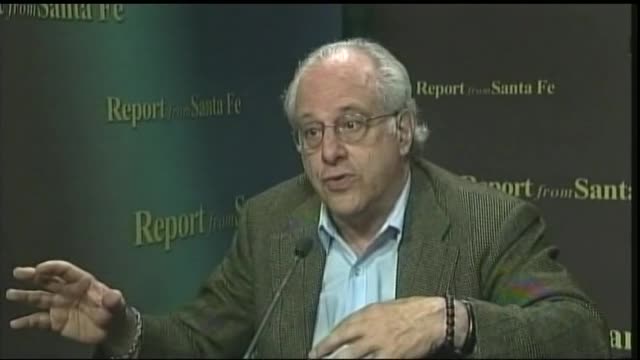
Report from Santa Fe; Richard D. Wolff, Part 2
- Transcript
The National Education Association of New Mexico, an organization of professionals who believe that investing in public education is an investment in our state's economic future. And by a grant from the Healey Foundation, Tau's New Mexico. Hello, I'm Lorraine Mills and welcome to report from Santa Fe. Today we continue a very important discussion with Richard D. Wolff. Thank you for coming back because I didn't get enough. You are an expert in the main problem that is concerning our world and nobody talks about it, which is the economic meltdown. You have degrees from Harvard, Princeton, Yale, your professor emeritus and economics at the University of Massachusetts. Amherst, you teach for the New School University in New York now. And you're on the radio. You have a wonderful website. I want to mention that. It's WDWOLF .com. And for people who are sparked by the ideas that we talk about today, there's a wealth of information there. And you are the
author of this groundbreaking book, Capitalism Hits the Fan. And it is. We all know that the global economic meltdown and what to do about it. Well, in our last interview, we talked about the meltdown, but we didn't get to go into enough about what to do about it. So, tell us what to do about it and tell us this. And then we're really going to let you talk. This is a huge problem facing the world. And yet, there has been a taboo. Nobody talks about it. They talk about these little tiny manifestations of it. But it's a huge worldwide global economic meltdown. What can we do? Well, I think you're on to something by saying we talk about little parts of it. Give me an example. Many of the media still talk about it as a quote unquote financial crisis, as if it were limited to or just involving banks and insurance companies. But it's a crisis that is affecting the entire economy, not just in Wall Street, but in Main Street, not just companies,
but also working people, not just the private sector, also the government. It's everything. Everything is not working very well. And the different parts, instead of helping each other to make a cohesive system, are actually making it worse. Our political gridlock worsens the economic system. And the economic systems problems are part of why we have political gridlock. That's why I tend to stress it's a system problem. It's not this one or that one. It's not the bed bankers or the bed folks who took out a loan that couldn't afford. It's a system in which everybody was doing things to make their situation work the way they used to. But now the system was making it all end up being a problem. So I stress that because I think it is a serious problem. It hasn't been addressed in any kind of systematic way, which is why we're now in the fifth year of this crisis. With no end in sight, with the reports from Europe, for example, that they're even in tougher shape and in
a more emergency situation. And as they solve their problem, it will impact us just as our crisis helped to produce theirs. So it really is a system that is not working. I want to talk about Europe in a minute. It's one of the main points I want to talk about. But I just want to have a little word for the American worker because Americans work so hard. And they've pretty much done everything they were supposed to. They put away for retirement. They bought their home. And then with Enron suddenly, people's retirement vanished. And then people invested in these retirement funds. We've had it in New Mexico. Our employee retirement funds and our public education funds invested in all these strange financial items, new concepts. And we lost tons of money. But the American worker, they can only think, well, what will get two jobs? And my wife will go to work. And then, you know, our teenagers old enough and we'll send him to work and they're just peddling
as fast as they can. And yet, the downhill slide, it seems inexorable. Yes. And I think that's a symptom of a system that's broken. We used to say about capitalism that it's a system that delivers the goods. And that even if it has some wrinkles and even if it has some flaws, it's delivering the goods. And for a long time, it did. But it doesn't anymore. It's delivering us one bad after another. Look at the, for example, that our federal government is not hiring people to solve the unemployment problem. It's cutting back everywhere. It's not helping people to feel better about their future by knowing that their pensions and their old age will be taken care of. It's cutting social security. It's cutting Medicare. It's cutting the supports. We're in an economic system that is in greater trouble than it's been for 75 years. And our government, which should be helping us through this difficult time, is all about cutting the services we need more than usual. And saying that there's no end of that insight. It's a very grim
situation. And I don't want to be the bearer of all bad news. But you would have to live in a fantasy world not to confront the reality of a crisis that is now not only not being fixed and solved by our political authorities, but there's a good argument that they're making it worse. And that's a sign of a system that doesn't work. We can take a minute here to compare the Great Depression and what FDR did with what's happening now in terms of the workers, the bosses, and the government. Just quick. It's radically different. Let's take the working people. In 1933 and four, two or three or four years depending on how you count into the Great Depression, the government faced a society in which 20 to 25 percent of the workers were unemployed, even worse than it is today. The unemployment was lasting long, although not as long as it's lasting today. We're worse in that way. And the working people got very upset. And here's what they did that was very different. First, they joined trade unions
by the millions. We had the biggest explosion of a trade union movement organizing workers that we've ever had in American history. Better, bigger than anything before or anything since. It was called the CIO, the Congress of Industrial Organization. And it swept people into trade unions. We had many Americans joining socialist parties and communist parties. And these were all expressions of a working class which felt betrayed by a system that was throwing them out of work in record numbers. And their response was militancy and left wing political activity. Look at it today. We have a working class stung by unemployment. Stung involvement, turning inward, resignation, and for the few that get involved in politics, they're more likely to get involved in the Tea Party than they are in anything on the left end of the political spectrum. Radically different. Look at the government. Roosevelt, who came into office as a balanced budget conservative Democrat, radically changed. In
1934, he decided to have a government employment program because the workers were unemployed and the private sector wasn't hiring anybody. And between 1934 and 40, he created and filled 11 million federal jobs. He put people back to work the most direct, straightforward way you could by hiring them, giving them a job, making them feel better about themselves, giving them an income that allowed them to maintain their mortgage payments. So you didn't have a housing collapse, etc. And what do we have now? We have Bush and then Obama saying we're going to rely on the private sector. We're going to give them inducements and we're going to give them tax cuts and they're going to do the hiring. They haven't done the hiring for the last three years. That's a policy that didn't work in the 30s, doesn't work now. The difference is in the 1930s, a Democratic president changed year. Today, that president doesn't do it. And I suspect it's because he doesn't have the pressure from below that Roosevelt had from the unions and socialists and communists. We don't have those things in America today. And as a result, the government isn't pushed in that direction. Well, the jobs bill, you
know, just recently, the president came up with a jobs bill again, that rewards small business and business for doing the hiring. It's no direct things like the WPA, the CCC. Nothing of that. And with the infrastructure needs that our country has in terms of roads and bridges, it just seems that anyone could figure this out. We've got the materials and the equipment. We've got the huge number of unemployed. It's a sad, sad thing, you know, the stimulus program that Obama put into effect right after he became president was about 800 billion dollars, a big stimulus program. It didn't solve our unemployment problem. So the one he proposed the other week is about 400 billions, half the size. Well, if 800 wasn't enough, 400 is certainly not going to do the trick. And it's sad to watch because it's condemning millions of Americans to that many more months of being unemployed. And let's remember what that means. If you're unemployed, you use up whatever savings you had to take you through the unemployment time since your unemployment check is not
enough and will come to an end soon. So you eat up your savings, then you become a burden on your relatives and your friends and your associates, who in a difficult time are now having to help you. And then you get desperate and then you're willing to work for less money, which undercuts the wages of other people that you offer yourself for less. Every statistic we know, medical statistic, mental health statistic shows that unemployment is a terrible burden for people. It shatters their self -esteem, it produces anxiety of all sorts. We're condemning lots of people to a level of suffering that should not be allowed to go on, that draws their family, their children into its own orbit. It's costly to us as an economy for years into the future. So it really isn't something that there should be a lot of wrangling about. It's something that should be solved. And we know from our own history as a nation how to do it because we've had a president in a similar crisis showing us at least how to make the suffering for millions of American families a lot less than it would have
been if he let them live in unemployment the way we're doing now. And one of the choices that the government is choosing at least a faction of it is to actually further penalize the people who are most vulnerable and most dependent on government by cuts in Medicaid, Medicare, and Social Security. It's really, it is tragic. We have had a policy of the government which used to be called by the nasty name trickle down. The idea was if the government helps the banks and the big corporations and the folks at the top, then the benefits will trickle down to benefit everybody else. And as the WAGS used to say in the 1930s, trickle down, never works, it never manages to trickle, it stays at the top. Well nothing could better describe what we've had for the last several years under Bush and Obama. We've been helping those at the top. We've been providing incentives to the private sector, which is the polite way of saying, helping those at the top, and waiting for it to trickle down and it hasn't
done it. And so it is imposing enormous burden on this society. And there is something to be said about the basic morality and ethics of this. You are helping the people who need at least who have done the best of the last 30 years in terms of wealth. We've become a society where the gap between rich and poor has become more extreme. So instead of going to the people who've done the best and who have the most and saying, you must help the rest of your community, we're saying, no, we the government going to help you. And when the piper has to be paid, when the cost of that help we're giving you has to be found, we're going to cut back the support for retired people and sick people to find the money. There's something terribly wrong in a system that works that way. Al Sharpton put it this way on the show. He said it's like having a fabulous blowout party. Wonderful, wonderful, expensive. And then when the bill comes to give it to somebody who didn't even go to the party and expect them to pay for it. But there's so much to talk about. I need for us to talk about what can we do about it? And can we look
to Europe for possibilities, ways to change some of the things that are going on? So describe if you would briefly what's happening in Europe. And then how we can learn from some of their experiences? Well, in Europe in some ways, situation is similar and some ways it's different. Similar is they have a crisis very much like hours. Indeed, we help to produce the crisis there and their difficulties are now making our crisis here worse. Again, it's a system that is not helping the different parts, but actually collectively making it worse. And so they are suffering all the same symptoms we have, but they react differently. And let me give you an example. You cannot take away from people, their social security, their pensions, their medical insurance programs, their subsidized education. And they won't let you. They have strong trade unions. We have had trade unions weakening for the last 50 years. They have strong socialist parties, communist parties, green parties, anti -capitalist parties. And when you put all of them together, they are very major political
forces. And so whatever happens, you cannot take out the cost of dealing with this crisis on the mass of people. So their personal conditions are simply not the same. It gives you one example. Every major European country has a national health program that takes care of people, whether they're employed or not. So if you lose your job, which is a tragedy, and that's happening in Europe, it doesn't mean you've lost medical coverage, not for yourself, not for your spouse, not for your children. And so people are insulated from the level of suffering that this kind of crisis produces in a way that is not true in the United States. And that's a big difference. And the irony is, despite the fact that they're suffering less, they're much more militant in demanding a change in the economic system so that they're not put in their suffering. They're out in the streets, for example, Greece, Italy, Portugal, all have had general strikes demanding that they not be made, to use your words, not be made to
pay the price of a party they never were allowed to attend. And the euphemism for these programs tell me what austerity means. And is that what we're being asked to do? Exactly. In Europe, because of the power of the critical forces, unions, left wing parties, they call the spade a spade. They say, you're trying to make us pay with an austerity, cut social programs, laying off public employees so they can't provide services for people. You're making us, trying to make us pay, that's an austerity program, we will not allow it. Here in the United States, the same thing is being done, cutting benefits, cutting public sector workers. Every city is doing that in America, more or less. Every state is struggling with that problem. The federal government is struggling with that problem. But we call it being responsible, politically, fiscally, conservative, all kinds of languages other than the blunt truth, which is we're trying to impose austerity on the people so that the government can take the money and instead of spending it on services for people, use it to bail out an
economic system that doesn't work anymore. Well, in Germany, you had described how Anglo -America with her status is not changing. And you said that in one of her home bases, she was defeated by a coalition of socialists, greens, and something called the left. The left party. Whose motto is? Germany can do better than capitalism, and that party got 20 % of the vote. And because of proportional representation, which is the norm in Europe, the way it works is not like the United States. It's not a winner -take -all. So if the Republicans get 51 % and the Democrats get 49, then the Republicans win the election, win the government. It doesn't work like that in Germany. So if the left party gets 20 % of the vote, it gets 20 % of the seats in the parliament of that state, and the same thing applies on the national level. So for example, in the last national election, this left party, whose
slogan is, Germany can do better than capitalism, captured 12 % of the vote, which means they have 12 % of the seats in the German national parliament. They are a political force. And that's interesting because Germany is the most powerful economy in Europe. And there's an economy that is going through the crisis, but in that crisis, the left is what is saying that the fault is the system and is winning election after election, because the mass of people are not going in the Tea Party type of direction. They're going the other way. And that's a different reaction to the same crisis compared to what's happening here. Talk to me about the riots in England. Well, I think that's a warning shot that Americans ought to pay a lot of attention to. You cannot believe and you cannot have confidence that if you put people in an economic crisis, now entering its fifth year, it started in the middle of 2007, and we're now in the second
half of 2011. So we're in the fifth year of this. You cannot expect that there will not be people whose level of suffering from unemployment, from home foreclosure, from cutback of benefits of those members of the family that still have a job, from a government telling you that there are less and less services going to be provided. You can't expect that people are simply going to take that and sit there and suffer with a deluded declining standard of living. The British made that mistake. They started cutting all kinds of programs. They were going to save money here, and they were going to be fiscally conservative. And then a few weeks ago, a mass of young people blew up. They weren't going to take it anymore. And of course, as usually happens, they got angry at the police and the police got angry at them. And then they burnt some stores and started looting the material. And at first, it wasn't only one neighborhood of London, and then it became many neighborhoods of London. Then it spread to five or different major cities. This is simply
a symptom of the kinds of blowback that are going to come when you try to make the people who didn't go to the party to use your metaphor, pay the price of all the good times for other people. They're not going to keep doing it. And I think it's naive to expect that we in the United States are not going to have the same kinds of upsets and angry people that are being produced everywhere else with these same policies are being pursued. So you often introduce your speeches with don't kill the messenger, because people have a hard time assimilating what you have to say. We have been watching the American public react to these things. And like you say, the Tea Party started with a really righteous anger at waiting on what's going on. And do you actually think that the people, how much suffering will it take to get Americans to say, wait a minute, this is not fair, because Americans have such an innate sense of fairness.
Well, I think it's going to take a while. I wish I could give you a prediction. I can't. But I am very confident that the American people will bear with this system a long time. Capitalism has been good to a lot of people over a long period of American history. It gets a lot of loyalty and that's understandable. And it is hard for people to deal with the fact that a system that they believe in and a system that worked for their parents may no longer work. That's a hard thing to face. I understand the resistance even to people like me that are explaining what's going on. There's a desire to believe we'll get out of this somehow. It'll be over soon. We'll tough it out all of that. But I think eventually when it looks like this is a broken system that finally the people will realize they have to make a change. And then we will be surprised at the speed with which things begin to change. In the 1930s, there were suffering for
three, four years, like we have been doing in a deepening depression, suddenly, very quickly, everything changed. The president changed, the political system changed, the flavor of discussion in the halls of government changed. And my suspicion is we'll see that pattern again. It'll take a while. But when it comes, it'll be big and it'll be dramatic. And in this age of mass communications, it will really be fast. So the generation now is the first generation in America that will not reach a standard of living of the parents. And I'm going to have to face what that means and what it means for their kids. And you've got kids who went to the good school, got the good education, took out a lot of money and student loans, can't get a job. And they're saying, but I did everything I was supposed to, like most American workers say, I did, I did, I sacrificed, I saved, I did all this. I played by the rules. And now the game is rigged, the deck is stacked. Right. And they feel betrayed and they feel upset. And sooner
or later, that's going to show up in their political views, in their cultural patterns, in their interpersonal relationships. Nothing is spared from this. And that's why I feel as though I am doing a useful service, even if it's hard to hear by saying, let's face the problems we have because as we know, that's the first step to finding a solution, is to face the fact that you've got a really big, basic problem. It's not going to be solved by this candidate or that one, by this law or that one, we can't scapegoat this group or that group. We got to change a basic system. And hard as it is, not doing it is becoming harder with each passing day. But that's why I wanted to continue our conversation. Because if we don't start talking about this, we are going to be really blindsided. This should be the national debate. Absolutely. It should have been for 50 years. You know, we discuss in this country whether our transportation system or our health system or our school system are meeting our
needs as a people. We debate it, we question it. We ought to have been doing this about our economic system. It's not sacrosanct. We think if we think that it is, we're making a mistake. If we don't debate and discuss our economic system, we'll be in no good shape to deal with it when it breaks down. Which is what we've got. So I think we have to grow up, overcome the taboos of the last 50 years when it was considered somehow disloyal or unreasonable to question capitalism. Stop comforting ourselves by saying it's the best system. It's the greatest system. It's an efficient system. It isn't working. And it's silly to keep saying these sorts of things. We ought to have the debate we've been postponing. Between those who think we can do better than capitalism, those who want to talk about its limits, those who want to talk about its strength should have their share. And we should have a national debate out of which we should develop a policy that our politicians will have to pursue as to how to do better for the American people. At the very least, fix a broken system, but also be open to the question that maybe there's changes in this system that we ought to think about. And
what we have today is we have some New York Times op -ed people. We've got Paul Kruebren. We've got Tom Friedman. And I want to point out that you are just one of many, many points of view. But you have the courage to say, let's talk about it. Let's agree to disagree. Let's look at all of our options. And let's try to fix what's broken. Now, a lot of the alternative systems are totally demonized. And we only have two minutes left. But you say that's the worst thing they can accuse a woman of socialist communist. My favorite in all of this was the man with the sign during the health care debate that said, keep your government hands off my Medicare, not even knowing it was a government program dare we say, may perhaps socialize, you know, what? So how can we overcome the demonization of these alternatives to actually then have a real debate? There's strengths in this system. There's strengths in that system. Let's take the best of both. I think we just have to, and I mean this for all of us, we have to grow up. You know, we don't
permit people to dismiss important ideas by putting a bad label on them. That's childish. We did that for too long. Calling it socialist, calling it communist. If all that does is prevent you from looking at those systems and seeing what they have to teach us, you're the loser. We're the loser. We need to interrogate all the systems. It's not as though the one we have is working all that well. It isn't. That's why our millions of people are unemployed. That's why we're losing our benefits, losing our future pensions, facing a future that our kids are going to have a heart. It's time for us to look at the alternative systems, and we're not trapped in what Russia or China or those other countries. If there are things about those societies, we don't want to replicate, let's not do it. Let's be honest and critical of them too. But if I could conclude with one thing, I would like to stress that what a lot of us think is the core problem that has to be addressed is the way we organize the production of goods and services, how we organize our enterprises. I want to stress that the ideas that are emerging now talk about those as the root of the problem. We have the massive people who go to work and
do the work and produce the goods and service, and we have a tiny number of people, boards of directors and major shareholders of our companies, who make all the decisions, what to produce, how to produce, where to produce, what to do with the profits. That's not working well. Those small groups are using the profits to keep themselves in that position. Suppose we think in a new way. Suppose we dare facing our problems to ask, what would have happened? What will happen? If instead of running businesses that way, we made them cooperative. We made them businesses in which people come to work Monday through Thursday and do their job. But on Friday, they sit around and together decide democratically what to produce, how to produce, where to produce, what to do with the profits. Imagine, would they, would workers together have allowed a tiny number of executives to get hundreds of millions in salary while everybody else is suffering? I don't think so. Or would they have outsourced jobs? Would they have closed their own business and moved to China? I don't think so. Would they have allowed dangerous technologies to be put into effect, the polutely environment,
where they and their family and their friends live? I don't think so. We would have had a different history. And therefore, we ought to look at that as an option for change at a time when our country needs it and needs it badly. Well, we're going to have to leave it there. Our guest today is Richard Wolf. I want our audience to know they can go to rdwolf .com because you have arguments on all sides of this. And you have a list of hard questions that people have asked you. There's just a lot of information. And also, there's a DVD version of your book, Capitalism hits the fan because we all know it's hit the fan. And we need to know ways to make it better. Thank you for joining us. Thank you very much for inviting me. Yes. And I'm Lorraine Mills. I'd like to thank your audience for being with us today and report from Santa Fe. We'll see you next week. Report from Santa Fe is made possible in part by grants from the members of the National Education Association of New Mexico. An organization of professionals who believe that investing in public
education is an investment in our state's economic future. And by a grant from the Healey Foundation, Taos, New Mexico.
- Series
- Report from Santa Fe
- Episode
- Richard D. Wolff, Part 2
- Producing Organization
- KENW-TV, Eastern New Mexico University, Portales, New Mexico
- Contributing Organization
- KENW-TV (Portales, New Mexico)
- AAPB ID
- cpb-aacip-40d689b1590
If you have more information about this item than what is given here, or if you have concerns about this record, we want to know! Contact us, indicating the AAPB ID (cpb-aacip-40d689b1590).
- Description
- Episode Description
- This week's guest on “Report from Santa Fe” is an economist and author Richard D. Wolff, whose book, "Capitalism Hits the Fan: The Global Economic Meltdown and What to Do About It,” has inspired a long-overdue public discussion about what is happening nationally and globally to America, and its economy. Guest: Richard D. Wolff (Author “Capitalism Hits the Fan”). Hostess: Lorene Mills.
- Broadcast Date
- 2011-09-24
- Created Date
- 2011-09-24
- Asset type
- Episode
- Genres
- Interview
- Media type
- Moving Image
- Duration
- 00:29:20.714
- Credits
-
-
Producer: Ryan, Duane W.
Producing Organization: KENW-TV, Eastern New Mexico University, Portales, New Mexico
- AAPB Contributor Holdings
-
KENW-TV
Identifier: cpb-aacip-7e496848d93 (Filename)
Format: DVD
If you have a copy of this asset and would like us to add it to our catalog, please contact us.
- Citations
- Chicago: “Report from Santa Fe; Richard D. Wolff, Part 2,” 2011-09-24, KENW-TV, American Archive of Public Broadcasting (GBH and the Library of Congress), Boston, MA and Washington, DC, accessed April 4, 2026, http://americanarchive.org/catalog/cpb-aacip-40d689b1590.
- MLA: “Report from Santa Fe; Richard D. Wolff, Part 2.” 2011-09-24. KENW-TV, American Archive of Public Broadcasting (GBH and the Library of Congress), Boston, MA and Washington, DC. Web. April 4, 2026. <http://americanarchive.org/catalog/cpb-aacip-40d689b1590>.
- APA: Report from Santa Fe; Richard D. Wolff, Part 2. Boston, MA: KENW-TV, American Archive of Public Broadcasting (GBH and the Library of Congress), Boston, MA and Washington, DC. Retrieved from http://americanarchive.org/catalog/cpb-aacip-40d689b1590